
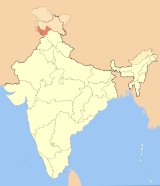
Jammu also known as
Duggar, is one of the three administrative divisions within
Jammu and KashmirJammu and Kashmir is the northernmost state of India. It is situated mostly in the Himalayan mountains. Jammu and Kashmir shares a border with the states of Himachal Pradesh and Punjab to the south and internationally with the People's Republic of China to the north and east and the...
, the northernmost state in
IndiaIndia , officially the Republic of India , is a country in South Asia. It is the seventh-largest country by geographical area, the second-most populous country with over 1.2 billion people, and the most populous democracy in the world...
.
Jammu cityJammu is the largest city in the Jammu region and the winter capital of the state of Jammu and Kashmir, India. It is a municipal corporation.It is close to Sialkot in Pakistan...
is the largest city in Jammu and the winter capital of Jammu and Kashmir. Jammu City is also known as "City of Temples" as it has many temples and shrines, with glittering
shikhars soaring into the sky, which dot the city’s skyline, creating the ambiance of a holy and peaceful Hindu city.
Home to some of the most popular
HinduHinduism is the predominant and indigenous religious tradition of the Indian Subcontinent. Hinduism is known to its followers as , amongst many other expressions...
shrines, such as
Vaishno DeviVaishno Devi Mandir is one of the holy Hindu temples dedicated to Shakti, located in the hills of Vaishno Devi, Jammu and Kashmir, India. In Hinduism, Vaishno Devi, also known as Mata Rani and Vaishnavi, is a manifestation of the Mother Goddess.The temple is near the town of Katra, in the Reasi...
, Jammu is a
pilgrimageA pilgrimage is a journey or search of great moral or spiritual significance. Typically, it is a journey to a shrine or other location of importance to a person's beliefs and faith...
tourismTourism is travel for recreational, leisure or business purposes. The World Tourism Organization defines tourists as people "traveling to and staying in places outside their usual environment for not more than one consecutive year for leisure, business and other purposes".Tourism has become a...
destination in India. The majority of Jammu's 4.9 million population practices
HinduismHinduism is the predominant and indigenous religious tradition of the Indian Subcontinent. Hinduism is known to its followers as , amongst many other expressions...
, while
IslamIslam . The most common are and . : Arabic pronunciation varies regionally. The first vowel ranges from ~~. The second vowel ranges from ~~~...
and
SikhismSikhism is a monotheistic religion founded during the 15th century in the Punjab region, by Guru Nanak Dev and continued to progress with ten successive Sikh Gurus . It is the fifth-largest organized religion in the world and one of the fastest-growing...
enjoy a strong cultural heritage in the region. Due to relatively better infrastructure, Jammu has emerged as the main economic center of the state.
Geography
Jammu borders
KashmirKashmir is the northwestern region of the Indian subcontinent. Until the mid-19th century, the term Kashmir geographically denoted only the valley between the Great Himalayas and the Pir Panjal mountain range...
to the north,
LadakhLadakh is a region of Jammu and Kashmir, the northernmost state of the Republic of India. It lies between the Kunlun mountain range in the north and the main Great Himalayas to the south, inhabited by people of Indo-Aryan and Tibetan descent...
to the east, and
Himachal PradeshHimachal Pradesh is a state in Northern India. It is spread over , and is bordered by the Indian states of Jammu and Kashmir on the north, Punjab on the west and south-west, Haryana and Uttar Pradesh on the south, Uttarakhand on the south-east and by the Tibet Autonomous Region on the east...
and
PunjabPunjab ) is a state in the northwest of the Republic of India, forming part of the larger Punjab region. The state is bordered by the Indian states of Himachal Pradesh to the east, Haryana to the south and southeast and Rajasthan to the southwest as well as the Pakistani province of Punjab to the...
to the south. In the west, the
Line of ControlThe term Line of Control refers to the military control line between the Indian- and Pakistani-controlled parts of the former princely state of Jammu and Kashmir—a line which, to this day, does not constitute a legally recognized international boundary but is the de facto border...
separates Jammu from the
PakistanPakistan , officially the Islamic Republic of Pakistan is a sovereign state in South Asia. It has a coastline along the Arabian Sea and the Gulf of Oman in the south and is bordered by Afghanistan and Iran in the west, India in the east and China in the far northeast. In the north, Tajikistan...
region called Azad Jammu and Kashmir. Sandwiched between the Vale of Kashmir to the north and the Daman Koh Plains to the south, the Shivalik Range comprises most of the region of Jammu. The
Pir Panjal RangeThe Pir Panjal ranges lie in the Inner Himalayan region, running from east southeast to west northwest across the states of Himachal Pradesh and Kashmir in India as well as Pakistan-administered Kashmir, where the average elevation varies from to . The Himalayas show a gradual elevation towards...
, the Trikuta Hills and the low-lying
Tawi RiverThe Tawi is a river that flows through the city of Jammu. Tawi river is also considered sacred and holy, as is generally the case with most rivers in India....
basin add beauty and diversity to the terrain of Jammu. The Pir Panjal range separates Jammu from the Kashmir valley.
The people of Jammu are called Dogra's and they speak the Dogri language.
History of Jammu
Many historians and locals believe that Jammu was founded by
RajaRaja is an Indian term for a monarch, or princely ruler of the Kshatriya varna...
Jambu Lochan in the
14th century BCThe 14th century BC is a century which lasted from the year 1400 BC until 1301 BC.-Events:* 1397 BC: Pandion I, legendary King of Athens, dies after a reign of 40 years and is succeeded by his son Erechtheus II of Athens....
. During one of his hunting campaigns, he reached the
Tawi RiverThe Tawi is a river that flows through the city of Jammu. Tawi river is also considered sacred and holy, as is generally the case with most rivers in India....
where he saw a goat and a lion drinking water at the same place. Having satisfied their thirst, the animals went their own ways. The Raja was amazed, abandoned the idea of hunting and returned to his companions. Recounting what he had seen, he exclaimed that this place, where a lion and a lamb could drink water side by side, was a place of peace and tranquility. The Raja commanded that a palace be built at this place and a city was founded around it. This city became known as
Jambu-Nagar, which then later changed into
Jammu. Jambu Lochan was the brother of Raja Bahu Lochan who constructed a fort on the bank of river Tawi.
Bahu FortThe Bahu Fort is located in Jammu city in the Indian state of Jammu and Kashmir. The fort, originally built by Raja Bahulochan some 3,000 years ago, was refurbished by the Dogra rulers in the 19th century. The fort is a religious place, and within its precincts has a temple dedicated to the Hindu...
is a historical place in Jammu.
The city name figures in the ancient book
MahabharataThe Mahabharata is one of the two major Sanskrit epics of ancient India and Nepal, the other being the Ramayana. The epic is part of itihasa....
. Excavation near
AkhnoorAkhnoor is a town in Jammu district in the state of Jammu & Kashmir, India.Located from Jammu, Akhnoor is located in the foothills of the Himalayas. It is an extremely beautiful town...
, 20 miles (32.2 km) from Jammu city, provides evidence that Jammu was once part of the
HarappanHarappan can refer to:* Aspects related to Harappa an archaeological site and city in northeast Pakistan* The Indus Valley Civilization that thrived along Indus River...
civilization.
Remains from the Maurya, Kushan, Kushanshahs and
GuptaThe Gupta Empire was an ancient Indian empire which existed approximately from 320 to 550 CE and covered much of the Indian Subcontinent. Founded by Maharaja Sri-Gupta, the dynasty was the model of a classical civilization. The peace and prosperity created under leadership of Guptas enabled the...
periods have also been found in Jammu. After 480 AD the area was dominated by the Hephthalites and ruled from Kapisa and Kabul. They were succeeded by the Kushano-Hephthalite dynasty from 565 to 670 AD, then by the
ShahiThe Shahi , Sahi, also called Shahiya dynasties ruled one of the Middle kingdoms of India which included portions of the Kabulistan and the old province of Gandhara , from the decline of the Kushan Empire in the 3rd century to the early 9th century...
from 670 to the early 11th century, when the Shahi were destroyed by the Ghaznavids.
Jammu is also mentioned in accounts of the campaigns of
TimurTimur , historically known as Tamerlane in English , was a 14th-century conqueror of West, South and Central Asia, and the founder of the Timurid dynasty in Central Asia, and great-great-grandfather of Babur, the founder of the Mughal Dynasty, which survived as the Mughal Empire in India until...
. The area witnessed changes of control following invasions by
MughalsThe Mughal Empire , or Mogul Empire in traditional English usage, was an imperial power from the Indian Subcontinent. The Mughal emperors were descendants of the Timurids...
and
SikhA Sikh is a follower of Sikhism. It primarily originated in the 15th century in the Punjab region of South Asia. The term "Sikh" has its origin in Sanskrit term शिष्य , meaning "disciple, student" or शिक्ष , meaning "instruction"...
s, before finally falling under the control of the
BritishThe United Kingdom of Great Britain and Northern IrelandIn the United Kingdom and Dependencies, other languages have been officially recognised as legitimate autochthonous languages under the European Charter for Regional or Minority Languages...
. Upon the
Partition of IndiaThe Partition of India was the partition of British India on the basis of religious demographics that led to the creation of the sovereign states of the Dominion of Pakistan and the Union of India on 14 and 15...
, it became part of India following the Kashmir war.
Once a seat of the
DograThe Dogras are an Indo-Aryan ethnic group in South Asia. Being a diversified group, the Dogras include both Savarnas such as Brahmins, Rajputs and Non-savarnas. The Dogras also incluide merchant castes such as Mahajans...
RajputA Rajput is a member of one of the patrilineal clans of western, central, northern India and in some parts of Pakistan. Rajputs are descendants of one of the major ruling warrior classes in the Indian subcontinent, particularly North India...
dynasty, Jammu came under the control of
Maharaja Ranjit SinghMaharaja Ranjit Singh Ji was the first Maharaja of the Sikh Empire.-Early life:...
Ji in the 19 century and became a part of the Sikh Empire. Maharaja Ranjit Singh soon appointed Gulab Singh Ji the ruler of Jammu. After the death of Maharaja Ranjit Singh, Punjab, The Sikh Empire was defeated by the
BritishThe United Kingdom of Great Britain and Northern IrelandIn the United Kingdom and Dependencies, other languages have been officially recognised as legitimate autochthonous languages under the European Charter for Regional or Minority Languages...
after Maharaja Duleep Singh was taken by the British to England under the orders of The Company. Not having the resources to occupy the hills immediately after annexing parts of Punjab, the British recognized
Maharaja Gulab SinghMaharaja Gulab Singh was the founder and first Maharaja of the princely state of Jammu and Kashmir, the second largest princely state in British India...
, the strongest ruler north of the
SutlejThe Sutlej River is the longest of the five rivers that flow through the historic crossroad region of Punjab in northern India and Pakistan. It is located north of the Vindhya Range, south of the Hindu Kush segment of the Himalayas, and east of the Central Sulaiman Range in Pakistan.The Sutlej...
River, as ruler of
Jammu and KashmirJammu and Kashmir is the northernmost state of India. It is situated mostly in the Himalayan mountains. Jammu and Kashmir shares a border with the states of Himachal Pradesh and Punjab to the south and internationally with the People's Republic of China to the north and east and the...
. But for this he had to pay a sum of Rs. 75 Lakhs in cash—this payment being legal as the Maharaja was a former vassal of the Sikh Empire and was partly responsible for its treaty obligations. Maharaja Gulab Singh is thus credited as the founder of Jammu and Kashmir.
During the partition of India the ruler was Maharaja Hari Singh and he along with all the other princes was given the choice according to the instruments of partition of India in 1947, to freely accede to either India or Pakistan, or to remain independent. the princes were however advised to accede to the contiguous dominion, taking into consideration the geographical and ethnic issues.
Demographics
Ethnically, Jammu is largely Dogra, which group constitutes approximately 67% of the population. There is also a sizable population of
PunjabiThe Punjabi people , ਪੰਜਾਬੀ ), also Panjabi people, are an Indo-Aryan group from South Asia. They are the second largest of the many ethnic groups in South Asia. They originate in the Punjab region, which has been been the location of some of the oldest civilizations in the world including, the...
descent, most of them being Hindus and Sikhs.
Jammu is the only region in the state of Jammu and Kashmir that has a
HinduHindu refers to an identity associated with the philosophical, religious and cultural systems that are indigenous to the Indian subcontinent. As used in the Constitution of India, the word "Hindu" is also attributed to all persons professing any Indian religion...
majority population - 65% of Jammu's population practice
HinduismHinduism is the predominant and indigenous religious tradition of the Indian Subcontinent. Hinduism is known to its followers as , amongst many other expressions...
, 30% practice
IslamIslam . The most common are and . : Arabic pronunciation varies regionally. The first vowel ranges from ~~. The second vowel ranges from ~~~...
and most of the remainder are
SikhA Sikh is a follower of Sikhism. It primarily originated in the 15th century in the Punjab region of South Asia. The term "Sikh" has its origin in Sanskrit term शिष्य , meaning "disciple, student" or शिक्ष , meaning "instruction"...
s. Most of Jammu's Hindus are Dogras, Kashmiri Pandits, migrants from
KotliKotli is the chief town of Kotli District, in the Pakistani-administered Azad Jammu and Kashmir. Kotli is linked with Mirpur by two metalled roads, one via Rajdhani, and the other via Charhoi...
and Mirpur and
Punjabi HindusPunjabi Hindus are a group of people that follows the Hindu religion and has its roots in the erstwhile joint ancient Panjab region. Today it is spread out across most parts of northern India and in some parts of western India like Mumbai, Maharashtra. In India, most Punjabi Hindus are...
. Many Sikhs are migrants from Pakistani Controlled Kashmir (from areas like
MuzaffarabadMuzaffarabad is the capital of Pakistan Occupied Kashmir, Pakistan. It is located in Muzaffarabad District on the banks of the Jhelum and Neelum rivers...
and Punch sector areas occupied by Pakistan during 1947).
People of Jammu speak mostly Dogri, Poonchi, Gojri,
KotliKotli is the chief town of Kotli District, in the Pakistani-administered Azad Jammu and Kashmir. Kotli is linked with Mirpur by two metalled roads, one via Rajdhani, and the other via Charhoi...
,
MirpuriMirpuri may refer to:* Potwari language, an Indo-Aryan Lahnda language related to Hindko* Mahan Singh Mirpuri , General in the kingdom of Maharaja Ranjit Singh* Mirpur, Azad Kashmir, city in Pakistan-administered Jammu & Kashmir...
,
HindiStandard Hindi, or more precisely Modern Standard Hindi, also known as Manak Hindi , High Hindi, Nagari Hindi, and Literary Hindi, is a standardized and sanskritized register of the Hindustani language derived from the Khariboli dialect of Delhi...
,
PunjabiThe Punjabi people , ਪੰਜਾਬੀ ), also Panjabi people, are an Indo-Aryan group from South Asia. They are the second largest of the many ethnic groups in South Asia. They originate in the Punjab region, which has been been the location of some of the oldest civilizations in the world including, the...
, and
UrduUrdu is a register of the Hindustani language that is identified with Muslims in South Asia. It belongs to the Indo-European family. Urdu is the national language and lingua franca of Pakistan. It is also widely spoken in some regions of India, where it is one of the 22 scheduled languages and an...
.
HinduHindu refers to an identity associated with the philosophical, religious and cultural systems that are indigenous to the Indian subcontinent. As used in the Constitution of India, the word "Hindu" is also attributed to all persons professing any Indian religion...
s of Jammu region are subdivided into various ethnic groups, and of them
BrahminBrahmin Brahman, Brahma and Brahmin.Brahman, Brahmin and Brahma have different meanings. Brahman refers to the Supreme Self...
s and
RajputA Rajput is a member of one of the patrilineal clans of western, central, northern India and in some parts of Pakistan. Rajputs are descendants of one of the major ruling warrior classes in the Indian subcontinent, particularly North India...
s are the predominant ones. According to the 1941 census, 30% of them were
BrahminBrahmin Brahman, Brahma and Brahmin.Brahman, Brahmin and Brahma have different meanings. Brahman refers to the Supreme Self...
, 27%
RajputA Rajput is a member of one of the patrilineal clans of western, central, northern India and in some parts of Pakistan. Rajputs are descendants of one of the major ruling warrior classes in the Indian subcontinent, particularly North India...
, 15%
ThakkarThakkar or Thakrar, thakkur is a Lohana surname found primarily in the Indian state of Gujarat, and also among Odichya in the Malwa and Nimar regions of Madhya Pradesh, U.P....
, 4% Jat and 8%
KhatriKhatri is a caste from the northern Indian subcontinent. Khatris in India are mostly from Punjab, region but later they migrated to regions like Rajasthan, Uttar Pradesh, Delhi, Jammu, Uttarkhand, Himachal Pradesh, Gujarat, Madhya Pradesh, Haryana, Balochistan, Sindh and Khyber...
.
Districts
Jammu Division consists of ten districts:
- Doda
Area11,691 km²Population525,000 Population density36/km2 Literacy18.5% Doda is a district of Jammu region in the state of Jammu and Kashmir, India...
- Jammu
Jammu District is a district in Jammu and Kashmir. Jammu is the winter capital of the state. The majority of the population of the district practise Hinduism; people of all religions, Muslims, Sikhs live in peace and harmony. Jammu is also known as city of temples with major attraction as Maa...
- Kathua
Kathua district is one of 22 administrative districts that comprise the state of Jammu and Kashmir in India. It is surrounded by Jammu to the northwest, the Doda and Udhampur districts to the north, the state of Himachal Pradesh to the east, Punjab to the south, and Pakistan's working boundary to...
- Kishtwar
- Poonch
District Poonch or Punch is one of the remotest districts of Jammu and Kashmir. It is bounded by the Line of Control on three sides . The 1947-48 war between India and Pakistan divided it into two parts...
- Rajouri
Rajouri is a district of Jammu province in the Indian-administered Kashmir. It is close to the control line and borders with Ponch to the north and Mirpur to the southwest, both of which are in Pakistan-administered Kashmir....
- Reasi
Reasi is one of the oldest towns of the Jammu and Kashmir State. It was the seat of the erstwhile Bhimgarh State, said to have been established by Raja Bhim Dev somewhere in the 8th century. It remained an independent principality till 1822, when Maharaja Gulab Singh the then King of Jammu...
- Ramban
- Samba
- Udhampur
Udhampur is a district in Jammu and Kashmir. The town of Udhampur is the headquarters of this district.The 2001 census indicates the population of the district to be 743,509. There are 871 females for every 1000 males in the district. The overall literacy rate is 54.16%, with 66.43% for males and...
Places of interest
Jammu is known for its landscape, ancient temples,
HinduHindu refers to an identity associated with the philosophical, religious and cultural systems that are indigenous to the Indian subcontinent. As used in the Constitution of India, the word "Hindu" is also attributed to all persons professing any Indian religion...
shrines,
Mubarak Mandi PalaceMubarak Mandi is a palace in Jammu, India. The palace was the royal residence of the maharadja of Jammu and Kashmir from the Dogra Dynasty. It was their main seat till 1925 when maharadja Hari Singh moved to the Hari Niwas Palace in the northen part of Jammu...
,
Amar Mahal PalaceThe Amar Mahal Palace is a palace in Jammu, in the Indian state of Jammu and Kashmir, India, which has now been converted into a Museum. It was built in the nineteenth century for Raja Amar Singh, a Dogra king by a French architect on the lines of a French Chateau. The palace was donated to the...
(a castle type) now a Museum, gardens and forts.
HinduHindu refers to an identity associated with the philosophical, religious and cultural systems that are indigenous to the Indian subcontinent. As used in the Constitution of India, the word "Hindu" is also attributed to all persons professing any Indian religion...
holy shrines of
AmarnathLocated in the Indian state of Jammu and Kashmir and situated on Mount Amarnath, the Amarnath caves are one of the most famous shrines in Hinduism. Dedicated to the god Shiva, the shrine is said to be over 5,000 years old...
and Vaishno Devi attracts tens of thousands of Hindu devotees every year. Jammu's beautiful natural landscape has made it one of the most favoured destinations for adventure tourism in
South AsiaSouth Asia, also known as Southern Asia, is the southern region of the Asian continent, which comprises the sub-Himalayan countries and, for some authorities , also includes the adjoining countries to the west and the east...
. Jammu's historic monuments feature a unique blend of Islamic and
HinduHindu refers to an identity associated with the philosophical, religious and cultural systems that are indigenous to the Indian subcontinent. As used in the Constitution of India, the word "Hindu" is also attributed to all persons professing any Indian religion...
architecture styles.
Purmandal
Purmandal, also known as
Chhota Kashi, is located 35 km from Jammu city. An ancient holy place, it has several temples of
ShivaShiva is a major Hindu deity, and is the destroyer god or transformer among the Trimurti, the Hindu Trinity of the primary aspects of the divine. God Shiva is a yogi who has notice of everything that happens in the world and is the main aspect of life. Yet one with great power lives a life of a...
and other deities. On Shivratri, the town wears a festive look and for three days as people celebrate the marriage of Lord Shiva to Goddess
ParvatiParvati is a Hindu goddess. Parvati is Shakti, the wife of Shiva and the gentle aspect of Mahadevi, the Great Goddess...
.
Vaishno Devi shrine
The town of
KatraKatra or Katra Vaishno Devi, as it is popularly known, is a small town in Jammu and Kashmir, India, situated in the foothills of the Trikuta Mountains, where the holy shrine of Mata Vaishno Devi is located...
, which is close to Jammu, contains the
Vaishno DeviVaishno Devi Mandir is one of the holy Hindu temples dedicated to Shakti, located in the hills of Vaishno Devi, Jammu and Kashmir, India. In Hinduism, Vaishno Devi, also known as Mata Rani and Vaishnavi, is a manifestation of the Mother Goddess.The temple is near the town of Katra, in the Reasi...
shrine. Nestling on top of the Trikuta Hills at a height of 1700 m is the sacred cave shrine of Vaishno Devi, the mother
goddessA goddess is a female deity. In some cultures goddesses are associated with Earth, motherhood, love, and the household. In other cultures, goddesses also rule over war, death, and destruction as well as healing....
. At a distance of 48 km from Jammu, the cave is 30 m long and just 1.5 m high. At the end of the cave are shrines dedicated to the three forms of the mother goddess—
MahakaliMahakali , literally translated as Great Kali, is a Hindu Goddess, considered to be the consort of Shiva the God of consciousness, and as the basis of Reality and existence...
, Mahalakshmi and Mahasarasvati.
PilgrimsPilgrims , or Pilgrim Fathers , is a name commonly applied to early settlers of the Plymouth Colony in present-day Plymouth, Massachusetts, United States...
start trekking to the cave temple, which is 13 km from Katra, enter in small groups through a narrow opening and walk through ice-cold waters to reach the shrines. According to legend, the mother goddess hid in the cave while escaping a demon whom she ultimately killed.
Nandini Wildlife Sanctuary
Nandini Wildlife Sanctuary, called and best known for wonderful species of pheasants, has been established in an area of thick forests teeming with wild life. It is renowned natural habitat for a significant population of pheasants. Among the other avifauna are Indian mynah, Blue Rock Pigeon,
Indian PeafowlThe Indian Peafowl or Blue Peafowl is a large and brightly coloured bird of the pheasant family native to South Asia, but introduced and semi-feral in many other parts of the world...
,
Red JunglefowlThe Red Junglefowl is a tropical member of the Pheasant family. They are thought to be ancestors of the domestic chicken with some hybridisation with the Grey Junglefowl...
,
Cheer PheasantThe Cheer Pheasant, Catreus wallichii also known as Wallich's Pheasant is an endangered species of the pheasant family, Phasianidae. It is the only member in monotypic genus Catreus...
and chakor.
Spread over an area of 34 km
2, the sanctuary is rich in fauna and provides refuge to a wide variety of mammals. The main species are
leopardThe leopard , Panthera pardus, is a member of the Felidae family and the smallest of the four "big cats" in the genus Panthera, the other three being the tiger, lion, and jaguar. The leopard was once distributed across eastern and southern Asia and Africa, from Siberia to South Africa, but its...
, wild boar, rhesus monkey,
bharalThe bharal or Himalayan blue sheep or naur, Pseudois nayaur, is a caprid found in the high Himalayas of Nepal, Tibet, China, India, Pakistan, and Bhutan...
and grey langur.
Manasar lake
Situated 62 km from Jammu,
Mansar LakeMansar Lake is situated from Jammu, Mansar is a beautiful lake fringed by forest-covered hills, over a mile in length by half-a-mile in width....
is a beautiful
lakeA lake is a body of relatively still fresh or salt water of considerable size, localized in a basin, that is surrounded by land. Lakes are inland and not part of the ocean and therefore are distinct from lagoons, and are larger and deeper than ponds. Lakes can be contrasted with rivers or streams,...
fringed by forest-covered hills, over a mile in length by half-a-mile in width. 34°14′54.35"N 74°40′3.43"E Besides being a popular excursion destination in Jammu, it is also a holy site, sharing the legend and sanctity of Lake Mansarovar.
On the eastern bank of Mansar Lake there is a shrine dedicated to Sheshnag, a mythological snake with six heads. The shrine comprises a big boulder on which are placed a number of iron chains perhaps representing the small serpents waiting on the tutelary deity of the Sheshnag. Newlyweds consider it auspicious to perform three circumambulations (
Parikarma) around the lake to seek the blessings of Sheshnag.
Two ancient temples of Umapati Mahadev and Narsimha and a temple of Durga are situated in the vicinity of the Mansar Lake, which are visited by devotees in large numbers. People take a holy dip in the water of the lake on festive occasions. Certain communities of Hindus perform the Mundan ceremony (first hair cut) of their male children here.
Mansar Lake also has boating facilities provided by the Tourism Department. which is not fully maintained by the tourism department and no one likes to visit this place.
With all religions belief and heritage behind the Mansar Lake is also picking up its fame among the tourists with all its
floraFlora is the plant life occurring in a particular region or time, generally the naturally occurring or indigenous—native plant life. The corresponding term for animals is fauna.-Etymology:...
and
faunaFauna or faunæ is all of the animal life of any particular region or time. The corresponding term for plants is flora.Zoologists and paleontologists use fauna to refer to a typical collection of animals found in a specific time or place, e.g. the "Sonoran Desert fauna" or the "Burgess shale fauna"...
. The lake has cemented path all around with required illumination, with projected view decks to observe seasonal birds,
tortoiseTortoises are a family of land-dwelling reptiles of the order of turtles . Like their marine cousins, the sea turtles, tortoises are shielded from predators by a shell. The top part of the shell is the carapace, the underside is the plastron, and the two are connected by the bridge. The tortoise...
and
fishFish are a paraphyletic group of organisms that consist of all gill-bearing aquatic vertebrate animals that lack limbs with digits. Included in this definition are the living hagfish, lampreys, and cartilaginous and bony fish, as well as various extinct related groups...
es of different species. There is a wild life sanctuary housing jungle life including Spotted Deer and Neelgai and water birds such as Cranes and Ducks. One can also witness the traditional and typical distinct life style of
GujjarThe Gurjar are an ethnic group in India, Pakistan and Afghanistan. Alternative spellings include Gurjara, Gujar, Gurjjara and Gūrjara. The spelling Gurjara or Gurjar is preferable to the rest....
and Backarwals wearing ethnic costumes, living in open Kullhas in the hills around Mansar Lake.
The Mansar Lake road joins to another important road that directly links
PathankotPathankot became 22nd district on 28th July 2011 and a municipal corporation in the Indian state of Punjab. It was a part of the Nurpur princely state ruled by the Rajputs prior to 1849 AD. It is a meeting point of the three northern states of Punjab, Himachal Pradesh and Jammu and Kashmir...
to
UdhampurUdhampur is a city and a municipal council in Udhampur District in the Indian state of Jammu and Kashmir. It is the second lardest city of Duggardesh region and the fourth largest city in the state of Jammu and Kashmir. It serves as the district capital and the Northern Command headquarter of the...
. Udhampur is a town of strategic importance, on National Highway No. 1A. The shortcut road from Mansar or Samba to Udhampur by-pass the Jammu town. Surinsar Lake, a smaller lake that is linked to Mansar, is 24 km from Jammu via the by-pass road.
Bahu Fort
Bahu FortThe Bahu Fort is located in Jammu city in the Indian state of Jammu and Kashmir. The fort, originally built by Raja Bahulochan some 3,000 years ago, was refurbished by the Dogra rulers in the 19th century. The fort is a religious place, and within its precincts has a temple dedicated to the Hindu...
, which also serves as a religious temple, is situated about 5 km from Jammu city on a rock face on the left bank of the river Tawi. This is perhaps the oldest fort and edifice in Jammu city. Constructed originally by Raja Bahulochan over 300 years ago, the fort was improved and rebuilt by Dogra rulers. Inside the fort, there is a temple dedicated to the Goddess
Kali' , also known as ' , is the Hindu goddess associated with power, shakti. The name Kali comes from kāla, which means black, time, death, lord of death, Shiva. Kali means "the black one". Since Shiva is called Kāla - the eternal time, Kālī, his consort, also means "Time" or "Death" . Hence, Kāli is...
, popularly known as
Bave Wali Mata, the presiding deity of Jammu. Every Tuesday and Sunday pilgrims throng this temple and partake in "Tawi flowing worship". Today the fort is surrounded with a beautiful terraced garden which is a favourite
picnicIn contemporary usage, a picnic can be defined simply as a pleasure excursion at which a meal is eaten outdoors , ideally taking place in a beautiful landscape such as a park, beside a lake or with an interesting view and possibly at a public event such as before an open air theatre performance,...
spot of the city folk.
Bagh-E-Bahu located on the banks of Tawi river, is a Mughal-age garden. It gives a nice view of the old city and Tawi river. Bagh itself is very beautiful. There is a small cafeteria on one side of the garden.
On the by-pass road behind Bahu Fort, the city forest surrounds the ancient Mahamaya Temple overlooking the river Tawi. A small garden surrounded by acres of woods provides a commanding view of the city.
Opposite the Bahu Fort, overlooking the River
TawiThe Tawi is a river that flows through the city of Jammu. Tawi river is also considered sacred and holy, as is generally the case with most rivers in India....
is a temple dedicated to Mahamaya of Dogra decent, who lost her life fourteen centuries ago fighting foreign invaders. The present temple of Bawey Wali Mata was built shortly after the coronation of
Maharaja Gulab SinghMaharaja Gulab Singh was the founder and first Maharaja of the princely state of Jammu and Kashmir, the second largest princely state in British India...
, in 1822. It is also known as the temple of
MahakaliMahakali , literally translated as Great Kali, is a Hindu Goddess, considered to be the consort of Shiva the God of consciousness, and as the basis of Reality and existence...
and the goddess is considered second only to Mata Vaishno Devi in terms of mystical power.
Raghunath Temple
Amongst the
templeA temple is a structure reserved for religious or spiritual activities, such as prayer and sacrifice, or analogous rites. A templum constituted a sacred precinct as defined by a priest, or augur. It has the same root as the word "template," a plan in preparation of the building that was marked out...
s in Jammu, the
Raghunath TempleRaghunath Temple, with seven shrines each with its own Sikhara, is one of the largest temple complex of north India, located in the Indian state of Jammu and Kashmir....
takes pride of place being situated right in the heart of the city. This temple is situated at the city center and was built in 1857. Work on the temple was started by Maharaja Gulab Singh, founder of the Kingdom of Jammu and Kashmir, in 1835 AD and was completed by his son Maharaja
Ranbir SinghGeneral Shriman Rajrajeshwar Maharajadhiraj Sri Sir Ranbir Singhji, Indar Mahindar Bahadur, Sipar-i-Sultanat, Mushir-i-Khas-i-Kaiser-i-Hind GCSI, CIE, Kaiser-i-Hind was the son of Maharaja Gulab Singh, Maharaja of Jammu and Kashmir and head of the Jamwal Rajput clan.The trans-Himalayan territories...
in 1860 AD. The inner walls of the main temple are covered with gold sheet on three sides. There are many galleries with
lakhA lakh is a unit in the Indian numbering system equal to one hundred thousand . It is widely used both in official and other contexts in Pakistan, Bangladesh, India, Maldives, Nepal, Sri Lanka, Myanmar and is often used in Indian English.-Usage:...
s of saligrams. The surrounding Temples are dedicated to various Gods and Goddesses connected with the epic
RamayanaThe Ramayana is an ancient Sanskrit epic. It is ascribed to the Hindu sage Valmiki and forms an important part of the Hindu canon , considered to be itihāsa. The Ramayana is one of the two great epics of India and Nepal, the other being the Mahabharata...
. This temple consists of seven shrines, each with a tower of its own. It is the largest temple complex in northern India. Though 130 years old, the complex is remarkable for sacred scriptures, one of the richest collections of ancient texts and manuscripts in its library. Its arches, surface and niches are undoubtedly influenced by
Mughal architectureMughal architecture, an amalgam of Islamic, Persian, Turkish and Indian architecture, is the distinctive style developed by the Mughals in the 16th, 17th and 18th centuries in what is now India, Pakistan, Bangladesh and Afghanistan. It is symmetrical and decorative in style.The Mughal dynasty was...
while the interiors of the temple are plated with gold. The main sanctuary is dedicated to Lord
VishnuVishnu is the Supreme god in the Vaishnavite tradition of Hinduism. Smarta followers of Adi Shankara, among others, venerate Vishnu as one of the five primary forms of God....
's eighth incarnation and Dogras' patron deity, the
RamaRama or full name Ramachandra is considered to be the seventh avatar of Vishnu in Hinduism, and a king of Ayodhya in ancient Indian...
. It also houses a
SanskritSanskrit , is a historical Indo-Aryan language and the primary liturgical language of Hinduism, Jainism and Buddhism.Buddhism: besides Pali, see Buddhist Hybrid Sanskrit Today, it is listed as one of the 22 scheduled languages of India and is an official language of the state of Uttarakhand...
Library containing rare
SanskritSanskrit , is a historical Indo-Aryan language and the primary liturgical language of Hinduism, Jainism and Buddhism.Buddhism: besides Pali, see Buddhist Hybrid Sanskrit Today, it is listed as one of the 22 scheduled languages of India and is an official language of the state of Uttarakhand...
manuscripts.
Peer Kho Cave
Alongside the same Tawi river are the Peer Kho Cave temple, the Panchbakhtar temple and the Ranbireshwar temple dedicated to Lord
ShivaShiva is a major Hindu deity, and is the destroyer god or transformer among the Trimurti, the Hindu Trinity of the primary aspects of the divine. God Shiva is a yogi who has notice of everything that happens in the world and is the main aspect of life. Yet one with great power lives a life of a...
with their own legends and specific days of worship. Peer Kho cave is located on the bank of river Tawi and it is widely believed that Ramayan character
JamvantJambavan also known as Jamvanta, Jambavantha, Jambavat, or Jambuvan the King of the Bears, is a sloth bear in Indian epic tradition , immortal to all but his father Vishnu. In the Valmiki Ramayana however, he is described as being a Vanara or monkey...
(the bear god) meditated in this cave. The Ranbireshwar Temple has twelve Shiva lingams of crystal measuring 12" to 18" and galleries with thousands of
saligrams fixed on stone slabs. Located on the
ShalimarShalimar is a Kashmiri term that may refer to:In Pakistan and India*Shalimar means abode of love.*Shalimar Gardens, also called Shalimar Bagh, several royal gardens of the Mughal Empire...
Road near the New Secretariat, and built by Maharaja
Ranbir SinghGeneral Shriman Rajrajeshwar Maharajadhiraj Sri Sir Ranbir Singhji, Indar Mahindar Bahadur, Sipar-i-Sultanat, Mushir-i-Khas-i-Kaiser-i-Hind GCSI, CIE, Kaiser-i-Hind was the son of Maharaja Gulab Singh, Maharaja of Jammu and Kashmir and head of the Jamwal Rajput clan.The trans-Himalayan territories...
in 1883 AD. It has one central lingam measuring seven and a half feet height (2.3 m) and twelve Shiva lingams of crystal measuring from 15 cm to 38 cm and galleries with thousands of Shiva lingams fixed on stone slabs.
Shivkhori
The cave shrine of
Shivkhori, situated in District Reasi of Jammu and Kashmir state, depicts the natural formation of shivlingum. It is one of the most venerated cave shrines of Lord Shiva in the region. The Holy cave is more than 150 mts long & houses 4 feet high Svayambhu Lingum, which constantly baths in a milky lime fluid dripping from the ceiling. The cave is full of natural impression and images of various Hindu Deities and full of divine feelings. That is why Shivkhori is known as "Home of Gods". The route from Jammu to Shiv Khori is full of beautiful and picturesque mountains, waterfalls and lakes.
Machel Mata
Machel MataMachel MataThis Goddess Durga shrine popularly known as Machel Mata is laocated in the village Machel, Kishtwar District of Jammu region in India...
The Chandi Maa temple is located in the village Machel, Distt Kishtwar, Jammu Region. The place is about 290KM from Jammu. During 'Chhadi Yatra', thousands of people visit the shrine.
City Centers And Attractions
One of the major attractions of Jammu, it is a revolving restaurant named
Falak located on the top of the hotel KC Residency. Ragunath Bazar is the main tourist and shopping center of the city. The locality of Gandhi Nagar, hosts the market areas of Gole Market, Apsara Road. On any pleasant evening you can take a stroll in Green Belt Park alongside the magnificent bungalows that adorn Green Belt Road. Rajinder Park, which is located on Canal Road, is a new development. This park is situated between two canals and features a large fountain which is lit up at night. A Children's Area is located next to the park.
The city has finally got its own shopping mall called "City Square". The mall has all the latest brands and accessories all under one roof,and an excellent food court. Also a beautiful complex and a new age commercial hub by the name of Bahu-Plaza in Trikuta Nagar area is a major hang out spot for youngsters and young professionals. Most of the corporate sector & all the Mobile Phone companies like Airtel, BSNL,
VodafoneVodafone Group Plc is a global telecommunications company headquartered in London, United Kingdom. It is the world's largest mobile telecommunications company measured by revenues and the world's second-largest measured by subscribers , with around 341 million proportionate subscribers as of...
, Aircel,Reliance and
Tata IndicomTata Teleservices Limited is a Indian broadband and telecommunications provider based in Mumbai, India. It is a subsidiary of the Tata Group, an Indian conglomerate...
are based in Bahu Plaza complex. After opening up of the K.C. Cineplex, the first multiplex in the city, the city has also got another multiplex in the form of the old Indira theater being converted to K.C. Central.
Jammu Cuisine
Jammu is known for its Chocolate
BarfiBarfi, sometimes burfi or burfee , is a sweet confection from the Indian subcontinent. Plain barfi is made from condensed milk, cooked with sugar until it solidifies. There are many varieties of barfi, which include besan barfi , kaaju barfi , and pista barfi...
, Sund panjeeri,Patisa and its exotic local food -
RajmaRājmā or Rāzmā is a popular North Indian vegetarian dish consisting of red kidney beans in a thick gravy with lots of Indian whole spices and usually served with rice and roti. Although, kidney bean is not of Indian origin, it is a part of regular diet in northern regions Punjab, Kashmir, Delhi,...
(with rice) is one of the specialty dishes of Jammu. Another specialty of Jammu is Kalaadi which is processed cheese.
Dogri food specialties include Ambal, Khatta Meat, Kulthein di Dal, Dal Patt, Maa da Madra, Rajma, and Auriya. Pickles typical of Jammu are made of Kasrod, Girgle, Mango with Saunf, Zimikand, Tyaoo, Seyoo, and Potatoes. Auriya is a dish made with Potatoes. During weddings it is typical to make Kayoor, and Sund.
Jammu folks love their chaats specially Gol Gappas, Kachaalo, Gulgule, Rajma Kulche, Nutri Kulche etc.
Lohri (13 January)
This festival heralds the onset of spring and is also known as Makar Sankranti. The whole region wears a festive look on this day.
Thousands take a dip in the holy river, called
HavanHavanam is the term for a sacred purifying ritual in Hinduism that involves a fire ceremony. It is a ritual of sacrifice made to the fire god Agni. After lighting a Havan Kund , objects such as fruits, honey, or wooden goods are put into the sacred fire...
Yagnas, and candles light up nearly every house and temple in Jammu. In the rural areas, it is customary for young boys to go around asking for gifts from newly-weds and parents of new-borns.
A special dance called the
Chajja is held on the occasion of
Lohri. It makes a striking picture to see boys along with their 'Chajjas' elaborately decorated with coloured paper and flowers dance on the street in a procession. The whole atmosphere of Jammu comes alive with pulsating drumbeats.
Baisakhi (April 13 or 14)
The name Baisakhi is taken from the first month of the Vikram calendar. Every year, on the first day of
VaisakhVaisakh is the second month in the Nanakshahi calendar. This month coincides with April and May in the Gregorian calendar and to Vaisakha in the Hindu calendar; it comprises the time of crop-harvesting in the Punjab region....
, the people of Jammu, celebrate Baisakhi. Also known as the "harvest festival" it is considered auspicious especially for marriages. Devotees who take a ritual dip every year, throng the rivers, canals and ponds. Many people go to the Nagbani temple to witness the grand New Year celebration.
The occasion is marked by numerous fairs and people come in thousands to celebrate the beginning of the New Year and watch the
Bhangra dance of
PunjabThe Punjab , also spelled Panjab |water]]s"), is a geographical region straddling the border between Pakistan and India which includes Punjab province in Pakistan and the states of the Punjab, Haryana, Himachal Pradesh, Chandigarh and some northern parts of the National Capital Territory of Delhi...
. For the Sikhs of Jammu, Baisakhi is the day their tenth guru,
Guru Gobind SinghGuru Gobind Singh is the tenth and last Sikh guru in a sacred lineage of ten Sikh gurus. Born in Patna, Bihar in India, he was also a warrior, poet and philosopher. He succeeded his father Guru Tegh Bahadur as the leader of Sikhs at a young age of nine...
, formed the
Khalsa+YouWebImagesVideosMapsNewsMailMoreTranslateFrom: ArabicTo: EnglishEnglishHindiEnglishAllow phonetic typingHindiEnglishArabicAssumptionGoogle Translate for Business:Translator ToolkitWebsite TranslatorGlobal Market Finder...
sect in 1699. The Gurdwaras are full of people who come to listen to kirtans, offer prayers and feast on the ‘prasad’ from the common kitchen ('langar').
Bahu Mela (March–April and September–October)
A major festival is held at the
Kali' , also known as ' , is the Hindu goddess associated with power, shakti. The name Kali comes from kāla, which means black, time, death, lord of death, Shiva. Kali means "the black one". Since Shiva is called Kāla - the eternal time, Kālī, his consort, also means "Time" or "Death" . Hence, Kāli is...
Temple in
Bahu FortThe Bahu Fort is located in Jammu city in the Indian state of Jammu and Kashmir. The fort, originally built by Raja Bahulochan some 3,000 years ago, was refurbished by the Dogra rulers in the 19th century. The fort is a religious place, and within its precincts has a temple dedicated to the Hindu...
twice a year.
Chaitre Chaudash (March–April)
Chaitre Chaudash is celebrated at Uttar Behni and Purmandal, about 25 km and 28 from Jammu respectively. Uttar Behni gets its name from the fact that the Devak river (locally also known as Gupt Ganga) flows here in the northerly direction.
Purmandal Mela (February–March)
Purmandal is 39 km from Jammu city. On Shivratri the town wears a festive look for three days as people celebrate the marriage of Lord Shiva to Goddess
ParvatiParvati is a Hindu goddess. Parvati is Shakti, the wife of Shiva and the gentle aspect of Mahadevi, the Great Goddess...
. The people of Jammu also come out in their colourful best to celebrate Shivratri at Peer Khoh Cave Temple, the Ranbireshwar Temple and the Panjbhaktar Temple. In fact, if one visits Jammu during Shivratri, one finds a celebration going on almost everywhere.
Jhiri Mela (October–November)
An annual fair is held in the name of Baba Jitu, a simple and honest farmer who preferred to kill himself rather than submit to the unjust demands of the local landlord to part with his crop. He killed himself in the village of Jhiri, 14 km from Jammu. A legend has grown around the Baba and his followers congregate at Jhiri on the appointed day from every corner of North India; they revere him for his compassion, courage and honesty.
Navratri Festival (Sept-Oct)
Though the
yatra' , in Hinduism and other Indian religions, generally means pilgrimage to holy places such as confluences of sacred rivers, places associated with Hindu epics such as the Mahabharata and Ramayana, and other sacred pilgrimage sites. Tīrtha-yātrā refers to a pilgrimage to a holy site, and is...
to the shrine of Mata Vaishno Devi is a round-the-year event, a pilgrimage undertaken during the Navratras is considered the most auspicious. In order to showcase and highlight the regional
cultureCulture is a term that has many different inter-related meanings. For example, in 1952, Alfred Kroeber and Clyde Kluckhohn compiled a list of 164 definitions of "culture" in Culture: A Critical Review of Concepts and Definitions...
,
heritageIndustrial heritage is an aspect of cultural heritage dealing specifically with the buildings and artifacts of industry which are inherited from past generations, maintained in the present and bestowed for the benefit of future generations, often forming a significant attraction for tourism.The...
and traditions of the area during this period, the State Tourism Department has instituted the Navratri Festival as an annual event to be held during September/October for the nine auspicious days of the Navratras. A large number of tourists pay their obeisance to the deity during this period. This festival showcases the religious traditions as well as the popular culture of the region among the millions of
pilgrimsPilgrims , or Pilgrim Fathers , is a name commonly applied to early settlers of the Plymouth Colony in present-day Plymouth, Massachusetts, United States...
who visit the Vaishnodeviji Shrine during this period.
Urs (all year round)
The
UrsUrs is the death anniversary of a Sufi saint in South Asia, usually held at the saint's dargah . South Asian Sufis being mainly Chishtiyya, refer to their saints as lovers and God as beloved...
(or
ziarats) is a typical Kashmiri festival. The Urs are held annually at the shrines of Muslim saints on their death anniversaries. There is a saying " It snows when the Urs of Meesha Sahib is held, it is windy when the Urs of Batamol Sahib takes place, it rains on the occasion of the Urs of Bahauddin". The Urs festivals are popular despite the rigours of weather.
Education
- Acharya Shri Chander College of Medical Sciences & Hospital
- Faculty of Veterinary Sciences and Animal Husbandry, R.S.Pura
- Government College of Engineering & Technology, Jammu
- G.G.M. Science College, Jammu
- Government Medical College and Hospital, Jammu
- I.C.E.S. College of Engineering & Technology
- Mahant Bachittar Singh College of Engineering & Technology (MBSCET) Baliana, Jammu
- Maharaja Harisingh Agri Collegiate School
Maharaja Harisingh Agri Collegiate School is affiliated to Central Board of Secondary Education New Delhi. The School is situated on Akhnoor road, off the main city of Jammu Tawi, India.The salient features of the school are:...
- Model Institute of Engineering and Technology (M.I.E.T), Kot Bhalwal, Jammu
- Sainik School, Nagrota
- Sher-e-Kashmir University of Agricultural Sciences and Technology - Jammu
- Shri Mata Vaishno Devi University
The Shri Mata Vaishno Devi University, commonly referred to as SMVD University or SMVDU, is a Statutory university on an campus located near Katra, Jammu and Kashmir. It is situated near the Shrine of the Mata Vaishno Devi, after which it is named...
Katra, Kakrial
- Sri Pratap Memorial Rajput College of Commerce, B.B.A, B.C.A.
- University of Jammu
The University of Jammu was established in 1969 by an Act of the State Legislature which effectively bifurcated the erstwhile Jammu and Kashmir University into the Universities of Jammu and Kashmir respectively. The University is at present located on the banks of the Tawi River...
Notable People
- Gulab Singh
- Ranbir Singh
General Shriman Rajrajeshwar Maharajadhiraj Sri Sir Ranbir Singhji, Indar Mahindar Bahadur, Sipar-i-Sultanat, Mushir-i-Khas-i-Kaiser-i-Hind GCSI, CIE, Kaiser-i-Hind was the son of Maharaja Gulab Singh, Maharaja of Jammu and Kashmir and head of the Jamwal Rajput clan.The trans-Himalayan territories...
- Pratap Singh
Pratap Singh may refer to:*Partab Singh of Kashmir, Maharaja of Jammu and Kashmir*Pratap Singh of Mewar , Maharana of Mewar, India, 1540–1597*Pratap Singh of Idar , Maharaja of Idar, India, 1902–1911...
- Hari Singh
Maharaja Hari Singh was the last ruling Maharaja of the princely state of Jammu and Kashmir in India.He was married four times...
- Karan Singh
Karan Singh is an MP in the Rajya Sabha, a senior member of the ruling Indian National Congress Party serving as Chairman of the Foreign Affairs Department, President of the Indian Council for Cultural Relations , India's Ambassador to UNESCO, Chairman of the Auroville Foundation and of the Temple...
- Kundan Lal Saigal
Kundan Lal Saigal was an Indian singer and actor who is considered the first superstar of the Hindi film industry, which was centered in Calcutta during Saigal's time, but is currently centered in Mumbai.-Early life:Saigal was born at Jammu where his father Amar Chand was a tehsildar at the...
, singer and actor
- Nirmal Chander Vij
General Nirmal Chander Vij was the 21st Indian Chief of Army Staff during 1 Jan 2003 - 31 Jan 2005.-Career:General Vij was born in January 1943 at Jammu. He completed his studies at the SRML Higher Secondary School, Jammu and joined the National Defence Academy in 1959. He was commissioned into...
, ex Chief Of army staff
- Mukesh Rishi
Mukesh Rishi is an Indian film actor who works in Bollywood and Tollywood and Canada. Coming from a brahmin family in Jammu, Mukesh was the first person in his family to try his luck in the world of cinema...
, actor
See also
- List of topics on the land and the people of “Jammu and Kashmir”
- Roman Catholic Diocese of Jammu–Srinagar
- Dogri
- Dogra
The Dogras are an Indo-Aryan ethnic group in South Asia. Being a diversified group, the Dogras include both Savarnas such as Brahmins, Rajputs and Non-savarnas. The Dogras also incluide merchant castes such as Mahajans...
- Prakash Singh
Prakash Singh VC was an Indian recipient of the Victoria Cross, the highest and most prestigious award for gallantry in the face of the enemy that can be awarded to British and Commonwealth forces.-Biography:...
Further reading
- Hutchinson, J. & J. PH Vogel (1933). History of the Panjab Hill States, Vol. I. 1st edition: Govt. Printing, Pujab, Lahore, 1933. Reprint 2000. Department of Language and Culture, Himachal Pradesh. Chapter XIV Jammu State, pp. 514–563..
External links