

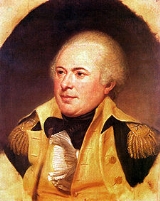
James Wilkinson

Encyclopedia
James Wilkinson was an American
soldier and statesman
, who was associated with several scandals and controversies. He served in the Continental Army
during the American Revolutionary War
, but was twice compelled to resign. He was twice the Commanding General of the United States Army
, appointed first Governor of the Louisiana Territory
in 1805, and commanded two unsuccessful campaigns in the St. Lawrence theater during the War of 1812
. After his death, he was discovered to have been a paid agent of the Spanish Crown.
, on a farm south of Hunting Creek. His grandfather had been sufficiently wealthy to buy Stoakley Manor in Calvert County. The family felt that even though their property was smaller, they still fell in with a higher social class. James grew up with the idea that "the image of respectability excused the reality of betrayal." His father, Joseph Wilkinson, inherited the property but, by that time, the family was in debt. In 1764, Stoakley Manor was broken up and sold. His older brother, Joseph, inherited the property after his father died and, as the second son, James was left with nothing. However, his father left with the last words of “My son, if you ever put up with and insult, I will disinherit you.” Andro Linklater argues that this upbringing led to James’ aggressive reaction towards insults of his behavior.
James Wilkinson received his early education from a private tutor, funded by his grandmother; his study of medicine in Philadelphia at the University of Pennsylvania
was interrupted by the American Revolution
.
Wilkinson married Ann Biddle
of the Biddle family
on November 12, 1778 in Philadelphia, and had four children with her. Several of his boys went on to careers in the American military. After Ann's death on February 23, 1807, he married Celeste Laveau Trudeau on March 5, 1810, with whom he had three children (Stephanie and Theofannie, twin girls, January 1816 [Theofannie, his favorite, died in early 1822] and son, Theodore, born 1819).
Dying on December 28, 1825 at the age of 68, he was buried in Mexico City, Mexico
.
rifle battalion, 1775–76, and was commissioned a captain in September 1775. He served as an aide to Nathanael Greene
during the Siege of Boston
, participated in the placing of guns on the Dorchester Heights
in March of 1776, and following the British abandonment of Boston, went with the rest of the Continental Army to New York where he left Greene's staff and was given command of an infantry company.
Sent to Canada as part of the reinforcements for Benedict Arnold
's intrepid little army besieging Quebec, he arrived just in time to witness the arrival of 8,000 British reinforcements under General John Burgoyne
which precipitated the collapse of the American effort in Canada. He became aide to Arnold just prior to the final retreat and left Canada with Arnold on the very last boat out. Shortly thereafter, he left Arnold's service and became an aide to General Horatio Gates
in August 1776.
When Gates sent him to Congress with official dispatches about the victory at the Battle of Saratoga
, Wilkinson kept Congress waiting while he attended to personal affairs. When he finally showed up, he embellished his own role in the victory, and was brevet
ted as a brigadier general
and appointed to the newly created board of war. The promotion over more senior colonels caused an uproar among Continental officers, especially because Wilkinson's gossiping seemed to indicate he was a participant in the Conway Cabal
, a conspiracy to replace George Washington with Horatio Gates as commander-in-chief. Gates soon had enough of Wilkinson, and the young officer was compelled to resign in March 1778. On July 29, 1779, Congress appointed him clothier general of the Army, but he resigned on March 27, 1781 due to his "lack of aptitude for the job."
in the Pennsylvania militia in 1782 and also a state assemblyman in 1783, due to the wishes of George Washington. He moved to the Kentucky
District in 1784 and was active there in efforts to achieve independence from Virginia
.
In April 1787, Wilkinson took a highly controversial trip to New Orleans, which was a colony of Spain
At that time, Americans were not allowed to trade in New Orleans. Wilkinson met with Spanish Governor Esteban Rodríguez Miró
and managed to convince him to allow Kentucky to have a trading monopoly on the Mississippi River
; in return he promised to promote Spanish interests in the west. On August 22 1787, Wilkinson signed an expatriation declaration and swore allegiance to the King of Spain to satisfy his own commercial needs. The “Spanish Conspiracy,” as it is known, was initiated by Wilkinson’s “First Memorial,” a 7,500-word report written before he left New Orleans for Charleston, South Carolina, from New Orleans, to the Spanish concerning the “political future of western settlers” and to convince Spain to “admit us [Kentuckians] under protection as vassals”. This was encoded with myriad symbols, numbers, and letters that was decoded via a complex English-Spanish cipher code-named “Number 13,” which became the basis for his pseudonym, “Agent 13”.
Upon returning to Kentucky in February 1788, Wilkinson vigorously opposed the new U.S. Constitution. Kentucky had very nearly achieved statehood under the old Articles of Confederation
, and there was widespread disappointment when this was delayed because of the new constitution.
Leading up to Kentucky's seventh convention regarding separation from Virginia in November 1788, Wilkinson attempted to gauge the support for Kentucky to seek union with Spain. Wilkinson was not an extremely honorable man, but his ability to win people over with his charm and sincerity got him elected committee chair at the convention. He advocated for Kentucky to seek independence from Virginia first, and then to consider joining the Union of states as a second step. For many, joining the Union was conditional upon the Union negotiating free navigation on the Mississippi with Spain, a contentious point which many Kentuckians doubted the eastern states would act upon.
Unable to gather enough support for his position at the convention, Wilkinson then approached Miró with a proposal. His intention was to grant them 60,000 acres (243 km²) in the Yazoo lands
at the junction of the Yazoo River
and the Mississippi (near present-day Vicksburg, Mississippi
). The land was to be payment for Wilkinson's efforts on behalf of Spain and also to serve as a refuge in the event he and his supporters had to flee from the United States. Wilkinson asked for and received a pension of $7,000 from Miro and also requested pensions on behalf of several prominent Kentuckians, including: Harry Innes
, Benjamin Sebastian, John Brown
, Caleb Wallace, Benjamin Logan
, Isaac Shelby
, George Muter
, George Nicholas
, and even Humphrey Marshall (who at one time was a bitter rival of Wilkinson's).
However, by 1788 Wilkinson had apparently lost the support of officials in the Spanish mainland. Miro was not to grant any of the proposed pensions and was forbidden from giving money to support a revolution in Kentucky. Furthermore, Wilkinson continued to secretly receive funds from Spain for many years.
, Colonel Wilkinson led a force of Kentucky volunteers against American Indians
at Ouiatenon
in May 1791. He commanded a follow-up raid that autumn, highlighted by the Battle of Kenapacomaqua
. In October he received a commission to the U.S. Army as lieutenant colonel, commandant of the 2nd U.S. Infantry.
crisis of the late 1790s between France
and the United States, he was given the third place in the United States Army behind George Washington and Alexander Hamilton
. Among other duties, he was charged by Hamilton with establishing a "Reserve Corps" of United States troops in the lower Ohio Valley who would seize the lower Mississippi River Valley and New Orleans in the event of war with France and her ally Spain. Despite the end of the crisis in mid-1800 and the fall of Hamilton from power, Wilkinson for unknown reasons continued the plan for the establishment of the base which he named "Cantonment Wilkinson" after himself. Located in southern Illinois, the base operated from January 1801 to late 1802 before finally being abandoned. Archaeologists from Southern Illinois University
have recently located the remains of this base, which is producing much previously unknown information regarding the daily lives and artifacts of the frontier army.
on behalf of the United States in 1803. At this time, Wilkinson renewed his treasonous connection with Spanish colonial officials, offering advice on how to contain American expansion in exchange for restoration of his pension. Among other things, Wilkinson tipped off the Spanish to the object of the Lewis and Clark expedition.
In 1805, following the Louisiana Purchase, President Thomas Jefferson appointed Wilkinson governor of the northern Louisiana territory despite his high-ranking position in the military.[3] This was unusual: Jefferson had given Wilkinson a startling amount of power and authority. Wilkinson then sent Zebulon Pike on expeditions to the Southwest in 1805 and 1806 to discover the source of the Mississippi River.[11]
He was removed from office after being publicly criticized for heavy-handed administration and abuse of power.[citation needed] Noting the lack of support for his new nation with Burr, Wilkinson revealed Burr's plans to Jefferson.[3] Wilkinson testified at Burr's trial, arousing public accusation against him and two congressional inquiries of his private ventures and intrigues. This information drove President James Madison to order his court-martial in 1811. He was found not guilty on December 25, 1811.
. In March 1813, Wilkinson led the American force that occupied Mobile
in Spanish West Florida
. He was then assigned to the St. Lawrence River theater of war, following Henry Dearborn
's reassignment. Wilkinson engaged in two failed campaigns (the Battle of Crysler's Farm
and the second Battle of Lacolle Mills
(1814). He was then relieved from active service, but was cleared by a military inquiry. In 1816, Wilkinson published a rambling apologia, titled Memoirs of My Own Times, in a final attempt to clear his name.
in pursuit of a Texas
land grant. While awaiting government approval of his Texas scheme, Wilkinson died in Mexico City
, where he was buried.
Wilkinson's involvement with the Spanish (Agent 13), although widely suspected in his own day, was not proven until 1854, with Louisiana historian Charles Gayarré
's publication of the American general's correspondence with Rodríguez Miró, the Spanish governor of Louisiana. Other historians would subsequently add to the catalog of Wilkinson's treasonous activities.
United States
The United States of America is a federal constitutional republic comprising fifty states and a federal district...
soldier and statesman
Statesman
A statesman is usually a politician or other notable public figure who has had a long and respected career in politics or government at the national and international level. As a term of respect, it is usually left to supporters or commentators to use the term...
, who was associated with several scandals and controversies. He served in the Continental Army
Continental Army
The Continental Army was formed after the outbreak of the American Revolutionary War by the colonies that became the United States of America. Established by a resolution of the Continental Congress on June 14, 1775, it was created to coordinate the military efforts of the Thirteen Colonies in...
during the American Revolutionary War
American Revolutionary War
The American Revolutionary War , the American War of Independence, or simply the Revolutionary War, began as a war between the Kingdom of Great Britain and thirteen British colonies in North America, and ended in a global war between several European great powers.The war was the result of the...
, but was twice compelled to resign. He was twice the Commanding General of the United States Army
Commanding General of the United States Army
Prior to the institution of the Chief of Staff of the United States Army in 1903, there was generally a single senior-most officer in the army. From 1783, he was known simply as the Senior Officer of the United States Army, but in 1821, the title was changed to Commanding General of the United...
, appointed first Governor of the Louisiana Territory
Louisiana Territory
The Territory of Louisiana or Louisiana Territory was an organized incorporated territory of the United States that existed from July 4, 1805 until June 4, 1812, when it was renamed to Missouri Territory...
in 1805, and commanded two unsuccessful campaigns in the St. Lawrence theater during the War of 1812
War of 1812
The War of 1812 was a military conflict fought between the forces of the United States of America and those of the British Empire. The Americans declared war in 1812 for several reasons, including trade restrictions because of Britain's ongoing war with France, impressment of American merchant...
. After his death, he was discovered to have been a paid agent of the Spanish Crown.
Personal Life
James Wilkinson was born about three miles (5 km) northeast of Benedict, MarylandBenedict, Maryland
Benedict, Maryland is a small unincorporated town in Charles County, Maryland, located on the Patuxent River in Southern Maryland, USA.-History:...
, on a farm south of Hunting Creek. His grandfather had been sufficiently wealthy to buy Stoakley Manor in Calvert County. The family felt that even though their property was smaller, they still fell in with a higher social class. James grew up with the idea that "the image of respectability excused the reality of betrayal." His father, Joseph Wilkinson, inherited the property but, by that time, the family was in debt. In 1764, Stoakley Manor was broken up and sold. His older brother, Joseph, inherited the property after his father died and, as the second son, James was left with nothing. However, his father left with the last words of “My son, if you ever put up with and insult, I will disinherit you.” Andro Linklater argues that this upbringing led to James’ aggressive reaction towards insults of his behavior.
James Wilkinson received his early education from a private tutor, funded by his grandmother; his study of medicine in Philadelphia at the University of Pennsylvania
University of Pennsylvania
The University of Pennsylvania is a private, Ivy League university located in Philadelphia, Pennsylvania, United States. Penn is the fourth-oldest institution of higher education in the United States,Penn is the fourth-oldest using the founding dates claimed by each institution...
was interrupted by the American Revolution
American Revolution
The American Revolution was the political upheaval during the last half of the 18th century in which thirteen colonies in North America joined together to break free from the British Empire, combining to become the United States of America...
.
Wilkinson married Ann Biddle
Ann Biddle Wilkinson
Ann Biddle was married to the eventual ranking officer of the U.S. Army, General James Wilkinson....
of the Biddle family
Biddle family
The American Biddle family of Philadelphia, Pennsylvania yielded numerous and diverse people of interest down to the present era.William Biddle and Sarah Kempe were Quakers who emigrated from England to America in 1681 in part to avoid religious persecution...
on November 12, 1778 in Philadelphia, and had four children with her. Several of his boys went on to careers in the American military. After Ann's death on February 23, 1807, he married Celeste Laveau Trudeau on March 5, 1810, with whom he had three children (Stephanie and Theofannie, twin girls, January 1816 [Theofannie, his favorite, died in early 1822] and son, Theodore, born 1819).
Dying on December 28, 1825 at the age of 68, he was buried in Mexico City, Mexico
Mexico City
Mexico City is the Federal District , capital of Mexico and seat of the federal powers of the Mexican Union. It is a federal entity within Mexico which is not part of any one of the 31 Mexican states but belongs to the federation as a whole...
.
Revolutionary War actions
Wilkinson first served in Thompson's PennsylvaniaPennsylvania
The Commonwealth of Pennsylvania is a U.S. state that is located in the Northeastern and Mid-Atlantic regions of the United States. The state borders Delaware and Maryland to the south, West Virginia to the southwest, Ohio to the west, New York and Ontario, Canada, to the north, and New Jersey to...
rifle battalion, 1775–76, and was commissioned a captain in September 1775. He served as an aide to Nathanael Greene
Nathanael Greene
Nathanael Greene was a major general of the Continental Army in the American Revolutionary War. When the war began, Greene was a militia private, the lowest rank possible; he emerged from the war with a reputation as George Washington's most gifted and dependable officer. Many places in the United...
during the Siege of Boston
Siege of Boston
The Siege of Boston was the opening phase of the American Revolutionary War, in which New England militiamen—who later became part of the Continental Army—surrounded the town of Boston, Massachusetts, to prevent movement by the British Army garrisoned within...
, participated in the placing of guns on the Dorchester Heights
Fortification of Dorchester Heights
The Fortification of Dorchester Heights was a decisive action early in the American Revolutionary War that precipitated the end of the siege of Boston and the withdrawal of British troops from that city....
in March of 1776, and following the British abandonment of Boston, went with the rest of the Continental Army to New York where he left Greene's staff and was given command of an infantry company.
Sent to Canada as part of the reinforcements for Benedict Arnold
Benedict Arnold
Benedict Arnold V was a general during the American Revolutionary War. He began the war in the Continental Army but later defected to the British Army. While a general on the American side, he obtained command of the fort at West Point, New York, and plotted to surrender it to the British forces...
's intrepid little army besieging Quebec, he arrived just in time to witness the arrival of 8,000 British reinforcements under General John Burgoyne
John Burgoyne
General John Burgoyne was a British army officer, politician and dramatist. He first saw action during the Seven Years' War when he participated in several battles, mostly notably during the Portugal Campaign of 1762....
which precipitated the collapse of the American effort in Canada. He became aide to Arnold just prior to the final retreat and left Canada with Arnold on the very last boat out. Shortly thereafter, he left Arnold's service and became an aide to General Horatio Gates
Horatio Gates
Horatio Lloyd Gates was a retired British soldier who served as an American general during the Revolutionary War. He took credit for the American victory at the Battle of Saratoga – Benedict Arnold, who led the attack, was finally forced from the field when he was shot in the leg – and...
in August 1776.
When Gates sent him to Congress with official dispatches about the victory at the Battle of Saratoga
Battle of Saratoga
The Battles of Saratoga conclusively decided the fate of British General John Burgoyne's army in the American War of Independence and are generally regarded as a turning point in the war. The battles were fought eighteen days apart on the same ground, south of Saratoga, New York...
, Wilkinson kept Congress waiting while he attended to personal affairs. When he finally showed up, he embellished his own role in the victory, and was brevet
Brevet (military)
In many of the world's military establishments, brevet referred to a warrant authorizing a commissioned officer to hold a higher rank temporarily, but usually without receiving the pay of that higher rank except when actually serving in that role. An officer so promoted may be referred to as being...
ted as a brigadier general
Brigadier General
Brigadier general is a senior rank in the armed forces. It is the lowest ranking general officer in some countries, usually sitting between the ranks of colonel and major general. When appointed to a field command, a brigadier general is typically in command of a brigade consisting of around 4,000...
and appointed to the newly created board of war. The promotion over more senior colonels caused an uproar among Continental officers, especially because Wilkinson's gossiping seemed to indicate he was a participant in the Conway Cabal
Conway Cabal
The Conway Cabal refers to a series of events in late 1777 and early 1778 suggesting that George Washington be replaced as commander of the Continental Army during the American Revolutionary War. It was named after Brigadier General Thomas Conway, whose letters criticizing Washington were forwarded...
, a conspiracy to replace George Washington with Horatio Gates as commander-in-chief. Gates soon had enough of Wilkinson, and the young officer was compelled to resign in March 1778. On July 29, 1779, Congress appointed him clothier general of the Army, but he resigned on March 27, 1781 due to his "lack of aptitude for the job."
Kentucky ventures
After his resignation from the Continental Army, Wilkinson reluctantly became a brigadier generalBrigadier General
Brigadier general is a senior rank in the armed forces. It is the lowest ranking general officer in some countries, usually sitting between the ranks of colonel and major general. When appointed to a field command, a brigadier general is typically in command of a brigade consisting of around 4,000...
in the Pennsylvania militia in 1782 and also a state assemblyman in 1783, due to the wishes of George Washington. He moved to the Kentucky
Kentucky
The Commonwealth of Kentucky is a state located in the East Central United States of America. As classified by the United States Census Bureau, Kentucky is a Southern state, more specifically in the East South Central region. Kentucky is one of four U.S. states constituted as a commonwealth...
District in 1784 and was active there in efforts to achieve independence from Virginia
Virginia
The Commonwealth of Virginia , is a U.S. state on the Atlantic Coast of the Southern United States. Virginia is nicknamed the "Old Dominion" and sometimes the "Mother of Presidents" after the eight U.S. presidents born there...
.
In April 1787, Wilkinson took a highly controversial trip to New Orleans, which was a colony of Spain
Spain
Spain , officially the Kingdom of Spain languages]] under the European Charter for Regional or Minority Languages. In each of these, Spain's official name is as follows:;;;;;;), is a country and member state of the European Union located in southwestern Europe on the Iberian Peninsula...
At that time, Americans were not allowed to trade in New Orleans. Wilkinson met with Spanish Governor Esteban Rodríguez Miró
Esteban Rodríguez Miró
Esteban Rodriguez Miró y Sabater , also known as Esteban Miro and Estevan Miro, was a Spanish army officer and governor of the Spanish American provinces of Louisiana and Florida....
and managed to convince him to allow Kentucky to have a trading monopoly on the Mississippi River
Mississippi River
The Mississippi River is the largest river system in North America. Flowing entirely in the United States, this river rises in western Minnesota and meanders slowly southwards for to the Mississippi River Delta at the Gulf of Mexico. With its many tributaries, the Mississippi's watershed drains...
; in return he promised to promote Spanish interests in the west. On August 22 1787, Wilkinson signed an expatriation declaration and swore allegiance to the King of Spain to satisfy his own commercial needs. The “Spanish Conspiracy,” as it is known, was initiated by Wilkinson’s “First Memorial,” a 7,500-word report written before he left New Orleans for Charleston, South Carolina, from New Orleans, to the Spanish concerning the “political future of western settlers” and to convince Spain to “admit us [Kentuckians] under protection as vassals”. This was encoded with myriad symbols, numbers, and letters that was decoded via a complex English-Spanish cipher code-named “Number 13,” which became the basis for his pseudonym, “Agent 13”.
Upon returning to Kentucky in February 1788, Wilkinson vigorously opposed the new U.S. Constitution. Kentucky had very nearly achieved statehood under the old Articles of Confederation
Articles of Confederation
The Articles of Confederation, formally the Articles of Confederation and Perpetual Union, was an agreement among the 13 founding states that legally established the United States of America as a confederation of sovereign states and served as its first constitution...
, and there was widespread disappointment when this was delayed because of the new constitution.
Leading up to Kentucky's seventh convention regarding separation from Virginia in November 1788, Wilkinson attempted to gauge the support for Kentucky to seek union with Spain. Wilkinson was not an extremely honorable man, but his ability to win people over with his charm and sincerity got him elected committee chair at the convention. He advocated for Kentucky to seek independence from Virginia first, and then to consider joining the Union of states as a second step. For many, joining the Union was conditional upon the Union negotiating free navigation on the Mississippi with Spain, a contentious point which many Kentuckians doubted the eastern states would act upon.
Unable to gather enough support for his position at the convention, Wilkinson then approached Miró with a proposal. His intention was to grant them 60,000 acres (243 km²) in the Yazoo lands
Yazoo lands
The Yazoo lands were the sparsely-populated central and western areas of the U.S. state of Georgia, when its western border stretched back to the Mississippi River. It was named for the Yazoo tribe of Native Americans. Several other places and things were named Yazoo, either for or along with the...
at the junction of the Yazoo River
Yazoo River
The Yazoo River is a river in the U.S. state of Mississippi.The Yazoo River was named by French explorer La Salle in 1682 as "Rivière des Yazous" in reference to the Yazoo tribe living near the river's mouth. The exact meaning of the term is unclear...
and the Mississippi (near present-day Vicksburg, Mississippi
Vicksburg, Mississippi
Vicksburg is a city in Warren County, Mississippi, United States. It is the only city in Warren County. It is located northwest of New Orleans on the Mississippi and Yazoo rivers, and due west of Jackson, the state capital. In 1900, 14,834 people lived in Vicksburg; in 1910, 20,814; in 1920,...
). The land was to be payment for Wilkinson's efforts on behalf of Spain and also to serve as a refuge in the event he and his supporters had to flee from the United States. Wilkinson asked for and received a pension of $7,000 from Miro and also requested pensions on behalf of several prominent Kentuckians, including: Harry Innes
Harry Innes
Harry Innes was the first United States federal judge in Kentucky.Innes was born in Caroline County, Virginia, the son of the Reverend Robert Innes and Catharine Innes. Innes attended Donald Robertson's school and William and Mary College...
, Benjamin Sebastian, John Brown
John Brown (Kentucky)
John Brown was an American lawyer and statesman heavily involved with creating the State of Kentucky.Brown represented Virginia in the Continental Congress and the U.S. Congress . While in Congress, he introduced the bill granting Statehood to Kentucky. Once that was accomplished, he was elected...
, Caleb Wallace, Benjamin Logan
Benjamin Logan
Benjamin Logan was an American pioneer, soldier, and politician from Shelby County, Kentucky. As colonel of the Kentucky County militia of Virginia during the American Revolutionary War, he was second-in-command of militia in Kentucky. Logan was a leader in Kentucky's efforts to become a state...
, Isaac Shelby
Isaac Shelby
Isaac Shelby was the first and fifth Governor of the U.S. state of Kentucky and served in the state legislatures of Virginia and North Carolina. He was also a soldier in Lord Dunmore's War, the Revolutionary War, and the War of 1812...
, George Muter
George Muter
George Muter was an early settler of Kentucky and served as chief justice of the Kentucky Court of Appeals.-Early life and military career:Muter was born in Madison County, Virginia. He was the son of a German father and a Scottish mother. Little is known of his early life.During the Revolutionary...
, George Nicholas
George Nicholas
George Nicholas was the first professor of law at Transylvania University in Kentucky. He was also briefly attorney general of Kentucky, and had been several times a member of the Virginia House of Delegates. He was the son of Robert C. Nicholas, Sr.; his brothers included Wilson Cary Nicholas...
, and even Humphrey Marshall (who at one time was a bitter rival of Wilkinson's).
However, by 1788 Wilkinson had apparently lost the support of officials in the Spanish mainland. Miro was not to grant any of the proposed pensions and was forbidden from giving money to support a revolution in Kentucky. Furthermore, Wilkinson continued to secretly receive funds from Spain for many years.
Second military career
In the Northwest Indian WarNorthwest Indian War
The Northwest Indian War , also known as Little Turtle's War and by various other names, was a war fought between the United States and a confederation of numerous American Indian tribes for control of the Northwest Territory...
, Colonel Wilkinson led a force of Kentucky volunteers against American Indians
Native Americans in the United States
Native Americans in the United States are the indigenous peoples in North America within the boundaries of the present-day continental United States, parts of Alaska, and the island state of Hawaii. They are composed of numerous, distinct tribes, states, and ethnic groups, many of which survive as...
at Ouiatenon
Ouiatenon
Ouiatenon is a name that refers to a dwelling place of members of the Wea tribe of Native Americans. The name Ouiatenon, also variously given as Ouiatanon, Oujatanon, Ouiatano or other similar forms, is a French rendering of a term from the Wea dialect of the Miami-Illinois language which means...
in May 1791. He commanded a follow-up raid that autumn, highlighted by the Battle of Kenapacomaqua
Battle of Kenapacomaqua
The Battle of Kenapacomaqua, also called the Battle of Old Town, was a raid in 1791 by United States forces under the command of Lieutenant Colonel James Wilkinson on the Miami town of Kenapacomaqua on the Eel River approximately six miles upstream from present-day Logansport, Indiana...
. In October he received a commission to the U.S. Army as lieutenant colonel, commandant of the 2nd U.S. Infantry.
Rivalry with Wayne
When the United States government formed the Legion of the United States, President Washington was faced with the decision of who to name as its General. The two major candidates for this promotion were James Wilkinson and Anthony Wayne. In the end, the cabinet chose Wayne over Wilkinson due his suspected with the Spanish government. The cabinet promoted Wilkinson to Brigadier General as a consolation prize, since Washington was aware of Wilkinson’s fragile ego. Wilkinson developed a jealousy towards Wayne, but maintained an ostensible respect towards the General. However, upon Wilkinson’s refusal of an invitation to Wilkinson’s Christmas Party, he developed a full-fledged hatred for Wilkinson, deeming that refusal as an act of disrespect. For example, Wayne had led the legion army against the Native Americans in Battle of Fallen Timbers in August 1794. This battle was a huge victory for the United States, yet Wilkinson had criticized the General’s actions during the battle simply to antagonize Wayne. Wilkinson proceeded to file formal complaints against the General and his decisions to the President. Upon finding out about the complaints against him, Wayne decided to fight back, launching an investigation into Wilkinson’s history with the Spanish. During all of this time, Wilkinson had renewed his secret alliance with the Spanish government (through the Governor of Louisiana Carondelet), alerting them to the actions of both the US and the French occupancy in North America. When Spanish couriers were intercepted carrying Wilkinson’s payments from the Spanish, Wayne’s suspicions were confirmed and attempted to court martial Wilkinson for his treachery. However, Wayne developed a stomach ulcer and died on December 15, 1796. Despite of his nearly confirmed treason, upon Wayne’s death, the President promoted Wilkinson to Major General of the Legion Army.Quasi-War with France
Wilkinson was transferred to the southern frontier in 1798. During the Quasi-WarQuasi-War
The Quasi-War was an undeclared war fought mostly at sea between the United States and French Republic from 1798 to 1800. In the United States, the conflict was sometimes also referred to as the Franco-American War, the Pirate Wars, or the Half-War.-Background:The Kingdom of France had been a...
crisis of the late 1790s between France
France
The French Republic , The French Republic , The French Republic , (commonly known as France , is a unitary semi-presidential republic in Western Europe with several overseas territories and islands located on other continents and in the Indian, Pacific, and Atlantic oceans. Metropolitan France...
and the United States, he was given the third place in the United States Army behind George Washington and Alexander Hamilton
Alexander Hamilton
Alexander Hamilton was a Founding Father, soldier, economist, political philosopher, one of America's first constitutional lawyers and the first United States Secretary of the Treasury...
. Among other duties, he was charged by Hamilton with establishing a "Reserve Corps" of United States troops in the lower Ohio Valley who would seize the lower Mississippi River Valley and New Orleans in the event of war with France and her ally Spain. Despite the end of the crisis in mid-1800 and the fall of Hamilton from power, Wilkinson for unknown reasons continued the plan for the establishment of the base which he named "Cantonment Wilkinson" after himself. Located in southern Illinois, the base operated from January 1801 to late 1802 before finally being abandoned. Archaeologists from Southern Illinois University
Southern Illinois University
Southern Illinois University is a state university system based in Carbondale, Illinois, in the Southern Illinois region of the state, with multiple campuses...
have recently located the remains of this base, which is producing much previously unknown information regarding the daily lives and artifacts of the frontier army.
Service under President Jefferson
Wilkinson remained senior officer of the United States Army under President Thomas Jefferson. Along with Governor William C. C. Claiborne, Wilkinson shared the honor of taking possession of the Louisiana PurchaseLouisiana Purchase
The Louisiana Purchase was the acquisition by the United States of America of of France's claim to the territory of Louisiana in 1803. The U.S...
on behalf of the United States in 1803. At this time, Wilkinson renewed his treasonous connection with Spanish colonial officials, offering advice on how to contain American expansion in exchange for restoration of his pension. Among other things, Wilkinson tipped off the Spanish to the object of the Lewis and Clark expedition.
Connections with Aaron Burr
In 1804-05, he exchanged communications with Aaron Burr regarding Burr's conspiracy to set up an independent nation in the west.[3] Some embittered associates (more specifically, Jefferson’s cabinet members)[who?] later claimed that Wilkinson was the mastermind behind the plot of which Burr was accused. Others, namely author Theodore Crackel, play devil’s (Wilkinson’s) advocate, supporting Wilkinson’s innocence and proclaiming his role as the scapegoat for Aaron Burr’s reputation. (Crackel, General Wilkinson’s Army, 132).In 1805, following the Louisiana Purchase, President Thomas Jefferson appointed Wilkinson governor of the northern Louisiana territory despite his high-ranking position in the military.[3] This was unusual: Jefferson had given Wilkinson a startling amount of power and authority. Wilkinson then sent Zebulon Pike on expeditions to the Southwest in 1805 and 1806 to discover the source of the Mississippi River.[11]
He was removed from office after being publicly criticized for heavy-handed administration and abuse of power.[citation needed] Noting the lack of support for his new nation with Burr, Wilkinson revealed Burr's plans to Jefferson.[3] Wilkinson testified at Burr's trial, arousing public accusation against him and two congressional inquiries of his private ventures and intrigues. This information drove President James Madison to order his court-martial in 1811. He was found not guilty on December 25, 1811.
War of 1812
Wilkinson was commissioned a major general in the War of 1812War of 1812
The War of 1812 was a military conflict fought between the forces of the United States of America and those of the British Empire. The Americans declared war in 1812 for several reasons, including trade restrictions because of Britain's ongoing war with France, impressment of American merchant...
. In March 1813, Wilkinson led the American force that occupied Mobile
Mobile, Alabama
Mobile is the third most populous city in the Southern US state of Alabama and is the county seat of Mobile County. It is located on the Mobile River and the central Gulf Coast of the United States. The population within the city limits was 195,111 during the 2010 census. It is the largest...
in Spanish West Florida
West Florida
West Florida was a region on the north shore of the Gulf of Mexico, which underwent several boundary and sovereignty changes during its history. West Florida was first established in 1763 by the British government; as its name suggests it largely consisted of the western portion of the region...
. He was then assigned to the St. Lawrence River theater of war, following Henry Dearborn
Henry Dearborn
Henry Dearborn was an American physician, a statesman and a veteran of both the American Revolutionary War and the War of 1812. Born to Simon Dearborn and Sarah Marston in North Hampton, New Hampshire, he spent much of his youth in Epping, where he attended public schools...
's reassignment. Wilkinson engaged in two failed campaigns (the Battle of Crysler's Farm
Battle of Crysler's Farm
The Battle of Crysler's Farm, also known as the Battle of Crysler's Field, was fought on 11 November 1813, during the Anglo-American War of 1812. A British and Canadian force won a victory over an American force which greatly outnumbered them...
and the second Battle of Lacolle Mills
Battle of Lacolle Mills (1814)
The Second Battle of Lacolle Mills was fought on 30 March 1814 during the War of 1812. The small garrison of a British outpost position, aided by reinforcements, fought off a large American attack.-Background:After the St...
(1814). He was then relieved from active service, but was cleared by a military inquiry. In 1816, Wilkinson published a rambling apologia, titled Memoirs of My Own Times, in a final attempt to clear his name.
Last Years
In 1821 Wilkinson visited MexicoMexico
The United Mexican States , commonly known as Mexico , is a federal constitutional republic in North America. It is bordered on the north by the United States; on the south and west by the Pacific Ocean; on the southeast by Guatemala, Belize, and the Caribbean Sea; and on the east by the Gulf of...
in pursuit of a Texas
Texas
Texas is the second largest U.S. state by both area and population, and the largest state by area in the contiguous United States.The name, based on the Caddo word "Tejas" meaning "friends" or "allies", was applied by the Spanish to the Caddo themselves and to the region of their settlement in...
land grant. While awaiting government approval of his Texas scheme, Wilkinson died in Mexico City
Mexico City
Mexico City is the Federal District , capital of Mexico and seat of the federal powers of the Mexican Union. It is a federal entity within Mexico which is not part of any one of the 31 Mexican states but belongs to the federation as a whole...
, where he was buried.
Wilkinson's involvement with the Spanish (Agent 13), although widely suspected in his own day, was not proven until 1854, with Louisiana historian Charles Gayarré
Charles Gayarré
Charles Etienne Arthur Gayarre was an American historian born in New Orleans, Louisiana. A historian and a writer of plays, essays, and novels, he is chiefly remembered for his histories of Louisiana....
's publication of the American general's correspondence with Rodríguez Miró, the Spanish governor of Louisiana. Other historians would subsequently add to the catalog of Wilkinson's treasonous activities.
Legacy
- Some of his descendants used the surname Wilkerson, which appears in Southern Alabama and Eastern Louisiana.
- Historian Robert LeckieRobert Leckie (author)Robert Leckie was an American author of popular books on the military history of the United States. As a young man, he served in the Marine Corps with the 1st Marine Division during World War II...
characterized him as "a general who never won a battle or lost a court-martialCourt-martialA court-martial is a military court. A court-martial is empowered to determine the guilt of members of the armed forces subject to military law, and, if the defendant is found guilty, to decide upon punishment.Most militaries maintain a court-martial system to try cases in which a breach of...
." - Historian Frederick Jackson TurnerFrederick Jackson TurnerFrederick Jackson Turner was an American historian in the early 20th century. He is best known for his essay "The Significance of the Frontier in American History", whose ideas are referred to as the Frontier Thesis. He is also known for his theories of geographical sectionalism...
called Wilkinson "the most consummate artist in treason that the nation ever possessed." - George Rogers ClarkGeorge Rogers ClarkGeorge Rogers Clark was a soldier from Virginia and the highest ranking American military officer on the northwestern frontier during the American Revolutionary War. He served as leader of the Kentucky militia throughout much of the war...
biographer Temple Bodley said of Wilkinson, "He had considerable military talent, but used it only for his own gain." - Frankfort, KentuckyFrankfort, KentuckyFrankfort is a city in Kentucky that serves as the state capital and the county seat of Franklin County. The population was 27,741 at the 2000 census; by population it is the 5th smallest state capital in the United States...
's downtown was created from land owned by Wilkinson. He designed their layout and a major boulevard is named in his honor. - Wilkinson County, GeorgiaWilkinson County, GeorgiaWilkinson County is a county located in the U.S. state of Georgia. It was created on May 11, 1803. As of 2000, the population was 10,220. The 2007 Census Estimate shows a population of 10,064...
, is named for Wilkinson. A Georgia historic marker on the courthouse square gives a brief biography of the General and states he is the namesake for the county. - Wilkinson appears as a major character in the novel To the Ends of the Earth: The Last Journey of Lewis and Clark, by Frances Hunter (2006 - ISBN 0-9777636-2-5), in which he draws explorer Meriwether LewisMeriwether LewisMeriwether Lewis was an American explorer, soldier, and public administrator, best known for his role as the leader of the Lewis and Clark Expedition also known as the Corps of Discovery, with William Clark...
into a conspiracy to separate the western territories from the United States. - Wilkinson also appears as a major character in Janice Holt GilesJanice Holt GilesJanice Holt Giles was a Kentucky author who lived near Knifley in Adair County, Kentucky. She was born Janice Meredith Holt on March 28, 1905, in Altus, Arkansas. Her first marriage, to Otto Moore in 1927, ended in divorce in 1939. She met Henry Giles on a 40-hour bus trip in 1943 and married...
's novel The Land Beyond the Mountains which deals extensively with Wilkinson's participation in the issue of Kentucky statehood. - Wilkinson County, MississippiWilkinson County, Mississippi-Demographics:As of the census of 2000, there were 10,312 people, 3,578 households, and 2,511 families residing in the county. The population density was 15 people per square mile . There were 5,106 housing units at an average density of 8 per square mile...
is named for General Wilkinson, as well. It was there in the Old Natchez District that Wilkinson spent much of his time allegedly plotting the Burr Conspiracy, as Fort Adams (then a major U.S. Army post, located in present day Wilkinson County) was the most south-westerly point in the United States and the last stop on the Mississippi River before entering Spanish territory. It was also from these environs that Burr recruited his would-be revolutionaries, most notable amongst them a young Philip NolanPhilip NolanPhilip Nolan was a horse-trader and freebooter in Natchez, on the Mississippi River, and the Spanish province of Texas....
, famously remembered as "the man without a countryThe Man Without a Country"The Man Without a Country" is a short story by American writer Edward Everett Hale, first published anonymously in The Atlantic in December 1863. It is the story of American Army lieutenant Philip Nolan, who renounces his country during a trial for treason and is consequently sentenced to spend...
" in literature and history. - There is a road in New Windsor, New YorkNew Windsor, New YorkNew Windsor is a town in Orange County, New York, United States. The population was estimated at 25,244 in 2010 by the US Census.The Town of New Windsor is in the eastern part of the county, bordering the Town of Newburgh and the City of Newburgh....
named in honor of him. - Wilkinson was an avid supporter of the military's short hair codes. So much so that Wilkinson was attempting to prosecute Colonel Thomas Butler for keeping his long hair. Colonel Thomas Butler died before the trials had closed. He did not cut his hair prior to his death.
- At that point, the fate of the United States had hinged on his choice.” [(Linklater) 274] Wilkinson’s decision with the Burr Conspiracy was quintessential to American history. One of the many reasons why Wilkinson was so important was that at one point in time the fate of American history lied in his hands. Had he decided to side with Burr, America as it is known today would be completely different.
External links
- James Wilkinson, A Study in Controversy
- Spaniards, Scoundrels, and Statesmen: General James Wilkinson and the Spanish Conspiracy, 1787-1790
- Wilkinson Bio in Commanding Generals and Chiefs of Staff 1775-1995 a publication of the United States Army Center of Military History
- Encyclopedia Louisiana