
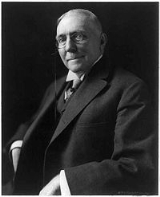
James Whitcomb Riley was an
AmericanThe United States of America is a federal constitutional republic comprising fifty states and a federal district...
writerA writer is a person who produces literature, such as novels, short stories, plays, screenplays, poetry, or other literary art. Skilled writers are able to use language to portray ideas and images....
,
poetA poet is a person who writes poetry. A poet's work can be literal, meaning that his work is derived from a specific event, or metaphorical, meaning that his work can take on many meanings and forms. Poets have existed since antiquity, in nearly all languages, and have produced works that vary...
, and best selling author. During his lifetime he was known as the
HoosierHoosier is the official demonym for a resident of the U.S. state of Indiana. Although residents of most U.S. states typically adopt a derivative of the state name, e.g., "Indianan" or "Indianian", natives of Indiana rarely use these. Indiana adopted the nickname "Hoosier State" more than 150...
Poet and Children's Poet for his
dialectThe term dialect is used in two distinct ways, even by linguists. One usage refers to a variety of a language that is a characteristic of a particular group of the language's speakers. The term is applied most often to regional speech patterns, but a dialect may also be defined by other factors,...
works and his children's poetry respectively. His poems tended to be humorous or sentimental, and of the approximately one thousand poems that Riley authored, the majority are in dialect. His famous works include "
Little Orphant Annie"Little Orphant Annie" is an 1885 poem written by James Whitcomb Riley and published by the Bowen-Merrill Company. First titled "The Elf Child", Riley changed the name to "Little Orphant Allie" at its third printing, however a typecasting error during printing renamed the poem to its current form...
" and "
The Raggedy ManThe Raggedy Man was a poem wrote by James Whitcomb Riley and first published in 1888. The poem was the inspiration for the Raggedy Ann doll, and two films by the same name. The poem is one of Riley's most famous and is based on a German tramp employed by his father during his youth.-External links:*...
".
Riley began his career writing verses as a sign maker and submitting poetry to newspapers. Thanks in part to an endorsement from poet
Henry Wadsworth LongfellowHenry Wadsworth Longfellow was an American poet and educator whose works include "Paul Revere's Ride", The Song of Hiawatha, and Evangeline...
, he eventually earned successive jobs at
IndianaIndiana is a US state, admitted to the United States as the 19th on December 11, 1816. It is located in the Midwestern United States and Great Lakes Region. With 6,483,802 residents, the state is ranked 15th in population and 16th in population density. Indiana is ranked 38th in land area and is...
newspaper publishers during the latter 1870s. Riley gradually rose in prominence during the 1880s through his poetry reading tours. He traveled a touring circuit first in the Midwest, and then nationally, holding shows and making joint appearances on stage with other famous talents. Regularly struggling with his alcohol addiction, Riley never married or had children, and was involved in a scandal in 1888 when he became too drunk to perform. He became more popular in spite of the bad press he received, and as a result extricated himself from poorly negotiated contracts that limited his earnings; he quickly became very wealthy.
Riley became a bestselling author in the 1890s. His children's poems were compiled into a book and illustrated by
Howard Chandler ChristyHoward Chandler Christy was an American artist and illustrator famous for the "Christy Girl", similar to a "Gibson Girl".He was born in Morgan County and attended early school in Duncan Falls, Ohio...
. Titled the
Rhymes of Childhood, the book was his most popular and sold millions of copies. As a poet, Riley achieved an uncommon level of fame during his own lifetime. He was honored with annual Riley Day celebrations around the United States and was regularly called on to perform readings at national civic events. He continued to write and hold occasional poetry readings until a
strokeA stroke, previously known medically as a cerebrovascular accident , is the rapidly developing loss of brain function due to disturbance in the blood supply to the brain. This can be due to ischemia caused by blockage , or a hemorrhage...
paralyzedParalysis is loss of muscle function for one or more muscles. Paralysis can be accompanied by a loss of feeling in the affected area if there is sensory damage as well as motor. A study conducted by the Christopher & Dana Reeve Foundation, suggests that about 1 in 50 people have been diagnosed...
his right arm in 1910.
Although popular in his day, modern critics rate Riley as a minor poet, citing the quality of his work and his lack of serious subject matter as their reasons. Riley's chief legacy was his influence in fostering the creation of a midwestern cultural identity and his contributions to the
Golden Age of Indiana LiteratureThe Golden Age of Indiana Literature is a period between 1880 and 1920, when many nationally and internationally acclaimed literary works were created by natives of the State of Indiana. During this time, many of the United States' most popular authors came from Indiana...
. Along with other writers of his era, he helped create a caricature of midwesterners and formed a literary community that produced works rivaling the established eastern literati. There are many memorials dedicated to Riley, including the
James Whitcomb Riley Hospital for ChildrenRiley Hospital for Children at Indiana University Health is a nationally ranked children's hospital located on the Indiana University-Purdue University Indianapolis campus in Indianapolis, Indiana....
.
Family and background
James Whitcomb Riley was born on October 7, 1849, in the town of
Greenfield, Indiana-Demographics:As of the census of 2000, there were 14,600 people, 5,917 households, and 4,017 families residing in the city. The population density was 1,818.0 people per square mile . There were 6,449 housing units at an average density of 803.0 per square mile...
, the third of the six children of Reuben Andrew and Elizabeth Marine Riley.
[Coincidentally, Riley was born on the day of Edgar Allan Poe]Edgar Allan Poe was an American author, poet, editor and literary critic, considered part of the American Romantic Movement. Best known for his tales of mystery and the macabre, Poe was one of the earliest American practitioners of the short story and is considered the inventor of the detective...
's death. (see: Van Allen, p. 2) Riley's father was an attorney, and in the year before Riley's birth, he was elected a member of the
Indiana House of RepresentativesThe Indiana House of Representatives is the lower house of the Indiana General Assembly, the state legislature of the U.S. state of Indiana. The House is composed of 100 members representing an equal number of constituent districts. House members serve two-year terms without term limits...
as a Democrat. He developed a friendship with
James WhitcombJames Whitcomb was a Democratic United States Senator and the eighth Governor of Indiana. As governor during the Mexican-American War, he oversaw the formation and deployment of the state's levies...
, the
governor of IndianaThe Governor of Indiana is the chief executive of the state of Indiana. The governor is elected to a four-year term, and responsible for overseeing the day-to-day management of the functions of many agencies of the Indiana state government. The governor also shares power with other statewide...
, after whom he named his son. Martin Riley, Riley's uncle, was an amateur poet who occasionally wrote verses for local newspapers. Riley was fond of his uncle who helped influence his early interest in poetry.
Shortly after Riley's birth, the family moved into a larger house in town. Riley was "a quiet boy, not talkative, who would often go about with one eye shut as he observed and speculated." His mother taught him to read and write at home before sending him to the local community school in 1852. He found school difficult and was frequently in trouble. Often punished, he had nothing kind to say of his teachers in his writings. His poem "The Educator" told of an intelligent but sinister teacher and may have been based on one of his instructors. Riley was most fond of his last teacher, Lee O. Harris. Harris noticed Riley's interest in poetry and reading and encouraged him to pursue it further.
Riley's school attendance was sporadic, and he graduated from grade eight at age twenty in 1869. In an 1892 newspaper article, Riley confessed that he knew little of mathematics, geography, or science, and his understanding of proper grammar was poor. Later critics, like Henry Beers, pointed to his poor education as the reason for his success in writing; his prose was written in the language of common people which spurred his popularity.
Childhood influences
Riley lived in
his parents' homeThe Riley Birthplace and Museum, one of two homes called the James Whitcomb Riley House on the National Register of Historic Places, is located at 250 West Main Street in Greenfield, Indiana, twenty miles east of downtown Indianapolis.-History:...
until he was twenty-one. At five years old he began spending time at the Brandywine Creek just outside of Greenfield. His poems "The Barefoot Boy" and "
The Old Swimmin' HoleThe Old Swimmin' Hole was a poem written by by James Whitcomb Riley under the pen name Benjamin F. Johnson of Boone County. The poem was first published in 1883 as part of a book entitled "The Old Swimmin' Hole and 'Leven More Poems". The poem is one of Riley's most famous and is written in dialect...
" referred back to his time at the creek. He was introduced in his childhood to many people who later influenced his poetry. His father regularly brought home a variety of clients and disadvantaged people to give them assistance. Riley's poem "The Raggedy Man" was based on a German tramp his father hired to work at the family home. Riley picked up the cadence and character of the
dialectThe term dialect is used in two distinct ways, even by linguists. One usage refers to a variety of a language that is a characteristic of a particular group of the language's speakers. The term is applied most often to regional speech patterns, but a dialect may also be defined by other factors,...
of central Indiana from the travelers along the old
National RoadThe National Road or Cumberland Road was the first major improved highway in the United States to be built by the federal government. Construction began heading west in 1811 at Cumberland, Maryland, on the Potomac River. It crossed the Allegheny Mountains and southwestern Pennsylvania, reaching...
. Their form of speech heavily influenced the hundreds of poems he wrote in nineteenth century
HoosierHoosier is the official demonym for a resident of the U.S. state of Indiana. Although residents of most U.S. states typically adopt a derivative of the state name, e.g., "Indianan" or "Indianian", natives of Indiana rarely use these. Indiana adopted the nickname "Hoosier State" more than 150...
dialect.
Riley's mother frequently told him stories of fairies, trolls, and giants, and read him children's poems. She was very superstitious, and influenced Riley with many of her beliefs. They both filled their homes with "spirit rappings" on places like tables and bureaus to capture any spirits that may have been wandering about. Her influence is recognized in many of his works, including "Flying Islands of the Night."
As was common at that time, Riley and his friends had few toys and they amused themselves with activities. With his mother's aid, Riley began creating plays and theatricals which he and his friends would practice and perform in the back of a local grocery store. As he grew older, the boys named their troupe the Adelphians and began to have their shows in barns where they could fit larger audiences. Riley wrote of these early performances in his poem "When We First Played 'Show'," where he referred to himself as "Jamesy."
Many of Riley's poems are filled with musical references. Riley had no musical education, and could not read
sheet musicSheet music is a hand-written or printed form of music notation that uses modern musical symbols; like its analogs—books, pamphlets, etc.—the medium of sheet music typically is paper , although the access to musical notation in recent years includes also presentation on computer screens...
, but learned from his father how to play
guitarThe guitar is a plucked string instrument, usually played with fingers or a pick. The guitar consists of a body with a rigid neck to which the strings, generally six in number, are attached. Guitars are traditionally constructed of various woods and strung with animal gut or, more recently, with...
, and from a friend how to play the
violinThe violin is a string instrument, usually with four strings tuned in perfect fifths. It is the smallest, highest-pitched member of the violin family of string instruments, which includes the viola and cello....
. He performed in two different local bands, and became so proficient on the violin he was invited to play with a group of adult
MasonsFreemasonry is a fraternal organisation that arose from obscure origins in the late 16th to early 17th century. Freemasonry now exists in various forms all over the world, with a membership estimated at around six million, including approximately 150,000 under the jurisdictions of the Grand Lodge...
at several events. A few of his later poems were set to music and sang, one of the most well known being
A Short'nin' Bread Song—Pieced Out"Shortnin' Bread" is a song by James Whitcomb Riley.-History:...
.
When Riley was ten, the first library opened in his hometown. From an early age he developed a love of literature. He and his friends spent time at the library where the librarian read stories and poems to them.
Charles DickensCharles John Huffam Dickens was an English novelist, generally considered the greatest of the Victorian period. Dickens enjoyed a wider popularity and fame than had any previous author during his lifetime, and he remains popular, having been responsible for some of English literature's most iconic...
became one Riley's favorites, and helped inspire the poems "St. Lirriper," "Christmas Season," and "God Bless Us Every One."
Riley's father enlisted in the Union Army during the
American Civil WarThe American Civil War was a civil war fought in the United States of America. In response to the election of Abraham Lincoln as President of the United States, 11 southern slave states declared their secession from the United States and formed the Confederate States of America ; the other 25...
, leaving his wife to manage the family home. While he was away, the family took in a twelve-year-old orphan named Mary Alice "Allie" Smith. Smith was the inspiration for Riley's poem
Little Orphant Annie"Little Orphant Annie" is an 1885 poem written by James Whitcomb Riley and published by the Bowen-Merrill Company. First titled "The Elf Child", Riley changed the name to "Little Orphant Allie" at its third printing, however a typecasting error during printing renamed the poem to its current form...
. Riley intended to name the poem
Little Orphant Allie, but a
typesetterTypesetting is the composition of text by means of types.Typesetting requires the prior process of designing a font and storing it in some manner...
's error changed the name of the poem during printing.
Finding poetry
Riley's father returned from the war partially paralyzed. He was unable to continue working in his legal practice and the family soon fell into financial distress. The war had a negative physiological effect on him, and his relationship with his family quickly deteriorated. He opposed Riley's interest in poetry and encouraged him to find a different career path. The family finances finally gave out and they were forced to sell their town home in April 1870 and return to their country farm. Riley's mother was able to keep peace in the family, but after her death in August from
heart diseaseHeart disease, cardiac disease or cardiopathy is an umbrella term for a variety of diseases affecting the heart. , it is the leading cause of death in the United States, England, Canada and Wales, accounting for 25.4% of the total deaths in the United States.-Types:-Coronary heart disease:Coronary...
, Riley and his father had a final break. He blamed his mother's death on his father's failure to care for her in her final weeks. He continued to regret the loss of his childhood home and frequently wrote of how it was so cruelly snatched from him by the war, subsequent poverty, and his mother's death. After the events of 1870, he developed an addiction to alcohol which he struggled with for the remainder of his life.
Becoming increasingly belligerent toward his father, Riley moved out of the family home and briefly took a job painting houses before leaving Greenfield in November 1870. He was recruited as a Bible salesman and began working in the nearby town of
RushvilleRushville is a city in Rushville Township, Rush County, Indiana, United States. The population was 6,341 at the 2010 census. The city is the county seat of Rush County. It was the campaign headquarters for Wendell Willkie's 1940 presidential campaign against Franklin D. Roosevelt. Willkie is buried...
. The job provided little income and he returned to Greenfield in March 1871 where he started an apprenticeship under a painter. He completed the study and opened a business in Greenfield creating and maintaining signs. His earliest known poems are verses he wrote as clever advertisements for his customers.
Riley began taking part in local theater productions with the Adelphians to earn a side income, and during the winter months, when the demand for painting declined, Riley began writing poetry which he mailed to his brother living in
IndianapolisIndianapolis is the capital of the U.S. state of Indiana, and the county seat of Marion County, Indiana. As of the 2010 United States Census, the city's population is 839,489. It is by far Indiana's largest city and, as of the 2010 U.S...
. His brother began acting as his agent and offered the poems to the
Indianapolis Mirror for free. His first poem was featured on March 30, 1872 under the pseudonym "Jay Whit." Riley wrote over twenty poems to the paper, including one that was featured on the front page.
In July 1872, after becoming convinced sales would provide more income than sign painting, he joined the McCrillus Company based in
AndersonAnderson is a city in and the county seat of Madison County, Indiana, United States. It is the principal city of the Anderson, Indiana Metropolitan Statistical Area which encompasses Madison county. Anderson is the headquarters of the Church of God and home of Anderson University, which is...
. The company sold
patent medicinePatent medicine refers to medical compounds of questionable effectiveness sold under a variety of names and labels. The term "patent medicine" is somewhat of a misnomer because, in most cases, although many of the products were trademarked, they were never patented...
s that they marketed in small traveling shows around Indiana. Riley joined the act as a
hucksterA huckster is a seller of small articles, who tricks others into buying cheap imitation products and then bargains them as if they were the real thing...
, calling himself the "Painter Poet". He traveled with the act composing poetry and performing at the shows. After his act he sold tonics to his audience, sometimes employing dishonesty. During one stop, Riley presented himself as a formerly blind painter who had been cured by a tonic, using himself as evidence to encourage the audience to purchase his product.
Riley began sending poems to his brother again in February 1873. About the same time he and several friends began an advertisement company. The men traveled around Indiana creating large billboard-like signs on the sides of buildings and barns and in high places that would be viewable from a distance. The company was financially successful, but Riley was continually drawn to poetry. I October he traveled to
South BendThe city of South Bend is the county seat of St. Joseph County, Indiana, United States, on the St. Joseph River near its southernmost bend, from which it derives its name. As of the 2010 Census, the city had a total of 101,168 residents; its Metropolitan Statistical Area had a population of 316,663...
where he took a job at Stockford & Blowney painting verses on signs for a month; the short duration of his job may have been due to his frequent drunkenness at that time.
In early 1874, Riley returned to Greenfield to focus exclusively on writing. In February he submitted a poem entitled "At Last" to the
Danbury News, a
ConnecticutConnecticut is a state in the New England region of the northeastern United States. It is bordered by Rhode Island to the east, Massachusetts to the north, and the state of New York to the west and the south .Connecticut is named for the Connecticut River, the major U.S. river that approximately...
Newspaper. The editors accepted his poem, paid him for it, and wrote him a letter encouraging him to submit more. Riley found the note and his first payment inspiring. He began regularly submitting poems to the editors, but after the paper shutdown in 1875, Riley was left without a paying publisher. He began traveling and performing with the Adelphians around central Indiana to earn an income while he searched for a new publisher. In August 1875 he joined another traveling tonic show ran by the
Wizard Oil CompanyHamlin's Wizard Oil was an American patent medicine sold as a cure-all under the slogan "There is no Sore it will Not Heal, No Pain it will not Subdue." First produced in 1861 in Chicago by former magician John Austen Hamlin and his brother Lysander B...
.
[Riley remained with the Wizard Oil Company until late 1877. During his time there made the acquaintance of Paul Dresser]Johann Paul Dresser, Jr. was a popular American songwriter of the late 19th century and early 20th century. As a child and adolescent he was frequently in trouble and spent several months in jail before joining a band of traveling minstrels...
. (see: Crowder, p. 68)
Newspaper work
Riley began sending correspondence to the famous American poet
Henry Wadsworth LongfellowHenry Wadsworth Longfellow was an American poet and educator whose works include "Paul Revere's Ride", The Song of Hiawatha, and Evangeline...
during late 1875 seeking his endorsement to help him start a career as a poet. He submitted many poems to Longfellow, who he considered the greatest living poet. Not receiving a prompt response, he sent similar letters to
John Townsend TrowbridgeJohn Townsend Trowbridge was an American author born in Ogden, New York, USA, to Windsor Stone Trowbridge and Rebecca Willey...
, and several other prominent writers looking for an endorsement. Longfellow finally replied in a brief letter, telling Riley that "I have read [the poems] in great pleasure, and think they show a true poetic faculty and insight." Riley carried the letter with him everywhere and, hoping to receive a job offer and to create a market for his poetry, he began sending poems to dozens of papers touting Longfellow's endorsement. Among the papers to take an interest in the poems was the
Indianapolis JournalThe Indianapolis Journal was a newspaper published in Indiana during the nineteenth and early twentieth centuries. The paper published daily editions every evening except on Sundays when it published a morning edition. The paper was established in the 1823 as a pro-Whig newspaper. M.B. Martindale...
, a major
RepublicanThe Republican Party is one of the two major contemporary political parties in the United States, along with the Democratic Party. Founded by anti-slavery expansion activists in 1854, it is often called the GOP . The party's platform generally reflects American conservatism in the U.S...
metropolitan newspaper in Indiana. Among the first poems the paper purchased from Riley were "Song of the New Year," "An Empty Nest," and a short story entitled "A Remarkable Man."
The editors of the
Anderson Democrat discovered Riley's poems in the
Indianapolis Journal and offered him a job as a reporter in February 1877. Riley accepted. He worked as a normal reporter gathering local news, writing articles, and assisting in setting the typecast on the printing press. He continued to regularly wrote poems for the paper and to sell other poems to larger papers. During the year Riley spent working in
AndersonAnderson is a city in and the county seat of Madison County, Indiana, United States. It is the principal city of the Anderson, Indiana Metropolitan Statistical Area which encompasses Madison county. Anderson is the headquarters of the Church of God and home of Anderson University, which is...
, he met and began to court Edora Mysers. The couple became engaged, but terminated the relationship after they decided against marriage in August.
After a rejection of his poems by an eastern periodical, Riley began to formulate a plot to prove his work was of high quality and that it was only being rejected because his name was unknown in the east. Riley authored a poem imitating the style of
Edgar Allan PoeEdgar Allan Poe was an American author, poet, editor and literary critic, considered part of the American Romantic Movement. Best known for his tales of mystery and the macabre, Poe was one of the earliest American practitioners of the short story and is considered the inventor of the detective...
and submitted it to the
Kokomo Dispatch under a fictitious name claiming it was a long lost Poe poem. The
Dispatch ran the poem and reported it as such. Riley and two other men who were part of the plot waited two weeks for the poem to be picked up by major papers in Chicago, Boston, and New York to gauge their reaction; they were disappointed. While a few papers believed the poem to be authentic, the majority did not, claiming the quality was too poor to be authored by Poe. An employee of the
Dispatch learned the truth of the incident, and reported it to the
Kokomo Tribune who published an expose that outed Riley as a conspirator behind the hoax. The revelation damaged the credibility of the
Dispatch and harmed Riley's reputation.
In the aftermath of the Poe plot, Riley was fired from the
Democrat, so he returned to Greenfield to spend time writing poetry. Back home, he met Clara Louise Bottsford, a school teacher boarding in his father's home. They found they had much in common, particularly their love of literature. The couple began a twelve year off-and-on relationship which would be Riley's longest lasting. In mid-1878 the couple had their first breakup, caused in part by Riley's alcohol addiction. The event led Riley to make his first attempt to give up liquor. He joined a local
temperanceA temperance movement is a social movement urging reduced use of alcoholic beverages. Temperance movements may criticize excessive alcohol use, promote complete abstinence , or pressure the government to enact anti-alcohol legislation or complete prohibition of alcohol.-Temperance movement by...
organization, but quit after a few weeks.
Performing poet
Without a steady income, his financial situation began to deteriorate. He began submitting his poems to more prominent literary magazines, including
Scribner’s MonthlyScribner's Monthly: An Illustrated Magazine for the People was an American literary periodical published from 1870 until 1881.-History:Charles Scribner I, Andrew Armstrong, Arthur Peabody, Edward Seymour, Josiah Gilbert Holland, and Roswell Smith established "Scribner & Co." on July 19, 1870 to...
, but was informed that although he showed promise, his work was still short of the standards required for use in their publications. Locally, he was still dealing with the stigma of the Poe plot. The
Indianapolis Journal and other papers refused to accept his poetry, leaving Riley desperate for income. In January 1878 on the advice of a friend, Riley paid an entrance fee to join a traveling lecture circuit where he could give poetry readings. In exchange, he received a portion of the profit his performances earned. Such circuits were popular at the time, and Riley quickly earned a local reputation for his entertaining readings.
In August 1878, Riley followed Indiana Governor
James D. WilliamsJames Douglas Williams , nicknamed Blue Jeans Bill, was a farmer and Democratic politician who held public office in Indiana for four decades, and was the only farmer elected as the Governor of Indiana, serving from 1877 to 1880...
as speaker at a civic event in a small town near Indianapolis. He recited a recently composed poem, "A Childhood Home of Long Ago," telling of life in pioneer Indiana. The poem was well received and was given glowing reviews in several newspapers.
"Flying Islands of the Night" is the only play that Riley wrote and published. It was authored while Riley was traveling with the Adelphians, but was never performed. With similarities to
A Midsummer Night's DreamA Midsummer Night's Dream is a play that was written by William Shakespeare. It is believed to have been written between 1590 and 1596. It portrays the events surrounding the marriage of the Duke of Athens, Theseus, and the Queen of the Amazons, Hippolyta...
, Riley may have used it as a model. The play concerns a kingdom under siege by evil forces led by a sinister queen who is eventually defeated by an angel-like heroine. Most reviews were positive. Riley published the play and it became popular in the central Indiana area during late 1878, helping Riley to convince newspapers to again accept his poetry. In November 1879 he was offered a position as a
columnistA columnist is a journalist who writes for publication in a series, creating an article that usually offers commentary and opinions. Columns appear in newspapers, magazines and other publications, including blogs....
at the
Indianapolis Journal and accepted after being encouraged by E.B. Matindale, the paper's chief editor.
Although the play and his newspaper work helped expose him to a wider audience, the chief source of his growing popularity arose from his performances on the lecture circuit. He made both dramatic and comedic readings of his poetry, and by early 1879 could guarantee large crowds whenever he performed. In an 1894 article,
Hamlin GarlandHannibal Hamlin Garland was an American novelist, poet, essayist, and short story writer. He is best known for his fiction involving hard-working Midwestern farmers.- Biography :...
wrote that Riley's celebrity sprang from his reading talent, saying "his vibrant individual voice, his flexible lips, his droll glance, united to make him at once poet and comedian - comedian in the sense in which makes for tears as well as for laughter." Although he was a good performer, his acts were not entirely original in style; he frequently played to his caricature and copied practices developed by
Samuel ClemensSamuel Langhorne Clemens , better known by his pen name Mark Twain, was an American author and humorist...
and
Will CarletonWilliam McKendree Carleton was an American poet. Carleton's poems were most often about his rural life.-Early years:...
. His tour in 1880 took him to every city in Indiana where he was introduced by local dignitaries and other popular figures, including
Maurice ThompsonJames Maurice Thompson was an American novelist.-Biography:Raised on a Georgia plantation, Thompson first pursued a career as a lawyer. In 1871 he opened a law practice with his brother, William Henry Thompson...
with whom he began to develop a close friendship.
Developing and maintaining his public image became a constant job, and received more of his focus as his fame grew. Keeping his alcohol addiction secret, maintaining the persona of a simple rural poet, and creating the image of a friendly common person became most important. Riley identified these traits as the key to his popularity during the mid-1880s, and wrote of his need to maintain a fictional persona. He fed the caricature by focusing on authoring poetry he thought would help build his identity. He was aided by editorials he authored and submitted to the
Indianapolis Journal offering observations on events from his perspective as a "humble rural poet". He changed his appearance to look more mainstream, and began by shaving his mustache off and abandoning the flamboyant dress he employed in his early circuit tours.
By 1880 his poems were beginning to be published nationally and were receiving positive reviews. "Tom Johnson's Quit" was carried by papers in twenty states, thanks in part to the careful cultivation of his popularity. Riley became frustrated that despite his growing acclaim, he found it difficult to achieve financial success. In the early 1880s, on top of his steady performing, Riley began producing a many poems to increase his income. Half of his poems were written during the period. The constant labor had adverse effects on his health, which was worsened by his drinking. At the urging of Maurice Thompson, he again attempted to stop drinking liquor, but was only able to give it up for a few months.
Newspaper poet
Riley moved to Indianapolis at the end of 1879 to begin his employment with the
Journal. It was the only metropolitan paper in Indianapolis with daily editions, and had wide readership. At the paper he wrote a regular society column that often included verses of poetry. At the paper, Riley came into contact with many prominent figures, and began a close friendship with
Eugene V. DebsEugene Victor Debs was an American union leader, one of the founding members of the International Labor Union and the Industrial Workers of the World , and several times the candidate of the Socialist Party of America for President of the United States...
. Debs enjoyed Riley's works and often complimented his sentiments. Riley has been using the pen name "Jay Whit" since he started authoring poetry, but finally began to write under his own name in April 1881.
Riley renewed his relationship with Bottsford in 1880, and the two corresponded frequently. Their relationship remained unstable, but Riley became deeply attached to her. She inspired his poem "The Werewife," which told of a perfect wife who could suddenly turn into a demonic monster. Bottsford pressed Riley for marriage several times, but Riley refused They broke off their relationship a second time in 1881 when she discovered his correspondence with two other women, and found that he had taken a secret vacation to
WisconsinWisconsin is a U.S. state located in the north-central United States and is part of the Midwest. It is bordered by Minnesota to the west, Iowa to the southwest, Illinois to the south, Lake Michigan to the east, Michigan to the northeast, and Lake Superior to the north. Wisconsin's capital is...
with one of them.
Riley's alcohol addiction influenced some of his poems during his time working at the
Journal, including "On Quitting California," "John Golliher's Third Womern," and "The Dismal Fate of Tit." Each made references to the delirium caused by drinking. Although Riley rarely published anything controversial, some of his poems published from the same period, including "Afterwhiles", elude to drug usage and make vague sexual references. Throughout the early 1880s, Riley still made submissions to the elite literary periodicals, but continued to be rejected. Riley found the rejection depressing, but persevered. He believed he would never be recognized as a true literary figure until one of the prestigious periodicals published his work.
Lyceum circuit
Riley made occasional reading tours around Indiana, and in August 1880 was invited to perform at Asbury University. His performance there so impressed the local
Phi Kappa PsiPhi Kappa Psi is an American collegiate social fraternity founded at Jefferson College in Canonsburg, Pennsylvania on February 19, 1852. There are over a hundred chapters and colonies at accredited four year colleges and universities throughout the United States. More than 112,000 men have been...
chapter, he was invited to join as an honorary member. Through the fraternity he met
Robert Jones BurdetteRobert Jones Burdette was an American humorist and clergyman who became noted through his paragraphs in the Burlington Hawkeye.-Early life:...
, a writer and minister in the Indianapolis area. Burdette was a member of the
Redpath Lyceum BureauJames Redpath was an American journalist and antislavery activist.-Life:...
of Boston, a prominent lecture circuit who's regular speakers included
Ralph Waldo EmersonRalph Waldo Emerson was an American essayist, lecturer, and poet, who led the Transcendentalist movement of the mid-19th century...
. Burdette encouraged Riley to join the circuit through its
ChicagoChicago is the largest city in the US state of Illinois. With nearly 2.7 million residents, it is the most populous city in the Midwestern United States and the third most populous in the US, after New York City and Los Angeles...
branch. Riley's accumulated debt and low income began causing him trouble in 1881 and he decided rejoining a lecture circuit would provide much needed funds. His agreement for continued employment with the circuit depended on his ability to draw audiences during the first season, beginning in April 1881. He succeeded, drawing the largest crowds in
ChicagoChicago is the largest city in the US state of Illinois. With nearly 2.7 million residents, it is the most populous city in the Midwestern United States and the third most populous in the US, after New York City and Los Angeles...
and
IndianapolisIndianapolis is the capital of the U.S. state of Indiana, and the county seat of Marion County, Indiana. As of the 2010 United States Census, the city's population is 839,489. It is by far Indiana's largest city and, as of the 2010 U.S...
.
Because of his success in the midwest, the circuit leaders invited him to make an east coast tour, starting in
BostonBoston is the capital of and largest city in Massachusetts, and is one of the oldest cities in the United States. The largest city in New England, Boston is regarded as the unofficial "Capital of New England" for its economic and cultural impact on the entire New England region. The city proper had...
at the
Tremont TempleThe Tremont Temple on 88 Tremont Street is a Baptist church in Boston, affiliated with the American Baptist Churches, USA. The existing structure opened in May 1896 and was designed by architect Clarence Blackall.-History:...
in February 1882. Riley agreed, signing a ten year agreement and granting half his receipts to his agent. Before his performance, he traveled to Longfellow's
MassachusettsThe Commonwealth of Massachusetts is a state in the New England region of the northeastern United States of America. It is bordered by Rhode Island and Connecticut to the south, New York to the west, and Vermont and New Hampshire to the north; at its east lies the Atlantic Ocean. As of the 2010...
home and convinced him to agree to a meeting. Their brief meeting was one of Riley's fondest memories, and he wrote a lengthy article on it after Longfellow's death only a month later. Longfellow encouraged Riley to focus on poetry, and gave him advice for his upcoming performance. At the performance, Riley was well received and his poems were greeted with laughter and given praise in the city's newspaper reviews. Boston was the literary center of the United States at the time, and Riley's impression on the city's literary community helped him to finally get his work accepted in the prestigious periodicals he had long sought acceptance from.
The Century MagazineThe Century Magazine was first published in the United States in 1881 by The Century Company of New York City as a successor to Scribner's Monthly Magazine...
was the first such periodical to accept his work, running "In Swimming-Time" in its September 1883 issue. Until the 1890s, it remained the only major literary magazine to publish Riley's work. Knowing the high standards of the magazine, Riley reserved his best work each year to submit, including one of his favorites, "The Old Man and Jim" in 1887.
By the end of 1882, Riley's finances began to improve dramatically, thanks largely to the income from his performances. During 1883 he began writing his "Boone County" poems under the pen name "Benjamin F. Johnson of Boone." The poems were almost entirely written in dialect and focused on topics of rural life during the early nineteenth century, often employing nostalgia and the simplicity of country life as key elements.
The Old Swimmin'-Hole and
When the Frost Is on the Punkin' were the most popular, and helped earn the entire series critical acclaim. The topics were popular to readers, reminding them of their childhood.
Merrill, Meigs & CompanyThe Bobbs-Merrill Company was a book publisher located in Indianapolis, Indiana. Bobbs-Merrill was known for publishing such authors as Richard Halliburton, David Markson, Ayn Rand, James Whitcomb Riley, Walter Dean Myers, and Irma S. Rombauer. Bobbs-Merrill also published the early works of...
(later renamed
Bobbs-Merrill CompanyThe Bobbs-Merrill Company was a book publisher located in Indianapolis, Indiana. Bobbs-Merrill was known for publishing such authors as Richard Halliburton, David Markson, Ayn Rand, James Whitcomb Riley, Walter Dean Myers, and Irma S. Rombauer. Bobbs-Merrill also published the early works of...
) approached Riley to compile the poems into a book. Riley agreed and printing of his first book began in August 1883, titled "The Old Swimmin'-Hole and 'Leven More Poems". The book's popularity necessitated a second printing before the end of the year. During this period Riley determined that his most popular poems were those on topics of rural life, and he began to use that as a common theme throughout his future work.
The income from Riley's book allowed him to ease his busy work schedule; he began submitting fewer articles to the
Journal and made fewer lecture stops. The amount of poems he authored slowed, but the quality of his poetry increased; he wrote his most famous poems during mid-1880s, including "Little Orphant Annie". Riley attempted to secure a new job at a periodical and leave the
Journal, but all the magazines he submitted to would not hire him unless he was willing to move. Riley was steadfast in his refusal to leave Indiana, and told reporters that his rural home was his inspiration and to leave would ruin his poetry.
Riley renewed his relationship with Bottsworth for a third and final time in 1883. The two corresponded frequently and had secret lovers' rendezvouses. He stopped seeing other women and their relationship became more dedicated and stable. Bottsworth, however, became convinced Riley was seeing another woman, and they terminated their relationship for the last time in January 1885. Riley's sister, Mary, had become close friends with Bottsworth and scolded him for his mistreatment of her. Her reputation was largely tarnished by the affair and she found it difficult to find employment once their relationship ended.
In 1884, Riley made another tour of the major cities in the eastern United States. Following the lectures, he began compiling a second book of poetry. He completed it during July and Bowen-Merrill published it in December under the title
The Boss Girl, A Christmas Story and Other Sketches. The book, which contained humorous poetry and short stories, received mixed reviews. It was popular around Indiana, where the majority of its copies were sold. One reviewer, however, called the poems "weird, nightmarish, and eerie," and compared them to Edgar Allan Poe's works.
While Riley was working on his book, he was unexpectedly invited by
James B. PondJames Burton Pond was an officer in the Union Army during the American Civil War. For his actions during the Battle of Baxter Springs, he received the Medal of Honor...
, the agent for many of the nations top performers, to join a one-hundred nights' engagement in
New York CityNew York is the most populous city in the United States and the center of the New York Metropolitan Area, one of the most populous metropolitan areas in the world. New York exerts a significant impact upon global commerce, finance, media, art, fashion, research, technology, education, and...
in a show that included Samuel Clemens and
Dudley WarnerCharles Dudley Warner was an American essayist, novelist, and friend of Mark Twain, with whom he co-authored the novel The Gilded Age: A Tale of Today.-Biography:...
. Riley, however, was unable to reach an agreement with the Redpath Bureau who had to authorize any other performance under the terms of their contract. Riley believed his contact with Redpath Bureau was limiting his opportunities, and began to have a strained relationship with his agent.
Western Association of Writers
In part due to the limited success of his latest book outside Indiana, Riley was persuaded to begin working with other midwestern writers to attempt to form an association to promote their work. Popular Hoosier writer
Lew WallaceLewis "Lew" Wallace was an American lawyer, Union general in the American Civil War, territorial governor and statesman, politician and author...
, author of
Ben-Hur, was a driving force in the effort. During 1885, over one-hundred writers joined the group. They held their first meeting in July, naming themselves the Western Association of Writers. At the meeting Maurice Thompson was named president, and Riley vice president. The association never succeeded in its goals of creating a powerful advertising force, but became a social club and a rival literary community to the eastern writing establishment. Riley was disappointed in the shortcomings of the group, but came to depend on its regular meetings as a escape from his normally hectic schedule.
Through the association, Riley became acquainted with most of the notable writers in the midwestern United States, including humorist
Edgar Wilson NyeEdgar Wilson "Bill" Nye was a distinguished American journalist, who later became widely known as a humorist...
of
ChicagoChicago is the largest city in the US state of Illinois. With nearly 2.7 million residents, it is the most populous city in the Midwestern United States and the third most populous in the US, after New York City and Los Angeles...
. After completing his lecture circuit in 1885, Riley formed a partnership with Nye and his agent to begin a new tour. The Redpath Bureau agreed to allow Riley to tour with Nye, provided he maintained his financial agreements with them. In addition to touring, Riley and Nye collaborated to write a book,
Nye and Riley's Railway Guide, a collection of humorous anecdotes and poems intended to parody popular tourist literature of the day. Published in 1888, the book was somewhat successful and went through three reprints.
In October 1887, Riley and the association joined with other writers to petition the
United States CongressThe United States Congress is the bicameral legislature of the federal government of the United States, consisting of the Senate and the House of Representatives. The Congress meets in the United States Capitol in Washington, D.C....
to attempt to negotiate international treaties to protect American copyrights abroad. The group became known as the International Copyright League and had significant success in its efforts. When traveling to one of the league's meetings in New York City that year, Riley was struck by
Bell's palsyBell's palsy is a form of facial paralysis resulting from a dysfunction of the cranial nerve VII that results in the inability to control facial muscles on the affected side. Several conditions can cause facial paralysis, e.g., brain tumor, stroke, and Lyme disease. However, if no specific cause...
. He recovered after three weeks, but remained secluded to hide the effects of the sickness which he believed was caused by his alcohol addiction. He made another attempt to stop drinking with the help of a minister, but again soon returned to his old habit.
After recovering, Riley remained briefly in New York to participate in a show at Chickering Hall with Edgar Nye, Samuel Clemens, and several others. Riley was introduced by
James Russell LowellJames Russell Lowell was an American Romantic poet, critic, editor, and diplomat. He is associated with the Fireside Poets, a group of New England writers who were among the first American poets who rivaled the popularity of British poets...
before his performance, and Lowell gave Riley a glowing endorsement to the crowd. Riley's poetry brought both tears and laughter according to
The New York Sun. Critic
Edmund Clarence StedmanEdmund Clarence Stedman , American poet, critic, and essayist was born at Hartford, Connecticut, United States.-Biography:...
, one of the foremost literary critics of the era, was present and wrote that Riley's dialect poems were the finest he had ever heard, "in which a homely dramatis persona's heart is laid open by subtle indirect, absolutely sure and tender" poetry. As a result of his New York performance, his name and picture were carried in all the major eastern papers and he quickly became well known throughout the United States. Sales of
The Boss Girl picked up, leading to the fifth and largest printing, and Riley finally began to achieve the widespread fame he sought.
Clemens disliked being upstaged by Riley, and thereafter attempted to avoid any future joint performances with him. According to one review, Clemens "shriveled up into a bitter patch of melancholy in the fierce light of Mr. Riley's humour."
After returning home from his tour in early-1888, Riley finished compiling his third book, titled
Old-Fashioned Roses. The book was arranged to appeal to British readers. It included only a few of his dialect poems and consisted mostly of
sonnetA sonnet is one of several forms of poetry that originate in Europe, mainly Provence and Italy. A sonnet commonly has 14 lines. The term "sonnet" derives from the Occitan word sonet and the Italian word sonetto, both meaning "little song" or "little sound"...
s. The book reprinted many poems Riley had already published, but included some new ones he wrote specifically for the book, including "The Days Gone By," "The Little White Hearse," and "The Serenade." The book was Riley's favorite because it contained his finest works and was published by the prestigious
Longmans, GreenLongman was a publishing company founded in London, England in 1724. It is now an imprint of Pearson Education.-Beginnings:The Longman company was founded by Thomas Longman , the son of Ezekiel Longman , a gentleman of Bristol. Thomas was apprenticed in 1716 to John Osborn, a London bookseller, and...
Publishers in a high quality binding and print.
In late-1888 he finished work on a fourth book,
Pipes o' Pan at Zekesbury which was released to great acclaim in the United States. Based on a fictional town in Indiana, Riley presented many sketches and poems about its citizens and way of life. It received mixed reviews among literary critics who wrote of it that Riley's stories were not of the same quality as his poetry. The book was very popular with the public and went through numerous reprints.
Riley was quickly becoming wealthy from his books and touring, earning nearly $20,000 in 1888. He no longer needed his job at the journal, and he left the job near the end of that year. The paper had served as the vehicle taking him to prominence and had published hundreds of his articles, stories, and poems.
Politics
In March 1888, Riley traveled to
Washington, D.C.Washington, D.C., formally the District of Columbia and commonly referred to as Washington, "the District", or simply D.C., is the capital of the United States. On July 16, 1790, the United States Congress approved the creation of a permanent national capital as permitted by the U.S. Constitution....
where he had dinner at the
White HouseThe White House is the official residence and principal workplace of the president of the United States. Located at 1600 Pennsylvania Avenue NW in Washington, D.C., the house was designed by Irish-born James Hoban, and built between 1792 and 1800 of white-painted Aquia sandstone in the Neoclassical...
with other members of the International Copyright League
President of the United StatesThe President of the United States of America is the head of state and head of government of the United States. The president leads the executive branch of the federal government and is the commander-in-chief of the United States Armed Forces....
Grover ClevelandStephen Grover Cleveland was the 22nd and 24th president of the United States. Cleveland is the only president to serve two non-consecutive terms and therefore is the only individual to be counted twice in the numbering of the presidents...
. Riley made a brief performance for the dignitaries at the event before speaking about the need for international copyright protections. Cleveland was enamored by Riley's performance and invited him back for a private meeting where the two men discussed cultural topics. In the
1888 Presidential Election campaignThe 1888 election for President of the United States saw Grover Cleveland of New York, the incumbent president and a Democrat, try to secure a second term against the Republican nominee Benjamin Harrison, a former U.S. Senator from Indiana...
, Riley's acquaintance
Benjamin HarrisonBenjamin Harrison was the 23rd President of the United States . Harrison, a grandson of President William Henry Harrison, was born in North Bend, Ohio, and moved to Indianapolis, Indiana at age 21, eventually becoming a prominent politician there...
was nominated as the Republican Candidate. Although Riley had shunned politics for most of his life, he gave Harrison a personal endorsement and participated in fund-raising events and vote stumping. The election was exceptionally partisan in Indiana, and Riley found the atmosphere of the campaign stressful; he vowed to never become involved in politics again.
Upon Harrison's election, he suggested Riley be named the national
poet laureateA poet laureate is a poet officially appointed by a government and is often expected to compose poems for state occasions and other government events...
, but Congress failed to act on the request. Riley was still honored by Harrison and visited him at the White House on several occasions to perform at civic events.
Pay problems and scandal
Riley and Nye made arrangements with James Pond to make two national tours during 1888 and 1889. The tours were popular and generally sold out, with hundreds having to be turned away. The shows were usually forty-five minutes to an hour long and featured Riley reading often humorous poetry interspersed by sketches and jokes from Nye. The shows were very flexible and the two men adjusted their performances based on their audiences reactions. Riley memorized forty of his poems for the shows to add to his own flexibility. Many prominent literary and theatrical figures attended the shows. At a New York City show in March 1888,
Augustin DalyJohn Augustin Daly was an American theatrical manager and playwright active in both the US and UK.-Biography:Daly was born in Plymouth, North Carolina and educated at Norfolk, Va...
was so enthralled by the show he insisted on hosting the two men at a banquet with several leading
Broadway TheatreBroadway theatre, commonly called simply Broadway, refers to theatrical performances presented in one of the 40 professional theatres with 500 or more seats located in the Theatre District centered along Broadway, and in Lincoln Center, in Manhattan in New York City...
actors.
Despite Riley serving as the act's main draw, he was not permitted to become an equal partner in the venture. Nye and Pond both received a percentage of the net profit, while Riley was paid a flat rate for each performance. In addition, because of Riley's past agreements with the Redpath Lyceum Bureau, he was required to pay half of his fee to his agent Amos Walker. This led the other men to profit more than Riley from his own work.
To remedy this situation, Riley hired his brother-in-law Henry Eitel, an Indianapolis banker, to manage his finances and act on his behalf to try and extricate him from his contract. Despite discussions and assurances from Pond that he would work to address the problem, Eitel had no success. Pond ultimately made the situation worse by booking months of solid performances, not allowing Riley and Nye a day of rest. These events took a physical and emotional toll on Riley who sank into depression and began his worst period of drinking. During November 1889, the tour was forced to cancel several shows after Riley became severely inebriated at a stop in
Madison, WisconsinMadison is the capital of the U.S. state of Wisconsin and the county seat of Dane County. It is also home to the University of Wisconsin–Madison....
.
Walker began monitoring Riley and denying him access to liquor, but Riley found ways to evade Walker. At a stop at the Masonic Temple Theatre in
Louisville, KentuckyLouisville is the largest city in the U.S. state of Kentucky, and the county seat of Jefferson County. Since 2003, the city's borders have been coterminous with those of the county because of a city-county merger. The city's population at the 2010 census was 741,096...
in January 1890, Riley paid the hotel's bartender to sneak whiskey to his room. He became so drunken, he was not only unable to perform, but unable to travel to the next stop. Nye terminated the partnership and tour in response. The reason for the breakup could not be kept secret, and hotel staff reported to the
Louisville Courier-JournalThe Courier-Journal, locally called "The C-J", is the main newspaper for the city of Louisville, Kentucky, USA. According to the 1999 Editor & Publisher International Yearbook, the paper is the 48th largest daily paper in the United States and the single largest in Kentucky.- Origins :The...
that they saw Riley in a drunken stupor walking around the hotel. The story made national news and Riley feared his career was ruined.
He secretly left Louisville at night and returned to Indianapolis by train. Eitel vociferously defended Riley to the press in an effort to gain sympathy for Riley, explaining the abusive financial arrangements his partners had put him in. Riley however refused to speak to reporters and hid himself away for weeks. Much to Riley's surprise, the news reports made him more popular than ever. Many people thought the stories were exaggerated, and Riley's carefully cultivated image made it difficult for the public to believe he was an alcoholic. Riley had stopped sending poetry to newspapers and magazines in the aftermath, but they soon began corresponding with him requesting that he resume writing. This encouraged Riley, and he made another attempt to give up liquor as he returned to his public career.
The negative press did not end however, as Nye and Pond threatened to sue Riley for causing their tour to end prematurely. They claimed to have lost $20,000. Walker threatened a separate suit demanding $1,000. Riley hired Indianapolis lawyer William P. Fishback to represent him and the men settled out of court. The full details of the settlement were never disclosed, but whatever the case, Riley finally extricated himself from his old contracts and became a free agent. The exorbitant amount Riley was being sued for only reinforced public opinion that Riley had been mistreated by his partners, and helped him maintain his image. Nye and Riley remained good friends, and Riley later wrote that Pond and Walker were the source of the problems.
Riley's poetry had become popular in Britain, in large part due to his book
Old-Fashioned Roses. In May 1891 he traveled to England to make a tour and what he considered a literary pilgrimage. He landed in
LiverpoolLiverpool is a city and metropolitan borough of Merseyside, England, along the eastern side of the Mersey Estuary. It was founded as a borough in 1207 and was granted city status in 1880...
and traveled first to
DumfriesDumfries is a market town and former royal burgh within the Dumfries and Galloway council area of Scotland. It is near the mouth of the River Nith into the Solway Firth. Dumfries was the county town of the former county of Dumfriesshire. Dumfries is nicknamed Queen of the South...
,
ScotlandScotland is a country that is part of the United Kingdom. Occupying the northern third of the island of Great Britain, it shares a border with England to the south and is bounded by the North Sea to the east, the Atlantic Ocean to the north and west, and the North Channel and Irish Sea to the...
, the home and burial place of
Robert BurnsRobert Burns was a Scottish poet and a lyricist. He is widely regarded as the national poet of Scotland, and is celebrated worldwide...
. Riley had long been compared to Burns by critics because they both used dialect in their poetry and drew inspiration from their rural homes. He then traveled to
EdinburghEdinburgh is the capital city of Scotland, the second largest city in Scotland, and the eighth most populous in the United Kingdom. The City of Edinburgh Council governs one of Scotland's 32 local government council areas. The council area includes urban Edinburgh and a rural area...
,
YorkYork is a walled city, situated at the confluence of the Rivers Ouse and Foss in North Yorkshire, England. The city has a rich heritage and has provided the backdrop to major political events throughout much of its two millennia of existence...
, and
LondonLondon is the capital city of :England and the :United Kingdom, the largest metropolitan area in the United Kingdom, and the largest urban zone in the European Union by most measures. Located on the River Thames, London has been a major settlement for two millennia, its history going back to its...
, reciting poetry for gatherings at each stop. Augustin Daly arranged for him to give a poetry reading to prominent British actors in London. Riley was warmly welcomed by its literary and theatrical community and he toured places that
ShakespeareWilliam Shakespeare was an English poet and playwright, widely regarded as the greatest writer in the English language and the world's pre-eminent dramatist. He is often called England's national poet and the "Bard of Avon"...
had frequented.
Riley quickly tired of traveling abroad and began longing for home, writing to his nephew that he regretted having left the United States. He cut his trip short and returned to New York City in August. He spent the next months in his Greenfield home attempting to write an
epic poemAn epic is a lengthy narrative poem, ordinarily concerning a serious subject containing details of heroic deeds and events significant to a culture or nation. Oral poetry may qualify as an epic, and Albert Lord and Milman Parry have argued that classical epics were fundamentally an oral poetic form...
, but after several attempts gave up, believing he did not possess the ability.
By 1890, Riley had authored almost all of his famous poems. The few poems he did write during the 1890s were generally less well received by the public. As a solution, Riley and his publishers began reusing poetry from other books and printing some of his earliest works. When
Neighborly Poems was published in 1891, a critic working for the
Chicago TribuneThe Chicago Tribune is a major daily newspaper based in Chicago, Illinois, and the flagship publication of the Tribune Company. Formerly self-styled as the "World's Greatest Newspaper" , it remains the most read daily newspaper of the Chicago metropolitan area and the Great Lakes region and is...
pointed out the use of Riley's earliest works, commenting that Riley was using his popularity to push his crude earlier works onto the public only to make money. Riley's newest poems published in the 1894 book
Armazindy received very negative reviews that referred to poems like "The Little Dog-Woggy" and "Jargon-Jingle" as "drivel" and to Riley as a "worn out genius." Most of his growing number of critics suggested that he ignored the quality of the poems for the sake of making money.
Last tours
Although Riley was wealthy from his books, he was able to triple his annual income by touring. He found the lure hard to resist and decided to return to the lecture circuit in 1892. He hired William C. Glass to assist Henry Eitel in managing his affairs. While Eitel handled the finances, Glass worked to organize his lecture tours. Glass worked closely with Riley's publishers to have his tours coincide with the release of new books, and ensured his tours were geographically varied enough to maintain his popularity in all regions of the nation. He was careful not to book busy schedules; Riley only performed four times a week and the tours were short, lasting only three months.
During his 1893 tour, Riley lectured mostly in the western United States, and in his 1894 in the east. His performances were major events, and generally sold out within days of their announcements. In 1894 he allowed author
Douglass SherleyGeorge Douglass Sherley was an author, journalist, and poet. Sherley was born and lived in Louisville, Kentucky. He was born into a wealthy family with interests in railroad companies, and inherited the family's estate. He graduated from Centre College, and then studied law at the University of...
to join his tour. Sherley was a millionaire who published his own books. The literary community had dismissed his work, but Riley was instrumental in helping him to be accepted.
In 1895 Riley made his last tour, making stops in most of the major cities in the United States. Advertised as his final performances, there was incredible demand for tickets and Riley performed before his largest audiences during the tour. He and Sherley continued a show very similar to those that he and Nye had done. Riley often lamented the lack of change in the program, but found when he tried to introduce new material, or left out any of his most popular poems, the crowds would demand encores until he agreed to recite their favorites.
Children's poet
Following the death of his father in 1894, Riley began regretting his choice to never marry or have children. To compensate for the lack of his own children, he became a doting uncle, showering gifts on his nieces and nephews. He had repurchased his childhood home in 1893 and allowed his divorced sister, Mary, his widowed sister-in-law, Julia, and their daughters to live in the home. He provided for all their needs and spent the summer months of 1893 living with them. He took his nephew Edmund Eital as a personal secretary and gave him a $50,000 wedding gift in 1912. Riley was well loved by his family.
Riley returned to live near
IndianapolisIndianapolis is the capital of the U.S. state of Indiana, and the county seat of Marion County, Indiana. As of the 2010 United States Census, the city's population is 839,489. It is by far Indiana's largest city and, as of the 2010 U.S...
later in 1893, boarding in a private home in the Lockerbie district, then a small suburb. He developed a close friendship with his landlords, the Nickum and Holstein families. The home became a destination for local schoolchildren to whom Riley would regularly recite poetry and tell stories. Riley's friends frequently visited his home, and he developed a closer relationship with Eugene Debs.
The same year, he began compiling his poems of most interest to children into a new book entitled
Rhymes of Childhood. The book was richly illustrated by
Howard Chandler ChristyHoward Chandler Christy was an American artist and illustrator famous for the "Christy Girl", similar to a "Gibson Girl".He was born in Morgan County and attended early school in Duncan Falls, Ohio...
and Riley authored a few new poems for the book under the pseudonym "Uncle Sydney."
Rhymes of Childhood became Riley's best selling book, and sold millions of copies. It has remained in print continually since 1912, and helped earn Riley the nickname the "Children's Poet." Even Riley's rival, Clemens, commented that the book was "charming" and made him weep for his "lost youth."
National poet
Riley had grown very wealthy by the time he ended touring in 1895, and was earning $1,000 a week ($ in 2011
chained dollarsChained dollars is a method of adjusting real dollar amounts for inflation over time, so as to allow comparison of figures from different years. The U.S. Department of Commerce introduced the chained-dollar measure in 1996...
). Although he retired, he continued to make minor appearances. In 1896, Riley performed four shows in Denver. Most of the performances in his later life were at civic celebrations. He was a regular speaker at
Decoration DayMemorial Day is a United States federal holiday observed on the last Monday of May. Formerly known as Decoration Day, it originated after the American Civil War to commemorate the fallen Union soldiers of the Civil War...
events and delivered poetry before the unveiling of monuments in Washington, D.C. Newspapers began referring to him as the "National Poet", "the poet laureate of America", and "the people's poet laureate". Riley wrote many of his patriotic poems for such events, including "The Soldier", "The Name of Old Glory", and his most famous such poem, "America!". The 1902 poem "America, Messiah of Nations" was written and read by Riley for the dedication of the
Indianapolis Soldiers' and Sailors' MonumentThe Indiana Soldiers' and Sailors' Monument is a tall neoclassical monument in the center of Indianapolis, Indiana that was designed by German architect Bruno Schmitz and completed in 1901....
.
The only new poetry Riley published after the turn of the century were
elegiesIn literature, an elegy is a mournful, melancholic or plaintive poem, especially a funeral song or a lament for the dead.-History:The Greek term elegeia originally referred to any verse written in elegiac couplets and covering a wide range of subject matter, including epitaphs for tombs...
for famous friends. The poetic qualities of the poems were often poor, but they contained many popularly held sentiments concerning the deceased. Among those he eulogized were Benjamin Harrison, Lew Wallace, and Henry Lawton. Because of the poor quality of the poems, his friends and publishers requested that he stop writing them, but he refused.
In 1897, Riley's publishers suggested that he create a multi-volume series of books containing his complete life works. With the help of his nephew, Riley began working to compile the books, which eventually totaled sixteen volumes and were finally completed in 1914. Such works were uncommon during the lives of writers, attesting to the uncommon level of popularity Riley had achieved.
His works had become staples for Ivy League literature courses and universities began offering him honorary degrees. The first was
YaleYale University is a private, Ivy League university located in New Haven, Connecticut, United States. Founded in 1701 in the Colony of Connecticut, the university is the third-oldest institution of higher education in the United States...
in 1902, followed by a Doctorate of Letters from the
University of PennsylvaniaThe University of Pennsylvania is a private, Ivy League university located in Philadelphia, Pennsylvania, United States. Penn is the fourth-oldest institution of higher education in the United States,Penn is the fourth-oldest using the founding dates claimed by each institution...
in 1904.
Wabash CollegeWabash College is a small, private, liberal arts college for men, located in Crawfordsville, Indiana. Along with Hampden-Sydney College and Morehouse College, Wabash is one of only three remaining traditional all-men's liberal arts colleges in the United States.-History:Wabash College was founded...
and
Indiana UniversityIndiana University is a multi-campus public university system in the state of Indiana, United States. Indiana University has a combined student body of more than 100,000 students, including approximately 42,000 students enrolled at the Indiana University Bloomington campus and approximately 37,000...
granted him similar awards. In 1908 he was elected member of the National Institute of Arts and Letters, and in 1912 they conferred upon him a special medal for poetry.
Riley was influential in helping other poets start their careers, having particularly strong influences on
Hamlin GarlandHannibal Hamlin Garland was an American novelist, poet, essayist, and short story writer. He is best known for his fiction involving hard-working Midwestern farmers.- Biography :...
,
William Allen WhiteWilliam Allen White was a renowned American newspaper editor, politician, author, and leader of the Progressive movement...
, and
Edgar Lee MastersEdgar Lee Masters was an American poet, biographer, and dramatist...
. He discovered aspiring African American poet
Paul Laurence DunbarPaul Laurence Dunbar was a seminal African American poet of the late 19th and early 20th centuries. Dunbar gained national recognition for his 1896 "Ode to Ethiopia", one poem in the collection Lyrics of Lowly Life....
in 1892. Riley thought Dunbar's work was "worthy of applause", and wrote him letters of recommendation to help him get his work published.
Declining health
In 1901, Riley's doctor diagnosed him with
neurastheniaNeurasthenia is a psycho-pathological term first used by George Miller Beard in 1869 to denote a condition with symptoms of fatigue, anxiety, headache, neuralgia and depressed mood...
, a nervous disorder. They recommended long periods of rest as a cure. Riley remained ill for the rest of his life and relied on his landlords and family to aid in his care. During the winter months he moved to Miami,
FloridaFlorida is a state in the southeastern United States, located on the nation's Atlantic and Gulf coasts. It is bordered to the west by the Gulf of Mexico, to the north by Alabama and Georgia and to the east by the Atlantic Ocean. With a population of 18,801,310 as measured by the 2010 census, it...
, and during summer spent time with his family in Greenfield. He made only a few trips during the decade, including one to
MexicoThe United Mexican States , commonly known as Mexico , is a federal constitutional republic in North America. It is bordered on the north by the United States; on the south and west by the Pacific Ocean; on the southeast by Guatemala, Belize, and the Caribbean Sea; and on the east by the Gulf of...
in 1906. He became very depressed by his condition, writing to his friends that he thought he could die at any moment, and often turned to alcohol for relief.
In March 1909, Riley was stricken a second time with Bell's palsy, and partial deafness, the symptoms only gradually eased over the course of the year. Riley was a difficult patient, and generally refused to take any medicine except the patent medicines he had sold in his earlier years; the medicines often worsened his conditions, but his doctors could not sway his opinion. On July 10, 1910 he suffered a
strokeA stroke, previously known medically as a cerebrovascular accident , is the rapidly developing loss of brain function due to disturbance in the blood supply to the brain. This can be due to ischemia caused by blockage , or a hemorrhage...
that paralyzed the right side of his body. Hoping for a quick recovery, his family kept the news from the press until September. Riley found the loss of use of his writing hand the worst part of the stroke, which served only to further depress him. With his health so poor, he decided to work on a legacy by which to be remembered in Indianapolis. In 1911 he donated land and funds to build a new library on Pennsylvania Avenue. By 1913, with the aid of a cane, Riley began to recover his ability to walk. His inability to write, however, nearly ended his production of poems.
George AdeGeorge Ade was an American writer, newspaper columnist, and playwright.-Biography:Ade was born in Kentland, Indiana, one of seven children raised by John and Adaline Ade. While attending Purdue University, he became a member of the Sigma Chi fraternity...
worked with him from 1910 through 1916 to write his last five poems and several short autobiographical sketches as Riley dictated. His publisher continued recycling old works into new books, which remained in high demand.
Since the mid-1880s, Riley had been the nation's most read poet, a trend that accelerated at the turn of the century. Demand for his works was so large that the level of popularity he achieved has not since been surpassed by any poet in their lifetime. In 1912 Riley recorded readings of his most popular poetry to be sold by
Edison RecordsEdison Records was one of the earliest record labels which pioneered recorded sound and was an important player in the early recording industry.- Early phonographs before commercial mass produced records :...
. Riley was the subject of three paintings by
T. C. SteeleTheodore Clement Steele was an American Impressionist painter known for his Indiana landscapes.Theodore Steele's paintings are in many public collections, including those of the Indianapolis Museum of Art, the Los Angeles County Museum of Art, and the Indiana University Art Museum in Bloomington,...
. The Indianapolis Arts Association commissioned a portrait of Riley to be created by world famous painter
John Singer SargentJohn Singer Sargent was an American artist, considered the "leading portrait painter of his generation" for his evocations of Edwardian era luxury. During his career, he created roughly 900 oil paintings and more than 2,000 watercolors, as well as countless sketches and charcoal drawings...
. Riley's image became a nationally known icon and many businesses capitalized on his popularity to sell their products; Hoosier Poet brand vegetables became a major brand in the midwest.
In 1912, the governor of Indiana instituted Riley Day on the poet's birthday. Schools were required to teach Riley's poems to their children, and banquet events were held in his honor around the state. In 1915 and 1916 the celebration was national after being proclaimed in most states. The annual celebration continued in Indiana until 1968. In early 1916 Riley was filmed as part of a movie to celebrate Indiana's centennial, the video is on display at the Indiana State Library.
Death and legacy
On July 22, 1916, Riley suffered a second stroke. He recovered enough during the day to speak and joke with his companions. He died before dawn the following morning, July 23. Riley's death shocked the nation and made front page headlines in all the major newspapers. President
Woodrow WilsonThomas Woodrow Wilson was the 28th President of the United States, from 1913 to 1921. A leader of the Progressive Movement, he served as President of Princeton University from 1902 to 1910, and then as the Governor of New Jersey from 1911 to 1913...
wrote a brief note to Riley's family offering condolences on behalf the entire nation. Indiana Governor
Samuel M. RalstonSamuel Moffett Ralston was Democratic politician, the 28th Governor of and a United States Senator from the U.S. state of Indiana. Born into a large impoverished family, he took many jobs as a child including working in a coal mine...
offered to allow Riley to lie in state at the Indiana Statehouse—
Abraham LincolnAbraham Lincoln was the 16th President of the United States, serving from March 1861 until his assassination in April 1865. He successfully led his country through a great constitutional, military and moral crisis – the American Civil War – preserving the Union, while ending slavery, and...
being the only other person to have previously received such an honor. During the ten hours he lay in state on July 24, over thirty-five thousand filed past his bronze casket; the line was still miles long at the end of the day and thousands were turned away. The following day a private funeral ceremony was held and attended by many dignitaries. A large funeral procession then carried him to
Crown Hill CemeteryCrown Hill Cemetery, located at 700 West 38th Street in Indianapolis, is the third largest non-governmental cemetery in the United States at . It contains of paved road, over 150 species of trees and plants, over 185,000 graves, and services roughly 1,500 burials per year. It sits on the highest...
where he was buried in a tomb at the top of the hill, the highest point in the city of Indianapolis.
Within a year of Riley's death many memorials were created, including several by the James Whitcomb Riley Memorial Association. The
James Whitcomb Riley Hospital for ChildrenRiley Hospital for Children at Indiana University Health is a nationally ranked children's hospital located on the Indiana University-Purdue University Indianapolis campus in Indianapolis, Indiana....
was created and named in his honor by a group of wealthy benefactors and opened in 1924. In the following years, other memorials aimed at benefiting children were created, including
Camp Riley for youth with disabilities.
The memorial foundation purchased the poet's Lockerbie home in Indianapolis and it is now maintained as a museum. The
James Whitcomb Riley Museum HomeThe James Whitcomb Riley Museum Home, one of two homes known as the James Whitcomb Riley House on the National Register of Historic Places, is a historic building in the Lockerbie Square Historic District of Indianapolis, Indiana at 528 Lockerbie Street. It was named a National Historic Landmark in...
is the only late-Victorian home in Indiana that is open to the public and the United States' only late-Victorian preservation, featuring authentic furniture and decor from that era. His birthplace and boyhood home, now the
James Whitcomb Riley HouseThe Riley Birthplace and Museum, one of two homes called the James Whitcomb Riley House on the National Register of Historic Places, is located at 250 West Main Street in Greenfield, Indiana, twenty miles east of downtown Indianapolis.-History:...
, is preserved as a historical site. A
Liberty shipLiberty ships were cargo ships built in the United States during World War II. Though British in conception, they were adapted by the U.S. as they were cheap and quick to build, and came to symbolize U.S. wartime industrial output. Based on vessels ordered by Britain to replace ships torpedoed by...
, commissioned April 23, 1942, was christened the
SS James Whitcomb Riley. It served with the
United States Maritime CommissionThe United States Maritime Commission was an independent executive agency of the U.S. federal government that was created by the Merchant Marine Act of 1936, passed by Congress on June 29, 1936, and replaced the U.S. Shipping Board which had existed since World War I...
until being scrapped in 1971.
James Whitcomb Riley High School-Location:James Whitcomb Riley High School is a secondary school in South Bend, Indiana. Its address is 1902 Fellows St, South Bend, IN 46613. The school is run by the South Bend Community School Corporation.-History:...
opened in
South BendThe city of South Bend is the county seat of St. Joseph County, Indiana, United States, on the St. Joseph River near its southernmost bend, from which it derives its name. As of the 2010 Census, the city had a total of 101,168 residents; its Metropolitan Statistical Area had a population of 316,663...
,
IndianaIndiana is a US state, admitted to the United States as the 19th on December 11, 1816. It is located in the Midwestern United States and Great Lakes Region. With 6,483,802 residents, the state is ranked 15th in population and 16th in population density. Indiana is ranked 38th in land area and is...
in 1924. In 1950, there was a James Whitcomb Riley Elementary School in
Hammond, IndianaHammond is a city in Lake County, Indiana, United States. It is part of the Chicago metropolitan area. The population was 80,830 at the 2010 census.-Geography:Hammond is located at ....
, but it was torn down in 2006.
East Chicago, IndianaEast Chicago is a city in Lake County, Indiana. The population was 29,698 at the 2010 census.-Geography:East Chicago is located at ....
had a Riley School at one time, as did neighboring
Gary, IndianaGary is a city in Lake County, Indiana, United States. The city is in the southeastern portion of the Chicago metropolitan area and is 25 miles from downtown Chicago. The population is 80,294 at the 2010 census, making it the seventh-largest city in the state. It borders Lake Michigan and is known...
and
Anderson, IndianaAnderson is a city in and the county seat of Madison County, Indiana, United States. It is the principal city of the Anderson, Indiana Metropolitan Statistical Area which encompasses Madison county. Anderson is the headquarters of the Church of God and home of Anderson University, which is...
. One of New Castle, Indiana's elementary schools is named for
Riley as is the
road it's located on. The former Greenfield High School was converted to Riley Elementary School and listed on the
National Register of Historic PlacesThe National Register of Historic Places is the United States government's official list of districts, sites, buildings, structures, and objects deemed worthy of preservation...
in 1986.
As a lasting tribute, the citizens of Greenfield hold a festival every year in Riley's honor. Taking place the first or second weekend of October, the "Riley Days" festival traditionally commences with a flower parade in which local school children place flowers around
Myra Reynolds RichardsMyra Reynolds Richards American sculptor and teacher born in Indianapolis, Indiana. She studied at the Herron Art Institute in Indianapolis with J. Ottis Adams, Helene Hibben, Rudolf Schwarz, and George Julian Zolnay...
statue of Riley on the county courthouse lawn, while a band plays lively music in honor of the poet. Weeks before the festival, the festival board has a queen contest. The 2010-2011 queen was Corinne Butler. The pageant has been going on many years in honor of the Hoosier poet
According to historian Elizabeth Van Allen, Riley was instrumental in helping form a midwestern cultural identity. Before the 1880s, the midwestern United States had no significant literary community and was largely shaped by the cultural influences of other regions of the United States. The works of the Western Association of Writers, most notably those of Riley and Wallace, helped create the midwest's cultural identity and create a rival literary community to the established eastern literari. For this reason, and the publicity Riley's work created, he was most commonly known as the "Hoosier Poet."
Critical reception and style
Riley was among the most popular and best-loved writers of the late nineteenth and early twentieth century, known for his "uncomplicated, sentimental, and humorous" writing. Often writing his verses in dialect, his poetry caused readers to recall a nostalgic and simpler time in earlier American history. This gave his poetry a unique appeal during a period of rapid industrialization and urbanization in the United States. Riley was a prolific writer who "achieved mass appeal partly due to his canny sense of marketing and publicity." He published more than fifty books, mostly of poetry and humorous short stories, and sold millions of copies.
Riley is often remembered for his most famous poems, including the "The Raggedy Man" and "Little Orphant Annie". Many of his poems, including those, where partially autobiographical, as he used events and people from his childhood as an inspiration for subject matter. His poems often contained morals and warnings for children, containing messages telling children to care for the less fortunate in society. David Galens and Van Allen both see these messages as Riley's subtle response to the turbulent economic times of the
Gilded AgeIn United States history, the Gilded Age refers to the era of rapid economic and population growth in the United States during the post–Civil War and post-Reconstruction eras of the late 19th century. The term "Gilded Age" was coined by Mark Twain and Charles Dudley Warner in their book The Gilded...
and the growing
progressive movementProgressivism in the United States is a broadly based reform movement that reached its height early in the 20th century and is generally considered to be middle class and reformist in nature. It arose as a response to the vast changes brought by modernization, such as the growth of large...
. Riley believed that the urbanization in the nation robbed children of their innocence and sincerity, and in his poems he attempted to introduce and idolize characters who had not lost those qualities. His children's poems are "exuberant, performative, and often display Riley's penchant for using humorous characterization, repetition, and dialect to make his poetry accessible to a wide-ranging audience."
Although indirectly hinted at in some poems, Riley wrote very little on serious subject matter, and actually mocked attempts at serious poetry. Only a few of his sentimental poems touched on serious subjects. "Little Mandy's Christmas-Tree", "The Absence of Little Wesley" and "The Happy Little Cripple" spoke about poverty, the death of a child, and disabilities. Like his children's poems, they too contained morals, suggesting society should take pity on the downtrodden and be charitable.
Riley wrote gentle and romantic poems that were not in dialect. They generally consisted of sonnets and were heavily influenced by the works of
John Greenleaf WhittierJohn Greenleaf Whittier was an influential American Quaker poet and ardent advocate of the abolition of slavery in the United States. He is usually listed as one of the Fireside Poets...
, Henry Wadsworth Longfellow, and Alfred, Lord Tennyson. His standard English poetry was never as popular as his Hoosier dialect poems. Still less popular where the poems Riley authored in his later years; most were to commemorate important events in American history and to eulogize the dead.
Riley's contemporaries acclaimed him "America's best-loved poet". In 1920, Henry Beers lauded the works of Riley "as natural and unaffected, with none of the discontent and deep thought of cultured song." Samuel Clemens,
William Dean HowellsWilliam Dean Howells was an American realist author and literary critic. Nicknamed "The Dean of American Letters", he was particularly known for his tenure as editor of the Atlantic Monthly as well as his own writings, including the Christmas story "Christmas Every Day" and the novel The Rise of...
, and Hamlin Garland, each praised Riley's work and the idealism he expressed in his poetry. Only a few critics of the period found fault with Riley's works. Ambrose Bierce criticized Riley for his frequent use of dialect. Bierce accused Riley of using dialect to "cover up [the] faulty construction" of his poems.
Edgar Lee MastersEdgar Lee Masters was an American poet, biographer, and dramatist...
found Riley's work to be superficial, claiming it lacked irony and that he had only a "narrow emotional range". By the 1930s popular critical opinion towards Riley's works began to shift in favor of the negative reviews. In 1951,
James T. FarrellJames Thomas Farrell was an American novelist. One of his most famous works was the Studs Lonigan trilogy, which was made into a film in 1960 and into a television miniseries in 1979...
said Riley's works were "cliched." Galens wrote that modern critics consider Riley to be a "minor poet, whose work—provincial, sentimental, and superficial though it may have been—nevertheless struck a chord with a mass audience in a time of enormous cultural change." Thomas C. Johnson wrote that what most interests modern critics was Riley's ability to market his work, saying he had a unique understanding of "how to commodify his own image and the nostalgic dreams of an anxious nation."
Among the earliest widespread criticisms to rise against Riley was opinions that his dialect writing did not actually reflect the true dialect of central Indiana. In 1970 Peter Revell wrote that Riley's dialect was more similar to the poor speech of a child rather than the dialect of his region. Revell made extensive comparison to historical texts and Riley's dialect usage. Philip Greasley wrote that that while "some critics have dismissed him as sub-literary, insincere, and an artificial entertainer, his defenders reply that an author so popular with millions of people in different walks of life must contribute something of value, and that his faults, if any, can be ignored."
See also
- American poetry
- Golden Age of Indiana Literature
The Golden Age of Indiana Literature is a period between 1880 and 1920, when many nationally and internationally acclaimed literary works were created by natives of the State of Indiana. During this time, many of the United States' most popular authors came from Indiana...
External links
- James Whitcomb Riley Museum Home - where Riley lived for most of his adult life, on a cobblestone street in the Lockerbie neighborhood near downtown Indianapolis
Indianapolis is the capital of the U.S. state of Indiana, and the county seat of Marion County, Indiana. As of the 2010 United States Census, the city's population is 839,489. It is by far Indiana's largest city and, as of the 2010 U.S...
- Guide to the Riley Collections at the Lilly Library - Indiana University, Bloomington.
- Riley Children's Foundation - supporting Riley Hospital for Children, Camp Riley for Youth with Physical Disabilities and the James Whitcomb Riley Museum Home
- The James Whitcomb Riley Digital Collection - IUPUI University Library
- Cambridge History of English and American Literature vol. 17: Later National poets
- Songs O' Cheer – collection of humorous poems (with art) from the book published in 1883.
- James Whitcomb Riley Recordings - 17 recordings from 1912 of James Whitcomb Riley reading his poems
- Still Another Look at Jim Riley, biographical essay by poet Jared Carter
-Background:Carter studied at Yale and at Goddard College. After military service and travel abroad, he made his home in Indianapolis, where he has lived since 1969...
.