

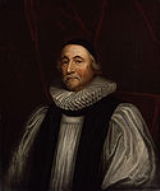
James Ussher

Encyclopedia
James Ussher was Church of Ireland
Archbishop of Armagh
and Primate of All Ireland between 1625–56. He was a prolific scholar, who most famously published a chronology that purported to establish the time and date of the creation as the night preceding Sunday, 23 October 4004 BC, according to the proleptic Julian calendar
.
, into a well-to-do Anglo-Irish
family. His maternal grandfather, James Stanihurst
, had been speaker of the Irish parliament
, and his father Arnold Ussher was a clerk in chancery who married Margaret Stanihurst. Ussher's younger, and only surviving, brother, Ambrose
, became a distinguished scholar of Arabic and Hebrew. According to his chaplain and biographer, Nicholas Bernard
, the elder brother was taught to read by two blind, spinster aunts.
Ussher was a gifted polyglot
, entering Dublin Free School and then the newly-founded (1591) Trinity College, Dublin
on 9 January 1594, at the age of thirteen (not an unusual age at the time). He had received his Bachelor of Arts
degree by 1598, and was a fellow and MA by 1600 (though Bernard claims he did not gain his MA till 1601). In May of 1602, he was ordained in the Trinity College Chapel as a deacon in the Protestant, established
, Church of Ireland
(and possibly priest on the same day) by his uncle Henry Ussher, the Archbishop of Armagh and Primate of All Ireland.
Ussher went on to become Chancellor
of St Patrick's Cathedral, Dublin in 1605 and Prebend
of Finglas
. He became Professor of Theological Controversies at Trinity College and a Bachelor of Divinity in 1607, Doctor of Divinity in 1612, and then Vice-Chancellor in 1615 and vice-provost in 1616. In 1613, he married Phoebe, daughter of a previous Vice-Provost
, Luke Challoner, and published his first work. In 1615, he was closely involved with the drawing up of the first confession of faith
of the Church of Ireland.
, was born in London in 1619. He became prominent after meeting James I
. In 1621, James nominated him Bishop of Meath
. He also became a national figure in Ireland, becoming Privy Councillor in 1623 and an increasingly substantial scholar. A noted collector of Irish manuscripts, he made them available for research to fellow-scholars such as his friend, Sir James Ware
. From 1623 until 1626, he was again in England and was excused from his episcopal duties in order to study church history. He was nominated Primate
of All Ireland and Archbishop of Armagh
in 1625 and succeeded Christopher Hampton.
offered Irish Catholics a series of concessions, including religious toleration, known as the Graces, in exchange for money for the upkeep of the army. Ussher was a convinced Calvinist
and viewed with dismay the possibility that people he regarded as anti-Christian papists might achieve any sort of power. He called a secret meeting of the Irish bishops in his house in November of 1626, the result being the "Judgement of the Arch-Bishops and Bishops of Ireland". This begins:
The Judgement was not published until it was read out at the end of a series of sermons against the Graces given at Dublin in April 1627. In the end, the Graces were not confirmed by the Irish parliament.
During a four-year interregnum between Lord Deputies from 1629 on, there was an increase in efforts to impose religious conformity on Ireland. In 1633, Ussher wrote to the new Archbishop of Canterbury
, William Laud
, in an effort to gain support for the imposition of recusancy
fines on Irish Catholics. Thomas Wentworth, who arrived as the new Lord Deputy in Ireland in 1633, deflected the pressure for conformity by stating that firstly, the Church of Ireland itself would have to be properly resourced, and he set about its re-endowment. He also settled the long-running primacy dispute between the sees of Armagh
and Dublin in Armagh's favour.
Ussher soon found himself at odds with the rise of Arminianism
and Wentworth and Laud's desire for conformity between the Church of England
and the more Calvinistic Church of Ireland
. Ussher resisted this pressure at a convocation
in 1634, ensuring that the English Articles of Religion
were adopted as well as the Irish articles, not instead of them, and that the Irish canons
had to be redrafted based on the English ones rather than replaced by them. Theologically, he was a Calvinist although on the matter of the atonement he was (somewhat privately) a hypothetical universalist. His most significant influence in this regard was John Davenant
, later an English delegate to the Synod of Dort
, who managed to significantly soften that Synod's teaching regarding limited atonement.
In 1633, Ussher had supported the appointment of Archbishop Laud
as Chancellor of Trinity
. He had hoped that Laud would help to impose order on what was, Ussher accepted, a somewhat mismanaged institution. Laud did that, rewriting the charter and statutes to limit the authority of the fellows, and ensure that the appointment of the provost was under royal control. But he also in 1634 imposed on the College an Arminian provost, William Chappell
, whose theological views, and peremptory style of government, were antithetical to all that Ussher stood for. By 1635, it was apparent that Ussher had lost de facto control of the church to John Bramhall
, Bishop of Derry
, in everyday matters, and to Laud in matters of policy.
The traditional view of Ussher is of a slightly-unworldly scholar, who was, at best, a mediocre politician and administrator. In reality he was an effective bishop and archbishop, and politically important; however, he was reactive and sought conciliation rather than confrontation. The story that he successfully opposed attempts to reintroduce the Irish language
for use in church services by William Bedell
, the Bishop of Kilmore
, has been refuted.
Ussher certainly preferred to be a scholar when he could be. He engaged in extensive disputations with Roman Catholic theologians, and even as a student he challenged a Jesuit relative, Henry Fitzsimon
(Ussher's mother was Catholic), to dispute publicly the identification of the Pope
with the Antichrist
. However, Ussher also wrote extensively on theology, patristics and ecclesiastical history, and these subjects gradually displaced his anti-Catholic work. As well as by his learning, he was also distinguished by his charity and good temper.
After Convocation in 1634, Ussher left Dublin for his episcopal residence at Drogheda
, where he concentrated on his archdiocese and his research. In 1631, he had published a Discourse on the Religion Anciently Professed by the Irish, a ground-breaking study of the early Irish church
, which sought to demonstrate how it differed from Rome and was, instead, much closer to the later Protestant church. This was to prove highly influential, establishing the idea that the Church of Ireland was the true successor of the early Celtic church – a belief which persists down to the present day.
In 1639, he published the most substantial history of Christianity in Britain to that date, Britannicarum ecclesiarum antiquitates – the antiquities of the British churches. It was an astonishing achievement in one respect – in gathering together so many previously unpublished manuscript sources. But Ussher was very reluctant to arrive at firm judgements as to the sources' authenticity – hence his devotion of a whole chapter to the imaginative but invented stories of King Lucius and the creation of a Christian episcopate in Britain.
, his reputation as a scholar and his moderate Calvinism meant that his opinion was sought by both King and Parliament. After Ussher lost his home and income through the Irish uprising
of 1641, Parliament voted him a pension of £400 while the King awarded him the income and property of the vacant See of Carlisle.
In early 1641 Ussher developed a mediatory position on church government, which sought to bridge the gap between the Laudians, who believed that bishops were divinely ordained and a separate order from priests and deacons, and the presbyterians, who wanted to abolish episcopacy entirely. His proposals, not published until 1656, after his death, as The Reduction of Episcopacy, proposed a compromise where bishops operated in a presbyterian synodal system, were initially designed to support a rapprochement between Charles and the parliamentarian leadership in 1641, but were rejected by the King. They did, however, have an afterlife, being published in England and Scotland well into the eighteenth century. In all, he wrote or edited five books relating to episcopacy; the last two, treatises on the Ignatian
epistles, were particular scholarly achievements that have largely survived modern scrutiny.
As the middle ground between King and Parliament vanished in 1641-2, Ussher was forced, reluctantly, to choose between his godly Calvinist allies in parliament and his instinctive loyalty to the monarchy. Eventually, in January 1642 (having asked parliament's permission), he moved to Oxford, a royalist stronghold. Though Charles severely tested Ussher's loyalty by negotiating with the Catholic Irish rebels, the Primate remained committed to the royal cause, though as king's fortunes waned Ussher had to move on to Bristol
, Cardiff
, and then to St Donat's
. In June of 1646, he returned to London under the protection of his friend, the Countess of Peterborough
, in whose houses he stayed from then on. He became a preacher at Lincoln's Inn
early in 1647, and despite his royalist loyalties was protected by his friends in Parliament. He watched the execution of Charles I from the roof of the Countess of Peterborough's London house but fainted before the axe fell.
. After a 1647 work on the origin of the Creed
s, Ussher published a treatise on the calendar in 1648. This was a warm-up for his most famous work, the Annales veteris testamenti, a prima mundi origine deducti ("Annals of the Old Testament, deduced from the first origins of the world"), which appeared in 1650, and its continuation, Annalium pars postierior, published in 1654. In this work, he calculated the date of the Creation to have been nightfall preceding 23 October 4004 BC. (Other scholars, such as Cambridge
academic, John Lightfoot
, calculated their own dates for the Creation.) The time of the Ussher chronology is frequently misquoted as being 9 a.m., noon or 9 p.m. on 23 October. See the related article on the chronology for a discussion of its claims and methodology.
Ussher's work is sometimes associated with Young Earth Creationism
, which holds that the universe was created, not millions of years ago, but thousands. But while calculating the date of the Creation is today in some circles considered a controversial activity, in Ussher's time such a calculation was still regarded as an important task, one previously attempted by many Post-Reformation scholars, such as Joseph Justus Scaliger
and physicist Isaac Newton
.
Ussher's chronology represented a considerable feat of scholarship: it demanded great depth of learning in what was then known of ancient history, including the rise of the Persians, Greeks and Romans, as well as expertise in the bible, biblical languages, astronomy, ancient calendars and chronology, Ussher's account of historical events for which he had multiple sources other than the Bible is usually in close agreement with modern accounts – for example, he placed the death of Alexander in 323 BC and that of Julius Caesar
in 44 BC.
But Ussher's last extra-biblical coordinate was the Babylonian king Nebuchadnezzar, and beyond this point he had to rely on other considerations. Faced with inconsistent texts of the Torah, each with a different number of years between Flood and Creation, Ussher chose the Masoretic version. Partly his reasons were sound scholarly ones – the Masoretic text claims an unbroken history of careful transcription stretching back centuries – but his choice was confirmed for him because it placed Creation exactly four thousand years before 4 BC, the generally accepted date for the birth of Christ; moreover, he calculated, Solomon’s temple was completed in the year 3000 from creation, so that there were exactly 1000 years from the temple to Christ, who was the fulfilment of the Temple.
, Surrey
. On 19 March, he felt a sharp pain in his side after supper and took to his bed with what sounds like an internal haemorrhage. He died at one o'clock on 21 March at the age of 75. His last words were reported as O Lord forgive me, especially my sins of omission. His body was embalmed and was to have been buried in Reigate, but at Cromwell
's insistence he was given a state funeral on 17 April and buried in the chapel of St Erasmus in Westminster Abbey
.
Church of Ireland
The Church of Ireland is an autonomous province of the Anglican Communion. The church operates in all parts of Ireland and is the second largest religious body on the island after the Roman Catholic Church...
Archbishop of Armagh
Archbishop of Armagh (Church of Ireland)
The Anglican Archbishop of Armagh is the ecclesiastical head of the Church of Ireland, the metropolitan of the Province of Armagh and the diocesan bishop of the Diocese of Armagh....
and Primate of All Ireland between 1625–56. He was a prolific scholar, who most famously published a chronology that purported to establish the time and date of the creation as the night preceding Sunday, 23 October 4004 BC, according to the proleptic Julian calendar
Proleptic Julian calendar
The proleptic Julian calendar is produced by extending the Julian calendar to dates preceding AD 4 when its quadrennial leap year stabilized. The leap years actually observed between its official implementation in 45 BC and AD 4 were erratic, see the Julian calendar article for details.A calendar...
.
Education
Ussher was born in Dublin, IrelandIreland
Ireland is an island to the northwest of continental Europe. It is the third-largest island in Europe and the twentieth-largest island on Earth...
, into a well-to-do Anglo-Irish
Anglo-Irish
Anglo-Irish was a term used primarily in the 19th and early 20th centuries to identify a privileged social class in Ireland, whose members were the descendants and successors of the Protestant Ascendancy, mostly belonging to the Church of Ireland, which was the established church of Ireland until...
family. His maternal grandfather, James Stanihurst
James Stanihurst
James Stanihurst was for three terms Speaker of the Irish House of Commons. He was also the first to hold the position of Recorder of Dublin.-Life:...
, had been speaker of the Irish parliament
Irish House of Commons
The Irish House of Commons was the lower house of the Parliament of Ireland, that existed from 1297 until 1800. The upper house was the House of Lords...
, and his father Arnold Ussher was a clerk in chancery who married Margaret Stanihurst. Ussher's younger, and only surviving, brother, Ambrose
Ambrose Ussher
Ambrose Ussher was an Irish Protestant clergyman and scholar, a fellow of Trinity College, Dublin and rector in the Church of Ireland, known as a biblical translator.-Life:...
, became a distinguished scholar of Arabic and Hebrew. According to his chaplain and biographer, Nicholas Bernard
Nicholas Bernard
Nicholas Bernard was an English clergyman and pamphleteer. A dean in Ireland at the time of the Rebellion of 1641, he wrote descriptions of current events. He was also the biographer of James Ussher.-Life:...
, the elder brother was taught to read by two blind, spinster aunts.
Ussher was a gifted polyglot
Polyglot (person)
A polyglot is someone with a high degree of proficiency in several languages. A bilingual person can speak two languages fluently, whereas a trilingual three; above that the term multilingual may be used.-Hyperpolyglot:...
, entering Dublin Free School and then the newly-founded (1591) Trinity College, Dublin
Trinity College, Dublin
Trinity College, Dublin , formally known as the College of the Holy and Undivided Trinity of Queen Elizabeth near Dublin, was founded in 1592 by letters patent from Queen Elizabeth I as the "mother of a university", Extracts from Letters Patent of Elizabeth I, 1592: "...we...found and...
on 9 January 1594, at the age of thirteen (not an unusual age at the time). He had received his Bachelor of Arts
Bachelor of Arts
A Bachelor of Arts , from the Latin artium baccalaureus, is a bachelor's degree awarded for an undergraduate course or program in either the liberal arts, the sciences, or both...
degree by 1598, and was a fellow and MA by 1600 (though Bernard claims he did not gain his MA till 1601). In May of 1602, he was ordained in the Trinity College Chapel as a deacon in the Protestant, established
State religion
A state religion is a religious body or creed officially endorsed by the state...
, Church of Ireland
Church of Ireland
The Church of Ireland is an autonomous province of the Anglican Communion. The church operates in all parts of Ireland and is the second largest religious body on the island after the Roman Catholic Church...
(and possibly priest on the same day) by his uncle Henry Ussher, the Archbishop of Armagh and Primate of All Ireland.
Ussher went on to become Chancellor
Chancellor (ecclesiastical)
Two quite distinct officials of some Christian churches have the title Chancellor.*In some churches, the Chancellor of a diocese is a lawyer who represents the church in legal matters....
of St Patrick's Cathedral, Dublin in 1605 and Prebend
Prebendary
A prebendary is a post connected to an Anglican or Catholic cathedral or collegiate church and is a type of canon. Prebendaries have a role in the administration of the cathedral...
of Finglas
Finglas
-See also:* List of towns and villages in Ireland* List of abbeys and priories in Ireland...
. He became Professor of Theological Controversies at Trinity College and a Bachelor of Divinity in 1607, Doctor of Divinity in 1612, and then Vice-Chancellor in 1615 and vice-provost in 1616. In 1613, he married Phoebe, daughter of a previous Vice-Provost
Provost (education)
A provost is the senior academic administrator at many institutions of higher education in the United States, Canada and Australia, the equivalent of a pro-vice-chancellor at some institutions in the United Kingdom and Ireland....
, Luke Challoner, and published his first work. In 1615, he was closely involved with the drawing up of the first confession of faith
Confession of Faith
A Confession of Faith is a statement of doctrine very similar to a creed, but usually longer and polemical, as well as didactic.Confessions of Faith are in the main, though not exclusively, associated with Protestantism...
of the Church of Ireland.
Early career
In 1619, Ussher travelled to England, where he remained for two years. His only child, ElizabethElizabeth Tyrrell (nee Ussher)
Elizabeth Tyrrell, daughter of James Ussher, Anglican Archbishop of Armagh and Primate of All Ireland, and Phoebe Ussher was born in London in 1619. Around 1653 she married Sir Timothy Tyrrell, of Oakley, Buckinghamshire. They later moved from Oakley to Shotover...
, was born in London in 1619. He became prominent after meeting James I
James I of England
James VI and I was King of Scots as James VI from 24 July 1567 and King of England and Ireland as James I from the union of the English and Scottish crowns on 24 March 1603...
. In 1621, James nominated him Bishop of Meath
Bishop of Meath
The Bishop of Meath is an episcopal title which takes its name after the ancient Kingdom of Meath. In the Roman Catholic Church it remains as a separate title, but in the Church of Ireland it has been united with another bishopric.-History:...
. He also became a national figure in Ireland, becoming Privy Councillor in 1623 and an increasingly substantial scholar. A noted collector of Irish manuscripts, he made them available for research to fellow-scholars such as his friend, Sir James Ware
Sir James Ware
Sir James Ware was an Irish historian.-Early life:Born at Castle Street, Dublin, Ware was the eldest son of James Ware, who arrived in Ireland in 1588 as a secretary to Lord Deputy FitzWilliam. His father was knighted by King James I, was elected M.P...
. From 1623 until 1626, he was again in England and was excused from his episcopal duties in order to study church history. He was nominated Primate
Primate (religion)
Primate is a title or rank bestowed on some bishops in certain Christian churches. Depending on the particular tradition, it can denote either jurisdictional authority or ceremonial precedence ....
of All Ireland and Archbishop of Armagh
Archbishop of Armagh (Church of Ireland)
The Anglican Archbishop of Armagh is the ecclesiastical head of the Church of Ireland, the metropolitan of the Province of Armagh and the diocesan bishop of the Diocese of Armagh....
in 1625 and succeeded Christopher Hampton.
Primate of All Ireland
After his consecration in 1626, Ussher found himself in turbulent political times. Tension was rising between England and Spain, and to secure Ireland Charles ICharles I of England
Charles I was King of England, King of Scotland, and King of Ireland from 27 March 1625 until his execution in 1649. Charles engaged in a struggle for power with the Parliament of England, attempting to obtain royal revenue whilst Parliament sought to curb his Royal prerogative which Charles...
offered Irish Catholics a series of concessions, including religious toleration, known as the Graces, in exchange for money for the upkeep of the army. Ussher was a convinced Calvinist
Calvinism
Calvinism is a Protestant theological system and an approach to the Christian life...
and viewed with dismay the possibility that people he regarded as anti-Christian papists might achieve any sort of power. He called a secret meeting of the Irish bishops in his house in November of 1626, the result being the "Judgement of the Arch-Bishops and Bishops of Ireland". This begins:
The Judgement was not published until it was read out at the end of a series of sermons against the Graces given at Dublin in April 1627. In the end, the Graces were not confirmed by the Irish parliament.
During a four-year interregnum between Lord Deputies from 1629 on, there was an increase in efforts to impose religious conformity on Ireland. In 1633, Ussher wrote to the new Archbishop of Canterbury
Archbishop of Canterbury
The Archbishop of Canterbury is the senior bishop and principal leader of the Church of England, the symbolic head of the worldwide Anglican Communion, and the diocesan bishop of the Diocese of Canterbury. In his role as head of the Anglican Communion, the archbishop leads the third largest group...
, William Laud
William Laud
William Laud was Archbishop of Canterbury from 1633 to 1645. One of the High Church Caroline divines, he opposed radical forms of Puritanism...
, in an effort to gain support for the imposition of recusancy
Recusancy
In the history of England and Wales, the recusancy was the state of those who refused to attend Anglican services. The individuals were known as "recusants"...
fines on Irish Catholics. Thomas Wentworth, who arrived as the new Lord Deputy in Ireland in 1633, deflected the pressure for conformity by stating that firstly, the Church of Ireland itself would have to be properly resourced, and he set about its re-endowment. He also settled the long-running primacy dispute between the sees of Armagh
Armagh
Armagh is a large settlement in Northern Ireland, and the county town of County Armagh. It is a site of historical importance for both Celtic paganism and Christianity and is the seat, for both the Roman Catholic Church and the Church of Ireland, of the Archbishop of Armagh...
and Dublin in Armagh's favour.
Ussher soon found himself at odds with the rise of Arminianism
Arminianism
Arminianism is a school of soteriological thought within Protestant Christianity based on the theological ideas of the Dutch Reformed theologian Jacobus Arminius and his historic followers, the Remonstrants...
and Wentworth and Laud's desire for conformity between the Church of England
Church of England
The Church of England is the officially established Christian church in England and the Mother Church of the worldwide Anglican Communion. The church considers itself within the tradition of Western Christianity and dates its formal establishment principally to the mission to England by St...
and the more Calvinistic Church of Ireland
Church of Ireland
The Church of Ireland is an autonomous province of the Anglican Communion. The church operates in all parts of Ireland and is the second largest religious body on the island after the Roman Catholic Church...
. Ussher resisted this pressure at a convocation
Convocation
A Convocation is a group of people formally assembled for a special purpose.- University use :....
in 1634, ensuring that the English Articles of Religion
Thirty-Nine Articles
The Thirty-Nine Articles of Religion are the historically defining statements of doctrines of the Anglican church with respect to the controversies of the English Reformation. First established in 1563, the articles served to define the doctrine of the nascent Church of England as it related to...
were adopted as well as the Irish articles, not instead of them, and that the Irish canons
Canon law
Canon law is the body of laws & regulations made or adopted by ecclesiastical authority, for the government of the Christian organization and its members. It is the internal ecclesiastical law governing the Catholic Church , the Eastern and Oriental Orthodox churches, and the Anglican Communion of...
had to be redrafted based on the English ones rather than replaced by them. Theologically, he was a Calvinist although on the matter of the atonement he was (somewhat privately) a hypothetical universalist. His most significant influence in this regard was John Davenant
John Davenant
John Davenant was an English academic and bishop of Salisbury from 1621.-Life:He was educated at Queens’ College, Cambridge, elected a fellow there in 1597, and was its President from 1614 to 1621...
, later an English delegate to the Synod of Dort
Synod of Dort
The Synod of Dort was a National Synod held in Dordrecht in 1618-1619, by the Dutch Reformed Church, to settle a divisive controversy initiated by the rise of Arminianism. The first meeting was on November 13, 1618, and the final meeting, the 154th, was on May 9, 1619...
, who managed to significantly soften that Synod's teaching regarding limited atonement.
In 1633, Ussher had supported the appointment of Archbishop Laud
William Laud
William Laud was Archbishop of Canterbury from 1633 to 1645. One of the High Church Caroline divines, he opposed radical forms of Puritanism...
as Chancellor of Trinity
Trinity College, Dublin
Trinity College, Dublin , formally known as the College of the Holy and Undivided Trinity of Queen Elizabeth near Dublin, was founded in 1592 by letters patent from Queen Elizabeth I as the "mother of a university", Extracts from Letters Patent of Elizabeth I, 1592: "...we...found and...
. He had hoped that Laud would help to impose order on what was, Ussher accepted, a somewhat mismanaged institution. Laud did that, rewriting the charter and statutes to limit the authority of the fellows, and ensure that the appointment of the provost was under royal control. But he also in 1634 imposed on the College an Arminian provost, William Chappell
William Chappell (bishop)
William Chappell was an English scholar and clergyman. He became Church of Ireland bishop of Cork and Ross.-Academic:...
, whose theological views, and peremptory style of government, were antithetical to all that Ussher stood for. By 1635, it was apparent that Ussher had lost de facto control of the church to John Bramhall
John Bramhall
John Bramhall was an Archbishop of Armagh, and an Anglican theologian and apologist. He was a noted controversialist who doggedly defended the English Church from both Puritan and Roman Catholic accusations, as well as the materialism of Thomas Hobbes.-Early life:Bramhall was born in Pontefract,...
, Bishop of Derry
Derry
Derry or Londonderry is the second-biggest city in Northern Ireland and the fourth-biggest city on the island of Ireland. The name Derry is an anglicisation of the Irish name Doire or Doire Cholmcille meaning "oak-wood of Colmcille"...
, in everyday matters, and to Laud in matters of policy.
The traditional view of Ussher is of a slightly-unworldly scholar, who was, at best, a mediocre politician and administrator. In reality he was an effective bishop and archbishop, and politically important; however, he was reactive and sought conciliation rather than confrontation. The story that he successfully opposed attempts to reintroduce the Irish language
Irish language
Irish , also known as Irish Gaelic, is a Goidelic language of the Indo-European language family, originating in Ireland and historically spoken by the Irish people. Irish is now spoken as a first language by a minority of Irish people, as well as being a second language of a larger proportion of...
for use in church services by William Bedell
William Bedell
William Bedell was an Anglican churchman.-Early life:He was born at Black Notley in Essex, and educated at Emmanuel College, Cambridge, where he was a pupil of William Perkins. He became a fellow of Emmanuel in 1593, and took orders...
, the Bishop of Kilmore
Kilmore
-Places:Australia*Kilmore, VictoriaNorthern Ireland*Kilmore, County Armagh, a village and townland in County Armagh, Northern Ireland*Kilmore, County Down, a village, parish and townland in County Down, Northern Ireland*Kilmore, County Tyrone...
, has been refuted.
Ussher certainly preferred to be a scholar when he could be. He engaged in extensive disputations with Roman Catholic theologians, and even as a student he challenged a Jesuit relative, Henry Fitzsimon
Henry Fitzsimon
Henry Fitzsimon was an Irish Jesuit controversialist.-Life:He was educated a Protestant at Oxford , 1583-1587...
(Ussher's mother was Catholic), to dispute publicly the identification of the Pope
Pope
The Pope is the Bishop of Rome, a position that makes him the leader of the worldwide Catholic Church . In the Catholic Church, the Pope is regarded as the successor of Saint Peter, the Apostle...
with the Antichrist
Antichrist
The term or title antichrist, in Christian theology, refers to a leader who fulfills Biblical prophecies concerning an adversary of Christ, while resembling him in a deceptive manner...
. However, Ussher also wrote extensively on theology, patristics and ecclesiastical history, and these subjects gradually displaced his anti-Catholic work. As well as by his learning, he was also distinguished by his charity and good temper.
After Convocation in 1634, Ussher left Dublin for his episcopal residence at Drogheda
Drogheda
Drogheda is an industrial and port town in County Louth on the east coast of Ireland, 56 km north of Dublin. It is the last bridging point on the River Boyne before it enters the Irish Sea....
, where he concentrated on his archdiocese and his research. In 1631, he had published a Discourse on the Religion Anciently Professed by the Irish, a ground-breaking study of the early Irish church
Celtic Christianity
Celtic Christianity or Insular Christianity refers broadly to certain features of Christianity that were common, or held to be common, across the Celtic-speaking world during the Early Middle Ages...
, which sought to demonstrate how it differed from Rome and was, instead, much closer to the later Protestant church. This was to prove highly influential, establishing the idea that the Church of Ireland was the true successor of the early Celtic church – a belief which persists down to the present day.
In 1639, he published the most substantial history of Christianity in Britain to that date, Britannicarum ecclesiarum antiquitates – the antiquities of the British churches. It was an astonishing achievement in one respect – in gathering together so many previously unpublished manuscript sources. But Ussher was very reluctant to arrive at firm judgements as to the sources' authenticity – hence his devotion of a whole chapter to the imaginative but invented stories of King Lucius and the creation of a Christian episcopate in Britain.
English Civil War
In 1640, Ussher left Ireland for England for what turned out to be the last time. In the years before the English Civil WarEnglish Civil War
The English Civil War was a series of armed conflicts and political machinations between Parliamentarians and Royalists...
, his reputation as a scholar and his moderate Calvinism meant that his opinion was sought by both King and Parliament. After Ussher lost his home and income through the Irish uprising
Irish Rebellion of 1641
The Irish Rebellion of 1641 began as an attempted coup d'état by Irish Catholic gentry, who tried to seize control of the English administration in Ireland to force concessions for the Catholics living under English rule...
of 1641, Parliament voted him a pension of £400 while the King awarded him the income and property of the vacant See of Carlisle.
In early 1641 Ussher developed a mediatory position on church government, which sought to bridge the gap between the Laudians, who believed that bishops were divinely ordained and a separate order from priests and deacons, and the presbyterians, who wanted to abolish episcopacy entirely. His proposals, not published until 1656, after his death, as The Reduction of Episcopacy, proposed a compromise where bishops operated in a presbyterian synodal system, were initially designed to support a rapprochement between Charles and the parliamentarian leadership in 1641, but were rejected by the King. They did, however, have an afterlife, being published in England and Scotland well into the eighteenth century. In all, he wrote or edited five books relating to episcopacy; the last two, treatises on the Ignatian
Ignatius of Antioch
Ignatius of Antioch was among the Apostolic Fathers, was the third Bishop of Antioch, and was a student of John the Apostle. En route to his martyrdom in Rome, Ignatius wrote a series of letters which have been preserved as an example of very early Christian theology...
epistles, were particular scholarly achievements that have largely survived modern scrutiny.
As the middle ground between King and Parliament vanished in 1641-2, Ussher was forced, reluctantly, to choose between his godly Calvinist allies in parliament and his instinctive loyalty to the monarchy. Eventually, in January 1642 (having asked parliament's permission), he moved to Oxford, a royalist stronghold. Though Charles severely tested Ussher's loyalty by negotiating with the Catholic Irish rebels, the Primate remained committed to the royal cause, though as king's fortunes waned Ussher had to move on to Bristol
Bristol
Bristol is a city, unitary authority area and ceremonial county in South West England, with an estimated population of 433,100 for the unitary authority in 2009, and a surrounding Larger Urban Zone with an estimated 1,070,000 residents in 2007...
, Cardiff
Cardiff
Cardiff is the capital, largest city and most populous county of Wales and the 10th largest city in the United Kingdom. The city is Wales' chief commercial centre, the base for most national cultural and sporting institutions, the Welsh national media, and the seat of the National Assembly for...
, and then to St Donat's
St Donat's Castle
St Donat's Castle is a medieval castle in the Vale of Glamorgan, Wales, overlooking the Bristol Channel in the village of St Donat's near Llantwit Major, and about 25km west of Cardiff...
. In June of 1646, he returned to London under the protection of his friend, the Countess of Peterborough
Peterborough
Peterborough is a cathedral city and unitary authority area in the East of England, with an estimated population of in June 2007. For ceremonial purposes it is in the county of Cambridgeshire. Situated north of London, the city stands on the River Nene which flows into the North Sea...
, in whose houses he stayed from then on. He became a preacher at Lincoln's Inn
Lincoln's Inn
The Honourable Society of Lincoln's Inn is one of four Inns of Court in London to which barristers of England and Wales belong and where they are called to the Bar. The other three are Middle Temple, Inner Temple and Gray's Inn. Although Lincoln's Inn is able to trace its official records beyond...
early in 1647, and despite his royalist loyalties was protected by his friends in Parliament. He watched the execution of Charles I from the roof of the Countess of Peterborough's London house but fainted before the axe fell.
Chronology
Ussher now concentrated on his research and writing and returned to the study of chronology and the church fathersChurch Fathers
The Church Fathers, Early Church Fathers, Christian Fathers, or Fathers of the Church were early and influential theologians, eminent Christian teachers and great bishops. Their scholarly works were used as a precedent for centuries to come...
. After a 1647 work on the origin of the Creed
Creed
A creed is a statement of belief—usually a statement of faith that describes the beliefs shared by a religious community—and is often recited as part of a religious service. When the statement of faith is longer and polemical, as well as didactic, it is not called a creed but a Confession of faith...
s, Ussher published a treatise on the calendar in 1648. This was a warm-up for his most famous work, the Annales veteris testamenti, a prima mundi origine deducti ("Annals of the Old Testament, deduced from the first origins of the world"), which appeared in 1650, and its continuation, Annalium pars postierior, published in 1654. In this work, he calculated the date of the Creation to have been nightfall preceding 23 October 4004 BC. (Other scholars, such as Cambridge
University of Cambridge
The University of Cambridge is a public research university located in Cambridge, United Kingdom. It is the second-oldest university in both the United Kingdom and the English-speaking world , and the seventh-oldest globally...
academic, John Lightfoot
John Lightfoot
John Lightfoot was an English churchman, rabbinical scholar, Vice-Chancellor of the University of Cambridge and Master of St Catharine's College, Cambridge.-Life:...
, calculated their own dates for the Creation.) The time of the Ussher chronology is frequently misquoted as being 9 a.m., noon or 9 p.m. on 23 October. See the related article on the chronology for a discussion of its claims and methodology.
Ussher's work is sometimes associated with Young Earth Creationism
Young Earth creationism
Young Earth creationism is the religious belief that Heavens, Earth, and all life on Earth were created by direct acts of the Abrahamic God during a relatively short period, sometime between 5,700 and 10,000 years ago...
, which holds that the universe was created, not millions of years ago, but thousands. But while calculating the date of the Creation is today in some circles considered a controversial activity, in Ussher's time such a calculation was still regarded as an important task, one previously attempted by many Post-Reformation scholars, such as Joseph Justus Scaliger
Joseph Justus Scaliger
Joseph Justus Scaliger was a French religious leader and scholar, known for expanding the notion of classical history from Greek and Ancient Roman history to include Persian, Babylonian, Jewish and Ancient Egyptian history.-Early life:He was born at Agen, the tenth child and third son of Italian...
and physicist Isaac Newton
Isaac Newton
Sir Isaac Newton PRS was an English physicist, mathematician, astronomer, natural philosopher, alchemist, and theologian, who has been "considered by many to be the greatest and most influential scientist who ever lived."...
.
Ussher's chronology represented a considerable feat of scholarship: it demanded great depth of learning in what was then known of ancient history, including the rise of the Persians, Greeks and Romans, as well as expertise in the bible, biblical languages, astronomy, ancient calendars and chronology, Ussher's account of historical events for which he had multiple sources other than the Bible is usually in close agreement with modern accounts – for example, he placed the death of Alexander in 323 BC and that of Julius Caesar
Julius Caesar
Gaius Julius Caesar was a Roman general and statesman and a distinguished writer of Latin prose. He played a critical role in the gradual transformation of the Roman Republic into the Roman Empire....
in 44 BC.
But Ussher's last extra-biblical coordinate was the Babylonian king Nebuchadnezzar, and beyond this point he had to rely on other considerations. Faced with inconsistent texts of the Torah, each with a different number of years between Flood and Creation, Ussher chose the Masoretic version. Partly his reasons were sound scholarly ones – the Masoretic text claims an unbroken history of careful transcription stretching back centuries – but his choice was confirmed for him because it placed Creation exactly four thousand years before 4 BC, the generally accepted date for the birth of Christ; moreover, he calculated, Solomon’s temple was completed in the year 3000 from creation, so that there were exactly 1000 years from the temple to Christ, who was the fulfilment of the Temple.
Death
In 1655, Ussher published his last book, De Graeca Septuaginta Interpretum Versione, the first serious examination of the Septuagint, discussing its accuracy as compared with the Hebrew text of the Old Testament. In 1656, he went to stay in the Countess of Peterborough's house in ReigateReigate
Reigate is a historic market town in Surrey, England, at the foot of the North Downs, and in the London commuter belt. It is one of the main constituents of the Borough of Reigate and Banstead...
, Surrey
Surrey
Surrey is a county in the South East of England and is one of the Home Counties. The county borders Greater London, Kent, East Sussex, West Sussex, Hampshire and Berkshire. The historic county town is Guildford. Surrey County Council sits at Kingston upon Thames, although this has been part of...
. On 19 March, he felt a sharp pain in his side after supper and took to his bed with what sounds like an internal haemorrhage. He died at one o'clock on 21 March at the age of 75. His last words were reported as O Lord forgive me, especially my sins of omission. His body was embalmed and was to have been buried in Reigate, but at Cromwell
Oliver Cromwell
Oliver Cromwell was an English military and political leader who overthrew the English monarchy and temporarily turned England into a republican Commonwealth, and served as Lord Protector of England, Scotland, and Ireland....
's insistence he was given a state funeral on 17 April and buried in the chapel of St Erasmus in Westminster Abbey
Westminster Abbey
The Collegiate Church of St Peter at Westminster, popularly known as Westminster Abbey, is a large, mainly Gothic church, in the City of Westminster, London, United Kingdom, located just to the west of the Palace of Westminster. It is the traditional place of coronation and burial site for English,...
.
Reputation
The fact that Cromwell was content to allow an Anglican bishop to be buried in Westminster is a clear indication of the respect in which Ussher was held, even by those who were theologically opposed to him. And indeed, after his death Ussher's reputation as a saintly scholar ensured that his posthumous endorsement was sought by a wide range of writers and ecclesiastical leaders, from the seventeenth century nonconformists to the nineteenth century Oxford movement. His scholarly achievements remain considerable – his work in sorting out the genuine from the spurious letters of Ignatius was a milestone in the study of that important early-church father; and his pioneering gathering of sources relating to early Irish church history laid the foundation for much subsequent research. Even his efforts to identify the date of creation, often derided these days, gathered together the most up to date scientific, chronological, historical and biblical scholarship in an impressive synthesis.See also
- Tadhg Og Ó Cianáin
- Peregrine Ó Duibhgeannain
- Lughaidh Ó CléirighLughaidh Ó CléirighLughaidh Ó Cléirigh , sometimes anglicised as Lewey O'Clery, was an Irish Gaelic poet and historian. He is best known today as the author of Beatha Aodha Ruaidh Uí Dhomhnaill, a biography of Red Hugh O'Donnell.-Life:...
- Mícheál Ó CléirighMícheál Ó CléirighMícheál Ó Cléirigh , sometimes known as Michael O'Clery, was an Irish chronicler, scribe and antiquary and chief author of the Annals of the Four Masters, assisted by Cú Choigcríche Ó Cléirigh, Fearfeasa Ó Maol Chonaire, and Peregrinus Ó Duibhgeannain.-Background and early life:Grandson of Tuathal...
- Sir James WareSir James WareSir James Ware was an Irish historian.-Early life:Born at Castle Street, Dublin, Ware was the eldest son of James Ware, who arrived in Ireland in 1588 as a secretary to Lord Deputy FitzWilliam. His father was knighted by King James I, was elected M.P...
- Mary Bonaventure BrowneMary Bonaventure BrowneMother Mary Bonaventure Browne, Poor Clare and Irish historian, born after 1610, died after 1670.-Background:A daughter of Andrew Browne fitz Oliver, a wealthy merchant and a member of The Tribes of Galway. She was a niece of Martin Browne, whose townhouse doorway, the Browne doorway, now stands in...
- Dubhaltach Mac FhirbhisighDubhaltach Mac FhirbhisighDubhaltach MacFhirbhisigh, also known as Dubhaltach Óg mac Giolla Íosa Mór mac Dubhaltach Mór Mac Fhirbhisigh, Duald Mac Firbis, Dudly Ferbisie, and Dualdus Firbissius was an Irish scribe, translator, historian and genealogist...
- Ruaidhrí Ó FlaithbheartaighRuaidhri Ó FlaithbheartaighRuaidhri Ó Flaithbheartaigh, King of Iar Connacht and Chief of the Name, fl. 1244-1273.-Biography:Ruaidhri was a brother of the preceding chief, Morogh...
- Uilliam Ó DuinnínUilliam Ó DuinnínUilliam Ó Duinnín was an Irish scribe.The son of Domhnall Óg Ó Duinnín, Uilliam was the owner of MS 1336, which he may have sold to Edward Lhuyd...
- Charles O'Conor (historian)Charles O'Conor (historian)Charles O'Conor Don, The O'Conor Don, Prince of Connacht of Belanagare was an Irish writer and antiquarian who was enormously influential as a protagonist for the preservation of Irish culture and history in the eighteenth century...
- Eugene O'CurryEugene O'Curry-Life:He was born at Doonaha, near Carrigaholt, County Clare, the son of Eoghan Ó Comhraí, a farmer, and his wife Cáit. Eoghan had spent some time as a travelling pedlar and had developed an interest in Irish folklore and music. Unusually for someone of his background, he appears to have been...
- John O'Donovan (scholar)John O'Donovan (scholar)John O'Donovan , from Atateemore, in the parish of Kilcolumb, County Kilkenny, and educated at Hunt's Academy, Waterford, was an Irish language scholar from Ireland.-Life:...
Further reading
- Alan Ford, Ussher, James (1581–1656), Oxford Dictionary of National Biography, Oxford University Press (2004)
- Alan Ford, James Ussher: Theology, History, and Politics in early-modern Ireland and England Oxford University Press (2007)
External links
- Ussher bibliography and list of secondary sources
- Bishop Ussher Dates the World: 4004 BC (Lockhaven University)
- Armagh Observatory-James Ussar
- The Ussher Project at Trinity College, DublinTrinity College, DublinTrinity College, Dublin , formally known as the College of the Holy and Undivided Trinity of Queen Elizabeth near Dublin, was founded in 1592 by letters patent from Queen Elizabeth I as the "mother of a university", Extracts from Letters Patent of Elizabeth I, 1592: "...we...found and...