

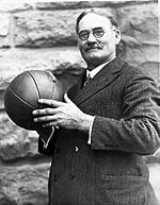
James Naismith

Encyclopedia
The first game of "Basket Ball" was played in December 1891. In a handwritten report, Naismith described the circumstances of the inaugural match; in contrast to modern basketball
, the players played nine versus nine, handled a soccer ball, not a basketball, and instead of shooting at two hoops, the goals were a pair of peach baskets: "When Mr. Stubbins brot [sic
] up the peach baskets to the gym I secured them on the inside of the railing of the gallery. This was about 10 feet from the floor, one at each end of the gymnasium. I then put the 13 rules on the bulletin board just behind the instructor's platform, secured a soccer ball and awaited the arrival of the class... The class did not show much enthusiasm but followed my lead... I then explained what they had to do to make goals, tossed the ball up between the two center men & tried to keep them somewhat near the rules. Most of the fouls were called for running with the ball, though tackling the man with the ball was not uncommon." In contrast to modern basketball
, the original rules did not include what is known today as the dribble
. Since the ball could only be moved up the court via a pass early players tossed the ball over their heads as they ran up court. Also, following each "goal" a jump ball
was taken in the middle of the court. Both practices are obsolete in the rules of modern basketball
.
By 1892, basketball had grown so popular on campus that Dennis Horkenbach (editor-in-chief of The Triangle, the Springfield college newspaper) featured it in an article called "A New Game", and there were calls to call this new game "Naismith Ball", but Naismith refused. By 1893, basketball was introduced internationally by the YMCA
movement. From Springfield, Naismith went to Denver where he acquired a medical degree and in 1898 he joined the University of Kansas
faculty at Lawrence, Kansas
after coaching at Baker University
.
There is some evidence that Dr. Naismith borrowed components for the game of basketball from Lambert G. Will. This evidence disputes the claim that Dr. Naismith was the sole inventor of the game. A team photo shows Will's team with a dated basketball before Naismith's claim of having the first game.
men's basketball program officially began in 1898, following Naismith's arrival, just six years after Naismith penned the sport's first official rules. Naismith was not initially hired to coach basketball, but rather as a chapel director and physical education instructor. In these early days, the majority of the basketball games were played against nearby YMCA
teams, with YMCA's across the nation having played an integral part in the birth of basketball. Other common opponents were Haskell Indian Nations University
and William Jewell College
. Under Naismith, the team played only two current Big 12 schools: Missouri (twice) and Kansas State (once). Naismith was, ironically, the only coach in the program's history to have a losing record (55–60). However, Naismith coached Forrest "Phog" Allen
, his eventual successor at Kansas, who went on to join his mentor in the Naismith Memorial Basketball Hall of Fame. When Allen became a coach himself and told him that he was going to coach basketball at Baker University
in 1904, Naismith discouraged him: "You can't coach basketball; you just play it." Instead, Allen embarked on a coaching career that would lead him to be known as "the Father of Basketball Coaching." During his time at Kansas, Allen coached Dean Smith
(1952 National Championship team) and Adolph Rupp
(1922 Helms Foundation National Championship team). When Dean Smith retired as head Basketball coach at North Carolina he was the winningest coach in college basketball history, #2 was Adolph Rupp (Kentucky) and #3 was Allen. The three coaches have joined Naismith as members of the Basketball Hall of Fame.
By the turn of the century, there were enough college teams in the East of the U.S. that the first intercollegiate competitions could be played out. Although his sport continuously grew, Naismith long regarded his game as a curiosity and preferred gymnastics and wrestling
as better forms of physical education. However, basketball became a demonstration sport
at the 1904 Games
in St. Louis, USA
. As the Naismith Memorial Basketball Hall of Fame reports, Naismith was also neither interested in self-promotion nor in the glory of competitive sports. Instead, he was more interested in his physical education career, receiving an honorary PE Masters degree in 1910, patrolled the Mexican border for four months in 1916 during World War I
, travelled to France, published two books ("A Modern College" in 1911 and "Essence of a Healthy Life" in 1918) and took on American citizenship in 1925.
In 1935, the National Association of Basketball Coaches
(created by Naismith's pupil Phog Allen) collected money so that the 74-year old Naismith could witness the introduction of basketball into the official Olympic sports program of the 1936 Summer Olympic Games. There, Naismith handed out the medals to three North American teams; United States, for the Gold Medal, Canada, for the Silver Medal, and Mexico
, for their Bronze medal win. During the Olympics, he was named the Honorary President of the International Basketball Federation
. When Naismith returned he commented that seeing the game played by many nations was the greatest compensation he could have received for his invention. In 1937, Naismith played a role in the formation of the National Association of Intercollegiate Basketball, which later became the National Association of Intercollegiate Athletics
(NAIA).
In his later years, Naismith became Professor Emeritus in Kansas and retired in 1937 at the age of 76. Including his years as coach, Naismith served as athletic director and faculty at the school for a total of almost 40 years. Naismith died in 1939 after he suffered a fatal brain hemorrhage and was buried in Lawrence, Kansas
. Posthumously, his masterwork "Basketball — its Origins and Development" was published in 1941. In Lawrence, Kansas, James Naismith has a road named in his honour, Naismith Drive, which runs in front of Allen Fieldhouse
(the official address of Allen Fieldhouse is 1651 Naismith Drive), the university's basketball facility. It is a separated, four-lane road that runs north and south from University Drive south to its end at 24th street, just south of the KU
campus. The university also named the court in Allen Fieldhouse
, James Naismith Court in his honour. Naismith Hall, a college residential dormitory, is located on the northeastern edge of 19th Street and Naismith Drive.
, who himself coached Hall of Fame coaches Dean Smith
, Adolph Rupp
, and Ralph Miller
who all coached future college coaches as well.
and has written the original 13 rules of this sport
. The Naismith Memorial Basketball Hall of Fame in Springfield, Massachusetts
, is named in his honour, and he was an inaugural inductee in 1959. The National Collegiate Athletic Association
rewards its best players and coaches annually with the Naismith Award
s, among them the Naismith College Player of the Year
, the Naismith College Coach of the Year
and the Naismith Prep Player of the Year. After the Olympic introduction to male athletes in 1936, women's basketball became an Olympic event in Montreal
during the 1976 Summer Olympics
. Naismith was also inducted into the Canadian Basketball Hall of Fame, the Canadian Olympic Hall of Fame, the Canadian Sports Hall of Fame, the Ontario Sports Legends Hall of Fame, the Ottawa Sports Hall of Fame, the McGill University
Sports Hall of Fame, the Kansas State Sports Hall of Fame, FIBA Hall of Fame
, and The Naismith Memorial Basketball Hall of Fame, which was named in his honour.
Basketball is today played by more than 300 million people worldwide, making it one of the most popular team sports. In North America, basketball has produced some of the most-admired athletes of the 20th century. Polls conducted by ESPN
and the Associated Press
named basketball player Michael Jordan
respectively first and second greatest North American athlete of the 20th century, and both polls featured fellow basketballers Wilt Chamberlain
(of KU, like Naismith) and Bill Russell
in the Top 20.
, Canada in 1852. His father, John Naismith, was born in 1836, left Europe when he was 18 and also settled down in Lanark County. After marrying, John Naismith worked as a saw hand, but unfortunately, the couple soon contracted typhoid fever
and died when Naismith was just 9 years old. He was then raised by a strict, religious grandmother and his uncle Peter.
On June 20, 1894, Naismith married Maude E. Sherman from Springfield, MA, USA. The couple had five children: Margaret Mason (1895-1976), Helen Carolyn (1897-1980), John Edwin (1900-1986), Maude Ann (1904-1972) and James Sherman (1913-1980). He was a member of the Pi Gamma Mu
and Sigma Phi Epsilon
fraternities, and regarding his spiritual beliefs, Naismith is remembered as a Freemason. Maude Naismith died in 1937, and on June 11, 1939, he married his second wife Florence B. Kincaid. Naismith suffered a major brain hemorrhage on November 19 the same year and died nine days later in his home located in Lawrence, Kansas
. Naismith was 78 years old. Naismith is buried with his first wife in Memorial Park Cemetery in Lawrence, KS. Florence Kincaid died in 1977 at the age of 98 and is buried with her first husband Dr. Frank B. Kincaid in Elmwood Cemetery in Beloit, KS.
During his lifetime, Naismith's education and academic positions held were as follows:
Basketball
Basketball is a team sport in which two teams of five players try to score points by throwing or "shooting" a ball through the top of a basketball hoop while following a set of rules...
, the players played nine versus nine, handled a soccer ball, not a basketball, and instead of shooting at two hoops, the goals were a pair of peach baskets: "When Mr. Stubbins brot [sic
Sic
Sic—generally inside square brackets, [sic], and occasionally parentheses, —when added just after a quote or reprinted text, indicates the passage appears exactly as in the original source...
] up the peach baskets to the gym I secured them on the inside of the railing of the gallery. This was about 10 feet from the floor, one at each end of the gymnasium. I then put the 13 rules on the bulletin board just behind the instructor's platform, secured a soccer ball and awaited the arrival of the class... The class did not show much enthusiasm but followed my lead... I then explained what they had to do to make goals, tossed the ball up between the two center men & tried to keep them somewhat near the rules. Most of the fouls were called for running with the ball, though tackling the man with the ball was not uncommon." In contrast to modern basketball
Basketball
Basketball is a team sport in which two teams of five players try to score points by throwing or "shooting" a ball through the top of a basketball hoop while following a set of rules...
, the original rules did not include what is known today as the dribble
Dribbling
In sports, dribbling refers to the maneuvering of a ball around a defender through short skillful taps or kicks with either the legs , hands , stick or swimming strokes...
. Since the ball could only be moved up the court via a pass early players tossed the ball over their heads as they ran up court. Also, following each "goal" a jump ball
Jump ball
A jump ball is a method used to begin or resume play in basketball. It is similar to a face-off in ice hockey or ball-up in Australian rules football...
was taken in the middle of the court. Both practices are obsolete in the rules of modern basketball
Rules of basketball
The rules of basketball are the rules and regulations that govern the play, officiating, equipment and procedures of basketball. While many of the basic rules are uniform throughout the world, variations do exist. Most leagues or governing bodies in North America, the most important of which are...
.
By 1892, basketball had grown so popular on campus that Dennis Horkenbach (editor-in-chief of The Triangle, the Springfield college newspaper) featured it in an article called "A New Game", and there were calls to call this new game "Naismith Ball", but Naismith refused. By 1893, basketball was introduced internationally by the YMCA
YMCA
The Young Men's Christian Association is a worldwide organization of more than 45 million members from 125 national federations affiliated through the World Alliance of YMCAs...
movement. From Springfield, Naismith went to Denver where he acquired a medical degree and in 1898 he joined the University of Kansas
University of Kansas
The University of Kansas is a public research university and the largest university in the state of Kansas. KU campuses are located in Lawrence, Wichita, Overland Park, and Kansas City, Kansas with the main campus being located in Lawrence on Mount Oread, the highest point in Lawrence. The...
faculty at Lawrence, Kansas
Lawrence, Kansas
Lawrence is the sixth largest city in the U.S. State of Kansas and the county seat of Douglas County. Located in northeastern Kansas, Lawrence is the anchor city of the Lawrence, Kansas, Metropolitan Statistical Area, which encompasses all of Douglas County...
after coaching at Baker University
Baker University
Baker University is a private, residential university located in Baldwin City, Kansas, United States. Founded in 1858, it is the oldest university in Kansas and is affiliated with the United Methodist Church. Baker University is made up of four schools...
.
There is some evidence that Dr. Naismith borrowed components for the game of basketball from Lambert G. Will. This evidence disputes the claim that Dr. Naismith was the sole inventor of the game. A team photo shows Will's team with a dated basketball before Naismith's claim of having the first game.
University of Kansas
The University of KansasUniversity of Kansas
The University of Kansas is a public research university and the largest university in the state of Kansas. KU campuses are located in Lawrence, Wichita, Overland Park, and Kansas City, Kansas with the main campus being located in Lawrence on Mount Oread, the highest point in Lawrence. The...
men's basketball program officially began in 1898, following Naismith's arrival, just six years after Naismith penned the sport's first official rules. Naismith was not initially hired to coach basketball, but rather as a chapel director and physical education instructor. In these early days, the majority of the basketball games were played against nearby YMCA
YMCA
The Young Men's Christian Association is a worldwide organization of more than 45 million members from 125 national federations affiliated through the World Alliance of YMCAs...
teams, with YMCA's across the nation having played an integral part in the birth of basketball. Other common opponents were Haskell Indian Nations University
Haskell Indian Nations University
Haskell Indian Nations University is a tribal university located in Lawrence, Kansas, for members of federally recognized Native American tribes in the United States...
and William Jewell College
William Jewell College
William Jewell College is a private, four-year liberal arts college of 1,100 undergraduate students located in Liberty, Missouri, U.S. It was founded in 1849 by members of the Missouri Baptist Convention and other civic leaders, including Robert S. James, a Baptist minister and father of the...
. Under Naismith, the team played only two current Big 12 schools: Missouri (twice) and Kansas State (once). Naismith was, ironically, the only coach in the program's history to have a losing record (55–60). However, Naismith coached Forrest "Phog" Allen
Phog Allen
Forrest Clare "Phog" Allen was an American basketball and baseball player, coach of American football, basketball, and baseball, college athletics administrator, and osteopathic physician...
, his eventual successor at Kansas, who went on to join his mentor in the Naismith Memorial Basketball Hall of Fame. When Allen became a coach himself and told him that he was going to coach basketball at Baker University
Baker University
Baker University is a private, residential university located in Baldwin City, Kansas, United States. Founded in 1858, it is the oldest university in Kansas and is affiliated with the United Methodist Church. Baker University is made up of four schools...
in 1904, Naismith discouraged him: "You can't coach basketball; you just play it." Instead, Allen embarked on a coaching career that would lead him to be known as "the Father of Basketball Coaching." During his time at Kansas, Allen coached Dean Smith
Dean Smith
Dean Edwards Smith is a retired American head coach of men's college basketball. Originally from Emporia, Kansas, Smith has been called a “coaching legend” by the Basketball Hall of Fame. Smith is best known for his successful 36-year coaching tenure at the University of North Carolina at Chapel...
(1952 National Championship team) and Adolph Rupp
Adolph Rupp
Adolph Frederick Rupp was one of the most successful coaches in the history of American college basketball. Rupp is fourth in total victories by a men's NCAA Division I college coach, winning 876 games in 41 years of coaching...
(1922 Helms Foundation National Championship team). When Dean Smith retired as head Basketball coach at North Carolina he was the winningest coach in college basketball history, #2 was Adolph Rupp (Kentucky) and #3 was Allen. The three coaches have joined Naismith as members of the Basketball Hall of Fame.
By the turn of the century, there were enough college teams in the East of the U.S. that the first intercollegiate competitions could be played out. Although his sport continuously grew, Naismith long regarded his game as a curiosity and preferred gymnastics and wrestling
Wrestling
Wrestling is a form of grappling type techniques such as clinch fighting, throws and takedowns, joint locks, pins and other grappling holds. A wrestling bout is a physical competition, between two competitors or sparring partners, who attempt to gain and maintain a superior position...
as better forms of physical education. However, basketball became a demonstration sport
Basketball at the 1904 Summer Olympics
Basketball appeared at the 1904 Summer Olympics for the first time, as a demonstration sport. There were four different events in Saint Louis for basketball competition.-Amateur championships:*Buffalo German YMCA def. Missouri AC, 97-8...
at the 1904 Games
1904 Summer Olympics
The 1904 Summer Olympics, officially known as the Games of the III Olympiad, was an international multi-sport event which was celebrated in St. Louis, Missouri, in the United States from 1 July 1904, to November 23, 1904, at what is now known as Francis Field on the campus of Washington University...
in St. Louis, USA
St. Louis, Missouri
St. Louis is an independent city on the eastern border of Missouri, United States. With a population of 319,294, it was the 58th-largest U.S. city at the 2010 U.S. Census. The Greater St...
. As the Naismith Memorial Basketball Hall of Fame reports, Naismith was also neither interested in self-promotion nor in the glory of competitive sports. Instead, he was more interested in his physical education career, receiving an honorary PE Masters degree in 1910, patrolled the Mexican border for four months in 1916 during World War I
World War I
World War I , which was predominantly called the World War or the Great War from its occurrence until 1939, and the First World War or World War I thereafter, was a major war centred in Europe that began on 28 July 1914 and lasted until 11 November 1918...
, travelled to France, published two books ("A Modern College" in 1911 and "Essence of a Healthy Life" in 1918) and took on American citizenship in 1925.
In 1935, the National Association of Basketball Coaches
National Association of Basketball Coaches
The National Association of Basketball Coaches , headquartered in Kansas City, Missouri, is an American organization of college men's basketball coaches...
(created by Naismith's pupil Phog Allen) collected money so that the 74-year old Naismith could witness the introduction of basketball into the official Olympic sports program of the 1936 Summer Olympic Games. There, Naismith handed out the medals to three North American teams; United States, for the Gold Medal, Canada, for the Silver Medal, and Mexico
Mexico
The United Mexican States , commonly known as Mexico , is a federal constitutional republic in North America. It is bordered on the north by the United States; on the south and west by the Pacific Ocean; on the southeast by Guatemala, Belize, and the Caribbean Sea; and on the east by the Gulf of...
, for their Bronze medal win. During the Olympics, he was named the Honorary President of the International Basketball Federation
International Basketball Federation
The International Basketball Federation, more commonly known as FIBA , from its French name Fédération Internationale de Basketball, is an association of national organizations which governs international competition in basketball...
. When Naismith returned he commented that seeing the game played by many nations was the greatest compensation he could have received for his invention. In 1937, Naismith played a role in the formation of the National Association of Intercollegiate Basketball, which later became the National Association of Intercollegiate Athletics
National Association of Intercollegiate Athletics
The National Association of Intercollegiate Athletics is an athletic association that organizes college and university-level athletic programs. Membership in the NAIA consists of smaller colleges and universities across the United States. The NAIA allows colleges and universities outside the USA...
(NAIA).
In his later years, Naismith became Professor Emeritus in Kansas and retired in 1937 at the age of 76. Including his years as coach, Naismith served as athletic director and faculty at the school for a total of almost 40 years. Naismith died in 1939 after he suffered a fatal brain hemorrhage and was buried in Lawrence, Kansas
Lawrence, Kansas
Lawrence is the sixth largest city in the U.S. State of Kansas and the county seat of Douglas County. Located in northeastern Kansas, Lawrence is the anchor city of the Lawrence, Kansas, Metropolitan Statistical Area, which encompasses all of Douglas County...
. Posthumously, his masterwork "Basketball — its Origins and Development" was published in 1941. In Lawrence, Kansas, James Naismith has a road named in his honour, Naismith Drive, which runs in front of Allen Fieldhouse
Allen Fieldhouse
Allen Fieldhouse is an indoor arena at the University of Kansas in Lawrence, Kansas. The arena, named in honor of Dr. Forrest C. "Phog" Allen, who coached the university's men's basketball team for 39 years, is one of college basketball's most historically significant and prestigious buildings...
(the official address of Allen Fieldhouse is 1651 Naismith Drive), the university's basketball facility. It is a separated, four-lane road that runs north and south from University Drive south to its end at 24th street, just south of the KU
University of Kansas
The University of Kansas is a public research university and the largest university in the state of Kansas. KU campuses are located in Lawrence, Wichita, Overland Park, and Kansas City, Kansas with the main campus being located in Lawrence on Mount Oread, the highest point in Lawrence. The...
campus. The university also named the court in Allen Fieldhouse
Allen Fieldhouse
Allen Fieldhouse is an indoor arena at the University of Kansas in Lawrence, Kansas. The arena, named in honor of Dr. Forrest C. "Phog" Allen, who coached the university's men's basketball team for 39 years, is one of college basketball's most historically significant and prestigious buildings...
, James Naismith Court in his honour. Naismith Hall, a college residential dormitory, is located on the northeastern edge of 19th Street and Naismith Drive.
Head coaching record
In 1898, Naismith became the first college basketball coach of the University of Kansas basketball team. He compiled a record of 55–60, and is, ironically, the only losing coach in Kansas history. Naismith is at the top of massive and prestigious coaching tree, as he coached Naismith Memorial Basketball Hall of Fame coach Phog AllenPhog Allen
Forrest Clare "Phog" Allen was an American basketball and baseball player, coach of American football, basketball, and baseball, college athletics administrator, and osteopathic physician...
, who himself coached Hall of Fame coaches Dean Smith
Dean Smith
Dean Edwards Smith is a retired American head coach of men's college basketball. Originally from Emporia, Kansas, Smith has been called a “coaching legend” by the Basketball Hall of Fame. Smith is best known for his successful 36-year coaching tenure at the University of North Carolina at Chapel...
, Adolph Rupp
Adolph Rupp
Adolph Frederick Rupp was one of the most successful coaches in the history of American college basketball. Rupp is fourth in total victories by a men's NCAA Division I college coach, winning 876 games in 41 years of coaching...
, and Ralph Miller
Ralph Miller
Ralph H. Miller was an American basketball coach. A native of Chanute, Kansas, Miller coached at the University of Wichita , the University of Iowa and Oregon State University , compiling a 657-382 overall record in 38 seasons combined...
who all coached future college coaches as well.
| Season | |Team | Wins | Losses | Win % |
|---|---|---|---|---|
| 1898–99 | Kansas | 7 | 4 | .636 |
| 1899–1900 | Kansas | 3 | 4 | .429 |
| 1900–01 | Kansas | 4 | 8 | .333 |
| 1901–02 1901–02 Kansas Jayhawks men's basketball team The 1901-1902 Kansas Jayhawks men's basketball team represented the University of Kansas in its fourth season of collegiate basketball. The head coach was Dr. James Naismith, who served his 4th year in that capacity.-Schedule:... |
Kansas | 5 | 7 | .417 |
| 1902–03 1902–03 Kansas Jayhawks men's basketball team The 1902-1903 Kansas Jayhawks men's basketball team represented the University of Kansas in its fifth season of collegiate basketball. The head coach was Dr. James Naismith, the inventor of the game, who served his 5th year in that capacity.-Schedule:... |
Kansas | 7 | 8 | .467 |
| 1903–04 1903–04 Kansas Jayhawks men's basketball team The 1903-1904 Kansas Jayhawks men's basketball team represented the University of Kansas in its sixth season of collegiate basketball. The head coach was Dr. James Naismith, the inventor of the game, who served his 6th year.-Schedule:... |
Kansas | 5 | 8 | .385 |
| 1904–05 1904–05 Kansas Jayhawks men's basketball team The 1904-1905 Kansas Jayhawks men's basketball team represented the University of Kansas in its seventh season of collegiate basketball. The head coach was Dr. James Naismith, the inventor of the game, who served his 7th year.-Schedule:... |
Kansas | 5 | 6 | .455 |
| 1905–06 1905–06 Kansas Jayhawks men's basketball team The 1905-1906 Kansas Jayhawks men's basketball team represented the University of Kansas in its eighth season of collegiate basketball. The head coach was Dr. James Naismith, the inventor of the game, who served his 8th year in that capacity.-Schedule:... |
Kansas | 12 | 7 | .632 |
| 1906–07 1906–07 Kansas Jayhawks men's basketball team The 1906-1907 Kansas Jayhawks men's basketball team represented the University of Kansas in its ninth season of collegiate basketball. The head coach was Dr. James Naismith, the inventor of the game, who served his 9th and final year in that capacity.... |
Kansas | 7 | 8 | .467 |
| Total | Kansas | 55 | 60 | .478 |
Legacy
Naismith is the inventor of basketballBasketball
Basketball is a team sport in which two teams of five players try to score points by throwing or "shooting" a ball through the top of a basketball hoop while following a set of rules...
and has written the original 13 rules of this sport
Rules of basketball
The rules of basketball are the rules and regulations that govern the play, officiating, equipment and procedures of basketball. While many of the basic rules are uniform throughout the world, variations do exist. Most leagues or governing bodies in North America, the most important of which are...
. The Naismith Memorial Basketball Hall of Fame in Springfield, Massachusetts
Springfield, Massachusetts
Springfield is the most populous city in Western New England, and the seat of Hampden County, Massachusetts, United States. Springfield sits on the eastern bank of the Connecticut River near its confluence with three rivers; the western Westfield River, the eastern Chicopee River, and the eastern...
, is named in his honour, and he was an inaugural inductee in 1959. The National Collegiate Athletic Association
National Collegiate Athletic Association
The National Collegiate Athletic Association is a semi-voluntary association of 1,281 institutions, conferences, organizations and individuals that organizes the athletic programs of many colleges and universities in the United States...
rewards its best players and coaches annually with the Naismith Award
Naismith Award
Naismith Award is a basketball award named after Dr. James Naismith, and awarded by the Atlanta Tipoff Club.The Naismith Award can be:* Naismith College Player of the Year...
s, among them the Naismith College Player of the Year
Naismith College Player of the Year
The Naismith College Player of the Year is an annual basketball award given by the Atlanta Tipoff Club to the top men's and women's collegiate basketball players. It is named in honor of the inventor of basketball , Dr. James Naismith....
, the Naismith College Coach of the Year
Naismith College Coach of the Year
Naismith College Coach of the Year Award is an award given by the Atlanta Tipoff Club to one men's and one women's NCAA Division I collegiate coach each season since 1987...
and the Naismith Prep Player of the Year. After the Olympic introduction to male athletes in 1936, women's basketball became an Olympic event in Montreal
Montreal
Montreal is a city in Canada. It is the largest city in the province of Quebec, the second-largest city in Canada and the seventh largest in North America...
during the 1976 Summer Olympics
1976 Summer Olympics
The 1976 Summer Olympics, officially known as the Games of the XXI Olympiad, was an international multi-sport event celebrated in Montreal, Quebec, Canada, in 1976. Montreal was awarded the rights to the 1976 Games on May 12, 1970, at the 69th IOC Session in Amsterdam, over the bids of Moscow and...
. Naismith was also inducted into the Canadian Basketball Hall of Fame, the Canadian Olympic Hall of Fame, the Canadian Sports Hall of Fame, the Ontario Sports Legends Hall of Fame, the Ottawa Sports Hall of Fame, the McGill University
McGill University
Mohammed Fathy is a public research university located in Montreal, Quebec, Canada. The university bears the name of James McGill, a prominent Montreal merchant from Glasgow, Scotland, whose bequest formed the beginning of the university...
Sports Hall of Fame, the Kansas State Sports Hall of Fame, FIBA Hall of Fame
FIBA Hall of Fame
FIBA Hall of Fame honors basketball players, coaches and administrators who have contributed to international competitive basketball. It was established by FIBA in 1991. It includes the "Samaranch Library", the biggest basketball library in the world that, as of 2007, has over 10,000 basketball...
, and The Naismith Memorial Basketball Hall of Fame, which was named in his honour.
Basketball is today played by more than 300 million people worldwide, making it one of the most popular team sports. In North America, basketball has produced some of the most-admired athletes of the 20th century. Polls conducted by ESPN
ESPN
Entertainment and Sports Programming Network, commonly known as ESPN, is an American global cable television network focusing on sports-related programming including live and pre-taped event telecasts, sports talk shows, and other original programming....
and the Associated Press
Associated Press
The Associated Press is an American news agency. The AP is a cooperative owned by its contributing newspapers, radio and television stations in the United States, which both contribute stories to the AP and use material written by its staff journalists...
named basketball player Michael Jordan
Michael Jordan
Michael Jeffrey Jordan is a former American professional basketball player, active entrepreneur, and majority owner of the Charlotte Bobcats...
respectively first and second greatest North American athlete of the 20th century, and both polls featured fellow basketballers Wilt Chamberlain
Wilt Chamberlain
Wilton Norman "Wilt" Chamberlain was an American professional NBA basketball player for the Philadelphia/San Francisco Warriors, the Philadelphia 76ers and the Los Angeles Lakers; he also played for the Harlem Globetrotters prior to playing in the NBA...
(of KU, like Naismith) and Bill Russell
Bill Russell
William Felton "Bill" Russell is a retired American professional basketball player who played center for the Boston Celtics of the National Basketball Association...
in the Top 20.
Personal life
Naismith was the eldest child of Margaret and John Naismith, two Scottish immigrants. His mother, Margaret Young, was born in 1833 and immigrated as the fourth of 11 children to Lanark CountyLanark County, Ontario
Lanark County is a county located in the Canadian province of Ontario. As of 2006, the population is 63,785. Its county seat is Perth.The county took its name from the town of Lanark in Scotland.-Geography:...
, Canada in 1852. His father, John Naismith, was born in 1836, left Europe when he was 18 and also settled down in Lanark County. After marrying, John Naismith worked as a saw hand, but unfortunately, the couple soon contracted typhoid fever
Typhoid fever
Typhoid fever, also known as Typhoid, is a common worldwide bacterial disease, transmitted by the ingestion of food or water contaminated with the feces of an infected person, which contain the bacterium Salmonella enterica, serovar Typhi...
and died when Naismith was just 9 years old. He was then raised by a strict, religious grandmother and his uncle Peter.
On June 20, 1894, Naismith married Maude E. Sherman from Springfield, MA, USA. The couple had five children: Margaret Mason (1895-1976), Helen Carolyn (1897-1980), John Edwin (1900-1986), Maude Ann (1904-1972) and James Sherman (1913-1980). He was a member of the Pi Gamma Mu
Pi Gamma Mu
Pi Gamma Mu or ΠΓΜ is the oldest and preeminent honor society in the social sciences. It is also the only interdisciplinary social science honor society. It serves the various social science disciplines which seek to understand and explain human behavior and social relationships as well as their...
and Sigma Phi Epsilon
Sigma Phi Epsilon
Sigma Phi Epsilon , commonly nicknamed SigEp or SPE, is a social college fraternity for male college students in the United States. It was founded on November 1, 1901, at Richmond College , and its national headquarters remains in Richmond, Virginia. It was founded on three principles: Virtue,...
fraternities, and regarding his spiritual beliefs, Naismith is remembered as a Freemason. Maude Naismith died in 1937, and on June 11, 1939, he married his second wife Florence B. Kincaid. Naismith suffered a major brain hemorrhage on November 19 the same year and died nine days later in his home located in Lawrence, Kansas
Lawrence, Kansas
Lawrence is the sixth largest city in the U.S. State of Kansas and the county seat of Douglas County. Located in northeastern Kansas, Lawrence is the anchor city of the Lawrence, Kansas, Metropolitan Statistical Area, which encompasses all of Douglas County...
. Naismith was 78 years old. Naismith is buried with his first wife in Memorial Park Cemetery in Lawrence, KS. Florence Kincaid died in 1977 at the age of 98 and is buried with her first husband Dr. Frank B. Kincaid in Elmwood Cemetery in Beloit, KS.
During his lifetime, Naismith's education and academic positions held were as follows:
| Location | Position | Period | Remarks |
|---|---|---|---|
| Bennie's Corner Grade School (Ontario Ontario Ontario is a province of Canada, located in east-central Canada. It is Canada's most populous province and second largest in total area. It is home to the nation's most populous city, Toronto, and the nation's capital, Ottawa.... ) |
Primary school | 1867–1875 | |
| Almonte High School Almonte and District High School Almonte and District High School is a secondary school in the Upper Canada District School Board. It is located in Almonte, Ontario, which since 1998 has been a ward of the town of Mississippi Mills... |
Secondary school Secondary school Secondary school is a term used to describe an educational institution where the final stage of schooling, known as secondary education and usually compulsory up to a specified age, takes place... |
1875–1877, 1881–83 | Dropped out and reentered |
| McGill University McGill University Mohammed Fathy is a public research university located in Montreal, Quebec, Canada. The university bears the name of James McGill, a prominent Montreal merchant from Glasgow, Scotland, whose bequest formed the beginning of the university... |
University student | 1883–87 | |
| McGill University | Instructor in Physical Education | 1887–1890 | Gold Wickstead Medal (1887), Best All-Around Athlete; Silver Cup (1886), first prize for one-mile walk; Silver Wickstead Medal (1885), Best All-Around Athlete; Awarded one of McGill's first varsity letters |
| McGill: Thool Seminary | Education in Theology Theology Theology is the systematic and rational study of religion and its influences and of the nature of religious truths, or the learned profession acquired by completing specialized training in religious studies, usually at a university or school of divinity or seminary.-Definition:Augustine of Hippo... |
1887–1890 | Silver medal (1890), second highest award for regular and special honour work in Theology |
| Springfield College Springfield College Springfield College is a private, coeducational university located in the City of Springfield, Massachusetts. Springfield College is most famous as the site where the sport of basketball was invented... |
Instructor in Physical Education | 1890–1895 | Invented "Basket Ball" in December 1891 |
| YMCA of Denver | Instructor in Physical Education | 1895–1898 | |
| University of Kansas University of Kansas The University of Kansas is a public research university and the largest university in the state of Kansas. KU campuses are located in Lawrence, Wichita, Overland Park, and Kansas City, Kansas with the main campus being located in Lawrence on Mount Oread, the highest point in Lawrence. The... |
Instructor in Physical Education and Chapel Director | 1898–1909 | |
| University of Kansas | Basketball Coach | 1898–1907 | First-ever campus basketball coach |
| University of Kansas | Professor and University Physician | 1909–1917 | Hiatus from 1914 on due to World War I World War I World War I , which was predominantly called the World War or the Great War from its occurrence until 1939, and the First World War or World War I thereafter, was a major war centred in Europe that began on 28 July 1914 and lasted until 11 November 1918... |
| First Kansas Infantry | Chaplain/Captain | 1914–1917 | Military service due to World War I |
| First Kansas Infantry (Mexican Border) | Chaplain | 1916 | |
| Military & YMCA YMCA The Young Men's Christian Association is a worldwide organization of more than 45 million members from 125 national federations affiliated through the World Alliance of YMCAs... secretary in France |
Lecturer of Moral Conditions and Sex Education Sex education Sex education refers to formal programs of instruction on a wide range of issues relating to human sexuality, including human sexual anatomy, sexual reproduction, sexual intercourse, reproductive health, emotional relations, reproductive rights and responsibilities, abstinence, contraception, and... |
1917–1919 | |
| University of Kansas | Athletic Director Athletic director An athletic director is an administrator at many American colleges and universities, as well as in larger high schools and middle schools, who oversees the work of coaches and related staff involved in intercollegiate or interscholastic athletic programs... |
1919–1937 | Emeritus Emeritus Emeritus is a post-positive adjective that is used to designate a retired professor, bishop, or other professional or as a title. The female equivalent emerita is also sometimes used.-History:... in 1937 |
Further reading
- Rains, Rob; Carpenter, Hellen, (2009). James Naismith: The Man Who Invented Basketball Temple University Press, ISBN 9781439901335