

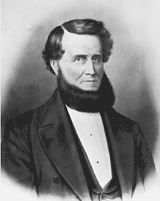
James Lick

Encyclopedia
James Lick was an American
carpenter, piano
builder, land baron, and patron of the sciences. At the time of his death, he was the wealthiest man in California
, and left the majority of his estate to social and scientific causes.
) Pennsylvania
on August 25, 1796. Lick's grandfather, William Lick, served during the American Revolutionary War
under General George Washington
and his son, John Lick, during the American Civil War
. The son of a carpenter
, Lick began learning the craft at an early age. When he was twenty one, after a failed romance with Barbara Snavely, Lick left Stumpstown for Baltimore, Maryland, where he learned the art of piano making. He quickly mastered the skill, and moved to New York
and set up his own shop. In 1821 Lick moved to Argentina
, after learning that his pianos were being export
ed to South America
.
to be difficult, due to his ignorance of Spanish
and the turbulent political situation in the country. However, his business thrived and in 1825 Lick left Argentina to tour Europe
for a year. On his return trip, his ship was captured by the Portuguese
, and the passengers and crew were taken to Montevideo
as prisoners of war
. Lick escaped captivity and returned to Buenos Aires on foot.
In 1832, Lick decided to return to Stumpstown. He failed to reunite with Barbara Snavely and their son and returned to Buenos Aires. He decided the political situation was too unstable and moved to Valparaíso
, Chile
. After four years, he again moved his business, this time to Lima
, Peru
.
In 1846, Lick decided to return to North America
and, anticipating the Mexican-American War and the future annexation of California
, he decided to settle there. However, a backlog of orders for his pianos delayed him an additional 18 months, as the Mexican workers he employed left to return to their homes and join the Mexican Army following the outbreak of war in April of that year; he finished the orders himself.
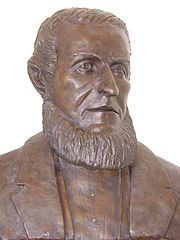 Lick arrived in San Francisco, California
, in January 1848, bringing with him his tools, work bench, $30,000 in gold
, and 600 pounds (275 kilograms) of chocolate
. The chocolate quickly sold, and Lick convinced his neighbor and friend in Peru
, the confectioner Domingo Ghirardelli
, to move to San Francisco, where he founded the Ghirardelli Chocolate Company
.
Upon his arrival, Lick began buying real estate
in the small village of San Francisco. The discovery of gold at Sutter's Mill
near Sacramento
a few days after Lick's arrival in the future state began the California Gold Rush
and created a housing boom in San Francisco, which grew from about one thousand residents in 1848 to over twenty thousand by 1850. Lick himself got a touch of "gold fever" and went out to mine the metal, but after a week he decided his fortune was to be made by owning land, not digging in it. Lick continued buying land in San Francisco, and also began buying farmland in and around San Jose
, where he planted orchard
s and built the largest flour
mill in the state to feed the growing population in San Francisco.
In 1861, Lick began construction of a hotel
, which became known as Lick House, at the intersection of Montgomery and Sutter Streets in San Francisco. The hotel had a dining room that could seat 400, based on a similar room at the palace of Versailles
. Lick House was considered the finest hotel west of the Mississippi River
. The hotel was destroyed in the fire following the San Francisco earthquake of 1906.
Following the construction, Lick returned to his San Jose orchards. In 1874, Lick suffered a massive stroke
in the kitchen of his home in Santa Clara
. The following morning, he was found by his employee, Thomas Fraser, and taken to Lick House, where he could be better cared for. At the time of his illness, his estates, outside his considerable area in Santa Clara County
and San Francisco, included large holdings around Lake Tahoe
, a large ranch
in Los Angeles County
, and all of Santa Catalina Island
. James Lick was the richest man in California.
In the next three years, Lick spent his time determining how to dispense with his fortune. He originally wanted to build giant statues of himself and his parents, and erect a pyramid
larger than the Great Pyramid of Giza
in his own honor in downtown San Francisco. However, through the efforts of George Davidson, president of the California Academy of Sciences
, Lick was persuaded to leave the greatest portion of his fortune to the establishment of a mountain top observatory
, with the largest, most powerful telescope
yet built by man.
In 1874 he placed $3,000,000 at the disposal of seven trustees, by whom the funds were to be applied to specific uses. The principal divisions of the funds were:
Lick had had an interest in astronomy since at least 1860, when he and George Madeira
, the founder of the first observatory in California, spent several nights observing. They had also met again in 1873 and Lick said that Madeira's telescopes were the only ones he had ever used. In 1875, Thomas Fraser recommended a site at the summit
of Mount Hamilton, near San Jose. Lick approved, on the condition that Santa Clara County build a "first class" road to the site. The county agreed and the hand built road was completed by the fall of 1876.
On October 1, 1876, Lick died in his room in Lick House, San Francisco. In 1887, his body was moved to its final resting place, under the future home of the Great Lick Refracting Telescope.
United States
The United States of America is a federal constitutional republic comprising fifty states and a federal district...
carpenter, piano
Piano
The piano is a musical instrument played by means of a keyboard. It is one of the most popular instruments in the world. Widely used in classical and jazz music for solo performances, ensemble use, chamber music and accompaniment, the piano is also very popular as an aid to composing and rehearsal...
builder, land baron, and patron of the sciences. At the time of his death, he was the wealthiest man in California
California
California is a state located on the West Coast of the United States. It is by far the most populous U.S. state, and the third-largest by land area...
, and left the majority of his estate to social and scientific causes.
Early years
James Lick was born in Stumpstown (now FredericksburgFredericksburg, Lebanon County, Pennsylvania
Fredericksburg is a census-designated place in Lebanon County, Pennsylvania, United States. The population was 987 at the 2000 census.-Geography:Fredericksburg is located at ....
) Pennsylvania
Pennsylvania
The Commonwealth of Pennsylvania is a U.S. state that is located in the Northeastern and Mid-Atlantic regions of the United States. The state borders Delaware and Maryland to the south, West Virginia to the southwest, Ohio to the west, New York and Ontario, Canada, to the north, and New Jersey to...
on August 25, 1796. Lick's grandfather, William Lick, served during the American Revolutionary War
American Revolutionary War
The American Revolutionary War , the American War of Independence, or simply the Revolutionary War, began as a war between the Kingdom of Great Britain and thirteen British colonies in North America, and ended in a global war between several European great powers.The war was the result of the...
under General George Washington
George Washington
George Washington was the dominant military and political leader of the new United States of America from 1775 to 1799. He led the American victory over Great Britain in the American Revolutionary War as commander-in-chief of the Continental Army from 1775 to 1783, and presided over the writing of...
and his son, John Lick, during the American Civil War
American Civil War
The American Civil War was a civil war fought in the United States of America. In response to the election of Abraham Lincoln as President of the United States, 11 southern slave states declared their secession from the United States and formed the Confederate States of America ; the other 25...
. The son of a carpenter
Carpenter
A carpenter is a skilled craftsperson who works with timber to construct, install and maintain buildings, furniture, and other objects. The work, known as carpentry, may involve manual labor and work outdoors....
, Lick began learning the craft at an early age. When he was twenty one, after a failed romance with Barbara Snavely, Lick left Stumpstown for Baltimore, Maryland, where he learned the art of piano making. He quickly mastered the skill, and moved to New York
New York
New York is a state in the Northeastern region of the United States. It is the nation's third most populous state. New York is bordered by New Jersey and Pennsylvania to the south, and by Connecticut, Massachusetts and Vermont to the east...
and set up his own shop. In 1821 Lick moved to Argentina
Argentina
Argentina , officially the Argentine Republic , is the second largest country in South America by land area, after Brazil. It is constituted as a federation of 23 provinces and an autonomous city, Buenos Aires...
, after learning that his pianos were being export
Export
The term export is derived from the conceptual meaning as to ship the goods and services out of the port of a country. The seller of such goods and services is referred to as an "exporter" who is based in the country of export whereas the overseas based buyer is referred to as an "importer"...
ed to South America
South America
South America is a continent situated in the Western Hemisphere, mostly in the Southern Hemisphere, with a relatively small portion in the Northern Hemisphere. The continent is also considered a subcontinent of the Americas. It is bordered on the west by the Pacific Ocean and on the north and east...
.
South American years
Lick found his time in Buenos AiresBuenos Aires
Buenos Aires is the capital and largest city of Argentina, and the second-largest metropolitan area in South America, after São Paulo. It is located on the western shore of the estuary of the Río de la Plata, on the southeastern coast of the South American continent...
to be difficult, due to his ignorance of Spanish
Spanish language
Spanish , also known as Castilian , is a Romance language in the Ibero-Romance group that evolved from several languages and dialects in central-northern Iberia around the 9th century and gradually spread with the expansion of the Kingdom of Castile into central and southern Iberia during the...
and the turbulent political situation in the country. However, his business thrived and in 1825 Lick left Argentina to tour Europe
Europe
Europe is, by convention, one of the world's seven continents. Comprising the westernmost peninsula of Eurasia, Europe is generally 'divided' from Asia to its east by the watershed divides of the Ural and Caucasus Mountains, the Ural River, the Caspian and Black Seas, and the waterways connecting...
for a year. On his return trip, his ship was captured by the Portuguese
Portugal
Portugal , officially the Portuguese Republic is a country situated in southwestern Europe on the Iberian Peninsula. Portugal is the westernmost country of Europe, and is bordered by the Atlantic Ocean to the West and South and by Spain to the North and East. The Atlantic archipelagos of the...
, and the passengers and crew were taken to Montevideo
Montevideo
Montevideo is the largest city, the capital, and the chief port of Uruguay. The settlement was established in 1726 by Bruno Mauricio de Zabala, as a strategic move amidst a Spanish-Portuguese dispute over the platine region, and as a counter to the Portuguese colony at Colonia del Sacramento...
as prisoners of war
Prisoner of war
A prisoner of war or enemy prisoner of war is a person, whether civilian or combatant, who is held in custody by an enemy power during or immediately after an armed conflict...
. Lick escaped captivity and returned to Buenos Aires on foot.
In 1832, Lick decided to return to Stumpstown. He failed to reunite with Barbara Snavely and their son and returned to Buenos Aires. He decided the political situation was too unstable and moved to Valparaíso
Valparaíso
Valparaíso is a city and commune of Chile, center of its third largest conurbation and one of the country's most important seaports and an increasing cultural center in the Southwest Pacific hemisphere. The city is the capital of the Valparaíso Province and the Valparaíso Region...
, Chile
Chile
Chile ,officially the Republic of Chile , is a country in South America occupying a long, narrow coastal strip between the Andes mountains to the east and the Pacific Ocean to the west. It borders Peru to the north, Bolivia to the northeast, Argentina to the east, and the Drake Passage in the far...
. After four years, he again moved his business, this time to Lima
Lima
Lima is the capital and the largest city of Peru. It is located in the valleys of the Chillón, Rímac and Lurín rivers, in the central part of the country, on a desert coast overlooking the Pacific Ocean. Together with the seaport of Callao, it forms a contiguous urban area known as the Lima...
, Peru
Peru
Peru , officially the Republic of Peru , is a country in western South America. It is bordered on the north by Ecuador and Colombia, on the east by Brazil, on the southeast by Bolivia, on the south by Chile, and on the west by the Pacific Ocean....
.
In 1846, Lick decided to return to North America
North America
North America is a continent wholly within the Northern Hemisphere and almost wholly within the Western Hemisphere. It is also considered a northern subcontinent of the Americas...
and, anticipating the Mexican-American War and the future annexation of California
California
California is a state located on the West Coast of the United States. It is by far the most populous U.S. state, and the third-largest by land area...
, he decided to settle there. However, a backlog of orders for his pianos delayed him an additional 18 months, as the Mexican workers he employed left to return to their homes and join the Mexican Army following the outbreak of war in April of that year; he finished the orders himself.
California years
San Francisco, California
San Francisco , officially the City and County of San Francisco, is the financial, cultural, and transportation center of the San Francisco Bay Area, a region of 7.15 million people which includes San Jose and Oakland...
, in January 1848, bringing with him his tools, work bench, $30,000 in gold
Gold
Gold is a chemical element with the symbol Au and an atomic number of 79. Gold is a dense, soft, shiny, malleable and ductile metal. Pure gold has a bright yellow color and luster traditionally considered attractive, which it maintains without oxidizing in air or water. Chemically, gold is a...
, and 600 pounds (275 kilograms) of chocolate
Chocolate
Chocolate is a raw or processed food produced from the seed of the tropical Theobroma cacao tree. Cacao has been cultivated for at least three millennia in Mexico, Central and South America. Its earliest documented use is around 1100 BC...
. The chocolate quickly sold, and Lick convinced his neighbor and friend in Peru
Peru
Peru , officially the Republic of Peru , is a country in western South America. It is bordered on the north by Ecuador and Colombia, on the east by Brazil, on the southeast by Bolivia, on the south by Chile, and on the west by the Pacific Ocean....
, the confectioner Domingo Ghirardelli
Domingo Ghirardelli
Domenico "Domingo" Ghirardelli, Sr. was born in Rapallo, Italy, the son and apprentice of a chocolatier. In 1837, Ghirardelli moved to Uruguay, then in 1838 to Lima, Peru, and established a confectionery, and began using the Spanish equivalent of his Italian name, Domingo.In 1849 he moved to...
, to move to San Francisco, where he founded the Ghirardelli Chocolate Company
Ghirardelli Chocolate Company
The Ghirardelli Chocolate Company is a United States division of Swiss candymaker Lindt & Sprüngli. The company was founded by and is named after Italian chocolatier Domingo Ghirardelli, who, after working in South America, moved to California...
.
Upon his arrival, Lick began buying real estate
Real estate
In general use, esp. North American, 'real estate' is taken to mean "Property consisting of land and the buildings on it, along with its natural resources such as crops, minerals, or water; immovable property of this nature; an interest vested in this; an item of real property; buildings or...
in the small village of San Francisco. The discovery of gold at Sutter's Mill
Sutter's Mill
Sutter's Mill was a sawmill owned by 19th century pioneer John Sutter in partnership with James W. Marshall. It was located in Coloma, California, at the bank of the South Fork American River...
near Sacramento
Sacramento, California
Sacramento is the capital city of the U.S. state of California and the county seat of Sacramento County. It is located at the confluence of the Sacramento River and the American River in the northern portion of California's expansive Central Valley. With a population of 466,488 at the 2010 census,...
a few days after Lick's arrival in the future state began the California Gold Rush
California Gold Rush
The California Gold Rush began on January 24, 1848, when gold was found by James W. Marshall at Sutter's Mill in Coloma, California. The first to hear confirmed information of the gold rush were the people in Oregon, the Sandwich Islands , and Latin America, who were the first to start flocking to...
and created a housing boom in San Francisco, which grew from about one thousand residents in 1848 to over twenty thousand by 1850. Lick himself got a touch of "gold fever" and went out to mine the metal, but after a week he decided his fortune was to be made by owning land, not digging in it. Lick continued buying land in San Francisco, and also began buying farmland in and around San Jose
San Jose, California
San Jose is the third-largest city in California, the tenth-largest in the U.S., and the county seat of Santa Clara County which is located at the southern end of San Francisco Bay...
, where he planted orchard
Orchard
An orchard is an intentional planting of trees or shrubs that is maintained for food production. Orchards comprise fruit or nut-producing trees which are grown for commercial production. Orchards are also sometimes a feature of large gardens, where they serve an aesthetic as well as a productive...
s and built the largest flour
Flour
Flour is a powder which is made by grinding cereal grains, other seeds or roots . It is the main ingredient of bread, which is a staple food for many cultures, making the availability of adequate supplies of flour a major economic and political issue at various times throughout history...
mill in the state to feed the growing population in San Francisco.
In 1861, Lick began construction of a hotel
Hotel
A hotel is an establishment that provides paid lodging on a short-term basis. The provision of basic accommodation, in times past, consisting only of a room with a bed, a cupboard, a small table and a washstand has largely been replaced by rooms with modern facilities, including en-suite bathrooms...
, which became known as Lick House, at the intersection of Montgomery and Sutter Streets in San Francisco. The hotel had a dining room that could seat 400, based on a similar room at the palace of Versailles
Palace of Versailles
The Palace of Versailles , or simply Versailles, is a royal château in Versailles in the Île-de-France region of France. In French it is the Château de Versailles....
. Lick House was considered the finest hotel west of the Mississippi River
Mississippi River
The Mississippi River is the largest river system in North America. Flowing entirely in the United States, this river rises in western Minnesota and meanders slowly southwards for to the Mississippi River Delta at the Gulf of Mexico. With its many tributaries, the Mississippi's watershed drains...
. The hotel was destroyed in the fire following the San Francisco earthquake of 1906.
Following the construction, Lick returned to his San Jose orchards. In 1874, Lick suffered a massive stroke
Stroke
A stroke, previously known medically as a cerebrovascular accident , is the rapidly developing loss of brain function due to disturbance in the blood supply to the brain. This can be due to ischemia caused by blockage , or a hemorrhage...
in the kitchen of his home in Santa Clara
Santa Clara, California
Santa Clara , founded in 1777 and incorporated in 1852, is a city in Santa Clara County, in the U.S. state of California. The city is the site of the eighth of 21 California missions, Mission Santa Clara de Asís, and was named after the mission. The Mission and Mission Gardens are located on the...
. The following morning, he was found by his employee, Thomas Fraser, and taken to Lick House, where he could be better cared for. At the time of his illness, his estates, outside his considerable area in Santa Clara County
Santa Clara County, California
Santa Clara County is a county located at the southern end of the San Francisco Bay Area in the U.S. state of California. As of 2010 it had a population of 1,781,642. The county seat is San Jose. The highly urbanized Santa Clara Valley within Santa Clara County is also known as Silicon Valley...
and San Francisco, included large holdings around Lake Tahoe
Lake Tahoe
Lake Tahoe is a large freshwater lake in the Sierra Nevada of the United States. At a surface elevation of , it is located along the border between California and Nevada, west of Carson City. Lake Tahoe is the largest alpine lake in North America. Its depth is , making it the USA's second-deepest...
, a large ranch
Rancho Los Feliz
Rancho Los Feliz was a Spanish land concession in present day Los Angeles County, California given in 1795 by Spanish Governor Pedro Fages to Jose Vicente Feliz. The land of the grant includes Los Feliz and Griffith Park, and was bounded on the east by the Los Angeles River.-History:Given to Jose...
in Los Angeles County
Los Angeles County, California
Los Angeles County is a county in the U.S. state of California. As of 2010 U.S. Census, the county had a population of 9,818,605, making it the most populous county in the United States. Los Angeles County alone is more populous than 42 individual U.S. states...
, and all of Santa Catalina Island
Santa Catalina Island, California
Santa Catalina Island, often called Catalina Island, or just Catalina, is a rocky island off the coast of the U.S. state of California. The island is long and across at its greatest width. The island is located about south-southwest of Los Angeles, California. The highest point on the island is...
. James Lick was the richest man in California.
In the next three years, Lick spent his time determining how to dispense with his fortune. He originally wanted to build giant statues of himself and his parents, and erect a pyramid
Pyramid
A pyramid is a structure whose outer surfaces are triangular and converge at a single point. The base of a pyramid can be trilateral, quadrilateral, or any polygon shape, meaning that a pyramid has at least three triangular surfaces...
larger than the Great Pyramid of Giza
Great Pyramid of Giza
The Great Pyramid of Giza is the oldest and largest of the three pyramids in the Giza Necropolis bordering what is now El Giza, Egypt. It is the oldest of the Seven Wonders of the Ancient World, and the only one to remain largely intact...
in his own honor in downtown San Francisco. However, through the efforts of George Davidson, president of the California Academy of Sciences
California Academy of Sciences
The California Academy of Sciences is among the largest museums of natural history in the world. The academy began in 1853 as a learned society and still carries out a large amount of original research, with exhibits and education becoming significant endeavors of the museum during the twentieth...
, Lick was persuaded to leave the greatest portion of his fortune to the establishment of a mountain top observatory
Observatory
An observatory is a location used for observing terrestrial or celestial events. Astronomy, climatology/meteorology, geology, oceanography and volcanology are examples of disciplines for which observatories have been constructed...
, with the largest, most powerful telescope
Telescope
A telescope is an instrument that aids in the observation of remote objects by collecting electromagnetic radiation . The first known practical telescopes were invented in the Netherlands at the beginning of the 1600s , using glass lenses...
yet built by man.
In 1874 he placed $3,000,000 at the disposal of seven trustees, by whom the funds were to be applied to specific uses. The principal divisions of the funds were:
- $700,000 to the University of CaliforniaUniversity of CaliforniaThe University of California is a public university system in the U.S. state of California. Under the California Master Plan for Higher Education, the University of California is a part of the state's three-tier public higher education system, which also includes the California State University...
for the construction of an observatory and the placing therein of a telescope to be more powerful than any other in existence - $150,000 for the building and maintenance of free public baths in San Francisco
- $540,000 to found and endow an institution of San Francisco to be known as the California School of Mechanic Arts
- $100,000 for the erection of three appropriate groups of bronze statuary to represent three periods in Californian history and to be placed before the city hall of San Francisco
- $60,000 to erect in Golden Gate ParkGolden Gate ParkGolden Gate Park, located in San Francisco, California, is a large urban park consisting of of public grounds. Configured as a rectangle, it is similar in shape but 20% larger than Central Park in New York, to which it is often compared. It is over three miles long east to west, and about half a...
, San Francisco, a memorial to Francis Scott KeyFrancis Scott KeyFrancis Scott Key was an American lawyer, author, and amateur poet, from Georgetown, who wrote the lyrics to the United States' national anthem, "The Star-Spangled Banner".-Life:...
, author of “The Star-Spangled BannerThe Star-Spangled Banner"The Star-Spangled Banner" is the national anthem of the United States of America. The lyrics come from "Defence of Fort McHenry", a poem written in 1814 by the 35-year-old lawyer and amateur poet, Francis Scott Key, after witnessing the bombardment of Fort McHenry by the British Royal Navy ships...
”
Lick had had an interest in astronomy since at least 1860, when he and George Madeira
George Madeira
George David Madeira was a mining engineer and mineralogist who founded the first astronomical observatory in California in the town of Volcano....
, the founder of the first observatory in California, spent several nights observing. They had also met again in 1873 and Lick said that Madeira's telescopes were the only ones he had ever used. In 1875, Thomas Fraser recommended a site at the summit
Summit (topography)
In topography, a summit is a point on a surface that is higher in elevation than all points immediately adjacent to it. Mathematically, a summit is a local maximum in elevation...
of Mount Hamilton, near San Jose. Lick approved, on the condition that Santa Clara County build a "first class" road to the site. The county agreed and the hand built road was completed by the fall of 1876.
On October 1, 1876, Lick died in his room in Lick House, San Francisco. In 1887, his body was moved to its final resting place, under the future home of the Great Lick Refracting Telescope.
Lick's legacy
- Lick's will stipulated that all of his fortune should be used for the public good, including $700,000 for the building of the observatory.
- In 1888, Lick ObservatoryLick ObservatoryThe Lick Observatory is an astronomical observatory, owned and operated by the University of California. It is situated on the summit of Mount Hamilton, in the Diablo Range just east of San Jose, California, USA...
was completed and given to the University of CaliforniaUniversity of CaliforniaThe University of California is a public university system in the U.S. state of California. Under the California Master Plan for Higher Education, the University of California is a part of the state's three-tier public higher education system, which also includes the California State University...
as the Lick Astronomical Department. The Observatory was the first permanently staffed mountain top observatory in the world and housed the largest refracting telescopeRefracting telescopeA refracting or refractor telescope is a type of optical telescope that uses a lens as its objective to form an image . The refracting telescope design was originally used in spy glasses and astronomical telescopes but is also used for long focus camera lenses...
in the world at that time. - The body of James Lick lies beneath the refractor telescope he funded, and his will stipulates that fresh flowers be on his grave — always.
- In 1887 Lick's body was buried under the future site of the telescope, with a brass tablet bearing the inscription “Here lies the body of James Lick.”
- James Lick MansionJames Lick MansionThe James Lick Mansion, in Santa Clara, California, is the estate of James Lick, who was the richest man in California at the time of his death in 1876. The estate is listed on the National Register of Historic Places...
in Santa Clara is a nationally registered historical landmark, and is leased at very low rates to non-profit organizations. the mansion is occupied by the S.A.F.E. Place. - In 1884, the Lick Old Ladies' Home, later renamed the University Mound Ladies Home, was established in San Francisco with a grant from the Lick estate.
- The Conservatory of FlowersConservatory of FlowersThe Conservatory of Flowers is a greenhouse and botanical garden that houses a collection of rare and exotic plants in Golden Gate Park, San Francisco, California. With construction completed in 1878, it remains the oldest building in the park, and the oldest municipal wooden conservatory remaining...
and the statueStatueA statue is a sculpture in the round representing a person or persons, an animal, an idea or an event, normally full-length, as opposed to a bust, and at least close to life-size, or larger...
of Francis Scott KeyFrancis Scott KeyFrancis Scott Key was an American lawyer, author, and amateur poet, from Georgetown, who wrote the lyrics to the United States' national anthem, "The Star-Spangled Banner".-Life:...
in Golden Gate ParkGolden Gate ParkGolden Gate Park, located in San Francisco, California, is a large urban park consisting of of public grounds. Configured as a rectangle, it is similar in shape but 20% larger than Central Park in New York, to which it is often compared. It is over three miles long east to west, and about half a...
were donated to San Francisco by Lick. - The Pioneer Monument in front of San Francisco's City Hall was donated by Lick to the city.
- James Lick High SchoolJames Lick High SchoolJames Lick High School is a high school in the East Side Union High School District located in San Jose.-History:Lick High School was built in 1950 and is the oldest of the eleven high schools in the ESUHSD...
in San JoseSan Jose, CaliforniaSan Jose is the third-largest city in California, the tenth-largest in the U.S., and the county seat of Santa Clara County which is located at the southern end of San Francisco Bay...
and James Lick Middle School, Lick-Wilmerding High SchoolLick-Wilmerding High SchoolLick-Wilmerding High School is a college-preparatory high school located in San Francisco, California, United States.-History:Lick-Wilmerding was founded on September 21, 1874 as the California School of Mechanical Arts by a trust by James Lick. George Merrill was hired to manage the school as the...
, and the James Lick Freeway, all in San Francisco, are named in his honor. - The Southern Pacific RailroadSouthern Pacific RailroadThe Southern Pacific Transportation Company , earlier Southern Pacific Railroad and Southern Pacific Company, and usually simply called the Southern Pacific or Espee, was an American railroad....
named a Control Point after Lick (CP Lick) on their Coast LineCoast Line (UP)The Coast Line is a railroad line from Burbank, California north to the San Francisco Bay Area, roughly along the Pacific Coast.The first version of the Coast line, via Saugus and Santa Paula, was completed by the Southern Pacific Railroad on December 31, 1900; the line via Santa Susana opened in...
route in San Jose, California. At the same location there was also once a Lick Station and Lick Branch rail line that went into San Jose's Almaden Valley but was abandoned in the early 1980s. - The crater LickLick (crater)Lick is a lunar crater that has been flooded with basaltic lava. The north rim is attached to the smaller, bowl-shaped crater Greaves. Lick lies on the southwest edge of Mare Crisium. Its rim is broken at the north and south ends, and the southwest rim is attached to the crater remnant Lick A...
on the MoonMoonThe Moon is Earth's only known natural satellite,There are a number of near-Earth asteroids including 3753 Cruithne that are co-orbital with Earth: their orbits bring them close to Earth for periods of time but then alter in the long term . These are quasi-satellites and not true moons. For more...
and the asteroidAsteroidAsteroids are a class of small Solar System bodies in orbit around the Sun. They have also been called planetoids, especially the larger ones...
1951 Lick1951 Lick1951 Lick is a Mars-crossing asteroid discovered on July 26, 1949 by C. A. Wirtanen at Mount Hamilton.- External links :*...
are named after him. - Lickdale, Pennsylvania, a village approximately 3 miles west of Fredericksburg, Pennsylvania (formerly Stumpstown), was named for James Lick. Lickdale was a prominent 19th century canal port along a branch of the Union Canal and contained a large commercial ice house.
- A large monument to James Lick was erected by the local citizens in the community cemetery in Fredericksburg, Pennsylvania.
