

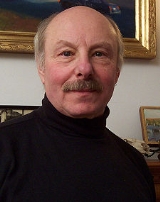
James Howard Kunstler

Encyclopedia
James Howard Kunstler is an American author
, social critic, public speaker, and blog
ger. He is best known for his books The Geography of Nowhere
(1994), a history of American suburbia
and urban development, and the more recent The Long Emergency
(2005), where he argues that declining oil production is likely to result in the end of industrialized society as we know it and force Americans to live in smaller-scale, localized, agrarian (or semi-agrarian) communities. He has written a science fiction
novel
conjecturing such a culture in the future, World Made by Hand in 2008. He also gives lectures on topics related to suburbia, urban development, and the challenges of what he calls "the global oil predicament" and a resultant change in the “American Way of Life.” He is also a leading proponent of the movement known as "New Urbanism
."
to Jewish parents, who divorced when he was eight. His father was a middleman in the diamond
trade. Kunstler spent most of his childhood with his mother and stepfather, a publicist for Broadway shows
. While spending summers at a boys' camp in New Hampshire
, he became acquainted with the small town ethos that would later permeate many of his works. In 1966 he graduated from New York City's High School of Music & Art
, and then attended the State University of New York at Brockport
where he majored in Theater.
After college Kunstler worked as a reporter and feature writer for a number of newspapers, and finally as a staff writer for Rolling Stone
. In 1975, he began writing books and lecturing full-time. He lives in Saratoga Springs, New York
and was formerly married to the children's author Jennifer Armstrong
.
Since the mid-1990s, he has written four non-fiction books about suburban development and diminishing global oil supplies. According to the Columbia Journalism Review
, his first work on the subject, The Geography of Nowhere, discussed the effects of "cartoon architecture, junked cities, and a ravaged countryside", as he put it. Described as a jeremiad by The Washington Post
, Kunstler is critic of suburbia and urban development trends throughout the United States, and is a proponent of the New Urbanism
movement. According to Scott Carlson, reporter for The Chronicle of Higher Education, Kunstler's books on the subject have become "standard reading in architecture and urban planning courses".
He describes America as a poorly planned and "tragic landscape of highway strips, parking lots, housing tracts, mega-malls, junked cities, and ravaged countryside that makes up the everyday environment where most Americans live and work." In a 2001 op-ed for Planetizen
, he wrote that in the wake of 9/11 the "age of skyscrapers is at an end", that no new megatowers would be built, and that existing tall buildings are destined to be dismantled.
In his books that followed, such as Home From Nowhere, The City in Mind, and The Long Emergency
(2005), he pushed hard on taboo topics like a post-oil America. He was featured in the "peak oil
" documentary, The End of Suburbia
, widely circulated on the internet, as well as the Canadian documentary Radiant City
(2006).
In his recent science fiction
novel World Made by Hand (2008), he describes a future dependent on localized production and agriculture, with little reliance on imports. The Witch of Hebron, a sequel, was released in the autumn of 2010; two more sequels are under development.
In his writings and lectures, he makes a strong case that there is no other alternative energy
source on the horizon that can replace relatively cheap oil. He therefore envisions a "low energy" world that will be radically different from today's. This has contributed to his becoming an outspoken advocate for one of his solutions, a more energy-efficient rail system, and writes "we have to get cracking on the revival of the railroad system if we expect to remain a united country."
has called Kunstler the "scourge of suburbia," and a "slashingly witty Jeremiah
." In a review of Kunstler's weekly audio podcast, the Columbia Journalism Review
called the KunstlerCast "a weekly podcast that offers some of the smartest, most honest urban commentary around—online or off." However, in critiquing The Long Emergency, Christopher Hayes
claims that while Kunstler makes valid points about the consequences of peak oil, he undermines his own credibility with his rhetoric and perceived misanthropy
; likewise, Kevin Drum
, another peak oil theorist, considers Kunstler to be a "crank" who hurts his own cause. Ezra Klein
, writing for The American Prospect
, notes that Kunstler lacks credentials as an oil expert, and claims that his work "definitely has a crazy-guy-on-Venice feel to it."
Charles Bensinger, co-founder of Renewable Energy Partners of New Mexico, describes Kunstler's views as "fashionably fear-mongering
" and uninformed regarding the potential of renewable energy, biofuels, energy efficiency and smart-growth policies to eliminate the need for fossil fuels. Contrarily, Paul Salopek of The Chicago Tribune finds that, "Kunstler has plotted energy starvation to its logical extremes" and points to the US Department of Energy Hirsch report
as drawing similar conclusions while David Ehrenfeld writing for American Scientist sees Kunstler delivering a "powerful integration of science, technology, economics, finance, international politics and social change" with a "lengthy discussion of the alternatives to cheap oil."
In May 2008 oil reached $132 a barrel, lending credence to Kunstler's warnings about high energy prices. Kunstler commented on the price surge, stating "I'm not cheerleading for doom, you understand... merely asserting that we have a problem in the USA. Our behavior and our lifestyle are not consistent with reality. The markets are registering this for the moment."
Kunstler, who has no formal training in the fields in which he prognosticates, made similar dire predictions for Y2K as he makes for peak oil
. Kunstler responds to this criticism by saying that a Y2K-related catastrophe was averted precisely because of the billions of dollars that were spent fixing the problem. As with acid rain
and ozone depletion
in the '90s, a resoundingly successful, well-coordinated international response had the ironic side effect of discrediting the very worst-case scenarios that inspired the efforts in the first place.
Kunstler has made several failed predictions regarding U.S. stock markets. In June 2005 and again in early 2006, Kunstler predicted that the Dow
would crash to 4,000 by the end of the year. The Dow in fact reached a new peak of approximately 12,500 by the end of 2006. In his predictions for 2007, Kunstler admitted his mistake, ascribing the Dow's climb to "inertia combined with sheer luck". In January 2009, Kunstler again repeated with Dow 4000 prediction. The Dow, in fact, ended 2009 at more than twice that value.
The Albany Times Union reviewed World Made by Hand, opening with, "James Howard Kunstler is fiddling his way to the apocalypse
, one jig at a time." The reviewer calls it "a grim scenario" with "an upside" or two.
Kunstler has faced strong criticism for his pro-Israeli
stance in the debate over the Israeli–Palestinian conflict
.
"...we are in danger not just of oil prices going way back up again, but of losing access to our supplies from the exporting countries. In other words, we're just as likely to face shortages as high prices, and soon. Oil shortages are certain to produce a political freak-out here unless we get our heads screwed on right..."
"the truth is that no combination of solar
, wind
, nuclear power
, ethanol
, biodiesel
, tar sands
and used French-fry oil will allow us to power ... the interstate highway system
– or even a fraction of these things – in the future...our quandary: the American public's narrow focus on keeping all our cars running at any cost."
"... we'll have to figure out how to make things in this country again. We will not be manufacturing things at the scale, or in the manner, we were used to in, say, 1962. We'll have to do it far more modestly, using much more meager amounts of energy than we did in the past."
"The idea that we can become "energy independent" and maintain our current lifestyle is absurd."
Society
"...the American public is deathly afraid of the kind of changes we actually face – such as, the end of consumer culture, the gross loss of value in suburban real estate (which forms the bulk of the middle class's private wealth), the prospect of food and fuel scarcities, the need to re-localize our lives, the need to physically shape up to stop the costly and unnecessary drain on our medical resources, to grow more of our own food, to work harder at things that actually matter, and to save whatever we can for a difficult future."
"... we're not going back to a "consumer" economy. We're heading into a hard work economy in which people derive their pleasures and gratification more traditionally – mainly through the company of their fellow human beings..."
"Please stop referring to yourselves as consumers. "Consumers" are different than citizens. Consumers do not have obligations, responsibilities, and duties to their fellow human beings. And as long as you are using that word “consumer,” you will be degrading the quality of the public discussion as we go into the very difficult future that we face."
Food
"... we'll have to dramatically reorganize the everyday activities of American life. We'll have to grow our food closer to home, in a manner that will require more human attention. In fact, agriculture
needs to return to the center of economic life."
Commerce
"... we're going to have to make things again, and raise things out of the earth, locally, and trade these things for money of some kind that we earn through our own productive activities."
"We'll have to restore local economic networks – the very networks that the big-box stores systematically destroyed – made of fine-grained layers of wholesalers, middlemen
and retailers."
Transportation
"...we have to move away from the private automobile and commercial trucking
, and the airline industry is certain to contract dramatically. When are we going to start the discussion about rebuilding a US public transit system that was once the envy of the world? It no longer matters how much Americans love their cars, or even how much investment we've made in car infrastructure
."
"Fixing the U.S. passenger railroad system is probably the one project we could undertake right away that would have the greatest impact on the country's oil consumption."
"California (and every other region of America) would benefit much more from normal-speed trains running every hour on the hour on tracks that already exist than from a mega-expensive, grandiose sci-fi program that might not get built for ten years. The dregs of the Big Three automakers can and should be reorganized to produce the rolling stock for a revived railroad system."
"The motoring era is coming to an end. Heroic investments in highway infrastructure to create jobs will be a tragic waste of our dwindling capital."
"[Economic] Stimulus aimed at perpetuating mass motoring will be a tragic waste of our dwindling resources. We'd be better off aiming it at fixing the railroads (especially electrifying them), refitting our harbors with piers and warehouses in preparation to move more stuff by boats, and in repairing the electric grid."
"The airline industry is disintegrating under the enormous pressure of fuel costs. Airlines cannot fire any more employees and have already offloaded their pension obligations and outsourced their repairs. At least five small airlines have filed for bankruptcy protection in the past two months. If we don't get the passenger trains running again, Americans will be going nowhere five years from now."
"One other implication of this is the necessity to use our waterways for moving things and people again. Has anybody noticed, for instance, that the once-bustling New York Harbor
, possibly the biggest and best sheltered deepwater harbor in the world, has next-to-zero operating docks left along its massive perimeter?" (In 2008, New York Harbor was the third busiest in the US out of 149, as measured by tons of cargo handled, with over 150,000,000.)
Author
An author is broadly defined as "the person who originates or gives existence to anything" and that authorship determines responsibility for what is created. Narrowly defined, an author is the originator of any written work.-Legal significance:...
, social critic, public speaker, and blog
Blog
A blog is a type of website or part of a website supposed to be updated with new content from time to time. Blogs are usually maintained by an individual with regular entries of commentary, descriptions of events, or other material such as graphics or video. Entries are commonly displayed in...
ger. He is best known for his books The Geography of Nowhere
The Geography of Nowhere
The Geography of Nowhere: The Rise and Decline of America's Man-Made Landscape is a book written in 1993 by James Howard Kunstler exploring the effects of suburban sprawl, civil planning and the automobile on American society. The book is an attempt to discover how and why suburbia has ceased to...
(1994), a history of American suburbia
SubUrbia
subUrbia is a play by Eric Bogosian chronicling the nighttime activities of a group of aimless 20-somethings still living in their suburban Boston hometown and their reunion with a former high school classmate who has become a successful musician...
and urban development, and the more recent The Long Emergency
The Long Emergency
The Long Emergency: Surviving the Converging Catastrophes of the Twenty-first Century is a book by James Howard Kunstler exploring the consequences of a world oil production peak, coinciding with the forces of climate change, resurgent diseases, water scarcity, global economic instability and...
(2005), where he argues that declining oil production is likely to result in the end of industrialized society as we know it and force Americans to live in smaller-scale, localized, agrarian (or semi-agrarian) communities. He has written a science fiction
Science fiction
Science fiction is a genre of fiction dealing with imaginary but more or less plausible content such as future settings, futuristic science and technology, space travel, aliens, and paranormal abilities...
novel
Novel
A novel is a book of long narrative in literary prose. The genre has historical roots both in the fields of the medieval and early modern romance and in the tradition of the novella. The latter supplied the present generic term in the late 18th century....
conjecturing such a culture in the future, World Made by Hand in 2008. He also gives lectures on topics related to suburbia, urban development, and the challenges of what he calls "the global oil predicament" and a resultant change in the “American Way of Life.” He is also a leading proponent of the movement known as "New Urbanism
New urbanism
New Urbanism is an urban design movement, which promotes walkable neighborhoods that contain a range of housing and job types. It arose in the United States in the early 1980s, and has gradually continued to reform many aspects of real estate development, urban planning, and municipal land-use...
."
Background
Kunstler was born in New York CityNew York City
New York is the most populous city in the United States and the center of the New York Metropolitan Area, one of the most populous metropolitan areas in the world. New York exerts a significant impact upon global commerce, finance, media, art, fashion, research, technology, education, and...
to Jewish parents, who divorced when he was eight. His father was a middleman in the diamond
Diamond
In mineralogy, diamond is an allotrope of carbon, where the carbon atoms are arranged in a variation of the face-centered cubic crystal structure called a diamond lattice. Diamond is less stable than graphite, but the conversion rate from diamond to graphite is negligible at ambient conditions...
trade. Kunstler spent most of his childhood with his mother and stepfather, a publicist for Broadway shows
Broadway theatre
Broadway theatre, commonly called simply Broadway, refers to theatrical performances presented in one of the 40 professional theatres with 500 or more seats located in the Theatre District centered along Broadway, and in Lincoln Center, in Manhattan in New York City...
. While spending summers at a boys' camp in New Hampshire
New Hampshire
New Hampshire is a state in the New England region of the northeastern United States of America. The state was named after the southern English county of Hampshire. It is bordered by Massachusetts to the south, Vermont to the west, Maine and the Atlantic Ocean to the east, and the Canadian...
, he became acquainted with the small town ethos that would later permeate many of his works. In 1966 he graduated from New York City's High School of Music & Art
Fiorello H. LaGuardia High School of Music & Art and Performing Arts
Fiorello H. LaGuardia High School of Music & Art and Performing Arts is a high school specializing in teaching visual arts and performing arts, located near Lincoln Center and the Juilliard School in the Lincoln Center district of Manhattan, on Amsterdam Avenue...
, and then attended the State University of New York at Brockport
State University of New York at Brockport
The College at Brockport: State University of New York, also known as SUNY Brockport, Brockport State, College at Brockport, or the State University of New York at Brockport, is a four-year liberal arts college located in Brockport, Monroe County, New York, United States, near Rochester...
where he majored in Theater.
After college Kunstler worked as a reporter and feature writer for a number of newspapers, and finally as a staff writer for Rolling Stone
Rolling Stone
Rolling Stone is a US-based magazine devoted to music, liberal politics, and popular culture that is published every two weeks. Rolling Stone was founded in San Francisco in 1967 by Jann Wenner and music critic Ralph J...
. In 1975, he began writing books and lecturing full-time. He lives in Saratoga Springs, New York
Saratoga Springs, New York
Saratoga Springs, also known as simply Saratoga, is a city in Saratoga County, New York, United States. The population was 26,586 at the 2010 census. The name reflects the presence of mineral springs in the area. While the word "Saratoga" is known to be a corruption of a Native American name, ...
and was formerly married to the children's author Jennifer Armstrong
Jennifer Armstrong
Jennifer Mary Armstrong is a children's author of fiction and non-fiction.-Books:* Armstrong, Jennifer. . Shipwreck at the Bottom of the World : The Extraordinary True Story of Shackleton and the Endurance Crown Books for Young Readers...
.
Writing
Over the course of the first 14 years of his writing career (1979–1993) Kunstler wrote seven novels.Since the mid-1990s, he has written four non-fiction books about suburban development and diminishing global oil supplies. According to the Columbia Journalism Review
Columbia Journalism Review
The Columbia Journalism Review is an American magazine for professional journalists published bimonthly by the Columbia University Graduate School of Journalism since 1961....
, his first work on the subject, The Geography of Nowhere, discussed the effects of "cartoon architecture, junked cities, and a ravaged countryside", as he put it. Described as a jeremiad by The Washington Post
The Washington Post
The Washington Post is Washington, D.C.'s largest newspaper and its oldest still-existing paper, founded in 1877. Located in the capital of the United States, The Post has a particular emphasis on national politics. D.C., Maryland, and Virginia editions are printed for daily circulation...
, Kunstler is critic of suburbia and urban development trends throughout the United States, and is a proponent of the New Urbanism
New urbanism
New Urbanism is an urban design movement, which promotes walkable neighborhoods that contain a range of housing and job types. It arose in the United States in the early 1980s, and has gradually continued to reform many aspects of real estate development, urban planning, and municipal land-use...
movement. According to Scott Carlson, reporter for The Chronicle of Higher Education, Kunstler's books on the subject have become "standard reading in architecture and urban planning courses".
He describes America as a poorly planned and "tragic landscape of highway strips, parking lots, housing tracts, mega-malls, junked cities, and ravaged countryside that makes up the everyday environment where most Americans live and work." In a 2001 op-ed for Planetizen
Planetizen
Planetizen is a planning-related news website owned by Urban Insight of Los Angeles, California. It features user-submitted and editor-evaluated news and weekly user-contributed op-eds about urban planning and several related fields...
, he wrote that in the wake of 9/11 the "age of skyscrapers is at an end", that no new megatowers would be built, and that existing tall buildings are destined to be dismantled.
In his books that followed, such as Home From Nowhere, The City in Mind, and The Long Emergency
The Long Emergency
The Long Emergency: Surviving the Converging Catastrophes of the Twenty-first Century is a book by James Howard Kunstler exploring the consequences of a world oil production peak, coinciding with the forces of climate change, resurgent diseases, water scarcity, global economic instability and...
(2005), he pushed hard on taboo topics like a post-oil America. He was featured in the "peak oil
Peak oil
Peak oil is the point in time when the maximum rate of global petroleum extraction is reached, after which the rate of production enters terminal decline. This concept is based on the observed production rates of individual oil wells, projected reserves and the combined production rate of a field...
" documentary, The End of Suburbia
The End of Suburbia
The End of Suburbia: Oil Depletion and the Collapse of The American Dream is a 2004 documentary film concerning peak oil and its implications for the suburban lifestyle, written and directed by Toronto-based filmmaker Gregory Greene....
, widely circulated on the internet, as well as the Canadian documentary Radiant City
Radiant City
Radiant City is a National Film Board of Canada filmreleased in 2006 at the Toronto Film Festival, about suburban sprawl and the fictional Moss family who live in the suburbs, written and directed by Gary Burns and Jim Brown....
(2006).
In his recent science fiction
Science fiction
Science fiction is a genre of fiction dealing with imaginary but more or less plausible content such as future settings, futuristic science and technology, space travel, aliens, and paranormal abilities...
novel World Made by Hand (2008), he describes a future dependent on localized production and agriculture, with little reliance on imports. The Witch of Hebron, a sequel, was released in the autumn of 2010; two more sequels are under development.
In his writings and lectures, he makes a strong case that there is no other alternative energy
Alternative energy
Alternative energy is an umbrella term that refers to any source of usable energy intended to replace fuel sources without the undesired consequences of the replaced fuels....
source on the horizon that can replace relatively cheap oil. He therefore envisions a "low energy" world that will be radically different from today's. This has contributed to his becoming an outspoken advocate for one of his solutions, a more energy-efficient rail system, and writes "we have to get cracking on the revival of the railroad system if we expect to remain a united country."
Reactions and criticisms
Bill KauffmanBill Kauffman
Bill Kauffman is an American political writer generally aligned with the paleoconservative movement. He was born in Batavia, New York, and currently resides in Elba, New York, with his wife and daughter....
has called Kunstler the "scourge of suburbia," and a "slashingly witty Jeremiah
Jeremiah
Jeremiah Hebrew:יִרְמְיָה , Modern Hebrew:Yirməyāhū, IPA: jirməˈjaːhu, Tiberian:Yirmĭyahu, Greek:Ἰερεμίας), meaning "Yahweh exalts", or called the "Weeping prophet" was one of the main prophets of the Hebrew Bible...
." In a review of Kunstler's weekly audio podcast, the Columbia Journalism Review
Columbia Journalism Review
The Columbia Journalism Review is an American magazine for professional journalists published bimonthly by the Columbia University Graduate School of Journalism since 1961....
called the KunstlerCast "a weekly podcast that offers some of the smartest, most honest urban commentary around—online or off." However, in critiquing The Long Emergency, Christopher Hayes
Christopher Hayes (journalist)
Christopher L. "Chris" Hayes is an American broadcaster, journalist and liberal political commentator. Hayes hosts Up with Chris Hayes, a weekend news and opinion television show on MSNBC. Hayes had formerly been a frequent guest host and commentator on shows such as The Rachel Maddow Show and...
claims that while Kunstler makes valid points about the consequences of peak oil, he undermines his own credibility with his rhetoric and perceived misanthropy
Misanthropy
Misanthropy is generalized dislike, distrust, disgust, contempt or hatred of the human species or human nature. A misanthrope, or misanthropist is someone who holds such views or feelings...
; likewise, Kevin Drum
Kevin Drum
Kevin Drum is an American political blogger and columnist. He was born in Long Beach, California and now lives in Irvine, California.-Education:...
, another peak oil theorist, considers Kunstler to be a "crank" who hurts his own cause. Ezra Klein
Ezra Klein
Ezra Klein is a liberal American blogger and columnist for The Washington Post, columnist for Bloomberg, a columnist for Newsweek, and a contributor to MSNBC...
, writing for The American Prospect
The American Prospect
The American Prospect is a monthly American political magazine dedicated to American liberalism. Based in Washington, DC, The American Prospect is a journal "of liberal ideas, committed to a just society, an enriched democracy, and effective liberal politics" which focuses on United States politics...
, notes that Kunstler lacks credentials as an oil expert, and claims that his work "definitely has a crazy-guy-on-Venice feel to it."
Charles Bensinger, co-founder of Renewable Energy Partners of New Mexico, describes Kunstler's views as "fashionably fear-mongering
Fear mongering
Fear mongering is the use of fear to influence the opinions and actions of others towards some specific end...
" and uninformed regarding the potential of renewable energy, biofuels, energy efficiency and smart-growth policies to eliminate the need for fossil fuels. Contrarily, Paul Salopek of The Chicago Tribune finds that, "Kunstler has plotted energy starvation to its logical extremes" and points to the US Department of Energy Hirsch report
Hirsch report
The Hirsch report, the commonly referred to name for the report Peaking of World Oil Production: Impacts, Mitigation, and Risk Management, was created by request for the US Department of Energy and published in February 2005....
as drawing similar conclusions while David Ehrenfeld writing for American Scientist sees Kunstler delivering a "powerful integration of science, technology, economics, finance, international politics and social change" with a "lengthy discussion of the alternatives to cheap oil."
In May 2008 oil reached $132 a barrel, lending credence to Kunstler's warnings about high energy prices. Kunstler commented on the price surge, stating "I'm not cheerleading for doom, you understand... merely asserting that we have a problem in the USA. Our behavior and our lifestyle are not consistent with reality. The markets are registering this for the moment."
Kunstler, who has no formal training in the fields in which he prognosticates, made similar dire predictions for Y2K as he makes for peak oil
Peak oil
Peak oil is the point in time when the maximum rate of global petroleum extraction is reached, after which the rate of production enters terminal decline. This concept is based on the observed production rates of individual oil wells, projected reserves and the combined production rate of a field...
. Kunstler responds to this criticism by saying that a Y2K-related catastrophe was averted precisely because of the billions of dollars that were spent fixing the problem. As with acid rain
Acid rain
Acid rain is a rain or any other form of precipitation that is unusually acidic, meaning that it possesses elevated levels of hydrogen ions . It can have harmful effects on plants, aquatic animals, and infrastructure. Acid rain is caused by emissions of carbon dioxide, sulfur dioxide and nitrogen...
and ozone depletion
Ozone depletion
Ozone depletion describes two distinct but related phenomena observed since the late 1970s: a steady decline of about 4% per decade in the total volume of ozone in Earth's stratosphere , and a much larger springtime decrease in stratospheric ozone over Earth's polar regions. The latter phenomenon...
in the '90s, a resoundingly successful, well-coordinated international response had the ironic side effect of discrediting the very worst-case scenarios that inspired the efforts in the first place.
Kunstler has made several failed predictions regarding U.S. stock markets. In June 2005 and again in early 2006, Kunstler predicted that the Dow
Dow Jones Industrial Average
The Dow Jones Industrial Average , also called the Industrial Average, the Dow Jones, the Dow 30, or simply the Dow, is a stock market index, and one of several indices created by Wall Street Journal editor and Dow Jones & Company co-founder Charles Dow...
would crash to 4,000 by the end of the year. The Dow in fact reached a new peak of approximately 12,500 by the end of 2006. In his predictions for 2007, Kunstler admitted his mistake, ascribing the Dow's climb to "inertia combined with sheer luck". In January 2009, Kunstler again repeated with Dow 4000 prediction. The Dow, in fact, ended 2009 at more than twice that value.
The Albany Times Union reviewed World Made by Hand, opening with, "James Howard Kunstler is fiddling his way to the apocalypse
Apocalypse
An Apocalypse is a disclosure of something hidden from the majority of mankind in an era dominated by falsehood and misconception, i.e. the veil to be lifted. The Apocalypse of John is the Book of Revelation, the last book of the New Testament...
, one jig at a time." The reviewer calls it "a grim scenario" with "an upside" or two.
Kunstler has faced strong criticism for his pro-Israeli
Zionism
Zionism is a Jewish political movement that, in its broadest sense, has supported the self-determination of the Jewish people in a sovereign Jewish national homeland. Since the establishment of the State of Israel, the Zionist movement continues primarily to advocate on behalf of the Jewish state...
stance in the debate over the Israeli–Palestinian conflict
Israeli–Palestinian conflict
The Israeli–Palestinian conflict is the ongoing conflict between Israelis and Palestinians. The conflict is wide-ranging, and the term is also used in reference to the earlier phases of the same conflict, between Jewish and Zionist yishuv and the Arab population living in Palestine under Ottoman or...
.
Quotations
Energy"...we are in danger not just of oil prices going way back up again, but of losing access to our supplies from the exporting countries. In other words, we're just as likely to face shortages as high prices, and soon. Oil shortages are certain to produce a political freak-out here unless we get our heads screwed on right..."
"the truth is that no combination of solar
Solar power
Solar energy, radiant light and heat from the sun, has been harnessed by humans since ancient times using a range of ever-evolving technologies. Solar radiation, along with secondary solar-powered resources such as wind and wave power, hydroelectricity and biomass, account for most of the available...
, wind
Wind
Wind is the flow of gases on a large scale. On Earth, wind consists of the bulk movement of air. In outer space, solar wind is the movement of gases or charged particles from the sun through space, while planetary wind is the outgassing of light chemical elements from a planet's atmosphere into space...
, nuclear power
Nuclear power
Nuclear power is the use of sustained nuclear fission to generate heat and electricity. Nuclear power plants provide about 6% of the world's energy and 13–14% of the world's electricity, with the U.S., France, and Japan together accounting for about 50% of nuclear generated electricity...
, ethanol
Ethanol
Ethanol, also called ethyl alcohol, pure alcohol, grain alcohol, or drinking alcohol, is a volatile, flammable, colorless liquid. It is a psychoactive drug and one of the oldest recreational drugs. Best known as the type of alcohol found in alcoholic beverages, it is also used in thermometers, as a...
, biodiesel
Biodiesel
Biodiesel refers to a vegetable oil- or animal fat-based diesel fuel consisting of long-chain alkyl esters. Biodiesel is typically made by chemically reacting lipids with an alcohol....
, tar sands
Tar sands
Bituminous sands, colloquially known as oil sands or tar sands, are a type of unconventional petroleum deposit. The sands contain naturally occurring mixtures of sand, clay, water, and a dense and extremely viscous form of petroleum technically referred to as bitumen...
and used French-fry oil will allow us to power ... the interstate highway system
Interstate Highway System
The Dwight D. Eisenhower National System of Interstate and Defense Highways, , is a network of limited-access roads including freeways, highways, and expressways forming part of the National Highway System of the United States of America...
– or even a fraction of these things – in the future...our quandary: the American public's narrow focus on keeping all our cars running at any cost."
"... we'll have to figure out how to make things in this country again. We will not be manufacturing things at the scale, or in the manner, we were used to in, say, 1962. We'll have to do it far more modestly, using much more meager amounts of energy than we did in the past."
"The idea that we can become "energy independent" and maintain our current lifestyle is absurd."
Society
"...the American public is deathly afraid of the kind of changes we actually face – such as, the end of consumer culture, the gross loss of value in suburban real estate (which forms the bulk of the middle class's private wealth), the prospect of food and fuel scarcities, the need to re-localize our lives, the need to physically shape up to stop the costly and unnecessary drain on our medical resources, to grow more of our own food, to work harder at things that actually matter, and to save whatever we can for a difficult future."
"... we're not going back to a "consumer" economy. We're heading into a hard work economy in which people derive their pleasures and gratification more traditionally – mainly through the company of their fellow human beings..."
"Please stop referring to yourselves as consumers. "Consumers" are different than citizens. Consumers do not have obligations, responsibilities, and duties to their fellow human beings. And as long as you are using that word “consumer,” you will be degrading the quality of the public discussion as we go into the very difficult future that we face."
Food
"... we'll have to dramatically reorganize the everyday activities of American life. We'll have to grow our food closer to home, in a manner that will require more human attention. In fact, agriculture
Agriculture
Agriculture is the cultivation of animals, plants, fungi and other life forms for food, fiber, and other products used to sustain life. Agriculture was the key implement in the rise of sedentary human civilization, whereby farming of domesticated species created food surpluses that nurtured the...
needs to return to the center of economic life."
Commerce
"... we're going to have to make things again, and raise things out of the earth, locally, and trade these things for money of some kind that we earn through our own productive activities."
"We'll have to restore local economic networks – the very networks that the big-box stores systematically destroyed – made of fine-grained layers of wholesalers, middlemen
Reseller
A reseller is a company or individual that purchases goods or services with the intention of reselling them rather than consuming or using them. This is usually done for profit...
and retailers."
Transportation
"...we have to move away from the private automobile and commercial trucking
Truck driver
A truck driver , is a person who earns a living as the driver of a truck, usually a semi truck, box truck, or dump truck.Truck drivers provide an essential service to...
, and the airline industry is certain to contract dramatically. When are we going to start the discussion about rebuilding a US public transit system that was once the envy of the world? It no longer matters how much Americans love their cars, or even how much investment we've made in car infrastructure
Infrastructure
Infrastructure is basic physical and organizational structures needed for the operation of a society or enterprise, or the services and facilities necessary for an economy to function...
."
"Fixing the U.S. passenger railroad system is probably the one project we could undertake right away that would have the greatest impact on the country's oil consumption."
"California (and every other region of America) would benefit much more from normal-speed trains running every hour on the hour on tracks that already exist than from a mega-expensive, grandiose sci-fi program that might not get built for ten years. The dregs of the Big Three automakers can and should be reorganized to produce the rolling stock for a revived railroad system."
"The motoring era is coming to an end. Heroic investments in highway infrastructure to create jobs will be a tragic waste of our dwindling capital."
"[Economic] Stimulus aimed at perpetuating mass motoring will be a tragic waste of our dwindling resources. We'd be better off aiming it at fixing the railroads (especially electrifying them), refitting our harbors with piers and warehouses in preparation to move more stuff by boats, and in repairing the electric grid."
"The airline industry is disintegrating under the enormous pressure of fuel costs. Airlines cannot fire any more employees and have already offloaded their pension obligations and outsourced their repairs. At least five small airlines have filed for bankruptcy protection in the past two months. If we don't get the passenger trains running again, Americans will be going nowhere five years from now."
"One other implication of this is the necessity to use our waterways for moving things and people again. Has anybody noticed, for instance, that the once-bustling New York Harbor
New York Harbor
New York Harbor refers to the waterways of the estuary near the mouth of the Hudson River that empty into New York Bay. It is one of the largest natural harbors in the world. Although the U.S. Board of Geographic Names does not use the term, New York Harbor has important historical, governmental,...
, possibly the biggest and best sheltered deepwater harbor in the world, has next-to-zero operating docks left along its massive perimeter?" (In 2008, New York Harbor was the third busiest in the US out of 149, as measured by tons of cargo handled, with over 150,000,000.)
External links
- James Howard Kunstler home page
- Comment on current events by Jim Kunstler
- Interviews with the author
- Chaos in the City. Architecture, Modernism and Peak Oil Production—James Howard Kunstler in Interview
- James Howard Kunstler Interview in MungBeing Magazine
- James Howard Kunstler interview in The Chronicle of Higher EducationThe Chronicle of Higher EducationThe Chronicle of Higher Education is a newspaper and website that presents news, information, and jobs for college and university faculty, staff members and administrators....
- Orion Magazine 5-part video interview
- World Made By Hand interview, The Jeff Farias Show, NovaM Radio / 1480 KPHX
- TED Talks: James Howard Kunstler dissects suburbia at TEDTED (conference)TED is a global set of conferences owned by the private non-profit Sapling Foundation, formed to disseminate "ideas worth spreading"....
in 2004