

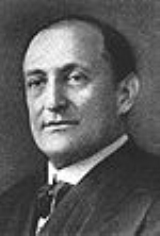
James Clark McReynolds

Encyclopedia
James Clark McReynolds was an American
lawyer
and judge
who served as United States Attorney General
under President
Woodrow Wilson
and as an Associate Justice of the United States Supreme Court. He served on the Court from October 12, 1914 to his retirement on January 31, 1941, and was known for his conservative opinions opposing much of President Franklin D. Roosevelt
's New Deal legislation.
, the son of Dr. John Oliver and Ellen (née Reeves) McReynolds. His parents were both members of the fundamentalist Campbellite
sect of the Disciples of Christ Church. He graduated from the prestigious Green River Academy
and later matriculated at Vanderbilt University
, Nashville, Tennessee
, graduating with status as a valedictorian
in 1882 and graduated from the University of Virginia
School of Law in 1884. He was secretary to Senator Howell Edmunds Jackson
, who later became an associate justice himself. McReynolds practiced law in Nashville and served as Professor of Commercial Law
, Insurance
, & Corporations
at Vanderbilt University Law School
, and ran unsuccessfully for Congress in 1896 as a "Goldbug" Democrat. Under Theodore Roosevelt
he was Assistant Attorney General
from 1903 to 1907, when he resigned to take up private practice in New York City
.
laws, particularly in proceedings against the "Tobacco trust" (see United States v. American Tobacco, 221 U.S. 106 (1911)) and the combination of the anthracite coal
railroads.
On March 15, 1913, McReynolds was appointed the 48th United States Attorney General
by President Wilson, where he remained until August 29, 1914. He earned a reputation as a liberal 'trust buster'. On August 19, 1914, Wilson appointed him to the Supreme Court, to a seat vacated by Horace H. Lurton. McReynolds was confirmed by the United States Senate
and received his commission the same day, starting with the new term on October 12, 1914. When rendering opinions, he was known for conciseness and brevity. His fierce opposition in the face of Franklin Roosevelt's legislation to fight the Great Depression
led to his being labeled one of the "Four Horsemen
", along with George Sutherland
, Willis Van Devanter
and Pierce Butler
. McReynolds voted to strike down: the Tennessee Valley Authority
; the National Industrial Recovery Act
; and the Social Security Act 42 U.S.C.A. § 301 et seq. in Steward Machine Co. v. Davis, 301 U.S. 548, 57 S. Ct. 883, 81 L. Ed. 1279 (1937). He continued to vote against New Deal measures after the Court's 1937 "switch
" to upholding New Deal legislation. Professor Howard Ball called McReynolds "the most strident Court critic of Roosevelt's New Deal programs". When the Supreme Court Building opened in 1935, McReynolds, like most of the other Justices, refused to move his office from his apartment into the new building but continued to work out of the office he maintained at his apartment.
on January 31, 1941, effectively resigning from the court. He lived at the Rochambeau apartment complex in Washington, D.C.
until his death on August 24, 1946, aged 84.
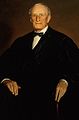 Justice McReynolds wrote two early decisions using the Fourteenth Amendment
to protect civil liberties
: Meyer v. Nebraska
, and Pierce v. Society of Sisters
. Meyer involved a state law that prohibited the teaching of modern foreign languages in public schools. Meyer, who taught German in a Lutheran school, was convicted under this law. McReynolds wrote that the liberty guaranteed by the Due Process Clause of the Fourteenth Amendment included an individual's right "to contract, to engage in any of the common occupations of life, to acquire useful knowledge, to marry, to establish a home and bring up children, to worship God according to the dictates of his conscience, and generally to enjoy privileges, essential to the orderly pursuit of happiness by free men".
Pierce involved a challenge to a law forbidding parents to send their children to any but public schools. Justice McReynolds wrote the opinion for a unanimous Court, holding that the Act violated the liberty of parents to direct the education of their children. McReynolds wrote that "the fundamental liberty upon which all governments in this Union repose excludes any general power of the State to standardize its children by forcing them to accept instruction from public teachers only". These decisions were revived long after McReynolds departed from the bench, to buttress the Court's announcement of a constitutional right to privacy in Griswold v. Connecticut
, and later the constitutional right to abortion in Roe v. Wade
.
McReynolds authored the controversial decision in United States v. Miller
, which was the only Supreme Court case that directly involved the Second Amendment
until District of Columbia v. Heller
in 2008.
In the field of tax law, McReynolds wrote for the Court in Burnet v. Logan
, 283 U.S. 404 (1931), a significant decision setting out the Court's doctrine regarding "open transactions".
McReynolds also wrote the dissent in the Gold Clause Cases
, which required the surrender of all gold coins, gold bullion, and gold certificates to the government by May 1, 1933 under Executive Order 6102, issued by President Franklin Roosevelt.
. Chief Justice William Howard Taft
thought him selfish, prejudiced, "and someone who seems to delight in making others uncomfortable ... [H]e has a continual grouch, and is always offended because the court is doing something that he regards as undignified". Taft also wrote that McReynolds was the most irresponsible member of the Court, and that "[i]n the absence of McReynolds everything went smoothly."
Taft wrote that although he considered McReynolds an "able man", he found him to be "selfish to the last degree... fuller of prejudice than any man I have ever known ... one who delights in making others uncomfortable. He has no sense of duty ... really seems to have less of a loyal spirit to the Court than anybody". Addicted to vacations, in 1929, McReynolds asked Taft to announce opinions assigned to him (McReynolds), explaining that "an imperious voice has called me out of town. I don't think my sudden illness will prove fatal, but strange things some time [sic] happen around Thanksgiving". Duck hunting season had opened and McReynolds was off to Maryland for some shooting. In 1925, he left so suddenly on a similar errand that he had no opportunity to notify the Chief Justice of his departure. Taft was infuriated as two important decisions he wanted to deliver were held up because McReynolds had not handed in a dissent before leaving.
McReynolds would not accept "Jews, drinkers, blacks, women, smokers, married or engaged individuals as law clerks". A blatant anti-Semite, "Time [magazine] called him 'Puritanical', 'intolerably rude', 'savagely sarcastic', 'incredibly reactionary', and 'anti-Semitic'". McReynolds refused to speak to Louis Brandeis
, the first Jew on the Court, for three years following Brandeis's appointment and, when Brandeis retired in 1939, did not sign the customary dedicatory letter sent to justices on their retirement. He habitually left the conference room whenever Brandeis spoke. When Benjamin Cardozo
's appointment was being pressed on President Herbert C. Hoover, McReynolds joined with fellow justices Butler
and Van Devanter
in urging the White House not to "afflict the Court with another Jew". When news of Cardozo's appointment was announced, McReynolds is claimed to have said "Huh, it seems that the only way you can get on the Supreme Court these days is to be either the son of a criminal or a Jew, or both." During Cardozo's swearing-in ceremony, McReynolds pointedly read a newspaper, and would often hold a brief or record in front of his face when Cardozo delivered an opinion from the bench. Likewise, he refused to sign opinions authored by Brandeis.
According to John Frush Knox
(1907–1997), McReynolds's law clerk from 1936–37, and the author of a memoir of his service, McReynolds never spoke to Cardozo at all. McReynolds even absented himself from the memorial ceremonies held at the Supreme Court in honor of Cardozo. He did not attend Felix Frankfurter's
swearing-in, exclaiming "My God, another Jew on the Court!".
In 1922, Taft proposed that members of the Court accompany him to Philadelphia on a ceremonial occasion, but McReynolds refused to go, writing: "As you know, I am not always to be found when there is a Hebrew abroad. Therefore, my 'inability' to attend must not surprise you." McReynolds refused to sit next to Brandeis (where he belonged on the basis of seniority) for the Court photograph in 1924. "The difficulty is with me and me alone," McReynolds wrote Taft. "I have absolutely refused to go through the bore of picture-taking again until there is a change in the Court, and maybe not even then." Taft capitulated, and no photograph was taken that year.
McReynolds odium extended to fellow Justice John Hessin Clarke
. McReynolds' behavior towards Clarke has been cited as a reason for the latter's premature resignation from the Court in 1922. McReynolds refused to sign the joint letter sent to Clarke on his resignation. In a letter, Taft commented that "[t]his is a fair sample of McReynolds's personal character and the difficulty of getting along with him." Once, when another colleague, Harlan Fiske Stone
, remarked to him of an attorney's brief: "That was the dullest argument I ever heard in my life", McReynolds replied: "The only duller thing I can think of is to hear you read one of your opinions."
McReynolds's rudeness was not confined to colleagues on the Court. Once, when called before the chairman of the Golf Committee at the Chevy Chase club after complaints were filed against him, McReynolds said: "I've been a member of this club a good many years, and no one around here has ever shown me any courtesy, so I don't intend to show any to anyone else." The indignant chairman replied: "Mr Justice, you wouldn't be a member of this club if it wasn't for your official position. The members of this club have put up with your discourtesy for years, merely because you are a member of the Supreme Court. But I'm telling you now that the next time there is a complaint against you, you'll be suspended from the privileges of the golf course." Justices Pierce Butler
and Willis Van Devanter
transferred from the Chevy Chase club to Burning Tree
because McReynolds "got disagreeable even beyond their endurance".
When a woman lawyer appeared in the courtroom, McReynolds would reportedly mutter: "I see the female is here again." He would often leave the bench when a woman lawyer rose to present a case. He thought the wearing of wrist watches by men to be effeminate, and the use of red fingernail polish by women to be vulgar.
He forbade smoking in his presence. He is said to have been responsible for the "No Smoking" signs in the Supreme Court building
, which was inaugurated during his tenure. He would announce to any Justice who attempted to smoke in Conference that "tobacco smoke is personally objectionable to me". Any who tried "were stopped at the threshold".
However, he was reportedly "extremely charitable" to the pages who worked at the Court, and had a great love of children. For example, he gave very generous assistance and adopted thirty-three children who were victims of the German bombing of London in 1940, and left a sizable fortune to charity. When Oliver Wendell Holmes
's wife died, McReynolds broke down and wept at her funeral. Holmes wrote in 1926: "Poor McReynolds is, I think, a man of feeling and of more secret kindliness than he would get credit for." He would often entertain at his apartment, and even passed cigarettes to his guests on occasion. He often invited people for brunch on Sunday mornings. According to William O. Douglas
, "[o]n these informal occasions in his own home he was the essence of hospitality and a very delightful companion". Once, when riding to his office on a street car, a drunk got on board and fell out in the aisle. McReynolds picked him up, helped him back to his seat, and sat beside him until they reached the top of Capitol Hill, leaving him only after giving explicit instructions to the conductor. And when due to absence of more senior justices it fell on him to preside in court, "he was the soul of courtesy, graciously greeting and raptly listening to the arguments by lawyers of both sexes".
. Elkton residents fondly remember Justice McReynolds pointing out both his home and office "with great pride and respect".
One of McReynolds' law clerks wrote "... in 1946 he [McReynolds] died a very lonely death in a hospital – without a single friend or relative at his bedside. He was buried in Kentucky, but no member of the Court attended his funeral though one employee of the Court travelled to Kentucky for the services." In contrast, as the clerk noted, McReynolds's aged African-American messenger, Harry Parker, died in 1953, and his funeral was attended by five or six Justices, including the Chief Justice.
; Harvard University Law School in Cambridge, Massachusetts
, Felix Frankfurter
papers; John Knox papers (1920–80), available at the University of Virginia
and Northwestern University
; University of Kentucky
at Lexington, Kentucky
, William Jennings Price (1851–1952) papers; University of Michigan
Bentley Historical Library
at Ann Arbor, Michigan
, Frank Murphy
papers; Minnesota Historical Society
, St. Paul, Minnesota Pierce Butler
papers; Tennessee State Library and Archives
in Nashville, Tennessee
, Robert Boyte Crawford Howell papers;University of Virginia
, Charlottesville, Virginia
, Homer Stille Cummings papers
United States
The United States of America is a federal constitutional republic comprising fifty states and a federal district...
lawyer
Lawyer
A lawyer, according to Black's Law Dictionary, is "a person learned in the law; as an attorney, counsel or solicitor; a person who is practicing law." Law is the system of rules of conduct established by the sovereign government of a society to correct wrongs, maintain the stability of political...
and judge
Judge
A judge is a person who presides over court proceedings, either alone or as part of a panel of judges. The powers, functions, method of appointment, discipline, and training of judges vary widely across different jurisdictions. The judge is supposed to conduct the trial impartially and in an open...
who served as United States Attorney General
United States Attorney General
The United States Attorney General is the head of the United States Department of Justice concerned with legal affairs and is the chief law enforcement officer of the United States government. The attorney general is considered to be the chief lawyer of the U.S. government...
under President
President of the United States
The President of the United States of America is the head of state and head of government of the United States. The president leads the executive branch of the federal government and is the commander-in-chief of the United States Armed Forces....
Woodrow Wilson
Woodrow Wilson
Thomas Woodrow Wilson was the 28th President of the United States, from 1913 to 1921. A leader of the Progressive Movement, he served as President of Princeton University from 1902 to 1910, and then as the Governor of New Jersey from 1911 to 1913...
and as an Associate Justice of the United States Supreme Court. He served on the Court from October 12, 1914 to his retirement on January 31, 1941, and was known for his conservative opinions opposing much of President Franklin D. Roosevelt
Franklin D. Roosevelt
Franklin Delano Roosevelt , also known by his initials, FDR, was the 32nd President of the United States and a central figure in world events during the mid-20th century, leading the United States during a time of worldwide economic crisis and world war...
's New Deal legislation.
Early life
Born in Elkton, KentuckyElkton, Kentucky
Elkton is a city in and the county seat of Todd County, Kentucky, United States. The population was 1,984 at the 2000 census. The city was founded by Major John Gray...
, the son of Dr. John Oliver and Ellen (née Reeves) McReynolds. His parents were both members of the fundamentalist Campbellite
Christian Church (Disciples of Christ)
The Christian Church is a Mainline Protestant denomination in North America. It is often referred to as The Christian Church, The Disciples of Christ, or more simply as The Disciples...
sect of the Disciples of Christ Church. He graduated from the prestigious Green River Academy
Green River Female Academy
The Green River Female Academy in Todd County, Kentucky is one of the best physical representations of early women's rights in the United States and is an example of early Kentucky Federal and Greek Revival architecture....
and later matriculated at Vanderbilt University
Vanderbilt University
Vanderbilt University is a private research university located in Nashville, Tennessee, United States. Founded in 1873, the university is named for shipping and rail magnate "Commodore" Cornelius Vanderbilt, who provided Vanderbilt its initial $1 million endowment despite having never been to the...
, Nashville, Tennessee
Nashville, Tennessee
Nashville is the capital of the U.S. state of Tennessee and the county seat of Davidson County. It is located on the Cumberland River in Davidson County, in the north-central part of the state. The city is a center for the health care, publishing, banking and transportation industries, and is home...
, graduating with status as a valedictorian
Valedictorian
Valedictorian is an academic title conferred upon the student who delivers the closing or farewell statement at a graduation ceremony. Usually, the valedictorian is the highest ranked student among those graduating from an educational institution...
in 1882 and graduated from the University of Virginia
University of Virginia
The University of Virginia is a public research university located in Charlottesville, Virginia, United States, founded by Thomas Jefferson...
School of Law in 1884. He was secretary to Senator Howell Edmunds Jackson
Howell Edmunds Jackson
Howell Edmunds Jackson was an American jurist and politician. He served on the United States Supreme Court, in the U.S. Senate, United States Court of Appeals for the Sixth Circuit, and the Tennessee House of Representatives. He authored notable opinions on the Interstate Commerce Act and the...
, who later became an associate justice himself. McReynolds practiced law in Nashville and served as Professor of Commercial Law
Commercial law
Commercial law is the body of law that governs business and commercial transactions...
, Insurance
Insurance law
Insurance law is the name given to practices of law surrounding insurance, including insurance policies and claims. It can be broadly broken into three categories - regulation of the business of insurance; regulation of the content of insurance policies, especially with regard to consumer...
, & Corporations
Corporations law
Companies law is the field of law concerning companies and other business organizations. This includes corporations, partnerships and other associations which usually carry on some form of economic or charitable activity. The most prominent kind of company, usually referred to as a "corporation",...
at Vanderbilt University Law School
Vanderbilt University Law School
Vanderbilt University Law School is a graduate school of Vanderbilt University. Established in 1874, it is one of the oldest law schools in the southern United States. Vanderbilt Law has consistently ranked among the top 20 law schools in the nation, and is currently ranked 16th in the 2012...
, and ran unsuccessfully for Congress in 1896 as a "Goldbug" Democrat. Under Theodore Roosevelt
Theodore Roosevelt
Theodore "Teddy" Roosevelt was the 26th President of the United States . He is noted for his exuberant personality, range of interests and achievements, and his leadership of the Progressive Movement, as well as his "cowboy" persona and robust masculinity...
he was Assistant Attorney General
United States Assistant Attorney General
Many of the divisions and offices of the United States Department of Justice are headed by an Assistant Attorney General.The President of the United States appoints individuals to the position of Assistant Attorney General with the advice and consent of the Senate...
from 1903 to 1907, when he resigned to take up private practice in New York City
New York City
New York is the most populous city in the United States and the center of the New York Metropolitan Area, one of the most populous metropolitan areas in the world. New York exerts a significant impact upon global commerce, finance, media, art, fashion, research, technology, education, and...
.
Attorney General and Supreme Court tenure
While in private practice, he was retained by the Government in matters relating to enforcement of antitrustAntitrust
The United States antitrust law is a body of laws that prohibits anti-competitive behavior and unfair business practices. Antitrust laws are intended to encourage competition in the marketplace. These competition laws make illegal certain practices deemed to hurt businesses or consumers or both,...
laws, particularly in proceedings against the "Tobacco trust" (see United States v. American Tobacco, 221 U.S. 106 (1911)) and the combination of the anthracite coal
Anthracite coal
Anthracite is a hard, compact variety of mineral coal that has a high luster...
railroads.
On March 15, 1913, McReynolds was appointed the 48th United States Attorney General
United States Attorney General
The United States Attorney General is the head of the United States Department of Justice concerned with legal affairs and is the chief law enforcement officer of the United States government. The attorney general is considered to be the chief lawyer of the U.S. government...
by President Wilson, where he remained until August 29, 1914. He earned a reputation as a liberal 'trust buster'. On August 19, 1914, Wilson appointed him to the Supreme Court, to a seat vacated by Horace H. Lurton. McReynolds was confirmed by the United States Senate
United States Senate
The United States Senate is the upper house of the bicameral legislature of the United States, and together with the United States House of Representatives comprises the United States Congress. The composition and powers of the Senate are established in Article One of the U.S. Constitution. Each...
and received his commission the same day, starting with the new term on October 12, 1914. When rendering opinions, he was known for conciseness and brevity. His fierce opposition in the face of Franklin Roosevelt's legislation to fight the Great Depression
Great Depression
The Great Depression was a severe worldwide economic depression in the decade preceding World War II. The timing of the Great Depression varied across nations, but in most countries it started in about 1929 and lasted until the late 1930s or early 1940s...
led to his being labeled one of the "Four Horsemen
Four Horsemen (Supreme Court)
The "Four Horsemen" was the nickname given by the press to four conservative members of the United States Supreme Court during the 1932–1937 terms, who opposed the New Deal agenda of President Franklin Roosevelt. They were Justices Pierce Butler, James Clark McReynolds, George Sutherland,...
", along with George Sutherland
George Sutherland
Alexander George Sutherland was an English-born U.S. jurist and political figure. One of four appointments to the Supreme Court by President Warren G. Harding, he served as an Associate Justice of the U.S...
, Willis Van Devanter
Willis Van Devanter
Willis Van Devanter was an Associate Justice of the United States Supreme Court, January 3, 1911 to June 2, 1937.- Early life and career :...
and Pierce Butler
Pierce Butler (justice)
Pierce Butler was an American jurist who served as an Associate Justice of the Supreme Court of the United States from 1923 until his death in 1939...
. McReynolds voted to strike down: the Tennessee Valley Authority
Tennessee Valley Authority
The Tennessee Valley Authority is a federally owned corporation in the United States created by congressional charter in May 1933 to provide navigation, flood control, electricity generation, fertilizer manufacturing, and economic development in the Tennessee Valley, a region particularly affected...
; the National Industrial Recovery Act
National Industrial Recovery Act
The National Industrial Recovery Act , officially known as the Act of June 16, 1933 The National Industrial Recovery Act (NIRA), officially known as the Act of June 16, 1933 The National Industrial Recovery Act (NIRA), officially known as the Act of June 16, 1933 (Ch. 90, 48 Stat. 195, formerly...
; and the Social Security Act 42 U.S.C.A. § 301 et seq. in Steward Machine Co. v. Davis, 301 U.S. 548, 57 S. Ct. 883, 81 L. Ed. 1279 (1937). He continued to vote against New Deal measures after the Court's 1937 "switch
The switch in time that saved nine
“The switch in time that saved nine” is the name given to what was perceived as the sudden jurisprudential shift by Associate Justice Owen J. Roberts of the U.S. Supreme Court in West Coast Hotel Co. v. Parrish...
" to upholding New Deal legislation. Professor Howard Ball called McReynolds "the most strident Court critic of Roosevelt's New Deal programs". When the Supreme Court Building opened in 1935, McReynolds, like most of the other Justices, refused to move his office from his apartment into the new building but continued to work out of the office he maintained at his apartment.
Retirement and death
After a substantial hearing loss, he assumed senior statusSenior status
Senior status is a form of semi-retirement for United States federal judges, and judges in some state court systems. After federal judges have reached a certain combination of age and years of service on the federal courts, they are allowed to assume senior status...
on January 31, 1941, effectively resigning from the court. He lived at the Rochambeau apartment complex in Washington, D.C.
Washington, D.C.
Washington, D.C., formally the District of Columbia and commonly referred to as Washington, "the District", or simply D.C., is the capital of the United States. On July 16, 1790, the United States Congress approved the creation of a permanent national capital as permitted by the U.S. Constitution....
until his death on August 24, 1946, aged 84.
Important opinions
Fourteenth Amendment to the United States Constitution
The Fourteenth Amendment to the United States Constitution was adopted on July 9, 1868, as one of the Reconstruction Amendments.Its Citizenship Clause provides a broad definition of citizenship that overruled the Dred Scott v...
to protect civil liberties
Civil liberties
Civil liberties are rights and freedoms that provide an individual specific rights such as the freedom from slavery and forced labour, freedom from torture and death, the right to liberty and security, right to a fair trial, the right to defend one's self, the right to own and bear arms, the right...
: Meyer v. Nebraska
Meyer v. Nebraska
Meyer v. Nebraska, 262 U.S. 390 , was a U.S. Supreme Court case that held that a 1919 Nebraska law restricting foreign-language education violated the Due Process clause of the Fourteenth Amendment.-Context and legislation:...
, and Pierce v. Society of Sisters
Pierce v. Society of Sisters
Pierce v. Society of Sisters of the Holy Names of Jesus and Mary, , was an early 20th century United States Supreme Court decision that significantly expanded coverage of the Due Process Clause in the Fourteenth Amendment to the United States Constitution. The case has been cited as a precedent in...
. Meyer involved a state law that prohibited the teaching of modern foreign languages in public schools. Meyer, who taught German in a Lutheran school, was convicted under this law. McReynolds wrote that the liberty guaranteed by the Due Process Clause of the Fourteenth Amendment included an individual's right "to contract, to engage in any of the common occupations of life, to acquire useful knowledge, to marry, to establish a home and bring up children, to worship God according to the dictates of his conscience, and generally to enjoy privileges, essential to the orderly pursuit of happiness by free men".
Pierce involved a challenge to a law forbidding parents to send their children to any but public schools. Justice McReynolds wrote the opinion for a unanimous Court, holding that the Act violated the liberty of parents to direct the education of their children. McReynolds wrote that "the fundamental liberty upon which all governments in this Union repose excludes any general power of the State to standardize its children by forcing them to accept instruction from public teachers only". These decisions were revived long after McReynolds departed from the bench, to buttress the Court's announcement of a constitutional right to privacy in Griswold v. Connecticut
Griswold v. Connecticut
Griswold v. Connecticut, , was a landmark case in which the Supreme Court of the United States ruled that the Constitution protected a right to privacy. The case involved a Connecticut law that prohibited the use of contraceptives...
, and later the constitutional right to abortion in Roe v. Wade
Roe v. Wade
Roe v. Wade, , was a controversial landmark decision by the United States Supreme Court on the issue of abortion. The Court decided that a right to privacy under the due process clause in the Fourteenth Amendment to the United States Constitution extends to a woman's decision to have an abortion,...
.
McReynolds authored the controversial decision in United States v. Miller
United States v. Miller
United States v. Miller, 307 U.S. 174 , was the first Supreme Court of the United States decision to involve the Second Amendment to the United States Constitution. Miller is a controversial decision in the ongoing American gun politics debate, as both sides claim that it supports their...
, which was the only Supreme Court case that directly involved the Second Amendment
Second Amendment to the United States Constitution
The Second Amendment to the United States Constitution is the part of the United States Bill of Rights that protects the right of the people to keep and bear arms. It was adopted on December 15, 1791, along with the rest of the Bill of Rights.In 2008 and 2010, the Supreme Court issued two Second...
until District of Columbia v. Heller
District of Columbia v. Heller
District of Columbia v. Heller, 554 U.S. 570 , was a landmark case in which the Supreme Court of the United States held that the Second Amendment to the United States Constitution protects an individual's right to possess a firearm for traditionally lawful purposes in federal enclaves, such as...
in 2008.
In the field of tax law, McReynolds wrote for the Court in Burnet v. Logan
Burnet v. Logan
Burnet v. Logan, , 51 S.Ct. 550, 75 L.Ed. 1143 was a case before the United States Supreme Court.- Facts :Respondent, Mrs. Logan, prior to March, 1913 and until March 11, 1916, owned shares in Andrews & Hitchcock Iron Company which in turn held 12% in the Mahoning Ore & Steel Company which mined...
, 283 U.S. 404 (1931), a significant decision setting out the Court's doctrine regarding "open transactions".
McReynolds also wrote the dissent in the Gold Clause Cases
Gold Clause Cases
The Gold Clause Cases were a series of actions brought before the Supreme Court of the United States, in which the court narrowly upheld restrictions on the ownership of gold implemented by the administration of U.S. President Franklin D. Roosevelt in order to fight the Great Depression. The cases...
, which required the surrender of all gold coins, gold bullion, and gold certificates to the government by May 1, 1933 under Executive Order 6102, issued by President Franklin Roosevelt.
Personality and conflicts
McReynolds was labeled "Scrooge" by journalist Drew PearsonDrew Pearson (journalist)
Andrew Russell Pearson , known professionally as Drew Pearson, was one of the best-known American columnists of his day, noted for his muckraking syndicated newspaper column "Washington Merry-Go-Round," in which he attacked various public persons, sometimes with little or no objective proof for his...
. Chief Justice William Howard Taft
William Howard Taft
William Howard Taft was the 27th President of the United States and later the tenth Chief Justice of the United States...
thought him selfish, prejudiced, "and someone who seems to delight in making others uncomfortable ... [H]e has a continual grouch, and is always offended because the court is doing something that he regards as undignified". Taft also wrote that McReynolds was the most irresponsible member of the Court, and that "[i]n the absence of McReynolds everything went smoothly."
Taft wrote that although he considered McReynolds an "able man", he found him to be "selfish to the last degree... fuller of prejudice than any man I have ever known ... one who delights in making others uncomfortable. He has no sense of duty ... really seems to have less of a loyal spirit to the Court than anybody". Addicted to vacations, in 1929, McReynolds asked Taft to announce opinions assigned to him (McReynolds), explaining that "an imperious voice has called me out of town. I don't think my sudden illness will prove fatal, but strange things some time [sic] happen around Thanksgiving". Duck hunting season had opened and McReynolds was off to Maryland for some shooting. In 1925, he left so suddenly on a similar errand that he had no opportunity to notify the Chief Justice of his departure. Taft was infuriated as two important decisions he wanted to deliver were held up because McReynolds had not handed in a dissent before leaving.
McReynolds would not accept "Jews, drinkers, blacks, women, smokers, married or engaged individuals as law clerks". A blatant anti-Semite, "Time [magazine] called him 'Puritanical', 'intolerably rude', 'savagely sarcastic', 'incredibly reactionary', and 'anti-Semitic'". McReynolds refused to speak to Louis Brandeis
Louis Brandeis
Louis Dembitz Brandeis ; November 13, 1856 – October 5, 1941) was an Associate Justice on the Supreme Court of the United States from 1916 to 1939.He was born in Louisville, Kentucky, to Jewish immigrant parents who raised him in a secular mode...
, the first Jew on the Court, for three years following Brandeis's appointment and, when Brandeis retired in 1939, did not sign the customary dedicatory letter sent to justices on their retirement. He habitually left the conference room whenever Brandeis spoke. When Benjamin Cardozo
Benjamin N. Cardozo
Benjamin Nathan Cardozo was a well-known American lawyer and associate Supreme Court Justice. Cardozo is remembered for his significant influence on the development of American common law in the 20th century, in addition to his modesty, philosophy, and vivid prose style...
's appointment was being pressed on President Herbert C. Hoover, McReynolds joined with fellow justices Butler
Pierce Butler (justice)
Pierce Butler was an American jurist who served as an Associate Justice of the Supreme Court of the United States from 1923 until his death in 1939...
and Van Devanter
Willis Van Devanter
Willis Van Devanter was an Associate Justice of the United States Supreme Court, January 3, 1911 to June 2, 1937.- Early life and career :...
in urging the White House not to "afflict the Court with another Jew". When news of Cardozo's appointment was announced, McReynolds is claimed to have said "Huh, it seems that the only way you can get on the Supreme Court these days is to be either the son of a criminal or a Jew, or both." During Cardozo's swearing-in ceremony, McReynolds pointedly read a newspaper, and would often hold a brief or record in front of his face when Cardozo delivered an opinion from the bench. Likewise, he refused to sign opinions authored by Brandeis.
According to John Frush Knox
John Frush Knox
John Frush Knox served as secretary and law clerk to United States Supreme Court Justice James Clark McReynolds from 1936 to 1937. He is chiefly known for his memoir of that experience.- Early life :...
(1907–1997), McReynolds's law clerk from 1936–37, and the author of a memoir of his service, McReynolds never spoke to Cardozo at all. McReynolds even absented himself from the memorial ceremonies held at the Supreme Court in honor of Cardozo. He did not attend Felix Frankfurter's
Felix Frankfurter
Felix Frankfurter was an Associate Justice of the United States Supreme Court.-Early life:Frankfurter was born into a Jewish family on November 15, 1882, in Vienna, Austria, then part of the Austro-Hungarian Empire in Europe. He was the third of six children of Leopold and Emma Frankfurter...
swearing-in, exclaiming "My God, another Jew on the Court!".
In 1922, Taft proposed that members of the Court accompany him to Philadelphia on a ceremonial occasion, but McReynolds refused to go, writing: "As you know, I am not always to be found when there is a Hebrew abroad. Therefore, my 'inability' to attend must not surprise you." McReynolds refused to sit next to Brandeis (where he belonged on the basis of seniority) for the Court photograph in 1924. "The difficulty is with me and me alone," McReynolds wrote Taft. "I have absolutely refused to go through the bore of picture-taking again until there is a change in the Court, and maybe not even then." Taft capitulated, and no photograph was taken that year.
McReynolds odium extended to fellow Justice John Hessin Clarke
John Hessin Clarke
John Hessin Clarke was an American lawyer and judge who served as an Associate Justice of the United States Supreme Court from 1916 to 1922.-Early life:...
. McReynolds' behavior towards Clarke has been cited as a reason for the latter's premature resignation from the Court in 1922. McReynolds refused to sign the joint letter sent to Clarke on his resignation. In a letter, Taft commented that "[t]his is a fair sample of McReynolds's personal character and the difficulty of getting along with him." Once, when another colleague, Harlan Fiske Stone
Harlan Fiske Stone
Harlan Fiske Stone was an American lawyer and jurist. A native of New Hampshire, he served as the dean of Columbia Law School, his alma mater, in the early 20th century. As a member of the Republican Party, he was appointed as the 52nd Attorney General of the United States before becoming an...
, remarked to him of an attorney's brief: "That was the dullest argument I ever heard in my life", McReynolds replied: "The only duller thing I can think of is to hear you read one of your opinions."
McReynolds's rudeness was not confined to colleagues on the Court. Once, when called before the chairman of the Golf Committee at the Chevy Chase club after complaints were filed against him, McReynolds said: "I've been a member of this club a good many years, and no one around here has ever shown me any courtesy, so I don't intend to show any to anyone else." The indignant chairman replied: "Mr Justice, you wouldn't be a member of this club if it wasn't for your official position. The members of this club have put up with your discourtesy for years, merely because you are a member of the Supreme Court. But I'm telling you now that the next time there is a complaint against you, you'll be suspended from the privileges of the golf course." Justices Pierce Butler
Pierce Butler (justice)
Pierce Butler was an American jurist who served as an Associate Justice of the Supreme Court of the United States from 1923 until his death in 1939...
and Willis Van Devanter
Willis Van Devanter
Willis Van Devanter was an Associate Justice of the United States Supreme Court, January 3, 1911 to June 2, 1937.- Early life and career :...
transferred from the Chevy Chase club to Burning Tree
Burning Tree Club
Burning Tree Club is a private, all-male golf club in Bethesda, Maryland. Membership in the club is extremely exclusive. The course at Burning Tree has been played by numerous presidents, foreign dignitaries, high-ranking executive officials, members of Congress, and military leaders...
because McReynolds "got disagreeable even beyond their endurance".
When a woman lawyer appeared in the courtroom, McReynolds would reportedly mutter: "I see the female is here again." He would often leave the bench when a woman lawyer rose to present a case. He thought the wearing of wrist watches by men to be effeminate, and the use of red fingernail polish by women to be vulgar.
He forbade smoking in his presence. He is said to have been responsible for the "No Smoking" signs in the Supreme Court building
United States Supreme Court building
The Supreme Court Building is the seat of the Supreme Court of the United States. It is situated in Washington, D.C. at 1 First Street, NE, on the block immediately east of the United States Capitol. The building is under the jurisdiction of the Architect of the Capitol. On May 4, 1987, the Supreme...
, which was inaugurated during his tenure. He would announce to any Justice who attempted to smoke in Conference that "tobacco smoke is personally objectionable to me". Any who tried "were stopped at the threshold".
However, he was reportedly "extremely charitable" to the pages who worked at the Court, and had a great love of children. For example, he gave very generous assistance and adopted thirty-three children who were victims of the German bombing of London in 1940, and left a sizable fortune to charity. When Oliver Wendell Holmes
Oliver Wendell Holmes, Jr.
Oliver Wendell Holmes, Jr. was an American jurist who served as an Associate Justice of the Supreme Court of the United States from 1902 to 1932...
's wife died, McReynolds broke down and wept at her funeral. Holmes wrote in 1926: "Poor McReynolds is, I think, a man of feeling and of more secret kindliness than he would get credit for." He would often entertain at his apartment, and even passed cigarettes to his guests on occasion. He often invited people for brunch on Sunday mornings. According to William O. Douglas
William O. Douglas
William Orville Douglas was an Associate Justice of the United States Supreme Court. With a term lasting 36 years and 209 days, he is the longest-serving justice in the history of the Supreme Court...
, "[o]n these informal occasions in his own home he was the essence of hospitality and a very delightful companion". Once, when riding to his office on a street car, a drunk got on board and fell out in the aisle. McReynolds picked him up, helped him back to his seat, and sat beside him until they reached the top of Capitol Hill, leaving him only after giving explicit instructions to the conductor. And when due to absence of more senior justices it fell on him to preside in court, "he was the soul of courtesy, graciously greeting and raptly listening to the arguments by lawyers of both sexes".
Legacy
McReynolds was buried in the Elkton Cemetery in Elkton, KentuckyElkton, Kentucky
Elkton is a city in and the county seat of Todd County, Kentucky, United States. The population was 1,984 at the 2000 census. The city was founded by Major John Gray...
. Elkton residents fondly remember Justice McReynolds pointing out both his home and office "with great pride and respect".
One of McReynolds' law clerks wrote "... in 1946 he [McReynolds] died a very lonely death in a hospital – without a single friend or relative at his bedside. He was buried in Kentucky, but no member of the Court attended his funeral though one employee of the Court travelled to Kentucky for the services." In contrast, as the clerk noted, McReynolds's aged African-American messenger, Harry Parker, died in 1953, and his funeral was attended by five or six Justices, including the Chief Justice.
Papers
McReynolds' papers are held at many libraries around the country, namely: mainly at the University of Virginia Law School in Charlottesville, VirginiaCharlottesville, Virginia
Charlottesville is an independent city geographically surrounded by but separate from Albemarle County in the Commonwealth of Virginia, United States, and named after Charlotte of Mecklenburg-Strelitz, the queen consort of King George III of the United Kingdom.The official population estimate for...
; Harvard University Law School in Cambridge, Massachusetts
Cambridge, Massachusetts
Cambridge is a city in Middlesex County, Massachusetts, United States, in the Greater Boston area. It was named in honor of the University of Cambridge in England, an important center of the Puritan theology embraced by the town's founders. Cambridge is home to two of the world's most prominent...
, Felix Frankfurter
Felix Frankfurter
Felix Frankfurter was an Associate Justice of the United States Supreme Court.-Early life:Frankfurter was born into a Jewish family on November 15, 1882, in Vienna, Austria, then part of the Austro-Hungarian Empire in Europe. He was the third of six children of Leopold and Emma Frankfurter...
papers; John Knox papers (1920–80), available at the University of Virginia
University of Virginia
The University of Virginia is a public research university located in Charlottesville, Virginia, United States, founded by Thomas Jefferson...
and Northwestern University
Northwestern University
Northwestern University is a private research university in Evanston and Chicago, Illinois, USA. Northwestern has eleven undergraduate, graduate, and professional schools offering 124 undergraduate degrees and 145 graduate and professional degrees....
; University of Kentucky
University of Kentucky
The University of Kentucky, also known as UK, is a public co-educational university and is one of the state's two land-grant universities, located in Lexington, Kentucky...
at Lexington, Kentucky
Lexington, Kentucky
Lexington is the second-largest city in Kentucky and the 63rd largest in the US. Known as the "Thoroughbred City" and the "Horse Capital of the World", it is located in the heart of Kentucky's Bluegrass region...
, William Jennings Price (1851–1952) papers; University of Michigan
University of Michigan
The University of Michigan is a public research university located in Ann Arbor, Michigan in the United States. It is the state's oldest university and the flagship campus of the University of Michigan...
Bentley Historical Library
Bentley Historical Library
The Bentley Historical Library is a historical library located on the University of Michigan's North Campus in Ann Arbor. It was established in 1935 by the regents of the University of Michigan...
at Ann Arbor, Michigan
Ann Arbor, Michigan
Ann Arbor is a city in the U.S. state of Michigan and the county seat of Washtenaw County. The 2010 census places the population at 113,934, making it the sixth largest city in Michigan. The Ann Arbor Metropolitan Statistical Area had a population of 344,791 as of 2010...
, Frank Murphy
Frank Murphy
William Francis Murphy was a politician and jurist from Michigan. He served as First Assistant U.S. District Attorney, Eastern Michigan District , Recorder's Court Judge, Detroit . Mayor of Detroit , the last Governor-General of the Philippines , U.S...
papers; Minnesota Historical Society
Minnesota Historical Society
The Minnesota Historical Society is a private, non-profit educational and cultural institution dedicated to preserving the history of the U.S. state of Minnesota. It was founded by the territorial legislature in 1849, almost a decade before statehood. The Society is named in the Minnesota...
, St. Paul, Minnesota Pierce Butler
Pierce Butler (justice)
Pierce Butler was an American jurist who served as an Associate Justice of the Supreme Court of the United States from 1923 until his death in 1939...
papers; Tennessee State Library and Archives
Tennessee State Library and Archives
The Tennessee State Library and Archives , established in 1854, currently operates as a unit of the Tennessee Department of State. According to the Tennessee Blue Book, the Library and Archives "collects and preserves books and records of historical, documentary and reference value, and encourages...
in Nashville, Tennessee
Nashville, Tennessee
Nashville is the capital of the U.S. state of Tennessee and the county seat of Davidson County. It is located on the Cumberland River in Davidson County, in the north-central part of the state. The city is a center for the health care, publishing, banking and transportation industries, and is home...
, Robert Boyte Crawford Howell papers;University of Virginia
University of Virginia
The University of Virginia is a public research university located in Charlottesville, Virginia, United States, founded by Thomas Jefferson...
, Charlottesville, Virginia
Charlottesville, Virginia
Charlottesville is an independent city geographically surrounded by but separate from Albemarle County in the Commonwealth of Virginia, United States, and named after Charlotte of Mecklenburg-Strelitz, the queen consort of King George III of the United Kingdom.The official population estimate for...
, Homer Stille Cummings papers
See also
- Demographics of the Supreme Court of the United StatesDemographics of the Supreme Court of the United StatesThe demographics of the Supreme Court of the United States encompass the gender, ethnic, religious, geographic, and economic backgrounds of the 112 justices appointed to the Supreme Court. Certain of these characteristics have been raised as an issue since the Court was established in 1789. For its...
- List of Justices of the Supreme Court of the United States
- List of law clerks of the Supreme Court of the United States
- List of United States Chief Justices by time in office
- List of U.S. Supreme Court Justices by time in office
- United States Supreme Court cases during the Hughes Court
- United States Supreme Court cases during the Taft Court
- United States Supreme Court cases during the White Court
Sources
- McReynolds, James Clark, American National BiographyAmerican National BiographyThe American National Biography is a 24 volume biographical encyclopedia set containing approximately 17,400 entries and 20 million words, first published in 1999 by Oxford University Press under the auspices of the American Council of Learned Societies. A 400-entry supplement appeared in 2002...
. - Bibliography on James Clark McReynolds at 6th Circuit United States Court of AppealsUnited States court of appealsThe United States courts of appeals are the intermediate appellate courts of the United States federal court system...
. - Biographical Dictionary of the Federal Judiciary. Detroit: Gale Research, 1976.
- "McReynolds, James Clark, Dictionary of American BiographyDictionary of American BiographyThe Dictionary of American Biography was published in New York City by Charles Scribner's Sons under the auspices of the American Council of Learned Societies. The first edition was published in 20 volumes from 1928 to 1936. These 20 volumes contained 15,000 biographies...
. - Hall, Kermit L. (2005) "McReynolds, James Clark." The Oxford Companion to the Supreme Court of the United States. Oxford Oxfordshire: Oxford University Press 1150 pp. ISBN 9780641997792; ISBN 0641997795.
External links
- Ariens, Michael, James C. McReynolds.
- Biography, James Clark McReynolds at 6th Circuit U.S. Court of Appeals.
- Oyez ProjectOyez.orgThe Oyez Project at the Chicago-Kent College of Law is an unofficial online multimedia archive of the Supreme Court of the United States, especially audio of oral arguments...
, Official Supreme Court media, James C. McReynolds. - Public Broadcasting ServicePublic Broadcasting ServiceThe Public Broadcasting Service is an American non-profit public broadcasting television network with 354 member TV stations in the United States which hold collective ownership. Its headquarters is in Arlington, Virginia....
James Clark McReynolds, Supreme Court History, Law, Power & Personality, Biographies of the Robes. - Supreme Court Historical SocietySupreme Court Historical SocietyThe Supreme Court Historical Society is a private, non-profit organization dedicated to preserving and communicating the history of the U.S. Supreme Court.-History:...
, James C. McReynolds.