


James A. Garfield assassination

Encyclopedia
James A. Garfield was shot in Washington, D.C.
on July 2, 1881 by Charles J. Guiteau
at 9:30 a.m., less than four months after taking office as the twentieth President of the United States
. Garfield died eleven weeks later on September 19, 1881, the second of four Presidents to be assassinated, following Abraham Lincoln
and preceding William McKinley
and John F. Kennedy
. His Vice President
, Chester Arthur, succeeded Garfield as President.
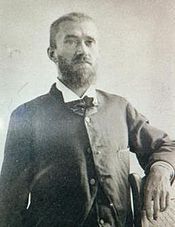 Charles Guiteau turned to politics after he failed in several ventures: theology, a law practice, bill collecting, time in the Oneida Community
. He wrote a speech in support of Ulysses S. Grant
called "Grant vs. Hancock", which he later revised to "Garfield vs. Hancock" after Garfield won the Republican nomination in the 1880 presidential campaign. Guiteau never delivered the speech in a public setting, instead printing up several hundred copies, but he believed that this speech along with his other efforts were largely responsible for Garfield's narrow victory over Winfield S. Hancock
in the election of 1880
. Guiteau believed he should be awarded a diplomatic post for his vital assistance, first asking for Vienna
, then settling for Paris
. He loitered around Republican headquarters in New York City during the 1880 campaign
, expecting rewards for his effort, to no avail. Still believing he would be rewarded, Guiteau arrived in Washington on March 5, 1881, the day after Garfield's inauguration, and obtained entrance to the White House and saw the President on March 8, 1881, dropping off a copy of his speech. He spent the next two months roaming around Washington, shuffling back and forth between the State Department and the White House, approaching various Cabinet members and other prominent Republicans and seeking support, to no avail. Guiteau was destitute and increasingly slovenly due to wearing the same clothes every day, the only clothes he owned, but he did not give up. On May 13, 1881, he was banned from the White House waiting room. On May 14, 1881, Secretary of State
James G. Blaine
told him never to return: "Never speak to me again of the Paris consulship as long as you live."
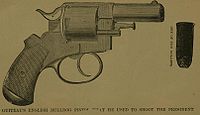 After this encounter, Guiteau decided that he had been commanded by God, he is quoted in saying, "I leave my justification to God..." to kill the ungrateful President. Guiteau borrowed $15 and went to purchase a revolver
. He knew little about firearms, but knew that he would need a large caliber gun. He chose to buy an ivory-handled .44 Webley British Bulldog revolver
over a similar wooden-handled Webley because he thought it would look good as a museum exhibit after the assassination. (The revolver was recovered and displayed by the Smithsonian in the early 1900s but has since been lost.) He spent the next few weeks in target practice—the kick from the revolver almost knocked him over the first time—and stalking the President. He wrote a letter to Garfield, saying that he should fire Blaine, or "you and the Republican party will come to grief." The letter was ignored, as was all the correspondence Guiteau sent to the White House.
Guiteau continued to prepare carefully, writing a letter in advance to Commanding General of the United States Army
William Sherman asking for protection from the mob, and writing other letters justifying his action as necessary to heal dissension between factions of the Republican Party
. He went to the District of Columbia jail, asking for a tour of the facility to see where he'd be incarcerated. (He was told to come back later.) Guiteau spent the whole month of June following Garfield around Washington. On one occasion, he trailed Garfield to the railway station as the President was seeing his wife off to a beach resort in Long Branch, New Jersey
, but he decided to shoot him later, as Mrs. Garfield
was in poor health and he did not want to upset her.
President Garfield came to the Sixth Street Station on his way to his alma mater
, Williams College
, where he was scheduled to deliver a speech. Garfield was accompanied by two of his sons, James
and Harry
, and Secretary of State
Blaine
. Secretary of War
Robert Todd Lincoln
waited at the station to see the President off. Garfield had no bodyguard or security detail; with the exception of Abraham Lincoln during the Civil War, early U.S. presidents never used any guards.
As President Garfield entered the waiting room of the station Guiteau stepped forward and pulled the trigger from behind at point-blank range. "My God, what is that?" Garfield cried out, flinging up his arms. Guiteau fired again and Garfield collapsed. One bullet grazed Garfield's shoulder; the other lodged in his spine in the first lumbar vertebra
, missing the spinal cord
.
Guiteau put his pistol back in his pocket and turned to leave the station for the cab he had waiting outside, but he was apprehended before he could leave by policeman Patrick Kearney, who was so excited at having arrested the man who shot the president that he neglected to take Guiteau's gun from him until after their arrival at the police station. The rapidly gathering crowd screamed "Lynch him!" but Kearney took Guiteau to the police station a few blocks away. As he surrendered to authorities, Guiteau uttered the exulting words, repeated everywhere: "'I am a Stalwart of the Stalwarts! I did it and I want to be arrested! Arthur
is President now!'" This statement briefly led to unfounded suspicions that Arthur or his supporters had put Guiteau up to the crime. The Stalwarts were a Republican faction loyal to ex-President Grant; they strongly opposed Garfield's Half-Breed
s. Like many Vice Presidents, Arthur was chosen for political advantage, to placate his faction, rather than for skills or loyalty to his running-mate. Guiteau, in his delusion, had convinced himself that he was striking a blow to unite the two factions of the Republican Party.
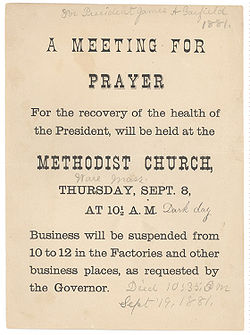 Garfield, conscious but in shock, was carried to an upstairs floor of the train station. One bullet remained lodged in his body, but doctors could not find it. Young Jim Garfield and James Blaine both broke down and wept. Robert Todd Lincoln, deeply upset and thinking back to the death of his father, said "How many hours of sorrow I have passed in this town."
Garfield was carried back to the White House. Although doctors told him that he would not survive the night, the President remained conscious and alert. The next morning his vital signs were good and doctors began to hope for recovery. A long vigil began, with Garfield's doctors issuing regular bulletins that the American public followed closely throughout the summer of 1881. His condition fluctuated. Fevers came and went. Garfield struggled to keep down solid food and spent most of the summer eating little, and that only liquids.
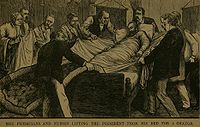 In an effort to relieve the sick man from the heat of a Washington summer, Navy engineers rigged up an early version of the modern air conditioner. Fans blew air over a large box of ice and into the President's sickroom; the device worked well enough to lower the temperature twenty degrees. Doctors continued to probe Garfield's wound with dirty, unsterilized fingers and instruments, attempting to find the location of the bullet. Alexander Graham Bell
devised a metal detector
specifically for the purpose of finding the bullet lodged inside Garfield, but the metal bed frame on which Garfield lay made the instrument malfunction. Because metal bed frames were relatively rare, the cause of the instrument's deviation was unknown at the time.
On July 29 Garfield met with his Cabinet for the only time during his illness; the members were under strict instruction from the doctors not to discuss anything upsetting. Garfield became increasingly ill over a period of several weeks due to infection, which caused his heart to weaken. He remained bedridden in the White House with fevers and extreme pains. Garfield's weight dropped from over two hundred pounds to 135 pounds as his inability to keep down and digest food took its toll. Because of his inability to digest food, nutrient enema
s were given in an attempt to extend his life. Blood poisoning and infection set in and for a brief period the President suffered from hallucinations.
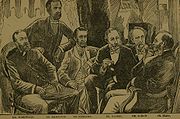 On September 6, Garfield was taken to the Jersey Shore
to escape the Washington heat, in the vain hope that the fresh air and quiet there might aid his recovery. Garfield was propped up in bed before a window with a view of the beach and ocean. New infections set in, as well as spasms of angina
. He died of a massive heart attack
or a ruptured splenic artery aneurysm
, following blood poisoning and bronchial pneumonia
, at 10:35 p.m. on Monday, September 19, 1881, in Long Branch, New Jersey
. The wounded president died exactly two months before his 50th birthday. During the eighty days between his shooting and death, his only official act was to sign an extradition
paper.
 Most historians and medical experts now believe that Garfield probably would have survived his wound had the doctors attending him been more capable. Several inserted their unsterilized fingers into the wound to probe for the bullet, and one doctor punctured Garfield's liver in doing so. This alone would not have brought about death as the liver is one of the few organs in the human body that can regenerate itself. However, this physician probably introduced Streptococcus
bacteria into the President's body and that caused blood poisoning for which at that time there were no antibiotics.
Chester Arthur was at his home in New York City when word came the night of September 19 that Garfield had died. After first getting the news, Arthur said "I hope—my God, I do hope it is a mistake." But confirmation by telegram came soon after. Arthur took the oath of office, administered by a New York Supreme Court judge, then left for Long Branch to pay his respects before going on to Washington.
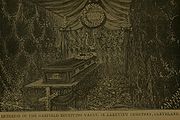
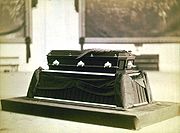
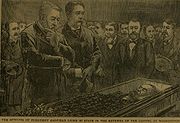
Garfield's body was taken to Washington, where it lay in state for two days in the Capitol Rotunda before being taken to Cleveland, where the funeral was held on September 26.
 Represented by his brother-in-law, George Scolville, Guiteau became something of a media darling during his trial for his bizarre behavior, including constantly insulting his defense team, formatting his testimony in epic poems which he recited at length, and soliciting legal advice from random spectators in the audience via passed notes. He claimed that he was not guilty because Garfield's murder was the will of God and he was only an instrument of God's will. He sang "John Brown's Body
" to the court. He dictated an autobiography to the New York Herald
, ending it with a personal ad for a nice Christian lady under thirty. He was blissfully oblivious to the American public's outrage and hatred of him, even after he was almost assassinated twice himself. At one point, he argued that Garfield was killed not by him but by medical malpractice
("The doctors killed Garfield, I just shot him"). Throughout the trial and up until his execution, Guiteau was housed at St. Elizabeths Hospital
in the southeastern quadrant of Washington, D.C.
Guiteau's trial was one of the first high profile cases in the United States
where the insanity defense was considered. Guiteau vehemently insisted that while he had been legally insane at the time of the shooting, he was not really medically insane, which was one of the major causes of the rift between him and his defense lawyers and probably also a reason the jury assumed Guiteau was merely trying to deny responsibility.
To the end, Guiteau was actively making plans to start a lecture tour after his perceived imminent release and to run for President himself in 1884, while at the same time continuing to delight in the media circus surrounding his trial. He was dismayed when the jury was unconvinced of his divine inspiration, convicting him of the murder. He was found guilty on January 25, 1882. He appealed, but his appeal was rejected, and he was hanged
on June 30, 1882 in the District of Columbia
. At his execution, Guiteau famously danced his way up to the gallows and while on the scaffold he waved at the audience, shook hands with his executioner and, as a last request, recited a poem he had written called "I am Going to the Lordy". He had requested an orchestra to play as he sang his poem, but this request was denied.
 Part of Charles Guiteau's preserved brain is on display at the Mütter Museum
at the College of Physicians of Philadelphia. Guiteau's bones and more of his brain, along with Garfield's backbone and a couple of ribs, are kept at the National Museum of Health and Medicine
in Washington, D.C. on the grounds of the Walter Reed Army Medical Center
.
 Garfield's assassination was instrumental to the passage of the Pendleton Civil Service Reform Act
on January 16, 1883. Garfield himself had called for civil service reform in his inaugural address and supported it as President in the belief that it would make government more efficient. It was passed as something of a memorial to the fallen President. Arthur lost the Republican Party nomination in 1884 to Blaine, who went on to lose a close election
to Democrat Grover Cleveland
.
The Sixth Street rail station was later demolished. The site is now occupied by the West Building of the National Gallery of Art
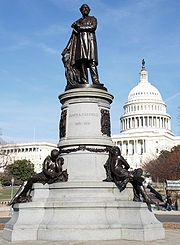
. No plaque or memorial marks the spot where Garfield was shot, but a few blocks away, a Garfield memorial statue stands on the southwest corner of the Capitol grounds.
The question of Presidential disability was not addressed. Article II, section 1, clause 6 of the Constitution says that in case of the "Inability [of the President] to discharge the Powers and Duties of the said Office, the same shall devolve on the Vice President", but gives no further instruction on what constitutes inability or how the President's inability should be determined. Garfield had lain on his sickbed for 80 days without performing any of the duties of his office except for the signing of an extradition paper, but this did not prove to be a difficulty because in the 19th century the federal government effectively shut down for the summer regardless. During Garfield's ordeal, the Congress was not in session and there was little for a President to do. Blaine suggested the Cabinet declare Arthur acting President, but this option was rejected by all, including Arthur, who did not wish to be perceived as grasping for power.
Congress did not deal with the problem of what to do if a President was alive but incapacitated as Garfield was. Nor did the Congress take up the question 38 years later, when Woodrow Wilson
suffered a stroke
that put him in a coma
for days and left him partially paralyzed and blind in one eye for the last year and a half of his Presidency. It was not until the ratification of the Twenty-fifth Amendment to the United States Constitution
in 1967 that United States law provided a procedure for what to do if the President were incapacitated.
Only sixteen years had passed between the first and second Presidential assassinations. Nevertheless, whereas Lincoln's assassination had taken place in the closing stages of the Civil War, both the public and the country's political leaders were keen to consider Garfield's murder to be an isolated act unlikely to be repeated in peacetime. Perhaps because the outrage as expressed in newspaper editorials focused specifically on the failure to adequately deal with the rejected office-seeker Guiteau as opposed to the inadequate security protecting the President, the Congress failed to take any measure to provide for Presidential protection. It was not until after the assassination of William McKinley
twenty years after Garfield's assassination, that the Congress charged the United States Secret Service
, originally founded to prevent counterfeiting, with Presidential security.
The Garfield Tea House
, built by the citizens of Long Branch, New Jersey
with the railroad ties that had been laid down specifically to give Garfield's train access to their town, still stands today near the location where Garfield died.
Washington, D.C.
Washington, D.C., formally the District of Columbia and commonly referred to as Washington, "the District", or simply D.C., is the capital of the United States. On July 16, 1790, the United States Congress approved the creation of a permanent national capital as permitted by the U.S. Constitution....
on July 2, 1881 by Charles J. Guiteau
Charles J. Guiteau
Charles Julius Guiteau was an American lawyer who assassinated U.S. President James A. Garfield. He was executed by hanging.- Background :...
at 9:30 a.m., less than four months after taking office as the twentieth President of the United States
President of the United States
The President of the United States of America is the head of state and head of government of the United States. The president leads the executive branch of the federal government and is the commander-in-chief of the United States Armed Forces....
. Garfield died eleven weeks later on September 19, 1881, the second of four Presidents to be assassinated, following Abraham Lincoln
Abraham Lincoln
Abraham Lincoln was the 16th President of the United States, serving from March 1861 until his assassination in April 1865. He successfully led his country through a great constitutional, military and moral crisis – the American Civil War – preserving the Union, while ending slavery, and...
and preceding William McKinley
William McKinley
William McKinley, Jr. was the 25th President of the United States . He is best known for winning fiercely fought elections, while supporting the gold standard and high tariffs; he succeeded in forging a Republican coalition that for the most part dominated national politics until the 1930s...
and John F. Kennedy
John F. Kennedy
John Fitzgerald "Jack" Kennedy , often referred to by his initials JFK, was the 35th President of the United States, serving from 1961 until his assassination in 1963....
. His Vice President
Vice President of the United States
The Vice President of the United States is the holder of a public office created by the United States Constitution. The Vice President, together with the President of the United States, is indirectly elected by the people, through the Electoral College, to a four-year term...
, Chester Arthur, succeeded Garfield as President.
Stalking the President
Oneida Community
The Oneida Community was a religious commune founded by John Humphrey Noyes in 1848 in Oneida, New York. The community believed that Jesus had already returned in the year 70 AD, making it possible for them to bring about Jesus's millennial kingdom themselves, and be free of sin and perfect in this...
. He wrote a speech in support of Ulysses S. Grant
Ulysses S. Grant
Ulysses S. Grant was the 18th President of the United States as well as military commander during the Civil War and post-war Reconstruction periods. Under Grant's command, the Union Army defeated the Confederate military and ended the Confederate States of America...
called "Grant vs. Hancock", which he later revised to "Garfield vs. Hancock" after Garfield won the Republican nomination in the 1880 presidential campaign. Guiteau never delivered the speech in a public setting, instead printing up several hundred copies, but he believed that this speech along with his other efforts were largely responsible for Garfield's narrow victory over Winfield S. Hancock
Winfield Scott Hancock
Winfield Scott Hancock was a career U.S. Army officer and the Democratic nominee for President of the United States in 1880. He served with distinction in the Army for four decades, including service in the Mexican-American War and as a Union general in the American Civil War...
in the election of 1880
United States presidential election, 1880
The United States presidential election of 1880 was largely seen as a referendum on the end of Reconstruction in Southern states carried out by the Republicans. There were no pressing issues of the day save tariffs, with the Republicans supporting higher tariffs and the Democrats supporting lower...
. Guiteau believed he should be awarded a diplomatic post for his vital assistance, first asking for Vienna
Vienna
Vienna is the capital and largest city of the Republic of Austria and one of the nine states of Austria. Vienna is Austria's primary city, with a population of about 1.723 million , and is by far the largest city in Austria, as well as its cultural, economic, and political centre...
, then settling for Paris
Paris
Paris is the capital and largest city in France, situated on the river Seine, in northern France, at the heart of the Île-de-France region...
. He loitered around Republican headquarters in New York City during the 1880 campaign
United States presidential election, 1880
The United States presidential election of 1880 was largely seen as a referendum on the end of Reconstruction in Southern states carried out by the Republicans. There were no pressing issues of the day save tariffs, with the Republicans supporting higher tariffs and the Democrats supporting lower...
, expecting rewards for his effort, to no avail. Still believing he would be rewarded, Guiteau arrived in Washington on March 5, 1881, the day after Garfield's inauguration, and obtained entrance to the White House and saw the President on March 8, 1881, dropping off a copy of his speech. He spent the next two months roaming around Washington, shuffling back and forth between the State Department and the White House, approaching various Cabinet members and other prominent Republicans and seeking support, to no avail. Guiteau was destitute and increasingly slovenly due to wearing the same clothes every day, the only clothes he owned, but he did not give up. On May 13, 1881, he was banned from the White House waiting room. On May 14, 1881, Secretary of State
United States Secretary of State
The United States Secretary of State is the head of the United States Department of State, concerned with foreign affairs. The Secretary is a member of the Cabinet and the highest-ranking cabinet secretary both in line of succession and order of precedence...
James G. Blaine
James G. Blaine
James Gillespie Blaine was a U.S. Representative, Speaker of the United States House of Representatives, U.S. Senator from Maine, two-time Secretary of State...
told him never to return: "Never speak to me again of the Paris consulship as long as you live."
Revolver
A revolver is a repeating firearm that has a cylinder containing multiple chambers and at least one barrel for firing. The first revolver ever made was built by Elisha Collier in 1818. The percussion cap revolver was invented by Samuel Colt in 1836. This weapon became known as the Colt Paterson...
. He knew little about firearms, but knew that he would need a large caliber gun. He chose to buy an ivory-handled .44 Webley British Bulldog revolver
British Bulldog revolver
The British Bull Dog was a popular type of solid-frame pocket revolver introduced by Philip Webley & Son of Birmingham, England in 1872 and subsequently copied by gunmakers in Continental Europe and the United States. It featured a barrel and was chambered for five .44 Short Rimfire, .442 Webley,...
over a similar wooden-handled Webley because he thought it would look good as a museum exhibit after the assassination. (The revolver was recovered and displayed by the Smithsonian in the early 1900s but has since been lost.) He spent the next few weeks in target practice—the kick from the revolver almost knocked him over the first time—and stalking the President. He wrote a letter to Garfield, saying that he should fire Blaine, or "you and the Republican party will come to grief." The letter was ignored, as was all the correspondence Guiteau sent to the White House.
Guiteau continued to prepare carefully, writing a letter in advance to Commanding General of the United States Army
Commanding General of the United States Army
Prior to the institution of the Chief of Staff of the United States Army in 1903, there was generally a single senior-most officer in the army. From 1783, he was known simply as the Senior Officer of the United States Army, but in 1821, the title was changed to Commanding General of the United...
William Sherman asking for protection from the mob, and writing other letters justifying his action as necessary to heal dissension between factions of the Republican Party
Republican Party (United States)
The Republican Party is one of the two major contemporary political parties in the United States, along with the Democratic Party. Founded by anti-slavery expansion activists in 1854, it is often called the GOP . The party's platform generally reflects American conservatism in the U.S...
. He went to the District of Columbia jail, asking for a tour of the facility to see where he'd be incarcerated. (He was told to come back later.) Guiteau spent the whole month of June following Garfield around Washington. On one occasion, he trailed Garfield to the railway station as the President was seeing his wife off to a beach resort in Long Branch, New Jersey
Long Branch, New Jersey
Long Branch is a city in Monmouth County, New Jersey, United States. As of the 2010 United States Census, the city population was 30,719.Long Branch was formed on April 11, 1867, as the Long Branch Commission, from portions of Ocean Township...
, but he decided to shoot him later, as Mrs. Garfield
Lucretia Garfield
Lucretia Rudolph Garfield , wife of James A. Garfield, was First Lady of the United States in 1881.-Early life:...
was in poor health and he did not want to upset her.
Assassination
Garfield was scheduled to leave Washington on July 2, 1881 for his summer vacation. On that day, Guiteau lay in wait for the President at the Baltimore and Potomac Railroad station, on the southwest corner of present day Sixth Street and Constitution Avenue NW, Washington, D.C.Washington, D.C.
Washington, D.C., formally the District of Columbia and commonly referred to as Washington, "the District", or simply D.C., is the capital of the United States. On July 16, 1790, the United States Congress approved the creation of a permanent national capital as permitted by the U.S. Constitution....
President Garfield came to the Sixth Street Station on his way to his alma mater
Alma mater
Alma mater , pronounced ), was used in ancient Rome as a title for various mother goddesses, especially Ceres or Cybele, and in Christianity for the Virgin Mary.-General term:...
, Williams College
Williams College
Williams College is a private liberal arts college located in Williamstown, Massachusetts, United States. It was established in 1793 with funds from the estate of Ephraim Williams. Originally a men's college, Williams became co-educational in 1970. Fraternities were also phased out during this...
, where he was scheduled to deliver a speech. Garfield was accompanied by two of his sons, James
James Rudolph Garfield
James Rudolph Garfield was an American politician, lawyer and son of President James Abram Garfield and First Lady Lucretia Garfield. He was Secretary of the Interior during Theodore Roosevelt's administration....
and Harry
Harry Augustus Garfield
Harry Augustus "Hal" Garfield was an American lawyer, academic and public official. He was president of Williams College and supervised the Federal Fuel Administration during World War I.-Biography:He was the son of U.S. President James A...
, and Secretary of State
United States Secretary of State
The United States Secretary of State is the head of the United States Department of State, concerned with foreign affairs. The Secretary is a member of the Cabinet and the highest-ranking cabinet secretary both in line of succession and order of precedence...
Blaine
James G. Blaine
James Gillespie Blaine was a U.S. Representative, Speaker of the United States House of Representatives, U.S. Senator from Maine, two-time Secretary of State...
. Secretary of War
United States Secretary of War
The Secretary of War was a member of the United States President's Cabinet, beginning with George Washington's administration. A similar position, called either "Secretary at War" or "Secretary of War," was appointed to serve the Congress of the Confederation under the Articles of Confederation...
Robert Todd Lincoln
Robert Todd Lincoln
Robert Todd Lincoln was an American lawyer and Secretary of War, and the first son of President Abraham Lincoln and Mary Todd Lincoln...
waited at the station to see the President off. Garfield had no bodyguard or security detail; with the exception of Abraham Lincoln during the Civil War, early U.S. presidents never used any guards.
As President Garfield entered the waiting room of the station Guiteau stepped forward and pulled the trigger from behind at point-blank range. "My God, what is that?" Garfield cried out, flinging up his arms. Guiteau fired again and Garfield collapsed. One bullet grazed Garfield's shoulder; the other lodged in his spine in the first lumbar vertebra
Lumbar vertebrae
The lumbar vertebrae are the largest segments of the movable part of the vertebral column, and are characterized by the absence of the foramen transversarium within the transverse process, and by the absence of facets on the sides of the body...
, missing the spinal cord
Spinal cord
The spinal cord is a long, thin, tubular bundle of nervous tissue and support cells that extends from the brain . The brain and spinal cord together make up the central nervous system...
.
Guiteau put his pistol back in his pocket and turned to leave the station for the cab he had waiting outside, but he was apprehended before he could leave by policeman Patrick Kearney, who was so excited at having arrested the man who shot the president that he neglected to take Guiteau's gun from him until after their arrival at the police station. The rapidly gathering crowd screamed "Lynch him!" but Kearney took Guiteau to the police station a few blocks away. As he surrendered to authorities, Guiteau uttered the exulting words, repeated everywhere: "'I am a Stalwart of the Stalwarts! I did it and I want to be arrested! Arthur
Chester A. Arthur
Chester Alan Arthur was the 21st President of the United States . Becoming President after the assassination of President James A. Garfield, Arthur struggled to overcome suspicions of his beginnings as a politician from the New York City Republican machine, succeeding at that task by embracing...
is President now!'" This statement briefly led to unfounded suspicions that Arthur or his supporters had put Guiteau up to the crime. The Stalwarts were a Republican faction loyal to ex-President Grant; they strongly opposed Garfield's Half-Breed
Half-Breed (politics)
The "Half-Breeds" were a political faction of the United States Republican Party that existed in the late 19th century. The Half-Breeds were a moderate-wing group, and they were the opponents of the Stalwarts, the other main faction of the Republican Party. The main issue that separated the...
s. Like many Vice Presidents, Arthur was chosen for political advantage, to placate his faction, rather than for skills or loyalty to his running-mate. Guiteau, in his delusion, had convinced himself that he was striking a blow to unite the two factions of the Republican Party.
Garfield's suffering and death
Garfield was carried back to the White House. Although doctors told him that he would not survive the night, the President remained conscious and alert. The next morning his vital signs were good and doctors began to hope for recovery. A long vigil began, with Garfield's doctors issuing regular bulletins that the American public followed closely throughout the summer of 1881. His condition fluctuated. Fevers came and went. Garfield struggled to keep down solid food and spent most of the summer eating little, and that only liquids.
Alexander Graham Bell
Alexander Graham Bell was an eminent scientist, inventor, engineer and innovator who is credited with inventing the first practical telephone....
devised a metal detector
Metal detector
A metal detector is a device which responds to metal that may not be readily apparent.The simplest form of a metal detector consists of an oscillator producing an alternating current that passes through a coil producing an alternating magnetic field...
specifically for the purpose of finding the bullet lodged inside Garfield, but the metal bed frame on which Garfield lay made the instrument malfunction. Because metal bed frames were relatively rare, the cause of the instrument's deviation was unknown at the time.
On July 29 Garfield met with his Cabinet for the only time during his illness; the members were under strict instruction from the doctors not to discuss anything upsetting. Garfield became increasingly ill over a period of several weeks due to infection, which caused his heart to weaken. He remained bedridden in the White House with fevers and extreme pains. Garfield's weight dropped from over two hundred pounds to 135 pounds as his inability to keep down and digest food took its toll. Because of his inability to digest food, nutrient enema
Nutrient enema
A nutrient enema, also known as feeding per rectum, rectal alimentation, or rectal feeding, is an enema administered with the intent of providing nutrition when normal eating is not possible...
s were given in an attempt to extend his life. Blood poisoning and infection set in and for a brief period the President suffered from hallucinations.
Jersey Shore
The Jersey Shore is a term used to refer to both the Atlantic coast of the U.S. state of New Jersey and the adjacent resort and residential communities. . The New Jersey State Department of Tourism considers the Shore Region, Greater Atlantic City, and the Southern Shore to be distinct, each having...
to escape the Washington heat, in the vain hope that the fresh air and quiet there might aid his recovery. Garfield was propped up in bed before a window with a view of the beach and ocean. New infections set in, as well as spasms of angina
Angina
Angina pectoris, commonly known as angina, is chest pain due to ischemia of the heart muscle, generally due to obstruction or spasm of the coronary arteries . Coronary artery disease, the main cause of angina, is due to atherosclerosis of the cardiac arteries...
. He died of a massive heart attack
Myocardial infarction
Myocardial infarction or acute myocardial infarction , commonly known as a heart attack, results from the interruption of blood supply to a part of the heart, causing heart cells to die...
or a ruptured splenic artery aneurysm
Aneurysm
An aneurysm or aneurism is a localized, blood-filled balloon-like bulge in the wall of a blood vessel. Aneurysms can commonly occur in arteries at the base of the brain and an aortic aneurysm occurs in the main artery carrying blood from the left ventricle of the heart...
, following blood poisoning and bronchial pneumonia
Pneumonia
Pneumonia is an inflammatory condition of the lung—especially affecting the microscopic air sacs —associated with fever, chest symptoms, and a lack of air space on a chest X-ray. Pneumonia is typically caused by an infection but there are a number of other causes...
, at 10:35 p.m. on Monday, September 19, 1881, in Long Branch, New Jersey
Long Branch, New Jersey
Long Branch is a city in Monmouth County, New Jersey, United States. As of the 2010 United States Census, the city population was 30,719.Long Branch was formed on April 11, 1867, as the Long Branch Commission, from portions of Ocean Township...
. The wounded president died exactly two months before his 50th birthday. During the eighty days between his shooting and death, his only official act was to sign an extradition
Extradition
Extradition is the official process whereby one nation or state surrenders a suspected or convicted criminal to another nation or state. Between nation states, extradition is regulated by treaties...
paper.
Streptococcus
Streptococcus is a genus of spherical Gram-positive bacteria belonging to the phylum Firmicutes and the lactic acid bacteria group. Cellular division occurs along a single axis in these bacteria, and thus they grow in chains or pairs, hence the name — from Greek στρεπτος streptos, meaning...
bacteria into the President's body and that caused blood poisoning for which at that time there were no antibiotics.
Chester Arthur was at his home in New York City when word came the night of September 19 that Garfield had died. After first getting the news, Arthur said "I hope—my God, I do hope it is a mistake." But confirmation by telegram came soon after. Arthur took the oath of office, administered by a New York Supreme Court judge, then left for Long Branch to pay his respects before going on to Washington.
Garfield's body was taken to Washington, where it lay in state for two days in the Capitol Rotunda before being taken to Cleveland, where the funeral was held on September 26.
Guiteau's trial and execution
John Brown's Body
"John Brown's Body" is an American marching song about the abolitionist John Brown. The song was popular in the Union during the American Civil War. The tune arose out of the folk hymn tradition of the American camp meeting movement of the 19th century...
" to the court. He dictated an autobiography to the New York Herald
New York Herald
The New York Herald was a large distribution newspaper based in New York City that existed between May 6, 1835, and 1924.-History:The first issue of the paper was published by James Gordon Bennett, Sr., on May 6, 1835. By 1845 it was the most popular and profitable daily newspaper in the UnitedStates...
, ending it with a personal ad for a nice Christian lady under thirty. He was blissfully oblivious to the American public's outrage and hatred of him, even after he was almost assassinated twice himself. At one point, he argued that Garfield was killed not by him but by medical malpractice
Medical malpractice
Medical malpractice is professional negligence by act or omission by a health care provider in which the treatment provided falls below the accepted standard of practice in the medical community and causes injury or death to the patient, with most cases involving medical error. Standards and...
("The doctors killed Garfield, I just shot him"). Throughout the trial and up until his execution, Guiteau was housed at St. Elizabeths Hospital
St. Elizabeths Hospital
St. Elizabeths Hospital is a psychiatric hospital operated by the District of Columbia Department of Mental Health. It was the first large-scale, federally-run psychiatric hospital in the United States. Housing several thousand patients at its peak, St. Elizabeths had a fully functioning...
in the southeastern quadrant of Washington, D.C.
Washington, D.C.
Washington, D.C., formally the District of Columbia and commonly referred to as Washington, "the District", or simply D.C., is the capital of the United States. On July 16, 1790, the United States Congress approved the creation of a permanent national capital as permitted by the U.S. Constitution....
Guiteau's trial was one of the first high profile cases in the United States
United States
The United States of America is a federal constitutional republic comprising fifty states and a federal district...
where the insanity defense was considered. Guiteau vehemently insisted that while he had been legally insane at the time of the shooting, he was not really medically insane, which was one of the major causes of the rift between him and his defense lawyers and probably also a reason the jury assumed Guiteau was merely trying to deny responsibility.
To the end, Guiteau was actively making plans to start a lecture tour after his perceived imminent release and to run for President himself in 1884, while at the same time continuing to delight in the media circus surrounding his trial. He was dismayed when the jury was unconvinced of his divine inspiration, convicting him of the murder. He was found guilty on January 25, 1882. He appealed, but his appeal was rejected, and he was hanged
Hanging
Hanging is the lethal suspension of a person by a ligature. The Oxford English Dictionary states that hanging in this sense is "specifically to put to death by suspension by the neck", though it formerly also referred to crucifixion and death by impalement in which the body would remain...
on June 30, 1882 in the District of Columbia
Washington, D.C.
Washington, D.C., formally the District of Columbia and commonly referred to as Washington, "the District", or simply D.C., is the capital of the United States. On July 16, 1790, the United States Congress approved the creation of a permanent national capital as permitted by the U.S. Constitution....
. At his execution, Guiteau famously danced his way up to the gallows and while on the scaffold he waved at the audience, shook hands with his executioner and, as a last request, recited a poem he had written called "I am Going to the Lordy". He had requested an orchestra to play as he sang his poem, but this request was denied.
Aftermath
Mütter Museum
The Mütter Museum is a medical museum located in the Center City area of Philadelphia, Pennsylvania. It contains a collection of medical oddities, anatomical and pathological specimens, wax models, and antique medical equipment. The museum is part of The College of Physicians of Philadelphia. The...
at the College of Physicians of Philadelphia. Guiteau's bones and more of his brain, along with Garfield's backbone and a couple of ribs, are kept at the National Museum of Health and Medicine
National Museum of Health and Medicine
The National Museum of Health and Medicine is a museum in Silver Spring, Maryland, near Washington, D.C., USA. An element of the Armed Forces Institute of Pathology, the NMHM is a member of the National Health Sciences Consortium....
in Washington, D.C. on the grounds of the Walter Reed Army Medical Center
Walter Reed Army Medical Center
The Walter Reed Army Medical Center was the United States Army's flagship medical center until 2011. Located on 113 acres in Washington, D.C., it served more than 150,000 active and retired personnel from all branches of the military...
.
Pendleton Civil Service Reform Act
The Pendleton Civil Service Reform Act of United States is a federal law established in 1883 that stipulated that government jobs should be awarded on the basis of merit. The act provided selection of government employees competitive exams, rather than ties to politicians or political affiliation...
on January 16, 1883. Garfield himself had called for civil service reform in his inaugural address and supported it as President in the belief that it would make government more efficient. It was passed as something of a memorial to the fallen President. Arthur lost the Republican Party nomination in 1884 to Blaine, who went on to lose a close election
United States presidential election, 1884
The United States presidential election of 1884 saw the first election of a Democrat as President of the United States since the election of 1856. New York Governor Grover Cleveland narrowly defeated Republican former United States Senator James G. Blaine of Maine to break the longest losing streak...
to Democrat Grover Cleveland
Grover Cleveland
Stephen Grover Cleveland was the 22nd and 24th president of the United States. Cleveland is the only president to serve two non-consecutive terms and therefore is the only individual to be counted twice in the numbering of the presidents...
.
The Sixth Street rail station was later demolished. The site is now occupied by the West Building of the National Gallery of Art
National Gallery of Art
The National Gallery of Art and its Sculpture Garden is a national art museum, located on the National Mall between 3rd and 9th Streets at Constitution Avenue NW, in Washington, DC...
. No plaque or memorial marks the spot where Garfield was shot, but a few blocks away, a Garfield memorial statue stands on the southwest corner of the Capitol grounds.
The question of Presidential disability was not addressed. Article II, section 1, clause 6 of the Constitution says that in case of the "Inability [of the President] to discharge the Powers and Duties of the said Office, the same shall devolve on the Vice President", but gives no further instruction on what constitutes inability or how the President's inability should be determined. Garfield had lain on his sickbed for 80 days without performing any of the duties of his office except for the signing of an extradition paper, but this did not prove to be a difficulty because in the 19th century the federal government effectively shut down for the summer regardless. During Garfield's ordeal, the Congress was not in session and there was little for a President to do. Blaine suggested the Cabinet declare Arthur acting President, but this option was rejected by all, including Arthur, who did not wish to be perceived as grasping for power.
Congress did not deal with the problem of what to do if a President was alive but incapacitated as Garfield was. Nor did the Congress take up the question 38 years later, when Woodrow Wilson
Woodrow Wilson
Thomas Woodrow Wilson was the 28th President of the United States, from 1913 to 1921. A leader of the Progressive Movement, he served as President of Princeton University from 1902 to 1910, and then as the Governor of New Jersey from 1911 to 1913...
suffered a stroke
Stroke
A stroke, previously known medically as a cerebrovascular accident , is the rapidly developing loss of brain function due to disturbance in the blood supply to the brain. This can be due to ischemia caused by blockage , or a hemorrhage...
that put him in a coma
Coma
In medicine, a coma is a state of unconsciousness, lasting more than 6 hours in which a person cannot be awakened, fails to respond normally to painful stimuli, light or sound, lacks a normal sleep-wake cycle and does not initiate voluntary actions. A person in a state of coma is described as...
for days and left him partially paralyzed and blind in one eye for the last year and a half of his Presidency. It was not until the ratification of the Twenty-fifth Amendment to the United States Constitution
Twenty-fifth Amendment to the United States Constitution
The Twenty-fifth Amendment to the United States Constitution deals with succession to the Presidency and establishes procedures both for filling a vacancy in the office of the Vice President, as well as responding to Presidential disabilities...
in 1967 that United States law provided a procedure for what to do if the President were incapacitated.
Only sixteen years had passed between the first and second Presidential assassinations. Nevertheless, whereas Lincoln's assassination had taken place in the closing stages of the Civil War, both the public and the country's political leaders were keen to consider Garfield's murder to be an isolated act unlikely to be repeated in peacetime. Perhaps because the outrage as expressed in newspaper editorials focused specifically on the failure to adequately deal with the rejected office-seeker Guiteau as opposed to the inadequate security protecting the President, the Congress failed to take any measure to provide for Presidential protection. It was not until after the assassination of William McKinley
William McKinley assassination
The assassination of William McKinley occurred on September 6, 1901, inside the Temple of Music located on the grounds of the 1901 Pan-American Exposition in Buffalo, New York...
twenty years after Garfield's assassination, that the Congress charged the United States Secret Service
United States Secret Service
The United States Secret Service is a United States federal law enforcement agency that is part of the United States Department of Homeland Security. The sworn members are divided among the Special Agents and the Uniformed Division. Until March 1, 2003, the Service was part of the United States...
, originally founded to prevent counterfeiting, with Presidential security.
The Garfield Tea House
Garfield Tea House
The Garfield Tea House, in Long Branch, New Jersey, is the only remaining structure directly related to President James A. Garfield's final trip to the Jersey Shore...
, built by the citizens of Long Branch, New Jersey
Long Branch, New Jersey
Long Branch is a city in Monmouth County, New Jersey, United States. As of the 2010 United States Census, the city population was 30,719.Long Branch was formed on April 11, 1867, as the Long Branch Commission, from portions of Ocean Township...
with the railroad ties that had been laid down specifically to give Garfield's train access to their town, still stands today near the location where Garfield died.
Cited works
- Peskin, Allan. Garfield. 1978, Kent State University Press. ISBN 0-87338-210-2
- Vowell, SarahSarah VowellSarah Jane Vowell is an American author, journalist, essayist and social commentator. Often referred to as a "social observer," Vowell has written five nonfiction books on American history and culture, and was a contributing editor for the radio program This American Life on Public Radio...
. Assassination VacationAssassination VacationAssassination Vacation is a book by Sarah Vowell, published in 2005, in which she travels around the United States researching the assassinations of U.S. Presidents Abraham Lincoln, William McKinley and James Garfield...
. Simon and Schuster, 2005. ISBN 0-7432-6003-1
External links
- History House's account of Guiteau's life and the assassination of Garfield, part 1, 2 and 3.
- New York Times article reprinting indictment
- New York Times article on shooting at time of shooting
- Garfield's murder and Guiteau's trial at the Crime Library
- Charles Guiteau Trial homepage at the University of Missouri-Kansas City
- Charles J. Guiteau collection at Georgetown University