

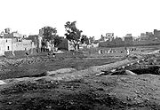
Jallianwala Bagh massacre

Encyclopedia
The Jallianwala Bagh massacre (Punjabi
: ਜਲ੍ਹਿਆਂਵਾਲਾ ਬਾਗ਼ ਹਤਿਆਕਾਂਡ, Hindi
: जलियांवाला बाग़ हत्याकांड, Urdu
: جليانوالہ باغ قتلِ عام Jallianwala Bāġa Hatyākāṇḍ), also known as the Amritsar massacre, took place in the Jallianwala Bagh
public garden in the northern India
n city of Amritsar
, and was ordered by Brigadier-General Reginald E.H. Dyer
. On Sunday 13 April 1919 (which happened to be 'Baisakhi'—one of Punjab's largest religious festivals), fifty British Indian Army
soldiers commanded by Dyer began shooting at an unarmed gathering of men, women, and children without warning. Dyer marched his fifty riflemen to a raised bank and ordered them to kneel and fire. Dyer ordered soldiers to reload their rifles several times and they were ordered to shoot to kill. Official Government of India sources estimated the fatalities at 379, with 1,100 wounded. Civil Surgeon Dr Williams DeeMeddy indicated that there were 1,526 casualties. The casualty number quoted by the Indian National Congress
was more than 1,500, with approximately 1,000 killed.
began with loyalty and goodwill towards the United Kingdom
from mainstream politicians in India, contrary to initial British fears of a revolt while they were committed militarily to a European war. British India contributed massively to the British war effort by providing men and resources. About 1.3 million Indian soldiers and labourers served in Europe
, Africa
, and the Middle East
, while both the Indian administration and the princes sent large supplies of food, money, and ammunition. However, Bengal
and Punjab
remained sources of anticolonial activities
. Revolutionary
attacks in Bengal, associated increasingly with disturbances in Punjab, were significant enough to nearly paralyse the regional administration. From the beginning of the war, the expatriate Indian population (notably in the United States, Canada, and Germany) attempted to initiate insurrections in India. Managed by the Berlin Committee
and the Ghadar Party
, Irish republicans, Germans, and Turks helped foment a widespread conspiracy that has since come to be termed the Hindu-German conspiracy. This conspiracy also attempted to rally Afghanistan
against British India. A number of failed attempts were made at mutiny
, of which the February mutiny plan and the Singapore mutiny
are the most notable. This movement was suppressed by means of a massive international counterintelligence operation and strict political acts (including the draconian Defence of India act 1915
) that lasted nearly ten years.
, high casualty rates, increasing inflation compounded by heavy taxation, a widespread influenza
epidemic, and the disruption of trade during the war escalated human suffering in India. The costs of the protracted war in both money and manpower were great. In India, long the "jewel in the crown" of the British Empire
, Indians were restless for independence. More than 43,000 Indian soldiers had died fighting for Britain.
Indian soldiers smuggled arms into India to fight British rule.
The pre-war Indian nationalist sentiment revived as moderate and extremist groups of the Indian National Congress
ended their differences in order to unify. In 1916, the Congress succeeded in establishing the Lucknow Pact
, a temporary alliance with the All-India Muslim League.
in 1919 were also influenced by activities associated with the Ghadar conspiracy. British Indian Army troops were returning from Europe and Mesopotamia to an economic depression in India. The attempts at mutiny during 1915 and the Lahore conspiracy trials were still in public attention. Reports of young Mohajir
s who fought on behalf of the Turkish Caliphate, and later, in the ranks of the Red Army
during the Russian Civil War
, were beginning to reach India. The Russian Revolution had also begun to influence Indians. It was at this time that Mohandas Karamchand Gandhi, until then relatively unknown to Indians, started becoming a popular leader.
Ominously, in 1919, the third Anglo-Afghan war
began after Amir Habibullah Khan's assassination and institution of Amanullah Khan
in a system influenced by the Kabul mission. In addition, in India, Gandhi's call for protest against the Rowlatt act
achieved an unprecedented response of furious unrest and protests. The situation especially in Punjab was deteriorating rapidly, with disruptions of rail, telegraph and communication systems.
In Amritsar, more than 5,000 people gathered at Jallianwala Bagh. This situation deteriorated perceptibly during the next few days. Michael O'Dwyer is said to have believed that these were the early and ill-concealed signs of a conspiracy for a coordinated revolt around May, at a time when British troops would have withdrawn to the hills for the summer. The Amritsar massacre
, as well as responses preceding and succeeding it, contrary to being an isolated incident, was the end result of a concerted plan of response from the Punjab administration to suppress such a conspiracy. James Houssemayne Du Boulay
is said to have ascribed a direct relationship between the fear of a Ghadarite uprising in the midst of an increasingly tense situation in Punjab, and the British response that ended in the massacre.
On April 10, 1919, there was a protest at the residence of the Deputy Commissioner of Amritsar, a city in Punjab, a large province in the northwestern part of the then unpartitioned India. The demonstration was to demand the release of two popular leaders of the Indian Independence Movement
, Satya Pal and Saifuddin Kitchlew, who had been earlier arrested by the government and removed to a secret location. Both were proponents of the Satyagraha
movement led by Mohandas Karamchand Gandhi. The crowd was shot at by a military picket, killing several protesters. The shooting set off a series of violent events. Later the same day, several bank
s and other government buildings, including the Town Hall and the railway station were attacked and set afire. The violence continued to escalate, culminating in the deaths of at least five European
s, including government employees and civilians. There was retaliatory shooting at crowds from the military several times during the day, and between eight and twenty people were killed.
For the next two days, the city of Amritsar was quiet, but violence continued in other parts of the Punjab. Railway lines were cut, telegraph posts destroyed, and government buildings burnt. Three Europeans were murdered. By April 13, the British government had decided to put most of the Punjab under martial law
. The legislation
restricted a number of civil liberties, including freedom of assembly
. Gatherings of more than four people were banned.
(garden) near the Harmandir Sahib
in Amritsar. Baisakhi is a Sikh
festival
, commemorating the day that Guru Gobind Singh
founded the Khalsa Panth in 1699, and also known as the 'Birth of Khalsa
.' During this time people celebrate by congregating in religious and community fairs, and there may have been a large number who were unaware of the political meeting.
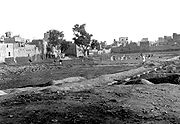
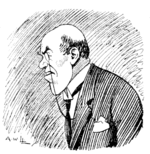 An hour after the meeting began as scheduled at 4:30 pm, Brigadier-General Reginald Dyer
marched a group of sixty-five Gurkha and twenty-five Baluchi soldiers into the Bagh, fifty of whom were armed with rifles. Dyer had also brought two armoured cars armed with machine guns, however the vehicles were stationed outside the main gate as they were unable to enter the Bagh through the narrow entrance.
The Jallianwala Bagh was bounded on all sides by houses and buildings and had few narrow entrances, most of which were kept permanently locked. The main entrance was relatively wider, but was guarded by the troops backed by the armoured vehicles. General Dyer ordered troops to begin shooting without warning or any order to disperse, and to direct shooting towards the densest sections of the crowd. He continued the shooting, approximately 1,650 rounds in all, until the ammunition supply was almost exhausted.
Apart from the many deaths directly from the shooting, a number of people died in stampedes at the narrow gates or by jumping into the solitary well on the compound to escape the shooting. A plaque in the monument at the site, set up after independence, says that 120 bodies were pulled out of the well.
The wounded could not be moved from where they had fallen, as a curfew
had been declared – many more died during the night.
The number of deaths caused by the shooting is disputed. While the official figure given by the British inquiry into the massacre is 379 deaths, the method used by the inquiry has been subject to criticism. In July 1919, three months after the massacre, officials were tasked with finding who had been killed by inviting inhabitants of the city to volunteer information about those who had died. This information was likely incomplete due to fear that those who participated would be identified as having been present at the meeting, and some of the dead may not have had close relations in the area. Additionally, a senior civil servant in the Punjab interviewed by the members of the committee admitted that the actual figure could be higher.
Since the official figures were likely flawed considering the size of the crowd (15,000–20,000), number of rounds shot and period of shooting, the politically interested Indian National Congress
instituted a separate inquiry of its own, with conclusions that differed considerably from the Government's. The casualty number quoted by the INC was more than 1,500, with approximately 1,000 killed. Despite the Government's best efforts to suppress information of the massacre, news spread elsewhere in India and widespread outrage ensued; however, the details of the massacre did not become known in Britain until December 1919.
Back in his headquarters, General Dyer reported to his superiors that he had been "confronted by a revolutionary army
".
In a telegram sent to Dyer, British Lieutenant-Governor of Punjab, Sir Michael O'Dwyer
wrote: "Your action is correct. Lieutenant Governor approves."
O'Dwyer requested that martial law
be imposed upon Amritsar and other areas; this was granted by the Viceroy
, Lord Chelmsford
, after the massacre. The "crawling order" was posted on Aug 19 under the auspices of martial law.
Dyer was called to appear before the Hunter Commission, a commission of inquiry into the massacre that was ordered to convene by Secretary of State for India
, Edwin Montagu
, in late 1919. Dyer said before the commission that he came to know about the meeting at the Jallianwala Bagh at 12:40 hours that day but did not attempt to prevent it. He stated that he had gone to the Bagh with the deliberate intention of opening fire if he found a crowd assembled there.
Dyer said he would have used his machine gun
s if he could have got them into the enclosure, but these were mounted on armoured cars. He said he did not stop the shooting when the crowd began to disperse because he thought it was his duty to keep shooting until the crowd dispersed, and that a little shooting would not do any good. In fact he continued the shooting until the ammunition was almost exhausted.
He stated that he did not make any effort to tend to the wounded after the shooting: "Certainly not. It was not my job. Hospitals were open and they could have gone there."
The Hunter Commission did not award any penal nor disciplinary action because Dyer's actions were condoned by various superiors (later upheld by the Army Council). However, he was finally found guilty of a mistaken notion of duty and relieved of his command.
protesting the killings at Amritsar. Police and aircraft were used against the demonstrators, resulting in 12 deaths and 27 injuries. The Officer Commanding the Royal Air Force
in India, Brigadier General N D K MacEwen
stated later that:
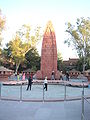
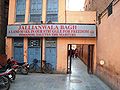
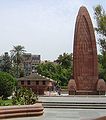
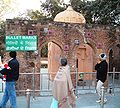 A trust was formed later 1920 to build a memorial at the site after a resolution passed by the Indian National Congress
. In 1923, the trust purchased land for the project. A memorial, designed by American architect Benjamin Polk
, was built on the site and inaugurated by the President of India, Dr Rajendra Prasad
on April 13, 1961, in the presence of Jawaharlal Nehru
and other leaders. A flame
was later added to the site.
The bullet holes can be seen on the walls and adjoining buildings to this day. The well into which many people jumped and drowned attempting to save themselves from the bullets is also a protected monument inside the park.
, participating with an already controversial British visit to the Monument, provoked outrage in India with an offhand comment. Having observed a plaque claiming "This place is saturated with the blood of about two thousand Hindus
, Sikhs
and Muslims
who were martyred in a non-violent struggle", Prince Philip
observed, "That's a bit exaggerated, it must include the wounded". (Official government sources estimated the fatalities at 379, and with 1,100 wounded. Civil Surgeon Dr Smith indicated that there were 1,526 casualties
, which might account for the Prince's opinion.) When asked how he had concluded this, Prince Philip said "I was told about the killings by General Dyer's son. I'd met him while I was in the Navy
."
On October 14, 1997 Queen Elizabeth II visited Jallianwala Bagh and paid her respects with a 30‑second moment of silence. During the visit, she wore a dress of a colour described as pink apricot or saffron
, which was of religious significance to Hindus and Sikhs. She removed her shoes while visiting the monument and laid a wreath at the monument.
While some Indians welcomed the expression of regret and sadness in the Queen's statement, others criticised it for being less than an apology. The then-Prime Minister of India
Inder Kumar Gujral
defended the Queen, stating that the Queen herself had played no part in the events and should not be required to apologize.
 On March 13, 1940, at Caxton Hall in London, Udham Singh
, an Indian independence activist from Sunam who had witnessed the events in Amritsar and was himself wounded, shot and killed Michael O'Dwyer
, the British Lieutenant-Governor of Punjab at the time of the massacre, who had approved Dyer's action and was believed to be the main planner. (Dyer himself had died in 1927.)
The action by Singh was condemned generally, but some press, like nationalist newspaper Amrita Bazar Patrika
, also made positive statements. The common people and revolutionaries glorified the action of Udham Singh. Much of the press worldwide recalled the story of Jallianwala Bagh and alleged Michael O'Dwyer to have been responsible for the massacre. Singh was termed a "fighter for freedom" and his action was referred to in The Times
newspaper as "an expression of the pent-up fury of the down-trodden Indian People". In Fascist countries, the incident was used for anti-British propaganda: Bergeret, published in large scale from Rome
at that time, while commenting upon the Caxton Hall assassination, ascribed the greatest significance to the circumstance and praised the action of Udham Singh as courageous. The Berliner Börsen Zeitung termed the event "The torch of Indian freedom". German radio reportedly broadcast: "The cry of tormented people spoke with shots."
At a public meeting in Kanpur, a spokesman had stated that "at last an insult and humiliation of the nation had been avenged". Similar sentiments were expressed in numerous other places countrywide. Fortnightly reports of the political situation in Bihar
mentioned: "It is true that we had no love lost for Sir Michael. The indignities he heaped upon our countrymen in Punjab have not been forgotten." In its March 18, 1940 issue, Amrita Bazar Patrika wrote: "O'Dwyer's name is connected with Punjab incidents which India will never forget." The New Statesman observed: "British conservativism has not discovered how to deal with Ireland
after two centuries of rule. Similar comment may be made on British rule in India. Will the historians of the future have to record that it was not the Nazis
but the British ruling class which destroyed the British Empire?"
Singh had told the court at his trial:
Singh was hanged for the murder on July 31, 1940. At that time, many, including Jawaharlal Nehru and Mahatma Gandhi, condemned the action of Udham as senseless but courageous. In 1952, Nehru (by then, Prime Minister) honoured Udham Singh with the following statement which had appeared in the daily Partap: "I salute Shaheed-i-Azam Udham Singh with reverence who had kissed the noose so that we may be free." Soon after this recognition by the Prime Minister, Udham Singh
received the title of Shaheed, a name given to someone who has attained martyrdom or done something heroic on behalf of their country or religion.
Punjabi language
Punjabi is an Indo-Aryan language spoken by inhabitants of the historical Punjab region . For Sikhs, the Punjabi language stands as the official language in which all ceremonies take place. In Pakistan, Punjabi is the most widely spoken language...
: ਜਲ੍ਹਿਆਂਵਾਲਾ ਬਾਗ਼ ਹਤਿਆਕਾਂਡ, Hindi
Hindi
Standard Hindi, or more precisely Modern Standard Hindi, also known as Manak Hindi , High Hindi, Nagari Hindi, and Literary Hindi, is a standardized and sanskritized register of the Hindustani language derived from the Khariboli dialect of Delhi...
: जलियांवाला बाग़ हत्याकांड, Urdu
Urdu
Urdu is a register of the Hindustani language that is identified with Muslims in South Asia. It belongs to the Indo-European family. Urdu is the national language and lingua franca of Pakistan. It is also widely spoken in some regions of India, where it is one of the 22 scheduled languages and an...
: جليانوالہ باغ قتلِ عام Jallianwala Bāġa Hatyākāṇḍ), also known as the Amritsar massacre, took place in the Jallianwala Bagh
Jallianwala Bagh
Jallianwala Bagh is a public garden in Amritsar in the Punjab province of India, and houses a memorial of national importance, established in 1951 to commemorate the murder of peaceful celebrators on the occasion of the Punjabi New Year on April 13, 1919 in the Jallianwala Bagh Massacre...
public garden in the northern India
India
India , officially the Republic of India , is a country in South Asia. It is the seventh-largest country by geographical area, the second-most populous country with over 1.2 billion people, and the most populous democracy in the world...
n city of Amritsar
Amritsar
Amritsar is a city in the northern part of India and is the administrative headquarters of Amritsar district in the state of Punjab, India. The 2001 Indian census reported the population of the city to be over 1,500,000, with that of the entire district numbering 3,695,077...
, and was ordered by Brigadier-General Reginald E.H. Dyer
Reginald Dyer
Colonel Reginald Edward Harry Dyer CB was a British Indian Army officer who as a temporary Brigadier-General was responsible for the Jallianwala Bagh massacre in Amritsar ....
. On Sunday 13 April 1919 (which happened to be 'Baisakhi'—one of Punjab's largest religious festivals), fifty British Indian Army
British Indian Army
The British Indian Army, officially simply the Indian Army, was the principal army of the British Raj in India before the partition of India in 1947...
soldiers commanded by Dyer began shooting at an unarmed gathering of men, women, and children without warning. Dyer marched his fifty riflemen to a raised bank and ordered them to kneel and fire. Dyer ordered soldiers to reload their rifles several times and they were ordered to shoot to kill. Official Government of India sources estimated the fatalities at 379, with 1,100 wounded. Civil Surgeon Dr Williams DeeMeddy indicated that there were 1,526 casualties. The casualty number quoted by the Indian National Congress
Indian National Congress
The Indian National Congress is one of the two major political parties in India, the other being the Bharatiya Janata Party. It is the largest and one of the oldest democratic political parties in the world. The party's modern liberal platform is largely considered center-left in the Indian...
was more than 1,500, with approximately 1,000 killed.
India during World War I
World War IWorld War I
World War I , which was predominantly called the World War or the Great War from its occurrence until 1939, and the First World War or World War I thereafter, was a major war centred in Europe that began on 28 July 1914 and lasted until 11 November 1918...
began with loyalty and goodwill towards the United Kingdom
United Kingdom of Great Britain and Ireland
The United Kingdom of Great Britain and Ireland was the formal name of the United Kingdom during the period when what is now the Republic of Ireland formed a part of it....
from mainstream politicians in India, contrary to initial British fears of a revolt while they were committed militarily to a European war. British India contributed massively to the British war effort by providing men and resources. About 1.3 million Indian soldiers and labourers served in Europe
Europe
Europe is, by convention, one of the world's seven continents. Comprising the westernmost peninsula of Eurasia, Europe is generally 'divided' from Asia to its east by the watershed divides of the Ural and Caucasus Mountains, the Ural River, the Caspian and Black Seas, and the waterways connecting...
, Africa
Africa
Africa is the world's second largest and second most populous continent, after Asia. At about 30.2 million km² including adjacent islands, it covers 6% of the Earth's total surface area and 20.4% of the total land area...
, and the Middle East
Middle East
The Middle East is a region that encompasses Western Asia and Northern Africa. It is often used as a synonym for Near East, in opposition to Far East...
, while both the Indian administration and the princes sent large supplies of food, money, and ammunition. However, Bengal
Bengal
Bengal is a historical and geographical region in the northeast region of the Indian Subcontinent at the apex of the Bay of Bengal. Today, it is mainly divided between the sovereign land of People's Republic of Bangladesh and the Indian state of West Bengal, although some regions of the previous...
and Punjab
Punjab (British India)
Punjab was a province of British India, it was one of the last areas of the Indian subcontinent to fall under British rule. With the end of British rule in 1947 the province was split between West Punjab, which went to Pakistan, and East Punjab, which went to India...
remained sources of anticolonial activities
Revolutionary movement for Indian independence
The Revolutionary movement for Indian independence is often a less-highlighted aspect of the Indian independence movement -- the underground revolutionary factions. The groups believing in armed revolution against the ruling British fall into this category. The revolutionary groups were...
. Revolutionary
Revolutionary
A revolutionary is a person who either actively participates in, or advocates revolution. Also, when used as an adjective, the term revolutionary refers to something that has a major, sudden impact on society or on some aspect of human endeavor.-Definition:...
attacks in Bengal, associated increasingly with disturbances in Punjab, were significant enough to nearly paralyse the regional administration. From the beginning of the war, the expatriate Indian population (notably in the United States, Canada, and Germany) attempted to initiate insurrections in India. Managed by the Berlin Committee
Berlin Committee
The Berlin Committee, later known as the Indian Independence Committee after 1915, was an organisation formed in Germany in 1914 during World War I by Indian students and political activists residing in the country. The purpose of the Committee was to promote the cause of Indian Independence...
and the Ghadar Party
Ghadar Party
The Ghadar Party was an organization founded by Punjabi Indians, in the United States and Canada with the aim to liberate India from British rule...
, Irish republicans, Germans, and Turks helped foment a widespread conspiracy that has since come to be termed the Hindu-German conspiracy. This conspiracy also attempted to rally Afghanistan
Afghanistan
Afghanistan , officially the Islamic Republic of Afghanistan, is a landlocked country located in the centre of Asia, forming South Asia, Central Asia and the Middle East. With a population of about 29 million, it has an area of , making it the 42nd most populous and 41st largest nation in the world...
against British India. A number of failed attempts were made at mutiny
Mutiny
Mutiny is a conspiracy among members of a group of similarly situated individuals to openly oppose, change or overthrow an authority to which they are subject...
, of which the February mutiny plan and the Singapore mutiny
1915 Singapore Mutiny
The 1915 Singapore Mutiny, also known as the 1915 Sepoy Mutiny, or Mutiny of the 5th Native Light Infantry was a mutiny involving up to half of 850 sepoys against the British in Singapore during the First World War, linked with the 1915 Ghadar Conspiracy...
are the most notable. This movement was suppressed by means of a massive international counterintelligence operation and strict political acts (including the draconian Defence of India act 1915
Defence of India Act 1915
The Defence of India Act 1915, also referred to as the Defence of India Regulations Act, was an Emergency Criminal Law enacted by the British Raj in India in 1915 with the intention of curtailing the nationalist and revolutionary activities during and in the aftermath of World War I...
) that lasted nearly ten years.
After the war
In the aftermath of World War IAftermath of World War I
The fighting in World War I ended in western Europe when the Armistice took effect at 11:00 am GMT on November 11, 1918, and in eastern Europe by the early 1920s. During and in the aftermath of the war the political, cultural, and social order was drastically changed in Europe, Asia and Africa,...
, high casualty rates, increasing inflation compounded by heavy taxation, a widespread influenza
Influenza
Influenza, commonly referred to as the flu, is an infectious disease caused by RNA viruses of the family Orthomyxoviridae , that affects birds and mammals...
epidemic, and the disruption of trade during the war escalated human suffering in India. The costs of the protracted war in both money and manpower were great. In India, long the "jewel in the crown" of the British Empire
British Empire
The British Empire comprised the dominions, colonies, protectorates, mandates and other territories ruled or administered by the United Kingdom. It originated with the overseas colonies and trading posts established by England in the late 16th and early 17th centuries. At its height, it was the...
, Indians were restless for independence. More than 43,000 Indian soldiers had died fighting for Britain.
Indian soldiers smuggled arms into India to fight British rule.
The pre-war Indian nationalist sentiment revived as moderate and extremist groups of the Indian National Congress
Indian National Congress
The Indian National Congress is one of the two major political parties in India, the other being the Bharatiya Janata Party. It is the largest and one of the oldest democratic political parties in the world. The party's modern liberal platform is largely considered center-left in the Indian...
ended their differences in order to unify. In 1916, the Congress succeeded in establishing the Lucknow Pact
Lucknow Pact
Lucknow Pact refers to an agreement between the Indian National Congress and the Muslim League...
, a temporary alliance with the All-India Muslim League.
Prelude to the massacre
The events that ensued from the passage of the Rowlatt ActRowlatt Act
The Rowlatt Act was a law passed by the British in colonial India in March 1919, indefinitely extending "emergency measures" enacted during the First World War in order to control public unrest and root out conspiracy...
in 1919 were also influenced by activities associated with the Ghadar conspiracy. British Indian Army troops were returning from Europe and Mesopotamia to an economic depression in India. The attempts at mutiny during 1915 and the Lahore conspiracy trials were still in public attention. Reports of young Mohajir
Muhajir people
Muhajir [literally – migrants] is a term commonly used especially by Pakistanis to describe the Muslim immigrants who chose to settle in Pakistan and shifted their domicile after partition of British India into Pakistan and India. Some had participated in the movement for creation of Pakistan in...
s who fought on behalf of the Turkish Caliphate, and later, in the ranks of the Red Army
Red Army
The Workers' and Peasants' Red Army started out as the Soviet Union's revolutionary communist combat groups during the Russian Civil War of 1918-1922. It grew into the national army of the Soviet Union. By the 1930s the Red Army was among the largest armies in history.The "Red Army" name refers to...
during the Russian Civil War
Russian Civil War
The Russian Civil War was a multi-party war that occurred within the former Russian Empire after the Russian provisional government collapsed to the Soviets, under the domination of the Bolshevik party. Soviet forces first assumed power in Petrograd The Russian Civil War (1917–1923) was a...
, were beginning to reach India. The Russian Revolution had also begun to influence Indians. It was at this time that Mohandas Karamchand Gandhi, until then relatively unknown to Indians, started becoming a popular leader.
Ominously, in 1919, the third Anglo-Afghan war
Third Anglo-Afghan War
The Third Anglo-Afghan War began on 6 May 1919 and ended with an armistice on 8 August 1919. It was a minor tactical victory for the British. For the British, the Durand Line was reaffirmed as the political boundary between the Emirate of Afghanistan and British India and the Afghans agreed not to...
began after Amir Habibullah Khan's assassination and institution of Amanullah Khan
Amanullah Khan
Amanullah Khan was the King of the Emirate of Afghanistan from 1919 to 1929, first as Amir and after 1926 as Shah. He led Afghanistan to independence over its foreign affairs from the United Kingdom, and his rule was marked by dramatic political and social change...
in a system influenced by the Kabul mission. In addition, in India, Gandhi's call for protest against the Rowlatt act
Rowlatt Act
The Rowlatt Act was a law passed by the British in colonial India in March 1919, indefinitely extending "emergency measures" enacted during the First World War in order to control public unrest and root out conspiracy...
achieved an unprecedented response of furious unrest and protests. The situation especially in Punjab was deteriorating rapidly, with disruptions of rail, telegraph and communication systems.
In Amritsar, more than 5,000 people gathered at Jallianwala Bagh. This situation deteriorated perceptibly during the next few days. Michael O'Dwyer is said to have believed that these were the early and ill-concealed signs of a conspiracy for a coordinated revolt around May, at a time when British troops would have withdrawn to the hills for the summer. The Amritsar massacre
Massacre
A massacre is an event with a heavy death toll.Massacre may also refer to:-Entertainment:*Massacre , a DC Comics villain*Massacre , a 1932 drama film starring Richard Barthelmess*Massacre, a 1956 Western starring Dane Clark...
, as well as responses preceding and succeeding it, contrary to being an isolated incident, was the end result of a concerted plan of response from the Punjab administration to suppress such a conspiracy. James Houssemayne Du Boulay
James Houssemayne Du Boulay
Sir James Houssemayne Du Boulay KCIE ; CSI was a British civil servant in India.-Life and career:...
is said to have ascribed a direct relationship between the fear of a Ghadarite uprising in the midst of an increasingly tense situation in Punjab, and the British response that ended in the massacre.
On April 10, 1919, there was a protest at the residence of the Deputy Commissioner of Amritsar, a city in Punjab, a large province in the northwestern part of the then unpartitioned India. The demonstration was to demand the release of two popular leaders of the Indian Independence Movement
Indian independence movement
The term Indian independence movement encompasses a wide area of political organisations, philosophies, and movements which had the common aim of ending first British East India Company rule, and then British imperial authority, in parts of South Asia...
, Satya Pal and Saifuddin Kitchlew, who had been earlier arrested by the government and removed to a secret location. Both were proponents of the Satyagraha
Satyagraha
Satyagraha , loosely translated as "insistence on truth satya agraha soul force" or "truth force" is a particular philosophy and practice within the broader overall category generally known as nonviolent resistance or civil resistance. The term "satyagraha" was conceived and developed by Mahatma...
movement led by Mohandas Karamchand Gandhi. The crowd was shot at by a military picket, killing several protesters. The shooting set off a series of violent events. Later the same day, several bank
Bank
A bank is a financial institution that serves as a financial intermediary. The term "bank" may refer to one of several related types of entities:...
s and other government buildings, including the Town Hall and the railway station were attacked and set afire. The violence continued to escalate, culminating in the deaths of at least five European
European ethnic groups
The ethnic groups in Europe are the various ethnic groups that reside in the nations of Europe. European ethnology is the field of anthropology focusing on Europe....
s, including government employees and civilians. There was retaliatory shooting at crowds from the military several times during the day, and between eight and twenty people were killed.
For the next two days, the city of Amritsar was quiet, but violence continued in other parts of the Punjab. Railway lines were cut, telegraph posts destroyed, and government buildings burnt. Three Europeans were murdered. By April 13, the British government had decided to put most of the Punjab under martial law
Martial law
Martial law is the imposition of military rule by military authorities over designated regions on an emergency basis— only temporary—when the civilian government or civilian authorities fail to function effectively , when there are extensive riots and protests, or when the disobedience of the law...
. The legislation
Legislation
Legislation is law which has been promulgated by a legislature or other governing body, or the process of making it...
restricted a number of civil liberties, including freedom of assembly
Freedom of assembly
Freedom of assembly, sometimes used interchangeably with the freedom of association, is the individual right to come together and collectively express, promote, pursue and defend common interests...
. Gatherings of more than four people were banned.
The massacre
On April 13, the holiday of Baisakhi, thousands of Hindus, Sikhs and Muslims gathered in the Jallianwala BaghJallianwala Bagh
Jallianwala Bagh is a public garden in Amritsar in the Punjab province of India, and houses a memorial of national importance, established in 1951 to commemorate the murder of peaceful celebrators on the occasion of the Punjabi New Year on April 13, 1919 in the Jallianwala Bagh Massacre...
(garden) near the Harmandir Sahib
Harmandir Sahib
The Harmandir Sahib also Darbar Sahib , also referred to as the Golden Temple, is a prominent Sikh gurdwara located in the city of Amritsar, Punjab . Construction of the gurdwara was begun by Guru Ram Das, the fourth Sikh Guru, and completed by his successor, Guru Arjan Dev...
in Amritsar. Baisakhi is a Sikh
Sikh
A Sikh is a follower of Sikhism. It primarily originated in the 15th century in the Punjab region of South Asia. The term "Sikh" has its origin in Sanskrit term शिष्य , meaning "disciple, student" or शिक्ष , meaning "instruction"...
festival
Festival
A festival or gala is an event, usually and ordinarily staged by a local community, which centers on and celebrates some unique aspect of that community and the Festival....
, commemorating the day that Guru Gobind Singh
Guru Gobind Singh
Guru Gobind Singh is the tenth and last Sikh guru in a sacred lineage of ten Sikh gurus. Born in Patna, Bihar in India, he was also a warrior, poet and philosopher. He succeeded his father Guru Tegh Bahadur as the leader of Sikhs at a young age of nine...
founded the Khalsa Panth in 1699, and also known as the 'Birth of Khalsa
Khalsa
+YouWebImagesVideosMapsNewsMailMoreTranslateFrom: ArabicTo: EnglishEnglishHindiEnglishAllow phonetic typingHindiEnglishArabicAssumptionGoogle Translate for Business:Translator ToolkitWebsite TranslatorGlobal Market Finder...
.' During this time people celebrate by congregating in religious and community fairs, and there may have been a large number who were unaware of the political meeting.
Reginald Dyer
Colonel Reginald Edward Harry Dyer CB was a British Indian Army officer who as a temporary Brigadier-General was responsible for the Jallianwala Bagh massacre in Amritsar ....
marched a group of sixty-five Gurkha and twenty-five Baluchi soldiers into the Bagh, fifty of whom were armed with rifles. Dyer had also brought two armoured cars armed with machine guns, however the vehicles were stationed outside the main gate as they were unable to enter the Bagh through the narrow entrance.
The Jallianwala Bagh was bounded on all sides by houses and buildings and had few narrow entrances, most of which were kept permanently locked. The main entrance was relatively wider, but was guarded by the troops backed by the armoured vehicles. General Dyer ordered troops to begin shooting without warning or any order to disperse, and to direct shooting towards the densest sections of the crowd. He continued the shooting, approximately 1,650 rounds in all, until the ammunition supply was almost exhausted.
Apart from the many deaths directly from the shooting, a number of people died in stampedes at the narrow gates or by jumping into the solitary well on the compound to escape the shooting. A plaque in the monument at the site, set up after independence, says that 120 bodies were pulled out of the well.
The wounded could not be moved from where they had fallen, as a curfew
Curfew
A curfew is an order specifying a time after which certain regulations apply. Examples:# An order by a government for certain persons to return home daily before a certain time...
had been declared – many more died during the night.
The number of deaths caused by the shooting is disputed. While the official figure given by the British inquiry into the massacre is 379 deaths, the method used by the inquiry has been subject to criticism. In July 1919, three months after the massacre, officials were tasked with finding who had been killed by inviting inhabitants of the city to volunteer information about those who had died. This information was likely incomplete due to fear that those who participated would be identified as having been present at the meeting, and some of the dead may not have had close relations in the area. Additionally, a senior civil servant in the Punjab interviewed by the members of the committee admitted that the actual figure could be higher.
Since the official figures were likely flawed considering the size of the crowd (15,000–20,000), number of rounds shot and period of shooting, the politically interested Indian National Congress
Indian National Congress
The Indian National Congress is one of the two major political parties in India, the other being the Bharatiya Janata Party. It is the largest and one of the oldest democratic political parties in the world. The party's modern liberal platform is largely considered center-left in the Indian...
instituted a separate inquiry of its own, with conclusions that differed considerably from the Government's. The casualty number quoted by the INC was more than 1,500, with approximately 1,000 killed. Despite the Government's best efforts to suppress information of the massacre, news spread elsewhere in India and widespread outrage ensued; however, the details of the massacre did not become known in Britain until December 1919.
Back in his headquarters, General Dyer reported to his superiors that he had been "confronted by a revolutionary army
Army
An army An army An army (from Latin arma "arms, weapons" via Old French armée, "armed" (feminine), in the broadest sense, is the land-based military of a nation or state. It may also include other branches of the military such as the air force via means of aviation corps...
".
In a telegram sent to Dyer, British Lieutenant-Governor of Punjab, Sir Michael O'Dwyer
Michael O'Dwyer
Michael Francis O'Dwyer, KCIE was Lieutenant Governor of the Punjab in India from 1912 until 1919. O'Dwyer endorsed General Reginald Dyer's action regarding the Jallianwala Bagh massacre and termed it a "correct action"...
wrote: "Your action is correct. Lieutenant Governor approves."
O'Dwyer requested that martial law
Martial law
Martial law is the imposition of military rule by military authorities over designated regions on an emergency basis— only temporary—when the civilian government or civilian authorities fail to function effectively , when there are extensive riots and protests, or when the disobedience of the law...
be imposed upon Amritsar and other areas; this was granted by the Viceroy
Viceroy
A viceroy is a royal official who runs a country, colony, or province in the name of and as representative of the monarch. The term derives from the Latin prefix vice-, meaning "in the place of" and the French word roi, meaning king. A viceroy's province or larger territory is called a viceroyalty...
, Lord Chelmsford
Frederic Thesiger, 1st Viscount Chelmsford
Frederic John Napier Thesiger, 1st Viscount Chelmsford GCSI, GCMG, GCIE, GBE, PC was a British statesman who served as Governor of Queensland , Governor of New South Wales from 1909 to 1913, and Viceroy of India from 1916 to 1921, where he was responsible for the creation of the Montagu-Chelmsford...
, after the massacre. The "crawling order" was posted on Aug 19 under the auspices of martial law.
Dyer was called to appear before the Hunter Commission, a commission of inquiry into the massacre that was ordered to convene by Secretary of State for India
Secretary of State for India
The Secretary of State for India, or India Secretary, was the British Cabinet minister responsible for the government of India and the political head of the India Office...
, Edwin Montagu
Edwin Samuel Montagu
Edwin Samuel Montagu PC was a British Liberal politician. He notably served as Secretary of State for India between 1917 and 1922.-Background and education:...
, in late 1919. Dyer said before the commission that he came to know about the meeting at the Jallianwala Bagh at 12:40 hours that day but did not attempt to prevent it. He stated that he had gone to the Bagh with the deliberate intention of opening fire if he found a crowd assembled there.
- "I think it quite possible that I could have dispersed the crowd without firing but they would have come back again and laughed, and I would have made, what I consider, a fool of myself." — Dyer's response to the Hunter Commission Enquiry.
Dyer said he would have used his machine gun
Machine gun
A machine gun is a fully automatic mounted or portable firearm, usually designed to fire rounds in quick succession from an ammunition belt or large-capacity magazine, typically at a rate of several hundred rounds per minute....
s if he could have got them into the enclosure, but these were mounted on armoured cars. He said he did not stop the shooting when the crowd began to disperse because he thought it was his duty to keep shooting until the crowd dispersed, and that a little shooting would not do any good. In fact he continued the shooting until the ammunition was almost exhausted.
He stated that he did not make any effort to tend to the wounded after the shooting: "Certainly not. It was not my job. Hospitals were open and they could have gone there."
The Hunter Commission did not award any penal nor disciplinary action because Dyer's actions were condoned by various superiors (later upheld by the Army Council). However, he was finally found guilty of a mistaken notion of duty and relieved of his command.
Demonstration at Gujranwala
Two days later on April 15, demonstrations occurred in GujranwalaGujranwala
Gujranwala is a industrial city in the north-east of the Punjab province. It is the sixth largest city in Pakistan with a population of approximately 2,661,360 as on 24 June 2011...
protesting the killings at Amritsar. Police and aircraft were used against the demonstrators, resulting in 12 deaths and 27 injuries. The Officer Commanding the Royal Air Force
Royal Air Force
The Royal Air Force is the aerial warfare service branch of the British Armed Forces. Formed on 1 April 1918, it is the oldest independent air force in the world...
in India, Brigadier General N D K MacEwen
Norman MacEwen
Air Vice Marshal Sir Norman Duckworth Kerr MacEwen CB, CMG, DSO, RAF was a senior commander in the Royal Air Force during the first half of the 20th century.-Army career:...
stated later that:
- "I think we can fairly claim to have been of great use in the late riots, particularly at Gujranwala, where the crowd when looking at its nastiest was absolutely dispersed by a machine using bombs and Lewis guns."
Monument and legacy
Indian National Congress
The Indian National Congress is one of the two major political parties in India, the other being the Bharatiya Janata Party. It is the largest and one of the oldest democratic political parties in the world. The party's modern liberal platform is largely considered center-left in the Indian...
. In 1923, the trust purchased land for the project. A memorial, designed by American architect Benjamin Polk
Benjamin Polk
Benjamin Kauffman Polk was a notable American designer and architect, best known for his work in India and Nepal. Polk was raised by his parents, Harry Herndon Polk and Alice Kauffman in Des Moines, Polk County, Iowa...
, was built on the site and inaugurated by the President of India, Dr Rajendra Prasad
Rajendra Prasad
Dr. Rajendra Prasad was an Indian politician and educator. He was one of the architects of the Indian Republic, having drafted its first constitution and serving as the first president of independent India...
on April 13, 1961, in the presence of Jawaharlal Nehru
Jawaharlal Nehru
Jawaharlal Nehru , often referred to with the epithet of Panditji, was an Indian statesman who became the first Prime Minister of independent India and became noted for his “neutralist” policies in foreign affairs. He was also one of the principal leaders of India’s independence movement in the...
and other leaders. A flame
Eternal flame
An eternal flame is a flame or torch that burns day and night for an indefinite period. The flame that burned constantly at Delphi was an archaic feature, "alien to the ordinary Greek temple"....
was later added to the site.
The bullet holes can be seen on the walls and adjoining buildings to this day. The well into which many people jumped and drowned attempting to save themselves from the bullets is also a protected monument inside the park.
Formation of Shiromani Gurudwara Prabandhak Committee
The most glaring incident followed the massacre. Shortly after, the official Sikh clergy of Golden Temple conferred upon General Dyer the "Saropa" (the mark of distinguished service to the Sikh faith or, in general, humanity), sending shock waves among the Sikh masses. On October 12 1920, students and faculty of the Amritsar Khalsa College called a meeting to immediately liberate the Gurudwaras from the control of corrupt Mahants. The natural result of this action was the formation of Shiromani Gurudwara Prabhandak Committee on November 15, 1920 to manage and reform Sikh shrines.Artistic portrayals
- 1982: The massacre is depicted in Richard AttenboroughRichard AttenboroughRichard Samuel Attenborough, Baron Attenborough , CBE is a British actor, director, producer and entrepreneur. As director and producer he won two Academy Awards for the 1982 film Gandhi...
's filmFilmA film, also called a movie or motion picture, is a series of still or moving images. It is produced by recording photographic images with cameras, or by creating images using animation techniques or visual effects...
GandhiGandhi (film)Gandhi is a 1982 biographical film based on the life of Mohandas Karamchand Gandhi, who led the nonviolent resistance movement against British colonial rule in India during the first half of the 20th century. The film was directed by Richard Attenborough and stars Ben Kingsley as Gandhi. They both...
with the role of General Dyer played by Edward FoxEdward Fox (actor)Edward Charles Morice Fox, OBE is an English stage, film and television actor.He is generally associated with portraying the role of the upper-class Englishman, such as the title character in the film The Day of the Jackal and King Edward VIII in the serial Edward & Mrs...
. The film depicts most of the details of the massacre as well as the subsequent inquiry by the Montague commission. - 1984: The story of the massacre also occurs in the 7th episode of Granada TV's 1984 series The Jewel in the CrownThe Jewel in the CrownThe Jewel in the Crown is a British television serial about the final days of the British Raj in India during World War II, based upon the Raj Quartet novels by Paul Scott...
, recounted by the fictional widow of a British officer who is haunted by the inhumanity of it and who tells how she came to be reviled because she defied the honouring of Dyer and instead donated money to the Indian victims. - 2002: In the Hindi movie The Legend of Bhagat SinghThe Legend of Bhagat SinghThe Legend of Bhagat Singh is a 2002 Hindi historic biographical film about Bhagat Singh, a freedom fighter who fought for Indian independence. It was directed by Rajkumar Santoshi and starred Ajay Devgan, Sushant Singh, and Ian Davies...
directed by Rajkumar SantoshiRajkumar SantoshiRajkumar Santoshi is a Filmfare award-winning Indian film director and producer of Hindi films. He is the son of producer-director P.L. Santoshi.-Career:...
, the massacre is reconstructed with the child Bhagat Singh as a witness, eventually inspiring him to become a revolutionary in the Indian independence movement. - 2006: Portions of the Hindi movie Rang De BasantiRang De BasantiRang De Basanti is a 2006 Indian drama film written and directed by Rakeysh Omprakash Mehra. It features an ensemble cast comprising Aamir Khan, Soha Ali Khan, Madhavan, Kunal Kapoor, Siddharth Narayan, Sharman Joshi, Atul Kulkarni and British actress Alice Patten in the lead roles...
nonlinearly depict the massacre and the influence it had on the freedom fighters.
Prince Philip Controversy
In 1997, Prince Philip, the Duke of EdinburghPrince Philip, Duke of Edinburgh
Prince Philip, Duke of Edinburgh is the husband of Elizabeth II. He is the United Kingdom's longest-serving consort and the oldest serving spouse of a reigning British monarch....
, participating with an already controversial British visit to the Monument, provoked outrage in India with an offhand comment. Having observed a plaque claiming "This place is saturated with the blood of about two thousand Hindus
Hinduism
Hinduism is the predominant and indigenous religious tradition of the Indian Subcontinent. Hinduism is known to its followers as , amongst many other expressions...
, Sikhs
Sikhism
Sikhism is a monotheistic religion founded during the 15th century in the Punjab region, by Guru Nanak Dev and continued to progress with ten successive Sikh Gurus . It is the fifth-largest organized religion in the world and one of the fastest-growing...
and Muslims
Islam
Islam . The most common are and . : Arabic pronunciation varies regionally. The first vowel ranges from ~~. The second vowel ranges from ~~~...
who were martyred in a non-violent struggle", Prince Philip
Prince Philip, Duke of Edinburgh
Prince Philip, Duke of Edinburgh is the husband of Elizabeth II. He is the United Kingdom's longest-serving consort and the oldest serving spouse of a reigning British monarch....
observed, "That's a bit exaggerated, it must include the wounded". (Official government sources estimated the fatalities at 379, and with 1,100 wounded. Civil Surgeon Dr Smith indicated that there were 1,526 casualties
Casualty (person)
A casualty is a person who is the victim of an accident, injury, or trauma. The word casualties is most often used by the news media to describe deaths and injuries resulting from wars or disasters...
, which might account for the Prince's opinion.) When asked how he had concluded this, Prince Philip said "I was told about the killings by General Dyer's son. I'd met him while I was in the Navy
Royal Navy
The Royal Navy is the naval warfare service branch of the British Armed Forces. Founded in the 16th century, it is the oldest service branch and is known as the Senior Service...
."
Apology
Although she had not made any comments on the incident during her state visits later 1961 and 1983, Queen Elizabeth II spoke about the events at a state banquet in India on October 13, 1997:On October 14, 1997 Queen Elizabeth II visited Jallianwala Bagh and paid her respects with a 30‑second moment of silence. During the visit, she wore a dress of a colour described as pink apricot or saffron
Saffron
Saffron is a spice derived from the flower of Crocus sativus, commonly known as the saffron crocus. Crocus is a genus in the family Iridaceae. Each saffron crocus grows to and bears up to four flowers, each with three vivid crimson stigmas, which are each the distal end of a carpel...
, which was of religious significance to Hindus and Sikhs. She removed her shoes while visiting the monument and laid a wreath at the monument.
While some Indians welcomed the expression of regret and sadness in the Queen's statement, others criticised it for being less than an apology. The then-Prime Minister of India
Prime Minister of India
The Prime Minister of India , as addressed to in the Constitution of India — Prime Minister for the Union, is the chief of government, head of the Council of Ministers and the leader of the majority party in parliament...
Inder Kumar Gujral
Inder Kumar Gujral
Inder Kumar Gujral served as the 12th Prime Minister of India. Gujral was the first PM to govern exclusively from the Rajya Sabha; , only he and Manmohan Singh have done so.-Early life:...
defended the Queen, stating that the Queen herself had played no part in the events and should not be required to apologize.
Assassination of Michael O'Dwyer
Udham Singh
Udham Singh was an Indian independence activist, best known for assassinating Michael O'Dwyer in March 1940 in what has been described as an avenging of the Jallianwalla Bagh Massacre....
, an Indian independence activist from Sunam who had witnessed the events in Amritsar and was himself wounded, shot and killed Michael O'Dwyer
Michael O'Dwyer
Michael Francis O'Dwyer, KCIE was Lieutenant Governor of the Punjab in India from 1912 until 1919. O'Dwyer endorsed General Reginald Dyer's action regarding the Jallianwala Bagh massacre and termed it a "correct action"...
, the British Lieutenant-Governor of Punjab at the time of the massacre, who had approved Dyer's action and was believed to be the main planner. (Dyer himself had died in 1927.)
The action by Singh was condemned generally, but some press, like nationalist newspaper Amrita Bazar Patrika
Amrita Bazar Patrika
Amrita Bazar Patrika was one of the oldest newspapers in India; it is written Bengali . It debuted on 20 February 1868. It was started by Sisir Ghosh and Moti Lal Ghosh, sons of Hari Naryan Ghose, a rich merchant from Magur, in District Jessore, in Bengal Province of British Empire in India. The...
, also made positive statements. The common people and revolutionaries glorified the action of Udham Singh. Much of the press worldwide recalled the story of Jallianwala Bagh and alleged Michael O'Dwyer to have been responsible for the massacre. Singh was termed a "fighter for freedom" and his action was referred to in The Times
The Times
The Times is a British daily national newspaper, first published in London in 1785 under the title The Daily Universal Register . The Times and its sister paper The Sunday Times are published by Times Newspapers Limited, a subsidiary since 1981 of News International...
newspaper as "an expression of the pent-up fury of the down-trodden Indian People". In Fascist countries, the incident was used for anti-British propaganda: Bergeret, published in large scale from Rome
Rome
Rome is the capital of Italy and the country's largest and most populated city and comune, with over 2.7 million residents in . The city is located in the central-western portion of the Italian Peninsula, on the Tiber River within the Lazio region of Italy.Rome's history spans two and a half...
at that time, while commenting upon the Caxton Hall assassination, ascribed the greatest significance to the circumstance and praised the action of Udham Singh as courageous. The Berliner Börsen Zeitung termed the event "The torch of Indian freedom". German radio reportedly broadcast: "The cry of tormented people spoke with shots."
At a public meeting in Kanpur, a spokesman had stated that "at last an insult and humiliation of the nation had been avenged". Similar sentiments were expressed in numerous other places countrywide. Fortnightly reports of the political situation in Bihar
Bihar
Bihar is a state in eastern India. It is the 12th largest state in terms of geographical size at and 3rd largest by population. Almost 58% of Biharis are below the age of 25, which is the highest proportion in India....
mentioned: "It is true that we had no love lost for Sir Michael. The indignities he heaped upon our countrymen in Punjab have not been forgotten." In its March 18, 1940 issue, Amrita Bazar Patrika wrote: "O'Dwyer's name is connected with Punjab incidents which India will never forget." The New Statesman observed: "British conservativism has not discovered how to deal with Ireland
Ireland
Ireland is an island to the northwest of continental Europe. It is the third-largest island in Europe and the twentieth-largest island on Earth...
after two centuries of rule. Similar comment may be made on British rule in India. Will the historians of the future have to record that it was not the Nazis
Nazism
Nazism, the common short form name of National Socialism was the ideology and practice of the Nazi Party and of Nazi Germany...
but the British ruling class which destroyed the British Empire?"
Singh had told the court at his trial:
- "I did it because I had a grudge against him. He deserved it. He was the real culprit. He wanted to crush the spirit of my people, so I have crushed him. For full 21 years, I have been trying to wreak vengeance. I am happy that I have done the job. I am not scared of death. I am dying for my country. I have seen my people starving in India under the British rule. I have protested against this, it was my duty. What a greater honour could be bestowed on me than death for the sake of my motherland?"
Singh was hanged for the murder on July 31, 1940. At that time, many, including Jawaharlal Nehru and Mahatma Gandhi, condemned the action of Udham as senseless but courageous. In 1952, Nehru (by then, Prime Minister) honoured Udham Singh with the following statement which had appeared in the daily Partap: "I salute Shaheed-i-Azam Udham Singh with reverence who had kissed the noose so that we may be free." Soon after this recognition by the Prime Minister, Udham Singh
Udham Singh
Udham Singh was an Indian independence activist, best known for assassinating Michael O'Dwyer in March 1940 in what has been described as an avenging of the Jallianwalla Bagh Massacre....
received the title of Shaheed, a name given to someone who has attained martyrdom or done something heroic on behalf of their country or religion.
External links
- An NPR interview with Bapu Shingara Singh – the last known surviving witness.
- Churchill's speech after the incident.
- Amritsar Massacre at Jallianwala Bagh Listen to the Shaheed song of the Amritsar Massacre at Jallian Wala Bagh.
- A description of the Jallianwala Bagh Massacre
- Amritsar Massacre as a turning point in the British Raj – Description and analysis of the Jallianwala Bagh Massacre.