


Jakov Mikalja

Encyclopedia
Croatian language
Croatian is the collective name for the standard language and dialects spoken by Croats, principally in Croatia, Bosnia and Herzegovina, the Serbian province of Vojvodina and other neighbouring countries...
, also Giacomo Micaglia in Italian
Italian language
Italian is a Romance language spoken mainly in Europe: Italy, Switzerland, San Marino, Vatican City, by minorities in Malta, Monaco, Croatia, Slovenia, France, Libya, Eritrea, and Somalia, and by immigrant communities in the Americas and Australia...
, , (March 31, 1601 - December 1, 1654) was a linguist
Linguistics
Linguistics is the scientific study of human language. Linguistics can be broadly broken into three categories or subfields of study: language form, language meaning, and language in context....
and lexicographer, born in Peschici
Peschici
Peschici is a town and comune in the province of Foggia in the Apulia region of southeast Italy.Famous seaside resorts, its territory belongs to the Italian National Park of Gargano and to the Comunità Montana del Gargano.- Geography :...
, in the Italian region of Apulia
Apulia
Apulia is a region in Southern Italy bordering the Adriatic Sea in the east, the Ionian Sea to the southeast, and the Strait of Òtranto and Gulf of Taranto in the south. Its most southern portion, known as Salento peninsula, forms a high heel on the "boot" of Italy. The region comprises , and...
, at that time under the Kingdom of Naples
Kingdom of Naples
The Kingdom of Naples, comprising the southern part of the Italian peninsula, was the remainder of the old Kingdom of Sicily after secession of the island of Sicily as a result of the Sicilian Vespers rebellion of 1282. Known to contemporaries as the Kingdom of Sicily, it is dubbed Kingdom of...
. He said about himself to be "an Italian of Slavic language" .
Life
Micaglia was born in PeschiciPeschici
Peschici is a town and comune in the province of Foggia in the Apulia region of southeast Italy.Famous seaside resorts, its territory belongs to the Italian National Park of Gargano and to the Comunità Montana del Gargano.- Geography :...
, a small town on the Gargano
Gargano
Gargano is a historical and geographical Italian sub-region situated in Apulia, consisting of a wide isolated mountain massif made of highland and several peaks and forming the backbone of the Gargano Promontory projecting into the Adriatic Sea. The high point is Monte Calvo at . Most of the upland...
peninsula that six centuries before (about 970) was a settlement of Croat refugees and that in those years entertained fruitful trade with Venice
Republic of Venice
The Republic of Venice or Venetian Republic was a state originating from the city of Venice in Northeastern Italy. It existed for over a millennium, from the late 7th century until 1797. It was formally known as the Most Serene Republic of Venice and is often referred to as La Serenissima, in...
and the city-states on the Dalmatian
Dalmatian
Dalmatian may refer to:* Dalmatia, a region mainly in the southern part of modern Croatia* Dalmatae, an ancient people from the region* Dalmatian language, an extinct Romance language* Dalmatian , a breed of dog...
coast (like the Republic of Ragusa
Republic of Ragusa
The Republic of Ragusa or Republic of Dubrovnik was a maritime republic centered on the city of Dubrovnik in Dalmatia , that existed from 1358 to 1808...
).
He was the great-uncle of Pietro Giannone
Pietro Giannone
Pietro Giannone was an Italian historian born in Ischitella, in the province of Capitanata. He opposed the papal influence in Naples, for which he was imprisoned for twelve years until his death.-Early life:...
(1676 – 1748), the historian
Historian
A historian is a person who studies and writes about the past and is regarded as an authority on it. Historians are concerned with the continuous, methodical narrative and research of past events as relating to the human race; as well as the study of all history in time. If the individual is...
born in Ischitella
Ischitella
Ischitella is a town and comune in the province of Foggia in the Apulia region of southeast Italy.In 1936 it had a population of 5,187....
, few kilometers by Peschici. About it Giannone writes that «Scipio Giannone (his father) had married in Ischitella in 1677 Lucretia Micaglia, daughter of Matteo Micaglia from Peschici and Isabella Sabatello.»
The missions in the Republic of Ragusa and in the Banat
Because of his knowledge of the Croatian languageCroatian language
Croatian is the collective name for the standard language and dialects spoken by Croats, principally in Croatia, Bosnia and Herzegovina, the Serbian province of Vojvodina and other neighbouring countries...
, Micaglia was dispatched to the Republic of Ragusa
Republic of Ragusa
The Republic of Ragusa or Republic of Dubrovnik was a maritime republic centered on the city of Dubrovnik in Dalmatia , that existed from 1358 to 1808...
by the Jesuit order
Society of Jesus
The Society of Jesus is a Catholic male religious order that follows the teachings of the Catholic Church. The members are called Jesuits, and are also known colloquially as "God's Army" and as "The Company," these being references to founder Ignatius of Loyola's military background and a...
. It was the time of Counter-Reformation
Counter-Reformation
The Counter-Reformation was the period of Catholic revival beginning with the Council of Trent and ending at the close of the Thirty Years' War, 1648 as a response to the Protestant Reformation.The Counter-Reformation was a comprehensive effort, composed of four major elements:#Ecclesiastical or...
and the Catholic Church wished to restore its power in the Balkans
Balkans
The Balkans is a geopolitical and cultural region of southeastern Europe...
as well. For four years (1630-1633) he taught grammar at the Jesuit College in Ragusa
Dubrovnik
Dubrovnik is a Croatian city on the Adriatic Sea coast, positioned at the terminal end of the Isthmus of Dubrovnik. It is one of the most prominent tourist destinations on the Adriatic, a seaport and the centre of Dubrovnik-Neretva county. Its total population is 42,641...
(Dubrovnik). There he wrote "Latin grammar for Illyrian students" after Emanuel Alvares (De institutione grammatica pro Illyricis accommodata, 1637).
A few years later, in 1636, Micaglia sent a letter to the Sacred Congregation for the Propagation of the Faith
Congregation for the Evangelization of Peoples
The Congregation for the Evangelization of Peoples in Rome is the congregation of the Roman Curia responsible for missionary work and related activities...
, proposing a reform of the Latin alphabet
Latin alphabet
The Latin alphabet, also called the Roman alphabet, is the most recognized alphabet used in the world today. It evolved from a western variety of the Greek alphabet called the Cumaean alphabet, which was adopted and modified by the Etruscans who ruled early Rome...
for the needs of the Croatian language.
He discussed the same issue in the chapter "On Slavic Orthography
Orthography
The orthography of a language specifies a standardized way of using a specific writing system to write the language. Where more than one writing system is used for a language, for example Kurdish, Uyghur, Serbian or Inuktitut, there can be more than one orthography...
" of his work in Croatian "God-Loving Thoughts on the Lord's Prayer
Lord's Prayer
The Lord's Prayer is a central prayer in Christianity. In the New Testament of the Christian Bible, it appears in two forms: in the Gospel of Matthew as part of the discourse on ostentation in the Sermon on the Mount, and in the Gospel of Luke, which records Jesus being approached by "one of his...
Taken from the Books of St. Thomas Aquinas
Thomas Aquinas
Thomas Aquinas, O.P. , also Thomas of Aquin or Aquino, was an Italian Dominican priest of the Catholic Church, and an immensely influential philosopher and theologian in the tradition of scholasticism, known as Doctor Angelicus, Doctor Communis, or Doctor Universalis...
, the Angelic Doctor" (Bratislava
Bratislava
Bratislava is the capital of Slovakia and, with a population of about 431,000, also the country's largest city. Bratislava is in southwestern Slovakia on both banks of the Danube River. Bordering Austria and Hungary, it is the only national capital that borders two independent countries.Bratislava...
, 1642). From 1637 to 1645 he was a missionary among the Catholics in Timişoara
Timisoara
Timișoara is the capital city of Timiș County, in western Romania. One of the largest Romanian cities, with an estimated population of 311,586 inhabitants , and considered the informal capital city of the historical region of Banat, Timișoara is the main social, economic and cultural center in the...
in the Banat
Banat
The Banat is a geographical and historical region in Central Europe currently divided between three countries: the eastern part lies in western Romania , the western part in northeastern Serbia , and a small...
(present day Romania
Romania
Romania is a country located at the crossroads of Central and Southeastern Europe, on the Lower Danube, within and outside the Carpathian arch, bordering on the Black Sea...
).
He came back to Italy
Italy
Italy , officially the Italian Republic languages]] under the European Charter for Regional or Minority Languages. In each of these, Italy's official name is as follows:;;;;;;;;), is a unitary parliamentary republic in South-Central Europe. To the north it borders France, Switzerland, Austria and...
, where he was confessor in Slavic languages at the Basilica della Santa Casa in Loreto
Loreto (AN)
Loreto is a hilltown and comune of the Italian province of Ancona, in the Marche. It is mostly famous as the seat of the Basilica della Santa Casa, a popular Catholic pilgrimage site.-Location:...
, from 1645 till his death in that town.
Dictionary
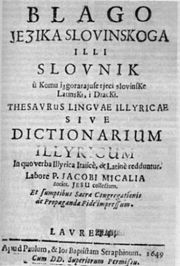
Micaglia's greatest work is "Thesaurus of Slovinian Language and Slovinian Dictionary (where Croatian words are translated in Italian and Latin)". It was first printed in LoretoLoreto (AN)
Loreto is a hilltown and comune of the Italian province of Ancona, in the Marche. It is mostly famous as the seat of the Basilica della Santa Casa, a popular Catholic pilgrimage site.-Location:...
in 1649, but a better printing press was needed, so it was completed in Ancona
Ancona
Ancona is a city and a seaport in the Marche region, in central Italy, with a population of 101,909 . Ancona is the capital of the province of Ancona and of the region....
in 1651. The dictionary was a Jesuits project, an instrument to fight the Protestant Reformation
Protestant Reformation
The Protestant Reformation was a 16th-century split within Western Christianity initiated by Martin Luther, John Calvin and other early Protestants. The efforts of the self-described "reformers", who objected to the doctrines, rituals and ecclesiastical structure of the Roman Catholic Church, led...
in the Balkans.
It was the first Croatian dictionary, with Croatian (under name of "Illyric" or "Slovinian") as the starting language (in the very same dictionary, he treats the terms Croatian, Slovinian and Illyric as synonyms ). An Important thing to note is that Micaglia names in his dicionary Croatian language as "Illyric" or "Slovinian", Italian as "Latin", which he names as the "students' language" (diacki). The introduction to the dictionary has a "Latin" dedication, a note to the reader in Italian (Al benigno lettore), a presentation of the alphabet and orthography in Latin and Croatian (Od ortographie jezika slovinskoga ili načina od pisanja), and an Italian grammar
Italian grammar
Italian grammar is the body of rules describing the properties of the Italian language. Italian words can be divided into these lexical categories: article, noun, adjective, pronoun, verb, adverb, preposition, conjunction and interjection.-Articles:...
in Croatian (Grammatika Talianska).
Micaglia explains in the foreword that he chose the Bosnian
Bosnian language
Bosnian is a South Slavic language, spoken by Bosniaks. As a standardized form of the Shtokavian dialect, it is one of the three official languages of Bosnia and Herzegovina....
dialect because "everyone says that the Bosnian language is the most beautiful one" ("Ogn'un dice che la lingua Bosnese sia la piu bella"). Bosnian is identified as the Shtokavian dialect
Shtokavian dialect
Shtokavian or Štokavian is the prestige dialect of the Serbo-Croatian language, and the basis of its Bosnian, Croatian, Serbian, and Montenegrin standards...
of the local South Slavic
South Slavs
The South Slavs are the southern branch of the Slavic peoples and speak South Slavic languages. Geographically, the South Slavs are native to the Balkan peninsula, the southern Pannonian Plain and the eastern Alps...
languages. The dictionary, intended primarily to teach students and young Jesuits, has around 25,000 words. It belongs to the corpse of dictionaries in Shtokavian dialect, with some Chakavian parts, and even Kaykavian lexic as entry or synonym. Mikalja's dictionary is regarded as a Croatian dictionary by mainstream lexicographers and linguists.
From the cultural point of view, Micaglia's work was influenced by earlier works of Fausto Veranzio and Bartolomeo Cassio
Bartol Kašic
Bartol Kašić was a Croatian linguist. He wrote the first Croatian grammar and translated the Bible and the Roman Rite into Croatian...
, and it influenced the Croatian
Croats
Croats are a South Slavic ethnic group mostly living in Croatia, Bosnia and Herzegovina and nearby countries. There are around 4 million Croats living inside Croatia and up to 4.5 million throughout the rest of the world. Responding to political, social and economic pressure, many Croats have...
circle of lexicographers (among them Franciscans Divković
Matija Divkovic
Matija Divković was a Croatian writer, the founder of the Croatian literature in Bosnia.-Life:Divković was born in Jelaške near Vareš in Bosnia. He probably joined the Franciscans in the nearest monastery in Olovo and was schooled there. He continued his studies in Italy, but then returned to...
and Tomo Babić), both in Croatia and in Bosnia and Herzegovina
Bosnia and Herzegovina
Bosnia and Herzegovina , sometimes called Bosnia-Herzegovina or simply Bosnia, is a country in Southern Europe, on the Balkan Peninsula. Bordered by Croatia to the north, west and south, Serbia to the east, and Montenegro to the southeast, Bosnia and Herzegovina is almost landlocked, except for the...
. His work is an integral part of development and standardization of Croatian modern language.
Works
- Thesaurus linguae Illyricae sive Dictionarium Illyricum. In quo verba Illyrica Italice, et Latine redduntur, Romae: et sumptibus Sacrae congregationis de propaganda fide impressum, Loreto, apud Paulum et Io. Baptistam Seraphinum, 1649 (Thesaurus of Croatian language or a Croatian "Dictionary", where Croatian words are translated in Italian and Latin) (Ancona, 1651).Blago jezika slovinskoga ili Slovnik u Komu izgovarajuse rjeci slovinske Latinski, i Diacki.
- Bogoljubno razmiscgljanje od ocenascja Pokupgljeno iz kgniga Svetoga Tomme od Aquina Nauciteglja Anghjelskoga (God-Loving Thoughts on the Lord's Prayer Taken from the Books of St Thomas Aquinas, the Angelic Doctor, Bratislava, 1642)
Printing of the "Thesaurus" was started by Serafini brothers in Loreto in 1649, and completed by O. Beltrano in Ancona in 1651.
External links
- Matica hrvatska - Kolo - Jubileji hrvatskih leksikografa by Vladimir Horvat
- Google book: Giacomo Micaglia. p 209 (in Italian)
- IHJJ - About Jakov Mikalja
- A page about Jakov Mikalja
- Scientific project about Jakov Mikalja's work
- List of Croatian dictionaries in history
- "Quando a Peschici gli slavi ... erano di casa"
- Jubileji leksikografa Mikalje (Jubilees of Lexicograph Mikalja)
- Neki ga još smatraju Talijanom (Some still regard him as Italian)
- Colonie slave in Puglia (in Italian)