
Home      Discussion      Topics      Dictionary      Almanac
Signup       Login
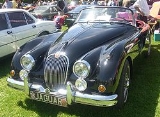
Jaguar XK150

Jaguar XK150

Overview
The Jaguar XK150 is a sports car
Sports car
A sports car is a small, usually two seat, two door automobile designed for high speed driving and maneuverability....

 produced by Jaguar between 1957 and 1961. It replaced the XK140
Jaguar XK140
The Jaguar XK140 is a sports car manufactured by Jaguar between 1954 and 1957, the successor to Jaguar's highly successful XK120. Upgrades included better brakes, rack and pinion steering, increased suspension travel and modern tube type shock absorbers instead of the older lever arm...

.
Discussion
Ask a question about 'Jaguar XK150'
Start a new discussion about 'Jaguar XK150'
Answer questions from other users
Full Discussion Forum
 
Unanswered Questions
Encyclopedia
The Jaguar XK150 is a sports car
Sports car
A sports car is a small, usually two seat, two door automobile designed for high speed driving and maneuverability....

 produced by Jaguar between 1957 and 1961. It replaced the XK140
Jaguar XK140
The Jaguar XK140 is a sports car manufactured by Jaguar between 1954 and 1957, the successor to Jaguar's highly successful XK120. Upgrades included better brakes, rack and pinion steering, increased suspension travel and modern tube type shock absorbers instead of the older lever arm...

.

Initially it was available in Fixed Head Coupé (FHC) and Drop Head Coupé (DHC) versions. The Open Two Seater roadster
Roadster
A roadster is a two-seat open car with emphasis on sporty handling and without a fixed roof or side weather protection. Strictly speaking a roadster with wind-up windows is a convertible but as true roadsters are no longer made the distinction is now irrelevant...

 (OTS) was not launched until 1958. Token rear seats were fitted in the coupé
Coupé
A coupé or coupe is a closed car body style , the precise definition of which varies from manufacturer to manufacturer, and over time...

s.

History


Although having a family resemblance to the XK120
Jaguar XK120
The Jaguar XK120 is a sports car which was manufactured by Jaguar between 1948 and 1954. It was Jaguar's first sports car since the SS 100, which ceased production in 1940.-History:...

 and XK140
Jaguar XK140
The Jaguar XK140 is a sports car manufactured by Jaguar between 1954 and 1957, the successor to Jaguar's highly successful XK120. Upgrades included better brakes, rack and pinion steering, increased suspension travel and modern tube type shock absorbers instead of the older lever arm...

, the XK150 was radically modernized. A one-piece windscreen replaced the split screen, and the wing line no longer dropped as much over the doors. The bonnet was widened, opened down to the wings, and on the roadster the bulkhead was moved back 4 inches (102 mm) to make the bonnet longer. The car was available at various times in Red, Pearl Grey, White, Indigo Blue, Claret, Cotswold Blue, Black, Mist Grey, Sherwood Green, Carmen Red, British racing Green, Cornish grey and Imperial Maroon.

In the interior, the XK140's walnut dashboard was replaced by one trimmed in leather. On the early Drop Head Coupés, an aluminium centre dash panel with an X pattern engraving was fitted which looked similar to the early 3.8 E-type. It was discontinued after June 1958. Thinner doors gave more interior space. On the front parking lights, which were located above the turn signal, a little red light was placed to remind the driver the lights were on.

The standard engine, the same as fitted to the XK140, was the 3.4 litre DOHC Jaguar straight-6
Straight-6
The straight-six engine or inline-six engine is a six-cylinder internal combustion engine with all six cylinders mounted in a straight line along the crankcase...

 rated at 180 SAE bhp at 5750 rpm but most cars were fitted with the SE engine that had a modified cylinder head with larger exhaust valves rated at 210 SAE bhp at 5500 rpm. Twin 1.75 inches (44.5 mm) SU HD6 carburettors were fitted.

While the first XK150 were slower than their predecessors, the deficit was corrected in the spring of 1958 with a 3.4-litre "S" engine with three 2 inches (50.8 mm) SU HD8 carburettors and a straight ported cylinder head giving a claimed 250 SAE bhp.

For 1960, Jaguar bored its 3.4 to 3.8 litres, rating this option at 220 hp in standard tune or 265 hp "S" form. A 3.8 litre 150S could top 135 mi/h and sprint from 0–60 mph in around 7.0 seconds, thus restoring whatever verve the XK had been missing. Fuel economy was 18mpg.

Four-wheel Dunlop 12 in (305 mm) disc brake
Disc brake
The disc brake or disk brake is a device for slowing or stopping the rotation of a wheel while it is in motion.A brake disc is usually made of cast iron, but may in some cases be made of composites such as reinforced carbon–carbon or ceramic matrix composites. This is connected to the wheel and/or...

s appeared for the first time although it was theoretically possible to order a car with drums. Either wire wheels or disc wheels could be specified. Suspension and chassis were very similar to that on the XK140. Steering was by rack and pinion; power steering
Power steering
Power steering helps drivers steer vehicles by augmenting steering effort of the steering wheel.Hydraulic or electric actuators add controlled energy to the steering mechanism, so the driver needs to provide only modest effort regardless of conditions. Power steering helps considerably when a...

was not offered.

Production ended in October 1960, and totaled 2265 Roadsters, 4445 Fixed Head Coupés and 2672 Drop Head Coupés.

Engine specifications

XK 150 ENGINES
Model Years Displacement Configuration Bore/Stroke Carburettor Power
XK 150 3.4 1957–1959
3442cc
DOHC Straight-6
83mm x 106mm
Double SU H6 190 bhp @ 5500 rpm
XK 150 3.4 S 1957–1959
3442 cc
DOHC Straight-6
83 mm x 106 mm
Triple SU H8  250 bhp @ 5500 rpm
XK 150 3.8 1959–1960
3781 cc
DOHC Straight-6
87 mm x 106 mm
Double SU H6 220 bhp @ 5500 rpm
XK 150 3.8 S 1959–1960
3781 cc
DOHC Straight-6
87 mm x 106 mm
Triple SU H8  265 bhp @ 5500 rpm

Performance


A 250 bhp 3.4 litre XK150S Fixed-head coupé with limited slip differential was tested by the British magazine The Motor in 1959. It had a top speed of 132 mph (212.4 km/h) and could accelerate from 0–60 mph (96.6 km/h) in 7.8 seconds. A fuel consumption of 22 mpgimp was recorded. The test car cost £2110 including taxes of £623. It was at the time the fastest closed car the magazine had ever subjected to a full road test.

External links

  • XKData.com volunteer maintained online registry with thousands of cars