


Jacobean architecture

Encyclopedia
The Jacobean style is the second phase of Renaissance
architecture
in England
, following the Elizabethan style. It is named after King James I of England
, with whose reign it is associated.
and Flemish carvers rather than directly from Italy
. Although the general lines of Elizabethan design remained, there was a more consistent and unified application of formal design, both in plan and elevation. Much use was made of columns and pilaster
s, round-arch arcade
s, and flat roofs with openwork parapet
s. These and other classical elements appeared in a free and fanciful vernacular rather than with any true classical purity. With them were mixed the prismatic rustications and ornamental detail of scrolls, straps, and lozenge
s also characteristic of Elizabethan design. The style influenced furniture design and other decorative arts.
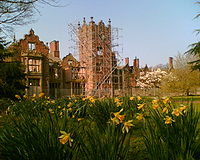 Already during Queen Elizabeth I
's reign reproductions of the classic orders had found their way into English architecture, based frequently upon John Shute
's The First and Chief Grounds of Architecture, published in 1563, with two other editions in 1579 and 1584. In 1577, three years before the commencement of Wollaton Hall
, a copybook of the orders was brought out in Antwerp by Hans Vredeman de Vries
. Though nominally based on the description of the orders by Vitruvius
, the author indulged freely not only in his rendering of them, but in suggestions of his own, showing how the orders might be employed in various buildings. Those suggestions were of a most decadent type, so that even the author deemed it advisable to publish a letter from a canon of the Church, stating that there was nothing in his architectural designs which was contrary to religion. It is to publications of this kind that Jacobean architecture owes the perversion of its forms and the introduction of strap work and pierced crestings, which appear for the first time at Wollaton
(1580); at Bramshill
, Hampshire
(1607–1612), and in Holland House, Kensington
(1624), it receives its fullest development.
Other Jacobean buildings of note are Hatfield House
, Hertfordshire
; Knole House
, near Sevenoaks
in Kent
; Holland House by John Thorpe
, Plas Teg
near Pontblyddyn
between Wrexham
, Mold
, Bank Hall
in Bretherton, Castle Bromwich Hall
near Solihul and Lilford Hall
in Northamptonshire.
Although the term is generally employed of the style which prevailed in England during the first quarter of the 17th century, its peculiar decadent detail will be found nearly twenty years earlier at Wollaton Hall, Nottinghamshire
, and in Oxford
and Cambridge
examples exist up to 1660, notwithstanding the introduction of the purer Italian style by Inigo Jones
in 1619 at Whitehall
.
in Barbados
and Bacon's Castle
in Surry County, Virginia
.
Renaissance
The Renaissance was a cultural movement that spanned roughly the 14th to the 17th century, beginning in Italy in the Late Middle Ages and later spreading to the rest of Europe. The term is also used more loosely to refer to the historical era, but since the changes of the Renaissance were not...
architecture
Architecture
Architecture is both the process and product of planning, designing and construction. Architectural works, in the material form of buildings, are often perceived as cultural and political symbols and as works of art...
in England
England
England is a country that is part of the United Kingdom. It shares land borders with Scotland to the north and Wales to the west; the Irish Sea is to the north west, the Celtic Sea to the south west, with the North Sea to the east and the English Channel to the south separating it from continental...
, following the Elizabethan style. It is named after King James I of England
James I of England
James VI and I was King of Scots as James VI from 24 July 1567 and King of England and Ireland as James I from the union of the English and Scottish crowns on 24 March 1603...
, with whose reign it is associated.
Characteristics
The reign of James VI of Scotland (or James I of England) (1603–1625), a disciple of the new scholarship, saw the first decisive adoption of Renaissance motifs in a free form communicated to England through GermanGermany
Germany , officially the Federal Republic of Germany , is a federal parliamentary republic in Europe. The country consists of 16 states while the capital and largest city is Berlin. Germany covers an area of 357,021 km2 and has a largely temperate seasonal climate...
and Flemish carvers rather than directly from Italy
Italy
Italy , officially the Italian Republic languages]] under the European Charter for Regional or Minority Languages. In each of these, Italy's official name is as follows:;;;;;;;;), is a unitary parliamentary republic in South-Central Europe. To the north it borders France, Switzerland, Austria and...
. Although the general lines of Elizabethan design remained, there was a more consistent and unified application of formal design, both in plan and elevation. Much use was made of columns and pilaster
Pilaster
A pilaster is a slightly-projecting column built into or applied to the face of a wall. Most commonly flattened or rectangular in form, pilasters can also take a half-round form or the shape of any type of column, including tortile....
s, round-arch arcade
Arcade (architecture)
An arcade is a succession of arches, each counterthrusting the next, supported by columns or piers or a covered walk enclosed by a line of such arches on one or both sides. In warmer or wet climates, exterior arcades provide shelter for pedestrians....
s, and flat roofs with openwork parapet
Parapet
A parapet is a wall-like barrier at the edge of a roof, terrace, balcony or other structure. Where extending above a roof, it may simply be the portion of an exterior wall that continues above the line of the roof surface, or may be a continuation of a vertical feature beneath the roof such as a...
s. These and other classical elements appeared in a free and fanciful vernacular rather than with any true classical purity. With them were mixed the prismatic rustications and ornamental detail of scrolls, straps, and lozenge
Lozenge
A lozenge , often referred to as a diamond, is a form of rhombus. The definition of lozenge is not strictly fixed, and it is sometimes used simply as a synonym for rhombus. Most often, though, lozenge refers to a thin rhombus—a rhombus with acute angles of 45°...
s also characteristic of Elizabethan design. The style influenced furniture design and other decorative arts.
History and examples
Elizabeth I of England
Elizabeth I was queen regnant of England and Ireland from 17 November 1558 until her death. Sometimes called The Virgin Queen, Gloriana, or Good Queen Bess, Elizabeth was the fifth and last monarch of the Tudor dynasty...
's reign reproductions of the classic orders had found their way into English architecture, based frequently upon John Shute
John Shute
John Shute was an English artist and architect. His book, The First and Chief Grounds of Architecture, was the first work in English on classical architecture. Shute's patron was John Dudley, 1st Duke of Northumberland, for whom he built a residential wing at Dudley Castle.- References :*Morris,...
's The First and Chief Grounds of Architecture, published in 1563, with two other editions in 1579 and 1584. In 1577, three years before the commencement of Wollaton Hall
Wollaton Hall
Wollaton Hall is a country house standing on a small but prominent hill in Wollaton, Nottingham, England. Wollaton Park is the area of parkland that the stately house stands in. The house itself is a natural history museum, with other museums in the out-buildings...
, a copybook of the orders was brought out in Antwerp by Hans Vredeman de Vries
Hans Vredeman de Vries
Hans Vredeman de Vries was a Dutch Renaissance architect, painter, and engineer. Vredeman de Vries is known for his publication in 1583 on garden design and his books with many examples on ornaments and perspective ....
. Though nominally based on the description of the orders by Vitruvius
Vitruvius
Marcus Vitruvius Pollio was a Roman writer, architect and engineer, active in the 1st century BC. He is best known as the author of the multi-volume work De Architectura ....
, the author indulged freely not only in his rendering of them, but in suggestions of his own, showing how the orders might be employed in various buildings. Those suggestions were of a most decadent type, so that even the author deemed it advisable to publish a letter from a canon of the Church, stating that there was nothing in his architectural designs which was contrary to religion. It is to publications of this kind that Jacobean architecture owes the perversion of its forms and the introduction of strap work and pierced crestings, which appear for the first time at Wollaton
Wollaton
Wollaton is an area in the western part of Nottingham, England. It is home to Wollaton Hall with its museum, deer park, lake, walks and golf course...
(1580); at Bramshill
Bramshill
Bramshill is a civil parish in the English county of Hampshire. Its name has become synonymous with the Police Staff College, Bramshill located in Bramshill House. Bramshill forms part of the district of Hart...
, Hampshire
Hampshire
Hampshire is a county on the southern coast of England in the United Kingdom. The county town of Hampshire is Winchester, a historic cathedral city that was once the capital of England. Hampshire is notable for housing the original birthplaces of the Royal Navy, British Army, and Royal Air Force...
(1607–1612), and in Holland House, Kensington
Kensington
Kensington is a district of west and central London, England within the Royal Borough of Kensington and Chelsea. An affluent and densely-populated area, its commercial heart is Kensington High Street, and it contains the well-known museum district of South Kensington.To the north, Kensington is...
(1624), it receives its fullest development.
Other Jacobean buildings of note are Hatfield House
Hatfield House
Hatfield House is a country house set in a large park, the Great Park, on the eastern side of the town of Hatfield, Hertfordshire, England. The present Jacobean house was built in 1611 by Robert Cecil, First Earl of Salisbury and Chief Minister to King James I and has been the home of the Cecil...
, Hertfordshire
Hertfordshire
Hertfordshire is a ceremonial and non-metropolitan county in the East region of England. The county town is Hertford.The county is one of the Home Counties and lies inland, bordered by Greater London , Buckinghamshire , Bedfordshire , Cambridgeshire and...
; Knole House
Knole House
Knole is an English country house in the town of Sevenoaks in west Kent, surrounded by a deer park. One of England's largest houses, it is reputed to be a calendar house, having 365 rooms, 52 staircases, 12 entrances and 7 courtyards...
, near Sevenoaks
Sevenoaks
Sevenoaks is a commuter town situated on the London fringe of west Kent, England, some 20 miles south-east of Charing Cross, on one of the principal commuter rail lines from the capital...
in Kent
Kent
Kent is a county in southeast England, and is one of the home counties. It borders East Sussex, Surrey and Greater London and has a defined boundary with Essex in the middle of the Thames Estuary. The ceremonial county boundaries of Kent include the shire county of Kent and the unitary borough of...
; Holland House by John Thorpe
John Thorpe
John Thorpe or Thorp was an English architect. Little is known of his life, and his work is dubiously inferred, rather than accurately known, from a folio of drawings in the Sir John Soane's Museum, to which Horace Walpole called attention, in 1780, in his Anecdotes of Painting; but how far these...
, Plas Teg
Plas Teg
Plas Teg is a Jacobean house in Wales. Located near the village of Pontblyddyn between Wrexham and Mold, it was built by Sir John Trevor I in about 1610. At the time of construction it was the most advanced house in Wales and few others of this date can truly be compared to its uniqueness...
near Pontblyddyn
Pontblyddyn
Pontblyddyn is a small village outside Leeswood, in the North Wales county of Flintshire and is situated around 8 miles from Wrexham. Plas Teg, one of the most important Jacobean era houses in Wales is located near the village....
between Wrexham
Wrexham
Wrexham is a town in Wales. It is the administrative centre of the wider Wrexham County Borough, and the largest town in North Wales, located in the east of the region. It is situated between the Welsh mountains and the lower Dee Valley close to the border with Cheshire, England...
, Mold
Mold
Molds are fungi that grow in the form of multicellular filaments called hyphae. Molds are not considered to be microbes but microscopic fungi that grow as single cells called yeasts...
, Bank Hall
Bank Hall
Bank Hall is a Jacobean mansion south of the village of Bretherton in Lancashire, England. It is a Grade II* Listed Building. The hall was built on the site of a previous building in 1608 during the reign of James I by the Banastre family who were Lords of the Manor. It was extended during the 18th...
in Bretherton, Castle Bromwich Hall
Castle Bromwich Hall
Castle Bromwich Hall is a Jacobean Mansion in the village of Castle Bromwich, which is situated in the northern part of the Metropolitan Borough of Solihull in West Midlands, England. It is a Grade I listed building.-History:...
near Solihul and Lilford Hall
Lilford Hall
Lilford Hall is a Grade 1 listed stately 100-room home having a Jacobean exterior and Georgian interior with a floor area, located in the eastern part of the County of Northamptonshire in the United Kingdom, south of Oundle and north of Thrapston. A Grade 1 listed building is considered by the UK...
in Northamptonshire.
Although the term is generally employed of the style which prevailed in England during the first quarter of the 17th century, its peculiar decadent detail will be found nearly twenty years earlier at Wollaton Hall, Nottinghamshire
Nottinghamshire
Nottinghamshire is a county in the East Midlands of England, bordering South Yorkshire to the north-west, Lincolnshire to the east, Leicestershire to the south, and Derbyshire to the west...
, and in Oxford
Oxford
The city of Oxford is the county town of Oxfordshire, England. The city, made prominent by its medieval university, has a population of just under 165,000, with 153,900 living within the district boundary. It lies about 50 miles north-west of London. The rivers Cherwell and Thames run through...
and Cambridge
Cambridge
The city of Cambridge is a university town and the administrative centre of the county of Cambridgeshire, England. It lies in East Anglia about north of London. Cambridge is at the heart of the high-technology centre known as Silicon Fen – a play on Silicon Valley and the fens surrounding the...
examples exist up to 1660, notwithstanding the introduction of the purer Italian style by Inigo Jones
Inigo Jones
Inigo Jones is the first significant British architect of the modern period, and the first to bring Italianate Renaissance architecture to England...
in 1619 at Whitehall
Whitehall
Whitehall is a road in Westminster, in London, England. It is the main artery running north from Parliament Square, towards Charing Cross at the southern end of Trafalgar Square...
.
In the Americas
Examples of original Jacobean architecture in the Americas include Drax Hall Great HouseDrax Hall Estate
Drax Hall Estate was a sugar plantation of Saint George in central Barbados in the Caribbean. It is the site where the first sugar cane was cultivated in 1642 and is still only one of two Jacobean houses remaining in Barbados. The estate has belonged to the Drax family since it was built in the...
in Barbados
Barbados
Barbados is an island country in the Lesser Antilles. It is in length and as much as in width, amounting to . It is situated in the western area of the North Atlantic and 100 kilometres east of the Windward Islands and the Caribbean Sea; therein, it is about east of the islands of Saint...
and Bacon's Castle
Bacon's Castle
Bacon's Castle, also variously known as "Allen's Brick House" or the "Arthur Allen House" is located in Surry County, Virginia, USA, and is one of the oldest dateable brick buildings in Virginia....
in Surry County, Virginia
Surry County, Virginia
As of the census of 2010, there were 7,058 people, 2,619 households, and 1,917 families residing in the county. The population density was 24 people per square mile . There were 3,294 housing units at an average density of 12 per square mile...
.