

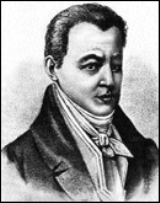
Ivan Kotlyarevsky

Encyclopedia
Ivan Petrovych Kotlyarevsky ' onMouseout='HidePop("73736")' href="/topics/Poltava">Poltava
– , Poltava, Russian Empire, now Ukraine), was a Ukrainian
writer, poet and playwright, regarded as the pioneer of modern Ukrainian literature
. Kotliarevsky was a veteran of the Russo-Turkish War.
at rural estates, where he became familiar with Ukrainian folk life and the peasant vernacular
. He served in the Imperial Russian Army
between 1796 and 1808 in the Siversky Karabiner Regiment. Kotlyarevsky participated in the Russo-Turkish War (1806–1812) as a staff-captain (something of 1LT or junior CPT) during which the Russian troops laid the siege to the city of Izmail
. In 1808 he retired from the Army. In 1810 he became the trustee
of an institution for the education of children of impoverished nobles. In 1812, during the French invasion of Imperial Russia
he organized the 5th Ukrainian Cossack Regiment in the town of Horoshyn (Khorol uyezd, Poltava Governorate
) under the condition that it will be left after the war as a permanent military formation. For that he received a rank of major
.
He helped stage theatrical productions at the Poltava governor-general's residence and was the artistic director of the Poltava Free Theater between 1812 and 1821. In 1818 together with Vasyl Lukashevych, V.Taranovsky, and others he was the member of the Poltava Freemasonry Lodge
The Love for Truth . Kotlyarevsky participated in the buyout of Mikhail Shchepkin
out of the serfdom. From 1827 to 1835 he directed several philanthropic
agencies.
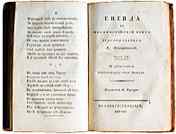 Ivan Kotlyarevsky's epic-style
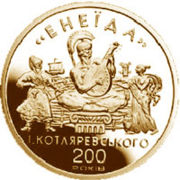
1798 poem Eneyida , is considered to be the first literary work published wholly in the modern Ukrainian language
. Although Ukrainian was an everyday language to millions of people in Ukraine
, it was officially discouraged from literary use in the area controlled by Imperial Russia. Eneyida is a parody of Virgil's
Aeneid
, where Kotlyarevsky transformed the Trojan
heroes into Zaporozhian Cossacks. Critics believe that it was written in the light of the destruction of Zaporizhian Host by the order of Catherine the Great.
His two plays, also living classics, Natalka Poltavka
(Natalka from Poltava) and Moskal-Charivnyk
(The Muscovite-Sorcerer), became the impetus for the creation of the Natalka Poltavka opera
and the development of Ukrainian national theater.
Poltava
Poltava is a city in located on the Vorskla River in central Ukraine. It is the administrative center of the Poltava Oblast , as well as the surrounding Poltava Raion of the oblast. Poltava's estimated population is 298,652 ....
– , Poltava, Russian Empire, now Ukraine), was a Ukrainian
Ukraine
Ukraine is a country in Eastern Europe. It has an area of 603,628 km², making it the second largest contiguous country on the European continent, after Russia...
writer, poet and playwright, regarded as the pioneer of modern Ukrainian literature
Ukrainian literature
Ukrainian literature is literature written in the Ukrainian language. Ukrainian literature had a difficult development because, due to constant foreign domination over Ukrainian territories, there was often a significant difference between the spoken and written language...
. Kotliarevsky was a veteran of the Russo-Turkish War.
Biography
Kotlyarevsky was born in the Ukrainian city of Poltava in the family of a clerk. After studying at the Poltava Theological Seminary (1780–1789), he worked as a tutor for the gentryGentry
Gentry denotes "well-born and well-bred people" of high social class, especially in the past....
at rural estates, where he became familiar with Ukrainian folk life and the peasant vernacular
Vernacular
A vernacular is the native language or native dialect of a specific population, as opposed to a language of wider communication that is not native to the population, such as a national language or lingua franca.- Etymology :The term is not a recent one...
. He served in the Imperial Russian Army
Imperial Russian Army
The Imperial Russian Army was the land armed force of the Russian Empire, active from around 1721 to the Russian Revolution of 1917. In the early 1850s, the Russian army consisted of around 938,731 regular soldiers and 245,850 irregulars . Until the time of military reform of Dmitry Milyutin in...
between 1796 and 1808 in the Siversky Karabiner Regiment. Kotlyarevsky participated in the Russo-Turkish War (1806–1812) as a staff-captain (something of 1LT or junior CPT) during which the Russian troops laid the siege to the city of Izmail
Izmail
Izmail is a historic town near the Danube river in the Odessa Oblast of south-western Ukraine. Serving as the administrative center of the Izmail Raion , the city itself is also designated as a separate raion within the oblast....
. In 1808 he retired from the Army. In 1810 he became the trustee
Trustee
Trustee is a legal term which, in its broadest sense, can refer to any person who holds property, authority, or a position of trust or responsibility for the benefit of another...
of an institution for the education of children of impoverished nobles. In 1812, during the French invasion of Imperial Russia
French invasion of Russia
The French invasion of Russia of 1812 was a turning point in the Napoleonic Wars. It reduced the French and allied invasion forces to a tiny fraction of their initial strength and triggered a major shift in European politics as it dramatically weakened French hegemony in Europe...
he organized the 5th Ukrainian Cossack Regiment in the town of Horoshyn (Khorol uyezd, Poltava Governorate
Poltava Governorate
The Poltava Governorate or Government of Poltava was a guberniya in the historical Left-bank Ukraine region of the Russian Empire, which was officially created in 1802 from the disbanded Malorossiya Governorate which was split between the Chernigov Governorate and Poltava Governorate with an...
) under the condition that it will be left after the war as a permanent military formation. For that he received a rank of major
Major
Major is a rank of commissioned officer, with corresponding ranks existing in almost every military in the world.When used unhyphenated, in conjunction with no other indicator of rank, the term refers to the rank just senior to that of an Army captain and just below the rank of lieutenant colonel. ...
.
He helped stage theatrical productions at the Poltava governor-general's residence and was the artistic director of the Poltava Free Theater between 1812 and 1821. In 1818 together with Vasyl Lukashevych, V.Taranovsky, and others he was the member of the Poltava Freemasonry Lodge
Freemasonry in Ukraine
Freemasonry in Ukraine has appeared sometime in mid 18th century when the first lodges were created on its territory at that time within the Polish-Lithuanian Commonwealth.-Development of the freemasonry movement:...
The Love for Truth . Kotlyarevsky participated in the buyout of Mikhail Shchepkin
Mikhail Shchepkin
Mikhail Semyonovich Shchepkin was the most famous Russian actor of the 19th century.As his father was a serf, Shchepkin's freedom had to be bought by his admirers in 1821. Three years later, he joined the Maly Theatre in Moscow, which he would dominate for the next 40 years—it became known as the...
out of the serfdom. From 1827 to 1835 he directed several philanthropic
Philanthropy
Philanthropy etymologically means "the love of humanity"—love in the sense of caring for, nourishing, developing, or enhancing; humanity in the sense of "what it is to be human," or "human potential." In modern practical terms, it is "private initiatives for public good, focusing on quality of...
agencies.
The first modern Ukrainian writer
Epic poetry
An epic is a lengthy narrative poem, ordinarily concerning a serious subject containing details of heroic deeds and events significant to a culture or nation. Oral poetry may qualify as an epic, and Albert Lord and Milman Parry have argued that classical epics were fundamentally an oral poetic form...
1798 poem Eneyida , is considered to be the first literary work published wholly in the modern Ukrainian language
Ukrainian language
Ukrainian is a language of the East Slavic subgroup of the Slavic languages. It is the official state language of Ukraine. Written Ukrainian uses a variant of the Cyrillic alphabet....
. Although Ukrainian was an everyday language to millions of people in Ukraine
Ukraine
Ukraine is a country in Eastern Europe. It has an area of 603,628 km², making it the second largest contiguous country on the European continent, after Russia...
, it was officially discouraged from literary use in the area controlled by Imperial Russia. Eneyida is a parody of Virgil's
Virgil
Publius Vergilius Maro, usually called Virgil or Vergil in English , was an ancient Roman poet of the Augustan period. He is known for three major works of Latin literature, the Eclogues , the Georgics, and the epic Aeneid...
Aeneid
Aeneid
The Aeneid is a Latin epic poem, written by Virgil between 29 and 19 BC, that tells the legendary story of Aeneas, a Trojan who travelled to Italy, where he became the ancestor of the Romans. It is composed of roughly 10,000 lines in dactylic hexameter...
, where Kotlyarevsky transformed the Trojan
Troy
Troy was a city, both factual and legendary, located in northwest Anatolia in what is now Turkey, southeast of the Dardanelles and beside Mount Ida...
heroes into Zaporozhian Cossacks. Critics believe that it was written in the light of the destruction of Zaporizhian Host by the order of Catherine the Great.
His two plays, also living classics, Natalka Poltavka
Natalka Poltavka
Natalka Poltavka is a Ukrainian play written by Ivan Kotlyarevsky.-History:The play was written in 1819 in the Ukrainian language, first performed in 1821 in the city of Kharkiv, though it was not available in print until 1838...
(Natalka from Poltava) and Moskal-Charivnyk
Moskal-Charivnyk
Moskal-Charivnyk , is a 1995 musical comedy by the Ukrainian filmmaker Mykola Zasieyev-Rudenko based on the book by Ukrainian writer Ivan Kotliarevskyi. The film features a detailed portrayal of Ukrainian culture, showing the beauty of Ukrainian traditions, music, costumes, and language.-Plot:The...
(The Muscovite-Sorcerer), became the impetus for the creation of the Natalka Poltavka opera
Natalka Poltavka (opera)
Natalka Poltavka is an opera in three acts by the Ukrainian composer Mykola Lysenko, based on the play Natalka Poltavka by Ivan Kotlyarevsky, first performed in 1889.-Background:...
and the development of Ukrainian national theater.
External links
- Ivan Kotlyarevsky in Encyclopædia BritannicaEncyclopædia BritannicaThe Encyclopædia Britannica , published by Encyclopædia Britannica, Inc., is a general knowledge English-language encyclopaedia that is available in print, as a DVD, and on the Internet. It is written and continuously updated by about 100 full-time editors and more than 4,000 expert...
- Ivan Kotliarevsky in Encyclopedia of Ukraine
- Eneyida - a living classic of Ukrainian literature in Welcome to Ukraine, 1999, 1
- Excerpts from Eneyida (translated into English)
- Text of Eneyida