

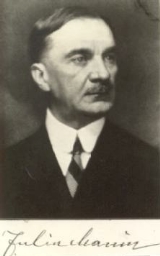
Iuliu Maniu

Encyclopedia
Iuliu Maniu (ˈjulju maˈni.u; January 8, 1873 – February 5, 1953) was an Austro-Hungarian
-born Romania
n politician. A leader of the National Party
of Transylvania
and Banat
before and after World War I
, he served as Prime Minister of Romania
for three terms during 1928–1933, and, with Ion Mihalache
, co-founded the National Peasants' Party
.
, Hungarian Kingdom
in Austria-Hungary; his father was Ioan Maniu
. He finished lyceum
in Zalău
, and studied Law at the University of Cluj
, then at the University of Budapest and that of Vienna
, being awarded the doctorate
in 1896.
Maniu joined the Romanian National Party of Transylvania and Banat (PNR), became a member of its collective leadership body in 1897, and represented it in the Budapest
Parliament on several occasions. He settled in Blaj
, and served as lawyer
for the Greek Catholic Church
(to which he belonged). Maniu was influenced by the activity of Simion Bărnuţiu
, a maternal uncle of his father, Ioan Maniu
.
After serving as an advisor for Archduke Franz Ferdinand, counseling on the latter's projects to redefine the Habsburg
states along the lines of a United States of Greater Austria
, Maniu moved towards the option of a union with the Romanian Old Kingdom
when the Archduke was assassinated in Sarajevo in 1914.
, Gheorghe Pop de Băseşti
, the Romanian Orthodox
cleric Miron Cristea
, and Alexandru Vaida-Voevod
, he engaged in an intensive unionist campaign, leading to the Alba Iulia gathering on December 1, 1918 (during which Romanians
demanded separation from Austria-Hungary). On December 2, Maniu became head of Transylvania's Directory Council - a position equivalent to interim governor
ship.
After the creation of Greater Romania
, the PNR formed the government in Bucharest
—a cabinet led by Al. Vaida-Voevod and allied with Ion Mihalache
's Peasants' Party
. It entered in competition with one of the traditional parties of the Romanian Kingdom, the National Liberal Party
, and with its leader Ion I. C. Brătianu
, when the Peasants' Party deadlocked the Parliament of Romania
with calls for a widespread land reform
.
After King
Ferdinand I
dissolved the Parliament, Iuliu Maniu found himself at odds with the national leadership, especially after the new Prime Minister Alexandru Averescu
(with support from the National Liberals) dissolved the Transylvanian Council in April 1920. Consequently, Maniu refused to attend King Ferdinand's Crowning ceremony as King of Greater Romania (held in Alba Iulia
, in 1922), seeing it as an attempt to tie multi-religious Transylvania to Orthodoxy. At the same time, the PNR rejected the centralization
imposed by the 1923 Constitution
favored by Brătianu, and demanded that any constitutional reform be passed by a Constituent Assembly
, and not by a regular vote in Parliament. Citing fears that the PNL had ensured a grip over Romanian politics, the PNR and the Peasants' Party united in 1926, and Maniu was the President of the new political force, the National Peasants' Party
(PNŢ), for the following seven years, and again between 1937 and 1947.
of King Ferdinand (who had preferred to nominate Brătianu, Averescu, and Prince Barbu Ştirbey
). Maniu publicly protested, and attempted to organize a peasants' march on Bucharest as a public show of support modeled on the Alba Iulia assembly. He also showed himself open to deals proposed by Viscount Rothermere
regarding a review of the Treaty of Trianon
, and, as King Ferdinand's death approached, started negotiations with the disinherited Prince Carol
(King Ferdinand's son), proposing that the latter bypass the Constitution and crown himself in Alba Iulia (as a new foundation for the Romanian Kingdom). Talks with Carol were ended abruptly after the Romanian authorities called on the United Kingdom
to expel the Prince from its territory.
The PNŢ only came to power in November 1928, after both King Ferdinand and Brătianu had died (in the elections of that year, it allied itself with the Romanian Social Democratic Party
and the German Party
). In 1930, Maniu maneuvered against the Constitution, and, together with Gheorghe Mironescu
, brought about Carol's return and deposition of his son Michael
. However, Carol did not respect the terms of his agreement with Maniu, refusing to resume his marriage to Queen Elena. After alternating governments of Maniu and Vaida-Voevod that had brought the party into conflict with the King's inner circle and with his lover Magda Lupescu
, and had to deal with major problems caused by the Great Depression
(including the soviet backed strike action
s—see Griviţa Strike of 1933
), Carol ultimately removed the PNŢ from national leadership.
regime formed around Carol and prompted by the rapid growth of the fascist
Iron Guard
. In 1937, Maniu agreed to sign an electoral pact with the Iron Guard's Corneliu Zelea Codreanu
, in the hope that this would block the monarch's maneuvers. The king instead sought an agreement with other members of the political class, including the National Liberal Ion Duca and the former PNŢ politician Armand Călinescu
, while clamping down on the Iron Guard—leading to a wave of terrorist
actions in reprisal.
With the loss of Northern Transylvania
, Bessarabia
, and Southern Dobruja
in 1940, Carol conceded power and exiled himself, leading to the creation of the National Legionary State
around the Iron Guard
and General Ion Antonescu
, a regime which aligned Romania with Nazi Germany
and the Axis
. The PNŢ survived in semi-clandestinity and, after Antonescu purged the Guard, achieved some unofficial status when Maniu began holding talks with the general over several issues (notably, he called for an end to persecution of the Jews
and transports of Jews to Transnistria). He remained an opponent of Antonescu, a view which he balanced with his adversity towards the Soviet Union
, and joined the plotters of the pro-Allied
royal coup in 1944, while expressing his resentment of the Romanian Communist Party
(PCR) involvement.
 Subsequently, Maniu was a prominent adversary of Soviet influence
and advocate of the Western Allies
, while his party became the predilect target of PCR hostility. After events such as the street fighting between its supporters and Communists in February 1945, and the loss of the general election
of November 1946 through widespread electoral fraud
carried out by the pro-communist Petru Groza
government, the PNŢ was sidelined, with the PCR ensuring the collaboration of several former party members, such as Nicolae L. Lupu
and Anton Alexandrescu.
In a telegram to the State Department, the US representative in Romania, Burton Berry, wrote:
"The Department well knows that Maniu has stood out boldly as a champion of pro-Allied action and sentiment in Rumania even during the dark days of the Antonescu dictatorship. He has an enormous political following in the country and I believe the respect in which all Rumanians hold him eclipses that held for any other Rumanian. Because of what he has been and what he is it seems important that he be preserved from slipping into sharing the general conviction that the dissolution of the
Rumanian state is now in progress."
The party was outlawed in July 1947. That month, Ion Mihalache
was alleged to have attempted to flee the country in an airplane which landed at Tămădău, in order to establish a government in exile
(see Tămădău Affair
). This was judged as treason
able, and both Maniu and Mihalache faced a kangaroo court
that sentenced them to life imprisonment
in a hard labour prison
; given their advanced age, this amounted to a death sentence. The show trial
, signaling the suppression of opposition groups, was a significant step towards the establishment of a communist regime in Romania
.
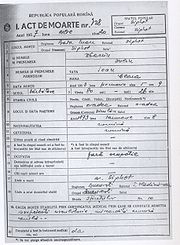
Iuliu Maniu died in 1953 in Sighet prison
, and his body was thrown into the common grave in the courtyard.
Austria-Hungary
Austria-Hungary , more formally known as the Kingdoms and Lands Represented in the Imperial Council and the Lands of the Holy Hungarian Crown of Saint Stephen, was a constitutional monarchic union between the crowns of the Austrian Empire and the Kingdom of Hungary in...
-born Romania
Romania
Romania is a country located at the crossroads of Central and Southeastern Europe, on the Lower Danube, within and outside the Carpathian arch, bordering on the Black Sea...
n politician. A leader of the National Party
Romanian National Party
The Romanian National Party , initially known as the Romanian National Party in Transylvania and Banat , was a political party which was initially designed to offer ethnic representation to Romanians in the Kingdom of Hungary, the Transleithanian half of Austria-Hungary, and especially to those in...
of Transylvania
Transylvania
Transylvania is a historical region in the central part of Romania. Bounded on the east and south by the Carpathian mountain range, historical Transylvania extended in the west to the Apuseni Mountains; however, the term sometimes encompasses not only Transylvania proper, but also the historical...
and Banat
Banat
The Banat is a geographical and historical region in Central Europe currently divided between three countries: the eastern part lies in western Romania , the western part in northeastern Serbia , and a small...
before and after World War I
World War I
World War I , which was predominantly called the World War or the Great War from its occurrence until 1939, and the First World War or World War I thereafter, was a major war centred in Europe that began on 28 July 1914 and lasted until 11 November 1918...
, he served as Prime Minister of Romania
Prime Minister of Romania
The Prime Minister of Romania is the head of the Government of Romania. Initially, the office was styled President of the Council of Ministers , when the term "Government" included more than the Cabinet, and the Cabinet was called The Council of Ministers...
for three terms during 1928–1933, and, with Ion Mihalache
Ion Mihalache
Ion Mihalache was a Romanian agrarian politician, the founder and leader of the Peasants' Party and a main figure of its successor, the National Peasants' Party .-Early life:...
, co-founded the National Peasants' Party
National Peasants' Party
The National Peasants' Party was a Romanian political party, formed in 1926 through the fusion of the Romanian National Party from Transylvania and the Peasants' Party . It was in power between 1928 and 1933, with brief interruptions...
.
Early years
Maniu was born to an ethnic Romanian family in Bădăcin (Szilágybadacsony before 1919 and between 1940 and 1944, now administered from Pericei), near Şimleu SilvanieiSimleu Silvaniei
Şimleu Silvaniei is a town in Sălaj County, Transylvania, Romania with a population of 16,066 people .Three villages are administered by the town: Bic , Cehei and Pusta .-History:...
, Hungarian Kingdom
Kingdom of Hungary
The Kingdom of Hungary comprised present-day Hungary, Slovakia and Croatia , Transylvania , Carpatho Ruthenia , Vojvodina , Burgenland , and other smaller territories surrounding present-day Hungary's borders...
in Austria-Hungary; his father was Ioan Maniu
Ioan Maniu
Ioan Maniu was a Transylvanian Romanian lawyer, politician and journalist.- Biography :He studied law in Pest and Vienna. Maniu was deeply influenced by his uncle Simion Bărnuţiu....
. He finished lyceum
Lyceum
The lyceum is a category of educational institution defined within the education system of many countries, mainly in Europe. The definition varies between countries; usually it is a type of secondary school.-History:...
in Zalău
Zalau
Zalău is the seat of Sălaj County, Transylvania, Romania. In 2004, its estimated population was 62,900.- Ancient times :Zalău is situated in the area inhabited by "Free Dacians", 8 kilometers away from the historical landmark of Porolissum, a well-preserved Roman Castrum with an imposing fortress,...
, and studied Law at the University of Cluj
Babes-Bolyai University
The Babeș-Bolyai University in Cluj-Napoca is an university in Romania. With almost 50,000 students, the university offers 105 specialisations, of which there are 105 in Romanian, 67 in Hungarian, 17 in German, and 5 in English...
, then at the University of Budapest and that of Vienna
University of Vienna
The University of Vienna is a public university located in Vienna, Austria. It was founded by Duke Rudolph IV in 1365 and is the oldest university in the German-speaking world...
, being awarded the doctorate
Doctorate
A doctorate is an academic degree or professional degree that in most countries refers to a class of degrees which qualify the holder to teach in a specific field, A doctorate is an academic degree or professional degree that in most countries refers to a class of degrees which qualify the holder...
in 1896.
Maniu joined the Romanian National Party of Transylvania and Banat (PNR), became a member of its collective leadership body in 1897, and represented it in the Budapest
Budapest
Budapest is the capital of Hungary. As the largest city of Hungary, it is the country's principal political, cultural, commercial, industrial, and transportation centre. In 2011, Budapest had 1,733,685 inhabitants, down from its 1989 peak of 2,113,645 due to suburbanization. The Budapest Commuter...
Parliament on several occasions. He settled in Blaj
Blaj
Blaj is a city in Alba County, Transylvania, Romania. It has a population of 20,758 inhabitants.The landmark of the city is the fact that it was the principal religious and cultural center of the Romanian Greek-Catholic Church in Transylvania....
, and served as lawyer
Lawyer
A lawyer, according to Black's Law Dictionary, is "a person learned in the law; as an attorney, counsel or solicitor; a person who is practicing law." Law is the system of rules of conduct established by the sovereign government of a society to correct wrongs, maintain the stability of political...
for the Greek Catholic Church
Romanian Church United with Rome, Greek-Catholic
The Romanian Church United with Rome, Greek-Catholic is an Eastern Catholic Church which is in full union with the Roman Catholic Church. It is ranked as a Major Archiepiscopal Church and uses the Byzantine liturgical rite in the Romanian language....
(to which he belonged). Maniu was influenced by the activity of Simion Bărnuţiu
Simion Barnutiu
Simion Bărnuţiu was a Transylvanian-born Romanian historian, academic, philosopher, jurist, and liberal politician. A leader of the 1848 revolutionary movement of Transylvanian Romanians, he represented its Eastern Rite Catholic wing...
, a maternal uncle of his father, Ioan Maniu
Ioan Maniu
Ioan Maniu was a Transylvanian Romanian lawyer, politician and journalist.- Biography :He studied law in Pest and Vienna. Maniu was deeply influenced by his uncle Simion Bărnuţiu....
.
After serving as an advisor for Archduke Franz Ferdinand, counseling on the latter's projects to redefine the Habsburg
Habsburg
The House of Habsburg , also found as Hapsburg, and also known as House of Austria is one of the most important royal houses of Europe and is best known for being an origin of all of the formally elected Holy Roman Emperors between 1438 and 1740, as well as rulers of the Austrian Empire and...
states along the lines of a United States of Greater Austria
United States of Greater Austria
The United States of Greater Austria was an idea created by a group of scholars surrounding the Austrian Archduke Franz Ferdinand that never came to pass...
, Maniu moved towards the option of a union with the Romanian Old Kingdom
Romanian Old Kingdom
The Romanian Old Kingdom is a colloquial term referring to the territory covered by the first independent Romanian nation state, which was composed of the Danubian Principalities—Wallachia and Moldavia...
when the Archduke was assassinated in Sarajevo in 1914.
PNR leadership
Together with such figures as Vasile GoldişVasile Goldis
Vasile Goldiş was a Romanian politician and member of the Romanian Academy.-Early life:He was born on 12 November 1862 in his grandfather's house in the village of Mocirla. His parents were Isaia and Floarea Goldiş. The family of his father had its origins in the Chişcău village, Bihor County...
, Gheorghe Pop de Băseşti
Gheorghe Pop de Basesti
Gheorghe Pop de Băseşti was an Austro-Hungarian-born Romanian politician. He was the vice-president and then the president of the Romanian National Party at a time when Transylvania was part of the Kingdom of Hungary inside Austria-Hungary.Born in the Transylvanian village of Băseşti , he...
, the Romanian Orthodox
Romanian Orthodox Church
The Romanian Orthodox Church is an autocephalous Eastern Orthodox church. It is in full communion with other Eastern Orthodox churches, and is ranked seventh in order of precedence. The Primate of the church has the title of Patriarch...
cleric Miron Cristea
Miron Cristea
Miron Cristea, was an Austro-Hungarian-born Romanian cleric and politician....
, and Alexandru Vaida-Voevod
Alexandru Vaida-Voevod
Alexandru Vaida-Voevod or Vaida-Voievod was a Romanian politician who was a supporter and promoter of the union of Transylvania with the Romanian Old Kingdom; he later served three terms as a Prime Minister of Greater Romania.-Transylvanian politics:He was born to a Greek-Catholic family in the...
, he engaged in an intensive unionist campaign, leading to the Alba Iulia gathering on December 1, 1918 (during which Romanians
Romanians
The Romanians are an ethnic group native to Romania, who speak Romanian; they are the majority inhabitants of Romania....
demanded separation from Austria-Hungary). On December 2, Maniu became head of Transylvania's Directory Council - a position equivalent to interim governor
Governor
A governor is a governing official, usually the executive of a non-sovereign level of government, ranking under the head of state...
ship.
After the creation of Greater Romania
Greater Romania
The Greater Romania generally refers to the territory of Romania in the years between the First World War and the Second World War, the largest geographical extent of Romania up to that time and its largest peacetime extent ever ; more precisely, it refers to the territory of the Kingdom of...
, the PNR formed the government in Bucharest
Bucharest
Bucharest is the capital municipality, cultural, industrial, and financial centre of Romania. It is the largest city in Romania, located in the southeast of the country, at , and lies on the banks of the Dâmbovița River....
—a cabinet led by Al. Vaida-Voevod and allied with Ion Mihalache
Ion Mihalache
Ion Mihalache was a Romanian agrarian politician, the founder and leader of the Peasants' Party and a main figure of its successor, the National Peasants' Party .-Early life:...
's Peasants' Party
Peasants' Party (Romania)
The Peasants' Party was a political party in post-World War I Romania that espoused a left-wing ideology partly connected with Agrarianism and Populism, and aimed to represent the interests of the Romanian peasantry. Through many of its leaders, the party was connected with Romanian populism , a...
. It entered in competition with one of the traditional parties of the Romanian Kingdom, the National Liberal Party
National Liberal Party (Romania)
The National Liberal Party , abbreviated to PNL, is a centre-right liberal party in Romania. It is the third-largest party in the Romanian Parliament, with 53 seats in the Chamber of Deputies and 22 in the Senate: behind the centre-right Democratic Liberal Party and the centre-left Social...
, and with its leader Ion I. C. Brătianu
Ion I. C. Bratianu
Ion I. C. Brătianu was a Romanian politician, leader of the National Liberal Party , the Prime Minister of Romania for five terms, and Foreign Minister on several occasions; he was the eldest son of statesman and PNL leader Ion Brătianu, the brother of Vintilă and Dinu Brătianu, and the father of...
, when the Peasants' Party deadlocked the Parliament of Romania
Parliament of Romania
The Parliament of Romania is made up of two chambers:*The Chamber of Deputies*The SenatePrior to the modifications of the Constitution in 2003, the two houses had identical attributes. A text of a law had to be approved by both houses...
with calls for a widespread land reform
Land reform
[Image:Jakarta farmers protest23.jpg|300px|thumb|right|Farmers protesting for Land Reform in Indonesia]Land reform involves the changing of laws, regulations or customs regarding land ownership. Land reform may consist of a government-initiated or government-backed property redistribution,...
.
After King
King of Romania
King of the Romanians , rather than King of Romania , was the official title of the ruler of the Kingdom of Romania from 1881 until 1947, when Romania was proclaimed a republic....
Ferdinand I
Ferdinand I of Romania
Ferdinand was the King of Romania from 10 October 1914 until his death.-Early life:Born in Sigmaringen in southwestern Germany, the Roman Catholic Prince Ferdinand Viktor Albert Meinrad of Hohenzollern-Sigmaringen, later simply of Hohenzollern, was a son of Leopold, Prince of...
dissolved the Parliament, Iuliu Maniu found himself at odds with the national leadership, especially after the new Prime Minister Alexandru Averescu
Alexandru Averescu
Alexandru Averescu was a Romanian marshal and populist politician. A Romanian Armed Forces Commander during World War I, he served as Prime Minister of three separate cabinets . He first rose to prominence during the peasant's revolt of 1907, which he helped repress in violence...
(with support from the National Liberals) dissolved the Transylvanian Council in April 1920. Consequently, Maniu refused to attend King Ferdinand's Crowning ceremony as King of Greater Romania (held in Alba Iulia
Alba Iulia
Alba Iulia is a city in Alba County, Transylvania, Romania with a population of 66,747, located on the Mureş River. Since the High Middle Ages, the city has been the seat of Transylvania's Roman Catholic diocese. Between 1541 and 1690 it was the capital of the Principality of Transylvania...
, in 1922), seeing it as an attempt to tie multi-religious Transylvania to Orthodoxy. At the same time, the PNR rejected the centralization
Centralized government
A centralized or centralised government is one in which power or legal authority is exerted or coordinated by a de facto political executive to which federal states, local authorities, and smaller units are considered subject...
imposed by the 1923 Constitution
1923 Constitution of Romania
The 1923 Constitution of Romania, also called the Constitution of Union, was intended to align the organisation of the state on the basis of universal male suffrage and the new realities that arose after the Great Union of 1918. Four draft constitutions existed: one belonging to the National...
favored by Brătianu, and demanded that any constitutional reform be passed by a Constituent Assembly
Constituent assembly
A constituent assembly is a body composed for the purpose of drafting or adopting a constitution...
, and not by a regular vote in Parliament. Citing fears that the PNL had ensured a grip over Romanian politics, the PNR and the Peasants' Party united in 1926, and Maniu was the President of the new political force, the National Peasants' Party
National Peasants' Party
The National Peasants' Party was a Romanian political party, formed in 1926 through the fusion of the Romanian National Party from Transylvania and the Peasants' Party . It was in power between 1928 and 1933, with brief interruptions...
(PNŢ), for the following seven years, and again between 1937 and 1947.
PNŢ in democratic Romania
Despite its success in elections, the PNŢ was blocked out of government by the Royal PrerogativeRoyal Prerogative
The royal prerogative is a body of customary authority, privilege, and immunity, recognized in common law and, sometimes, in civil law jurisdictions possessing a monarchy as belonging to the sovereign alone. It is the means by which some of the executive powers of government, possessed by and...
of King Ferdinand (who had preferred to nominate Brătianu, Averescu, and Prince Barbu Ştirbey
Barbu Stirbey
Prince Barbu Ştirbey was briefly Prime Minister of the Kingdom of Romania in 1927. He was the son of Prince Alexandru Ştirbey and his wife Maria Ghika-Comăneşti, and grandson of another Barbu Dimitrie Ştirbey , who was Prince of Wallachia and died in 1869.He married Princess Nadèje Bibescu about...
). Maniu publicly protested, and attempted to organize a peasants' march on Bucharest as a public show of support modeled on the Alba Iulia assembly. He also showed himself open to deals proposed by Viscount Rothermere
Harold Sidney Harmsworth, 1st Viscount Rothermere
Harold Sidney Harmsworth, 1st Viscount Rothermere was a highly successful British newspaper proprietor, owner of Associated Newspapers Ltd. He is known in particular, with his brother Alfred Harmsworth, the later Viscount Northcliffe, for the development of the London Daily Mail and Daily Mirror....
regarding a review of the Treaty of Trianon
Treaty of Trianon
The Treaty of Trianon was the peace agreement signed in 1920, at the end of World War I, between the Allies of World War I and Hungary . The treaty greatly redefined and reduced Hungary's borders. From its borders before World War I, it lost 72% of its territory, which was reduced from to...
, and, as King Ferdinand's death approached, started negotiations with the disinherited Prince Carol
Carol II of Romania
Carol II reigned as King of Romania from 8 June 1930 until 6 September 1940. Eldest son of Ferdinand, King of Romania, and his wife, Queen Marie, a daughter of Prince Alfred, Duke of Edinburgh, the second eldest son of Queen Victoria...
(King Ferdinand's son), proposing that the latter bypass the Constitution and crown himself in Alba Iulia (as a new foundation for the Romanian Kingdom). Talks with Carol were ended abruptly after the Romanian authorities called on the United Kingdom
United Kingdom
The United Kingdom of Great Britain and Northern IrelandIn the United Kingdom and Dependencies, other languages have been officially recognised as legitimate autochthonous languages under the European Charter for Regional or Minority Languages...
to expel the Prince from its territory.
The PNŢ only came to power in November 1928, after both King Ferdinand and Brătianu had died (in the elections of that year, it allied itself with the Romanian Social Democratic Party
Romanian Social Democratic Party (defunct)
The Romanian Social Democratic Party was a social-democratic political party in Romania. It published the magazine România Muncitoare, and later Socialismul, Lumea Nouă, and Libertatea.-Early party:...
and the German Party
German Party (Romania)
The German Party was a political party in post-World War I Romania, claiming to represent the entire ethnic German community.The German Party went through a rather lengthy period of creation. It was founded on the initiative of part of the ethnic German bourgeoisie at Timişoara on September 6,...
). In 1930, Maniu maneuvered against the Constitution, and, together with Gheorghe Mironescu
Gheorghe Mironescu
Gheorghe G. Mironescu, commonly known as G. G. Mironescu , was a Romanian politician, member of the National Peasants' Party , who served as a Prime Minister of Romania for two terms.-Biography:...
, brought about Carol's return and deposition of his son Michael
Michael I of Romania
Michael was the last King of Romania. He reigned from 20 July 1927 to 8 June 1930, and again from 6 September 1940 until 30 December 1947 when he was forced, by the Communist Party of Romania , to abdicate to the Soviet armies of occupation...
. However, Carol did not respect the terms of his agreement with Maniu, refusing to resume his marriage to Queen Elena. After alternating governments of Maniu and Vaida-Voevod that had brought the party into conflict with the King's inner circle and with his lover Magda Lupescu
Magda Lupescu
Elena Lupescu , better known as Magda Lupescu, was the mistress of King Carol II of the Romanians and later , his wife.-Parents and siblings:...
, and had to deal with major problems caused by the Great Depression
Great Depression
The Great Depression was a severe worldwide economic depression in the decade preceding World War II. The timing of the Great Depression varied across nations, but in most countries it started in about 1929 and lasted until the late 1930s or early 1940s...
(including the soviet backed strike action
Strike action
Strike action, also called labour strike, on strike, greve , or simply strike, is a work stoppage caused by the mass refusal of employees to work. A strike usually takes place in response to employee grievances. Strikes became important during the industrial revolution, when mass labour became...
s—see Griviţa Strike of 1933
Grivita Strike of 1933
The Grivița Strike of 1933 was a railway strike which was started at the Grivița Workshops, Bucharest, Romania, on 16 February 1933 by workers of Căile Ferate Române . The strike was brought about by the increasingly poor working conditions of railway employees in the context of the worldwide Great...
), Carol ultimately removed the PNŢ from national leadership.
Under successive dictatorships
The country moved towards an authoritarianAuthoritarianism
Authoritarianism is a form of social organization characterized by submission to authority. It is usually opposed to individualism and democracy...
regime formed around Carol and prompted by the rapid growth of the fascist
Fascism
Fascism is a radical authoritarian nationalist political ideology. Fascists seek to rejuvenate their nation based on commitment to the national community as an organic entity, in which individuals are bound together in national identity by suprapersonal connections of ancestry, culture, and blood...
Iron Guard
Iron Guard
The Iron Guard is the name most commonly given to a far-right movement and political party in Romania in the period from 1927 into the early part of World War II. The Iron Guard was ultra-nationalist, fascist, anti-communist, and promoted the Orthodox Christian faith...
. In 1937, Maniu agreed to sign an electoral pact with the Iron Guard's Corneliu Zelea Codreanu
Corneliu Zelea Codreanu
Corneliu Zelea Codreanu was a Romanian politician of the far right, the founder and charismatic leader of the Iron Guard or The Legion of the Archangel Michael , an ultra-nationalist and violently antisemitic organization active throughout most of the interwar period...
, in the hope that this would block the monarch's maneuvers. The king instead sought an agreement with other members of the political class, including the National Liberal Ion Duca and the former PNŢ politician Armand Călinescu
Armand Calinescu
Armand Călinescu was a Romanian economist and politician, who served as Prime Minister between March 1939 and the time of his death.-Early life:...
, while clamping down on the Iron Guard—leading to a wave of terrorist
Terrorism
Terrorism is the systematic use of terror, especially as a means of coercion. In the international community, however, terrorism has no universally agreed, legally binding, criminal law definition...
actions in reprisal.
With the loss of Northern Transylvania
Northern Transylvania
Northern Transylvania is a region of Transylvania, situated within the territory of Romania. The population is largely composed of both ethnic Romanians and Hungarians, and the region has been part of Romania since 1918 . During World War II, as a consequence of the territorial agreement known as...
, Bessarabia
Bessarabia
Bessarabia is a historical term for the geographic region in Eastern Europe bounded by the Dniester River on the east and the Prut River on the west....
, and Southern Dobruja
Southern Dobruja
Southern Dobruja is an area of north-eastern Bulgaria comprising the administrative districts named for its two principal cities of Dobrich and Silistra...
in 1940, Carol conceded power and exiled himself, leading to the creation of the National Legionary State
National Legionary State
The National Legionary State was the Romanian government from September 6, 1940 to January 23, 1941. It was a single-party regime dictatorship dominated by the overtly fascist Iron Guard in uneasy conjunction with the head of government and Conducător Ion Antonescu, the leader of the Romanian...
around the Iron Guard
Iron Guard
The Iron Guard is the name most commonly given to a far-right movement and political party in Romania in the period from 1927 into the early part of World War II. The Iron Guard was ultra-nationalist, fascist, anti-communist, and promoted the Orthodox Christian faith...
and General Ion Antonescu
Ion Antonescu
Ion Victor Antonescu was a Romanian soldier, authoritarian politician and convicted war criminal. The Prime Minister and Conducător during most of World War II, he presided over two successive wartime dictatorships...
, a regime which aligned Romania with Nazi Germany
Nazi Germany
Nazi Germany , also known as the Third Reich , but officially called German Reich from 1933 to 1943 and Greater German Reich from 26 June 1943 onward, is the name commonly used to refer to the state of Germany from 1933 to 1945, when it was a totalitarian dictatorship ruled by...
and the Axis
Axis Powers
The Axis powers , also known as the Axis alliance, Axis nations, Axis countries, or just the Axis, was an alignment of great powers during the mid-20th century that fought World War II against the Allies. It began in 1936 with treaties of friendship between Germany and Italy and between Germany and...
. The PNŢ survived in semi-clandestinity and, after Antonescu purged the Guard, achieved some unofficial status when Maniu began holding talks with the general over several issues (notably, he called for an end to persecution of the Jews
History of the Jews in Romania
The history of Jews in Romania concerns the Jews of Romania and of Romanian origins, from their first mention on what is nowadays Romanian territory....
and transports of Jews to Transnistria). He remained an opponent of Antonescu, a view which he balanced with his adversity towards the Soviet Union
Soviet Union
The Soviet Union , officially the Union of Soviet Socialist Republics , was a constitutionally socialist state that existed in Eurasia between 1922 and 1991....
, and joined the plotters of the pro-Allied
Allies of World War II
The Allies of World War II were the countries that opposed the Axis powers during the Second World War . Former Axis states contributing to the Allied victory are not considered Allied states...
royal coup in 1944, while expressing his resentment of the Romanian Communist Party
Romanian Communist Party
The Romanian Communist Party was a communist political party in Romania. Successor to the Bolshevik wing of the Socialist Party of Romania, it gave ideological endorsement to communist revolution and the disestablishment of Greater Romania. The PCR was a minor and illegal grouping for much of the...
(PCR) involvement.
Opposition to communism
Soviet occupation of Romania
The Soviet occupation of Romania refers to the period from 1944 to August 1958, during which the Soviet Union maintained a significant military presence in Romania...
and advocate of the Western Allies
Western Allies
The Western Allies were a political and geographic grouping among the Allied Powers of the Second World War. It generally includes the United Kingdom and British Commonwealth, the United States, France and various other European and Latin American countries, but excludes China, the Soviet Union,...
, while his party became the predilect target of PCR hostility. After events such as the street fighting between its supporters and Communists in February 1945, and the loss of the general election
Romanian general election, 1946
The Romanian general election of 1946 was a general election held on November 19, 1946, in Romania. Officially, it was carried with 79.86% of the vote by the Romanian Communist Party , its allies inside the Bloc of Democratic Parties , and its associates — the Hungarian People's Union , the...
of November 1946 through widespread electoral fraud
Electoral fraud
Electoral fraud is illegal interference with the process of an election. Acts of fraud affect vote counts to bring about an election result, whether by increasing the vote share of the favored candidate, depressing the vote share of the rival candidates or both...
carried out by the pro-communist Petru Groza
Petru Groza
Petru Groza was a Romanian politician, best known as the Prime Minister of the first Communist Party-dominated governments under Soviet occupation during the early stages of the Communist regime in Romania....
government, the PNŢ was sidelined, with the PCR ensuring the collaboration of several former party members, such as Nicolae L. Lupu
Nicolae L. Lupu
Dr. Nicolae Lupu was a Romanian politician and medical doctor, active in the National Peasants' Party....
and Anton Alexandrescu.
In a telegram to the State Department, the US representative in Romania, Burton Berry, wrote:
"The Department well knows that Maniu has stood out boldly as a champion of pro-Allied action and sentiment in Rumania even during the dark days of the Antonescu dictatorship. He has an enormous political following in the country and I believe the respect in which all Rumanians hold him eclipses that held for any other Rumanian. Because of what he has been and what he is it seems important that he be preserved from slipping into sharing the general conviction that the dissolution of the
Rumanian state is now in progress."
The party was outlawed in July 1947. That month, Ion Mihalache
Ion Mihalache
Ion Mihalache was a Romanian agrarian politician, the founder and leader of the Peasants' Party and a main figure of its successor, the National Peasants' Party .-Early life:...
was alleged to have attempted to flee the country in an airplane which landed at Tămădău, in order to establish a government in exile
Government in exile
A government in exile is a political group that claims to be a country's legitimate government, but for various reasons is unable to exercise its legal power, and instead resides in a foreign country. Governments in exile usually operate under the assumption that they will one day return to their...
(see Tămădău Affair
Tamadau Affair
The Tămădău Affair was an incident that took place in Romania in the summer of 1947, the source of a political scandal and show trial.It was provoked when an important number of National Peasants' Party leaders, including party vice president Ion Mihalache, had been offered a chance to flee...
). This was judged as treason
Treason
In law, treason is the crime that covers some of the more extreme acts against one's sovereign or nation. Historically, treason also covered the murder of specific social superiors, such as the murder of a husband by his wife. Treason against the king was known as high treason and treason against a...
able, and both Maniu and Mihalache faced a kangaroo court
Kangaroo court
A kangaroo court is "a mock court in which the principles of law and justice are disregarded or perverted".The outcome of a trial by kangaroo court is essentially determined in advance, usually for the purpose of ensuring conviction, either by going through the motions of manipulated procedure or...
that sentenced them to life imprisonment
Life imprisonment
Life imprisonment is a sentence of imprisonment for a serious crime under which the convicted person is to remain in jail for the rest of his or her life...
in a hard labour prison
Penal labour
Penal labour is a form of unfree labour in which prisoners perform work, typically manual labour. The work may be light or hard, depending on the context. Forms of sentence which involve penal labour include penal servitude and imprisonment with hard labour...
; given their advanced age, this amounted to a death sentence. The show trial
Show trial
The term show trial is a pejorative description of a type of highly public trial in which there is a strong connotation that the judicial authorities have already determined the guilt of the defendant. The actual trial has as its only goal to present the accusation and the verdict to the public as...
, signaling the suppression of opposition groups, was a significant step towards the establishment of a communist regime in Romania
Communist Romania
Communist Romania was the period in Romanian history when that country was a Soviet-aligned communist state in the Eastern Bloc, with the dominant role of Romanian Communist Party enshrined in its successive constitutions...
.
Iuliu Maniu died in 1953 in Sighet prison
Sighet prison
The Sighet prison, located in the town of Sighetu Marmaţiei, Maramureş county, Romania, was used by the communist regime to hold political prisoners...
, and his body was thrown into the common grave in the courtyard.