
All Topics  
Isoquant


   Email Print
   Bookmark   Link


Isoquant


In economics
Economics

File:Ballard Farmers' Market - vegetables.jpgEconomics is the Social sciences that studies the Production theory basics, Distribution , and Consumption of Good and Service ....
, an isoquant (derived from quantity and the Greek word iso, meaning equal) is a contour line
Contour line

A contour line of a Function of two variables is a curve along which the function has a constant value. In cartography, a contour line joins points of equal elevation above a given level, such as mean sea level....
 drawn through the set of points at which the same quantity of output is produced while changing the quantities of two or more inputs. While an indifference curve
Indifference curve

In microeconomic theory, an indifference curve is a graph of a function showing different bundles of good , each measured as to quantity, between which a consumer is indifferent. That is, at each point on the curve, the consumer has no preference for one bundle over another....
 helps to answer the utility-maximizing problem of consumers, the isoquant deals with the cost-minimization problem of producers. Isoquants are typically drawn on capital-labor graphs, showing the tradeoff between capital and labor in the production function, and the decreasing marginal returns of both inputs.


Discussion
Ask a question about 'Isoquant'
Start a new discussion about 'Isoquant'
Answer questions from other users
Full Discussion Forum


Recent Posts


Encyclopedia


In economics
Economics

File:Ballard Farmers' Market - vegetables.jpgEconomics is the Social sciences that studies the Production theory basics, Distribution , and Consumption of Good and Service ....
, an isoquant (derived from quantity and the Greek word iso, meaning equal) is a contour line
Contour line

A contour line of a Function of two variables is a curve along which the function has a constant value. In cartography, a contour line joins points of equal elevation above a given level, such as mean sea level....
 drawn through the set of points at which the same quantity of output is produced while changing the quantities of two or more inputs. While an indifference curve
Indifference curve

In microeconomic theory, an indifference curve is a graph of a function showing different bundles of good , each measured as to quantity, between which a consumer is indifferent. That is, at each point on the curve, the consumer has no preference for one bundle over another....
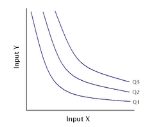
 helps to answer the utility-maximizing problem of consumers, the isoquant deals with the cost-minimization problem of producers. Isoquants are typically drawn on capital-labor graphs, showing the tradeoff between capital and labor in the production function, and the decreasing marginal returns of both inputs. Adding one input while holding the other constant eventually leads to decreasing marginal output, and this is reflected in the shape of the isoquant. A family of isoquants can be represented by an isoquant map, a graph combining a number of isoquants, each representing a different quantity of output.

An isoquant shows that the firm in question has the ability to substitute between the two different inputs at will in order to produce the same level of output. An isoquant map can also indicate decreasing or increasing returns to scale
Returns to scale

In economics, returns to scale and economies of scale are related terms that describe what happens as the scale of production increases. They are different terms and should not be used interchangeably....
 based on increasing or decreasing distances between the isoquants on the map as you increase output. If the distance between isoquants increases as output increases, the firm's production function is exhibiting decreasing returns to scale; doubling both inputs will result in placement on an isoquant with less than double the output of the previous isoquant. Conversely, if the distance is decreasing as output increases, the firm is experiencing increasing returns to scale; doubling both inputs results in placement on an isoquant with more than twice the output of the original isoquant.

As with indifference curves, two isoquants can never cross. Also, every possible combination of inputs is on an isoquant. Finally, any combination of inputs above or to the right of an isoquant results in more output than any point on the isoquant. Although the marginal product of an input decreases as you increase the quantity of the input while holding all other inputs constant, the marginal product is never negative since a rational
Rational choice theory

Rational choice theory, also known as rational action theory, is a framework for understanding and often Model social and economic behavior....
 firm would never increase an input to decrease output.

Shapes of Isoquant Curve: If the two inputs are perfect substitutes, the resulting isoquant map generated is represented in fig. A; with a given level of production Q3, input X is effortlessly replaced by input Y in the production function. The perfect substitute inputs do not experience decreasing marginal rates of return when they are substituted for each other in the production function.

If the two inputs are perfect complements, the isoquant map takes the form of fig. B; with a level of production Q3, input X and input Y can only be combined efficiently in a certain ratio represented by the kink in the isoquant. The firm will combine the two inputs in the required ratio to maximize output and minimize cost. If the firm is not producing at this ratio, there is no rate of return for increasing the input that is already in excess. Isoquants are typically combined with isocost
Isocost

In economics an isocost line represents a combination of inputs which all cost the same amount. Although similar to the budget constraint in consumer theory, the use of the isocost pertains to cost-minimization in production, as opposed to utility-maximization....
 lines in order to provide a cost-minimization production optimization problem.

See also

  • Microeconomics
    Microeconomics

    Microeconomics is a branch of economics that studies how individuals, households and firms and some states make decisions to allocate limited resources, typically in markets where goods or services are being bought and sold....
  • Production, costs, and pricing
    Production, costs, and pricing

    In microeconomics, industrial organization is the field which describes the behavior of firms in the marketplace with regard to production, pricing, employment and other decisions....
  • Production theory basics
    Production theory basics

    In microeconomics, production is quite simply the conversion of inputs into outputs. It is an economic process that uses resources to create a good or service that is suitable for trade....
  • Marginal rate of technical substitution
    Marginal Rate of Technical Substitution

    In economics, the marginal rate of technical substitution or the Technical Rate of Substitution is the amount by which the quantity of one input has to be reduced when one extra unit of another input is used , so that output remains constant ....