
Home      Discussion      Topics      Dictionary      Almanac
Signup       Login
Isometric projection

Isometric projection

Overview
Isometric projection is a method for visually representing three-dimensional objects in two dimensions in technical
Technical drawing
Technical drawing, also known as drafting or draughting, is the act and discipline of composing plans that visually communicate how something functions or has to be constructed.Drafting is the language of industry....

 and engineering drawing
Engineering drawing
An engineering drawing, a type of technical drawing, is used to fully and clearly define requirements for engineered items.Engineering drawing produces engineering drawings . More than just the drawing of pictures, it is also a language—a graphical language that communicates ideas and information...

s. It is an axonometric projection
Axonometric projection
Axonometric projection is a type of parallel projection, more specifically a type of orthographic projection, used to create a pictorial drawing of an object, where the object is rotated along one or more of its axes relative to the plane of projection....

 in which the three coordinate axes
Cartesian coordinate system
A Cartesian coordinate system specifies each point uniquely in a plane by a pair of numerical coordinates, which are the signed distances from the point to two fixed perpendicular directed lines, measured in the same unit of length...

 appear equally foreshortened and the angles between any two of them are 120 degrees.
Discussion
Ask a question about 'Isometric projection'
Start a new discussion about 'Isometric projection'
Answer questions from other users
Full Discussion Forum
 
Unanswered Questions
Encyclopedia
Isometric projection is a method for visually representing three-dimensional objects in two dimensions in technical
Technical drawing
Technical drawing, also known as drafting or draughting, is the act and discipline of composing plans that visually communicate how something functions or has to be constructed.Drafting is the language of industry....

 and engineering drawing
Engineering drawing
An engineering drawing, a type of technical drawing, is used to fully and clearly define requirements for engineered items.Engineering drawing produces engineering drawings . More than just the drawing of pictures, it is also a language—a graphical language that communicates ideas and information...

s. It is an axonometric projection
Axonometric projection
Axonometric projection is a type of parallel projection, more specifically a type of orthographic projection, used to create a pictorial drawing of an object, where the object is rotated along one or more of its axes relative to the plane of projection....

 in which the three coordinate axes
Cartesian coordinate system
A Cartesian coordinate system specifies each point uniquely in a plane by a pair of numerical coordinates, which are the signed distances from the point to two fixed perpendicular directed lines, measured in the same unit of length...

 appear equally foreshortened and the angles between any two of them are 120 degrees.

Overview


The term "isometric" comes from the Greek
Greek language
Greek is an independent branch of the Indo-European family of languages. Native to the southern Balkans, it has the longest documented history of any Indo-European language, spanning 34 centuries of written records. Its writing system has been the Greek alphabet for the majority of its history;...

 for "equal measure", reflecting that the scale along each axis of the projection is the same (unlike some other forms of graphical projection
Graphical projection
Graphical projection is a protocol by which an image of a three-dimensional object is projected onto a planar surface without the aid of mathematical calculation, used in technical drawing.- Overview :...

).

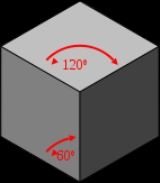
An isometric view of an object can be obtained by choosing the viewing direction in a way that the angles between the projection of the x, y, and z axes are all the same, or 120°. For example when taking a cube, this is done by first looking straight towards one face. Next the cube is rotated ±45° about the vertical axis, followed by a rotation of approximately ±35.264° (precisely arcsin(tan 30°) or arctan(sin 45°) ) about the horizontal axis. Note that with the cube (see image) the perimeter of the 2D drawing is a perfect regular hexagon: all the black lines are of equal length and all the cube's faces are the same area.

In a similar way an isometric view can be obtained for example in a 3D scene editor. Starting with the camera aligned parallel to the floor and aligned to the coordinate axes, it is first rotated downwards around the horizontal axes by about 35.264° as above, and then rotated ±45° around the vertical axis.

Another way in which isometric projection can be visualized is by considering a view within a cubical room starting in an upper corner and looking towards the opposite, lower corner. The x-axis extends diagonally down and right, the y-axis extends diagonally down and left, and the z-axis is straight up. Depth is also shown by height on the image. Lines drawn along the axes are at 120° to one another.

The term "isometric" is often mistakenly used to refer to axonometric projections in general. (There are three types of axonometric projections: isometric, dimetric and trimetric.)

Mathematics


There are eight different orientations to obtain an isometric view, depending into which octant
Octant
An octant is one of eight divisions.-Octant in the plane :Traditionally wind direction is given as one of the 8 octants because that is more accurate than merely giving one of the 4 quadrants, and the wind vane typically does not have enough accuracy to bother with more precise indication.-Octant...

 the viewer looks. The isometric transform from a point in 3D space to a point in 2D space looking into the first octant can be written mathematically with rotation matrices as:

where and . As explained above, this is a rotation around the vertical (here y) axis by , followed by a rotation around the horizontal (here x) axis by . This is then followed by an orthographic projection to the x-y plane:

The other 7 possibilities are obtained by either rotating to the opposite sides or not, and then inverting the view direction or not.

History and limitations


First formalized by Professor William Farish
William Farish (professor)
William Farish was a British scientist who was a professor of Chemistry and Natural Philosophy at the University of Cambridge, known for the development of the method of isometric projection and development of the first written university examination.- Biography :Farish's father was the Reverend...

 (1759–1837), the concept of an isometric
Isometric
The term isometric comes from the Greek for "having equal measurement".isometric may mean:* Isometric projection , a method for the visual representation of three-dimensional objects in two dimensions; a form of orthographic projection, or more specifically, an axonometric projection.* Isometry and...

 had existed in a rough empirical form for centuries. From the middle of the 19th century isometry became an "invaluable tool for engineers, and soon thereafter axonometry and isometry were incorporated in the curriculum of architectural training courses in Europe and the U.S." According to Jan Krikke (2000) however, "axonometry originated in China
China
Chinese civilization may refer to:* China for more general discussion of the country.* Chinese culture* Greater China, the transnational community of ethnic Chinese.* History of China* Sinosphere, the area historically affected by Chinese culture...

. Its function in Chinese art was similar to linear perspective in European art. Axonometry, and the pictorial grammar that goes with it, has taken on a new significance with the advent of visual computing".
As with all types of parallel projection
Parallel projection
Parallel projections have lines of projection that are parallel both in reality and in the projection plane.Parallel projection corresponds to a perspective projection with an infinite focal length , or "zoom".Within parallel projection there is an ancillary category known as "pictorials"...

, objects drawn with isometric projection do not appear larger or smaller as they extend closer to or away from the viewer. While advantageous for architectural drawing
Architectural drawing
An architectural drawing or architect's drawing is a technical drawing of a building that falls within the definition of architecture...

s where measurements need to be taken directly, the result is a perceived distortion, as unlike perspective projection, it is not how our eyes or photography normally work. It also can easily result in situations where depth and altitude are difficult to gauge, as is shown in the illustration to the right.

External links