
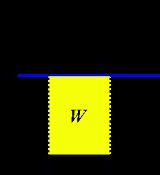
An
isobaric process is a thermodynamic process in which the pressure stays constant: The term derives from the Greek
isos, meaning "equal," and
barus, "heavy." The heat transferred to the system does work but also changes the internal energy of the system:
According to the
first law of thermodynamicsThe first law of thermodynamics, an expression of the principle of conservation of energy, states that energy can be transformed , but cannot be created or destroyed. Alternatively:-Description:...
, where
W is work done
by the system,
U is internal energy, and
Q is heat.
An
isobaric process is a thermodynamic process in which the pressure stays constant: The term derives from the Greek
isos, meaning "equal," and
barus, "heavy." The heat transferred to the system does work but also changes the internal energy of the system:
According to the
first law of thermodynamicsThe first law of thermodynamics, an expression of the principle of conservation of energy, states that energy can be transformed , but cannot be created or destroyed. Alternatively:-Description:...
, where
W is work done
by the system,
U is internal energy, and
Q is heat. Pressure-volume work (
by the system) is defined as: (Δ means change over the whole process, it doesn't mean differential)
but since pressure is constant, this means that
.
Applying the
ideal gas lawThe Ideal gas law is the equation of state of a hypothetical ideal gas. It is a good approximation to the behaviour of many gases under many conditions, although it has several limitations. It was first stated by Émile Clapeyron in 1834 as a combination of Boyle's law and Charles's law...
, this becomes
assuming that the quantity of gas stays constant (e.g. no phase change during a
chemical reactionA chemical reaction is a process that leads to the transformation of one set of chemical substances to another. They are studied by chemists under a field of science called chemistry. Chemical reactions can be either spontaneous, requiring no input of energy, or non-spontaneous, often coming about...
). Since it is generally true that
then substituting the last two equations into the first equation produces:
The quantity in parentheses is equivalent to the molar specific heat for constant
pressurePressure is the force per unit area applied in a direction perpendicular to the surface of an object. Gauge pressure is the pressure relative to the local atmospheric or ambient pressure.- Definition :...
:
and if the gas involved in the isobaric process is monatomic then and .
An isobaric process is shown on a P-V diagram as a straight horizontal line, connecting the initial and final thermostatic states. If the process moves towards the right, then it is an expansion. If the process moves towards the left, then it is a compression.
Sign Discussion
If the volume compresses (delta V = final volume - initial volume < 0), then W < 0. That is, during isobaric compression the gas does negative work, or the environment does positive work. Restated, the environment does positive work on the gas.
If the volume expands (delta V = final volume - initial volume > 0), then W > 0. That is, during isobaric expansion the gas does positive work, or equivalently, the environment does negative work. Restated, the gas does positive work on the environment.
Defining Enthalpy
An
isochoric processAn isochoric process, also called a constant-volume process, an isovolumetric process, or an isometric process, is a thermodynamic process during which the volume of the closed system undergoing such process remains constant...
is described by the equation . It would be convenient to have a similar equation for isobaric processes. Substituting the second equation into the first yields
The quantity
U + p V is a state function so that it can be given a name. It is called
enthalpyIn thermodynamics and molecular chemistry, the enthalpy is a thermodynamic property of a thermodynamic system. It can be used to calculate the heat transfer during a quasistatic process taking place in a closed thermodynamic system under constant pressure...
, and is denoted as
H. Therefore an isobaric process can be more succinctly described as
.
Variable density viewpoint
A given quantity (mass
M) of gas in a changing volume produces a change in density ρ. In this context the ideal gas law is written
- R(T ρ) = M P
where
T is
thermodynamic temperatureThermodynamic temperature is the absolute measure of temperature and is one of the principal parameters of thermodynamics. Thermodynamic temperature is an “absolute” scale because it is the measure of the fundamental property underlying temperature: its null or zero point, absolute zero, is the...
above
absolute zeroAbsolute zero is a temperature marked by a 0 entropy configuration. It is the coldest temperature theoretically possible and cannot be reached by artificial or natural means, because it is impossible to decouple a system fully from the rest of the universe...
.
When R and M are taken as constant, then pressure
P can stay constant as the density-tempertature quadrant (ρ,
T ) undergoes a
squeeze mappingIn linear algebra, a squeeze mapping is a type of linear map that preserves Euclidean area of regions in the Cartesian plane, but is not a Euclidean motion.For a fixed positive real number r, the mapping →...
. It is this context that explains Peter Olver's use of the term
isobaric group when referring to the group of squeeze mappings on page 217 of his book
Classical Invariant Theory (1999).
See also
- Adiabatic process
In thermodynamics, an adiabatic process or an isocaloric process is a thermodynamic process in which no heat is transferred to or from the working fluid. The term "adiabatic" literally means impassable, coming from the Greek roots ἀ- , διὰ- , and βαῖνειν ; this etymology corresponds here to an...
- Cyclic process
- Isochoric process
An isochoric process, also called a constant-volume process, an isovolumetric process, or an isometric process, is a thermodynamic process during which the volume of the closed system undergoing such process remains constant...
- Isothermal process
An isothermal process is a change in which the temperature of the system stays constant: ΔT = 0. This typically occurs when a system is in contact with an outside thermal reservoir , and the change occurs slowly enough to allow the system to continually adjust to the temperature of the...
- Polytropic process
A polytropic process is a thermodynamic process that obeys the relation:,where P is the pressure, V is volume, n is any real number , and C is a constant...
- Isoenthalpic process