
Sepsis is a serious medical condition that is characterized by a whole-body inflammatory state and the presence of a known or suspected infection.
and become critically ill.
Patients with mild to moderate ischemic colitis are usually treated with IV fluids, analgesia, and bowel rest (that is, no food or water by mouth) until the symptoms resolve. Those with severe ischemia who develop complications such as sepsis, intestinal gangreneGangrene is a complication of necrosis or cell death characterized by the decay of body tissues, which become black and malodorous. It is caused by infection or ischemia, such as from thrombosis. It is usually the result of critically insufficient blood supply and is often associated with...
, or bowel perforation may require more aggressive interventions such as surgerySurgery is a medical specialty that uses operative manual and instrumental techniques on a patient to investigate and/or treat a pathological condition such as disease or injury, to help improve bodily function or appearance, or sometimes for some other reason...
and intensive care. Most patients make a full recovery; occasionally, after severe ischemia, patients may develop long-term complications such as a strictureA stenosis is an abnormal narrowing in a blood vessel or other tubular organ or structure.It is also sometimes called a "stricture" ....
or chronic colitisColitis is a chronic digestive disease characterized by inflammation of the colon.Colitis is one of a group of conditions which are inflammatory and auto-immune, affecting the tissue that lines the gastrointestinal system...
.
Causes and epidemiology
The exact incidence of ischemic colitis is difficult to estimate, as many patients with mild ischemia may not seek medical attention. Ischemic colitis is responsible for about 1 in 2000 hospital admissions, and is seen on about 1 in 100 endoscopies. Men and women are affected equally; ischemic colitis is a disease of the elderly, with more than 90% of cases occurring in people over the age of 60.
Ischemic colitis is often classified according to the underlying cause. Non-occlusive ischemia develops because of low blood pressure or constriction of the vessels feeding the colon; occlusive ischemia indicates that a blood clot or other blockage has cut off blood flow to the colon.
Non-occlusive ischemia
In hemodynamic unstable patients (i.e. shock) the mesenteric perfusion may be compromised. This condition is commonly asymptomatic, and usually only apparent through a systemic inflammatory response.
Occlusive ischemia
Mostly the result of a thromboembolism. Commonly the embolism is caused by atrial fibrillationAtrial fibrillation is the most common cardiac arrhythmia and involves the two upper chambers of the heart. Its name comes from the fibrillating of the heart muscles of the atria, instead of a coordinated contraction...
, valvular disease, myocardial infarctionMyocardial infarction or acute myocardial infarction , commonly known as a heart attack, is the interruption of blood supply to part of the heart, causing some heart cells to die...
, or cardiomyopathyCardiomyopathy, which literally means "heart muscle disease," is the deterioration of the function of the myocardium for any reason...
.
In addition, ischemic colitis is a well-recognized complication of abdominal aortic aneurysm repair, when the origin of the inferior mesenteric artery is covered by the aortic graft. Thus, patients without adequate collateralization are at risk for ischemia of the descending and sigmoid colon. Bloody diarrhea and leukocytosis in the postoperative period are essentially diagnostic of ischemic colitis.
Colonic blood supply
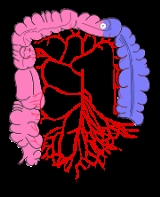
The colon receives blood from both the superiorSee also: Superior Mesenteric Artery SyndromeIn human anatomy, the superior mesenteric artery arises from the anterior surface of the abdominal aorta, just inferior to the origin of the celiac trunk, and supplies the intestine from the lower part of the duodenum through two-thirds of the...
and inferior mesenteric arteriesIn human anatomy, the inferior mesenteric artery, often abbreviated as IMA, supplies the large intestine from the left colic flexure to the upper part of the rectum, which includes the descending colon, the sigmoid colon, and part of the rectum...
. The blood supply from these two major arteries overlap, with abundant collateral circulation. However, there are weak points, or "watershed" areas, at the borders of the territory supplied by each of these arteries, such as the splenic flexure and the transverse portion of the colon. These watershed areas are most vulnerable to ischemia when blood flow decreases, as they have the fewest vascular collaterals.
The rectumThe rectum is the final straight portion of the large intestine in some mammals, and the gut in others, terminating in the anus. The human rectum is about 12 cm long...
receives blood from both the inferior mesenteric artery and the internal iliac arteryThe internal iliac artery is the main artery of the pelvis.-Structure:The internal iliac artery supplies the walls and viscera of the pelvis, the buttock, the reproductive organs, and the medial compartment of the thigh.It is a short, thick vessel, smaller than the external iliac artery, and about...
; the rectum is rarely involved by colonic ischemia due to this dual blood supply.
Development of ischemia
Under ordinary conditions, the colon receives between 10% and 35% of the total cardiac output. If blood flow to the colon drops by more than about 50%, ischemia will develop. The arteries feeding the colon are very sensitive to vasoconstrictors; presumably this is an evolutionary adaptation to shunt blood away from the bowel and to the heartThe heart is a muscular organ found in all vertebrates that is responsible for pumping blood throughout the blood vessels by repeated, rhythmic contractions...
and brainThe brain is the center of the nervous system in all vertebrate, and most invertebrate, animals. Some primitive animals such as jellyfish and starfish have a decentralized nervous system without a brain, while sponges lack any nervous system at all...
in times of stress. As a result, during periods of low blood pressureIn physiology and medicine, hypotension refers to an abnormally low blood pressure. This is best understood as a physiologic state, rather than a disease. It is often associated with shock, though not necessarily indicative of it. Hypotension is the opposite of hypertension, which is high blood...
, the arteries feeding the colon clamp down vigorously; a similar process can result from vasoconstricting drugs such as ergotamineErgotamine is an ergopeptine and part of the ergot family of alkaloids; it is structurally and biochemically closely related to ergoline. It possesses structural similarity to several neurotransmitters, and has biological activity as a vasoconstrictor...
, cocaineCocaine is a crystalline tropane alkaloid that is obtained from the leaves of the coca plant. The name comes from "coca" in addition to the alkaloid suffix -ine, forming cocaine. It is a stimulant of the central nervous system and an appetite suppressant...
, or vasopressors. This vasoconstriction can result in non-occlusive ischemic colitis.
Pathologic findings
A range of pathologic findings are seen in ischemic colitis, corresponding to the spectrum of clinical severity. In its mildest form, mucosal and submucosal hemorrhage and edemaEdema or oedema , formerly known as dropsy or hydropsy, is an abnormal accumulation of fluid beneath the skin, or in one or more cavities of the body...
are seen, possibly with mild necrosisNecrosis is the premature death of cells and living tissue. Necrosis is caused by external factors, such as infection, toxins , or trauma. This is in contrast to apoptosis, which is a naturally occurring cause of cellular death...
or ulcerationA peptic ulcer, also known as ulcus pepticum, PUD or peptic ulcer disease, is an ulcer of an area of the gastrointestinal tract that is usually acidic and thus extremely painful...
. With more severe ischemia, a pathologic picture resembling inflammatory bowel diseaseIn medicine, inflammatory bowel disease is a group of inflammatory conditions of the colon and small intestine. The major types of IBD are Crohn's disease and ulcerative colitis..-Forms:...
(i.e. chronic ulcerations, crypt abscessAn abscess is a collection of pus that has accumulated in a cavity formed by the tissue on the basis of an infectious process or other foreign materials...
es and pseudopolyps) may be seen. In the most severe cases, transmural infarction with resulting perforation may be seen; after recovery, the muscularis propria may be replaced by fibrous tissue, resulting in a stricture. Following restoration of normal blood flow, reperfusion injuryReperfusion injury refers to damage to tissue caused when blood supply returns to the tissue after a period of ischemia. The absence of oxygen and nutrients from blood creates a condition in which the restoration of circulation results in inflammation and oxidative damage through the induction of...
may also contribute to the damage to the colon.
Diagnosis
Ischemic colitis must be differentiated from the many other causes of abdominal painAbdominal pain can be one of the symptoms associated with transient disorders or serious disease. Making a definitive diagnosis of the cause of abdominal pain can be difficult, because many diseases can result in this symptom. Abdominal pain is a common problem...
and rectal bleedingLower gastrointestinal bleeding, commonly abbreviated LGIB, refers to any form of bleeding in the lower gastrointestinal tract.-Diagnosis:The following suggest an LGIB:*Melena and a negative oesophagogastroduodenoscopy*Hematochezia...
(for example, infectionAn infection is the detrimental colonization of a host organism by a foreign species. In an infection, the infecting organism seeks to utilize the host's resources to multiply, usually at the expense of the host. The infecting organism, or pathogen, interferes with the normal functioning of the...
, inflammatory bowel diseaseIn medicine, inflammatory bowel disease is a group of inflammatory conditions of the colon and small intestine. The major types of IBD are Crohn's disease and ulcerative colitis..-Forms:...
, diverticulosisDiverticulosis, otherwise known as "diverticular disease," is the condition of having diverticula in the colon, which are outpocketings of the colonic mucosa and submucosa through weaknesses of muscle layers in the colon wall. These are more common in the sigmoid colon, which is a common place for...
, or colon cancer). It is also important to differentiate ischemic colitis, which often resolves on its own, from the more immediately life-threatening condition of acute mesenteric ischemia of the small bowel.
There are devices which test the sufficiency of oxygen delivery to the colon. The first device approved by the U.S. FDA in 2004 uses visible light spectroscopy to analyze capillary oxygen levels. Use during Aortic Aneurysm repair detected when colon oxygen levels fell below sustainable levels, allowing real-time repair. In several studies, Specificity has been 90% or higher for acute colonic ischemia, and 83% for chronic mesenteric ischemia, with a sensitivity of 71%-92%. This device must be placed using endoscopy, however.,,
Signs and symptoms
Three progressive phases of ischemic colitis have been described:
- A hyperactive phase occurs first, in which the primary symptoms are severe abdominal pain and the passage of bloody stools. Many patients get better and do not progress beyond this phase.
- A paralytic phase can follow if ischemia continues; in this phase, the abdominal pain becomes more widespread, the belly becomes more tender to the touch, and bowel motility
Motility is a biological term which refers to the ability to move spontaneously and actively, consuming energy in the process. It can apply to either single-celled or multicellular organisms. Motile marine animals are commonly called free-swimming...
decreases, resulting in abdominal bloating, no further bloody stools, and absent bowel sounds on exam.
- Finally, a shock phase can develop as fluids start to leak through the damaged colon lining. This can result in shock and metabolic acidosis
In medicine, metabolic acidosis is a process which if unchecked leads to acidemia, i.e. blood pH is low due to increased production of H+ by the body or the inability of the body to form bicarbonate in the kidney. Its causes are diverse, and its consequences can be serious, including...
with dehydrationDehydration is defined as excessive loss of body water. It is literally the removal of water from an object. In physiological terms, it entails a relative deficiency of water molecules in relation to other dissolved solutes...
, low blood pressureIn physiology and medicine, hypotension refers to an abnormally low blood pressure. This is best understood as a physiologic state, rather than a disease. It is often associated with shock, though not necessarily indicative of it. Hypotension is the opposite of hypertension, which is high blood...
, rapid heart rateTachycardia comes from the Greek words tachys and kardia . Tachycardia typically refers to a heart rate that exceeds the normal range for a resting heartrate...
, and confusion. Patients who progress to this phase are often critically ill and require intensive care.
Symptoms of ischemic colitis vary depending on the severity of the ischemia. The most common early signs of ischemic colitis include abdominal painAbdominal pain can be one of the symptoms associated with transient disorders or serious disease. Making a definitive diagnosis of the cause of abdominal pain can be difficult, because many diseases can result in this symptom. Abdominal pain is a common problem...
(often left-sided), with mild to moderate amounts of rectal bleedingLower gastrointestinal bleeding, commonly abbreviated LGIB, refers to any form of bleeding in the lower gastrointestinal tract.-Diagnosis:The following suggest an LGIB:*Melena and a negative oesophagogastroduodenoscopy*Hematochezia...
. The sensitivity of findings among 73 patients were:
- abdominal pain (78%)
- lower digestive bleeding (62%)
- diarrhea (38%)
- Fever higher than 38°C (34%) (38°C equals approximately 100.4°F)
Physical examination
- abdominal pain (77%)
- abdominal tenderness (21%)
Diagnostic tests
There is a recent optical test, but it requires endoscopy (see Diagnosis). There are recent device no specific blood tests for ischemic colitis. The sensitivity of tests among 73 patients were:
- The white blood cell count was more than 15,000/mm3 in 20 patients (27%)
- The serum bicarbonate level was less than 24 mmol/L in 26 patients (36%)
Plain X-rayX-radiation is a form of electromagnetic radiation. X-rays have a wavelength in the range of 10 to 0.01 nanometers, corresponding to frequencies in the range 30 petahertz to 30 exahertz and energies in the range 120 eV to 120 keV. They are shorter in wavelength than UV rays...
s are often normal or show non-specific findings. In a series of 73 patients, plain abdominal radiography (56%) showing colic distension in 53% or a pneumoperitoneum in 3%.
CT scans are often used in the evaluation of abdominal pain and rectal bleeding, and may suggest the diagnosis of ischemic colitis, pick up complications, or suggest an alternate diagnosis.
EndoscopicEndoscopy means looking inside and typically refers to looking inside the body for medical reasons using an instrument called an endoscope...
evaluation, via colonoscopyColonoscopy is the endoscopic examination of the large colon and the distal part of the small bowel with a CCD camera or a fiber optic camera on a flexible tube passed through the anus. It may provide a visual diagnosis Colonoscopy is the endoscopic examination of the large colon and the distal...
or flexible sigmoidoscopySigmoidoscopy is the minimally invasive medical examination of the large intestine from the rectum through the last part of the colon. There are two types of sigmoidoscopy, flexible sigmoidoscopy, which uses a flexible endoscope, and rigid sigmoidoscopy, which uses a rigid device. Flexible...
, is the procedure of choice if the diagnosis remains unclear. Ischemic colitis has a distinctive endoscopic appearance; endoscopy can also facilitate alternate diagnoses such as infectionAn infection is the detrimental colonization of a host organism by a foreign species. In an infection, the infecting organism seeks to utilize the host's resources to multiply, usually at the expense of the host. The infecting organism, or pathogen, interferes with the normal functioning of the...
or inflammatory bowel diseaseIn medicine, inflammatory bowel disease is a group of inflammatory conditions of the colon and small intestine. The major types of IBD are Crohn's disease and ulcerative colitis..-Forms:...
. BiopsiesA biopsy is a medical test involving the removal of cells or tissues for examination. It is the removal of tissue from a living subject to determine the presence or extent of a disease. The tissue is generally examined under a microscope by a pathologist, and can also be analyzed chemically...
can be taken via endoscopy to provide more information. Visible light spectroscopy, performed using catheters placed through the 5 mm channel of the endoscope, is diagnostic (see Diagnosis).
Treatment
Except in the most severe cases, ischemic colitis is treated with supportive care. IV fluidsIntravenous therapy or IV therapy is the giving of liquid substances directly into a vein. It can be intermittent or continuous; continuous administration is called an intravenous drip. The word intravenous simply means "within a vein", but is most commonly used to refer to IV therapy...
are given to treat dehydrationDehydration is defined as excessive loss of body water. It is literally the removal of water from an object. In physiological terms, it entails a relative deficiency of water molecules in relation to other dissolved solutes...
, and the patient is placed on bowel rest (meaning nothing to eat or drink) until the symptoms resolve. If possible, cardiac function and oxygenation should be optimized to improve oxygen delivery to the ischemic bowel. A nasogastric tube may be inserted if an ileusIleus is a disruption of the normal propulsive gastrointestinal motor activity due to non-mechanical causes. In contrast, motility disorders that result from structural abnormalities are termed mechanical bowel obstruction...
is present.
AntibioticIn common usage, an antibiotic is a substance or compound that kills or inhibits the growth of bacteria...
s are sometimes given in moderate to severe cases; the data supporting this practice date to the 1950s, although there is more recent animal data suggesting that antibiotics may increase survival and prevent bacteriaThe bacteria are a large group of unicellular microorganisms. Typically a few micrometres in length, bacteria have a wide range of shapes, ranging from spheres to rods and spirals...
from crossing the damaged lining of the colon into the bloodstream. The use of prophylactic antibiotics in ischemic colitis has not been prospectively evaluated in humanHumans are bipedal primates belonging to the species Homo sapiens in Hominidae, the great ape family. They are the only surviving member of the genus Homo. Humans have a highly developed brain, capable of abstract reasoning, language, introspection, and problem solving...
s, but many authorities recommend their use based on the animal data.
Patients being treated supportively are carefully monitored. If they develop worsening symptoms and signs such as high white blood cell countLeukocytosis is a raised white blood cell count above the normal range. This increase in leukocytes is usually accompanied by a "left shift" in the ratio of immature to mature neutrophils...
, feverFever is a frequent medical sign that describes an increase in internal body temperature to levels above normal...
, worsened abdominal pain, or increased bleeding, then they may require surgical interventionSurgery is a medical specialty that uses operative manual and instrumental techniques on a patient to investigate and/or treat a pathological condition such as disease or injury, to help improve bodily function or appearance, or sometimes for some other reason...
; this usually consists of laparotomyA laparotomy is a surgical procedure involving an incision through the abdominal wall to gain access into the abdominal cavity. It is also known as coeliotomy.-Terminology:...
and bowel resectionA bowel resection is a surgical procedure in which a part of the large or small intestine is removed....
.
Prognosis
Most patients with ischemic colitis recovery fully, although the prognosis depends on the severity of the ischemia. Patients with pre-existing peripheral vascular disease or ischemia of the ascending (right) colon may be at increased risk for complications or death.
Non-gangrenous ischemic colitis, which comprises the vast majority of cases, is associated with a mortality rate of approximately 6%. However, the minority of patients who develop gangreneGangrene is a complication of necrosis or cell death characterized by the decay of body tissues, which become black and malodorous. It is caused by infection or ischemia, such as from thrombosis. It is usually the result of critically insufficient blood supply and is often associated with...
as a result of colonic ischemia have a mortality rate of 50-75% with surgical treatment; the mortality rate is almost 100% without surgical intervention.
Long-term complications
About 20% of patients with acute ischemic colitis may develop a long-term complication known as chronic ischemic colitis. Symptoms can include recurrent infections, bloody diarrhea, weight loss, and chronic abdominal pain. Chronic ischemic colitis is often treated with surgical removal of the chronically diseased portion of the bowel.
A colonic strictureA stenosis is an abnormal narrowing in a blood vessel or other tubular organ or structure.It is also sometimes called a "stricture" ....
is a band of scar tissue which forms as a result of the ischemic injury and narrows the lumenA lumen in biology is the inside space of a tubular structure, such as an artery or intestine...
of the colon. Strictures are often treated observantly; they may heal spontaneously over 12–24 months. If a bowel obstructionBowel obstruction is a mechanical or functional obstruction of the intestines, preventing the normal transit of the products of digestion. It can occur at any level distal to the duodenum of the small intestine and is a medical emergency...
develops as a result of the stricture, surgical resection is the usual treatment, although endoscopic dilatationEsophageal dilatation is a therapeutic endoscopic procedure that enlarges the lumen of the esophagus.-Indications:It can be used to treat a number of medical conditions that result in narrowing of the esophageal lumen, or decrease motility in the distal esophagus...
and stentIn medicine, a stent is a man-made 'tube' inserted into a natural passage/conduit in the body to prevent, or counteract, a disease-induced, localized flow constriction. The term may also refer to a tube used to temporarily hold such a natural conduit open to allow access for surgery.-Etymology:The...
ing have also been employed.