
All Topics  
Iraqi dinar

 
Iraqi Dinar

   Email Print
   Bookmark   Link


Iraqi dinar


The dinar (pronounced: di-'när) (Arabic
Arabic language

Arabic is a Central Semitic language, thus related to and classified alongside other Semitic languages languages such as Hebrew language and Aramaic language....
: ?????, Kurdish
Kurdish language

The Kurdish language is a term used for the language spoken by Kurdish people. It is mainly concentrated in the parts of Iran, Iraq, Syria and Turkey....
: ?????) (sign
Currency sign

A currency sign is a graphic symbol often used as a shorthand for a currency's name. Internationally, ISO 4217 codes are used instead of currency signs, though currency signs may be in common use in their respective countries....
: ?.?; code
ISO 4217

ISO 4217 is the international standard describing three-letter codes to define the names of currency established by the International Organization for Standardization ....
: IQD) is the currency
Currency

A currency is a Medium of exchange, facilitating the trade of goods and/or Service s. It is coins and paper bills used as money. It is one form of money, where money is anything that serves as a medium of exchange, a store of value, and a standard of value....
 of Iraq
Iraq

Iraq , officially the Republic of Iraq , is a country in Western Asia spanning most of the northwestern end of the Zagros Mountains, the eastern part of the Syrian Desert and the northern part of the Arabian Desert....
. It is issued by the Central Bank of Iraq
Central Bank of Iraq

The Central Bank of Iraq is the central bank of Iraq....
 and is subdivided into 1,000 fils, although inflation has rendered the fils obsolete.

dinar was introduced into circulation in 1931, replacing the Indian rupee
Indian rupee

The rupee is the currency of India. The issuance of the currency is controlled by the Reserve Bank of India. The most commonly used symbols for the rupee are Rs, ? and ??....
, which had been the official currency since the British occupation of the country in World War I
World War I

World War I, or the First World War , was a global military conflict which involved the Great powers, organized into two opposing military alliances: the Allies of World War I and the Central Powers....
, at a rate of 1 dinar = 13? rupees.


Discussion
Ask a question about 'Iraqi dinar'
Start a new discussion about 'Iraqi dinar'
Answer questions from other users
Full Discussion Forum


Encyclopedia


The dinar (pronounced: di-'när) (Arabic
Arabic language

Arabic is a Central Semitic language, thus related to and classified alongside other Semitic languages languages such as Hebrew language and Aramaic language....
: ?????, Kurdish
Kurdish language

The Kurdish language is a term used for the language spoken by Kurdish people. It is mainly concentrated in the parts of Iran, Iraq, Syria and Turkey....
: ?????) (sign
Currency sign

A currency sign is a graphic symbol often used as a shorthand for a currency's name. Internationally, ISO 4217 codes are used instead of currency signs, though currency signs may be in common use in their respective countries....
: ?.?; code
ISO 4217

ISO 4217 is the international standard describing three-letter codes to define the names of currency established by the International Organization for Standardization ....
: IQD) is the currency
Currency

A currency is a Medium of exchange, facilitating the trade of goods and/or Service s. It is coins and paper bills used as money. It is one form of money, where money is anything that serves as a medium of exchange, a store of value, and a standard of value....
 of Iraq
Iraq

Iraq , officially the Republic of Iraq , is a country in Western Asia spanning most of the northwestern end of the Zagros Mountains, the eastern part of the Syrian Desert and the northern part of the Arabian Desert....
. It is issued by the Central Bank of Iraq
Central Bank of Iraq

The Central Bank of Iraq is the central bank of Iraq....
 and is subdivided into 1,000 fils, although inflation has rendered the fils obsolete.

History

The dinar was introduced into circulation in 1931, replacing the Indian rupee
Indian rupee

The rupee is the currency of India. The issuance of the currency is controlled by the Reserve Bank of India. The most commonly used symbols for the rupee are Rs, ? and ??....
, which had been the official currency since the British occupation of the country in World War I
World War I

World War I, or the First World War , was a global military conflict which involved the Great powers, organized into two opposing military alliances: the Allies of World War I and the Central Powers....
, at a rate of 1 dinar = 13? rupees. The dinar was pegged at par with the British pound
Pound sterling

----The pound sterling , subdivided into 100 pence , is the currency of the United Kingdom, its Crown dependency and the British Overseas Territories of South Georgia and the South Sandwich Islands and British Antarctic Territory....
 until 1959 when, without changing its value, the peg was switched to the United States dollar
United States dollar

The United States dollar is the unit of currency of the United States and was defined by the Coinage Act of 1792 to be between 371 and 416 grains of silver ....
 at the rate of 1 dinar = 2.8 dollars. By not following the devaluations of the U.S. currency in 1971 and 1973, the dinar rose to a value of US$3.3778, before a 5 percent devaluation reduced the value of the dinar to US$3.2169, a rate which remained until the Gulf War
Gulf War

"Persian Gulf War" and "First Gulf War" redirect here. For other uses, see Persian Gulf War .The Persian Gulf War was a United Nations-authorized military conflict between Iraq and a Coalition of Gulf War from 34 nations commissioned with expelling Iraqi forces from Kuwait after Iraq's Invasion of Kuwait of Kuwait in August 1990....
, although in late 1989, the black market rate was reported at five to six times higher (1.86 dinars for US$1) than the official rate.

After the Gulf War in 1991, and due to the economic blockade, the previously used Swiss printing technology was no longer available. A new, inferior quality notes issue was produced. The previous issue became known as the Swiss dinar
Swiss dinar

Swiss dinar is a term used to describe the Iraqi currency in circulation prior to the 1990 Gulf War with the United States. The reason for the adjective "Swiss" is unknown, but there are two possible explanations....
 and continued to circulate in the Kurdish region of Iraq. Due to excessive government printing of the new notes issue, the dinar devalued quickly, and in late 1995, US$1 was valued at 3,000 dinars.

Following the deposition
Deposition (politics)

Deposition by political means concerns the removal of a politician or monarch. It may be done by coup, impeachment, invasion or forced abdication....
 of Saddam Hussein in the 2003 invasion of Iraq
2003 invasion of Iraq

The 2003 invasion of Iraq, from March 20 to May 1, 2003, was spearheaded by the United States, backed by United Kingdom forces and smaller contingents from Australia, Spain, Poland and Denmark....
, the Iraqi Governing Council
Iraqi Governing Council

The Iraqi Governing Council was the provisional government of Iraq from July 13, 2003 to June 1, 2004. It was established by and served under the United States-led Coalition Provisional Authority ....
 and the Office for Reconstruction and Humanitarian Assistance began printing more Saddam dinar notes as a stopgap measure to maintain the money supply until new currency could be introduced.

Between October 15, 2003 and January 15, 2004, the Coalition Provisional Authority
Coalition Provisional Authority

The Coalition Provisional Authority ???? ???????? ??????? was established as a transitional government following the invasion of Iraq by the United States, United Kingdom and the other members of the coalition of the willing which was formed to oust the government of Saddam Hussein in 2003....
 issued new Iraqi dinar coins and notes, with the notes printed by De La Rue
De La Rue

De La Rue plc is a United Kingdom security printing, papermaking and cash handling systems company headquartered in Basingstoke, Hampshire. It also has a factory on the Team Valley, Gateshead....
 using modern anti-forgery techniques, to "create a single unified currency that is used throughout all of Iraq and will also make money more convenient to use in people’s everyday lives." Old banknotes were exchanged for new at a one-to-one rate, except for the Swiss dinars, which were exchanged at a rate of 150 new dinars for one Swiss dinar.

Although the value of the dinar appreciated following the introduction of the new banknotes from 4,000 dinars per U.S. dollar, at the time of their introduction, to a high of 980 dinars per dollar, it is now held at a "program" exchange rate
Exchange rate

In finance, the exchange rates between two currency specifies how much one currency is worth in terms of the other. It is the value of a foreign nation?s currency in terms of the home nation?s currency....
, as specified by the International Monetary Fund, of 1170 . However, there is not yet a set international exchange rate and so international banks do not yet exchange Iraqi dinar. The exchange rate
Exchange rate

In finance, the exchange rates between two currency specifies how much one currency is worth in terms of the other. It is the value of a foreign nation?s currency in terms of the home nation?s currency....
 available on the streets of Iraq was around 1500 dinars per US dollar in April 2006.

Speculation

On May 3, 2007, the IMF
International Monetary Fund

The International Monetary Fund is an international organization that oversees the global financial system by following the macroeconomic policies of its member countries, in particular those with an impact on exchange rates and the balance of payments....
 released a statement in relation to the international compact with Iraq, which has turned the tide in regards to speculation on the Iraq dinar. The contents of the article discuss changes made in Iraq on the economic front of how the Iraq government had eliminated fuel subsidies. The article also stated that the Central Bank of Iraq had raised interest rates in an attempt to allow a gradual appreciation of the dinar in an attempt to fight dollarization
Dollarization

Dollarization occurs when the inhabitants of a country use foreign currency in parallel to or instead of the domestic currency.Dollarization can occur...
 of the Iraq economy. Although there are claims of wide-spread optimism of some language used later in the press release among some dinar speculators, there have been no publicly released statements or analysis by any news sources or governments.

Coins

Coins were introduced in 1931 and 1932 in denominations of 1, 2, 4, 10, 20, 50 and 200 fils, with the 200 fils known as a rial. The 20, 50 and 200 fils were minted in silver. In 1953, silver 100 fils coins were introduced.

Following the establishment of the Iraqi Republic, a new series of coins was introduced in denominations of 1, 5, 10, 25, 50 and 100 fils, with the 25, 50 and 100 fils in silver until 1969. In 1970, 250 fils pieces were introduced, followed by 500 fils and 1 dinar coins in 1982. Coin production ceased after 1990.

In 2004, new 25, 50, and 100 dinars coins were introduced. However, these coins proved to be unpopular:

Value Diameter Weight Composition Obverse Reverse
25 dinars 17.5 mm 2 g Copper
Copper

Copper is a chemical element with the symbol Cu and atomic number 29.It is a ductile metal with very high thermal and electrical conductivity....
 plated steel
Steel

Steel is an alloy consisting mostly of iron, with a carbon content between 0.2% and 2.14% by weight , depending on grade. Carbon is the most cost-effective alloying material for iron, but various other alloying elements are used such as manganese, chromium, vanadium, and tungsten....
Inscriptions: "Central Bank of Iraq" and "25 dinars" Outline map of Iraq
50 dinars Brass
Brass

Brass is any alloy of copper and zinc; the proportions of zinc and copper can be varied to create a range of brasses with varying properties. In comparison, bronze is principally an alloy of copper and tin....
 plated steel
Steel

Steel is an alloy consisting mostly of iron, with a carbon content between 0.2% and 2.14% by weight , depending on grade. Carbon is the most cost-effective alloying material for iron, but various other alloying elements are used such as manganese, chromium, vanadium, and tungsten....
Inscriptions: "Central Bank of Iraq" and "50 dinars" Outline map of Iraq
100 dinars 22 mm 4.3 g Nickel
Nickel

Nickel is a chemical element, with the chemical symbol Ni and atomic number 28. It is a silvery-white lustrous metal with a slight golden tinge....
 plated steel
Steel

Steel is an alloy consisting mostly of iron, with a carbon content between 0.2% and 2.14% by weight , depending on grade. Carbon is the most cost-effective alloying material for iron, but various other alloying elements are used such as manganese, chromium, vanadium, and tungsten....
Inscriptions: "Central Bank of Iraq" and "100 dinars" Outline map of Iraq


Banknotes

5dinar
In 1931, banknotes were issued by the government in denominations of ¼, ½, 1, 5, 10 and 100 dinar. The notes were printed in the United Kingdom
United Kingdom

The United Kingdom of Great Britain and Northern Ireland, commonly known as the United Kingdom , the UK or Britain,is a sovereign state located off the northwestern coast of continental Europe....
. From 1931 to 1947, the banknotes were issued by the Iraqi currency board for the government of Iraq and banknotes were convertible into pound sterling. From 1947, the banknotes were issued by the National Bank of Iraq, then after 1954 by the Central Bank of Iraq
Central Bank of Iraq

The Central Bank of Iraq is the central bank of Iraq....
.

100 dinars notes ceased production in the 1940s but otherwise, the same denominations were issued until 1978, when 25 dinars notes were introduced. In 1991, 50 and 100 dinars were introduced, followed by 250 dinars notes in 1995 and 10,000 dinars notes in 2002.

Banknotes issued between 1990 and October 2003, along with a 25-dinars note issued in 1986, bear an idealized engraving of former Iraqi President Saddam Hussein
Saddam Hussein

Saddam Hussein Abd al-Majid al-Tikriti was the President of Iraq of Iraq from 16 July 1979 until 9 April 2003.A leading member of the revolutionary Ba'ath Party, which espoused secular pan-Arabism, economic modernization, and Arab socialism, Saddam played a key role in the 1968 coup that brought the party to long-term power....
. Following the 1991 Gulf War, Iraq's currency was printed both locally and in China
China

China is a Culture of China, an ancient civilization, and, depending on perspective, a national or multinational entity extending over a large area in East Asia....
, using poor grade wood pulp
Wood pulp

Pulp is a dry fibrous material prepared by chemically or mechanically separating fibers from wood or fiber crops.Pulp can be either fluffy or formed into thick sheets....
 paper (rather than cotton
Cotton

Cotton is a soft, staple fiber that grows in a form known as a boll around the seeds of the cotton plant a shrub native to tropical and subtropical regions around the world, including the Americas, India and Africa....
 or linen
Linen

Linen is a textile made from the fibers of the flax plant, Linum usitatissimum. Linen is labor-intensive to manufacture, but when it is made into garments, it is valued for its exceptional coolness and freshness in hot weather....
) and inferior quality lithography
Lithography

Lithography is a method for printing using a stone or a metal plate with a completely smooth surface. By contrast, in intaglio a plate is engraving, etching or mezzotint to make cavities to contain the printing ink, and in woodblock printing and letterpress ink is applied to the raised surfaces of letters or images....
 (some notes were reputedly printed on presses designed for printing newspapers).

Counterfeit
Counterfeit

A counterfeit is an imitation made usually with the intent to deceptively represent its content or origins, thus increasing sales appeal due to the reputation of the imitated product....
ed banknotes often appeared to be of better quality than real notes. Despite the collapse in the value of the Iraqi dinar, the highest denomination printed until 2002 was 250 dinars. In 2002, the Central Bank of Iraq
Central Bank of Iraq

The Central Bank of Iraq is the central bank of Iraq....
 issued a 10,000-dinars banknote to be used for "larger, and inter-bank transactions". This note was rarely accepted in practice due to fears of looting and counterfeiting. This forced people to carry around stacks of 250-dinars notes for everyday use. The other, smaller bills were so worthless that they largely fell into disuse. This situation meant that Iraq, for the most part, had only one denomination of banknote in wide circulation.

Currency printed before the Gulf War was often called the Swiss dinar. It got its name from the Swiss printing technology that produced banknotes of a considerably higher quality than those later produced under the economic sanctions that were imposed after the first Gulf War. After a change-over period, this currency was disendorsed by the Iraqi government. However, this old currency still circulated in the Kurdish regions of Iraq until it was replaced with the new dinar after the second Gulf War. During this time the Swiss dinar retained its value, whilst the new currency consistently lost value at sometimes 30 percent per annum.

In 2003, new banknotes were issued consisting of six denominations: 50, 250, 1,000, 5,000, 10,000, and 25,000 dinar. The notes were similar in design to notes issued by the Central Bank of Iraq
Central Bank of Iraq

The Central Bank of Iraq is the central bank of Iraq....
 in the 1970s and 1980s. A 500 dinars note was issued a year later, in October 2004. In the Kurdish regions of Iraq, the 50 dinar note is not in circulation.

1990-2002 Series


1990-2002 Series
Image Value Main Colour Description
Obverse Reverse Obverse Reverse
1/4 Dinar (1993) Green Palm trees Building
1/2 Dinar (1993) Violet Astrolab Great Mosque of Samarra
Great Mosque of Samarra

The Great Mosque of Samarra is a 9th century mosque which is located in the Iraqi city of Samarra. The mosque was commissioned in 848 and completed in 852 by the Abbasid caliph Al-Mutawakkil who reigned from 847 until 861....
1 Dinar (1992) Pink & Green Coin Musanteriah School
5 Dinar (1992) Red Saddam Hussein
Saddam Hussein

Saddam Hussein Abd al-Majid al-Tikriti was the President of Iraq of Iraq from 16 July 1979 until 9 April 2003.A leading member of the revolutionary Ba'ath Party, which espoused secular pan-Arabism, economic modernization, and Arab socialism, Saddam played a key role in the 1968 coup that brought the party to long-term power....
Soldier's tomb
10 Dinar (1992) blueish-green Saddam Hussein Winged beast
25 Dinar (1990) Green Horses Building
25 Dinar (1986) Brownish-Green Saddam Hussein & Horses 
25 Dinar (2001) Green Saddam Hussein Ishtar gate
Ishtar Gate

The Ishtar Gate was the eighth gate to the inner city of Babylon. It was constructed in about 575 BC by order of King Nebuchadnezzar II on the north side of the city....
Iraq 50 Dinars Rewers
50 Dinar (1991) Pink and Green Saddam Hussein Great Mosque of Samarra
Great Mosque of Samarra

The Great Mosque of Samarra is a 9th century mosque which is located in the Iraqi city of Samarra. The mosque was commissioned in 848 and completed in 852 by the Abbasid caliph Al-Mutawakkil who reigned from 847 until 861....
50 Dinar (1994) Brown and Blue Saddam Hussein Saddam Bridge
100 Dinar (1991) Green & Purple Saddam Hussein Swords
100 Dinar (1994) Blue Saddam Hussein Baghdad Clock
100 Dinar (2002) Blue Saddam Hussein Old Houses
250 Dinar (1995) Violet Saddam Hussein Liberty Monument friese
250 Dinar (2002) Violet Saddam Hussein Dome of the Rock
Dome of the Rock

The Dome of the Rock is an Islamic shrine and a major landmark located on the Temple Mount in Jerusalem. It was completed in 691, making it the oldest extant Islamic building in the world....
10,000 Dinar (2002) Pink / Violet Saddam Hussein Arabic astrolabe


Current banknotes


2003 Series
Image Value Main Colour Description
Obverse Reverse Obverse Reverse
50dinarsfront (small)
50dinarsback (small)
50 dinars Purple Grain silos at Basra Date palms
250 dinars Blue An astrolabe Spiral minaret of the Great Mosque of Samarra
Great Mosque of Samarra

The Great Mosque of Samarra is a 9th century mosque which is located in the Iraqi city of Samarra. The mosque was commissioned in 848 and completed in 852 by the Abbasid caliph Al-Mutawakkil who reigned from 847 until 861....
500 dinars Bluish-Green Dûkan Dam on the Al Zab river Assyrian carving of a winged bull
1,000 dinars Brown A gold dinar coin Mustansiriya University
Mustansiriya School

Mustansiriya School is one of the oldest Islamic University in the world, established in 1233 by the Abbasid Caliph al-Mustansir, based in Iraq....
 , Baghdad
5,000 dinars Dark blue Gelî Ali Beg and its waterfall Desert fortress at Al-Ukhether
10,000 dinars Green Abu Ali Hasan Ibn al-Haitham Hadba Minaret at the Great Nurid Mosque, Mosul
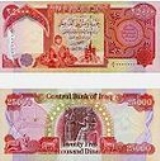
25,000 dinars Red A Kurdish farmer holding a sheaf of wheat Carving of the Code of King Hammurabi
Code of Hammurabi

The Code of Hammurabi is a well-preserved ancient law code, created ca. 1760 BC in ancient Babylon. It was enacted by the sixth Babylonian king, Hammurabi....

See also

  • Economy of Iraq
    Economy of Iraq

    Iraq's economy is dominated by the petroleum sector, which has traditionally provided about 95% of foreign exchange earnings. In the 1980s, financial problems caused by massive expenditures in the eight-year war with Iran and damage to oil export facilities by Iran led the government to implement austerity measures, borrow heavily, and later resche...
  • Iraqi Swiss dinar


External links