
All Topics  
Iraq disarmament crisis

 
Iraq Disarmament Crisis

   Email Print
   Bookmark   Link


Iraq disarmament crisis


The issue of Iraq's disarmament reached a crisis in 2002-2003, when U.S. President
President of the United States

The President of the United States is the head of state and head of government of the United States and is the highest political official in the United States by influence and recognition....
 George W. Bush
George W. Bush

George Walker Bush served as the List of Presidents of the United States President of the United States from 2001 to 2009. He was the 46th List of Governors of Texas from 1995 to 2000 before being United States presidential inauguration as President on January 20, 2001....
 demanded a complete end to what he alleged was Iraqi production of weapons of mass destruction
Iraq and weapons of mass destruction

This article concerns the Iraqi government's use, possession, and alleged intention of acquiring more types of weapons of mass destruction during the presidency of Saddam Hussein....
 and that Iraq
Iraq

Iraq , officially the Republic of Iraq , is a country in Western Asia spanning most of the northwestern end of the Zagros Mountains, the eastern part of the Syrian Desert and the northern part of the Arabian Desert....
 comply with UN Resolutions requiring UN inspectors unfettered access to areas those inspectors thought might have weapons production facilities.


Discussion
Ask a question about 'Iraq disarmament crisis'
Start a new discussion about 'Iraq disarmament crisis'
Answer questions from other users
Full Discussion Forum


Timeline

1991   Iraq disarmament crisis: The U.N. Security Council passes the Cease Fire Agreement, Resolution 687. The resolution calls for the destruction or removal of all of Iraq's chemical and biological weapons, all stocks of agents and components, and all research, development, support and manufacturing facilities for ballistic missiles with a range greater than 150km and production facilities; and for an end to its support for international terrorism. Iraq accepts the terms of the resolution on April 6.

1991   Iraq disarmament crisis: Iraq declares some of its chemical weapons and materials to the UN, as required by Resolution 687, and claims that it does not have a biological weapons program.

1991   September 30 - Iraq disarmament crisis: IAEA inspectors discover files on Iraq's hidden nuclear weapons program. Iraqi officials confiscate documents from UN weapons inspectors, and refuse to allow them to leave the site without turning over other documents. A 4-day standoff ensues. Iraq permits the team to leave with the documents after a statement from the UN Security Council threatens enforcement actions.

1991   Iraq disarmament crisis: The U.N. Security Council passes Resolution 715, which demands that Iraq "accept unconditionally the inspectors and all other personnel designated by the Special Commission". Iraq rejects the resolution, calling it "unlawful".

1992   Iraq disarmament crisis: The Executive Chairman of UNSCOM details Iraq's refusal to abide by UN Security Council disarmament resolutions.

1993   Iraq disarmament crisis: Iraq refuses to allow UNSCOM inspectors to use its own aircraft to fly into Iraq, and begins military operations in the demilitarized zone between Iraq and Kuwait, and the northern No-Fly Zone. U.S. forces fire approximately 40 Tomahawk cruise missiles at Baghdad factories linked to Iraq's illegal nuclear weapons program. Iraq then informs UNSCOM that it will be able to resume its flights.

1993   Iraq disarmament crisis: Iraq refuses to allow UNSCOM weapons inspectors to install remote-controlled monitoring cameras at 2 missile engine test stands.

1993   Iraq disarmament crisis: UN inspection teams leave Iraq. Iraq then agrees to UNSCOM demands and the inspection teams return.

1994   Iraq disarmament crisis: Iraq threatens to stop cooperating with UNSCOM inspectors and begins to once again deploy troops near its border with Kuwait. In response, the U.S. begins to deploy troops to Kuwait.

1994   Iraq disarmament crisis: UN weapons inspectors Ritter and Smidovitch learn, through Israeli intelligence reports, that Qusay Hussein, Saddam Hussein's son, is the key player in efforts by the Iraqi government to hide the country's alleged illegal weapons.


Encyclopedia


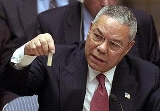
Powell Anthrax Vial
The issue of Iraq's disarmament reached a crisis in 2002-2003, when U.S. President
President of the United States

The President of the United States is the head of state and head of government of the United States and is the highest political official in the United States by influence and recognition....
 George W. Bush
George W. Bush

George Walker Bush served as the List of Presidents of the United States President of the United States from 2001 to 2009. He was the 46th List of Governors of Texas from 1995 to 2000 before being United States presidential inauguration as President on January 20, 2001....
 demanded a complete end to what he alleged was Iraqi production of weapons of mass destruction
Iraq and weapons of mass destruction

This article concerns the Iraqi government's use, possession, and alleged intention of acquiring more types of weapons of mass destruction during the presidency of Saddam Hussein....
 and that Iraq
Iraq

Iraq , officially the Republic of Iraq , is a country in Western Asia spanning most of the northwestern end of the Zagros Mountains, the eastern part of the Syrian Desert and the northern part of the Arabian Desert....
 comply with UN Resolutions requiring UN inspectors unfettered access to areas those inspectors thought might have weapons production facilities. Iraq had been banned by the United Nations from developing or possessing such weapons since the 1991 Gulf War
Gulf War

"Persian Gulf War" and "First Gulf War" redirect here. For other uses, see Persian Gulf War .The Persian Gulf War was a United Nations-authorized military conflict between Iraq and a Coalition of Gulf War from 34 nations commissioned with expelling Iraqi forces from Kuwait after Iraq's Invasion of Kuwait of Kuwait in August 1990....
. It was also required to permit inspections to confirm Iraqi compliance. Bush repeatedly backed demands for unfettered inspection and disarmament with threats of invasion.

On 20 March 2003, a coalition of primarily U.S. and British forces
Multinational force in Iraq

The Multi-National Force - Iraq is a military command , led by the United States, that is fighting the Iraq War against Iraqi insurgency. Multi-National Force - Iraq replaced the previous force, Combined Joint Task Force 7, on May 15, 2004....
 invaded Iraq (see 2003 invasion of Iraq
2003 invasion of Iraq

The 2003 invasion of Iraq, from March 20 to May 1, 2003, was spearheaded by the United States, backed by United Kingdom forces and smaller contingents from Australia, Spain, Poland and Denmark....
). After the war, a number of failed Iraqi peace initiatives
Failed Iraqi peace initiatives

After the 2003 invasion of Iraq, evidence began to emerge of failed attempts to bring the conflict to a peaceful resolution....
 were revealed.

Background

In the decade following the 1991 Gulf War, the United Nations
United Nations

The United Nations is an international organization whose stated aims are to facilitate cooperation in international law, international security, economic development, Social change, human rights and achieving world peace....
 passed 16 Security Council resolutions
United Nations Security Council Resolution

A United Nations Security Council Resolution is a United Nations resolution voted on by the fifteen members of the United Nations Security Council; the United Nations organization charged with "primary responsibility for the maintenance of...
 calling for the complete elimination of Iraqi weapons of mass destruction. Member states
United Nations member states

This article lists the member states of the United Nations . There are currently 192 UN member states, and each of them is a member of the United Nations General Assembly....
 communicated their frustration over the years that Iraq was impeding the work of the special commission
United Nations Special Commission

United Nations Special Commission was an inspection regime created by the United Nations to ensure Iraq's compliance with policies concerning Iraqi production and use of weapons of mass destruction after the Gulf War....
 and failing to take seriously its disarmament obligations. Iraqi security forces had on several occasions physically prevented weapons inspectors from doing their job and in at least one case, took documents away from them.

In 1998, US President Bill Clinton
Bill Clinton

William Jefferson "Bill" Clinton served as the List of Presidents of the United States President of the United States from 1993 to 2001. He was the fifteenth Democrat elected to that office....
 expressed concern about Iraq's failure to disarm, noting that it was "only a matter of time" before Saddam Hussein
Saddam Hussein

Saddam Hussein Abd al-Majid al-Tikriti was the President of Iraq of Iraq from 16 July 1979 until 9 April 2003.A leading member of the revolutionary Ba'ath Party, which espoused secular pan-Arabism, economic modernization, and Arab socialism, Saddam played a key role in the 1968 coup that brought the party to long-term power....
 handed weapons of mass destruction to another country. On 29 September 1998, the United States Congress
United States Congress

The United States Congress is the Bicameralism legislature of the Federal government of the United States of the United States of America, consisting of two houses, the United States Senate and the United States House of Representatives....
 passed the Iraq Liberation Act
Iraq Liberation Act

The Iraq Liberation Act of 1998 is a United States United States Congress statement of policy calling for regime change in Iraq. It was signed into law by President Bill Clinton....
 supporting the efforts of Iraqi opposition groups
Iraqi opposition

The Iraqi opposition can refer to three things:* Pre-2003: Iraqi anti-Saddam groups were composed of a number of groups in Iraq opposed to the Saddam regime....
 to remove Saddam Hussein from office. The Act was signed by President Clinton on 31 October 1998. On the same day, Iraq announced it would no longer cooperate with United Nations weapons inspectors because of US spies in their ranks.

The UN, under Kofi Annan
Kofi Annan

Kofi Atta Annan, Order of St Michael and St George is a Ghanaian diplomat who served as the seventh United Nations Secretary-General of the United Nations from 1 January 1997 to 1 January 2007....
, brokered a deal wherein Iraq would allow weapons inspectors back into the country. Iraq quit cooperating with the inspectors only days later and the inspectors left the country in December. Inspectors would return the following year as part of The United Nations Monitoring, Verification and Inspection Commission
United Nations Monitoring, Verification and Inspection Commission

The United Nations Monitoring, Verification and Inspection Commission was created through the adoption of United Nations Security Council UN Security Council Resolution 1284 of 17 December 1999....
 (UNMOVIC).

Paul Wolfowitz
Paul Wolfowitz

Paul Dundes Wolfowitz is a former United States Ambassador to Indonesia, United States Deputy Secretary of Defense, and President of the World Bank....
, the military analyst for the United States Department of Defense
United States Department of Defense

The United States Department of Defense is the federal department charged with coordinating and supervising all agencies and functions of the government relating directly to national security and the Military of the United States....
 under Ronald Reagan
Ronald Reagan

Ronald Wilson Reagan was the List of Presidents of the United States President of the United States and the 33rd Governor of California . Born in Illinois, Reagan moved to Los Angeles, California in the 1930s, where he was an actor, president of the Screen Actors Guild , and a spokesman for General Electric ....
, had formulated a new foreign policy with regard to Iraq and other "potential aggressor states", dismissing "containment" in favor of "preemption
Preemptive war

Preemptive war is waged in an attempt to repel or defeat a perceived inevitable offensive or invasion, or to gain a strategic advantage in an impending war before that threat materializes....
," with the goal of striking first to eliminate threats.

This policy was short-lived, however, and Clinton, along with George H. W. Bush
George H. W. Bush

George Herbert Walker Bush served as the List of Presidents of the United States President of the United States from 1989 to 1993. Bush held a variety of political positions prior to his presidency, including Vice President of the United States in the administration of Ronald Reagan and Director of Central Intelligence under Gerald R....
, Colin Powell
Colin Powell

Colin Luther Powell, Knight Commander of the Order of the Bath, Meritorious Service Decoration, is an American statesman and a former four-star General in the United States Army....
, and other former Bush administration officials, dismissed calls for preemption in favor of continued containment. This was the policy of George W. Bush as well for his first several months in office. The September 11, 2001 attacks brought to life Wolfowitz's and other "hawks'" advocacy for preemptive action; Iraq was widely agreed to be a likely subject of this new policy, despite absolutely no evidence yet having been produced to connect Iraq with the attacks. Powell continued to support the philosophy behind containment.

2002-2003

During most of 2002 and into 2003, the United States government continued to call for "regime change
Regime change

"Regime change" is the replacement of one regime with another. While it is widely believed that the term was first coined by former President of the United States Bill Clinton, use of the term dates to at least 1925....
" in Iraq
Iraq

Iraq , officially the Republic of Iraq , is a country in Western Asia spanning most of the northwestern end of the Zagros Mountains, the eastern part of the Syrian Desert and the northern part of the Arabian Desert....
 and threatened to use military force to overthrow the Iraqi government unless Iraq rid itself of all weapons of mass destruction
Weapons of mass destruction

A weapon of mass destruction is a weapon that can kill large numbers of humans and/or cause great damage to man-made structures , natural structures , or the biosphere in general....
 and convinced the UN that it had done so.

US diplomatic pressure to bring Iraq to compliance quickly created a diplomatic crisis in the UN, where some were in agreement with the US position, while others dissented, notably the permanent security council members France
France

France , officially the French Republic , is a country whose Metropolitan France is located in Western Europe and that also comprises various Overseas departments and territories of France....
, Russia
Russia

Russia , or the Russian Federation , is a list of countries spanning more than one continent country extending over much of northern Eurasia....
 and the People's Republic of China
People's Republic of China

The People's Republic of China , commonly known as China, is the largest country in East Asia and the List of countries by population in the world with over 1.3 billion people, approximately a fifth of the world's population....
, and fellow NATO
NATO

The North Atlantic Treaty Organization , also called the Atlantic Alliance, is a military alliance established by the signing of the North Atlantic Treaty on 4 April 1949....
 members Germany
Germany

Germany , officially the Federal Republic of Germany , is a country in Central Europe. It is bordered to the north by the North Sea, Denmark, and the Baltic Sea; to the east by Poland and the Czech Republic; to the south by Austria and Switzerland; and to the west by France, Luxembourg, Belgium, and the Netherlands....
 and Belgium
Belgium

* A small German-speaking Community of Belgium exists in eastern Wallonia. Belgium's linguistic diversity and related political and cultural conflicts are reflected in the history of Belgium and a complex Communities and regions of Belgium....
.

The Bush administration began a military buildup in the region, and pushed for the passage of UN Security Council Resolution 1441, which brought weapons inspectors led by Hans Blix
Hans Blix

is a Sweden diplomat and politician. He was Minister for Foreign Affairs . Blix was also the head of the United Nations Monitoring, Verification and Inspection Commission from March 2000 to June 2003, when he was succeeded by Demetrius Perricos....
 and Mohamed ElBaradei
Mohamed ElBaradei

Dr. Mohamed Mostafa El-Baradei is the Director General of the International Atomic Energy Agency , an inter-governmental organization under the auspices of the United Nations....
 to Iraq.

Inspectors began visiting sites where WMD production was suspected, but found no evidence of such activities, except for 18 undeclared empty 122mm chemical rockets that were destroyed under UNMOVIC supervision. Inspectors also found that the Al-Samoud-2 and Al-fatah missiles violated the UN range restrictions, the former also being partially destroyed under UNMOVIC supervision.

On March 7, Hans Blix reported accelerated cooperation throughout the month of February and he informed the UN security council that "it will not take years, nor weeks, but months" to verify whether Iraq had complied with its disarmament obligations.

President Bush and British Prime Minister
Prime Minister of the United Kingdom

The Prime Minister of the United Kingdom of Great Britain and Northern Ireland is the political leader of the United Kingdom and the head of government Her Majesty's Government....
 Tony Blair
Tony Blair

Anthony Charles Lynton "Tony" Blair is a British politician, who served as Prime Minister of the United Kingdom from 2 May 1997 to 27 June 2007....
 met in the Azores
Azores

The Azores is a Portugal archipelago in the Atlantic Ocean, about 1,500 km from Lisbon and about 3,900 km from the east coast of North America....
 for an "emergency summit" over the weekend of March 15-16 2003, after which Bush declared that, despite Blix's report, "diplomacy had failed" to compel Iraq to comply with UN Resolution inspection requirements, and stated his intention to use military force to attack Iraq in what was, according to the Bush administration, compliance with the threat of "serious consequences" in UN 1441.

UNSC disagreement


Bush 2002 Unga
Several close allies of the U.S. (e.g. Germany
Germany

Germany , officially the Federal Republic of Germany , is a country in Central Europe. It is bordered to the north by the North Sea, Denmark, and the Baltic Sea; to the east by Poland and the Czech Republic; to the south by Austria and Switzerland; and to the west by France, Luxembourg, Belgium, and the Netherlands....
, Belgium and France
France

France , officially the French Republic , is a country whose Metropolitan France is located in Western Europe and that also comprises various Overseas departments and territories of France....
) opposed a military intervention because they asserted it would increase rather than decrease the risk of terrorist attacks. Although the British government and some governments of other members of the EU and NATO
NATO

The North Atlantic Treaty Organization , also called the Atlantic Alliance, is a military alliance established by the signing of the North Atlantic Treaty on 4 April 1949....
 supported the US position, opinion polls show that in general their populations were against an attack, especially an attack without clear UN Security Council support. Millions of people in the major cities of Europe
Europe

Europe is, conventionally, one of the world's seven continents. Comprising the westernmost peninsula of Eurasia, Europe is generally divided from Asia to its east by the water divide of the Ural Mountains, the Ural , the Caspian Sea, and by the Caucasus Mountains to the southeast....
, and hundreds of thousands in major cities of North America
North America

North America is the northern continent of the Americas, situated in the Earth's northern hemisphere and almost totally in the western hemisphere....
, participated in peace marches on 15 February 2003.

Statements by President Bush

On 7 October 2002 President Bush stated:

Eleven years ago, as a condition for ending the Persian Gulf War, the Iraqi regime was required to destroy its weapons of mass destruction, to cease all development of such weapons, and to stop all support for terrorist groups. The Iraqi regime has violated all of those obligations. It possesses and produces chemical and biological weapons. It is seeking nuclear weapons. It has given shelter and support to terrorism, and practices terror against its own people. The entire world has witnessed Iraq's eleven-year history of defiance, deception and bad faith.


On 17 March 2003 Bush stated in an address to the nation:

Intelligence gathered by this and other governments leaves no doubt that the Iraq regime continues to possess and conceal some of the most lethal weapons ever devised. This regime has already used weapons of mass destruction against Iraq's neighbors and against Iraq's people.


Bush did not remind his audience that when the Iraqi government used poison gas against Iran
Iran

Iran , officially the Islamic Republic of Iran and formerly known internationally as Persian Empire until 1935, is a country in Central Eurasia, located on the northeastern shore of the Persian Gulf and the southern shore of the Caspian Sea....
 and the Kurds of Iraqi Kurdistan
Iraqi Kurdistan

Iraqi Kurdistan Region is an autonomous, federally recognized political, ethnic and economic region of Iraq. It borders Iran to the east, Turkey to the north, and Syria to the west and the rest of Iraq to the South....
 during the Iran-Iraq war
Iran-Iraq War

The Iran?Iraq War, also known as the Imposed War and Holy Defense in Iran, and Saddam's Battle of al-Qadisiyyah in Iraq, and the First Persian Gulf War in the Arab world , was a war between the armed forces of Iraq and Iran lasting from September 1980 to August 1988....
, the US said and did nothing. Iran was considered a bigger threat at the time.

Two days later on March 19, 2003, as the invasion of Iraq began, Bush stated in an address to the nation:

"My fellow citizens, at this hour, American and coalition forces are in the early stages of military operations to disarm Iraq, to free its people and to defend the world from grave danger.


Statement by Russian President Vladimir Putin


On October 11, 2002, Russian President Vladimir Putin
Vladimir Putin

Vladimir Vladimirovich Putin was the second President of Russia and is the current Prime Minister of Russia as well as chairman of United Russia and Chairman of the Council of Ministers of the Union of Russia and Belarus....
 met with then British Prime Minister Tony Blair
Tony Blair

Anthony Charles Lynton "Tony" Blair is a British politician, who served as Prime Minister of the United Kingdom from 2 May 1997 to 27 June 2007....
. At a news conference, he said:

Russia
Russia

Russia , or the Russian Federation , is a list of countries spanning more than one continent country extending over much of northern Eurasia....
 does not have in its possession any trustworthy data that supports the existence of nuclear weapons or any weapons of mass destruction in Iraq and we have not received any such information from our partners as yet.


Statements by French President Jacques Chirac


In a February 2003 joint declaration by Russia, Germany and France, Jacques Chirac
Jacques Chirac

Jacques Ren? Chirac served as the President of France from 17 May 1995 until 16 May 2007. As President he also served as an ex officio Co-Prince of Andorra and Grand Master of the French L?gion d'honneur....
 remarked:

As far as France is concerned, we are ready to envisage everything that can be done under UNSCR 1441. ... But I repeat that every possibility offered by the present resolution must be explored, that there are a lot of them and they still leave us with a lot of leeway when it comes to ways of achieving the objective of eliminating any weapons of mass destruction which may exist in Iraq. I'd like nevertheless to note that, as things stand at the moment, I have, to my knowledge, no indisputable proof in this sphere.


Criticism of U.S. policy

Although it received only mild press attention, by the UN nuclear inspectors cast serious doubt of the existence and extent of a then current Iraqi nuclear program. It later transpired that incriminating documents had been forged to deceive the US public, particularly concerning Iraqi acquisition of uranium (see Yellowcake Forgery).

Many opponents of the invasion also contended that some or all of the weapons inspectors' reports were vastly misrepresented by the Bush administration, especially in the connection between Iraq and terrorist groups. Fundamentalist Muslim groups, at the time generally did not support Iraq, as it was a secular nation that did not enforce Sharia law. In a tape reputedly released by Osama bin Laden
Osama bin Laden

Osama bin Laden is a member of the prominent Saudi Arabia bin Laden family and the founder of the terrorist organization al-Qaeda, best known for the September 11 attacks on the United States....
 in February 2003, Saddam Hussein is referred to as an 'ignorant infidel' and placed only second on the list of evils, after an invasion by the United States.

Although Bush originally stated that existing resolutions were sufficient to justify the US launching a war, Anthony Blair had insisted that the UN must be involved, and it was widely believed that Colin Powell agreed strongly with this view, that a new resolution was required.

The United States led the tumultuous effort within the United Nations to pass UN Security Council Resolution 1441, which called for sweeping new powers for weapons inspectors within Iraq and threatened "serious consequences" if Iraq failed to comply with the resolution. This measure had been successful, according to the peace faction, as Iraq had allowed inspections to continue (after a four-year hiatus) soon after the measure passed, and had responded in a timely fashion to concerns raised about it, despite their concerns about continued US espionage
Espionage

Espionage or spying involves an individual obtaining information that is considered secrecy or confidential without the permission of the holder of the information....
.

The head of the UN weapons inspectors team, Hans Blix, expressed skepticism over Iraq's claims to have destroyed its stockpiles of anthrax and VX nerve agent. Blix said he found it "a bit odd" that Iraq, with "one of the best-organized regimes in the Arab world," would claim to have no records of the destruction of these illegal substances. "I don't see that they have acquired any credibility," Blix said. "There has to be solid evidence of everything, and if there is not evidence, or you can't find it, I simply say, 'Sorry, I don't find any evidence,' and I cannot guarantee or recommend any confidence."

In February 2003 the effort to draft an 18th resolution in the UN Security Council was underway. It was influenced at least in part by a near-revolt inside the British Labour Party, which has the power to remove Blair from office, and which had made clear that without another resolution, Blair would be proceeding without the support of most of the UK's voting population, which was strongly against a war including only US and UK forces.

Legality


Authority under International Law

The position of whether the invasion was legal under international law
International law

Public international law concerns the structure and conduct of states and intergovernmental organizations. To a lesser degree, international law also may affect multinational corporations and individuals, an impact increasingly evolving beyond domestic legal interpretation and enforcement....
 is unclear. Article 2 of the United Nations Charter
United Nations Charter

The United Nations Charter is the treaty that forms and establishes the international organization called the United Nations. It was signed at the United Nations Conference on International Organization in San Francisco, California, United States, on June 26, 1945, by 50 of the 51 original member countries ....
 forbids UN members from employing "the threat or use of force" against other states in a manner inconsistent with the purposes of the United Nations. Two exceptions exist to the rule: self-defense (Article 51) or an authorization by the Security Council to protect international peace and security (Chapter VII).

The government of the United States said publicly, and the British pledged privately, that they were willing to invade Iraq with or without Security Council authorization, despite this being illegal under international law.

There have been two military actions carried out with the approval of the Security Council. These two instances were the Korean War
Korean War

The Korean War refers to a period of military conflict between North Korea and South Korea regimes, with major hostilities lasting from June 25, 1950 until the armistice signed on July 27, 1953....
 and the 1991 Gulf War.

The United States does not recognize the jurisdiction of any international court over its citizens or military, holding that the United States Supreme Court is its final authority. One example of this policy is that the United States did not ratify the International Criminal Court
International Criminal Court

The International Criminal Court , Cour p?nale internationale in french language, is a permanent tribunal to prosecute individuals for genocide, crime against humanity, war crimes, and the crime of aggression ....
 (ICC) treaty, and on 6 May 2002 it informed the UN that it has no intention to do so.

As of 24 February 2005 neither Iraq nor the United States have ratified the ICC treaty, and therefore neither the US attack on Iraq nor subsequent actions in Iraq fall under the jurisdiction of the ICC. The actions of signatories such as the United Kingdom and Spain
Spain

Spain or the Kingdom of Spain , is a country located in Southern Europe on the Iberian Peninsula.The Spanish constitution does not establish any official denomination of the country, even though Espa?a , Estado espa?ol and Naci?n espa?ola are used interchangeably....
 could however fall under the ICC jurisdiction.

On March 17, 2003, Peter Goldsmith
Peter Goldsmith, Baron Goldsmith

Peter Henry Goldsmith, Baron Goldsmith, Privy Council of the United Kingdom, Queen's Counsel , is a former Attorney General for England and Wales and Attorney General for Northern Ireland....
, Attorney General for England and Wales
Attorney General for England and Wales

Her Majesty's Attorney General for England and Wales, usually known simply as the Attorney General, is the chief legal adviser of the the Crown in England and Wales....
, set out his government's legal justification for an invasion of Iraq. He said that the 1990 Security Council Resolution 678
United Nations Security Council Resolution 678

United Nations Security Council Resolution 678 was the legal authorization for the Gulf War which was passed by the United Nations Security Council by 12 votes to 2 on 29 November 1990....
 authorised force against Iraq, which was suspended but not terminated by the 1991 Resolution 687
United Nations Security Council Resolution 687

United Nations List of UN Security Council Resolutions 687 which was on 3 April 1991 set the terms with which Iraq was to comply after losing the Gulf War....
, which imposed continuing obligations on Iraq to eliminate its weapons of mass destruction. A material breach of resolution 687 would revive the authority to use force under resolution 678. In Resolution 1441 the Security Council determined that Iraq was in material breach of resolution 687 because it had not fully carried out its obligations to disarm, and in early 2003 sent teams of weapons inspectors to verify the facts on the ground
Facts on the ground

Facts on the ground is a diplomatic term that means the situation in reality as opposed to in the abstract. It can often be heard in discussions of the Israeli-Palestinian conflict....
.

Most member governments of the United Nations Security Council made clear that in their view, after resolution 1441 there was still no authorization for the use of force. Other longstanding breaches of UN Resolutions in the region by US allies were ignored.

Authority under US Constitution

The Constitution grants the power to declare war exclusively to the United States Congress
United States Congress

The United States Congress is the Bicameralism legislature of the Federal government of the United States of the United States of America, consisting of two houses, the United States Senate and the United States House of Representatives....
, but declares the President to be Commander-in-Chief of the US military. Because of this division of power, there has long been controversy regarding the authority of the President outside of a declared war. Nonetheless, of the hundreds of times the United States has exercised force outside its borders, only five have been as part of a declared war
Declaration of war by the United States

A declaration of war is a formal declaration issued by a national government indicating that a state of war exists between that nation and another....
.

In 1973, amid increasing domestic controversy about the Vietnam War
Vietnam War

The Vietnam War, also known as the Second Indochina Wars, the Vietnam Conflict, or often in Vietnam the American War occurred in Vietnam, Laos and Cambodia from 1959 to April 30, 1975....
, Congress passed the War Powers Resolution
War Powers Resolution

The War Powers Resolution of 1973 is a United States federal law providing that the President of the United States can send Military of the United States into action abroad only by authorization of United States Congress or if the United States is already under attack or serious threat....
 to limit the ability of the president to undertake prolonged military action without Congressional authority. No president since has recognized the constitutionality of this act, and most legal scholars believe it would not survive a challenge in court.

To avoid initiating a crisis under the War Powers Resolution, the Bush administration sought explicit approval from the Congress to exercise force in Iraq. On October 9, 2002, the Congress passed a joint resolution which explicitly authorized the President to use the Armed Forces of the United States as he determines to be necessary and appropriate. This raises the issue of whether or not Congress has the authority to delegate legislative power to the executive branch. However, in a recent United States Supreme Court case, Hamdan v. Rumsfeld
Hamdan v. Rumsfeld

Hamdan v. Rumsfeld, Case citation , is a case in which the Supreme Court of the United States held that Guantanamo military commissions set up by the George W....
,
the Supreme Court ruled that the military commissions that the President had established, (and defended by arguing that he was given the power to create military courts by this resolution), were unconstitutional because they were unauthorized by Congress.

The Constitution also provides that international treaties ratified by the United States are among the highest law of the land (US Constitution, Article VI). The UN Charter is a treaty ratified by the US, which forbids member states, including the US, from attacking fellow member states, including Iraq, except in two carefully circumbscribed situations (see UN Charter).

Aftermath

After the invasion of Iraq, the Iraq Survey Group
Iraq Survey Group

The Iraq Survey Group was a fact-finding mission sent by the multinational force in Iraq after the 2003 Invasion of Iraq to find the alleged Iraq and weapons of mass destruction that had been the main ostensible reason for the invasion....
, headed by David Kay
David Kay

Dr. David A. Kay is best known for heading the Iraq Survey Group and acting as a weapons inspector in Iraq after the 2003 invasion of Iraq....
 was formed to find the alleged weapons of mass destruction. Apart from a small quantity of degraded pre-1991 shells, nothing was found. Iraq had destroyed its stockpiles of biological and chemical weapons, the technology for which it had been given by Western nations
Western world

The term Western world, the West or the Occident can have multiple meanings dependent on its context . Accordingly, the basic definition of what constitutes "the West" varies, expanding and contracting over time, in relation to various historical circumstances....
. Artillery shells containing sarin
Sarin

Sarin, also known by its NATO designation of GB, is an extremely toxic substance whose sole application is as a nerve agent. As a chemical weapons, it is classified as a weapon of mass destruction by the United Nations in UN Resolution 687....
 were discovered, and one was used as an improvised explosive device (IED), probably without the attacker's knowledge. Weapons marked for destruction by UN inspectors have also been recovered. Mobile laboratories
Mobile weapons laboratory

Mobile weapons laboratories are bioreactors and other processing equipment to manufacture and process biological weapons that can be moved from location to locating either by train or vehicle....
, alleged at the time to be used to create chemical or biological weapons, were discovered shortly after the invasion, but subsequent testing of the mobile labs proved they had nothing to do with weapons production.

See also

  • United Nations actions regarding Iraq
  • Iraq disarmament crisis timeline 1990-1996
    Iraq disarmament crisis timeline 1990-1996

    Timeline of events related to the Iraq disarmament crisis...
    , 1997-2000
    Iraq disarmament crisis timeline 1997-2000

    Timeline of events related to the Iraq disarmament crisis...
    , 2001-2003
    Iraq disarmament crisis timeline 2001-2003

    Timeline of events related to the Iraq disarmament crisis...
  • Blair's tests for Iraq Disarmament
    Blair's tests for Iraq Disarmament

    On March 12, 2003, Tony Blair and Jack Straw proposed a draft resolution to the United Nations. If the demands for disarmament were met by 17 March, it was suggested that military action would be averted and Saddam Hussein allowed to remain in power....
  • Support and opposition for the U.S. plan to invade Iraq


External links

  • - BBC News
  • - BBC News
  • - Slate Magazine
  • - Washington Post
  • - International Institute for Strategic Studies
  • - World Socialist Web Site
  • - Washington Times
  • Counterpunch, February 19, 2003
  • - Mother Jones
  • - Wall Street Journal
  • - San Francisco Chronicle
  • - American Liberty Foundation
  • - Guardian