


Iranian nationalism

Encyclopedia
Iranian nationalism refers to nationalism among the people of Iran
and individuals whose national identity is Iranian. Iranian nationalism consists of political and social movements and sentiments prompted by a love for Iranian (Persian
) culture, language and history, and a sense of pride in Iran
and Iranian (Persian) people. Whilst national consciousness in Iran can be traced back for centuries, nationalism has been a predominant determinant of Iranian attitudes mainly since the 20th century.
During the Pahlavi dynasty (1925–1979), Iranian nationalism experienced a resurgence due to the Pahlavi government's bolstering of patriotic sentiment.
After the Iranian revolution
, Iranian (Persian) ethnic nationalism
was mostly found among the Iranian diaspora, but there has been a resurgence of nationalism also within the Islamic Republic of Iran in the wake of the Iran student protests, July 1999 and the Republic's autocratic policies over its thirty-year existence.
Third-century Iran was shaken by a conflict between universalism
and nationalism
that was most clearly manifest in the religious and cultural sphere. The outcome of this conflict is well known: the traditionalistic and nationalistic impulses gained the upper hand, and Manichean universalism succumbed to the nationalism of the Zoroastrian Magi
. Iranian identity, which up to that point had been essentially of a cultural and religious nature, assumed a definite political value, placing Persia and the Persians at the center of the Ērān-šahr, in other words, at the center of a state based on the twin powers of throne and altar and sustained by an antiquarian and archaizing ideology. This ideology became more and more accentuated during the Sassanian period, reaching its height in the long reign of Khosrow I (531-79 C.E.). Of course, economic and social factors favored the victory of the stronger classes in a society that was based mainly on a rural economy, namely the aristocratic landed and warrior classes and the Magian clergy.
refers to a response by Persian
Muslim
s to the growing Arabization
of Islam
in the 9th and 10th centuries in what is now Iran
. It was primarily concerned with preserving Persian culture and protecting Persian identity.Some of the famous Iranian Shu'ubi figures are Bashar ibn Burd
, Ismail e Nesayi , Zeyad e Ajam , Hesam ebn ada , Abulhassan Ali e Madaeni , Abuhatam e Sajestani , Ibrahim ebn e Mamshad and Abuabdullah Muhmamd e Marzbani .Many consider Ferdowsi
of Shu'ubi poets .
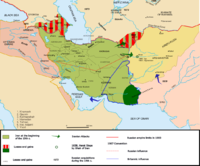 The modern Iranian national movement began in the late 19th century. Iranian nationalism is in origin a reaction to 19th century European colonialism
in the region, which led to the loss of Qajar
possessions in the Caucasus
.
The initial objectives of these nationalists e.g. ending the feudalistic landholding system, governmental sloth and corruption and the wholesale distribution of Iranian resources to foreigners also greatly appealed to modernisers.
Reza Shah
, helped shape Iranian nationalism by infusing it with a distinctly secular ideology, and diminishing the influence of Islam on Iran. In addition, Reza Shah sought to change the names of various towns to honor pre-Islamic Persian kings and mythological heroes, and to continue to reduce the power of the mullahs by seeking to modernize Iran. The Pahlavi dynasty thus was set irrevocably down the road towards infusing the country with a form of secular nationalism, a path that would eventually bring it into conflict with the country's clerical class.
Iranian nationalism was a deciding force in the 1951 movement to nationalize
Iran's oil wealth.
Iranian nationalist discourse focuses on pre-Islamic Persian antiquity, whilst negating the 'Islamization' of Persia by Muslim forces. In the 20th century, different aspects of this idealization of a distant past would be instrumentalized by both the Pahlavi monarchy
, which employed archaizing titles such as Āryāmehr
"Light of the Aryans", and by the Islamic Republic that followed it; the Pahlavis used it as a foundation for anticlerical monarchism, and the clerics used it to exalt Iranian values vis-á-vis westernization.
This dichotomy of ethnic vs. religious nationalism continues into the present, with the former taken up by Iranians in the diaspora, and the latter represented in the figure of Mahmoud Ahmadinejad.
defunct
Iran
Iran , officially the Islamic Republic of Iran , is a country in Southern and Western Asia. The name "Iran" has been in use natively since the Sassanian era and came into use internationally in 1935, before which the country was known to the Western world as Persia...
and individuals whose national identity is Iranian. Iranian nationalism consists of political and social movements and sentiments prompted by a love for Iranian (Persian
Persian people
The Persian people are part of the Iranian peoples who speak the modern Persian language and closely akin Iranian dialects and languages. The origin of the ethnic Iranian/Persian peoples are traced to the Ancient Iranian peoples, who were part of the ancient Indo-Iranians and themselves part of...
) culture, language and history, and a sense of pride in Iran
Iran
Iran , officially the Islamic Republic of Iran , is a country in Southern and Western Asia. The name "Iran" has been in use natively since the Sassanian era and came into use internationally in 1935, before which the country was known to the Western world as Persia...
and Iranian (Persian) people. Whilst national consciousness in Iran can be traced back for centuries, nationalism has been a predominant determinant of Iranian attitudes mainly since the 20th century.
During the Pahlavi dynasty (1925–1979), Iranian nationalism experienced a resurgence due to the Pahlavi government's bolstering of patriotic sentiment.
After the Iranian revolution
Iranian Revolution
The Iranian Revolution refers to events involving the overthrow of Iran's monarchy under Shah Mohammad Reza Pahlavi and its replacement with an Islamic republic under Ayatollah Ruhollah Khomeini, the leader of the...
, Iranian (Persian) ethnic nationalism
Ethnic nationalism
Ethnic nationalism is a form of nationalism wherein the "nation" is defined in terms of ethnicity. Whatever specific ethnicity is involved, ethnic nationalism always includes some element of descent from previous generations and the implied claim of ethnic essentialism, i.e...
was mostly found among the Iranian diaspora, but there has been a resurgence of nationalism also within the Islamic Republic of Iran in the wake of the Iran student protests, July 1999 and the Republic's autocratic policies over its thirty-year existence.
Origins
The idea of Iran as a religious, cultural, and ethnic reality goes back as far as the end of the 6th century B.C.E. As a political idea, we first catch sight of it in the twenties of the 3rd century C.E. as an essential feature of Sassanian propaganda.Third-century Iran was shaken by a conflict between universalism
Universalism
Universalism in its primary meaning refers to religious, theological, and philosophical concepts with universal application or applicability...
and nationalism
Nationalism
Nationalism is a political ideology that involves a strong identification of a group of individuals with a political entity defined in national terms, i.e. a nation. In the 'modernist' image of the nation, it is nationalism that creates national identity. There are various definitions for what...
that was most clearly manifest in the religious and cultural sphere. The outcome of this conflict is well known: the traditionalistic and nationalistic impulses gained the upper hand, and Manichean universalism succumbed to the nationalism of the Zoroastrian Magi
Magi
Magi is a term, used since at least the 4th century BC, to denote a follower of Zoroaster, or rather, a follower of what the Hellenistic world associated Zoroaster with, which...
. Iranian identity, which up to that point had been essentially of a cultural and religious nature, assumed a definite political value, placing Persia and the Persians at the center of the Ērān-šahr, in other words, at the center of a state based on the twin powers of throne and altar and sustained by an antiquarian and archaizing ideology. This ideology became more and more accentuated during the Sassanian period, reaching its height in the long reign of Khosrow I (531-79 C.E.). Of course, economic and social factors favored the victory of the stronger classes in a society that was based mainly on a rural economy, namely the aristocratic landed and warrior classes and the Magian clergy.
Shu'ubiyya
Iranian identity came under threat after the defeat of the Sassanid Empire and the conquest of Iran by the Arab Muslims.The term Shu'ubiyyaShu'ubiyya
Shu'ubiyyah refers to the response by non-Arab Muslims to the privileged status of Arabs within the Ummah.There has been discrimination and in many cases oppression of minority groups resulting in many defined periods of cultural struggle throughout Islamic History.-Terminology:The name of the...
refers to a response by Persian
Persian people
The Persian people are part of the Iranian peoples who speak the modern Persian language and closely akin Iranian dialects and languages. The origin of the ethnic Iranian/Persian peoples are traced to the Ancient Iranian peoples, who were part of the ancient Indo-Iranians and themselves part of...
Muslim
Muslim
A Muslim, also spelled Moslem, is an adherent of Islam, a monotheistic, Abrahamic religion based on the Quran, which Muslims consider the verbatim word of God as revealed to prophet Muhammad. "Muslim" is the Arabic term for "submitter" .Muslims believe that God is one and incomparable...
s to the growing Arabization
Arabization
Arabization or Arabisation describes a growing cultural influence on a non-Arab area that gradually changes into one that speaks Arabic and/or incorporates Arab culture...
of Islam
Islam
Islam . The most common are and . : Arabic pronunciation varies regionally. The first vowel ranges from ~~. The second vowel ranges from ~~~...
in the 9th and 10th centuries in what is now Iran
Iran
Iran , officially the Islamic Republic of Iran , is a country in Southern and Western Asia. The name "Iran" has been in use natively since the Sassanian era and came into use internationally in 1935, before which the country was known to the Western world as Persia...
. It was primarily concerned with preserving Persian culture and protecting Persian identity.Some of the famous Iranian Shu'ubi figures are Bashar ibn Burd
Bashar ibn Burd
Bashār ibn Burd nicknamed "al-Mura'ath" meaning the wattled, was a poet in the late Umayyad and the early Abbasid periods. Bashar was of Persian origin; his grandfather was taken as a captive to Iraq, his father was a freedman of the Uqayl tribe. Some Arab scholars considered Bashar the first...
, Ismail e Nesayi , Zeyad e Ajam , Hesam ebn ada , Abulhassan Ali e Madaeni , Abuhatam e Sajestani , Ibrahim ebn e Mamshad and Abuabdullah Muhmamd e Marzbani .Many consider Ferdowsi
Ferdowsi
Ferdowsi was a highly revered Persian poet. He was the author of the Shahnameh, the national epic of Iran and related societies.The Shahnameh was originally composed by Ferdowsi for the princes of the Samanid dynasty, who were responsible for a revival of Persian cultural traditions after the...
of Shu'ubi poets .
Qajar Era
The Great Game
The Great Game or Tournament of Shadows in Russia, were terms for the strategic rivalry and conflict between the British Empire and the Russian Empire for supremacy in Central Asia. The classic Great Game period is generally regarded as running approximately from the Russo-Persian Treaty of 1813...
in the region, which led to the loss of Qajar
Qajar dynasty
The Qajar dynasty was an Iranian royal family of Turkic descent who ruled Persia from 1785 to 1925....
possessions in the Caucasus
Caucasus
The Caucasus, also Caucas or Caucasia , is a geopolitical region at the border of Europe and Asia, and situated between the Black and the Caspian sea...
.
The initial objectives of these nationalists e.g. ending the feudalistic landholding system, governmental sloth and corruption and the wholesale distribution of Iranian resources to foreigners also greatly appealed to modernisers.
Modern nationalism
Modern nationalism in Iran dates back to 1906, when an almost bloodless constitutional revolution created Iran's first parliament.Reza Shah
Reza Shah
Rezā Shāh, also known as Rezā Shāh Pahlavi and Rezā Shāh Kabir , , was the Shah of the Imperial State of Iran from December 15, 1925, until he was forced to abdicate by the Anglo-Soviet invasion of Iran on September 16, 1941.In 1925, Reza Shah overthrew Ahmad Shah Qajar, the last Shah of the Qajar...
, helped shape Iranian nationalism by infusing it with a distinctly secular ideology, and diminishing the influence of Islam on Iran. In addition, Reza Shah sought to change the names of various towns to honor pre-Islamic Persian kings and mythological heroes, and to continue to reduce the power of the mullahs by seeking to modernize Iran. The Pahlavi dynasty thus was set irrevocably down the road towards infusing the country with a form of secular nationalism, a path that would eventually bring it into conflict with the country's clerical class.
Iranian nationalism was a deciding force in the 1951 movement to nationalize
Nationalization
Nationalisation, also spelled nationalization, is the process of taking an industry or assets into government ownership by a national government or state. Nationalization usually refers to private assets, but may also mean assets owned by lower levels of government, such as municipalities, being...
Iran's oil wealth.
Iranian nationalist discourse focuses on pre-Islamic Persian antiquity, whilst negating the 'Islamization' of Persia by Muslim forces. In the 20th century, different aspects of this idealization of a distant past would be instrumentalized by both the Pahlavi monarchy
Pahlavi dynasty
The Pahlavi dynasty consisted of two Iranian/Persian monarchs, father and son Reza Shah Pahlavi and Mohammad Reza Shah Pahlavi The Pahlavi dynasty consisted of two Iranian/Persian monarchs, father and son Reza Shah Pahlavi (reg. 1925–1941) and Mohammad Reza Shah Pahlavi The Pahlavi dynasty ...
, which employed archaizing titles such as Āryāmehr
Aryamehr
Aryamehr was the title used in the Pahlavi dynasty by Shahanshah Mohammad Reza Shah of Iran. It means Light of the Aryans.-History:It was granted as a secondary title by a session of the joint Houses of Parliament 1965 September 15, to Mohammad Reza Pahlavi, the last Shah of Iran, reigning since...
"Light of the Aryans", and by the Islamic Republic that followed it; the Pahlavis used it as a foundation for anticlerical monarchism, and the clerics used it to exalt Iranian values vis-á-vis westernization.
This dichotomy of ethnic vs. religious nationalism continues into the present, with the former taken up by Iranians in the diaspora, and the latter represented in the figure of Mahmoud Ahmadinejad.
Nationalist parties of Iran
active- Pan-Iranist Party of Iran (since 1950)
- National Front (Iran)National Front (Iran)The National Front of Iran or Jebhe Melli is a Democratic, political opposition group founded by Mohammad Mossadegh and other secular Iranian leaders of Nationalist, Liberal, and Social-Democratic political orientation who had been educated in France in the late 1940s...
(1949–1982) (based underground)
defunct
- RastakhizRastakhizRastakhiz Party was founded on March 2, 1975 by Mohammad Reza Pahlavi, the Shah of Iran. The party was intended as Iran's new single party, holding a monopoly on political activity in Iran, and to which all Iranians were required to belong...
(1975–1978)
Other groups
- Kingdom Assembly of IranKingdom Assembly of IranKingdom Assembly of Iran is a militant Iranian royalist group which seeks to overthrow the Islamic Republic and restore the ousted Iranian monarchy...
(militant royalist group) - SUMKASUMKASUMKA is an Iranian neo-Nazi group that is otherwise known as Hezb-e Sosialist-e Melli-ye Kargaran-e Iran or the Iran National-Socialist Workers group.-Foundation:...
(Neo-Nazi group in Iran) - The Constitutionalist Party of Iran (CPI) (since 1994, based in exile)
- Marz-e Por Gohar (since 1999, based in exile)
- Mellat IranMellat IranHezb-e Mellat-e Iran also known as Nation Party of Iran or Iran Nation Party is a liberal nationalist political party seeking secular democracy and separation of religion and state in Iran.-History:The group was founded by Dariush Forouhar in 1951, which he continued to lead up until...
(since 1951, illegal since 1979, based in exile) - Revenge group (Anjoman)Revenge group (Anjoman)The Revenge group also known as Anjoman were an underground nationalist guerrilla group mainly active around 1941 to 1947 in Tehran, Iran.-See also:*Pan-Iranist Party of Iran*Iranian nationalism...
(nationalist guerilla during World War II)
See also
- Rezā ShāhReza ShahRezā Shāh, also known as Rezā Shāh Pahlavi and Rezā Shāh Kabir , , was the Shah of the Imperial State of Iran from December 15, 1925, until he was forced to abdicate by the Anglo-Soviet invasion of Iran on September 16, 1941.In 1925, Reza Shah overthrew Ahmad Shah Qajar, the last Shah of the Qajar...
- Mohammad Reza PahlaviMohammad Reza PahlaviMohammad Rezā Shāh Pahlavi, Shah of Iran, Shah of Persia , ruled Iran from 16 September 1941 until his overthrow by the Iranian Revolution on 11 February 1979...
- Pan-IranismPan-IranismPan-Iranism is an ideology that advocates solidarity and reunification of Iranian peoples living in the Iranian plateau and other regions that have significant Iranian cultural influence, including the Talysh, Georgians, North Caucasian peoples, Ossetians, Kurds, Armenians, Persians of Iran,...
- Mohammad Mossadegh
- Reza PahlaviReza PahlaviReza Pahlavi may refer to:*Reza Shah , aka Reza Shah Pahlavi, Shah of Persia from 1925 until 1935 and Shah of Iran from 1935 until 1941* Mohammad Reza Pahlavi , Shah of Iran from 1941 to 1979, son of Reza Shah...
- Mehdi BazarganMehdi BazarganMehdi Bazargan was a prominent Iranian scholar, academic, long-time pro-democracy activist and head of Iran's interim government, making him Iran's first prime minister after the Iranian Revolution of 1979. He was the head of the first engineering department of Tehran University...
- Dariush ForouharDariush ForouharDariush Forouhar was a founder and leader of the Hezb-e Mellat-e Iran , a pan-Iranist opposition party in Iran and served as Minister of Labor in the Provisional Revolutionary Government of Mehdi Bazargan in 1979...