


International reaction to the 2008 Kosovo declaration of independence

Encyclopedia
Kosovo
's declaration of independence
from Serbia
was enacted on Sunday, 17 February 2008 by the Assembly of Kosovo
with a unanimous quorum
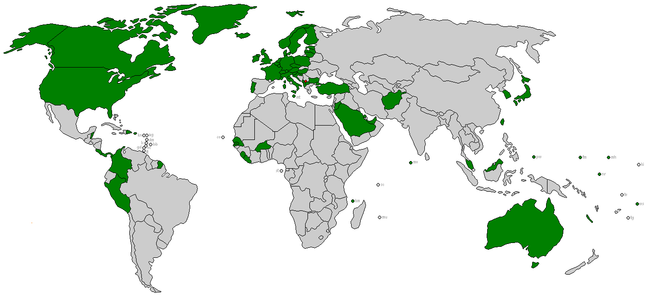
. All 11 representatives of the Serb minority boycotted the proceedings. International reaction was mixed, and the world community continues to be divided on the issue of the international recognition of Kosovo.
diplomatic recognition
s as an independent state. Notably, out of United Nations
member states, 22 out of 27 European Union
member states, 24 out of 28 NATO member states, and 27 out of 57 member states of the Organisation of Islamic Cooperation (OIC) have recognised Kosovo. Serbia
refuses to recognise it.
, three (the United States
, United Kingdom
, France
) have recognised the declaration of independence, while the People's Republic of China
has expressed concern, urging the continuation of the previous negotiation framework. Russia
has rejected the declaration and considers it illegal. On 15 May 2008, Russia, China, and India
released a joint statement where they called for new negotiations between the authorities of Belgrade
and Pristina
.
Although EU member states decide individually whether to recognise Kosovo, by consensus the EU has commissioned the European Union Rule of Law Mission in Kosovo (EULEX)
to ensure peace and continued external oversight. Due to the dispute in the UN Security Council, the reconfiguration of the UN Interim Administration Mission in Kosovo (UNMIK)
and partial handover to the EULEX mission met with difficulties. In spite of Russian and Serbian protests, the UN Secretary-General Ban Ki-moon
proceeded with the reconfiguration plan. On 15 July 2008, he stated: "In the light of the fact that the Security Council is unable to provide guidance, I have instructed my Special Representative
to move forward with the reconfiguration of UNMIK... in order to adapt UNMIK to a changed reality". According to the Secretary-General, the "United Nations has maintained a position of strict neutrality on the question of Kosovo's status". On 26 November 2008, the UN Security Council gave the green light to the deployment of the EULEX mission in Kosovo. The EU mission is to assume police, justice and customs duties from the UN, while operating under the UN resolution 1244
that first placed Kosovo under UN administration in 1999.
As of late July 2008, UNMIK no longer provides the citizens of Kosovo with travel documents
, while their ability to travel using the new Kosovan passport does not coincide with diplomatic recognition: for example Greece
, Romania
and Slovakia
make it possible, despite not recognising Kosovo. The three neighbouring states that recognise Kosovo—Albania
, Montenegro
and Macedonia—all accept the Kosovan passport
, which Serbia refuses.
A UN General Assembly
resolution adopted on 8 October 2008 backed the request of Serbia to seek an advisory opinion
from the International Court of Justice
on the legality of Kosovo's unilaterally proclaimed independence. The International Court of Justice delivered its advisory opinion on 22 July 2010 and concluded that the declaration of independence of Kosovo "did not violate any applicable rule of international law", because it was not issued by the Assembly of Kosovo
, Provisional Institutions of Self-Government
, or any other official body and thus the authors, who named themselves "representatives of the people of Kosovo" were not bound by the Constitutional Framework (promulgated by UNMIK
) or by UNSCR1244
that is addressed only to United Nations Member States
and organs of the United Nations.
. Serbia also expelled ambassadors from countries that recognised Kosovo after the vote in the United Nations General Assembly in which the initiative of Serbia to seek an advisory opinion
by the International Court of Justice was adopted.
Republic of Kosovo
Kosovo , officially the Republic of Kosovo is a partially recognised state and a disputed territory in the Balkans...
's declaration of independence
2008 Kosovo declaration of independence
The 2008 Kosovo declaration of independence was adopted on 17 February 2008 by individual members of the Assembly of Kosovo acting in personal capacity and not binding to the Assembly itself...
from Serbia
Serbia
Serbia , officially the Republic of Serbia , is a landlocked country located at the crossroads of Central and Southeast Europe, covering the southern part of the Carpathian basin and the central part of the Balkans...
was enacted on Sunday, 17 February 2008 by the Assembly of Kosovo
Assembly of Kosovo
The Assembly of Kosovo was originally established by the United Nations Interim Administration Mission in Kosovo in 2001 to provide 'provisional, democratic self-government'....
with a unanimous quorum
Quorum
A quorum is the minimum number of members of a deliberative assembly necessary to conduct the business of that group...
. All 11 representatives of the Serb minority boycotted the proceedings. International reaction was mixed, and the world community continues to be divided on the issue of the international recognition of Kosovo.
diplomatic recognition
Diplomatic recognition
Diplomatic recognition in international law is a unilateral political act with domestic and international legal consequences, whereby a state acknowledges an act or status of another state or government in control of a state...
s as an independent state. Notably, out of United Nations
United Nations
The United Nations is an international organization whose stated aims are facilitating cooperation in international law, international security, economic development, social progress, human rights, and achievement of world peace...
member states, 22 out of 27 European Union
European Union
The European Union is an economic and political union of 27 independent member states which are located primarily in Europe. The EU traces its origins from the European Coal and Steel Community and the European Economic Community , formed by six countries in 1958...
member states, 24 out of 28 NATO member states, and 27 out of 57 member states of the Organisation of Islamic Cooperation (OIC) have recognised Kosovo. Serbia
Serbia
Serbia , officially the Republic of Serbia , is a landlocked country located at the crossroads of Central and Southeast Europe, covering the southern part of the Carpathian basin and the central part of the Balkans...
refuses to recognise it.
Background
A number of states expressed concern over the unilateral character of Kosovo's declaration, or announced explicitly that they will not recognise an independent Kosovo. The UN Security Council remains divided on this issue: of its five members with veto powerUnited Nations Security Council veto power
The United Nations Security Council "power of veto" refers to the veto power wielded solely by the five permanent members of the United Nations Security Council , enabling them to prevent the adoption of any "substantive" draft Council resolution, regardless of the level of international support...
, three (the United States
United States
The United States of America is a federal constitutional republic comprising fifty states and a federal district...
, United Kingdom
United Kingdom
The United Kingdom of Great Britain and Northern IrelandIn the United Kingdom and Dependencies, other languages have been officially recognised as legitimate autochthonous languages under the European Charter for Regional or Minority Languages...
, France
France
The French Republic , The French Republic , The French Republic , (commonly known as France , is a unitary semi-presidential republic in Western Europe with several overseas territories and islands located on other continents and in the Indian, Pacific, and Atlantic oceans. Metropolitan France...
) have recognised the declaration of independence, while the People's Republic of China
People's Republic of China
China , officially the People's Republic of China , is the most populous country in the world, with over 1.3 billion citizens. Located in East Asia, the country covers approximately 9.6 million square kilometres...
has expressed concern, urging the continuation of the previous negotiation framework. Russia
Russia
Russia or , officially known as both Russia and the Russian Federation , is a country in northern Eurasia. It is a federal semi-presidential republic, comprising 83 federal subjects...
has rejected the declaration and considers it illegal. On 15 May 2008, Russia, China, and India
India
India , officially the Republic of India , is a country in South Asia. It is the seventh-largest country by geographical area, the second-most populous country with over 1.2 billion people, and the most populous democracy in the world...
released a joint statement where they called for new negotiations between the authorities of Belgrade
Belgrade
Belgrade is the capital and largest city of Serbia. It is located at the confluence of the Sava and Danube rivers, where the Pannonian Plain meets the Balkans. According to official results of Census 2011, the city has a population of 1,639,121. It is one of the 15 largest cities in Europe...
and Pristina
Pristina
Pristina, also spelled Prishtina and Priština is the capital and largest city of Kosovo. It is the administrative centre of the homonymous municipality and district....
.
Although EU member states decide individually whether to recognise Kosovo, by consensus the EU has commissioned the European Union Rule of Law Mission in Kosovo (EULEX)
European Union Rule of Law Mission in Kosovo
The European Union Rule of Law Mission in Kosovo, EULEX Kosovo, is a deployment of European Union police and civilian resources to Kosovo...
to ensure peace and continued external oversight. Due to the dispute in the UN Security Council, the reconfiguration of the UN Interim Administration Mission in Kosovo (UNMIK)
United Nations Interim Administration Mission in Kosovo
The United Nations Interim Administration Mission in Kosovo or UNMIK is the interim civilian administration in Kosovo, under the authority of the United Nations. The mission was established on 10 June 1999 by Security Council Resolution 1244...
and partial handover to the EULEX mission met with difficulties. In spite of Russian and Serbian protests, the UN Secretary-General Ban Ki-moon
Ban Ki-moon
Ban Ki-moon is the eighth and current Secretary-General of the United Nations, after succeeding Kofi Annan in 2007. Before going on to be Secretary-General, Ban was a career diplomat in South Korea's Ministry of Foreign Affairs and in the United Nations. He entered diplomatic service the year he...
proceeded with the reconfiguration plan. On 15 July 2008, he stated: "In the light of the fact that the Security Council is unable to provide guidance, I have instructed my Special Representative
Special Representative of the Secretary-General for Kosovo
The Special Representative of the Secretary-General for Kosovo is an appointed by the Secretary-General to lead the United Nations Interim Administration Mission in Kosovo...
to move forward with the reconfiguration of UNMIK... in order to adapt UNMIK to a changed reality". According to the Secretary-General, the "United Nations has maintained a position of strict neutrality on the question of Kosovo's status". On 26 November 2008, the UN Security Council gave the green light to the deployment of the EULEX mission in Kosovo. The EU mission is to assume police, justice and customs duties from the UN, while operating under the UN resolution 1244
United Nations Security Council Resolution 1244
United Nations Security Council Resolution 1244, adopted on June 10, 1999, after recalling resolutions 1160 , 1199 , 1203 and 1239 , authorised an international civil and military presence in Kosovo ) and established the United Nations Interim Administration Mission in Kosovo .Resolution...
that first placed Kosovo under UN administration in 1999.
As of late July 2008, UNMIK no longer provides the citizens of Kosovo with travel documents
UNMIK Travel Document
An UNMIK Travel Document was a passport-sized document used to foreign travel for residents of Kosovo, who were not able to obtain a passport from Yugoslavia. The document was issued by the UNMIK from 2000 till 2008. After the government of Kosovo started to issue their own passports, the UNMIK...
, while their ability to travel using the new Kosovan passport does not coincide with diplomatic recognition: for example Greece
Greece
Greece , officially the Hellenic Republic , and historically Hellas or the Republic of Greece in English, is a country in southeastern Europe....
, Romania
Romania
Romania is a country located at the crossroads of Central and Southeastern Europe, on the Lower Danube, within and outside the Carpathian arch, bordering on the Black Sea...
and Slovakia
Slovakia
The Slovak Republic is a landlocked state in Central Europe. It has a population of over five million and an area of about . Slovakia is bordered by the Czech Republic and Austria to the west, Poland to the north, Ukraine to the east and Hungary to the south...
make it possible, despite not recognising Kosovo. The three neighbouring states that recognise Kosovo—Albania
Albania
Albania , officially known as the Republic of Albania , is a country in Southeastern Europe, in the Balkans region. It is bordered by Montenegro to the northwest, Kosovo to the northeast, the Republic of Macedonia to the east and Greece to the south and southeast. It has a coast on the Adriatic Sea...
, Montenegro
Montenegro
Montenegro Montenegrin: Crna Gora Црна Гора , meaning "Black Mountain") is a country located in Southeastern Europe. It has a coast on the Adriatic Sea to the south-west and is bordered by Croatia to the west, Bosnia and Herzegovina to the northwest, Serbia to the northeast and Albania to the...
and Macedonia—all accept the Kosovan passport
Kosovan passport
The Kosovan passport is a travel document that is issued to the citizens of the disputed Republic of Kosovo. The document facilitates international travel as well as serving as proof of citizenship. The issuance of passports is the prerogative of the Ministry of Internal Affairs, with the...
, which Serbia refuses.
A UN General Assembly
United Nations General Assembly
For two articles dealing with membership in the General Assembly, see:* General Assembly members* General Assembly observersThe United Nations General Assembly is one of the five principal organs of the United Nations and the only one in which all member nations have equal representation...
resolution adopted on 8 October 2008 backed the request of Serbia to seek an advisory opinion
Advisory opinion
An advisory opinion is an opinion issued by a court that does not have the effect of adjudicating a specific legal case, but merely advises on the constitutionality or interpretation of a law. Some countries have procedures by which the executive or legislative branches may certify important...
from the International Court of Justice
International Court of Justice
The International Court of Justice is the primary judicial organ of the United Nations. It is based in the Peace Palace in The Hague, Netherlands...
on the legality of Kosovo's unilaterally proclaimed independence. The International Court of Justice delivered its advisory opinion on 22 July 2010 and concluded that the declaration of independence of Kosovo "did not violate any applicable rule of international law", because it was not issued by the Assembly of Kosovo
Assembly of Kosovo
The Assembly of Kosovo was originally established by the United Nations Interim Administration Mission in Kosovo in 2001 to provide 'provisional, democratic self-government'....
, Provisional Institutions of Self-Government
Provisional Institutions of Self-Government
The Provisional Institutions of Self-Government or 'PISG' are the local administrative bodies in Kosovo established by the United Nations administration in that province under the terms of UNSCR 1244...
, or any other official body and thus the authors, who named themselves "representatives of the people of Kosovo" were not bound by the Constitutional Framework (promulgated by UNMIK
United Nations Interim Administration Mission in Kosovo
The United Nations Interim Administration Mission in Kosovo or UNMIK is the interim civilian administration in Kosovo, under the authority of the United Nations. The mission was established on 10 June 1999 by Security Council Resolution 1244...
) or by UNSCR1244
United Nations Security Council Resolution 1244
United Nations Security Council Resolution 1244, adopted on June 10, 1999, after recalling resolutions 1160 , 1199 , 1203 and 1239 , authorised an international civil and military presence in Kosovo ) and established the United Nations Interim Administration Mission in Kosovo .Resolution...
that is addressed only to United Nations Member States
United Nations member states
There are 193 United Nations member states, and each of them is a member of the United Nations General Assembly.The criteria for admission of new members are set out in the United Nations Charter, Chapter II, Article 4, as follows:...
and organs of the United Nations.
Serbia's reaction
Due to Serbian claims over Kosovo being a part of its sovereign territory, its reactions included recalling its ambassadors from countries that recognised Kosovo for consultations for several months, indicting the Kosovar leaders on charges of high treason, and announcing plans to litigate the case at the International Court of JusticeInternational Court of Justice
The International Court of Justice is the primary judicial organ of the United Nations. It is based in the Peace Palace in The Hague, Netherlands...
. Serbia also expelled ambassadors from countries that recognised Kosovo after the vote in the United Nations General Assembly in which the initiative of Serbia to seek an advisory opinion
Advisory opinion
An advisory opinion is an opinion issued by a court that does not have the effect of adjudicating a specific legal case, but merely advises on the constitutionality or interpretation of a law. Some countries have procedures by which the executive or legislative branches may certify important...
by the International Court of Justice was adopted.
Positions taken by states
UN member states
| Country | Date of recognition Diplomatic recognition Diplomatic recognition in international law is a unilateral political act with domestic and international legal consequences, whereby a state acknowledges an act or status of another state or government in control of a state... | Relevant international membership | |
|---|---|---|---|
| 1 | OIC member | ||
| 2 | |||
| 3 | , de jure since | NATO member OIC member |
|
| 4 | UNSC permanent member EU European Union The European Union is an economic and political union of 27 independent member states which are located primarily in Europe. The EU traces its origins from the European Coal and Steel Community and the European Economic Community , formed by six countries in 1958... member NATO member |
||
| 5 | NATO member OIC member |
||
| 6 | UNSC permanent member EU member NATO member |
||
| 7 | UNSC permanent member NATO member |
||
| 8 | |||
| 9 | OIC member | ||
| 10 | EU member NATO member |
||
| 11 | EU member NATO member |
||
| 12 | EU member NATO member |
||
| 13 | EU member NATO member |
||
| 14 | EU member NATO member |
||
| 15 | EU member NATO member |
||
| 16 | |||
| 17 | EU member NATO member |
||
| 18 | EU member NATO member |
||
| 19 | |||
| 20 | EU member | ||
| 21 | EU member | ||
| 22 | EU member | ||
| 23 | EU member NATO member |
||
| 24 | NATO member |
||
| 25 | EU member President country of Council of the European Union Council of the European Union The Council of the European Union is the institution in the legislature of the European Union representing the executives of member states, the other legislative body being the European Parliament. The Council is composed of twenty-seven national ministers... at time of declaration NATO member |
||
| 26 | EU member | ||
| 27 | |||
| 28 | NATO member | ||
| 29 | |||
| 30 | EU member NATO member |
||
| 31 | NATO member |
||
| 32 | EU member NATO member |
||
| 33 | |||
| 34 | |||
| 35 | NATO member | ||
| 36 | |||
| 37 | |||
| 38 | OIC member | ||
| 39 | EU member NATO member |
||
| 40 | |||
| 41 | EU member NATO member |
||
| 42 | |||
| 43 | OIC member | ||
| 44 | |||
| 45 | |||
| 46 | EU member |
||
| 47 | |||
| 48 | EU member NATO member |
||
| 49 | |||
| 50 | |||
| 51 | OIC member | ||
| 52 | OIC member | ||
| 53 | |||
| 54 | |||
| 55 | OIC member | ||
| 56 | |||
| 57 | OIC member | ||
| 58 | OIC member | ||
| 59 | OIC member | ||
| 60 | OIC member | ||
| 61 | OIC member | ||
| 62 | |||
| 63 | |||
| 64 | |||
| 65 | OIC member | ||
| 66 | |||
| 67 | |||
| 68 | OIC member | ||
| 69 | OIC member | ||
| 70 | |||
| 71 | |||
| 72 | |||
| 73 | OIC member | ||
| 74 | OIC member | ||
| 75 | OIC member | ||
| 76 | |||
| 77 | |||
| 78 | OIC member | ||
| 79 | OIC member | ||
| 80 | OIC member | ||
| 81 | |||
| 82 | OIC member | ||
| 83 | OIC member | ||
| 84 | OIC member | ||
| 85 | OIC member |
Other states and entities
| State or Entity | Date of recognition Diplomatic recognition Diplomatic recognition in international law is a unilateral political act with domestic and international legal consequences, whereby a state acknowledges an act or status of another state or government in control of a state... | Relevant international membership |
|---|---|---|
| (Taiwan Taiwan Taiwan , also known, especially in the past, as Formosa , is the largest island of the same-named island group of East Asia in the western Pacific Ocean and located off the southeastern coast of mainland China. The island forms over 99% of the current territory of the Republic of China following... ) |
||
 Knights Hospitaller Knights Hospitaller |
UN Permanent Observer |
UN member states
| Country | Position | Relevant international membership |
|---|---|---|
| In March 2008, Mourad Medelci Mourad Medelci Mourad Medelci is an Algerian politician and the current Minister of Foreign Affairs of Algeria.-Early life:Medelci studied Economics at the University of Algiers receiving his Bachelor's degree in 1966 and Masters degree in 1968... , Foreign Affairs Minister, stated that while Algeria sympathised with all Muslim countries Muslim world The term Muslim world has several meanings. In a religious sense, it refers to those who adhere to the teachings of Islam, referred to as Muslims. In a cultural sense, it refers to Islamic civilization, inclusive of non-Muslims living in that civilization... , it believed that international laws had to be adhered to. A year later, Medelci reaffirmed the Algerian position of Kosovo being an integral part of Serbia. In May 2009, the Ambassador of Algeria to Serbia, Abdelkader Mesdoua stated that Algeria would reconsider the issue of Kosovo if Serbia changed its own position. |
OIC member | |
| On 23 June 2008, President José Eduardo dos Santos José Eduardo dos Santos José Eduardo dos Santos is an Angolan politician who has been the second and current President of Angola since 1979. As President, José Eduardo dos Santos is also the commander in chief of the Angolan Armed Forces and president of the MPLA , the party that has been ruling Angola since... sent a message to his Serbian counterpart, Boris Tadić Boris Tadic Boris Tadić is the President of Serbia and leader of the Democratic Party. He was elected to a five-year term on 27 June 2004, and was sworn into office on 11 July. He was re-elected for a de facto second five-year term on 3 February 2008 and was sworn in on 15 February... , regarding the unilateral declaration of independence of Kosovo through Vicente Muanda, chargé d'affaires of the Angolan Embassy in Serbia. Muanda handed over the letter to Jovan Ratković Jovan Ratkovic Jovan Ratković is an advisor for relations with the European Union and NATO to the President of Serbia, appointed by Boris Tadić. He is a graduate of the University of East Anglia in politics and environmental economics with international relations.... , foreign policy advisor to the President. It reiterated the solidarity of President Eduardo dos Santos and Angola to Serbia, in regard to the preservation of its sovereignty and integrity. |
||
| In February 2008, Argentine Foreign Minister Jorge Taiana Jorge Taiana Jorge Enrique Taiana is an Argentine Justicialist Party politician, formerly Foreign Minister in the government of President Cristina Fernández de Kirchner, after occupying the same post during the previous government of Néstor Kirchner... said "if we were to recognize Kosovo, which has declared its independence unilaterally, without an agreement with Serbia, we would set a dangerous precedent that would seriously threaten our chances of a political settlement in the case of the Falkland Islands Falkland Islands The Falkland Islands are an archipelago in the South Atlantic Ocean, located about from the coast of mainland South America. The archipelago consists of East Falkland, West Falkland and 776 lesser islands. The capital, Stanley, is on East Falkland... ". He said that President Cristina Fernández de Kirchner Cristina Fernández de Kirchner Cristina Elisabet Fernández de Kirchner , commonly known as Cristina Fernández or Cristina Kirchner is the 55th and current President of Argentina and the widow of former President Néstor Kirchner. She is Argentina's first elected female president, and the second female president ever to serve... would not give any official statement on the issue, reiterating that there would be no recognition of Kosovo. Argentina will not recognise also because it "supports the principle of territorial integrity". Additionally, he stressed that the 1999 UN Resolution 1244 called for the mutual agreement of all parties to solve the dispute. In a 2 December 2009 hearing at the International Court of Justice, the Argentine delegation said that Kosovo's declaration of independence "breaches an obligation to respect the territorial integrity of Serbia, the obligation of peaceful settlement of disputes and principle of non-intervention. The resolution has no legal basis in the principle of self-determination," and that it "did not, and could not, abolish Serbia's sovereignty over Kosovo". |
||
| On 12 March 2008, President Serzh Sargsyan stated that "Armenia's possible recognition of Kosovo Kosovo Kosovo is a region in southeastern Europe. Part of the Ottoman Empire for more than five centuries, later the Autonomous Province of Kosovo and Metohija within Serbia... 's independence will not strain the Armenian-Russia Russia Russia or , officially known as both Russia and the Russian Federation , is a country in northern Eurasia. It is a federal semi-presidential republic, comprising 83 federal subjects... n relations" but also noted that "Kosovo recognition issue needs serious discussion... Armenia has always been an adherent to the right of nations to self-determination and in this aspect we welcome Kosovo's independence." On 3 September 2008 President Serzh Sargsyan stated: "Today one is wondering from time to time why Armenia is not recognizing the independence of Abkhazia Abkhazia Abkhazia is a disputed political entity on the eastern coast of the Black Sea and the south-western flank of the Caucasus.Abkhazia considers itself an independent state, called the Republic of Abkhazia or Apsny... and South Ossetia South Ossetia South Ossetia or Tskhinvali Region is a disputed region and partly recognized state in the South Caucasus, located in the territory of the South Ossetian Autonomous Oblast within the former Georgian Soviet Socialist Republic.... . The answer is simple: for the same reason that it did not recognize Kosovo's independence. Having the Nagorno-Karabakh Nagorno-Karabakh Republic The Nagorno-Karabakh Republic , or Artsakh Republic is a de facto independent republic located in the South Caucasus region of Eurasia... conflict, Armenia can not recognize another entity in the same situation as long as it has not recognized the Nagorno-Karabakh Republic". A nation's right to self-determination "takes times", requiring the understanding of "all interested parties". Accordingly, Armenia is trying to "convince" Azerbaijan to accept the loss of Karabakh, stated the president. In November 2008, whilst commenting on Russia's recognition of Georgia's breakaway regions, Sargsyan said "In case with Kosovo the right of nations to self-determination was applied. However, Russia's similar step was given a hostile reception". At a meeting in May 2009 between the Kosovan Foreign Minister, Skënder Hyseni Skënder Hyseni Skënder Hyseni is a former foreign minister of the Republic of Kosovo . Hyseni graduated at the University of Pristina, branch of English Language and Literature in 1979... , and Armen Martirosyan, the representative of Armenia to the UN, Mr. Martirosyan reportedly promised that the request for recognition would be forwarded to his government. On a July 2009 state visit to Armenia, Serbian President Boris Tadić Boris Tadic Boris Tadić is the President of Serbia and leader of the Democratic Party. He was elected to a five-year term on 27 June 2004, and was sworn into office on 11 July. He was re-elected for a de facto second five-year term on 3 February 2008 and was sworn in on 15 February... discussed the issues of Kosovo and Nagorno-Karabakh with Armenian President Serzh Sargsyan. The two leaders agreed that regional conflicts must be resolved without the use of force and only by peaceful means in keeping with international law. Tadić also met with Prime Minister Tigran Sargsyan Tigran Sargsyan Tigran Sargsyan has been the Prime Minister of Armenia since 9 April 2008.Tigran Sargsyan was born in Kirovakan, Armenian SSR . From 1980 to 1983, he attended Leningrad's Voznesenski Financial and Economic Institute. From 1983 to 1987 his postgraduate education ended in obtaining PhD degree... where the same issues were discussed. The Kosovo and Nagorno-Karabakh issues can only be solved through negotiations and "any imposed solutions are absolutely unacceptable and we fully agree on that," Tadić said afterwards. On 4 April 2011 Armenian President Serzh Sargsyan said that Armenia would not recognise the independence of Kosovo contrary to the interests of Serbia. |
||
| In February 2008, a spokesman of the Foreign Ministry, Khazar Ibrahim Khazar Ibrahim Khazar Ibrahim is an adviser for Azerbaijan's ambassador to the United States.-Education:He graduated from the Baku State University, Azerbaijan, with an MA in International Relations, from Georgetown University, Washington, D.C., with an MA in Security Studies.-Career:He is a career diplomat,... , said "We view this illegal act as being in contradiction with international law. Proceeding from this, Azerbaijan's position is clear: it does not recognise [Kosovo's] independence". Azerbaijan has also withdrawn peacekeepers from Kosovo. Zahid Oruj, member of the parliamentary committee on defence and security, explained it by saying "Owing to the change of situation in Kosovo, the Azeri peacekeeping battalion performing its mission within the Turkish contingent will be withdrawn. Azerbaijan acts in compliance with the country's political stance". At the summit of the Organisation of the Islamic Conference on 10 March 2008, Azerbaijan opposed adoption of the document, proposed by Turkey, that would lend support to Kosovo's declaration of independence. On 19 June 2008, during the meeting of Organisation of the Islamic Conference, Azerbaijan was among countries that opposed the recognition of Kosovo as an independent country. In a 3 December 2009 hearing at the International Court of Justice, the Azerbaijani delegation said that entities that declare secession while violating the internal laws of the state can not be considered to be states, and that a fait accompli may not be accepted - power is not the right, and the force is not the law. At a meeting with Serbian President in Baku in May 2010, President of Azerbaijan Ilham Aliyev Ilham Aliyev Ilham Heydar oglu Aliyev is the President of Azerbaijan since 2003. He also functions as the Chairman of the New Azerbaijan Party and the head of the National Olympic Committee... said that Serbia and Azerbaijan mutually help each other in the international arena and that his country provides strong support for the territorial integrity of Serbia. He stated that the unilaterally proclaimed independence of Kosovo is an illegal move and called on all UN member states to respect the international law. |
OIC member | |
| At a meeting on 18 June 2009 between the Kosovan Foreign Minister, Skënder Hyseni, and Paulette A. Bethel, the representative of the Bahamas to the UN, Ms. Bethel reportedly said that she would forward the request for recognition to her government. In April 2010, Bahamian Foreign Minister Brent Symonette said, "We have considered and continue to consider the situation on the ground on both sides and maintain a status of awaiting the outcome of negotiations between Kosovo and its neighbouring countries before committing support to either of the two countries". |
||
| On 29 June 2008 the Prime Minister, Fakhruddin Ahmed Fakhruddin Ahmed Dr Fakhruddin Ahmed is a noted Bangladeshi economist, civil servant, and a former governor of the Bangladesh Bank, the country's central bank... , during a meeting with the United States Ambassador to Bangladesh, James F. Moriarty James F. Moriarty James F. Moriarty is a United States diplomat and career foreign service officer with the rank of Minister-Counselor. As of 2008 he is the current U.S. Ambassador to Bangladesh. His appointment was confirmed as by the Senate on March 14, 2008 and he was sworn in on March 26, 2008.Prior to this... , affirmed that "Bangladesh will recognize the new European country". The Prime Minister also assured the US ambassador that "Bangladesh is committed to lobbing Asian Muslim countries to recognize Kosovo. Bangladesh will actively contribute to the development of Kosovo". Following a meeting on 17 December 2008 between Bangladeshi Foreign Adviser Dr. Iftekhar Ahmed Chowdhury and United States Ambassador James F. Moriarty, the media were told that the question of Kosovo recognition was under "active consideration of the [Bangladeshi] government." In a press briefing on 22 August 2009, Bangladesh's Foreign Secretary Mohamed Mijarul Quayes said "We don't feel the necessity to recognize Kosovo at this moment". He said that his government would consider "many factors" before making its decision. "If we recognize Kosovo, we are certainly taking a side. But if we don't, we are not leaning to any side," he said. In a meeting with US Ambassador James F. Moriarty on 15 November 2009, Quayes said that an independent decision would be made on Bangladesh's recognition of Kosovo, keeping the country's national interests in consideration. It has been reported that Bangladesh has not yet recognised Kosovo as it is focusing on strengthening ties with Moscow - Russia had formally requested Bangladesh not to recognise. Following a September 2010 meeting with the Prime Minister of Bangladesh, Albanian President Sali Berisha Sali Berisha Sali Ram Berisha is an Albanian politician and cardiologist, currently the Prime Minister of Albania and the leader of Democratic Party of Albania .... said that Bangladesh had promised to decide positively regarding recognition of Kosovo. |
OIC member | |
| At a meeting in January 2009 between the Kosovan Foreign Minister, Skënder Hyseni, and Kurt Mach, Barbados' general consul assigned to Vienna, Mr. Mach promised to inform his government about Kosovo's achievements, and that he would encourage his country to consider recognising Kosovo. | ||
| In February 2008, President Alexander Lukashenko Alexander Lukashenko Alexander Grigoryevich Lukashenko has been serving as the President of Belarus since 20 July 1994. Before his career as a politician, Lukashenko worked as director of a state-owned agricultural farm. Under Lukashenko's rule, Belarus has come to be viewed as a state whose conduct is out of line... wrote in a letter to Serbian President Boris Tadić Boris Tadic Boris Tadić is the President of Serbia and leader of the Democratic Party. He was elected to a five-year term on 27 June 2004, and was sworn into office on 11 July. He was re-elected for a de facto second five-year term on 3 February 2008 and was sworn in on 15 February... that "Belarus expresses its solidarity with the Serbians' intention to defend their sovereignty and territorial integrity". The National Assembly of the Republic of Belarus had issued a statement condemning the declaration of independence and encouraged all nations to call the move "illegal" under international law. The Foreign Ministry of the Republic of Belarus published a statement saying "that the settlement of the Kosovo and Metochia status should progress under international law, based on UN Security Council resolution 1244 (of 1999) which is a fundamental document for the Kosovo settlement certifying the sovereignty and territorial integrity of the Republic of Serbia, and based on the key provisions of the UN Charter and Helsinki Final Act, with the essential role of the UN Security Council bearing a predominant responsibility for safeguarding international peace and security". In a 3 December 2009 hearing at the International Court of Justice, the Belarussian delegation said that secession by international law was allowed only in former colonies, or in cases where the minority population was oppressed for a long period of time and was denied the participation in government, however the situation in Kosovo has not met these criteria traditionally interpreted as the right for "external" self-determination. The internal law of Serbia as well as UNSC resolutions are satisfactory for the "internal" self-determination of the Albanian population. |
||
| At a meeting on 28 May 2009 between the Kosovan Foreign Minister, Skënder Hyseni, and Lhatu Wangchuk, the representative of Bhutan to the UN, Mr. Wangchuk reportedly said that he had conveyed Kosovo's request for recognition to his government on 3 February, and he is awaiting the decision of his government. | ||
| In February 2008, President Evo Morales Evo Morales Juan Evo Morales Ayma , popularly known as Evo , is a Bolivian politician and activist, currently serving as the 80th President of Bolivia, a position that he has held since 2006. He is also the leader of both the Movement for Socialism party and the cocalero trade union... refused to recognise Kosovo's independence and compared Kosovo separatists to the leaders of four eastern Bolivian states who have demanded greater autonomy from the federal government. In a 4 December 2009 hearing at the International Court of Justice, the Bolivian delegation said that Kosovo is an integral part of Serbia and that the Republic of Kosovo does not exist. A unilateral declaration of independence cannot change the international regime established by the UNSC resolution, or decide the outcome of negotiations. |
||
| On 21 February 2008, Republika Srpska Republika Srpska Republika Srpska is one of two main political entities of Bosnia and Herzegovina, the other being the Federation of Bosnia and Herzegovina... , one of the two entities of Bosnia and Herzegovina Bosnia and Herzegovina Bosnia and Herzegovina , sometimes called Bosnia-Herzegovina or simply Bosnia, is a country in Southern Europe, on the Balkan Peninsula. Bordered by Croatia to the north, west and south, Serbia to the east, and Montenegro to the southeast, Bosnia and Herzegovina is almost landlocked, except for the... , adopted a resolution through which it denounced and refused to recognise the unilateral declaration of independence of Kosovo from Serbia. In addition, the parliament adopted a resolution stating that in the event that a majority of EU and UN states recognise Kosovo's independence, Republika Srpska would cite the Kosovo secession as a precedent and move to hold a referendum on its own constitutional status within Bosnia and Herzegovina. Finally, the resolution called upon all Republika Srpska officials to do everything in order to prevent Bosnia and Herzegovina from recognising Kosovo's declared independence. On 27 August 2008, former Bosnian ambassador in Turkey Hajrudin Somun wrote an editorial discussing Kosovan passport Kosovan passport The Kosovan passport is a travel document that is issued to the citizens of the disputed Republic of Kosovo. The document facilitates international travel as well as serving as proof of citizenship. The issuance of passports is the prerogative of the Ministry of Internal Affairs, with the... s, where he summarised to-date the Bosnian position on Kosovo: "As in many other matters, Bosnia and Herzegovina is deeply divided over Kosovo's independence. The parliament of the 'Republika Srpska' entity, which covers 49 percent of the country's territory, adopted a special resolution denouncing Kosovo's independence and wide demonstrations have been organized there in protest. Keeping in mind that Serb leaders of that entity have threatened to secede from Bosnia and Herzegovina and join Serbia as compensation for losing Kosovo, Bosnian Presidency Presidency of Bosnia and Herzegovina The Presidency of Bosnia and Herzegovina is the head of state of Bosnia and Herzegovina.-Overview:... Chairman Haris Silajdžić said simply that his country is 'unlikely to recognize Kosovo's independence any time soon due to strong objections from its own Serb community. The Foreign Minister Sven Alkalaj Sven Alkalaj Sven Alkalaj is a Bosnian diplomat who is the Foreign Minister of Bosnia and Herzegovina. Alkalaj, who is of Sephardic ethnicity, is one of the most prominent Bosnian Jews... informed the public on 2 August 2008 that by law Bosnia and Herzegovina cannot accept Kosovan passports, until the Bosnian presidency makes such a determination. On 26 September 2008 while attending General Assembly of the United Nations in New York, Bosnian President Haris Silajdžić said in a Voice of America Voice of America Voice of America is the official external broadcast institution of the United States federal government. It is one of five civilian U.S. international broadcasters working under the umbrella of the Broadcasting Board of Governors . VOA provides a wide range of programming for broadcast on radio... interview broadcast back to Bosnia in Bosnian language Bosnian language Bosnian is a South Slavic language, spoken by Bosniaks. As a standardized form of the Shtokavian dialect, it is one of the three official languages of Bosnia and Herzegovina.... that he supports Kosovo's independence and is opposed to Serbia's request that the International Court of Justice issue an opinion on the legitimacy of Kosovo's independence. Silajdžić spoke in his own name because the Presidency of Bosnia and Herzegovina Presidency of Bosnia and Herzegovina The Presidency of Bosnia and Herzegovina is the head of state of Bosnia and Herzegovina.-Overview:... did not adopt a platform which would allow him to speak officially. In August 2009 the Forum of Bosniaks (Bosnian Muslims) of Kosovo requested that Bosnia recognise Kosovo and the travel documents of its citizens. In response, Presidency member Nebojša Radmanović stated that the Presidency would not discuss the issue in the foreseeable future, and that those making such demands must consider "what kind of state Bosnia-Herzegovina is, what tendencies are present, and what could be the consequences of such a move". He said, "Sometimes, thinking with the heart is not good for the bigger political goals". In July 2010, Zeljko Komsic, the Croat member of Bosnia-Herzegovina's Presidency Presidency of Bosnia and Herzegovina The Presidency of Bosnia and Herzegovina is the head of state of Bosnia and Herzegovina.-Overview:... , announced that he recognised Serbia without Kosovo. |
||
| In a September 2010 between the Kosovan Foreign Minister, Skënder Hyseni, and his Botswanan counterpart, Phandu Skelemani, Mr. Skelemani said that the International Court of Justice had given "a clear decision", and said that he would soon formally present a position for recognition to his government. | ||
| In February 2008, the Brazilian government reaffirmed its belief that a peaceful solution for the issue of Kosovo must continue to be sought through dialogue and negotiation, under the auspices of the United Nations and the legal framework of Resolution 1244 of the Security Council. In his recent declarations, the Minister of Foreign Relations Celso Amorim Celso Amorim Celso Luiz Nunes Amorim is a Brazilian diplomat who has been Minister of Defence since August 2011. Amorim was the Minister of Foreign Relations from 1993 to 1995 under President Itamar Franco and again from 2003 to 2011 under President Luiz Inácio Lula da Silva.Before his appointment by Lula,... defended that Brazil should await a UN Security Council decision before defining its official position on the matter of Kosovo's independence. According to Serbian Foreign Minister Vuk Jeremić Vuk Jeremic Vuk Jeremić is a Serbian politician and the current Minister of Foreign Affairs in the Government of Serbia. He was sworn in on May 15, 2007 and reelected on July 7, 2008.-Education:Jeremić was born in Belgrade in 1975 to Miško Jeremić and Sena Buljubašić... , Brazil will support Serbia by presenting their negative opinion about Kosovo independence to the ICJ. In September 2009, Ambassador of Brazil to Serbia Dante Coelho de Lima said that "Our fundamental position is that we respect Serbia's territorial integrity. We supported Security Council resolution 1244, under which Kosovo is a part of Serbia. We also think that the principle of self-determination should not run counter to respect for international law". In a 4 December 2009 hearing at the International Court of Justice, the Brazilian delegation said that the unilateral declaration of independence ignored not only the authority of the UN Security Council, but also the principle of protecting the territorial integrity of states. There is no basis to justify the unilateral declaration of independence in the UNSC resolution 1244 because it predicted a solution agreed by both parties. Since such an agreement was not reached, the Kosovo dispute can be decided only by the UN Security Council. |
||
| At a meeting on 28 May 2009 between the Kosovan Foreign Minister, Skënder Hyseni, and Latif Tuah, the representative of Brunei Darussalam to the UN, Mr. Tuah reportedly said that Brunei is considering the case for recognition. In September 2011, Kosovo's Prime Minister Hashim Thaçi met with Prince Al-Muhtadee Billah of Brunei, who reportedly promised that his country would soon consider the recognition of Kosovo. |
OIC member | |
| In a 4 December 2009 hearing at the International Court of Justice, the Burundian delegation said that declaring the declaration of independence illegal will not have any practical effect because Kosovo exists as a fact. However, the court should limit the right to self-determination only to former and present colonies. There is no right to create new states outside the process of decolonisation, but this will not affect the existence of the Kosovo state. | ||
| In January 2011, the General Secretary of Cameroon's Ministry of Foreign Affairs, Ferdinand Ngoh Ngoh, reportedly said that his government cannot deny that Kosovo's independence is irreversible, but that it would have to be careful on how to proceed in order not to create a situation that would damage Cameroon's interests and position in the world. In November 2011, in a meeting with First Deputy Prime Minister of Kosovo, Behgjet Pacolli Behgjet Pacolli Behgjet Isa Pacolli is a former President of the Republic of Kosovo, and is now First Deputy Prime Minister serving in the cabinet of Hashim Thaçi... , Cameroon's Prime Minister, Philémon Yang, reportedly said that the recognition of Kosovo was underway. |
OIC member | |
| At a meeting in May 2009 between the Kosovan Foreign Minister, Skënder Hyseni, and Antonio Pedro Monteiro Lima, the representative of Cape Verde to the UN, Mr. Lima reportedly said that the decision on recognition of Kosovo is only "a matter of time" and that "Cape Verde knows very well the price of freedom". In December 2010, Cape Verde's National Director of Political Affairs and Cooperation, José Luis Rocha, said that his country will wait until there is consensus at the UN Security Council before considering its position. |
||
| In a 27 February 2008 press release, the Ministry of Foreign Affairs of Chile called on the parties concerned to achieve, by peaceable means, through dialogue and adherence to the international law, a solution that respects the principles and purposes of the United Nations Charter. Chile will continue to analyse the discussions that have taken and are taking place, both in the UN Security Council, and in the Council of Ministers of the European Union. | ||
| In February 2008, the Chinese Foreign Minister has made a statement stressing that the PRC "expresses grave concern" over Kosovo's unilateral declaration of independence. The Minister's remarks go on to add that "The resolution of the Kosovo issue bares on peace and stability of the Balkan region, the fundamental norms governing international relations as well as the authority and role of the UN Security Council. China always believes that a plan acceptable to both Serbia and Kosovo through negotiations is the best way to resolve this issue. The unilateral move taken by Kosovo will lead to a series of consequences. China is deeply worried about its severe and negative impact on peace and stability of the Balkan region and the goal of establishing a multi-ethnic society in Kosovo. China calls upon Serbia and Kosovo to continue negotiations for a proper resolution within the framework of the international law and work together to safeguard peace and stability of the Balkan region. The international community should create favorable conditions for that." On 15 May 2008, the Foreign Ministers of India, Russia and China made a joint statement regarding Kosovo during a conference in Yekaterinburg Yekaterinburg Yekaterinburg is a major city in the central part of Russia, the administrative center of Sverdlovsk Oblast. Situated on the eastern side of the Ural mountain range, it is the main industrial and cultural center of the Urals Federal District with a population of 1,350,136 , making it Russia's... . It was read by the host minister, Sergey Lavrov Sergey Lavrov Sergey Viktorovich Lavrov is the Foreign Minister of Russia. Prior to that, Lavrov was a Soviet diplomat and Russia's ambassador to the United Nations from 1994 to 2004. Lavrov speaks Russian, English, French and Sinhala.... of Russia, and it said "In our statement, we recorded our fundamental position that the unilateral declaration of independence by Kosovo contradicts Resolution 1244. Russia, India and China encourage Belgrade and Pristina to resume talks within the framework of international law and hope they reach an agreement on all problems of that Serbian territory". On 23 August 2009, Boris Tadić Boris Tadic Boris Tadić is the President of Serbia and leader of the Democratic Party. He was elected to a five-year term on 27 June 2004, and was sworn into office on 11 July. He was re-elected for a de facto second five-year term on 3 February 2008 and was sworn in on 15 February... and Hu Jintao Hu Jintao Hu Jintao is the current Paramount Leader of the People's Republic of China. He has held the titles of General Secretary of the Communist Party of China since 2002, President of the People's Republic of China since 2003, and Chairman of the Central Military Commission since 2004, succeeding Jiang... signed a joint declaration on the establishment of strategic partnerships. In point VI this document reconfirms that China respects the sovereignty and territorial integrity of Serbia. It considers that the best way to resolve the Kosovo issue is to develop a plan that would be acceptable for both sides, through dialogue and negotiations between the Government of Serbia and Kosovo authorities, in accordance with the purposes and principles of the UN Charter and relevant resolutions of United Nations Security Council, within international law. The declaration says that unilateral action will not contribute to resolving this issue, and that the international community should create favourable conditions for solving it. In 2009, for the first time in its history, China entered a process before the International Court of Justice International Court of Justice The International Court of Justice is the primary judicial organ of the United Nations. It is based in the Peace Palace in The Hague, Netherlands... . China backed the position of Serbia saying that sovereign states have a right to prevent unilateral secessions and protect their integrity. |
UNSC permanent member | |
| In November 2009, President Joseph Kabila Joseph Kabila Joseph Kabila Kabange is a Congolese politician who has been President of the Democratic Republic of the Congo since January 2001. He took office ten days after the assassination of his father, President Laurent-Désiré Kabila... said that Congo will not recognise the independence of Kosovo for as long as he lives. |
||
| On 29 February 2008, writing in his personal "Reflections of Fidel" column, which is published in the official newspaper of the Communist Party of Cuba, Granma Internacional Granma (newspaper) Granma is the official newspaper of the Central Committee of the Cuban Communist Party.Its name comes from the yacht Granma that carried Fidel Castro and 81 other rebels to Cuba's shores in 1956 launching the Cuban Revolution.-Editions:... (and since translated into English and archived on the Trabajadores website), Fidel Castro Fidel Castro Fidel Alejandro Castro Ruz is a Cuban revolutionary and politician, having held the position of Prime Minister of Cuba from 1959 to 1976, and then President from 1976 to 2008. He also served as the First Secretary of the Communist Party of Cuba from the party's foundation in 1961 until 2011... , the ex-President and First Secretary of the Communist Party of Cuba, attacked Javier Solana Javier Solana Francisco Javier Solana de Madariaga, KOGF is a Spanish physicist and Socialist politician. After serving in the Spanish government under Felipe González and Secretary General of NATO , he was appointed the European Union's High Representative for Common Foreign and Security Policy, Secretary... , accusing him of being the ideological father of Kosovo's "independence", and by doing so, putting at risk the ethnic cohesion and the very state integrity of Spain Spain Spain , officially the Kingdom of Spain languages]] under the European Charter for Regional or Minority Languages. In each of these, Spain's official name is as follows:;;;;;;), is a country and member state of the European Union located in southwestern Europe on the Iberian Peninsula... or the United Kingdom United Kingdom The United Kingdom of Great Britain and Northern IrelandIn the United Kingdom and Dependencies, other languages have been officially recognised as legitimate autochthonous languages under the European Charter for Regional or Minority Languages... , both of which experience separatist movements of their own. He referred to Kosovo independence in quotes as "independence". In December 2009, Ambassador of Cuba to Serbia, Mercedes Martínez Valdés, said that Cuba supports the territorial integrity and sovereignty of Serbia regarding the issue of Kosovo and advocates for the respect of international law. In a September 2010 meeting between the Foreign Ministers of Albania and Cuba, Edmond Haxhinasto and Bruno Rodriguez Parrilla, Mr. Parrilla said that Cuba is reconsidering recognition of Kosovo in light of the decision made by the International Court of Justice. |
||
| On 11 February 2008, then Foreign Minister Erato Kozakou-Marcoullis Erato Kozakou-Marcoullis Erato Kozakou-Marcoullis is a Cypriot politician who is currently the Minister of Foreign Affairs of Cyprus. She had also served in this post from July 2007 until March 2008. She is married with George Marcoullis and has a son.-References:... , of the Papadopoulos administration Tassos Papadopoulos Tassos Nikolaou Papadopoulos was a Cypriot politician. He served as the fifth President of the Republic of Cyprus from February 28, 2003 to February 28, 2008.His parents were Nicolas and Aggeliki from Assia. He was the first of three children... , stated that "Cyprus will never recognize a unilateral declaration of independence outside the U.N. framework, and in particular by side-stepping the role of the Security Council". Current President, Dimitris Christofias Dimitris Christofias Dimitris Christofias also Demetris is a left-wing Greek Cypriot politician and the current and sixth President of the Republic of Cyprus. Christofias was the General Secretary of AKEL and is Cyprus's first, and the European Union's first and so far only, communist head of state. He won the 2008... , confirmed in March 2008 that Cyprus would not recognise Kosovo as an independent country, out of respect for the territorial integrity and sovereignty of Serbia. Christofias reiterated his opposition to recognition in an interview with a Russian newspaper, saying, "The one thing that Kosovo and Cyprus have in common, as far as the situation in these regions is concerned, is that in both cases, the basic principles of international law and legality, as well as UN decisions, are constantly being violated". The Cypriot president underlined that the territorial integrity, sovereignty and independence of both Serbia and the Republic of Cyprus were being violated in the most brutal manner. On 23 February 2009, in a meeting with Serbian President Boris Tadić, Christofias said that "Cyprus has not recognized the unilaterally declared independence of Kosovo and we will not recognize it in the future. We are on your side, not only because your case is similar to ours, but because it is a matter of principles". On 16 June 2009, Minister of Defence of Cyprus Costas Papakostas said that Cyprus will never recognise the independence of Kosovo. In October 2009 this stance was reiterated by President Christofias who said Cyprus would not recognise Kosovo, even if all other EU members did so. |
EU member | |
| At a meeting on 28 May 2009 between the Kosovan Foreign Minister, Skënder Hyseni, and Crispin S. Gregoire, the representative of Dominica to the UN, Mr. Gregoire reportedly said "we recognize the right of the Kosovo people to self-determination and having their place in the family of free nations". In a September 2010 meeting between Skënder Hyseni and Dominican Foreign Affairs Minister, Alvin Bernard, Mr. Bernard said that his government will pay attention to the request for recognition, and in time a decision would be made. Mr. Bernard said, "our presence in this meeting is an indicator with regard to your request". |
||
| In response to a request from the University of Oxford University of Oxford The University of Oxford is a university located in Oxford, United Kingdom. It is the second-oldest surviving university in the world and the oldest in the English-speaking world. Although its exact date of foundation is unclear, there is evidence of teaching as far back as 1096... regarding the analysis of developments related to the independence of Kosovo, in August 2008 the Ministry of Foreign Affairs stated that there should be "unrestricted compliance with the rules and principles of the United Nations Charter and International Law". At a meeting in January 2009 between Kosovan Foreign Minister Skënder Hyseni and Maria Elena Moreira, Ecuador's Ambassador to Austria, Mrs. Moreira said that the government of her country has carefully followed developments in Kosovo, and taking into account the recognition of Kosovo by European and Latin American countries, Ecuador will seriously consider the request for recognition of Kosovo as an independent and sovereign country. At a meeting on 25 March 2009 between the Kosovan Foreign Minister, Skënder Hyseni, and Diego Morejón-Pazmino, the Ambassador of Ecuador to the UN, Mr. Morejón-Pazmino said that Ecuador has been carefully following developments in Kosovo, and he stressed the importance of building democratic institutions and a society with rights guaranteed to all communities. Mr. Morejón-Pazmino also said that Ecuador would carefully examine developments before making a decision on whether to recognise Kosovo. |
||
| Soon after Kosovo's declaration of independence, an Egyptian Foreign Ministry spokesman urged the parties to abide by international law and support regional stability, but did not say whether Egypt would recognise Kosovo. At the summit of the Organisation of the Islamic Conference on 10 March 2008, Egypt opposed adoption of the document, proposed by Turkey, that would lend support to Kosovo's declaration of independence. On 19 June 2008, during the meeting of Organisation of the Islamic Conference, Egypt was among countries that opposed the recognition of Kosovo as an independent country. On 29 September 2008, Foreign Minister Ahmed Aboul Gheit Ahmed Aboul Gheit Ahmed Aboul-Gheit is an Egyptian diplomat who was the Foreign Minister of Egypt from 11 July 2004 to 6 March 2011, since the government of Ahmed Nazif took office. Aboul-Gheit previously served as Egypt's ambassador to the United Nations. In December 2005 he began mediating the Chad-Sudan conflict... said that his government was closely following all developments in Kosovo and the region, and that his country would act at the right time regarding the issue of the recognition of Kosovo. In an interview with Večernje novosti Vecernje novosti Večernje novosti is a Belgrade-based daily newspaper. Founded in 1953, it quickly grew into a high-circulation daily.It first appeared on stands on October 16, 1953 edited by Slobodan Glumac who set the newspaper's tone for years to come... on 29 September 2008, the Ambassador of Egypt to Serbia, Adel Ahmed Naguib, stated that Egypt respects Serbia's sovereignty and territorial integrity, and believes that an agreement should be found to satisfy both sides, for a win-win Win-win game A win-win game is a game which is designed in a way that all participants can profit from it in one way or the other. In conflict resolution, a win-win strategy is a conflict resolution process that aims to accommodate all disputants.-Types:... outcome. In early November 2008, presidential adviser and former deputy foreign minister, Abdullah el-Esha'al stated "that recognition of Kosovo independence will assertively come from Egypt very soon, because we are keen to contribute to peace and stability to this part of the world, and now we are very well informed about your history and self-determination endeavors to build your independent state". In late November 2008, however, Egypt blocked Kosovo's delegation from taking part in the Organisation of the Islamic Conference's second Ministerial Conference on Women to be held in Cairo. Even though the OIC had previously allowed Kosovo to participate with guest status on the request of Albania, Egypt objected and barred the delegation from talks. On 1 April 2009, then President Hosni Mubarak Hosni Mubarak Muhammad Hosni Sayyid Mubarak is a former Egyptian politician and military commander. He served as the fourth President of Egypt from 1981 to 2011.... assured Serbian President Boris Tadić Boris Tadic Boris Tadić is the President of Serbia and leader of the Democratic Party. He was elected to a five-year term on 27 June 2004, and was sworn into office on 11 July. He was re-elected for a de facto second five-year term on 3 February 2008 and was sworn in on 15 February... that Egypt will not recognise Kosovo, according to Tadić. The two leaders agreed that all global problems should be resolved within the United Nations. At a meeting on 26 May 2009 between the Kosovan Foreign Minister, Skënder Hyseni, and Maged A. Abdelaziz, the representative of Egypt to the UN, Mr. Abdelaziz reportedly said that Egypt is closely tracking developments, and that Egypt will sooner or later join the countries that have recognised Kosovo. On 22 March 2010, the Egyptian Foreign Ministry announced that Egypt will not recognise Kosovo as an independent state before the ICJ gives its advisory opinion on the legality of Kosovo's unilaterally proclaimed independence. In a 29 September 2010 meeting with Skënder Hyseni, Egypt's Minister of Foreign Affairs, Ahmed Aboul Gheit, Mr. Gheit said that Egypt is considering Kosovo's request for recognition and will make a decision at the right time. He explained that the delay in recogntion was not due to Kosovo, but for other reasons. On 11 April 2011, after the Egyptian revolution Egyptian Revolution Egyptian revolution may refer to:* Egyptian revolution of 2011, a series of mass popular protests leading to the resignation of Hosni Mubarak* Egyptian revolution of 1952, led by Muhammad Naguib, Gamal Abdel Nasser, and the Free Officers Movement... had resulted in the installment of temporary military rule in place of the previous government, the Egyptian Deputy Foreign Minister, Ahmed Amin Fathallah, said that Egypt is taking practical steps towards recognising Kosovo. On 6 September 2011, Egypt's Foreign Minister Mohamed Kamel Amr said that even with a new government, Egypt would not change its position on recognising Kosovo. On 20 September 2011, the Secretariat of the Revolutionary Council of Egypt announced that it recognised Kosovo's independence, but that this was not a recognition by the current interim government. |
OIC member | |
| On 15 May 2009, Arber Geci, a spokesman for the New Kosovo Alliance Party announced that party leader Behgjet Pacolli Behgjet Pacolli Behgjet Isa Pacolli is a former President of the Republic of Kosovo, and is now First Deputy Prime Minister serving in the cabinet of Hashim Thaçi... had received a promise of recognition from the President-elect of El Salvador, Mauricio Funes Mauricio Funes Carlos Mauricio Funes Cartagena is the President of El Salvador. He won the 2009 presidential election as the candidate of the left-wing Farabundo Martí National Liberation Front political party and took office on 1 June 2009.-Biography:Funes is married to Dr. Vanada Pignado, who was involved in... . Geci said that this recognition would be made when Funes took charge on 1 June. At a meeting on 27 May 2009 between the Kosovan Foreign Minister, Skënder Hyseni, and Carmen M.G. Hernandez, the representative of El Salvador to the UN, Ms. Hernandez reportedly said that the issue of recognition is on the agendas of both the outgoing and incoming governments. She said that El Salvador is following up the situation in Kosovo and a decision will be taken in time. |
||
| In a 1 September 2010 press conference, Equatorial Guinea's Permanent Representative to the UN, Anatolio Ndong Mba, said that his country's foreign policy favours Kosovo's independence. In September 2011, the president of Equatorial Guinea, Teodoro Obiang, is reported to have responded positively to a request for recogition by Kosovo. On 21 November 2011, in a meeting with First Deputy Prime Minister of Kosovo, Behgjet Pacolli Behgjet Pacolli Behgjet Isa Pacolli is a former President of the Republic of Kosovo, and is now First Deputy Prime Minister serving in the cabinet of Hashim Thaçi... , President of Equatorial Guinea, Teodoro Obiang Nguema Mbasogo Teodoro Obiang Nguema Mbasogo Teodoro Obiang Nguema Mbasogo is an Equatoguinean politician who has been President of Equatorial Guinea since 1979. He ousted his uncle, Francisco Macías Nguema, in an August 1979 military coup and has overseen Equatorial Guinea's emergence as an important oil producer, beginning in the 1990s... reportedly promised to immediately begin formalising the recognition of Kosovo. |
||
| In September 2011, the president of Eritrea, Isiah Afewerki, is reported to have responded positively to a request for recogition by Kosovo. | ||
| At a meeting in January 2009 between the Kosovan Foreign Minister, Skënder Hyseni, and Kongit Sinegiorgis, Ethiopia's Ambassador to Austria, Mrs. Sinegiorgis stated that the Ethiopian Government remains committed to considering Kosovo and its recognition, and will bring a decision at the right time. According to Serbia, Kosovo's Foreign Minister Skënder Hyseni and other members of his delegation were denied entry into Ethiopia in January 2010. They allegedly wanted to attend an African Union summit in order to lobby African nations to recognise Kosovo. Their visas were denied after pressure by the Serbian government, the Serbian Foreign Ministry said. Serbian Foreign Minister Vuk Jeremić, who attended the summit, thanked his Ethiopian counterpart for denying the visas and supporting Serbia's cause. However, the Kosovo Foreign Ministry denies that they submitted any requests for visas. |
||
| The Foreign Minister of Georgia, David Bakradze David Bakradze David Shekris Bakradze is a Georgian politician and diplomat who has been serving as the Chairman of the Parliament of Georgia since June 7, 2008.... , said on 18 February 2008 that Tbilisi would not recognise Kosovo's independence, adding: "I think everyone in Georgia, regardless of political orientation, is unanimous on this". On 29 March 2008 the Prime Minister, Lado Gurgenidze, gave a recorded interview in Estonia, in which he clearly said in English that as Georgia's friends have recognised Kosovo, it is only natural that eventually Georgia will do likewise. The printed publication of the interview elicited demands by the opposition to impeach him, and the government spokesman stated that the Prime Minister was misinterpreted, after which the Estonian paper Postimees Postimees Postimees is an Estonian daily newspaper. It was established in 1 January 1857 by Johann Voldemar Jannsen and became Estonia's first daily newspaper in 1891.... , which conducted and printed the interview, released the audio to the world. On 9 May 2008 President of Georgia, Mikheil Saakashvili Mikheil Saakashvili Mikheil Saakashvili is a Georgian politician, the third and current President of Georgia and leader of the United National Movement Party.Involved in the national politics since 1995, Saakashvili became president on 25 January 2004 after President Eduard Shevardnadze resigned in a November 2003... , said "We are saying loud and clear that we have never planned to recognize Kosovo. Nor do we plan to do so in the future. The way out of the situation that has been chosen is not the best one. The Serbs should have been given more time for negotiations. The solution for Kosovo was a hasty one". |
||
| In mid-March 2008, Ghanaian president John Agyekum Kufuor stated that Ghana "would be guided by consultations through the United Nations (UN) system", and that he "wished the best for Serbia to attain genuine peace and stability". At a meeting on 25 March 2009 between the Kosovan Foreign Minister, Skënder Hyseni, and Leslie Kojo Christian, Ghana's ambassador to the UN, Mr. Christian said that in time, his government would make a decision on the recognition of Kosovo. Following a meeting with Ghana's Deputy Foreign Minister, Chris Kpodo in November 2009, Serbian Foreign Minister Vuk Jeremić Vuk Jeremic Vuk Jeremić is a Serbian politician and the current Minister of Foreign Affairs in the Government of Serbia. He was sworn in on May 15, 2007 and reelected on July 7, 2008.-Education:Jeremić was born in Belgrade in 1975 to Miško Jeremić and Sena Buljubašić... stated that Ghana would remain faithful to its position of not recognising the independence of Kosovo. In a 21 September 2010 meeting between Hyseni and the Ghanaian Minister of Foreign Affairs, Muhammad Mumuni, Mr. Mumuni said that he is closely following closely developments in Kosovo, that Ghana believes in self-determination and that it will make public its position on recognition at the right time. On 1 December 2011, John Atta Mills, the President of Ghana, promised that the issue of Kosovo's recognition would given be very special treatment. |
||
| The day after the declaration, Greece stated that it would make a decision whether to recognise independent Kosovo or not after examining the issue in depth and that its decision would come as a result of close cooperation with European and neighbouring countries, bearing in mind Serbia's role in maintaining regional stability. On 29 August 2008, following the South Ossetia war 2008 South Ossetia war The 2008 South Ossetia War or Russo-Georgian War was an armed conflict in August 2008 between Georgia on one side, and Russia and separatist governments of South Ossetia and Abkhazia on the other.... , an MFA spokesman replied in passing during a press briefing that Greece did not recognise Kosovo and will not recognise South Ossetia and Abkhazia because "the basic principle of respect for the territorial integrity and independence of states" is of "long-standing importance to, and is a fundamental constant of, the Greek foreign policy of all Greek governments". Subsequent official statements issued by the Greek Foreign Minister Dora Bakoyannis Dora Bakoyannis Dora Bakoyannis , born Theodora Mitsotaki , is a Greek politician. From 2006 to 2009 she was Minister of Foreign Affairs of Greece, the highest position ever held by a woman in the Cabinet of Greece; she was also Chairperson-in-Office of the Organization for Security and Co-operation in Europe in... in August and September 2008 about Greece's engagement in EULEX said that Greece has interest in the betterment of the living conditions in Kosovo, especially that of minorities. In February 2009, a spokesman from the Greek embassy in Belgrade said that Greece has no plans to alter its stance on Kosovo despite the adoption of EP resolution calling on EU states that have not recognised Kosovo to do so. He also added that all Greek MEPs who attended the debate in Strasbourg "voted against the resolution". In May 2009, Greece backed Kosovo's IMF bid and voted in favour of it to become the IMF's latest member. On 2 July 2009, President of Greece, Karolos Papoulias Karolos Papoulias -Honours:*Knight Grand Cross with Grand Cordon of the Order of Merit of the Italian Republic *Knight Grand Cross of the Grand Order of King Tomislav *Knight of the Order of the Elephant- External links :*... , stated "When it comes to Kosovo, the Greek position is well known. Our country has always been in favour of a mutually acceptable solution which would be based on international law, which would respect minority rights and would produce neither winners nor losers". In September 2009, new Greek Prime Minister George Papandreou commented on the issue of Kosovo's independence by saying that "its unilateral recognition is a flagrant violation of international law" and added that "Greece's insistence on international law is a profoundly patriotic stance". In a June 2008 letter to French President Nicolas Sarkozy, he had stated that "unilateral declaration of independence by Kosovo and its recognition by some EU member-states in violation of the principles of International Law and UN Security Council's resolutions and without a previous decision by the EU's 27 member-states, does not contribute to the region's stability". In September 2011, it was reported that Greece supported Kosovo's membership in the European Bank for Reconstruction and Development European Bank for Reconstruction and Development Founded in 1991, the European Bank for Reconstruction and Development uses the tools of investment to help build market economies and democracies in 30 countries from central Europe to central Asia. Its mission was to support the formerly communist countries in the process of establishing their... . |
EU member NATO member |
|
| At a meeting on 24 March 2009 between the Kosovan Foreign Minister, Skënder Hyseni, and Dessima M. Williams, Grenada's Ambassador to the UN, Mrs. Williams (the then chair of CARICOM Caribbean Community The Caribbean Community is an organisation of 15 Caribbean nations and dependencies. CARICOM's main purposes are to promote economic integration and cooperation among its members, to ensure that the benefits of integration are equitably shared, and to coordinate foreign policy... in the UN) said that Grenada, along with other CARICOM member countries, is trying to achieve unity to make a decision for Kosovo. She has also said that Grenada is closely following developments in Kosovo and the decision for recognition will be considered at the right time. In August 2010, Albanian Parliament Speaker Jozefina Topalli received a letter from the chairman of the Grenadian Grenada Grenada is an island country and Commonwealth Realm consisting of the island of Grenada and six smaller islands at the southern end of the Grenadines in the southeastern Caribbean Sea... Parliament, George J. McGuire, stating that Grenada considers Kosovo to be a legitimate and independent nation, and that it will process its request for recognition. |
||
| At a meeting on 26 March 2009 between the Kosovan Foreign Minister, Skënder Hyseni, and Gert Rosenfal, the Ambassador of Guatemala to the UN, Mr. Rosenfal said that his country's government is carefully studying the developments in Kosovo, and the ongoing preparations to present a case to the International Court of Justice. He also said that Guatemala is working with others in Latin America to reach a decision. | ||
| In a 22 September 2010 meeting with Kosovan politician Behgjet Pacolli Behgjet Pacolli Behgjet Isa Pacolli is a former President of the Republic of Kosovo, and is now First Deputy Prime Minister serving in the cabinet of Hashim Thaçi... , Guyanan Foreign Minister Carolyn Rodruiges-Birkett Carolyn Rodrigues Carolyn Allison Rodrigues-Birkett is a Guyanese politician who has served as Minister of Foreign Affairs since April 2008.Rodrigues, an Amerindian, was born in Moruca, Barima-Waini Region... reportedly said that Guyana will continue communicating with her CARICOM Caribbean Community The Caribbean Community is an organisation of 15 Caribbean nations and dependencies. CARICOM's main purposes are to promote economic integration and cooperation among its members, to ensure that the benefits of integration are equitably shared, and to coordinate foreign policy... counterparts regarding a fast block recognition of Kosovo from those countries. |
OIC member | |
| On 28 August 2008, the Parliament Speaker of the Republic of Kosovo, Jakup Krasniqi Jakup Krasniqi Jakup Krasniqi is an Albanian politician and former acting President of Kosovo. He is the Chairman of the Assembly of Kosovo.-Early life:... , was informed in a meeting with the Ambassador of Haiti to the US, Raymond Joseph, that the "Haitian government is in the process of recognition of Kosovo independence". At a meeting on 25 March 2009 between the Kosovan Foreign Minister, Skënder Hyseni, and Léo Mérorès, the Ambassador of Haiti to the UN, Mr. Mérorès said that the government of Haiti would very soon examine Kosovo's demand for recognition. In another meeting on 26 May 2009, Mr. Mérorès reiterated that the Government of Haiti would evaluate the righteousness of the request for recognition. |
||
| On 18 February 2008, in response to questions on developments regarding Kosovo, an official spokesperson of the Indian Ministry of Foreign Affairs said, "It has been India's consistent position that the sovereignty and territorial integrity of all countries should be fully respected by all states. We have believed that the Kosovo issue should have been resolved through peaceful means and through consultation and dialogue between the concerned parties. We have taken note of the Unilateral Declaration of Independence by Kosovo. There are several legal issues involved in this Declaration. We are studying the evolving situation". In March 2008, the Indian ambassador to Serbia, Ajay Swarup, told a Serbian newspaper, "India's position on Kosovo has been and still is consistent, and that is that the sovereignty and territorial integrity of every country must be fully respected by all other countries". Swarup added that a "high level of India's support to Serbia" can be seen from the comments and articles which appeared in the Indian press following Kosovo's declaration. Swarup also pointed out that Kosovo "can set a very dangerous precedent for similar cases around the world". On 15 May 2008, the Foreign Ministers of India, Russia and China made a joint statement regarding Kosovo during a conference in Yekaterinburg Yekaterinburg Yekaterinburg is a major city in the central part of Russia, the administrative center of Sverdlovsk Oblast. Situated on the eastern side of the Ural mountain range, it is the main industrial and cultural center of the Urals Federal District with a population of 1,350,136 , making it Russia's... . It was read by the host minister, Sergey Lavrov Sergey Lavrov Sergey Viktorovich Lavrov is the Foreign Minister of Russia. Prior to that, Lavrov was a Soviet diplomat and Russia's ambassador to the United Nations from 1994 to 2004. Lavrov speaks Russian, English, French and Sinhala.... of Russia, and it said "In our statement, we recorded our fundamental position that the unilateral declaration of independence by Kosovo contradicts Resolution 1244. Russia, India and China encourage Belgrade and Pristina to resume talks within the framework of international law and hope they reach an agreement on all problems of that Serbian territory". On 31 July 2008, Ambassador Swarup stated that "India abides by the principles of international law and does not recognize Kosovo's secession". In January 2009, Ajay Swarup, the Indian ambassador to Belgrade, stated "India will support Serbia on the issue of protection of her sovereignty in all international forums". In April 2011 the Indian Foreign Office stated that "Delhi is willing to recognise … Kosovo, but the situation in disputed Kashmir Kashmir Kashmir is the northwestern region of the Indian subcontinent. Until the mid-19th century, the term Kashmir geographically denoted only the valley between the Great Himalayas and the Pir Panjal mountain range... has barred it from doing so." |
||
| On 19 February 2008, Foreign Ministry spokesman Kristiarto Soeryo Legowo said that the Indonesian government will closely observe developments in Kosovo and is not yet in a position to give its recognition to the unilaterally declared independence. The issue will be debated in parliament among the Indonesian parties. At the summit of the Organisation of the Islamic Conference on 10 March 2008, Indonesia opposed adoption of the document, proposed by Turkey, that would lend support to Kosovo's declaration of independence. On 27 March 2008, Indonesian Foreign Minister Hassan Wirajuda Hassan Wirajuda Nur Hassan Wirajuda was the foreign minister of Indonesia from 2001 to 2009. Her serves under presidencies of Megawati Sukarnoputri andSusilo Bambang Yudhoyono- Educations :... stated that Indonesia does not see Kosovo as a religious, but as an ethnic and political problem as well as the question of principle of respecting sovereignty and territorial integrity of a UN member. He said that "Indonesia supports a solution to the Kosovo problem with peaceful means, through dialogue and negotiations", and added that "Indonesia supports Serbia's idea that the UN General Assembly asks for opinion from the International Court of Justice on the legality of declaration of independence by Kosovo". On 19 June 2008, during the meeting of Organisation of the Islamic Conference, Indonesia was among countries that opposed the recognition of Kosovo as an independent country. On 26 August 2008, the Ambassador of Indonesia in Belgrade, Muhammad Dalimunthe, said that "Indonesia stands firmly behind the notion that every move on the international scene must be based on international law, and that is not the case with the unilateral proclamation of Kosovo's independence. Our stance starts with the fact that we respect Serbia's integrity", and that Indonesia insisted among Islamic countries that Kosovo is a political and not a religious issue. In January 2009, the Indonesian ambassador in Belgrade said that the setting up of the Kosovo Security Force Kosovo Security Force The Kosovo Security Force is an emergency response force charged with conducting operations in Kosovo and abroad in the areas of Search and Rescue, Explosive Ordnance Disposal, Firefighting, and Hazardous Material Disposal. It is widely assumed that the KSF will take on an additional defense... was unnecessary and that Indonesia has not changed its position that it backs UN Security Council Resolution 1244 which guarantees the territorial integrity of Serbia. Whilst giving a lecture at a London school of Economics on 31 March 2009, President President of Indonesia The President of the Republic of Indonesia is the head of state and the head of government of the Republic of Indonesia.The first president was Sukarno and the current president is Susilo Bambang Yudhoyono.- Sukarno era :... Susilo Bambang Yudhoyono Susilo Bambang Yudhoyono Susilo Bambang Yudhoyono AC , is an Indonesian politician and retired Army general officer who has been President of Indonesia since 2004.... said "for now it is quite possible that Indonesia to accept the independent status of Kosovo after we examine carefully that there is a different situation in Myanmar, after the process of Balkanization you have the independent state of Kosovo" and that "we are still following the situation in Kosovo now and it is quite possible that some day Indonesia recognize the independence of Kosovo". In August 2009, the Ambassador of Indonesia to Serbia Muhammad Abduh Dalimunthe said that Indonesia respects international law, the integrity of Serbia and all the steps that Serbia has taken with the International Court of Justice regarding the legality of Kosovo's unilaterally proclaimed independence. He also said that every problem must be solved in a peaceful way, that the UN Security Council Resolution 1244 on Kosovo must be respected and that it is necessary to wait for the decision of the ICJ on Kosovo. At a meeting in September 2009 between the Kosovan Foreign Minister, Skënder Hyseni, and Nur Hassan Wirajuda, Indonesian Minister of Foreign Affairs, Mr. Wirajuda said that Indonesia was closely looking at Kosovo's request and that a decision would be taken when appropriate. In February 2010, Indonesian President Susilo Bambang Yudhoyono Susilo Bambang Yudhoyono Susilo Bambang Yudhoyono AC , is an Indonesian politician and retired Army general officer who has been President of Indonesia since 2004.... said that respect of international law was a foundation of foreign policy for Indonesia, and that his country would not recognise the independence of Kosovo. In July 2010, the Indonesian Foreign Ministry spokesman, Teuku Faizasyah, said the government would look further into the decision. "For the record, the ICJ's ruling was not unanimous and there was dissenting opinion. The ruling was more of a procedural matter and cannot be defined as a recognition of the freedom of Kosovo legally." Defence Ministry spokesman, I Wayan Midhio, said there would not be growing separatist movements affected by the ruling. "A country's sovereignty and integrity is part of its national interest and a country is obliged to improve its people's welfare. When that obligation is missed, separatist movements will rise." He asserted that the 2004 Regional Autonomy Law secured welfare in all regions. In August 2011, Taufiq Kiemas Taufiq Kiemas Taufiq Kiemas is the Speaker of Indonesia People's Consultative Assembly since 2009. He is the husband of Megawati Sukarnoputri, who was President of Indonesia from 2001 to 2004.... , the chairman of Indonesia's People's Consultative Assembly People's Consultative Assembly The People's Consultative Assembly is the legislative branch in Indonesia's political system. It is composed of the members of the People's Representative Council and the Regional Representative Council. Before 2004, and the amendments to the 1945 Constitution, the MPR was the highest governing... , promised to write to Indonesia's president to recommend recognition of Kosovo. |
OIC member | |
| On 13 March 2008, President Mahmoud Ahmadinejad said that Iran, after considering the region's issues and conditions, had not recognised the independence of Kosovo. In early March 2008, Gholamreza Ansari Gholamreza Ansari Gholamreza Ansari an Iranian diplomat, and is a former Ambassador of the Islamic Republic of Iran to the Russian Federation, a position he held from June 2005 to 2 October 2008. From May 1999 to October 2000, Ansari was the Iranian ambassador to the United Kingdom.- References :... , Ambassador of Iran to Russia, said that "this question has very important aspects. Frankly speaking, the United Nations divided one of its members into two parts, though Article 1244 confirms the territorial integrity of Serbia. This is a very strange event. We think that some countries try to weaken international organizations. Presently, Iran is studying the question of Kosovo's future. Iran... expresses its concern over the weakening of international organizations". |
OIC member | |
| At a meeting on 28 May 2009 between the Kosovan Foreign Minister, Skënder Hyseni, and Hamid Al Bayati, the representative of Iraq to the UN, Mr. Al Bayati reportedly said that Kosovo deserves to be recognised by other states and that Iraq's decision to recognise will come at a suitable time. At a meeting in September 2009 between the Kosovan Foreign Minister, Skënder Hyseni, and Hoshyar Zabari, Iraqi Foreign Minister, Mr. Zabari said that Kosovo's request for recognition was being studied closely. He said that he would forward the request to his Government, and that "we understand the right of peoples to self-determination". On 18 February 2010, following a meeting with Prime Minister Nouri al-Maliki Nouri al-Maliki Nouri Kamil Mohammed Hasan al-Maliki , also known as Jawad al-Maliki or Abu Esraa, is the Prime Minister of Iraq and the secretary-general of the Islamic Dawa Party. Al-Maliki and his government succeeded the Iraqi Transitional Government. He is currently in his second term as Prime Minister... , Serbian Foreign Minister Vuk Jeremić Vuk Jeremic Vuk Jeremić is a Serbian politician and the current Minister of Foreign Affairs in the Government of Serbia. He was sworn in on May 15, 2007 and reelected on July 7, 2008.-Education:Jeremić was born in Belgrade in 1975 to Miško Jeremić and Sena Buljubašić... said that Serbia strongly supports Iraq's territorial integrity just as Iraq supports Serbia. In May 2010, Ali al-Baldawi, a representative of the Islamic Supreme Council of Iraq, reportedly said that relations would be established with Kosovo once his party, which won the latest elections, forms a new government. On 6 August 2010, following a meeting with Prime Minister Nouri al-Maliki Nouri al-Maliki Nouri Kamil Mohammed Hasan al-Maliki , also known as Jawad al-Maliki or Abu Esraa, is the Prime Minister of Iraq and the secretary-general of the Islamic Dawa Party. Al-Maliki and his government succeeded the Iraqi Transitional Government. He is currently in his second term as Prime Minister... , the Serbian Defence Minister Dragan Šutanovac Dragan Šutanovac Dragan Šutanovac is the current Minister of Defence in the Government of Serbia.- Background :... said that Iraq did not recognise the independence of Kosovo and added that Iraq had supported the sovereignty and territorial integrity of Serbia. In March 2011 Hashim Thaçi met with the Iraqi Vice President Tarik al-Hashim, who promised that Iraq would consider the recognition of Kosovo in the immediate future to open the way for promotion of good relations between the two countries. In October 2011 Iraq's ambassador to Belgrade, Falah Abdulsada, said that Iraq supports international law and international mechanisms, and has not changed its position of non-recognition of Kosovo. |
OIC member | |
| "We haven't decided when we're going to decide, and instead will monitor events and consider the issue," an Israeli Foreign Ministry official said in February 2008. Israel will not recognise Kosovo's independence at this time, in part because of the possibility of Palestinians using recognition of Kosovo to justify their own unilateral declaration of independence. According to The Jewish Chronicle, Foreign Ministry officials and politicians are privately voicing a general sympathy towards the Kosovar cause, however Israel still won't recognise Kosovo. Knesset Knesset The Knesset is the unicameral legislature of Israel, located in Givat Ram, Jerusalem.-Role in Israeli Government :The legislative branch of the Israeli government, the Knesset passes all laws, elects the President and Prime Minister , approves the cabinet, and supervises the work of the government... representative Ruhama Avraham Balila said that "at present the government of Israel has made decision not to join the group of countries which recognised the independence of Kosovo". She also said that Israel considers the situation "very disturbing". On 28 April 2009, Arthur Koll, the Israeli ambassador to Serbia, said it had been more than a year since Kosovo unilaterally declared independence, and that Israel had no intention of recognising that independence and that "Israel is asked from time to time how solid this decision is, but the fact is that Israel's position has not changed throughout this time. The Serbian people and government should appreciate Israel's position, which also demonstrates the friendship between the two states". On 16 September 2009, Israeli foreign minister Avigdor Lieberman said that Israel is "monitoring the situation between Serbia and Kosovo" and that Israel hopes for "a really comprehensive and peaceful solution" which would be established through negotiations between Belgrade and Pristina. Liberman said that his country would be able to withstand the pressure made on it to recognise Kosovo because Israel has "been under pressure since 1948 on many issues and we know how to deal with any pressure". "Israeli officials have confirmed that Israel will remain firm in its stand [on Kosovo]," Serbian Interior Minister Ivica Dačić Ivica Dacic Ivica Dačić is a Serbian politician. He is the leader of Socialist Party of Serbia and is First Deputy Prime Minister of Serbia and Minister of Internal Affairs.... said during a visit to Israel in late October 2009. In June 2011, Israeli Foreign Minister Avigdor Lieberman said that Kosovo's independence is a "sensitive issue" and that Israel may recognise Kosovo after other countries like Greece and Spain accept it. |
||
| Following April 2010 meetings with Jamaican officials, Serbian Foreign Minister Vuk Jeremić Vuk Jeremic Vuk Jeremić is a Serbian politician and the current Minister of Foreign Affairs in the Government of Serbia. He was sworn in on May 15, 2007 and reelected on July 7, 2008.-Education:Jeremić was born in Belgrade in 1975 to Miško Jeremić and Sena Buljubašić... stated that Serbia can count on Jamaica's continued support in the preservation of its sovereignty and territorial integrity. |
||
| In February 2008, a Kazakh foreign ministry spokesperson said that Kazakhstan opposes Kosovo's unilateral proclamation of independence. Kazakhstan insists the Kosovo issue should be solved peacefully in accordance with UN principles on national sovereignty and territorial integrity, the spokesperson said. In October 2008, Foreign Minister Marat Tazhin Marat Tazhin Marat Muhanbetuly Tazhin is a Kazakh politician. He served as the Foreign Minister in the Government of Kazakhstan from 2007 to 2009. He previously served as Secretary of the National Security Committee... said that "the principle of territorial integrity is key in international law" and that for this reason Kazakhstan did not recognise Kosovo or Abkhazia and South Ossetia. In December 2008, Prime Minister Karim Masimov stated that "We have an official position. Kazakhstan did not recognise Kosovo and does not recognise Abkhazia and South Ossetia. We consider that borders are defined and Kazakhstan will not recognise any new states". |
OIC member | |
| On 30 July 2008, in a meeting between Kenya's Minister for Foreign Affairs Moses Wetangula Moses Wetangula Moses Masika Wetangula is a Kenyan politician and Member of Parliament representing Sirisia Constituency. He has been the Minister for Foreign Affairs since January 2008.-Early life:... , and Serbian Foreign Minister Vuk Jeremić Vuk Jeremic Vuk Jeremić is a Serbian politician and the current Minister of Foreign Affairs in the Government of Serbia. He was sworn in on May 15, 2007 and reelected on July 7, 2008.-Education:Jeremić was born in Belgrade in 1975 to Miško Jeremić and Sena Buljubašić... , Wetangula spoke of Kenya's principled position regarding Kosovo and the territorial integrity of Serbia. At a meeting on 27 May 2009 between the Kosovan Foreign Minister, Skënder Hyseni, and Zachary D. Muburi Muita, the representative of Kenya to the UN, Mr. Muita reportedly said that "Kosovo deserves a place in the family of nations" and that he will pass the request for recognition to his government. He also said that a right for self-determination is an undeniable right. Following a September 2010 meeting with Kenyan politicians, Albanian President Sali Berisha Sali Berisha Sali Ram Berisha is an Albanian politician and cardiologist, currently the Prime Minister of Albania and the leader of Democratic Party of Albania .... said that Kenya had promised to decide positively regarding recognition of Kosovo. |
OIC member | |
| An official statement issued in early 2008 states that Kyrgyzstan will not recognise Kosovo's independence and considers it a dangerous precedent for separatist organisations in the world. | OIC member | |
| On 27 February 2008, the Foreign Ministry issued a statement saying that "The Lao PDR urged all sides to respect the resolution of the UN Security Council No 1244, dated 10 June 1999, recognizing Kosovo as a Serbian province". | ||
| At a meeting on 28 May 2009 between the Kosovan Foreign Minister, Skënder Hyseni, and Nawaf Salam, the representative of Lebanon to the UN, Mr. Salam reportedly said that Lebanon will continue to support Kosovo and that the government of Lebanon is seeking the moment for recognition. In a November 2009 meeting between an Albanian delegation led by Deputy Minister of Foreign Affairs Edith Harxhi, and Lebanese officials including Prime Minister Saad Hariri Saad Hariri Saad-eddine Rafiq Al-Hariri is a Saudi-Lebanese billionaire who served as the Prime Minister of Lebanon from 2009 until 2011. He is the second son of Rafiq Hariri, the former Lebanese Prime Minister who was assassinated in 2005... , the Lebanese side reportedly said that Lebanon would soon recognise Kosovo. However, the Lebanese ambassador in Belgrade, Cehad Mualem, was later reported as saying that there was no possibility of Lebanon recognising Kosovo in the near future. He said that Lebanon would wait for the decision of the ICJ. |
OIC member | |
| Following a 3 September 2010 meeting with Lesotho's Minister of Foreign Affairs Mohlabi Kenneth Tsekoa, Serbian Foreign Minister Vuk Jeremić stated that Lesotho will support Serbia in all stages of the diplomatic struggle to preserve its sovereignty and territorial integrity. In March 2011, J.T. Metsing, Principal Secretary to Lesotho's Minister of Foreign Affairs is reported to have said that his government and the Ministry agree that Kosovo should be an independent country, but that they want it done right to ensure peace and stability. |
||
| According to Serbia, Abdulhati Al Obeidi, Secretary for European Affairs of the Libyan Arab Jamahiriya, after meeting with the Serbian Minister of Foreign Affairs Vuk Jeremić on 17 March 2008, stated that Libya will not recognise a unilateral declaration of independence by Kosovo. Al Obeidi said that Libya strongly supports the position of Serbia regarding Kosovo, despite the pressure from the European Union and some Islamic nations to recognise, and that Libya considers the unilateral declaration of independence illegal. Al Obeidi stated that Libyan leader Muammar al-Gaddafi Muammar al-Gaddafi Muammar Muhammad Abu Minyar Gaddafi or "September 1942" 20 October 2011), commonly known as Muammar Gaddafi or Colonel Gaddafi, was the official ruler of the Libyan Arab Republic from 1969 to 1977 and then the "Brother Leader" of the Libyan Arab Jamahiriya from 1977 to 2011.He seized power in a... considers the UN Security Council to be the only place where the Kosovo problem can be solved the right way. On 2 October 2008, according to Kosovan Foreign Minister Skënder Hyseni, the Libyan ambassador at the United Nations, Giadalla Ettalhi, pledged to back Kosovo's independence while opposing Serbia's initiative to contest this. However, Libya did not partake in the vote. According to Serbian Foreign Minister Vuk Jeremić Vuk Jeremic Vuk Jeremić is a Serbian politician and the current Minister of Foreign Affairs in the Government of Serbia. He was sworn in on May 15, 2007 and reelected on July 7, 2008.-Education:Jeremić was born in Belgrade in 1975 to Miško Jeremić and Sena Buljubašić... , President Muammar al-Gaddafi Muammar al-Gaddafi Muammar Muhammad Abu Minyar Gaddafi or "September 1942" 20 October 2011), commonly known as Muammar Gaddafi or Colonel Gaddafi, was the official ruler of the Libyan Arab Republic from 1969 to 1977 and then the "Brother Leader" of the Libyan Arab Jamahiriya from 1977 to 2011.He seized power in a... reassured him, during an 9 April 2009 meeting, that Libya will not recognise Kosovo. In the written statement supplied to the International Court of Justice in April 2009, Libya stated that "the proclamation of the independence of the Province of Kosovo unilaterally by its institutions of self-government is a violation of international law" and that "the commitment to the principle of the territorial integrity of the Republic of Serbia is in keeping with international law, which gives absolute sovereignty to States over their regions". Following a September 2009 meeting between Gaddafi and Kosovar politician Behgjet Pacolli, Pacolli's New Kosovo Alliance party stated that Gaddafi had promised to carefully examine the possibility of Libya recognising Kosovo. Gaddafi also reportedly told Pacolli that there would be no barrier to free movement of Kosovars in Libya, or the development of economic, and other, relations. In a subsequent interview, Pacolli said "Today I say that Muammar Gadafi is not against Kosovo... I have to say also that the problem is the relation of Libya with Russia... Even though he knows Kosovo, President Gadafi said to me that it's not the right time to recognize Kosovo". It has also been reported that during Pacolli's visit, Gaddafi said that he would "never recognise Kosovo as long as their leaders remained American poodles". |
OIC member | |
| Mali's President Amadou Toumani Touré Amadou Toumani Touré Amadou Toumani Touré is the president of Mali. He overthrew a military ruler, Moussa Traoré in 1991, then handed power to civilian authorities the next year... was reported in the press in March 2008 as having expressed the Malian stance on Kosovo as follows: "International norms must be respected, because their abuse and the violation of territorial integrity could threaten a series of countries with a similar problem". In a 21 May 2010 meeting with Serbian Prime Minister, Mirko Cvetković, Mali's Minister of Foreign Affairs, Moctar Ouane Moctar Ouane Moctar Ouane is a Malian diplomat and politician. He served in the government of Mali as Minister of Foreign Affairs from May 2004 to April 2011.-Diplomatic career:... , said that Serbia can count on Mali's support in its efforts to preserve its sovereignty and territorial integrity. In August 2011, President Touré is reported to have said that recognition of Kosovo will be seriously considered by Mali. |
OIC member | |
| On 19 February 2008, the Foreign Ministry issued a statement: "Our country is closely paying attention to the situation as it develops in order to adopt, at an opportune moment, a position on what took place last Sunday". The same statement calls on all parties to agree peacefully, through dialogue, on the final status of Kosovo and to reach an agreement on the rights of minorities and maintaining peace and security in the Balkans. | ||
| Kosovo's declaration creates "deep concerns in the Republic of Moldova," the Moldovan government said in a February 2008 statement. Moldova will not recognise Kosovo's independence. | ||
| On 8 May 2009 Kosovan President Fatmir Sejdiu met Nyamaa Enkhbold, the Mongolian Deputy Parliament Speaker, to request recognition of Kosovo by Mongolia. Mr. Enkhbold reportedly promised to deal with the request once he had returned home. | ||
| At a meeting in January 2009 between the Kosovan Foreign Minister, Skënder Hyseni and Omar Zniber, Morocco's Ambassador to Austria, Mr. Zniber said that the Kingdom of Morocco is carefully watching developments in Kosovo. He said, "People and institutions of my country understand and support the will of Kosovo people. We have been and remain close to Kosovo; I can tell you that my country is having wide consult[ation]s with other countries on the issue of Kosovo recognition. We will make a decision for Kosovo at [the] right time". During a September 2009 visit to Rabat, Serbian Foreign Minister Vuk Jeremić said that Moroccan leaders had confirmed that Rabat had consolidated its position on not recognising Kosovo. Morocco's Foreign Minister Taieb Fassi Fihri stated that entities could not become states by unilateral declarations of independence, but only through UN processes or mutual consent. In June 2011, Moroccan government representatives explained that they had difficulty in recognising Kosovo due to the political context of Western Sahara. |
OIC member | |
| In February 2008, Mozambican Deputy Foreign Minister Henrique Banze said in reference to Kosovo's declaration of independence, "We shall wait for the appropriate moment. It's a very sensitive matter and like all matters of this kind, it demands a lot of thought. Our government will work so that it may make the most appropriate decision in this case". In November 2008 Mozambique's ambassador to the UN, Filipe Chidumo, stated that his government is monitoring developments, and that it "understands Kosovo's people's will for freedom and independence". At a meeting on 18 June 2009 between Ambassador Chidumo and the Kosovan Foreign Minister, Skënder Hyseni, Mr. Chidumo reportedly said that the issue of Kosovo continues to remain on Mozambique's agenda and that he would resubmit the request for recognition to his government. |
OIC member | |
| In September 2010, following a meeting with a Foreign Minister of Namibia, Utoni Nujoma Utoni Nujoma Utoni Daniel Nujoma is a Namibian politician. He is the son of Sam Nujoma, who was President of Namibia from 1990 to 2005, and was Deputy Minister of Justice until being appointed as Minister of Foreign Affairs in 2010... , Serbian Foreign Minister Vuk Jeremić stated that he received assurances that Namibia will never recognise Kosovo. Nujoma stated that the most important thing is to continue to search for a peaceful solution to the problem of Kosovo and that the opportunities should be sought for reconciliation between nations in the Balkans. |
||
| In February 2008, the chancellor of Nicaragua, Samuel Santos, said that the government of his country maintains a position of "observation" to the unilateral declaration of independence of Kosovo. "Nicaragua is watching the issue of Kosovo's independence, we have friends who are in agreement with this independence and other friends who disagree, there are some who are saying that [independence] is a threat to peace in that tender area. We just look at [this case and] we have no opinion on this issue." | ||
| In February 2008, the Pakistani Foreign Ministry released the following statement: "We understand and support the legitimate aspirations of the Kosovars and the need for peace in Kosovo and the region. Pakistan is watching the developments in Kosovo carefully. We have noted the recognition extended by a number of important countries to the declaration of independence by the Kosovo Parliament and the statement made by the OIC Secretary General expressing happiness over this development, and solidarity and support with the Kosovars. Our policy will be guided by these developments and the aspirations of the people of Kosovo. It remains our earnest desire that situation remains calm and peaceful in Kosovo and the region." At a meeting on 28 January 2009 between the Kosovan Foreign Minister, Skënder Hyseni, and Mr. Shahbaz, Pakistan's Ambassador to Austria, the ambassador said that the people and government of Pakistan support Kosovo on its path. He said that Pakistan is conducting intensive talks with its neighbours and other members of the Organisation of the Islamic Conference on the issue, and that it is just a matter of time before Pakistan takes the decision to recognise Kosovo. At a meeting on 26 May 2009 between the Kosovan Foreign Minister, Skënder Hyseni, and Abdullah Hussain Haroon, the representative of Pakistan to the UN, Mr. Haroon reportedly said "finally we support your cause". In a 20 May 2010 conversation with the Turkish Prime Minister, Pakistani Prime Minister Syed Yusuf Raza Gilani said "that Pakistan was keenly observing the current situation" in Kosovo, and that Pakistan would "wait for ICJ's opinion before taking any decision". In April 2011, the Pakistani Foreign Office stated that "Islamabad is willing to recognise the Kosovo Republic, Pakistan is being pressed by several Muslim states and the United States to recognise the republic. Also, the people of Kosovo, whom it had been supporting in their freedom struggle against Serbian occupation, are also eagerly awaiting recognition by Pakistan, but the situation in Balochistan Balochistan Balochistan or Baluchistan is a region which covers parts of Afghanistan, Iran and Pakistan. It can also refer to one of several modern and historical territories within that region:... does not allow us to do so... We are sorry we can't do so, Pakistan finds it impossible to translate its desire into a reality." On 13 April 2011, Israr Hussain the Director for Europe at the Ministry of Foreign Affairs of Pakistan stated that the issue of Kosovo's recognition by Pakistan will be discussed very soon and that it is a priority for the Government of Islamabad. |
OIC member | |
| On 21 December 2009, Kosovar politician Behgjet Pacolli Behgjet Pacolli Behgjet Isa Pacolli is a former President of the Republic of Kosovo, and is now First Deputy Prime Minister serving in the cabinet of Hashim Thaçi... said that he had been informed by Papua New Guinea's Minister of Foreign Affairs, Samuel Abal, that his country is to recognise the independence of Kosovo, and that an official letter of recognition would be sent to his Kosovan counterpart in January 2010. On 8 April 2010, Pacolli stated that Kosovo's Ministry of Foreign Affairs had already received a note of recognition from Papua New Guinea, but for some reason this had not been announced by Kosovo's government. |
||
| In February 2008, Paraguay took note of the independence declaration and was analysing the situation. In April 2010, it was reported that the Paraguayan president had told Kosovan pilot James Berisha, who was on an awareness-raising journey around Central and South America, that Paraguay had already recognised Kosovo's independence but had not made this known so as not to jeopardise their relationship with Russia. |
||
| In February 2008, Foreign Secretary Alberto Romulo Alberto Romulo Alberto Gatmaitan Rómulo is a politician in the Philippines. He served as Foreign Secretary before and during the beginning of the administration of President Benigno Aquino III.... said in a statement: "Considering the existing sensibilities in the region, continued dialogue should be encouraged among all the parties concerned to ensure regional stability". They also said they are not willing to recognise Kosovo as an independent nation. On 19 February 2008, Alberto Romulo, the Secretary of Foreign Affairs stated that recognition could complicate peace talks with Muslim separatists in Mindanao Mindanao Mindanao is the second largest and easternmost island in the Philippines. It is also the name of one of the three island groups in the country, which consists of the island of Mindanao and smaller surrounding islands. The other two are Luzon and the Visayas. The island of Mindanao is called The... . He said that "while the Philippines does not oppose the idea of independence for Kosovo, it would prefer a settlement...taking into account the internationally accepted principles of sovereignty and territorial integrity". |
||
| On 18 February 2008, a joint session of Parliament voted not to recognise Kosovo's independence by 357 to 27, with support from all parties except the UDMR Democratic Union of Hungarians in Romania The Democratic Union of Hungarians in Romania, is the main political organisation representing the ethnic Hungarians of Romania.... . Also the President Traian Basescu Traian Băsescu is the current President of Romania. After serving as the mayor of Bucharest from June 2000 until December 2004, he was elected president in the Romanian Presidential Elections of 2004 and inaugurated on December 20, 2004... and the Prime Minister Calin Popescu-Tariceanu Călin Constantin Anton Popescu-Tăriceanu is a Romanian politician. He was the Prime Minister of Romania between 29 December 2004 and 22 December 2008... oppose recognition. In February 2009, Romanian Minister of Foreign Affairs Cristian Diaconescu Cristian Diaconescu Cristian Diaconescu is a Romanian jurist and politician. A member of the National Union for the Progress of Romania and formerly of the Social Democratic Party , he has sat in the Romanian Senate since 2004, representing Constanţa County from 2004 until 2008, and Bucharest since then... said that "Romania does not change its position and will not recognize Kosovo's independence, which contradicts to the norms and principles of the international law" and that the EP resolution on Kosovo is not binding. In September 2009, Traian Băsescu announced that Romania will partner Serbia in its action at the International Court of Justice and said that "Territorial partitions are unacceptable, regardless of what explanations [are] put forward to support them". On 24 September 2010, Romanian Prime Minister Emil Boc Emil Boc Emil Boc is the Prime Minister of Romania, having served since December 2008. In June 2004, he was elected Mayor of Cluj-Napoca, the largest city in Transylvania. Boc is also the president of the Democratic Liberal Party, who designated him as Prime Minister in 2008. On October 13, 2009, his... said in an address to the UN General Assembly that while Romania respected the International Court of Justice's opinion on the legality of Kosovo's independence it did not examine the key issue which was the legality of the creation of a new state. Romania will continue to not recognise Kosovo's independence. |
EU member NATO member |
|
| In February 2008, Russian President Vladimir Putin Vladimir Putin Vladimir Vladimirovich Putin served as the second President of the Russian Federation and is the current Prime Minister of Russia, as well as chairman of United Russia and Chairman of the Council of Ministers of the Union of Russia and Belarus. He became acting President on 31 December 1999, when... described the recognition of Kosovo's unilaterally declared independence by several major world powers as "a terrible precedent, which will de facto blow apart the whole system of international relations, developed not over decades, but over centuries", and that "They have not thought through the results of what they are doing. At the end of the day it is a two-ended stick and the second end will come back and hit them in the face". During an official state visit to Serbia following the declaration, Russian President-elect Dmitry Medvedev Dmitry Medvedev Dmitry Anatolyevich Medvedev is the third President of the Russian Federation.Born to a family of academics, Medvedev graduated from the Law Department of Leningrad State University in 1987. He defended his dissertation in 1990 and worked as a docent at his alma mater, now renamed to Saint... reiterated support for Serbia and its stance on Kosovo. In March 2008, Russia said that the recent violence in Tibet is linked with the recognition by some states of the independence of Serbia's breakaway province, Kosovo. Foreign Minister Sergey Lavrov Sergey Lavrov Sergey Viktorovich Lavrov is the Foreign Minister of Russia. Prior to that, Lavrov was a Soviet diplomat and Russia's ambassador to the United Nations from 1994 to 2004. Lavrov speaks Russian, English, French and Sinhala.... , in an interview with a Russian newspaper, also linked the demands for greater autonomy by ethnic Albanians in Macedonia with the Kosovo issue. Lavrov said, "There are ground[s] to presume that this is not occurring by chance. You can see what is happening in Tibet, how the separatists there are acting. The Albanians in Macedonia are already demanding a level of autonomy that is a clear step toward independence. Furthermore, events in other areas of the world give us grounds to assume that we are only at the beginning of a very precarious process". On 23 March 2008, Vladimir Putin ordered urgent humanitarian aid for Kosovo Serb enclaves Kosovo Serb enclaves Kosovo Serb Enclaves are the areas of Kosovo where Serbs form a majority, except for North Kosovo. While North Kosovo is connected to the rest of Serbia and mostly functions as a part of it, the enclaves are surrounded with areas of Albanian majority.... . The Prime Minister of Kosovo, Hashim Thaçi Hashim Thaci Hashim Thaçi is the Prime Minister of Republic of Kosovo, the leader of the Democratic Party of Kosovo , and former political leader of the Kosovo Liberation Army .-Early life and education:... , opposed this plan, stating that Russia could only send aid if it were agreed and coordinated with Government in Pristina. On 15 July 2008, President Dmitry Medvedev Dmitry Medvedev Dmitry Anatolyevich Medvedev is the third President of the Russian Federation.Born to a family of academics, Medvedev graduated from the Law Department of Leningrad State University in 1987. He defended his dissertation in 1990 and worked as a docent at his alma mater, now renamed to Saint... stated in a major foreign policy speech "For the EU, Kosovo is almost what Iraq Iraq Iraq ; officially the Republic of Iraq is a country in Western Asia spanning most of the northwestern end of the Zagros mountain range, the eastern part of the Syrian Desert and the northern part of the Arabian Desert.... is to the United States... This is the latest example of the undermining of international law". On 19 February 2009, Hashim Thaçi announced that Russia is planning the recognition of Kosovo. The Minister of Foreign Affairs of Russia, Sergey Lavrov Sergey Lavrov Sergey Viktorovich Lavrov is the Foreign Minister of Russia. Prior to that, Lavrov was a Soviet diplomat and Russia's ambassador to the United Nations from 1994 to 2004. Lavrov speaks Russian, English, French and Sinhala.... , responded on the following day by saying "I think Mr. Thaci is indulging in wishful thinking... Mr. Thaci is the last person to make statements on behalf of the Russian Federation" and that "When discussing the problem of Kosovo, the Russian side confirms that our position remains the same and supports the settlement of this problem in accordance with Security Council Resolution 1244. Our support for Serbia's course of action in defending its sovereignty and territorial integrity also stays firm". On 29 May 2009, President Dmitry Medvedev described Serbia as a "key partner" for Russia in Southeast Europe and announced "We intend to continue to coordinate our foreign policy moves in future, including the ones related to the solving of the issue with Kosovo". Russian ambassador to Serbia Aleksandr Konuzin told a Belgrade daily in June 2009 that "Russia's stand is rather simple — we are ready to back whatever position Serbia takes (with regards to Kosovo)." In September 2009, Vitaly Churkin when asked by journalists why Abkhazia and South Ossetia should be internationally recognised and Kosovo not, said that "the strongest argument is the fact that at the time when Kosovo's authorities made the UDI, nobody was threatening them or putting them in a position where they had to secede. On the contrary, Belgrade even went so far as to refrain from exerting any military or economic pressure on Pristina." On 29 November 2009, the Russian ambassador to Serbia Aleksandr Konuzin said that Russia will continue to help Serbia defend its sovereignty and territorial integrity. He also said that "Kosovo echoes in the hearts of all Russians with the same pain as it does in your hearts". During the debate before the International Court of Justice International Court of Justice The International Court of Justice is the primary judicial organ of the United Nations. It is based in the Peace Palace in The Hague, Netherlands... , Russia said that general international law prevents Kosovo from declaring independence and that the people of Kosovo do not enjoy a right to self-determination. Russia also rejected the claims coming from those countries who support the unilateral declaration that international law "does not regulate independence declarations", and reminded that the UN Security Council declared Northern Cyprus and Rhodesia's independence to be illegal, since secession is forbidden outside the colonial context. |
UNSC permanent member | |
| On 27 March 2008, Kosovo's declaration of independence was discussed at a meeting of St. Kitts & Nevis' Foreign Affairs Consultative Committee. It is "to be researched for fuller examination in future meetings". The St. Kitts & Nevis Foreign Ministry had the following to say in a commentary article: "The feud between Serbs and Albanians in Kosovo date[s] back to the 7th century and it would be naïve to expect the conflict will be resolved overnight. The issues relating to territory, sovereignty, religion, ethnicity and minority rights are intricate to the fracas in the Balkans". | ||
| On 30 October 2011, following a meeting with the Prime Minister of São Tomé and Príncipe, Patrice Trovoada Patrice Trovoada Patrice Emery Trovoada is a São Toméan politician. He has been Prime Minister of São Tomé and Príncipe since 14 August 2010; previously he was Prime Minister from February 2008 to June 2008.Trovoada was born in Libreville, Gabon... , Behgjet Pacolli, Kosovo's First Deputy Prime Minister, reported that recognition from São Tomé was expected soon. On 21 November, following a meeting with Behgjet Pacolli Behgjet Pacolli Behgjet Isa Pacolli is a former President of the Republic of Kosovo, and is now First Deputy Prime Minister serving in the cabinet of Hashim Thaçi... , the Prime Minister of São Tomé and Príncipe, Patrice Trovoada Patrice Trovoada Patrice Emery Trovoada is a São Toméan politician. He has been Prime Minister of São Tomé and Príncipe since 14 August 2010; previously he was Prime Minister from February 2008 to June 2008.Trovoada was born in Libreville, Gabon... reportedly said that the recognition of Kosovo was underway. |
||
| On 18 February 2008, the Singapore Ministry of Foreign Affairs issued a statement through its spokesman regarding Kosovo's declaration of independence: "Singapore is still studying the matter. This is a controversial move that has many complex ramifications around the world. The situation under international law is not clear and the kind of precedent that could be set needs to be carefully assessed. We hope international mediation efforts would continue so that a solution acceptable to all parties can be found". According to the Serbian Foreign Minister, Vuk Jeremić Vuk Jeremic Vuk Jeremić is a Serbian politician and the current Minister of Foreign Affairs in the Government of Serbia. He was sworn in on May 15, 2007 and reelected on July 7, 2008.-Education:Jeremić was born in Belgrade in 1975 to Miško Jeremić and Sena Buljubašić... , who met with Singaporean officials in August 2008, Singapore does not intend to recognise Kosovo and it considers the unilateral declaration a dangerous precedent which could cause instability throughout the world. On 8 October the representative of Singapore at the UN said that he was sympathetic to the quest of the people of Kosovo, as they, indeed, had suffered terrible treatment in the past and that many countries had expressed sympathy for some form of autonomy for Kosovo. However he said that to date, Singapore had not supported Kosovo’s unilateral declaration of independence, and was concerned about the precedent it could set. He also said that Singapore preferred that the matter be resolved peacefully by the concerned parties. In a 25 September 2010 meeting between the Foreign Ministers of Kosovo and Singapore, Skënder Hyseni and George Yeo, Mr. Yeo said that Singapore had been awaiting the outcome of the International Court of Justice case before making a decision on recognising Kosovo. Now that the court has made its decision, Singapore is studying it very carefully. |
||
| On the day of the declaration, the Slovak Ministry of Foreign Affairs issued this statement on its website: "Ministry of Foreign Affairs of the Slovak Republic takes note of the Kosovo unilateral declaration of independence. For the time being Slovakia does not consider recognizing Kosovo on the basis of this declaration. Slovakia has always been in favour of the final settlement of the Kosovo status based upon an agreement with the decisive role of the UN Security Council in accordance with the UN-approved principles of the Contact Group. Slovakia will support all activities of the UN, European Union, NATO OSCE and Council of Europe regarding Kosovo, primarily by the means of Slovak participation at NATO (KFOR) and the EU (EULEX) missions based on the UN Security Council Resolution 1244 (1999)". Shortly afterwards, in February 2008, several high officials of Slovakia made statements regarding Kosovo independence. Prime Minister Robert Fico Robert Fico Robert Fico served as the Prime Minister of Slovakia from July 4, 2006 to July 8, 2010.He is the leader of the left-wing party Direction – Social Democracy . The party won the parliamentary elections in 2006, receiving approximately 30 percent of the cast votes... said "I do not exclude the possibility that Slovakia will never recognize Kosovo. Kosovo is not some independent territory, it is an integral part of Serbia where Serbs, and members of the Albanian ethnic minority live. The declaration of independence violate[s] the basic principles of international law". Fico also said that he wanted Kosovo to be debated at the UN, since it is the only organisation that can decide on the change of borders. Fico added "Historians compare what is happening today in Serbia with what happened at Munich in 1938 Munich Agreement The Munich Pact was an agreement permitting the Nazi German annexation of Czechoslovakia's Sudetenland. The Sudetenland were areas along Czech borders, mainly inhabited by ethnic Germans. The agreement was negotiated at a conference held in Munich, Germany, among the major powers of Europe without... or with the Vienna arbitration Vienna Awards The Vienna Awards are two arbitral awards by which arbiters of Nazi Germany and Fascist Italy sought to enforce peacefully the claims of Hungary on territory it had lost in 1920 when it signed the Treaty of Trianon... ". President Ivan Gašparovič Ivan Gašparovic Ivan Gašparovič is a Slovak politician and law professor who has been the President of Slovakia since 15 June 2004. He is also the first Slovak president to be re-elected.-Biography:... said that Slovakia still had enough time to take a prudent stance. "I am sure that it will take not a year or two, but maybe even ten years, until countries can take a final position on Kosovo." Deputy Prime Minister Dušan Čaplovič Dušan Čaplovič PhD. Dušan Čaplovič, DrSc. is a Slovak politician, formerly a historian and archaeologist. He is the Deputy Prime Minister for Knowledge Society, European Affairs, Human Rights and Minorities... said that by declaring independence without Serbian consent, Kosovo broke international law and created a precedent. During 2009 there were several statements regarding Kosovo from Slovakia, most notable were made by President of Slovakia Ivan Gašparovič who said that "Slovakia prefers respect for international law, and therefore doesn't acknowledge independence for Kosovo." and by Foreign Minister Miroslav Lajčák Miroslav Lajcák Dr. Miroslav Lajčák is a Slovak diplomat.Lajčák is a law graduate from the Comenius University in Bratislava. He holds a Ph.D. in international relations from the State Institute of International Relations in Moscow and is also a graduate of the George C... who said that there is broad consensus across the Slovak Parliament, crossing party lines (with the exception of the Party of the Hungarian Coalition Party of the Hungarian Coalition The Party of the Hungarian Coalition, officially registered under the compound name Strana maďarskej koalície – Magyar Koalíció Pártja, is a political party in Slovakia, for the ethnic Hungarian minority... ), that supports the government's stance on Kosovo recognition. Ján Škoda, the Spokesman of the Ministry of Foreign Affairs of Slovakia stated that Slovakia will wait until the International Court of Justice produces its verdict before it takes the final decision towards Kosovo. In September 2009, Prime Minister of Slovakia Robert Fico explained that there was not a single reason for Slovakia to change its stance on Kosovo. At a meeting in September 2009 between the Kosovan Foreign Minister, Skënder Hyseni, and Miroslav Lajčák Miroslav Lajcák Dr. Miroslav Lajčák is a Slovak diplomat.Lajčák is a law graduate from the Comenius University in Bratislava. He holds a Ph.D. in international relations from the State Institute of International Relations in Moscow and is also a graduate of the George C... , Slovakian Minister of Foreign Affairs, Mr. Lajčák said that Slovakia sees Kosovo as a sui generis case, and said "we are aware that the process is irreversible". In a subsequent visit to Belgrade, Lajčák told the Serbian government that he would not support any initiative that put recognising Kosovo as a condition for Serbia to join the EU. Afterwards, Serbian president Boris Tadić thanked Slovakia for maintaining its support for Serbia's territorial integrity and sovereignty. In a 3 December 2009 meeting with Serbian President Boris Tadić, Slovak President Ivan Gašparovič said that Slovakia would not recognise Kosovo even if the International Court of Justice rules against Belgrade. On 2 September 2010, Slovak Minister of Foreign Affairs Mikulas Dzurinda stated that he had never said Slovakia would never recognise Kosovo. On 5 January 2011, Dzurinda said that Slovakia would not change its position on the case. |
EU member NATO member |
|
| Following Kosovo's declaration of independence, South Africa, in its capacity as a non-permanent member of the United Nations Security Council, called for further negotiation between Serbia and Kosovo. At a press conference on 19 February 2008, a spokesman from South Africa's Department for Foreign Affairs stated that the South African "government will be studying... the political and legal implications of this new development", that "there is no way South Africa can consciously not want to take a position on this. But you can only take a position in a matter that is not ongoing... It's a question of time before South Africa takes a definite position", and that "it's not a question of us being in the majority or minority, as it has never been. It's not a question of us being with Russia or China and it has never been and it will never be. We've got our own principles that guide us". On 9 May 2009, Serbian Foreign Minister Vuk Jeremić met the new South African President Jacob Zuma Jacob Zuma Jacob Gedleyihlekisa Zuma is the President of South Africa, elected by parliament following his party's victory in the 2009 general election.... and other officials. Afterwards, Jeremić said, "Serbia is grateful for the support and consistency of the Republic of South Africa not to recognize Kosovo's self-proclaimed independence". At a meeting on 28 May 2009 between the Kosovan Foreign Minister, Skënder Hyseni, and Baso Sangqu, the representative of South Africa to the UN, Mr. Sangqu reportedly said that he would forward the request for recognition to his government, and that South Africa is closely following developments in Kosovo. In a 30 August 2010 meeting with Vuk Jeremić, South African International Relations and Cooperation Minister Maite Nkoana-Mashabane confirmed that her country will not change its decision not to recognise Kosovo. In September 2011, it was reported that President Zuma had promised Kosovo's First Deputy Prime Minister, Behgjet Pacolli, that South Africa would proceed with priority recognition of Kosovo. |
||
| In July 2011, Kosovo's First Deputy Prime Minister, Behgjet Pacolli, was invited to attend South Sudan's independence ceremony. | ||
| On 18 February 2008, Spanish Foreign Minister Miguel Ángel Moratinos Miguel Ángel Moratinos Miguel Ángel Moratinos Cuyaubé is a Spanish diplomat and politician, a member of the Socialist Workers' Party and member of Congress where he represents Córdoba.... said that Spain would not recognise Kosovo because the declaration of independence did not respect international law. He also said that the independence of Kosovo would only be legal if it was the result of agreement by all sides involved or if there had been a UN Security Council resolution. Spain will not take part in the EULEX mission until legal questions over how it will replace the UN administration are answered. Moratinos told a meeting of European Union Foreign Ministers in Slovenia that Spain will not send its contingent to the EULEX mission until there has been a formal transfer of powers from the United Nations. In February 2009, Ambassador of Spain to Serbia Íñigo de Palacio España said that Spain's position not to recognise Kosovo independence "would not change even after the adoption of the resolution by the European Parliament" and that "Most UN members do not recognize Kosovo's independence. Just 54 of 194 have recognized. The EP resolution is not mandatory and was adopted by a narrow majority, which indicated that there was a division within the institution on the issue of Kosovo's independence". In May 2009 José García-Margallo José García-Margallo y Marfil José Manuel García-Margallo Y Marfil is a Spanish politician andMember of the European Parliament with the People's Party, part of the European People's Party and is vice-chair of the European Parliament's Committee on Economic and Monetary Affairs.He is a substitute for the Committee on... , Spanish member of the EU parliament, said that Spain does not recognise Kosovo because of principles related to Spain's Basque Basque Country (autonomous community) The Basque Country is an autonomous community of northern Spain. It includes the Basque provinces of Álava, Biscay and Gipuzkoa, also called Historical Territories.... and Catalonia Catalonia Catalonia is an autonomous community in northeastern Spain, with the official status of a "nationality" of Spain. Catalonia comprises four provinces: Barcelona, Girona, Lleida, and Tarragona. Its capital and largest city is Barcelona. Catalonia covers an area of 32,114 km² and has an... autonomous communities. However he also stressed that these Spanish autonomous communities are not comparable with Kosovo which is fundamentally different. García-Margallo said that despite Spain's non-recognition of Kosovo it will continue to support Kosovo and its development. On 14 May 2009, Juan Fernando López Aguilar Juan Fernando López Aguilar Juan Fernando López Aguilar is a Spanish Socialist Workers' Party politician, and former Minister of Justice in the government of José Luis Rodríguez Zapatero. He also represented Las Palmas in the congress between 2000 and 2004.... , head of the Spanish Socialist Party (PSOE) list for the European Parliament Elections (and former minister of justice), hinted that Spain might recognise Kosovo in the very long run, referring to the development of relations between Spain and Israel. At the press conference during the 64th Session of the UN General Assembly Prime Minister of Spain José Luis Rodríguez Zapatero José Luis Rodríguez Zapatero José Luis Rodríguez Zapatero is a member of the Spanish Socialist Workers' Party . He was elected for two terms as Prime Minister of Spain, in the 2004 and 2008 general elections. On 2 April 2011 he announced he will not stand for re-election in 2012... said that Spain has a consistent position on the question of recognition of the creation of independent States that required the respect of international law and that from Spain's point of view, it was not correct to recognise Kosovo. He stated that Spain will not change its position despite more than 60 countries that recognised and that "the question could be reverse: why are there more than 100 countries that have not recognized Kosovo and why do those 60 not see what the other 100 see?". |
EU member NATO member |
|
| In February 2008, the Foreign Ministry of Sri Lanka called Kosovo's declaration of independence a violation of the UN Charter and emphasised its concern that the act "could set an unmanageable precedent in the conduct of international relations, the established global order of sovereign States and could thus pose a grave threat to international peace and security". In a June 2009 meeting with Serbian President Boris Tadić Boris Tadic Boris Tadić is the President of Serbia and leader of the Democratic Party. He was elected to a five-year term on 27 June 2004, and was sworn into office on 11 July. He was re-elected for a de facto second five-year term on 3 February 2008 and was sworn in on 15 February... , Sri Lankan President Mahinda Rajapaksa Mahinda Rajapaksa Percy Mahendra "Mahinda" Rajapaksa ; ; born November 18, 1945) is the 6th and current President of Sri Lanka and Commander in Chief of the Sri Lankan Armed Forces. A lawyer by profession, Rajapaksa was first elected to the Parliament of Sri Lanka in 1970, and served as prime minister from April 6,... re-affirmed his country's solidarity with Serbia and stated that Sri Lanka remained firmly opposed to Kosovo's independence as it threatened the international order. Rajapaksa said that there could be no right for countries to be formed by secession, which was in violation of the UN Charter and the principles of national sovereignty. |
||
| At the summit of the Organisation of the Islamic Conference on 10 March 2008, Sudan opposed adoption of the document, proposed by Turkey, that would lend support to Kosovo's declaration of independence. On 28 August 2008, Sudan's envoy to the UN Abdel-Haleem Abdel-Mahmood stated that his government remains opposed to the independence of Kosovo and that they will support Serbia's request that the UN General Assembly ask for an advisory opinion from the International Court of Justice. In a September 2010 meeting between the Foreign Ministers of Kosovo and Sudan, Skënder Hyseni and Ali Karti, Mr. Karti said that Sudan has closely followed the decision of the International Court of Justice, and will, sooner or later, support Kosovo. |
||
| At a meeting on 28 May 2009 between the Kosovan Foreign Minister, Skënder Hyseni, and Henry Leonard MacDonald, the representative of Suriname to the UN, Mr. MacDonald reportedly ensured that he would submit the application for recognition to his government. | OIC member | |
| On 13 May 2009, Syria's ambassador to Serbia, Majed Shadoud, reported that Syrian President Bashar al-Assad Bashar al-Assad Bashar al-Assad is the President of Syria and Regional Secretary of the Ba'ath Party. His father Hafez al-Assad ruled Syria for 29 years until his death in 2000. Al-Assad was elected in 2000, re-elected in 2007, unopposed each time.- Early Life :... told Serbian Foreign Minister Vuk Jeremić Vuk Jeremic Vuk Jeremić is a Serbian politician and the current Minister of Foreign Affairs in the Government of Serbia. He was sworn in on May 15, 2007 and reelected on July 7, 2008.-Education:Jeremić was born in Belgrade in 1975 to Miško Jeremić and Sena Buljubašić... that that his country continues to oppose the recognition of the independence of Kosovo. Shadoud quoted as-Assad as saying "Syria urges a political solution for the situation in the Balkans and the Middle East and is opposed to any kind of divisions in both regions, regardless of whether religious, ethnic or nationalist reasons are in question". |
OIC member | |
| According to Serbian Foreign Minister Vuk Jeremić Vuk Jeremic Vuk Jeremić is a Serbian politician and the current Minister of Foreign Affairs in the Government of Serbia. He was sworn in on May 15, 2007 and reelected on July 7, 2008.-Education:Jeremić was born in Belgrade in 1975 to Miško Jeremić and Sena Buljubašić... , during an 8 April 2009 meeting in Libya, the Tanzanian President Jakaya Kikwete Jakaya Kikwete Jakaya Mrisho Kikwete is the 4th and current President of the United Republic of Tanzania. Kikwete was born in Msoga, Bagamoyo District, Tanganyika in present day Tanzania... reassured him that Tanzania would keep its policy of not recognising Kosovo's independence. In May 2010, the Foreign Minister of Tanzania, Bernard Membe Kamillius is reported to have told his Kosovan counterpart that Tanzania is now seriously considering recognition of Kosovo. In April 2011, Bernard Membe Kamillius stated that "Africa is ready to recognise Kosovo – even tomorrow morning – if the UK and the US acknowledge Western Sahara Western Sahara Western Sahara is a disputed territory in North Africa, bordered by Morocco to the north, Algeria to the northeast, Mauritania to the east and south, and the Atlantic Ocean to the west. Its surface area amounts to . It is one of the most sparsely populated territories in the world, mainly... 's sovereignty... We wish them all the best, and hope that they get will the 21 countries they still need" however until then "Kosovo is part of Serbia, as Pemba is to Tanzania" and that Tanzania has "excellent bilateral relations with Serbia". In May 2011, it was reported that Tanzania's refusal to recognise Kosovo was due to fear of jeopardising relations with Russia. In September 2011, Tanzania's President and Minister of Foreign Affairs, Jakaya Kikwete and Bernard Membe, are reported to have responded positively to a request for recogition by Kosovo. |
||
| In February 2008, Asomudin Saidov, Foreign Minister, stated that Tajikistan will not recognise Kosovo's independence as it considers it to be the violation of legal norms and a danger for Europe. | OIC member | |
| In February 2008, Thailand was awaiting the decision of the United Nations Security Council. | ||
| On 14 November 2008, it was reported that Kosovo's Foreign Minister Skënder Hyseni had received a promise of imminent recognition from Timor-Leste. At a meeting on 26 May 2009 between the Kosovan Foreign Minister, Skënder Hyseni, and Nelson Santos, the representative of Timor-Leste to the UN, Mr. Santos reportedly said that Kosovo is quite high up on Timor-Leste's agenda, that recognition of Kosovo from Timor-Leste is "just a matter of time" and that it is clear that "Kosovo's independence is irreversible". Following a September 2010 meeting with the President of Timor-Leste, Albanian President Sali Berisha Sali Berisha Sali Ram Berisha is an Albanian politician and cardiologist, currently the Prime Minister of Albania and the leader of Democratic Party of Albania .... said that Timor-Leste had started a parliamentary debate on the recognition of Kosovo. |
||
| At a meeting in May 2009 between the Kosovan Foreign Minister, Skënder Hyseni, and Sonatane Taumoepeau-Tupou, the representative of Tonga to the UN, Mr. Taumoepeau-Tupou reportedly said he would convey the request for recognition to his government. | ||
| At a meeting on 25 March 2009 between the Kosovan Foreign Minister, Skënder Hyseni, and Maria Annette Valere, the Ambassador of Trinidad and Tobago to the UN, Mrs. Valere said that her country knows how important the process of international recognition is for Kosovo, and that the government of Trinidad and Tobago would address the request for recognition in the near future. | ||
| At a meeting on 28 May 2009 between the Kosovan Foreign Minister, Skënder Hyseni, and Jalel Snoussi, the representative of Tunisia to the UN, Mr. Snoussi reportedly said that he would inform the Tunisian authorities of Kosovo's request for recognition. In November 2009, the Ambassador of Tunisia to Serbia, Houria Ferchichi, said that Tunisia supports Serbia's commitment to a peaceful and compromised solution of the Kosovo issue through the UN, and the efforts of Serbian diplomacy in that direction. In a September 2010 meeting between the Foreign Ministers of Kosovo and Tunisia, Skënder Hyseni and Kamel Morjane, Mr. Morjane said that Tunisia will take the opinion of the International Court of Justice very seriously, and will review Kosovo's request for recognition in government. On 29 October 2011, following a meeting with representatives of Tunisia's Hizb al-Nahḍah party, Behgjet Pacolli, Kosovo's First Deputy Prime Minister, reported that Tunisia was expected to recognise Kosovo following the forthcoming elections. |
OIC member | |
| In a September 2010 meeting with Albanian Prime Minister Sali Berisha Sali Berisha Sali Ram Berisha is an Albanian politician and cardiologist, currently the Prime Minister of Albania and the leader of Democratic Party of Albania .... , Turkmen President Gurbanguly Berdimuhamedow said that his country would consider the recognition of Kosovo at the right time. |
OIC member | |
| In February 2008, a senior Ugandan official said that the Ugandan government is carefully studying Kosovo's declaration of independence before it makes a decision to recognise it as a state or not. At a meeting on 26 March 2009 between the Kosovan Foreign Minister, Skënder Hyseni, and Ruhakana Rugunda, the Ambassador of Uganda to the UN, Mr. Rugunda expressed the need for intensification of contacts between the two countries for the purposes of information and co-operation. He also said that Uganda would in time take the optimal decision for Kosovo. In August 2011, Ugandan Foreign Minister Sam Kutesa wrote to Kosovo's Deputy Prime Minister Behgjet Pacolli promising to review the request for recognition in line with the ICJ decision. |
OIC member | |
| On 18 February 2008, the Ministry of Foreign Affairs Ministry of Foreign Affairs (Ukraine) The Ministry of Foreign Affairs of Ukraine is the Ukrainian government ministry which oversees the foreign relations of Ukraine.-Historical overlook:... stated that "The multilateral mechanisms, such as EU, OSCE, UN, should play an important role". Ukrainian President Viktor Yushchenko Viktor Yushchenko Viktor Andriyovych Yushchenko is a former President of Ukraine. He took office on January 23, 2005, following a period of popular unrest known as the Orange Revolution... stated on 19 February 2008 that Ukraine's position on the situation is to first of all follow national interests and international law. He emphasised that Ukraine's position proceeds from the opinion that the decision on recognising Kosovo or not requires timing for most of the world's countries. "We proceed from hope that resources of regulation through talks have not been yet exhausted." On 16 April 2008, the Office of Mass Media Relations of the Cabinet of Ministers Cabinet of Ministers of Ukraine The Cabinet of Ukraine is the highest body of state executive power in Ukraine also referred to as the Government of Ukraine... of the Ukraine Secretariat issued the following statement on the Government Portal official website: "Ukraine will decide on its position concerning [the] independence of Kosovo after [a] corresponding assessment by international institutions". Prime Minister Yulia Tymoshenko Yulia Tymoshenko Yulia Volodymyrivna Tymoshenko , née Grigyan , born 27 November 1960, is a Ukrainian politician. She was the Prime Minister of Ukraine from 24 January to 8 September 2005, and again from 18 December 2007 to 4 March 2010. She placed third in Forbes Magazine's List of The World's 100 Most Powerful... furthermore stated that Ukraine lies in the neighbourhood of several countries facing territorial problems and "That's why before taking any decision, Ukraine wishes to know whether Kosovo is already a norm, a common practice or a unique event the world should react on". Tymoshenko noted that Ukraine is holding multilateral diplomatic consultations, with the aim of establishing how Kosovo independence is perceived, which will allow it to determine its stand in this issue. On 22 October 2008, Deputy Foreign Minister Kostyantyn Yeliseyev stated that Ukraine intends to maintain its neutral stance. "If Ukraine chooses any position, the security of our peacemakers will be put in question," he said. On 4 December 2008, speaking at the OSCE meeting about separatism that took place in 2008, Foreign Minister Volodymyr Ohryzko said that "Ukraine will never make a compromise on question of territorial integrity of any state". In October 2009, Ukrainian Ambassador to Russia Kostyantyn Hryshchenko said that there are no cases in which Ukraine should recognise Kosovo, Abkhazia Abkhazia Abkhazia is a disputed political entity on the eastern coast of the Black Sea and the south-western flank of the Caucasus.Abkhazia considers itself an independent state, called the Republic of Abkhazia or Apsny... or South Ossetia South Ossetia South Ossetia or Tskhinvali Region is a disputed region and partly recognized state in the South Caucasus, located in the territory of the South Ossetian Autonomous Oblast within the former Georgian Soviet Socialist Republic.... . On 4 June 2010, Ukrainian President Viktor Yanukovych Viktor Yanukovych Viktor Fedorovych Yanukovych is a Ukrainian politician who has been the President of Ukraine since February 2010.Yanukovych served as the Governor of Donetsk Oblast from 1997 to 2002... said, "I have never recognized Abkhazia, South Ossetia or Kosovo's independence. This is a violation of international law". On 27 July 2010, Press Secretary of the Foreign Ministry of Ukraine Ministry of Foreign Affairs (Ukraine) The Ministry of Foreign Affairs of Ukraine is the Ukrainian government ministry which oversees the foreign relations of Ukraine.-Historical overlook:... Oleksandr Dikusarov said, "Ukraine's position not to recognize the independence of Kosovo remains unchanged: Relying on basic international legal documents… Ukraine is committed to the principle of absolute respect for the sovereignty and territorial integrity of all states with recognized international borders". |
||
| According to Ultimas Noticias, a news agency from Uruguay, in March 2008 "Uruguay has not recognised Kosovo's declaration of independence, because doing so would not be in accordance with its required three pillars of recognition: the principle of territorial integrity of states, achieving a solution through dialogue and consensus, and recognition by international organisations." On 27 September 2010, Uruguay's Deputy Foreign Affairs Minister Roberto Conde, stated that Uruguay would never recognise the independence of Kosovo. |
||
| In February 2008, the Uzbek government believes that questions of independence should be decided in the UN assembly. As for Kosovo, Uzbekistan has yet to come up with a final position. | OIC member | |
| In February 2008, Venezuelan President Hugo Chávez Hugo Chávez Hugo Rafael Chávez Frías is the 56th and current President of Venezuela, having held that position since 1999. He was formerly the leader of the Fifth Republic Movement political party from its foundation in 1997 until 2007, when he became the leader of the United Socialist Party of Venezuela... announced that Venezuela does not recognise Kosovo's independence on the grounds that it has been achieved through U.S. pressure and criticised a recent political movement calling out for a more autonomous Zulia State. On 24 March 2008, Chavez accused Washington Washington, D.C. Washington, D.C., formally the District of Columbia and commonly referred to as Washington, "the District", or simply D.C., is the capital of the United States. On July 16, 1790, the United States Congress approved the creation of a permanent national capital as permitted by the U.S. Constitution.... of trying to "weaken Russia" by supporting independence for Kosovo. He called Kosovo's new leader, Prime Minister Hashim Thaçi Hashim Thaci Hashim Thaçi is the Prime Minister of Republic of Kosovo, the leader of the Democratic Party of Kosovo , and former political leader of the Kosovo Liberation Army .-Early life and education:... , a "terrorist" put in power by the U.S. and noted that the former rebel leader's nom de guerre was "The Snake". |
||
| In February 2008, UN Ambassador Le Luong Minh "reaffirmed Vietnam policy that the fact that Kosovo's unilateral declaration of independence is not a correct implementation of the U.N. Security Council Resolution 1244 and that will only complicate the situation in Kosovo and the Balkan region". In a 23 February 2011 meeting between Vietnamese Deputy Prime Minister Pham Gia Khiem and Serbian Foreign Minister Vuk Jeremić, Khiem reaffirmed Vietnam's position of supporting "Kosovo-related issues under the United Nations Security Council's decree to gain comprehensive measures in terms of respecting national sovereignty and territorial integrity, and assuring the benefits of involved nations". In a 24 November 2011 meeting with Deputy Prime Minister and Minister of Foreign Affairs of Albania, Edmond Haxhinasto Edmond Haxhinasto Edmond Haxhinasto is the current deputy Prime Minister of Albania and the minister of Ministry of Foreign Affairs in Albania. Edmond Haxhinasto was born in Tirana on the 16th November 1966. Haxhinasto graduated from the University of Tirana, Faculty of History and Philology, English Chair in1989... , Vietnam's Minister of Foreign Affairs, Pham Binh Minh, said that Vietnam is following the developments in Kosovo, and that Serbia and Kosovo should continue the dialogue to find common ground that will be acceptable to both parties. |
||
| At a meeting on 26 May 2009 between the Kosovan Foreign Minister, Skënder Hyseni, and Abdullah M. Alsaidi, the representative of Yemen to the UN, Mr. Alsaidi reportedly said that he will be personally working to speed the process of recognition up on the part of Yemen Government. He is also reported to have said that "Kosovo's independence had no other alternative" and "is irreversible". At a meeting in September 2009 between the Kosovan Foreign Minister, Skënder Hyseni, and Abu Bakr al-Qirbi, Yemeni Minister of Foreign Affairs, Mr. al-Qiribi said that Yemen would recognise Kosovo's independence soon. In September 2011, Yemen's Minister of Foreign Affairs, al-Qirbi said that recognition of Kosovo is a priority for his government. |
OIC member | |
| In early March 2008, Foreign Affairs Minister, Kabinga Pande Kabinga Pande Kabinga Jacus Pande is a Zambian politician. Pande was appointed to the position of foreign minister in August 2007, replacing Mundia Sikatana. Pande had previously been the tourism minister.-External links:... , said that Zambia has not decided its position on the declaration of Kosovo's independence. Pande said the government needs more time to analyse the matter. In a September 2010 meeting with Kosovan Foreign Minister, Skënder Hyseni, Mr. Pande said that Zambia is carefully studying the opinion of the International Court of Justice and that the request for recognition will be processed soon. In a subsequent meeting with the Albanian Foreign Minister, Edmond Haxhinasto, Mr. Pande said that Kosovo's independence is an irreversible reality and that the decision of the ICJ's opinion eased the decision on recognition of Kosovo for many African countries. On 27 February 2011, regarding a request to recognise Kosovo, Pande stated that "We will evaluate that request. It will have to undergo scrutiny like we always do". |
Other states and entities
| Country | Position | Relevant international membership |
|---|---|---|
 Abkhazia Abkhazia |
President Sergei Bagapsh Sergei Bagapsh Sergei Uasyl-ipa Bagapsh was the second President of the Republic of Abkhazia. He was Prime Minister from 1997 to 1999 and was later elected as President in 2005. He was re-elected in the 2009 presidential election... of the Republic of Abkhazia, another country with partial recognition, regards "the promotion of Kosovo by the U.S.A. United States The United States of America is a federal constitutional republic comprising fifty states and a federal district... and some European states towards the declaration of independence as a visible demonstration of the policy of double standards". "Why does not the world community put any attention to the violent actions against ethnic minorities living in Kosovo..., the lack of interethnic reconciliation...", Sergey Bagapsh noted. "We are solidly convinced of the fact that [now] we have got an even wider moral base for the recognition of our independence." On 5 September 2008, the Abkhazian Minister of Foreign Affairs Sergei Shamba, said he was ready to recognise Kosovo's independence, "if Kosovo agrees to recognize our own (Abkhazia) independence, we will certainly recognize them as well". |
|
 Nagorno-Karabakh Republic Nagorno-Karabakh Republic |
In February 2008, Georgiy Petrosyan, Minister of Foreign Affairs of the non-recognised, de facto independent Republic of Nagorno-Karabakh, said that he does not regard the conflict between his motherland and Azerbaijan Azerbaijan Azerbaijan , officially the Republic of Azerbaijan is the largest country in the Caucasus region of Eurasia. Located at the crossroads of Western Asia and Eastern Europe, it is bounded by the Caspian Sea to the east, Russia to the north, Georgia to the northwest, Armenia to the west, and Iran to... , and the conflict between Kosovo and Serbia as completely similar. He noted that "approaches and solutions, which have recommended themselves while regulating one problem, can be used when looking for a solution to another one". Petrosyan stated that "the recognition of independent Kosovo will become an additional factor strengthening the status of [the] Stepanakert Stepanakert Stepanakert is the largest city and capital of the Nagorno-Karabakh Republic, a de facto independent republic, though is internationally recognized as a part of Azerbaijan... government" that he represents. On 12 March 2008 following Kosovo's declaration of independence, the parliament of the Nagorno-Karabakh Republic adopted a statement calling on the world's parliaments to be consistent in their recognition of states established on the basis of the right for self-determination and not to use double standards. The statement commended the stance of the international community respecting the human and civil rights of the majority of Kosovo's population. |
|
 Turkish Republic of Northern Cyprus Turkish Republic of Northern Cyprus |
The Turkish Republic of Northern Cyprus (TRNC) is recognised only by Turkey and is an observer of The Organisation of Islamic Cooperation. In February 2008, the then President President of Northern Cyprus The President of the Turkish Republic of Northern Cyprus is the head of state of the TRNC. Rauf Denktaş was the first and founder president of TRNC, and retired in 2005. His position was taken over by Mehmet Ali Talat, followed by the current president, Derviş Eroğlu.In the Turkish Republic of... Mehmet Ali Talat Mehmet Ali Talat Mehmet Ali Talat is the former President of the unrecognized Turkish Republic of Northern Cyprus. He was the leader of the left wing Republican Turkish Party . He became prime minister in 2004, and subsequently won the Presidential election held on 17 April 2005... welcomed Kosovo's independence, but the TRNC has not yet decided to recognise Kosovo. |
OIC Observer |
 State of Palestine State of Palestine |
Shortly after the declaration, two senior Palestinian officials representing the Mahmoud Abbas Mahmoud Abbas Mahmoud Abbas , also known by the kunya Abu Mazen , has been the Chairman of the Palestine Liberation Organisation since 11 November 2004 and became President of the Palestinian National Authority on 15 January 2005 on the Fatah ticket.Elected to serve until 9 January 2009, he unilaterally... West Bank West Bank The West Bank ) of the Jordan River is the landlocked geographical eastern part of the Palestinian territories located in Western Asia. To the west, north, and south, the West Bank shares borders with the state of Israel. To the east, across the Jordan River, lies the Hashemite Kingdom of Jordan... -controlling government, who also are part of the team negotiating with Israel, disagreed on what the Kosovo events implied for Palestine. Yasser Abed Rabbo said, "If things are not going in the direction of continuous and serious negotiations, then we should take the step and announce our independence unilaterally. Kosovo is not better than us. We deserve independence even before Kosovo, and we ask for the backing of the United States and the European Union for our independence". Saeb Erekat Saeb Erekat Saeb Muhammad Salih Erekat Saeb Muhammad Salih Erekat Saeb Muhammad Salih Erekat (also Erakat; Ṣāʼib ʻUrayqāt or ʻRēqāt, born April 28, 1955 in Jordanian controlled East Jerusalem was the Palestinian chief of the PLO Steering and Monitoring Committee until 12 February 2011... responded that the Palestine Liberation Organization Palestine Liberation Organization The Palestine Liberation Organization is a political and paramilitary organization which was created in 1964. It is recognized as the "sole legitimate representative of the Palestinian people" by the United Nations and over 100 states with which it holds diplomatic relations, and has enjoyed... had already declared independence in 1988. "Now we need real independence, not a declaration," said Erekat, "We need real independence by ending the occupation. We are not Kosovo. We are under Israeli occupation and for independence we need to acquire independence". During a July 2009 state visit to Serbia, President Mahmoud Abbas, when discussing both the situations in the Middle East and Kosovo said, "We are looking for a way to resolve these problems in a peaceful way, by upholding international law. We cannot impose solutions nor can we accept imposed solutions. That is why we must negotiate". In June 2011, Dr. Khraishi Ibrahim, Palestine's representative to the UN, stated that Palestine supports the process started for Kosovo's integration into the European and international communities, and supports its independence. In September 2011 during the meeting of Foreign Ministers of the Non-Aligned Movement summit in Belgrade, the Palestinian Ambassador to the United Nations Riyad Mansour said that Palestine was a "typical foreign occupation which cannot be compared to the issue of Kosovo" as confirmed by international law and the UN. |
UN Permanent Observer Non-state entity OIC member |
 Sahrawi Arab Democratic Republic Sahrawi Arab Democratic Republic |
The Polisario Front Polisario Front The POLISARIO, Polisario Front, or Frente Polisario, from the Spanish abbreviation of Frente Popular de Liberación de Saguía el Hamra y Río de Oro is a Sahrawi rebel national liberation movement working for the independence of Western Sahara from Morocco... , which governs the partially recognised Sahrawi Arab Democratic Republic, has stated that the speedy recognition of Kosovo's independence by many countries shows the double standards of the international community, considering that the Western Sahara Western Sahara Western Sahara is a disputed territory in North Africa, bordered by Morocco to the north, Algeria to the northeast, Mauritania to the east and south, and the Atlantic Ocean to the west. Its surface area amounts to . It is one of the most sparsely populated territories in the world, mainly... issue remains unsolved after three decades. |
African Union member |
 Somaliland Somaliland |
President Ahmed Silanyo Ahmed M. Mahamoud Silanyo Ahmed Mahamoud Silanyo is a Somali politician. He is the current President of Somaliland, a self-proclaimed republic internationally recognized as an autonomous region in Somalia... said in 2010, "We are heartened by Kosovo and what's happened to Southern Sudan that means it opens the door for us. The principle that countries should remain as they were at the time of independence has changed so why should it not work for us as well". |
|
 South Ossetia South Ossetia |
President President of South Ossetia The President of the Republic of South Ossetia is the de facto head of state of the partially recognized Republic of South Ossetia that is de jure part of Georgia... Eduard Kokoity Eduard Kokoity Eduard Dzhabeyevich Kokoity is the de facto President of South Ossetia.-Early life:Eduard Kokoity was born on 31 October 1964 in Tskhinvali, in the Georgian SSR, a part of the Soviet Union at the time. Kokoity was a member, and champion, of the Soviet Union's national wrestling team... of the Republic of South Ossetia, stated that it is not fair to compare this breakaway region with Kosovo because South Ossetians have far more right to a state of their own than Kosovo Albanians. He said that "Kosovo Albanians got independence after NATO's aggression on Serbia. Americans and NATO member countries took away Serbia's province. I feel sincerely for the Serb people," and that "Serbs had a well-organized state that provided for a normal life for Albanians. For this reason, what Americans have done to the Serbs is injustice". |
|
 Transnistria Transnistria is a breakaway territory located mostly on a strip of land between the Dniester River and the eastern Moldovan border to Ukraine... |
Transnistria, a de-facto independent state, recognised only by Abkhazia Abkhazia Abkhazia is a disputed political entity on the eastern coast of the Black Sea and the south-western flank of the Caucasus.Abkhazia considers itself an independent state, called the Republic of Abkhazia or Apsny... and South Ossetia, seceded from Moldova Moldova Moldova , officially the Republic of Moldova is a landlocked state in Eastern Europe, located between Romania to the West and Ukraine to the North, East and South. It declared itself an independent state with the same boundaries as the preceding Moldavian Soviet Socialist Republic in 1991, as part... in 1990, and has no policy towards Kosovo, but the Foreign Ministry has said that "The declaration and recognition of Kosovo are of fundamental importance, since thereby a new conflict settlement model has been established, based on the priority of people's right to self-determination. Pridnestrovie [Transnistria] holds that this model should be applicable to all conflicts which have similar political, legal, and economic bases". |
|
 Vatican City (Holy See Vatican City (Holy SeeHoly See The Holy See is the episcopal jurisdiction of the Catholic Church in Rome, in which its Bishop is commonly known as the Pope. It is the preeminent episcopal see of the Catholic Church, forming the central government of the Church. As such, diplomatically, and in other spheres the Holy See acts and... ) |
In February 2008 Pope Benedict XVI Pope Benedict XVI Benedict XVI is the 265th and current Pope, by virtue of his office of Bishop of Rome, the Sovereign of the Vatican City State and the leader of the Catholic Church as well as the other 22 sui iuris Eastern Catholic Churches in full communion with the Holy See... said the Vatican called for "prudence and moderation" in Kosovo and Serbia. The Holy See Holy See The Holy See is the episcopal jurisdiction of the Catholic Church in Rome, in which its Bishop is commonly known as the Pope. It is the preeminent episcopal see of the Catholic Church, forming the central government of the Church. As such, diplomatically, and in other spheres the Holy See acts and... urged politicians in the region to show "a decisive and concrete commitment to ward off extremist reactions and violence", Vatican spokesman Father Federico Lombardi Federico Lombardi Federico Lombardi, SJ is an Italian Roman Catholic priest and the current director of the Holy See Press Office.-Early life and ordination:... announced. "The Holy Father continues to look with affection at the people of Kosovo and Serbia, is close to them and is praying at this crucial moment of their history," the statement said. In April 2008, Monsignor Miguel Maury revealed to US diplomats that the Vatican had de facto recognised Kosovo and that its independence was irreversible, however it was not able to formally recognise in case this undermined its relations with the government of Serbia and the ecumenical dialogue with the Serbian Orthodox Church. In June 2008, Cardinal Walter Kasper, President of the Pontifical Council for Promoting Christian Unity Pontifical Council for Promoting Christian Unity The Pontifical Council for Promoting Christian Unity origins are associated with the Second Vatican Council which met intermittently from 1962–1965.Pope John XXIII wanted the Catholic Church to engage in the contemporary ecumenical movement... , stated that the Vatican has not recognised the independence of Kosovo and does not intend to do so in the near future. At a meeting in September 2009 between the Kosovan Foreign Minister, Skënder Hyseni, and Dominique Mamberti Dominique Mamberti Dominique François Joseph Mamberti is the current Secretary for Relations with States in the Roman Curia.-Education:Dominique Mamberti was born in Marrakesh, Morocco on 7 March 1952 and was ordained a priest of the Diocese of Ajaccio, France on 20 September 1981. He has academic degrees in civil... , the Holy See's Secretary for Relations with States, Archbishop Mamberti said that the Holy See was closely following developments in and around Kosovo, and he expressed his willingness to continue and intensify mutual communications. Following a meeting in November 2009 between the Serbian President Boris Tadić Boris Tadic Boris Tadić is the President of Serbia and leader of the Democratic Party. He was elected to a five-year term on 27 June 2004, and was sworn into office on 11 July. He was re-elected for a de facto second five-year term on 3 February 2008 and was sworn in on 15 February... and Pope Benedict XVI Pope Benedict XVI Benedict XVI is the 265th and current Pope, by virtue of his office of Bishop of Rome, the Sovereign of the Vatican City State and the leader of the Catholic Church as well as the other 22 sui iuris Eastern Catholic Churches in full communion with the Holy See... , Tadić said that the Vatican supported Serbia's integration and membership within the European Union and the sovereignty and preservation of its territorial integrity. On 10 February 2011, the Vatican appointed a new nuncio to Slovenia, who is also to exercise the function of apostolic delegate to Kosovo. In a press release, the Vatican stressed that this appointment was "completely distinct from considerations regarding juridical and territorial situations or any other question inherent to the diplomatic activity of the Holy See". In September 2011, Juliusz Janusz, Apostolic Delegate of the Vatican to Kosovo, indicated that there would soon be good news for Kosovo regarding its recognition by the Holy See. However, the head of the Vatican Press Service, Father Federico Lombardi, later stated that there was no change in the attitude of the Holy See toward Kosovo. |
UN Permanent Observer State |
Positions taken by intergovernmental organisations
Intergovernmental organisations do not themselves diplomatically recognise any state; their member states do so individually. However, depending on the intergovernmental organisation's rules of internal governance and the positions of their member states, they may express positive or negative opinions as to declarations of independence, or choose to offer or withhold membership to a partially recognised state.| International organisation | Position |
|---|---|
 Arab League Arab League |
In May 2009, the Secretary General of the Arab League, Amr Moussa, welcomed a request by Kosovo's Foreign Minister, Skënder Hyseni, to establish regular communications. At a meeting on 18 June 2009 between the Kosovan Foreign Minister, Skënder Hyseni, and Yahya A. Mahmassani, the representative of the Arab League to the UN, Ambassador Mahmassani said that the Kosovo issue is being discussed at the Arab League, and that there would be gradual movement towards recognition as most Arab states are supportive of Kosovo. |
 Caribbean Community (CARICOM) Caribbean Community (CARICOM) |
In August 2010, Albanian Parliament Speaker Jozefina Topalli received a letter from the chairman of the Grenadian Grenada Grenada is an island country and Commonwealth Realm consisting of the island of Grenada and six smaller islands at the southern end of the Grenadines in the southeastern Caribbean Sea... Parliament, George J. McGuire, stating that CARICOM members would soon make a joint decision on the recognition of Kosovo. On 19 August 2011, it was reported that the CARICOM members had made a joint decision to recognise Kosovo, with each state making an official recognition in the coming hours or days. |
 Council of Europe Council of EuropeCouncil of Europe The Council of Europe is an international organisation promoting co-operation between all countries of Europe in the areas of legal standards, human rights, democratic development, the rule of law and cultural co-operation... (CoE) |
Kosovo plans to apply for membership in the Council of Europe since it considers that it fulfills the statutory requirements to do so. If Kosovo receives 2/3 votes from the member countries, it will be admitted to the Council. Kosovo has already been recognised by 2/3 of the CoE members, thus it should be able to join the organisation. |
 European Union (EU) European Union (EU) |
The EU, like other IGOs, does not possess the legal capacity to diplomatically recognise any state; member states do so individually. The majority of member states have recognised Kosovo. To articulate a common EU policy of either support or opposition to Kosovo's independence would require unanimity on the subject from all 27 member states, which does not presently exist. On 18 February 2008, the EU officially stated that it would "take note" of the resolution of the Kosovo assembly. The EU is sending a EULEX European Union Rule of Law Mission in Kosovo The European Union Rule of Law Mission in Kosovo, EULEX Kosovo, is a deployment of European Union police and civilian resources to Kosovo... mission to Kosovo, which includes a special representative and 2000 police and judicial personnel. Although the European Parliament European Parliament The European Parliament is the directly elected parliamentary institution of the European Union . Together with the Council of the European Union and the Commission, it exercises the legislative function of the EU and it has been described as one of the most powerful legislatures in the world... is not formally vested with the authority to shape the EU's foreign policy, it was seen to be expressing its acceptance of Kosovan independence when it hosted the Kosovan Assembly in an interparliamentary meeting on 30 May 2008. This was also the first time Kosovo's flag was officially hoisted at an EU institution. On 5 February 2009, the European Parliament adopted a resolution that encouraged all EU member states to recognise Kosovo. The resolution also welcomed the successful deployment of EULEX across Kosovo, and rejected the possibility of Kosovo's partition. It was passed with 424 voted in favour, and 133 against. Some Romanian and Communist representatives called for a new international conference on Kosovo's status or to allow the northern part of the country to join Serbia. On 8 July 2010, the European Parliament adopted a resolution welcoming "the recognition by all Member States of the independence of Kosovo", and stating that EU Member States should "step up their common approach towards Kosovo". The resolution rejected the possibility of a partition of Kosovo. |
| International Monetary Fund International Monetary Fund The International Monetary Fund is an organization of 187 countries, working to foster global monetary cooperation, secure financial stability, facilitate international trade, promote high employment and sustainable economic growth, and reduce poverty around the world... (IMF) |
On 15 July 2008, the IMF issued a statement saying "It has been determined that Kosovo has seceded from Serbia as a new independent state and that Serbia is the continuing state," thus acknowledging the separation of Kosovo from Serbia. Kosovo became a member after it signed the IMF's Articles of Agreement on 29 June 2009. |
 North Atlantic Treaty Organization (NATO) North Atlantic Treaty Organization (NATO) |
NATO maintains that its ongoing Kosovo Force mission and mandate remain unchanged and that "NATO reaffirms that KFOR shall remain in Kosovo on the basis of UNSCR 1244, as agreed by Foreign Ministers in December 2007, unless the UN Security Council decides otherwise". |
| (OIC) | In February 2008, Secretary General of the OIC Prof. Ekmeleddin İhsanoğlu Ekmeleddin Ihsanoglu Ekmeleddin İhsanoğlu is a Turkish academic, diplomat and currently the Secretary-General of the Organisation of Islamic Cooperation , the second largest intergovernmental organisation after the United Nations... said "Kosovo has finally declared its independence after a long and determined struggle by its people. As we rejoice this happy result, we declare our solidarity with and support to our brothers and sisters there. The Islamic Umma Ummah Ummah is an Arabic word meaning "community" or "nation." It is commonly used to mean either the collective nation of states, or the whole Arab world... wishes them success in their new battle awaiting them which is the building of a strong and prosperous a state capable of satisfying of its people". The OIC did not call on its individual member states to extend recognition, as some member states, including Azerbaijan, Egypt, Indonesia and Sudan, were firmly against any issuance of such a statement. On 25 May 2009, at the OIC's 36th session of the Council of Foreign Ministers in Damascus, the 57 member states adopted a resolution that noted Kosovo's declaration of independence, upheld the role of the United Nations in Kosovo, reaffirmed the strong interest of the OIC regarding Muslims in the Balkans, welcomed the co-operation of Kosovo with the OIC Economic and Financial institutions, and called on the international community to continue contributing to the fostering of Kosovo's economy. It has been reported that an earlier draft of the resolution (tabled by Saudi Arabia) had called for recognition of Kosovo by Islamic countries, but this was rejected by some member states, including Syria, Egypt and Azerbaijan. The OIC mechanism is similar to the one adopted by the EU which leaves it up to member states to decide. In June 2011, the OIC adopted a resolution calling on member states to consider recognising Kosovo but once again it left the recognition issue to individual member states. |
 Organization for Security and Co-operation in Europe Organization for Security and Co-operation in EuropeOrganization for Security and Co-operation in Europe The Organization for Security and Co-operation in Europe is the world's largest security-oriented intergovernmental organization. Its mandate includes issues such as arms control, human rights, freedom of the press and fair elections... (OSCE) |
On 19 February 2008, Chairman Ilkka Kanerva Ilkka Kanerva Ilkka Armas Mikael Kanerva is a member of the Finnish Parliament. He was born in Lokalahti, now a part of Uusikaupunki in Finland Proper. He was the Minister for Foreign Affairs from 2007 to 2008. He was forced to resign from the position due to a scandal involving hundreds of text messages he... and OSCE Minorities Commissioner Knut Vollebæk Knut Vollebæk Knut Vollebæk is a Norwegian diplomat and centrist politician . He is educated from the Norwegian School of Economics and the University of California, Santa Barbara.... called for Kosovo's government to vigorously implement agreed-upon frameworks regarding minorities. Serbia has vowed to oppose OSCE membership for Kosovo and is calling for the organisation to condemn the declaration of independence. |
 United Nations (UN) United Nations (UN) |
Russia called an emergency session of the United Nations Security Council United Nations Security Council The United Nations Security Council is one of the principal organs of the United Nations and is charged with the maintenance of international peace and security. Its powers, outlined in the United Nations Charter, include the establishment of peacekeeping operations, the establishment of... on 17 February 2008, but the council members, given differences in stated position between permanent members, failed to reach a consensus. Russia requested another meeting on 18 February. In March 2008 the UNMIK mission in Kosovo told the Serbian government to cease its interference in North Kosovo after local Serbs burned down a customs office set up by the Republic of Kosovo. It is expected that Russia's refusal to recognise Kosovo will prevent Kosovo from attaining a seat at the UN, as Russia is one of the five permanent members of the Security Council from which Kosovo will need unanimous approval. Britain, France, and the United States, which take the opposite position and recognise Kosovo, and China, which has expressed concern, are the other permanent members. There are ten other non-permanent members, five of which have recognised Kosovo. |
| World Bank World Bank The World Bank is an international financial institution that provides loans to developing countries for capital programmes.The World Bank's official goal is the reduction of poverty... |
On 29 June 2009, the Republic of Kosovo became a full member of the World Bank. |
Autonomous regions and secessionist movements
| Entity | Position |
|---|---|
 Basque Government The Basque Government is the governing body of the Basque Autonomous Community of Spain. The head of this government is the lehendakari or Basque president that is appointed by the Basque Parliament every four years... |
The regional Basque government, unlike the central Spanish government in Madrid Madrid Madrid is the capital and largest city of Spain. The population of the city is roughly 3.3 million and the entire population of the Madrid metropolitan area is calculated to be 6.271 million. It is the third largest city in the European Union, after London and Berlin, and its metropolitan... , responded very positively to Kosovo's declaration of independence. A regional government spokeswoman said that "It's a lesson to be followed when it comes to peaceful and democratic solutions of the identity and allegiance problems... It shows that respect of the citizens' will is the key to solving difficult political problems". |
 Chechen Republic of Ichkeria The Chechen Republic of Ichkeria is the unrecognized secessionist government of Chechnya. The republic was proclaimed in late 1991 by Dzokhar Dudayev, and fought two devastating wars between separatists and the Russian Federation which denounced secession... (government in exile Government in exile A government in exile is a political group that claims to be a country's legitimate government, but for various reasons is unable to exercise its legal power, and instead resides in a foreign country. Governments in exile usually operate under the assumption that they will one day return to their... ) |
Usman Ferzauli, the Foreign Minister of the Chechen Republic of Ichkeria's government in exile, said that the rebels "welcome the declaration of state independence by Kosovo and do not question the right of the people of Kosovo to distance themselves from the state that terrorized it". Akhmed Zakayev, the government in exile's acting president, stated in an April 2010 interview that to him and his nation, Kosovo represented a hope, and also made reference to a letter he had apparently sent to Thaci congratulating the latter. |
.svg.png) East Turkestan East Turkestan is a controversial political term with multiple meanings depending on context and usage... (government in exile Government in exile A government in exile is a political group that claims to be a country's legitimate government, but for various reasons is unable to exercise its legal power, and instead resides in a foreign country. Governments in exile usually operate under the assumption that they will one day return to their... ) |
The self-declared East Turkistan Government-in-Exile is based in the United States, and does not have formalised relations with any UN-recognised state. On 18 February 2008, Ansar Yusuf Turani, the representative of the government-in-exile, released a press statement saying "On behalf of the people of East Turkistan, the East Turkistan Government in Exile hereby recognizes Kosovo as an independent and sovereign state and wishes peace and prosperity for the people of Kosovo". |
 Jammu Kashmir Liberation Front The Jammu Kashmir Liberation Front , founded by Amanullah Khan and Maqbool Bhat, is a Kashmiri nationalist organization founded in Birmingham, UK on May 29, 1977. From then until 1994 it was an active terrorist organization with branches in several cities and towns of the UK, and in several other... |
On 11 March 2008, the Jammu Kashmir Liberation Front Jammu Kashmir Liberation Front The Jammu Kashmir Liberation Front , founded by Amanullah Khan and Maqbool Bhat, is a Kashmiri nationalist organization founded in Birmingham, UK on May 29, 1977. From then until 1994 it was an active terrorist organization with branches in several cities and towns of the UK, and in several other... staged a demonstration in Brussels in front of the European Union Commission building. It was headed by one of its leaders, Barrister Abdul Majeed Tramboo, and its agenda cited Kosovo's independence, demanding equal treatment and commensurate application of the same solution by the EU in the Kashmir Kashmir Kashmir is the northwestern region of the Indian subcontinent. Until the mid-19th century, the term Kashmir geographically denoted only the valley between the Great Himalayas and the Pir Panjal mountain range... dispute involving India, Pakistan and China. Protesters included EU Parliament members, students and various NGO constituents and representatives. |
 Mejlis of the Crimean Tatar People Mejlis of the Crimean Tatar PeopleMejlis of the Crimean Tatar People The Mejlis of the Crimean Tatar People is the central executive body of the Kurultai of Crimean Tatars, living in their homeland of Crimea, Ukraine... (Crimea Crimea Crimea , or the Autonomous Republic of Crimea , is a sub-national unit, an autonomous republic, of Ukraine. It is located on the northern coast of the Black Sea, occupying a peninsula of the same name... in Ukraine Ukraine Ukraine is a country in Eastern Europe. It has an area of 603,628 km², making it the second largest contiguous country on the European continent, after Russia... ) |
Mustafa Cemilev Mustafa Abdülcemil Qirimoglu Mustafa Abdülcemil Qırımoğlu , also known as Mustafa Jemilev , is Chairman of the Mejlis of the Crimean Tatar People and a member of the Ukrainian Parliament since 1998... , the Chairman of the Mejlis of the Crimean Tatar People Mejlis of the Crimean Tatar People The Mejlis of the Crimean Tatar People is the central executive body of the Kurultai of Crimean Tatars, living in their homeland of Crimea, Ukraine... declared that he supported the right of self-determination for every nation, including Kosovo. He also added that the Crimean Tatars Crimean Tatars Crimean Tatars or Crimeans are a Turkic ethnic group that originally resided in Crimea. They speak the Crimean Tatar language... will not start a secession process from Ukraine Ukraine Ukraine is a country in Eastern Europe. It has an area of 603,628 km², making it the second largest contiguous country on the European continent, after Russia... if their rights are respected. Cemilev stated that he believes the motive for the Kosovars to declare independence was the anti-Albanian situation in Kosovo. |
International non-governmental organisations
| International organisation | Position |
|---|---|
 International Olympic Committee International Olympic Committee |
An Olympic Committee of Kosovo has been in existence since 1992, which is not recognised by the IOC. On 17 February 2008, the president of the IOC's commission of international relations announced that the IOC is set to recognise Kosovo. A day later, an IOC spokeswoman specified the requirements that Kosovo needs to meet before being recognised by the IOC, most notably it has to be recognised by the United Nations as independent first, a condition not imposed on the Republic of China or Palestine. |
 Unrepresented Nations and Peoples Organization The Unrepresented Nations and Peoples Organization , formed in 11 February 1991, in The Hague, is an international organization of political organisations and governments representing self-proclaimed "indigenous peoples, minorities, and unrecognised or occupied territories". The organization... (UNPO) |
The Hague The Hague The Hague is the capital city of the province of South Holland in the Netherlands. With a population of 500,000 inhabitants , it is the third largest city of the Netherlands, after Amsterdam and Rotterdam... -based Unrepresented Nations and Peoples Organization, whose members comprise 69 entities seeking self-determination and representation, of which Kosovo (listed as Kosova) is one, issued a statement on 18 February 2008: "for regions in similar conditions, Kosova's independence represents new hope for the future of their own potential statehood". In the days that followed, several African UNPO members expressed their own individual secession-minded reactions to Kosovo's independence. |
| Norwegian Nobel Committee Norwegian Nobel Committee The Norwegian Nobel Committee awards the Nobel Peace Prize each year.Its five members are appointed by the Norwegian Parliament and roughly represent the political makeup of that body.-History:... |
After former President of Finland Martti Ahtisaari Martti Ahtisaari Martti Oiva Kalevi Ahtisaari is a Finnish politician, the tenth President of Finland , Nobel Peace Prize laureate and United Nations diplomat and mediator, noted for his international peace work.... received the 2008 Nobel Peace Prize Nobel Peace Prize The Nobel Peace Prize is one of the five Nobel Prizes bequeathed by the Swedish industrialist and inventor Alfred Nobel.-Background:According to Nobel's will, the Peace Prize shall be awarded to the person who... "for his important efforts... to resolve international conflicts", including his work in Kosovo as a UN special envoy, the Norwegian Nobel Committee Norwegian Nobel Committee The Norwegian Nobel Committee awards the Nobel Peace Prize each year.Its five members are appointed by the Norwegian Parliament and roughly represent the political makeup of that body.-History:... Secretary, who is also the Director of the Norwegian Nobel Institute Norwegian Nobel Institute The Norwegian Nobel Institute was established in 1904 in Kristiania , Norway.The principal duty of the Nobel Institute is to assist the Norwegian Nobel Committee in the task of selecting the recipient of the Nobel Peace Prize and to organize the annual Nobel event in Oslo.The institute is situated... , Professor Geir Lundestad Geir Lundestad Geir Lundestad is a Norwegian historian, who serves as the director of the Norwegian Nobel Institute. In this capacity, he also serves as the secretary of the Norwegian Nobel Committee. However, he is not a member of the committee itself.... , said that the committee believed "there is no alternative to an independent Kosovo". |
| International Organization for Standardization International Organization for Standardization The International Organization for Standardization , widely known as ISO, is an international standard-setting body composed of representatives from various national standards organizations. Founded on February 23, 1947, the organization promulgates worldwide proprietary, industrial and commercial... (ISO) |
Kosovo is not currently a member of the governing structures for the International Organization for Standardization International Organization for Standardization The International Organization for Standardization , widely known as ISO, is an international standard-setting body composed of representatives from various national standards organizations. Founded on February 23, 1947, the organization promulgates worldwide proprietary, industrial and commercial... (ISO). Independently of its ISO membership status, ISO will also potentially issue a standardised country code for Kosovo. According to rules of procedure followed by the ISO 3166 Maintenance Agency ISO 3166 ISO 3166 is a standard published by the International Organization for Standardization . It defines codes for the names of countries, dependent territories, special areas of geographical interest, and their principal subdivisions . The official name of the standard is Codes for the representation... based in Geneva, a new ISO 3166-1 ISO 3166-1 ISO 3166-1 is part of the ISO 3166 standard published by the International Organization for Standardization , and defines codes for the names of countries, dependent territories, and special areas of geographical interest. The official name of the standard is Codes for the representation of names... code for Kosovo will only be issued once it appears in the United Nations Terminology Bulletin Country Names or in the UN Statistics Division's list of Country and Region Codes for Statistical Use. To appear in the terminology bulletin, it must either (a) be admitted into the United Nations, (b) join a UN Specialised Agency or (c) become a state party to the Statute of the International Court of Justice International Court of Justice The International Court of Justice is the primary judicial organ of the United Nations. It is based in the Peace Palace in The Hague, Netherlands... . Criterion (b) was met when Kosovo joined the International Monetary Fund and World Bank; a terminology bulletin has yet to be circulated. |
| Internet Corporation for Assigned Names and Numbers (ICANN) | ICANN ICANN The Internet Corporation for Assigned Names and Numbers is a non-profit corporation headquartered in Marina del Rey, California, United States, that was created on September 18, 1998, and incorporated on September 30, 1998 to oversee a number of Internet-related tasks previously performed directly... , through its Country Code Names Supporting Organization, is responsible for adding new country code top-level domain Country code top-level domain A country code top-level domain is an Internet top-level domain generally used or reserved for a country, a sovereign state, or a dependent territory.... s (ccTLDs) for use in Internet addressing. Rules of procedure dictate Kosovo must first receive an ISO 3166-1 ISO 3166-1 ISO 3166-1 is part of the ISO 3166 standard published by the International Organization for Standardization , and defines codes for the names of countries, dependent territories, and special areas of geographical interest. The official name of the standard is Codes for the representation of names... code (discussed above) before the ccTLD can be introduced; speculation has centred on ".ks" as the likeliest candidate. |
| International Road and Transport Union International Road and Transport Union (IRU) Founded in Geneva in 1948, the International Road Transport Union is the world road transport organisation, which upholds the interests of bus, coach, taxi and truck operators to ensure economic growth and prosperity via the sustainable mobility of people and goods by road worldwide... (IRU) |
Kosovo officially became the 181st member of the IRU in May 2009. |
See also
- International Court of Justice advisory opinion on Kosovo's declaration of independence
- List of states with limited recognition
- Membership of Kosovo in international sports federationsMembership of Kosovo in international sports federationsThe following sports federations have either admitted or have received the application from Republic of Kosovo to be admitted into their membership. Kosovo was a part of several federations in the 1990s, but has applied to become a member of many more after its 17 February 2008 unilateral...
- Reactions to the International Court of Justice advisory opinion on Kosovo's declaration of independence