
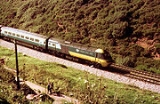
The
InterCity 125 was the brand name of
British RailBritish Railways , which from 1965 traded as British Rail, was the operator of most of the rail transport in Great Britain between 1948 and 1997. It was formed from the nationalisation of the "Big Four" British railway companies and lasted until the gradual privatisation of British Rail, in stages...
's
High Speed Train (
HST) fleet. The InterCity 125 train is made up of two
power carA power car is a railroad vehicle that is closely related to the locomotive. What differentiates the two is their construction or their use. A true locomotive can be physically separated from its train and does nothing but provide propulsion . A power car, on the other hand, is frequently an...
s, one at each end of a fixed formation of
Mark 3British Rail's third design of standard carriage was designated 'Mark 3' , and was developed primarily for the InterCity 125 High Speed Train...
carriages, and is capable of 125 mi/h, making the train the fastest diesel-powered locomotive in regular service in the world. Initially the sets were classified as Classes 253 and 254. A variant of the power cars operates in Australia as part of the XPT.
After three decades, the majority of the HST fleet is still in front-line revenue service under
privatisationThe privatisation of British Rail was set in motion when the Conservative government enacted, on 19 January 1993, the British Coal and British Rail Act 1993 . This enabled the relevant Secretary of State to issue directions to the relevant Board...
, and while the InterCity 125 brand name is rarely mentioned officially by the private
Train Operating CompaniesNational Rail is a title used by the Association of Train Operating Companies as a generic term to define the passenger rail services operated in Great Britain...
(TOCs), the HST still forms the backbone of express services on several British main lines. Most are expected to be replaced within the next 10 years by the
InterCity ExpressThe Intercity Express Programme is an initiative of the Department for Transport in the United Kingdom to procure new trains to replace the InterCity 125 fleet on the East Coast Main Line and Great Western Main Line, as well as replacing other trainsets on long distance services from London to...
(IEP) programme, but a number will continue in use on London to Devon/Cornwall services, where there are no plans to electrify the lines. Engineers from the companies responsible have calculated that, with a certain amount of rewiring, the
BR MkIIIBritish Rail's third design of standard carriage was designated 'Mark 3' , and was developed primarily for the InterCity 125 High Speed Train...
carriages used can be made to last until at least 2035.
Background and design
The appearance of the train is the work of British designer
Kenneth GrangeKenneth Grange, CBE, MCSD, RDI, is a British industrial designer.Grange’s career began as a drafting assistant with the architect Jack Howe in the 1950s...
. Grange was initially approached just to design the livery for the train, but under his own impetus decided to redesign the body working with aerodynamics engineers. He went on to present the new design to British Rail and persuade them to adopt it.
An
InterCity 125 consists of two Class 43 diesel-electric power cars and a set of Mark 3 coaches (typically 7 or 8). Normally there are two types of HST sets, 8+2 (5 standard class, 1 buffet, 2 first class) and 7+2 (4 standard class, 1 buffet, 2 first class), where the +2 refers to the power cars at each end of the rake.
Key features of the design are the high power-to-weight ratio of the locomotives (1678 kW per ~70-tonne loco), which were purpose-built for high-speed passenger travel, improved crashworthiness over previous models, and
bi-directional runningPush–pull is a mode of operation for locomotive-hauled trains allowing them to be driven from either end.A push–pull train has a locomotive at one end of the train, connected via some form of remote control, such as multiple-unit train control, to a vehicle equipped with a control cab at the other...
avoiding the need for a locomotive to run around at terminating stations.
The concept of the HST dates from the late 1960s. British Rail decided to pursue a parallel approach to future express trains. To complement the advanced technology tilting train project
APT-EThe APT-E, for Advanced Passenger Train Experimental, was the prototype Advanced Passenger Train tilting train unit. It was powered by gas turbines, the only multiple unit so powered that was used by British Rail. The APT-E consisted of two driving power cars and two trailer cars...
, being developed by the
Research DivisionThe British Rail Research Division came into being in 1964 directly under the control of the British Railways Board, moving into purpose-built premises at the Railway Technical Centre in Derby. The intention was to improve railway reliability and efficiency, while reducing costs and improving revenue...
in Derby, it was decided in 1970 to build two lightweight 125 mph (201.2 km/h)-capable
Bo-BoA Bo-Bo or Bo′Bo′ is a locomotive with two independent four-wheeled bogies with all axles powered by individual traction motors...
locomotives, to
top and tailA top-and-tail railway train has locomotives at both ends, for ease of changing direction. This is a British term. It is normal for only the leading locomotive to power the train when in top-and-tail mode, cf push pull operation with both locomotives powering.It is properly distinct from a...
a rake of the new 23-metre-long Mark 3 coaches. These trains would be designed by the Chief Mechanical and Electrical Engineer's Department, also in Derby, and were originally intended as a stop-gap until the APT was proven.
The prototype train of seven coaches and two locomotives was completed in August 1972. By the autumn it was running trials on the main line and in May 1973 the prototype, now designated
Class 252Class 252 was the classification allocated to the prototype High Speed Train unit, numbered 252001.-History:When originally built, in 1972, the prototype High Speed Train units were considered to be formed of two locomotives at either end of a rake of carriages...
, set a world diesel speed record of 143.2 mph (230.5 km/h). The concept was proven in trial running between 1973 and 1976, and British Rail decided to build 27 production HSTs to transform InterCity services between London Paddington, Bristol, and South Wales.
Production
The first production power car, numbered 43002, was delivered in late 1975, with a significantly different appearance from the prototype. The streamlined front end lacked conventional buffers, and the drawgear was hidden under a cowling. The single cab window was much larger than the prototype's, and there was no driving position at the inner end.
Deliveries continued through 1976, and in October a partial service of HSTs running at 125 mi/h began on the Western Region. A radical update of the standard BR livery on the power cars was complemented by the 'Inter-City 125' branding, which also appeared on timetables and promotional literature. By the start of the summer timetable in May 1977, the full complement of 27
Class 253Class 253, Class 254 and Class 255 are classifications that have in the past been applied to InterCity 125 high speed trains in Great Britain.-Class 253 and 254:...
sets (253001 – 253027) was in service on the Western Region, completely replacing locomotive-hauled trains on the Bristol and South Wales routes. Passenger volumes on the trains rapidly increased due to the speed and frequency of the service, an effect previously seen only when electric trains had replaced diesel or steam services. The displacement by HSTs of the
British Rail Class 50The British Rail Class 50 is a diesel locomotive built from 1967-68 by English Electric at their Vulcan Foundry Works in Newton-le-Willows. Fifty of these locomotives were built to haul express passenger trains on the, then non-electrified, section of the West Coast Main Line between Crewe,...
locomotives to slower services effectively finished off the last 'Western' diesel-hydraulics
Class 52British Rail assigned Class 52 to the class of 74 large Type 4 diesel-hydraulic locomotives built for the Western Region of British Railways between 1961 and 1964...
by early 1977.
The production of
Class 254 continued through 1977 for
East Coast Main LineThe East Coast Main Line is a long electrified high-speed railway link between London, Peterborough, Doncaster, Wakefield, Leeds, York, Darlington, Newcastle and Edinburgh...
services. Initially, British Rail planned to fit uprated 2500 bhp Valenta engines to these longer HSTs, but this plan was shelved as the intensive running on the Western Region began to result in a high level of engine failures, often due to inadequate cooling; for a while, the WR power cars were derated to 2000 bhp. The
Class 254s began to work important ECML expresses such as the
Flying ScotsmanThe Flying Scotsman is an express passenger train service that has been running between London and Edinburgh—the capitals of England and Scotland respectively—since 1862...
from the summer timetable in May 1978. Within a year they had displaced the Deltics to lesser workings and reduced the London-Edinburgh journey time by up to an hour.
Production of HSTs continued until 1982, allowing them to take over services from London to the West Country, many Cross-Country express trains, and finally the
Midland Main LineThe Midland Main Line is a major railway route in the United Kingdom, part of the British railway system.The present-day line links London St...
. Ninety-five HST sets including 197 Class 43 powercars were built between 1976 and 1982. More Mark 3 trailer cars were built in the 1980s for the Western Region
Class 253s, making them eight-car rakes in common with those used on East Coast and Midland Main Line services. During the 1990s only the Cross-Country sets remained as seven-car rakes, with just one first-class carriage.
The Intercity service overall had become a vast success for
British RailBritish Railways , which from 1965 traded as British Rail, was the operator of most of the rail transport in Great Britain between 1948 and 1997. It was formed from the nationalisation of the "Big Four" British railway companies and lasted until the gradual privatisation of British Rail, in stages...
.
Introduction of units
Until the HST's introduction, the maximum speed of British trains was limited to 100 mph (160 km/h). The HST allowed a 25% increase in service speeds along many lines they operated. British Rail initially used the fleet starting in 1976 on the
Great Western Main LineThe Great Western Main Line is a main line railway in Great Britain that runs westwards from London Paddington station to the west of England and South Wales. The core Great Western Main Line runs from London Paddington to Temple Meads railway station in Bristol. A major branch of the Great...
, on the
East Coast Main LineThe East Coast Main Line is a long electrified high-speed railway link between London, Peterborough, Doncaster, Wakefield, Leeds, York, Darlington, Newcastle and Edinburgh...
, on the Cross Country Route and latterly on the
Midland Main LineThe Midland Main Line is a major railway route in the United Kingdom, part of the British railway system.The present-day line links London St...
, serving destinations such as
LondonLondon is the capital city of :England and the :United Kingdom, the largest metropolitan area in the United Kingdom, and the largest urban zone in the European Union by most measures. Located on the River Thames, London has been a major settlement for two millennia, its history going back to its...
,
BristolBristol is a city, unitary authority area and ceremonial county in South West England, with an estimated population of 433,100 for the unitary authority in 2009, and a surrounding Larger Urban Zone with an estimated 1,070,000 residents in 2007...
,
EdinburghEdinburgh is the capital city of Scotland, the second largest city in Scotland, and the eighth most populous in the United Kingdom. The City of Edinburgh Council governs one of Scotland's 32 local government council areas. The council area includes urban Edinburgh and a rural area...
, as far south as
PenzancePenzance is a town, civil parish, and port in Cornwall, England, in the United Kingdom. It is the most westerly major town in Cornwall and is approximately 75 miles west of Plymouth and 300 miles west-southwest of London...
and as far north as
AberdeenAberdeen is Scotland's third most populous city, one of Scotland's 32 local government council areas and the United Kingdom's 25th most populous city, with an official population estimate of ....
and
InvernessInverness is a city in the Scottish Highlands. It is the administrative centre for the Highland council area, and is regarded as the capital of the Highlands of Scotland...
. Not only did the HST bring considerable improvements in service on the railways, British Rail entered a period of active marketing which accompanied and supported the train's success.
The lighter axle loading allowed the trains to travel faster than conventional services along lines not suited to full-speed running, such as the Edinburgh to Aberdeen line. Known as HST differential speeds, coupled with superior acceleration capability over older locomotives, this allowed substantial cuts in journey times over these lines. The increased speed and rapid acceleration and deceleration of the HST made it ideal for passenger use. The prototype InterCity 125 (power cars 43000 and 43001) set the
world recordDetermination of the fastest rail vehicle in the world varies depending on the definition of "rail".Official absolute world record for conventional train is held by the French TGV...
for diesel traction at 143 mph (230 km/h) on 12 June 1973. An HST also holds the world speed record for a diesel train carrying passengers. On 27 September 1985, a special press run for the launch of a new Tees-Tyne Pullman service from to , formed of a shortened 2+5 set, briefly touched 144 mi/h north of . The
world recordA world record is usually the best global performance ever recorded and verified in a specific skill or sport. The book Guinness World Records collates and publishes notable records of all types, from first and best to worst human achievements, to extremes in the natural world and beyond...
for the fastest diesel-powered train, a speed of 148 mph (238 km/h), was set by an HST on 1 November 1987, while descending Stoke Bank with a test run for a new type of
bogieA bogie is a wheeled wagon or trolley. In mechanics terms, a bogie is a chassis or framework carrying wheels, attached to a vehicle. It can be fixed in place, as on a cargo truck, mounted on a swivel, as on a railway carriage/car or locomotive, or sprung as in the suspension of a caterpillar...
- later to be used under the Mk4 coaches used on the same route.
South West England and South Wales
On Western Region, InterCity 125 trains (designated class 253) were introduced initially for all services from London to
BristolBristol is a city, unitary authority area and ceremonial county in South West England, with an estimated population of 433,100 for the unitary authority in 2009, and a surrounding Larger Urban Zone with an estimated 1,070,000 residents in 2007...
and South Wales, and then extended for most day-time services from London to Devon and Cornwall. Some South Wales servces were extended to , and in West Wales.
The
Class 47The British Rail Class 47, is a class of British railway diesel-electric locomotive that was developed in the 1960s by Brush Traction. A total of 512 Class 47s were built at Crewe Works and Brush's Falcon Works, Loughborough between 1962 and 1968, which made them the most numerous class of British...
locomotives still operated the cross-country services from Cornwall and South Wales to the North-East via the Cross Country Route, as well as London to the Midlands/Welsh Marches. However, Class 43s also replaced these services once the third batch of power cars was delivered. All these HSTs consisted of a 2+8 formation, normally with two first class coaches, a buffet car, and five second class coaches, all sandwiched between two power cars.
Great Western TrainsGreat Western Trains was a UK train company created in the mid 1990s as part of the privatisation of British Rail. It was one of the first two passenger companies to be privatised, passing into private ownership along with South West Trains on 4 February 1996....
was formed out of the privatisation of British Rail and operated the InterCity routes from London Paddington to the west of England. In 1998 FirstGroup acquired Great Western Trains and rebranded it
First Great WesternFirst Great Western is the operating name of First Greater Western Ltd, a British train operating company owned by FirstGroup that serves Greater London, the South East, South West and West Midlands regions of England, and South Wales....
. InterCity 125s continued to work the same diagrams they had under British Rail, albeit in a different livery. Between 2001 and 2009 the HSTs were supplemented by
British Rail Class 180The Class 180 is a type of British diesel multiple unit train built by Alstom between 2000 and 2001 for use on then-new express services by First Great Western . They were built at Washwood Heath in Birmingham and are part of the Coradia 1000 family along with the Class 175. FGW stopped using the...
DMUs, but these have since been returned to the leasing company as they proved less reliable than the older HST.
First Great Western uses its large fleet of 43 HST sets to operate most intercity services from Paddington to
BristolBristol Temple Meads railway station is the oldest and largest railway station in Bristol, England. It is an important transport hub for public transport in Bristol, with bus services to various parts of the city and surrounding districts, and a ferry service to the city centre in addition to the...
,
CardiffCardiff Central railway station is a major railway station on the South Wales Main Line in Cardiff, Wales.It is the largest and busiest station in Wales and one of the major stations of the British rail network, the tenth busiest station in the United Kingdom outside of London , based on 2007/08...
, , , , ,
WorcesterWorcester Shrub Hill railway station is one of two railway stations serving the city of Worcester in Worcestershire, England. It is managed by London Midland, and it is also served by First Great Western....
, , , and , as well as some commuter services to , and . As of 2011 all express services in the South-West region are worked by HSTs with the exception of sleeper services.
From 2005 the First Great Western HSTs were re-engined with MTU power units. At the same time, the coaches were refurbished. Units for services in the M4 corridor/Thames Valley to Bristol, Hereford, Oxford, Exeter and Cardiff were converted into a high-density layout of mostly airline-style seats (only two tables per coach). This was in order to provide more seats for commuters. The remainder (for the routes to Swansea and the West Country) kept the tables.
The refurbished coaches have new seating (leather in first class), at-seat power points and a redesigned buffet bar.
Eastern England / Scotland
On the
East Coast Main LineThe East Coast Main Line is a long electrified high-speed railway link between London, Peterborough, Doncaster, Wakefield, Leeds, York, Darlington, Newcastle and Edinburgh...
, the InterCity 125 designated Class 254 was the staple stock from the retirement of the
Class 55 DelticThe British Rail Class 55 is a class of diesel locomotive built in 1961 and 1962 by English Electric. They were designed for the high-speed express passenger services on the East Coast Main Line between and Edinburgh. They gained the name "Deltic" from the prototype locomotive, DP1 Deltic, which...
locomotives in 1980–1982 to the introduction of the
Intercity 225The InterCity 225 is a locomotive-hauled domestic train in the United Kingdom, comprising a Class 91 electric locomotive, nine Mark 4 coaches and a Driving Van Trailer...
following electrification in 1990. They were concentrated on services from London King's Cross to
NewcastleNewcastle railway station , is the mainline station of the city of Newcastle upon Tyne, England and is a principal stop on the East Coast Main Line. It opened in 1850 and is a Grade I listed building...
and
Edinburgh WaverleyEdinburgh Waverley railway station is the main railway station in the Scottish capital Edinburgh. Covering an area of over 25 acres in the centre of the city, it is the second-largest main line railway station in the United Kingdom in terms of area, the largest being...
with some extending to
Glasgow Queen StreetGlasgow Queen Street is a railway station in Glasgow, Scotland, the smaller of the city's two main line railway termini and the third-busiest station in Scotland. It is between George Street to the south and Cathedral Street Bridge to the north, at the northern end of Queen Street adjacent to...
,
InvernessInverness railway station is the railway station serving the Scottish city of Inverness.- History :Opened on 5 November 1855 as the western terminus of the Inverness and Nairn Railway, it is now the terminus of the Highland Main Line, the Aberdeen-Inverness Line , the Kyle of Lochalsh Line and the...
and
AberdeenAberdeen railway station is the main railway station in Aberdeen, Scotland. It is the busiest railway station in Scotland north of the major cities of Glasgow and Edinburgh.- History :...
. In the months following the Penmanshiel Tunnel collapse in 1979, London to Scotland services ran via the
Tyne Valley LineThe Newcastle and Carlisle Railway, occasionally referred to as the Tyne Valley Line, is a railway line in northern England. The line was built in the 1830s, and links the city of Newcastle upon Tyne in Tyne and Wear with in Cumbria. Formal opening took place on 18 June 1838.The line follows the...
from Newcastle to Carlisle then on to Scotland via the
West Coast Main LineThe West Coast Main Line is the busiest mixed-traffic railway route in Britain, being the country's most important rail backbone in terms of population served. Fast, long-distance inter-city passenger services are provided between London, the West Midlands, the North West, North Wales and the...
. HSTs were also used on some services from London to Leeds,
Bradford Forster SquareBradford Forster Square station is a railway station in Bradford, West Yorkshire, England. The majority of services to/from the station use Class 333 electrified trains operated by Northern Rail, on the Airedale Line to Skipton, the Wharfedale Line to Ilkley and the Leeds-Bradford Line to Leeds.The...
,
CleethorpesCleethorpes railway station is a rail terminus serving the seaside town of Cleethorpes in North East Lincolnshire. The station is operated by First TransPennine Express, and is also served by Northern Rail and East Midlands Trains....
, Hull and
ScarboroughScarborough railway station serves the seaside town of Scarborough in North Yorkshire, England. It lies east of York and is one of the eastern termini on the North TransPennine route operated by First TransPennine Express...
.
The basic East Coast (ECML) formation was originally 2+8, increased to 2+9 in 2002 when extra stock became available. The ECML formation is nominally two first-class coaches, one buffet (with further 1st Class seating) and five (later six) standard-class coaches, sandwiched between the buffet and power cars.
For a few years, formations included a TRUK (trailer restaurant kitchen) and buffet car, many formations being 4xTS, TRUK, Buffet, 2 x TF. Nine trailer car units followed this formation, with the addition of a TS. 'Pullman' services replace a TS with an additional first-class coach.
After privatisation, InterCity sets were operated by GNER, alongside electric
InterCity 225The InterCity 225 is a locomotive-hauled domestic train in the United Kingdom, comprising a Class 91 electric locomotive, nine Mark 4 coaches and a Driving Van Trailer...
units from London to Newcastle and Edinburgh, as well as beyond the electrified sections (or where
British Rail Class 91The British Rail Class 91 is a class of , electric locomotives ordered as a component of the East Coast Main Line modernisation and electrification programme of the late 1980s. The Class 91s were given the auxiliary name of InterCity 225 to indicate their envisaged top speed of...
s cannot operate due to route availability restrictions) such as services to
HullKingston upon Hull , usually referred to as Hull, is a city and unitary authority area in the ceremonial county of the East Riding of Yorkshire, England. It stands on the River Hull at its junction with the Humber estuary, 25 miles inland from the North Sea. Hull has a resident population of...
,
SkiptonSkipton is a market town and civil parish within the Craven district of North Yorkshire, England. It is located along the course of both the Leeds and Liverpool Canal and the River Aire, on the south side of the Yorkshire Dales, northwest of Bradford and west of York...
,
HarrogateHarrogate is a spa town in North Yorkshire, England. The town is a tourist destination and its visitor attractions include its spa waters, RHS Harlow Carr gardens, and Betty's Tea Rooms. From the town one can explore the nearby Yorkshire Dales national park. Harrogate originated in the 17th...
,
InvernessInverness is a city in the Scottish Highlands. It is the administrative centre for the Highland council area, and is regarded as the capital of the Highlands of Scotland...
and
AberdeenAberdeen is Scotland's third most populous city, one of Scotland's 32 local government council areas and the United Kingdom's 25th most populous city, with an official population estimate of ....
.
In January 2007 the first of GNER's 13 refurbished HSTs was unveiled, with the coaches rebuilt to the same 'Mallard' standard as its
InterCity 225The InterCity 225 is a locomotive-hauled domestic train in the United Kingdom, comprising a Class 91 electric locomotive, nine Mark 4 coaches and a Driving Van Trailer...
electric sets with similar seating, lighting, carpets and buffet cars. Members of this fleet which have been refurbished have had '200' added to their original numbers. The power cars were upgraded with
MTU enginesMTU Friedrichshafen GmbH is a manufacturer of commercial internal combustion engines founded by Wilhelm Maybach and his son Karl Maybach in 1909...
. The first of the HST Mallards was in service by spring 2007.
In 2007 the franchise was taken over by
National Express East CoastNational Express East Coast was a train operating company in the United Kingdom, running high speed passenger services on the East Coast Main Line between London and Scotland, as part of the East Coast passenger franchise...
, which continued the re-engining programme begun by GNER, and completed the refurbishment of the fleet in March 2009. Two power cars were transferred to First Great Western early in 2009. The final Mallard-upgraded Mark 3 coaches entered service with NXEC in October 2009.
Following an announcement by the National Express Group that it refused to provide further financial support to its subsidiary National Express East Coast, the NXEC franchise ceased on 13 November 2009, and the operation of the route returned to public ownership. As a result the 13 sets are now operated by Department of Transport operator
East CoastEast Coast is a British train operating company running high-speed passenger services on the East Coast Main Line between London, Yorkshire, the North East and Scotland...
(as of late 2009).
In 2006,
Grand Central Railway obtained six Class 43 power cars to operate its London-Sunderland passenger service via the East Coast Main Line. The service was due to begin in December 2006 although upgrade work to enable the coaching stock (which was formerly used for locomotive-hauled services and has a different electric heating/power supply system) to operate with Class 43 power cars was heavily delayed and therefore pushed the starting date back to 18 December 2007. A basic refurbishment at
DML DevonportHer Majesty's Naval Base Devonport , is one of three operating bases in the United Kingdom for the Royal Navy . HMNB Devonport is located in Devonport, in the west of the city of Plymouth in Devon, England...
, where they had been stored for some time, proved to be inadequate, and subsequently these power cars have had further work done at
LoughboroughThis article is about a British rail-locomotive maker. For the Detroit auto-maker, see Brush Motor Car CompanyBrush Traction is a manufacturer and maintainer of railway locomotives, part of the FKI group , based at Loughborough in Leicestershire, England situated alongside the Midland Main Line.-...
. Grand Central has released the first refreshed set in its new livery.
Midland Region
On London Midland Region, InterCity 125 trains were introduced later than on the other regions. They initially appeared on the former
Midland RailwayThe Midland Railway was a railway company in the United Kingdom from 1844 to 1922, when it became part of the London, Midland and Scottish Railway....
route from
London St. PancrasSt Pancras railway station, also known as London St Pancras and since 2007 as St Pancras International, is a central London railway terminus celebrated for its Victorian architecture. The Grade I listed building stands on Euston Road in St Pancras, London Borough of Camden, between the...
to
SheffieldSheffield is a city and metropolitan borough of South Yorkshire, England. Its name derives from the River Sheaf, which runs through the city. Historically a part of the West Riding of Yorkshire, and with some of its southern suburbs annexed from Derbyshire, the city has grown from its largely...
and
NottinghamNottingham is a city and unitary authority in the East Midlands of England. It is located in the ceremonial county of Nottinghamshire and represents one of eight members of the English Core Cities Group...
. Although they were not permitted to exceed 100 mi/h on any part of the route, they still delivered time savings compared with the loco-hauled trains they replaced.
The
Midland Main LineThe Midland Main Line is a major railway route in the United Kingdom, part of the British railway system.The present-day line links London St...
received a series of speed improvements over the next two decades, until it became possible for HSTs to run at up to 110 mi/h on some sections. An upgrade to the full 125 mi/h was proposed by
British RailBritish Railways , which from 1965 traded as British Rail, was the operator of most of the rail transport in Great Britain between 1948 and 1997. It was formed from the nationalisation of the "Big Four" British railway companies and lasted until the gradual privatisation of British Rail, in stages...
in the early 1990s, but because of privatisation this did not happen.
Most long-distance services on this route have been transferred to new
Class 222 MeridianThe British Rail Class 222 is a diesel-electric multiple unit high-speed train capable of . Twenty-seven units have been built by Bombardier Transportation....
diesel-electric multiple units, although most London services from are still worked by HSTs, along with occasional services to and . Members of this fleet are currently being re-painted at the company’s Neville Hill Depot in Leeds; they have been refurbished with a different power unit to FGW and NXEC sets and are retaining their original numbers.
Midland MainlineMidland Mainline was a British train operating company owned by the National Express Group and based in Derby. It was created after the privatisation of British Rail. Midland Mainline services operated from April 1996 to November 2007....
inherited HSTs from BR after privatisation and operated them on its primary services at up to 110 mph.
43089 also was returned to work on the mainline after being used in an experimental programme conducted by Network Rail and
HitachiHitachi is a multinational corporation specializing in high-technology.Hitachi may also refer to:*Hitachi, Ibaraki, Japan*Hitachi province, former province of Japan*Prince Hitachi and Princess Hitachi, members of the Japanese imperial family...
.
As of 2009, 26 are in service with East Midlands Trains.
Cross Country
Post privatisation the Cross Country Route was operated by
Virgin TrainsVirgin Trains is a train operating company in the United Kingdom. It operates long-distance passenger services on the West Coast Main Line between London, the West Midlands, North West England, North Wales and Scotland...
, who replaced the InterCity 125 trains in the period 2002–2004 with
VoyagerThe Voyager series is a group of express diesel-electric multiple-unit trains built by Bombardier Transportation for service on the UK railway network.-Class 220:...
high-speed
DMUsA diesel multiple unit or DMU is a multiple unit train consisting of multiple carriages powered by one or more on-board diesel engines. They may also be referred to as a railcar or railmotor, depending on country.-Design:...
.
The majority of the former Virgin Cross Country fleet went into storage for several years but a small number moved to
Midland MainlineMidland Mainline was a British train operating company owned by the National Express Group and based in Derby. It was created after the privatisation of British Rail. Midland Mainline services operated from April 1996 to November 2007....
to supplement its fleet.
In the 2007 the franchise passed to
Cross CountryCrossCountry is the brand name of XC Trains Ltd., a British train operating company owned by Arriva...
(an
Arriva TrainsArriva plc is a multinational public transport company owned by Deutsche Bahn and headquartered in Sunderland, United Kingdom. It has bus, coach, train, tram and waterbus operations in 12 countries across Europe, employs more than 47,500 people and services over 1.5 billion passenger journeys each...
subsidiary). Because of overcrowding, Cross Country reintroduced five HSTs to supplement its Voyagers. In late September 2008 Cross Country refurbished its first HST set. The coaches have been refurbished to a similar "Mallard" standard as GNER trains, though their interior is in burgundy and there are fewer tables. They also differ from the East Coast sets by having electronic seat reservations, and the buffet car has been removed, with all catering provided at-seat from a catering base in coach B. Most of the carriages are rebuilt from loco-hauled Mark 3s. The refurbishment was carried out by Wabtec,
Doncaster WorksDoncaster railway works is in the town of Doncaster, South Yorkshire, England.Always referred to as "the Plant", it was established by the Great Northern Railway in 1853, replacing the previous works in Boston and Peterborough...
.
Each set has had a TS removed (now 2 power cars + 7 coaches); four sets are now back in daily use again since December 2010, after only two sets were used in service (three on Mondays and Fridays) for a while in 2010; no explanation was provided for the sudden reduction in fleet usage.
West Coast and North Wales
Virgin Trains HSTs regularly worked out of
London EustonEuston railway station, also known as London Euston, is a central London railway terminus in the London Borough of Camden. It is the sixth busiest rail terminal in London . It is one of 18 railway stations managed by Network Rail, and is the southern terminus of the West Coast Main Line...
and
Birmingham InternationalBirmingham International railway station is located in the borough of Solihull, just east of the city of Birmingham in England.The station is on the Rugby-Birmingham-Stafford Line 14 km east of Birmingham New Street and serves both Birmingham International Airport and the National Exhibition...
to
HolyheadHolyhead railway station serves the town of Holyhead on Holy Island, Anglesey. It is the western terminus of the North Wales Coast Line and is managed by Arriva Trains Wales, although Virgin Trains also serves it....
and
Blackpool NorthBlackpool North railway station is the main railway station serving the seaside resort of Blackpool in Lancashire, England. It is the terminus of the main Blackpool branch line from Preston....
, until they were re-deployed in May 2004.
When the
West Coast Main LineThe West Coast Main Line is the busiest mixed-traffic railway route in Britain, being the country's most important rail backbone in terms of population served. Fast, long-distance inter-city passenger services are provided between London, the West Midlands, the North West, North Wales and the...
was upgraded by
Network RailNetwork Rail is the government-created owner and operator of most of the rail infrastructure in Great Britain .; it is not responsible for railway infrastructure in Northern Ireland...
in the 2000s, it became necessary to operate diversionary routes whilst work was going on. As a result
Midland MainlineMidland Mainline was a British train operating company owned by the National Express Group and based in Derby. It was created after the privatisation of British Rail. Midland Mainline services operated from April 1996 to November 2007....
was asked by the then
Strategic Rail AuthorityIn existence from 2001 to 2006, the Strategic Rail Authority was a non-departmental public body in the United Kingdom set up under the Transport Act 2000 to provide strategic direction for the railway industry....
(SRA) to operate London-to-Manchester services via the Midland Main Line and
Hope Valley LineThe Hope Valley Line is a railway line in England linking Sheffield with Manchester. It was completed in 1894.From Sheffield, trains head down the Midland Main Line to Dore, where the Hope Valley Line branches off to run through the Totley Tunnel .It emerges in the stunning scenery of the Hope...
into while
West Coast Main LineThe West Coast Main Line is the busiest mixed-traffic railway route in Britain, being the country's most important rail backbone in terms of population served. Fast, long-distance inter-city passenger services are provided between London, the West Midlands, the North West, North Wales and the...
renovation works took place. In a temporary operation dubbed
Project Rio, a large percentage of the stored Virgin Cross-Country power cars were overhauled and returned to service in an enlarged Midland Mainline fleet. Ending on 10 September 2004, the
Project Rio fleet was gradually disbanded, with power cars moving to
First Great WesternFirst Great Western is the operating name of First Greater Western Ltd, a British train operating company owned by FirstGroup that serves Greater London, the South East, South West and West Midlands regions of England, and South Wales....
, GNER or
CrossCountryCrossCountry is the brand name of XC Trains Ltd., a British train operating company owned by Arriva...
.
Network Rail
One HST set is in service with
Network RailNetwork Rail is the government-created owner and operator of most of the rail infrastructure in Great Britain .; it is not responsible for railway infrastructure in Northern Ireland...
, painted in departmental yellow, and often referred to as the 'flying banana' (a nickname that was originally applied to the whole class because when first introduced by BR they wore a predominantly yellow livery). The set is the New Measurement Train.
Another single engine, 43089, was used in tests on hybrid battery powered vehicles in collaboration with
HitachiHitachi is a multinational corporation specializing in high-technology.Hitachi may also refer to:*Hitachi, Ibaraki, Japan*Hitachi province, former province of Japan*Prince Hitachi and Princess Hitachi, members of the Japanese imperial family...
. It has since been returned to normal service with East Midlands Trains.
Numbering and formation
When
Crewe WorksCrewe railway works is a British railway engineering facility built in 1840 by the Grand Junction Railway. It is located in the town of Crewe, in the county of Cheshire....
built them, the InterCity 125 units were considered to be
diesel multiple unitA diesel multiple unit or DMU is a multiple unit train consisting of multiple carriages powered by one or more on-board diesel engines. They may also be referred to as a railcar or railmotor, depending on country.-Design:...
s, and were allocated
British Rail Class 253 and
Class 254 for Western and Eastern Region services respectively.
British Rail considered the HST, a fixed formation train with a locomotive at each end, as a multiple unit on introduction, and numbered them as such: 253 xxx (Western Region) and 254 xxx (Eastern and Scottish Regions). However, because two power cars carried the same 'set number', problems arose when, for servicing reasons, different units were used on a train, which would then display a different number at each end. For this reason, British Rail abolished the initial numbering system and all individual power cars became identified as such, using the format 43 xxx - this number was previously carried in small digits in the bodysides, prefixed by a 'W' for Western, 'E' for Eastern or 'Sc' for Scottish to identify the region, thus the power cars were reclassified as
Class 43The British Rail Class 43 is the TOPS classification used for the InterCity 125 High Speed Train power cars, built by BREL from 1975 to 1982....
diesel locomotives.
The vehicle types used to form High Speed Trains are listed below:
| Class |
Image |
Type |
Top speed |
Number |
Built |
Notes |
| mph |
km/h |
Class 43The British Rail Class 43 is the TOPS classification used for the InterCity 125 High Speed Train power cars, built by BREL from 1975 to 1982....
|
 |
Diesel locomotive A diesel locomotive is a type of railroad locomotive in which the prime mover is a diesel engine, a reciprocating engine operating on the Diesel cycle as invented by Dr. Rudolf Diesel...
|
125 |
201 |
197 |
1976–1982 |
2 InterCity 125 power cars, operated in Top and Tail formation. |
Mark 3 CoachBritish Rail's third design of standard carriage was designated 'Mark 3' , and was developed primarily for the InterCity 125 High Speed Train...
|
 |
Passenger A passenger is a term broadly used to describe any person who travels in a vehicle, but bears little or no responsibility for the tasks required for that vehicle to arrive at its destination.... rolling stockRolling stock comprises all the vehicles that move on a railway. It usually includes both powered and unpowered vehicles, for example locomotives, railroad cars, coaches and wagons...
|
125 |
201 |
848 |
1975–1988 |
British Rail's third fundamental design of carriage, developed primarily for the InterCity 125. |
| Carriage number |
| Number Range |
Type |
Notes |
| 400xx |
Trailer Buffet (TRSB) |
Renumbered 404xx in 1983; some converted to 402xx series |
| 403xx |
Trailer Buffet (TRUB) |
All converted to 407xx series (first class) |
| 405xx |
Trailer Kitchen (TRUK) |
All withdrawn and converted for other uses |
| 41xxx |
Trailer First (TF) |
Majority in service, some converted or scrapped |
| 42xxx |
Trailer Second (TS) |
Majority in service, some converted or scrapped |
| 43002-43198 |
Driving Motor (Brake) (DM or DMB) |
Majority in service, three scrapped after accidents These are now classified as British Rail Class 43The British Rail Class 43 is the TOPS classification used for the InterCity 125 High Speed Train power cars, built by BREL from 1975 to 1982....
|
| 44000-44101 |
Trailer Guard Second (TGS) |
Majority in service, some converted |
The 197 power cars produced are numbered 43002-43198. 43001 was applied to the second of the two prototype power cars, while the first of the pair (now preserved at York) became 43000 - unusual because BR
TOPSTotal Operations Processing System, or TOPS, is a computer system for managing the locomotives and rolling stock owned by a rail system...
classification numbered its locomotives from 001 upwards (this was because it was not, at the time, classified as a locomotive).
In 2002,
Class 255 was allocated for the reformation of some HST power cars and trailers into semi-fixed formation trains, to be known as Virgin
Challenger units, for use by
Virgin TrainsVirgin Trains is a train operating company in the United Kingdom. It operates long-distance passenger services on the West Coast Main Line between London, the West Midlands, North West England, North Wales and Scotland...
. These formations would have had power cars sandwiching one Trailer First, a Trailer Buffet, two Trailer Seconds and a Trailer Guard Second. These plans came to naught as the
Strategic Rail AuthorityIn existence from 2001 to 2006, the Strategic Rail Authority was a non-departmental public body in the United Kingdom set up under the Transport Act 2000 to provide strategic direction for the railway industry....
planned to transfer most of the stock to
Midland MainlineMidland Mainline was a British train operating company owned by the National Express Group and based in Derby. It was created after the privatisation of British Rail. Midland Mainline services operated from April 1996 to November 2007....
for its London-Manchester 'Rio' services.
Livery
The original "Inter-City 125" livery was blue and grey, with a yellow front to improve visibility which continued down the side of the power cars.
The second livery had mostly grey power cars with a white band along the middle, yellow underneath the white band, with the InterCity colours (cream, red, white, brown) for the parcel compartment of the power cars and the coaches.
There was brownish-grey, dark grey (almost black) around the windows with a red and white stripe below the windows, and retaining the yellow bands on the power cars. The final variant of this livery saw the yellow side-bands replaced with white and did not feature the British Rail name or logo: it carried the new sector branding
Intercity logoInterCity was introduced by British Rail in 1966 as a brand-name for its long-haul express passenger services ....
in serif type and an image of a flying swallow. This is commonly referred to as "InterCity Swallow" livery, and was applied to other locomotives in the sector.
After the
privatisation of British RailThe privatisation of British Rail was set in motion when the Conservative government enacted, on 19 January 1993, the British Coal and British Rail Act 1993 . This enabled the relevant Secretary of State to issue directions to the relevant Board...
, train operating companies painted the HSTs in their own colour schemes, with some lasting longer than others.
Public reaction
The Intercity service proved an instant hit with the British public. By the early 1980s the HST had caught the travelling public's imagination, thanks in part to a memorable television advertising campaign fronted by
Jimmy SavileSir James Wilson Vincent Savile, OBE, KCSG was an English disc jockey, television presenter and media personality, best known for his BBC television show Jim'll Fix It, and for being the first and last presenter of the long-running BBC music chart show Top of the Pops...
, together with the advertising strap-line "This Is The Age Of The Train". British Rail enjoyed a boom in patronage on the routes operated by the HSTs, and InterCity's profits jumped accordingly, with cross-subsidisation safeguarding the future of rural routes that had been under threat of closure since the
Beeching AxeThe Beeching Axe or the Beeching Cuts are informal names for the British Government's attempt in the 1960s to reduce the cost of running British Railways, the nationalised railway system in the United Kingdom. The name is that of the main author of The Reshaping of British Railways, Dr Richard...
of the 1960s.
One of the results of their introduction was increased house prices on routes served by these trains. Suddenly towns and cites such as
HuntingdonHuntingdon is a market town in Cambridgeshire, England. The town was chartered by King John in 1205. It is the traditional county town of Huntingdonshire, and is currently the seat of the Huntingdonshire district council. It is known as the birthplace in 1599 of Oliver Cromwell.-History:Huntingdon...
,
PeterboroughPeterborough is a cathedral city and unitary authority area in the East of England, with an estimated population of in June 2007. For ceremonial purposes it is in the county of Cambridgeshire. Situated north of London, the city stands on the River Nene which flows into the North Sea...
,
SwindonSwindon is a large town within the borough of Swindon and ceremonial county of Wiltshire, in South West England. It is midway between Bristol, west and Reading, east. London is east...
, and even as far afield as
YorkYork is a walled city, situated at the confluence of the Rivers Ouse and Foss in North Yorkshire, England. The city has a rich heritage and has provided the backdrop to major political events throughout much of its two millennia of existence...
and
BristolBristol is a city, unitary authority area and ceremonial county in South West England, with an estimated population of 433,100 for the unitary authority in 2009, and a surrounding Larger Urban Zone with an estimated 1,070,000 residents in 2007...
, were within commuter distances of London.
The Intercity 125 has become one of the recognised icons of Britain.
International attention
The success of the HST has had significant international impact. This impact is most obvious in Australia, where the HST was used as the base for developing the XPT, in cooperation with British Rail. Foreign press for decades observed and praised the speed and quality of the service. It ranks as the world's second high-speed commercial passenger service, following after Japan's
ShinkansenThe , also known as THE BULLET TRAIN, is a network of high-speed railway lines in Japan operated by four Japan Railways Group companies. Starting with the Tōkaidō Shinkansen in 1964, the network has expanded to currently consist of of lines with maximum speeds of , of Mini-shinkansen with a...
, which first connected
Tokyo, ; officially , is one of the 47 prefectures of Japan. Tokyo is the capital of Japan, the center of the Greater Tokyo Area, and the largest metropolitan area of Japan. It is the seat of the Japanese government and the Imperial Palace, and the home of the Japanese Imperial Family...
and
Osakais a city in the Kansai region of Japan's main island of Honshu, a designated city under the Local Autonomy Law, the capital city of Osaka Prefecture and also the biggest part of Keihanshin area, which is represented by three major cities of Japan, Kyoto, Osaka and Kobe...
on 1 October 1964.
The InterCity 125 was used as a case study for evaluating the potential for a High Speed Rail system in
CaliforniaCalifornia is a state located on the West Coast of the United States. It is by far the most populous U.S. state, and the third-largest by land area...
.
Scale models
There have been many model and toy guises of the IC125. One of the first in the UK was by
Hornby RailwaysHornby Railways is the leading brand of model railway in the United Kingdom. Its roots date back to 1901, when founder Frank Hornby received a patent for his Meccano construction toy. The first clockwork train was produced in 1920. In 1938, Hornby launched its first 00 gauge train...
, which launched its first model version in 1977. This model was supplied with an incorrect length Mk3 coach which was shortened to allow the model to reliably negotiate the smallest radius curves. This was done by removing one of the 8 side windows rather than scaling the whole length. It was later released in InterCity 'Swallow' livery,
First Great WesternGreat Western can refer to:* The Great Western Railway, a United Kingdom railway company nationalised in 1948 and that has since lent its name to:** Great Western Main Line, a principal passenger and freight rail route...
green-and-white,
Midland MainlineMidland Mainline was a British train operating company owned by the National Express Group and based in Derby. It was created after the privatisation of British Rail. Midland Mainline services operated from April 1996 to November 2007....
and
Virgin TrainsVirgin Trains is a train operating company in the United Kingdom. It operates long-distance passenger services on the West Coast Main Line between London, the West Midlands, North West England, North Wales and Scotland...
.
LimaLima S.p.A was a brand of railway models made in Vicenza, Italy, for almost 50 years, from the early 1950s until the company ceased trading in 2004...
released its version of the IC125 in 1982, of which the Mark 3 coaches were correct to the lengths of the real-life coaches and included the Guard's coach. Hornby eventually followed suit in the late-1990s, when its short Mark 3 coaches were replaced by correct scale length ones but omitted the Guard's coach. Hornby released a totally new version of the InterCity 125 power cars in late 2008.
Damaged vehicles and Accidents
Three
Class 43The British Rail Class 43 is the TOPS classification used for the InterCity 125 High Speed Train power cars, built by BREL from 1975 to 1982....
locomotives have been written off in railway accidents, all of which occurred on the
Great Western Main LineThe Great Western Main Line is a main line railway in Great Britain that runs westwards from London Paddington station to the west of England and South Wales. The core Great Western Main Line runs from London Paddington to Temple Meads railway station in Bristol. A major branch of the Great...
. 43011 was destroyed in the
Ladbroke Grove rail crashThe Ladbroke Grove Rail Crash was a rail accident which occurred on 5 October 1999 at Ladbroke Grove, London, England. Thirty-one people were killed and more than 520 injured...
, 43019 was written off after the
Ufton Nervet rail crashThe Ufton Nervet rail crash was a railway accident between a train and car near Ufton Nervet, Berkshire, England that caused seven deaths.-Collision:...
, and 43173 was scrapped after heavy damage in the
Southall rail crashThe Southall rail crash was an accident on the British railway system that occurred on 19 September 1997, on the Great Western Main Line at Southall, west London. Seven people were killed and 139 injured...
. In all cases, the damage was to the leading power car - the trailing end power cars at the other end of the HST set suffered only light or no damage, and were returned to service. At Ladbroke Grove and Ufton Nervet the accidents were ultimately caused by factors not involving the HST sets or their drivers, although the set involved in the Ladbroke Grove crash had a faulty AWS system; however, the Southall accident was the result of the driver of the HST
passing a red signal without stoppingA Signal passed at danger , in British railway terminology, occurs when a train passes a stop signal without authority to do so. It is a term primarily used within the British Railway Industry, although it can be applied worldwide.-Categories of SPAD:...
. In addition, the leading power car of the set had a faulty
Automatic Warning SystemThe Automatic Warning System is a form of limited cab signalling and train protection system introduced in 1956 in the United Kingdom to help train drivers observe and obey signals. It was based on a 1930 system developed by Alfred Ernest Hudd and marketed as the "Strowger-Hudd" system...
which if operational would have alerted the driver to his error and possibly prevented the accident. Following investigation, this system has since been required to be kept operational and switched on for all use of the Intercity 125 fleet.
Re-engining and refurbishment
In 2005, the train leasing company,
Angel TrainsAngel Trains is an English Rolling Stock Operating Company created in 1994 as part of the privatisation of British Rail. It was one of three ROSCOs...
, initiated and led an industry-wide programme to replace the 30-year old
PaxmanPaxman is a major British brand of diesel engines. Ownership has changed on a number of occasions since the company's formation in 1865, and now the brand is owned by MAN SE, as part of MAN Diesel & Turbo. At its peak, the Paxman works covered 23 acres and employed over 2,000 people. Engine...
engines in the HST power cars with new
MTUMTU Friedrichshafen GmbH is a manufacturer of commercial internal combustion engines founded by Wilhelm Maybach and his son Karl Maybach in 1909...
16V 4000 engines. The upgrade, which was part of a £110 million total investment made by Angel Trains on its fleet of high-speed trains, included the re-powering and refurbishment of 54 HST power cars, then on lease to GNER (now
East CoastEast Coast is a British train operating company running high-speed passenger services on the East Coast Main Line between London, Yorkshire, the North East and Scotland...
) (23),
First Great WesternFirst Great Western is the operating name of First Greater Western Ltd, a British train operating company owned by FirstGroup that serves Greater London, the South East, South West and West Midlands regions of England, and South Wales....
(26) and
CrossCountryCrossCountry is the brand name of XC Trains Ltd., a British train operating company owned by Arriva...
(5).
Additionally many operators undertook some sort of reburbishment programme on the Mark 3 carriages in the early 2000s. With the long-term delay and change of direction of the HST2 programme, operators began to refurbish their HST fleets in 2006 - both by remotoring with the more modern MTU4000 diesel generator, and by refurbishing the carriage interiors. It is anticipated that these overhauls will give the HST at least another 10 years in front-line service.
As of January 2011 there are now no remaining Class 43 power cars fitted with Paxman Valenta engines.
Replacements
The first replacement of HSTs occurred from 1988 on the
East Coast Main LineThe East Coast Main Line is a long electrified high-speed railway link between London, Peterborough, Doncaster, Wakefield, Leeds, York, Darlington, Newcastle and Edinburgh...
, with their partial replacement by the
InterCity 225The InterCity 225 is a locomotive-hauled domestic train in the United Kingdom, comprising a Class 91 electric locomotive, nine Mark 4 coaches and a Driving Van Trailer...
when the line to Edinburgh was electrified. Some were retained for services to Aberdeen, Inverness, Skipton, Bradford and Hull.
As the Intercity 125 has become old compared to most stock used in passenger service, it has been recognised that it is near the end of its days. More recently HSTs have been replaced (or augmented) by high-speed DMUs such as the
VoyagerThe Voyager series is a group of express diesel-electric multiple-unit trains built by Bombardier Transportation for service on the UK railway network.-Class 220:...
s and the UK express version of
AlstomAlstom is a large multinational conglomerate which holds interests in the power generation and transport markets. According to the company website, in the years 2010-2011 Alstom had annual sales of over €20.9 billion, and employed more than 85,000 people in 70 countries. Alstom's headquarters are...
's
CoradiaThe Alstom Coradia family range of Inter-city trains and regional trains includes multiple unit diesel or electric as well as double-decker trains that can carry up to 900 passengers. There are a number of variants of this series, used in several countries.-United Kingdom:In the United Kingdom,...
.
These new DMUs have better acceleration than the HST due to a higher power/weight ratio, with greater efficiency and braking performance in addition. However, passengers are often annoyed by the vibrations and the level of noise onboard many DMUs from the underfloor engines, compared to the much quieter Mark 3 coaches.
In 2005 the initial concept of HST2 was rejected by the Government and the rail industry as a like-for-like replacement for the HST fleet. In light of this rejection, in 2006 existing operators turned to refurbishments of the Intercity 125 trains.
Nevertheless, HST2 has been expanded and replaced by the
Intercity Express ProgrammeThe Intercity Express Programme is an initiative of the Department for Transport in the United Kingdom to procure new trains to replace the InterCity 125 fleet on the East Coast Main Line and Great Western Main Line, as well as replacing other trainsets on long distance services from London to...
, with proposals for a joint replacement of both HST and
Intercity 225The InterCity 225 is a locomotive-hauled domestic train in the United Kingdom, comprising a Class 91 electric locomotive, nine Mark 4 coaches and a Driving Van Trailer...
trains. The likely successor to the two Intercity trains is the Hitachi Super Express, which has emerged as the preferred bidder.
In fiction
Pip and Emma from The Railway Series are based on the Class 43 power cars and have appeared in Gordon the High-Speed Engine, Thomas and The Fat Controller's Engines, and Thomas and His Friends. They have not appeared in the TV series.
See also
- Class 43 locomotives
The British Rail Class 43 is the TOPS classification used for the InterCity 125 High Speed Train power cars, built by BREL from 1975 to 1982....
- the power cars sandwiching the Mark 3 coaches on HSTs.
- Mark 3 coaches
British Rail's third design of standard carriage was designated 'Mark 3' , and was developed primarily for the InterCity 125 High Speed Train...
- the coaches sandwiched by the Class 43 power cars on HSTs.
- InterCity 225
The InterCity 225 is a locomotive-hauled domestic train in the United Kingdom, comprising a Class 91 electric locomotive, nine Mark 4 coaches and a Driving Van Trailer...
- XPT - Australian high speed train based on the HST
- Train categories in Europe
Railway companies in Europe assign their trains to different categories or train types depending on their role. Passenger trains may be broadly split into long-distance and local trains; the latter having average journey times of under an hour and a range of less than 50 kilometres. Goods trains...
External links