

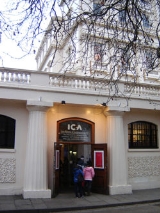
Institute of Contemporary Arts

Encyclopedia
The Institute of Contemporary Arts (ICA) is an artistic
and cultural centre on The Mall
in London
, just off Trafalgar Square
. It is located within Nash House, part of Carlton House Terrace
, near the Duke of York Steps and Admiralty Arch
. It contains galleries, a theatre, two cinemas, a bookshop and a bar.
, Peter Watson
, Herbert Read
, Peter Gregory
, Geoffrey Grigson
and E.L.T. Mesens in 1946. The ICA's founders intended to establish a space where artists, writers and scientists could debate ideas outside the traditional confines of the Royal Academy
. The first exhibitions were held in rented premises organised by Penrose, '40 Years of Modern Art' was followed by '40,000 Years of Modern Art' reflecting his interest in primitivism
.
In the late 1940s, the ICA met in the basement of the Academy of Cinema, 165 Oxford Street. The Academy Cinema building included the Pavilion, a restaurant, and the Marquee ballroom in the basement, the building was owned by George Hoellering the film, jazz and big band promoter http://www.screenonline.org.uk/film/cinemas/sect5.html.
In December 1950, the ICA's first regular premises was opened at 17-18 Dover Street
, with Ewan Phillips being its first director. It was the former residence of Vice Admiral Horatio Nelson. The interior design was by Jane Drew
and Maxwell Fry
, with the collaboration of Eduardo Paolozzi
, Nigel Henderson, Neil Morris and Terence Conran
.
Ewan Phillips left in 1951, and Dorothy Morland was asked to take over temporarily, but stayed there as director for eighteen years, until the move to the more spacious Nash House.
The critic Reyner Banham
acted as assistant Director during the early 1950s, followed by Lawrence Alloway
during the mid to later 1950s. In its early years, the Institute organised exhibitions of modern art including Picasso and Jackson Pollock
. It also launched Pop art
, Op art
, and British Brutalist art and architecture. The Independent Group
met at the ICA in 1952–1962/63 and organised several exhibitions, including This Is Tomorrow
.
With the support of the Arts Council
, the ICA moved to its current site at Nash House in 1968. For a period during the 1970s the Institute was known for its often anarchic programme and administration. Norman Rosenthal
was director of exhibitions at this time, and he was once assaulted by a group of people who were living in the upper floors of the building at the time. A bloodstain on the wall of the administrative offices is preserved under glass, with a note reading "this is Normans's blood". Rosenthal claims the group which assaulted him included the actor Keith Allen.
Bill McAllister was ICA Director from 1977–1990, when the Institute developed a system of separate departments specialising in visual art; cinema; and theatre, music and performance art. A fourth department was devoted to talks and lectures. Press Officer Sandy Broughton was responsible for publicising the ICA in her tenure from 1978 to 1986, and she is credited with raising the profile of the Institute and bringing "a much-needed touch of professionalism to the ICA"
Iwona Blazwick
was Director of Exhibitions from 1986 to 1993.
Mik Flood took over as director of the ICA in 1990 after McAllister's resignation. Flood announced that the Institute would have to leave its Mall location and move to a larger site, a plan which ultimately came to nothing. He also oversaw a sponsorship scheme whereby the electrical goods company Toshiba paid to have their logo included on every piece of ICA publicity for three years, and in effect changed the name of the ICA to ICA/Toshiba. He was replaced as Director in 1997 by Philip Dodd
.
In 2002, the then ICA Chairman Ivan Massow
criticised what he described as 'concept art', leading to his resignation.
The ICA appointed Ekow Eshun
Artistic Director in 2005 following the departure of Philip Dodd. Under Eshun's directorship the Live Arts Department was closed down in 2008, the charge for admission for non members was abandoned (resulting a reduction of membership numbers and a cash shortfall), the Talks Department lost all its personnel, and many commentators argued that the Institute suffered from a lack of direction.
A large financial deficit led to redundancies and resignations of key staff. Art critic JJ Charlesworth saw Eshun’s directorship as a direct cause of the ICA’s ills. He criticized his reliance on private sponsorship, his cultivation of a "cool" ICA brand, and his focus on a cross-disciplinary approach that was put in place "at the cost," Charlesworth wrote, "of a loss of curatorial expertise." Problems between staff and Eshun, sometimes supported by the Chairman of the ICA Board, Alan Yentob
, led to fractious and difficult staff relations. Eshun resigned in August 2010.
The ICA appointed Mark Sladen as Director of Exhibitions in 2007 to replace Jens Hoffmann
who was appointed Director of the Wattis Institute for Contemporary Arts
in 2006. Sladen left the post in 2010.
Alison Myners replaced Alan Yentob as Chair of the ICA Council in October 2010.
The ICA appointed Gregor Muir
as its new Executive Director in January 2011, taking up his post on 7 February 2011.
1952-53: Pop Art is born after a lecture, Bunk!, by Scottish sculptor Eduardo Paolozzi
. Jackson Pollock
features in a show called Opposing Forces.
1957: First UK screening of the French film Hurlements en Faveur de Sade by Guy Debord
, which caused riots when shown in Paris because it mostly featured a black screen and silence.
1966-68: Yoko Ono
contributes to a symposium on the disappearance of the art object.
1968: The inaugural exhibition in the Nash building The Obsessive Image features a waxwork model of a dead hippie by Paul Thek
. The Cybernetic Serendipity
exhibition features computers, pulsing TV screens and a mosaic floor made of coloured lights.
1976: Mary Kelly
exhibits 22 fouled nappy liners captioned with the food that the incumbent baby had consumed. A retrospective of COUM Transmissions
(Genesis P-Orridge and Cosey Fanni Tutti who subsequently formed Throbbing Gristle
) entitled Prostitution
features sanitary towels and explicit photographs.
1986: Helen Chadwick
’s stinking pile of rotting vegetables, Carcass, is removed after complaints from neighbours and a visit by health inspectors.
1989: Gerhard Richter
shows black and white oil paintings of the Baader-Meinhoff gang inspired by contemporary newspaper and police photographs.
1991: Damien Hirst
’s exhibition International Affairs, his first solo exhibition in a public gallery, features glass cases containing items such as a desk, cigarette packets and an ashtray.
1994: A video camera is set up in the men’s toilets, and real-time images of urinating visitors are relayed to a screen in the theatre in a piece by Rosa Sanchez.
1994: The world's first Cybercafe is held in the ICA theatre.
1996: Jake and Dinos Chapman
display Tragic Anatomies, sculptures of children with genitalia in place of facial features, as part of their exhibition Chapman World.
1996: The Onedotzero
digital film festival is hosted at the ICA for the first time.
1997: Four glamour girls, naked from the waist down, mill about the building for a piece by video artist Vanessa Beecroft
.
2000-05: The annual Beck’s Futures prize is set up to celebrate the work of emerging artists.
2005: The George and Dragon pub in E2 is recreated in the name of contemporary art, curated by Gregor Muir, as part of the ICA exhibition London in Six Easy Steps.
2006: The Alien Nation exhibition is presented with inIVA
, exploring the complex relationship between science fiction, race and contemporary art. Among the featured artists are Laylah Ali, Hew Locke
and Yinka Shonibare
.
2008: Over a six-month period, and as part of the ICA's 60th birthday year, the exhibition Nought to Sixty presents 60 emerging artists based in Britain and Ireland.
2010: The first major solo exhibition of cult figure, artist, musician and writer, Billy Childish
, is presented at the ICA.
2011: The ICA hosts Bruderskriegsoundsystem, the latest project from Edwin Burdis, Mark Leckey, Kieron Livingston and Steven Claydon. Pablo Bronstein
's exhibition Sketches for Regency Living takes over all of the ICA building for the first time in its history.
Modernism
Modernism, in its broadest definition, is modern thought, character, or practice. More specifically, the term describes the modernist movement, its set of cultural tendencies and array of associated cultural movements, originally arising from wide-scale and far-reaching changes to Western society...
and cultural centre on The Mall
The Mall (London)
The Mall in central London is the road running from Buckingham Palace at its western end to Admiralty Arch and on to Trafalgar Square at its eastern end. It then crosses Spring Gardens, which was where the Metropolitan Board of Works and, for a number of years, the London County Council were...
in London
London
London is the capital city of :England and the :United Kingdom, the largest metropolitan area in the United Kingdom, and the largest urban zone in the European Union by most measures. Located on the River Thames, London has been a major settlement for two millennia, its history going back to its...
, just off Trafalgar Square
Trafalgar Square
Trafalgar Square is a public space and tourist attraction in central London, England, United Kingdom. At its centre is Nelson's Column, which is guarded by four lion statues at its base. There are a number of statues and sculptures in the square, with one plinth displaying changing pieces of...
. It is located within Nash House, part of Carlton House Terrace
Carlton House Terrace
Carlton House Terrace refers to a street in the St. James's district of the City of Westminster in London, England, and in particular to two terraces of white stucco-faced houses on the south side of the street overlooking St. James's Park. These terraces were built in 1827–32 to overall designs by...
, near the Duke of York Steps and Admiralty Arch
Admiralty Arch
Admiralty Arch is a large office building in London which incorporates an archway providing road and pedestrian access between The Mall, which extends to the South-West, and Trafalgar Square to the North-East. It was designed by Sir Aston Webb, constructed by John Mowlem & Co and completed in 1912...
. It contains galleries, a theatre, two cinemas, a bookshop and a bar.
History
The ICA was founded by Roland PenroseRoland Penrose
Sir Roland Algernon Penrose CBE was an English artist, historian and poet. He was a major promoter and collector of modern art and an associate of the surrealists in the United Kingdom.- Biography :...
, Peter Watson
Peter Watson (arts benefactor)
Victor William Watson was a wealthy English art collector and benefactor. He funded the literary magazine, Horizon, edited by Cyril Connolly.-Life and work:...
, Herbert Read
Herbert Read
Sir Herbert Edward Read, DSO, MC was an English anarchist, poet, and critic of literature and art. He was one of the earliest English writers to take notice of existentialism, and was strongly influenced by proto-existentialist thinker Max Stirner....
, Peter Gregory
Eric Craven Gregory
Eric Craven Gregory, also known as Peter Gregory was a publisher and benefactor of modern art and artists in Britain....
, Geoffrey Grigson
Geoffrey Grigson
Geoffrey Edward Harvey Grigson was a British writer. He was born in Pelynt, a village near Looe in Cornwall.-Life:...
and E.L.T. Mesens in 1946. The ICA's founders intended to establish a space where artists, writers and scientists could debate ideas outside the traditional confines of the Royal Academy
Royal Academy
The Royal Academy of Arts is an art institution based in Burlington House on Piccadilly, London. The Royal Academy of Arts has a unique position in being an independent, privately funded institution led by eminent artists and architects whose purpose is to promote the creation, enjoyment and...
. The first exhibitions were held in rented premises organised by Penrose, '40 Years of Modern Art' was followed by '40,000 Years of Modern Art' reflecting his interest in primitivism
Primitivism
Primitivism is a Western art movement that borrows visual forms from non-Western or prehistoric peoples, such as Paul Gauguin's inclusion of Tahitian motifs in paintings and ceramics...
.
In the late 1940s, the ICA met in the basement of the Academy of Cinema, 165 Oxford Street. The Academy Cinema building included the Pavilion, a restaurant, and the Marquee ballroom in the basement, the building was owned by George Hoellering the film, jazz and big band promoter http://www.screenonline.org.uk/film/cinemas/sect5.html.
In December 1950, the ICA's first regular premises was opened at 17-18 Dover Street
Dover Street
Dover Street is a street in Mayfair, London, England. The street is notable for its Georgian architecture as well as the location of historic London clubs and hotels, which have been frequented by world leaders and historic figures in the arts. It also hosts a number of contemporary art galleries...
, with Ewan Phillips being its first director. It was the former residence of Vice Admiral Horatio Nelson. The interior design was by Jane Drew
Jane Drew
Dame Jane Drew, DBE, FRIBA was an English modernist architect and town planner. She qualified at the AA School in London, and prior to World War II became one of the leading exponents of the Modern Movement in London....
and Maxwell Fry
Maxwell Fry
Edwin Maxwell Fry, CBE, RA, FRIBA, FRTPI, known as Maxwell Fry , was an English modernist architect of the middle and late 20th century, known for his buildings in Britain, Africa and India....
, with the collaboration of Eduardo Paolozzi
Eduardo Paolozzi
Sir Eduardo Luigi Paolozzi, KBE, RA , was a Scottish sculptor and artist. He was a major figure in the international art sphere, while, working on his own interpretation and vision of the world. Paolozzi investigated how we can fit into the modern world to resemble our fragmented civilization...
, Nigel Henderson, Neil Morris and Terence Conran
Terence Conran
Sir Terence Orby Conran, FCSD, is an English designer, restaurateur, retailer and writer.-Early life and education:Terence Conran was born in Kingston upon Thames, the son of Christina Mabel and South African-born Gerard Rupert Conran, a businessman who owned a rubber importation company in East...
.
Ewan Phillips left in 1951, and Dorothy Morland was asked to take over temporarily, but stayed there as director for eighteen years, until the move to the more spacious Nash House.
The critic Reyner Banham
Reyner Banham
Peter Reyner Banham was a prolific architectural critic and writer best known for his 1960 theoretical treatise Theory and Design in the First Machine Age and for his 1971 book Los Angeles: The Architecture of Four Ecologies...
acted as assistant Director during the early 1950s, followed by Lawrence Alloway
Lawrence Alloway
Lawrence Alloway was an English art critic and curator who worked in the United States from the 1960s. In the 1950s he was a leading member of the Independent Group in the UK and in the 1960s was an influential writer and curator in the US...
during the mid to later 1950s. In its early years, the Institute organised exhibitions of modern art including Picasso and Jackson Pollock
Jackson Pollock
Paul Jackson Pollock , known as Jackson Pollock, was an influential American painter and a major figure in the abstract expressionist movement. During his lifetime, Pollock enjoyed considerable fame and notoriety. He was regarded as a mostly reclusive artist. He had a volatile personality, and...
. It also launched Pop art
Pop art
Pop art is an art movement that emerged in the mid 1950s in Britain and in the late 1950s in the United States. Pop art challenged tradition by asserting that an artist's use of the mass-produced visual commodities of popular culture is contiguous with the perspective of fine art...
, Op art
Op art
Op art, also known as optical art, is a style of visual art that makes use of optical illusions."Optical art is a method of painting concerning the interaction between illusion and picture plane, between understanding and seeing." Op art works are abstract, with many of the better known pieces made...
, and British Brutalist art and architecture. The Independent Group
Independent Group
The Independent Group met at the Institute of Contemporary Arts London from 1952-55. The IG consisted of painters, sculptors, architects, writers and critics who wanted to challenge prevailing modernist approaches to culture. They introduced mass culture into debates about high culture,...
met at the ICA in 1952–1962/63 and organised several exhibitions, including This Is Tomorrow
This is Tomorrow
This Is Tomorrow was a seminal art exhibition in August 1956 at the Whitechapel Art Gallery, facilitated by curator Bryan Robertson. The core of the exhibition was the ICA Independent Group.-History:...
.
With the support of the Arts Council
Arts council
An arts council is a government or private, non-profit organization dedicated to promoting the arts mainly by funding local artists, awarding prizes, and organizing events at home and abroad...
, the ICA moved to its current site at Nash House in 1968. For a period during the 1970s the Institute was known for its often anarchic programme and administration. Norman Rosenthal
Norman Rosenthal
Sir Norman Rosenthal is a British curator. He was Exhibitions Secretary at the Royal Academy from 1977 until 2008. His encyclopedic programme of exhibitions which stretched from Egyptian antiquities to recent art production, included the exhibition of Charles Saatchi's collection of contemporary...
was director of exhibitions at this time, and he was once assaulted by a group of people who were living in the upper floors of the building at the time. A bloodstain on the wall of the administrative offices is preserved under glass, with a note reading "this is Normans's blood". Rosenthal claims the group which assaulted him included the actor Keith Allen.
Bill McAllister was ICA Director from 1977–1990, when the Institute developed a system of separate departments specialising in visual art; cinema; and theatre, music and performance art. A fourth department was devoted to talks and lectures. Press Officer Sandy Broughton was responsible for publicising the ICA in her tenure from 1978 to 1986, and she is credited with raising the profile of the Institute and bringing "a much-needed touch of professionalism to the ICA"
Iwona Blazwick
Iwona Blazwick
Iwona Blazwick OBE is director of the Whitechapel Art Gallery in London.-Life and career:Iwona Blazwick was brought up by her architect parents in Blackheath, South East London...
was Director of Exhibitions from 1986 to 1993.
Mik Flood took over as director of the ICA in 1990 after McAllister's resignation. Flood announced that the Institute would have to leave its Mall location and move to a larger site, a plan which ultimately came to nothing. He also oversaw a sponsorship scheme whereby the electrical goods company Toshiba paid to have their logo included on every piece of ICA publicity for three years, and in effect changed the name of the ICA to ICA/Toshiba. He was replaced as Director in 1997 by Philip Dodd
Philip Dodd
Philip Dodd is a British broadcaster, writer and editor. He is chairman of the creative industries company Made in China.-Early career:...
.
In 2002, the then ICA Chairman Ivan Massow
Ivan Massow
Ivan Massow is a British entrepreneur and financial adviser. He founded PayMeMy.com in September 2011; a service which pays back 'trail' commissions - often thousands of pounds a year - to policy-holders themselves, instead of the IFAs who originally set the policies up.Ivan was also Chairman of...
criticised what he described as 'concept art', leading to his resignation.
The ICA appointed Ekow Eshun
Ekow Eshun
Ekow Eshun is a British writer, journalist, and broadcaster. Until November 2010 he was the artistic director of the Institute of Contemporary Arts in London, leaving before the end of his six month notice period. He is a contributor to BBC2's Friday night arts programme Newsnight Review and a...
Artistic Director in 2005 following the departure of Philip Dodd. Under Eshun's directorship the Live Arts Department was closed down in 2008, the charge for admission for non members was abandoned (resulting a reduction of membership numbers and a cash shortfall), the Talks Department lost all its personnel, and many commentators argued that the Institute suffered from a lack of direction.
A large financial deficit led to redundancies and resignations of key staff. Art critic JJ Charlesworth saw Eshun’s directorship as a direct cause of the ICA’s ills. He criticized his reliance on private sponsorship, his cultivation of a "cool" ICA brand, and his focus on a cross-disciplinary approach that was put in place "at the cost," Charlesworth wrote, "of a loss of curatorial expertise." Problems between staff and Eshun, sometimes supported by the Chairman of the ICA Board, Alan Yentob
Alan Yentob
Alan Yentob is a British television executive and presenter who has worked throughout his career at the BBC.-Early life:...
, led to fractious and difficult staff relations. Eshun resigned in August 2010.
The ICA appointed Mark Sladen as Director of Exhibitions in 2007 to replace Jens Hoffmann
Jens Hoffmann
Jens Hoffmann Mesèn is a writer and exhibition organizer. He has organzied exhibitions since 1997 and is currently the Director of the Wattis Institute for Contemporary Arts at the California College of the Arts in San Francisco where he also directs the Capp Street Project artist-in-residence...
who was appointed Director of the Wattis Institute for Contemporary Arts
Wattis Institute for Contemporary Arts
The Wattis Institute for Contemporary Arts is a contemporary art center in San Francisco, California, United States and part of the California College of the Arts....
in 2006. Sladen left the post in 2010.
Alison Myners replaced Alan Yentob as Chair of the ICA Council in October 2010.
The ICA appointed Gregor Muir
Gregor Muir
Gregor Muir is the Executive Director of the Institute of Contemporary Arts in London. He was previously director of one of the branches of the commercial art gallery Hauser & Wirth, in London...
as its new Executive Director in January 2011, taking up his post on 7 February 2011.
Notable exhibitions and events
1948: The UK’s first show of work by Pablo PicassoPablo Picasso
Pablo Diego José Francisco de Paula Juan Nepomuceno María de los Remedios Cipriano de la Santísima Trinidad Ruiz y Picasso known as Pablo Ruiz Picasso was a Spanish expatriate painter, sculptor, printmaker, ceramicist, and stage designer, one of the greatest and most influential artists of the...
1952-53: Pop Art is born after a lecture, Bunk!, by Scottish sculptor Eduardo Paolozzi
Eduardo Paolozzi
Sir Eduardo Luigi Paolozzi, KBE, RA , was a Scottish sculptor and artist. He was a major figure in the international art sphere, while, working on his own interpretation and vision of the world. Paolozzi investigated how we can fit into the modern world to resemble our fragmented civilization...
. Jackson Pollock
Jackson Pollock
Paul Jackson Pollock , known as Jackson Pollock, was an influential American painter and a major figure in the abstract expressionist movement. During his lifetime, Pollock enjoyed considerable fame and notoriety. He was regarded as a mostly reclusive artist. He had a volatile personality, and...
features in a show called Opposing Forces.
1957: First UK screening of the French film Hurlements en Faveur de Sade by Guy Debord
Guy Debord
Guy Ernest Debord was a French Marxist theorist, writer, filmmaker, member of the Letterist International, founder of a Letterist faction, and founding member of the Situationist International . He was also briefly a member of Socialisme ou Barbarie.-Early Life:Guy Debord was born in Paris in 1931...
, which caused riots when shown in Paris because it mostly featured a black screen and silence.
1966-68: Yoko Ono
Yoko Ono
is a Japanese artist, musician, author and peace activist, known for her work in avant-garde art, music and filmmaking as well as her marriage to John Lennon...
contributes to a symposium on the disappearance of the art object.
1968: The inaugural exhibition in the Nash building The Obsessive Image features a waxwork model of a dead hippie by Paul Thek
Paul Thek
Paul Thek was an American painter and, later, sculptor and installation artist. Born in Brooklyn, he studied locally, at the Art Students League and the Pratt Institute. In 1951 he entered the Cooper Union....
. The Cybernetic Serendipity
Cybernetic Serendipity
"Cybernetic Serendipity" was an exhibition of computer art curated by Jasia Reichardt, shown at the Institute of Contemporary Arts, London in 1968, and then touring the United States.-Content:...
exhibition features computers, pulsing TV screens and a mosaic floor made of coloured lights.
1976: Mary Kelly
Mary Kelly
Mary Kelly may refer to:*Mary Jane Kelly , widely believed to be the fifth and final victim of Jack the Ripper*Mary Kelly , Scottish writer*Mary Kelly , American artist and writer...
exhibits 22 fouled nappy liners captioned with the food that the incumbent baby had consumed. A retrospective of COUM Transmissions
COUM Transmissions
COUM Transmissions was a performance art group interested in pushing boundaries, influenced by Dada and the Merry Pranksters.CT was a whimsical, eccentric as well as confrontational band and performance art group, from Hull, Yorkshire – a collective the constants of which were its...
(Genesis P-Orridge and Cosey Fanni Tutti who subsequently formed Throbbing Gristle
Throbbing Gristle
Throbbing Gristle were an English industrial, avant-garde music and visual arts group that evolved from the performance art group COUM Transmissions...
) entitled Prostitution
Prostitution
Prostitution is the act or practice of providing sexual services to another person in return for payment. The person who receives payment for sexual services is called a prostitute and the person who receives such services is known by a multitude of terms, including a "john". Prostitution is one of...
features sanitary towels and explicit photographs.
1986: Helen Chadwick
Helen Chadwick
Helen Chadwick was a British conceptual artist.-Life and work:Chadwick studied at Croydon College of Art, The Faculty of Arts and Architecture Brighton Polytechnic and then at the Chelsea School of Art....
’s stinking pile of rotting vegetables, Carcass, is removed after complaints from neighbours and a visit by health inspectors.
1989: Gerhard Richter
Gerhard Richter
Gerhard Richter is a German visual artist. Richter has simultaneously produced abstract and photorealistic painted works, as well as photographs and glass pieces, thus undermining the concept of the artist’s obligation to maintain a single cohesive style.- Biography :Gerhard Richter was born in...
shows black and white oil paintings of the Baader-Meinhoff gang inspired by contemporary newspaper and police photographs.
1991: Damien Hirst
Damien Hirst
Damien Steven Hirst is an English artist, entrepreneur and art collector. He is the most prominent member of the group known as the Young British Artists , who dominated the art scene in Britain during the 1990s. He is internationally renowned, and is reportedly Britain's richest living artist,...
’s exhibition International Affairs, his first solo exhibition in a public gallery, features glass cases containing items such as a desk, cigarette packets and an ashtray.
1994: A video camera is set up in the men’s toilets, and real-time images of urinating visitors are relayed to a screen in the theatre in a piece by Rosa Sanchez.
1994: The world's first Cybercafe is held in the ICA theatre.
1996: Jake and Dinos Chapman
Jake and Dinos Chapman
Iakovos "Jake" Chapman and Konstantinos "Dinos" Chapman are English visual artists, often known as the Chapman Brothers, who work together as a collaborative sibling duo...
display Tragic Anatomies, sculptures of children with genitalia in place of facial features, as part of their exhibition Chapman World.
1996: The Onedotzero
Onedotzero
onedotzero is a contemporary, digital arts organisation with a remit to promote innovation across all forms of moving image and motion arts....
digital film festival is hosted at the ICA for the first time.
1997: Four glamour girls, naked from the waist down, mill about the building for a piece by video artist Vanessa Beecroft
Vanessa Beecroft
Vanessa Beecroft is an Italian contemporary artist living in Los Angeles.-Artistic practice:Beecroft's work is a fusion of conceptual issues and aesthetic concerns, focusing on large-scale performance art, usually involving live female models...
.
2000-05: The annual Beck’s Futures prize is set up to celebrate the work of emerging artists.
2005: The George and Dragon pub in E2 is recreated in the name of contemporary art, curated by Gregor Muir, as part of the ICA exhibition London in Six Easy Steps.
2006: The Alien Nation exhibition is presented with inIVA
InIVA
Iniva is the Institute of International Visual Art, an arts institution that represents artists, curators and writers. It consists of exhibition spaces and the Stuart Hall Library, and together with Autograph ABP is housed in Rivington Place, a visual arts centre in Shoreditch, in the heart of...
, exploring the complex relationship between science fiction, race and contemporary art. Among the featured artists are Laylah Ali, Hew Locke
Hew Locke
Hew Donald Joseph Locke is a sculptor and contemporary British visual artist based in London.-Background:...
and Yinka Shonibare
Yinka Shonibare
Yinka Shonibare, MBE, is a British-Nigerian artist living in the UK. He readily acknowledges physical disability as part of his identity but creates work in which this is just one strand of a far richer weave.-Life and career:...
.
2008: Over a six-month period, and as part of the ICA's 60th birthday year, the exhibition Nought to Sixty presents 60 emerging artists based in Britain and Ireland.
2010: The first major solo exhibition of cult figure, artist, musician and writer, Billy Childish
Billy Childish
Billy Childish is an English artist, painter, author, poet, photographer, film maker, singer and guitarist...
, is presented at the ICA.
2011: The ICA hosts Bruderskriegsoundsystem, the latest project from Edwin Burdis, Mark Leckey, Kieron Livingston and Steven Claydon. Pablo Bronstein
Pablo Bronstein
Pablo Bronstein is an artist based in London. He attended Central Saint Martins College of Art and Design, at the University of the Arts London, theSlade School of Fine Art, UCL, and graduated from Goldsmiths College of Art....
's exhibition Sketches for Regency Living takes over all of the ICA building for the first time in its history.
See also
- Gregor MuirGregor MuirGregor Muir is the Executive Director of the Institute of Contemporary Arts in London. He was previously director of one of the branches of the commercial art gallery Hauser & Wirth, in London...
, current Executive Director - Ekow EshunEkow EshunEkow Eshun is a British writer, journalist, and broadcaster. Until November 2010 he was the artistic director of the Institute of Contemporary Arts in London, leaving before the end of his six month notice period. He is a contributor to BBC2's Friday night arts programme Newsnight Review and a...
, former Artistic Director - Jens HoffmannJens HoffmannJens Hoffmann Mesèn is a writer and exhibition organizer. He has organzied exhibitions since 1997 and is currently the Director of the Wattis Institute for Contemporary Arts at the California College of the Arts in San Francisco where he also directs the Capp Street Project artist-in-residence...
, former Director of Exhibitions - Norman RosenthalNorman RosenthalSir Norman Rosenthal is a British curator. He was Exhibitions Secretary at the Royal Academy from 1977 until 2008. His encyclopedic programme of exhibitions which stretched from Egyptian antiquities to recent art production, included the exhibition of Charles Saatchi's collection of contemporary...
, former Director of Exhibitions - Alexander "Sandy" Nairne, former Director of Exhibitions
- Johnny SandelsonJohnny SandelsonJohnny Sandelson is a UK businessman, entrepreneur and award-winning real estate developer. He is best known for investing in a number of high profile property ventures. He proposed the 1,000,000 sq. ft...
, former Council member