


Inner Mongolia Museum

Encyclopedia
The Inner Mongolia Museum is a regional
museum
in the city of Hohhot
in Inner Mongolia
, in north China
.
This museum was founded on the occasion of the tenth anniversary of the establishment of the Inner Mongolia Autonomous Region, in 1957. The building, expressive of local minority characteristics, is located at the intersection of Xinhua Dajie and Zhongshan Lu in the heart of Hohhot City, the capital of the autonomous region.
The Museum has over 44,000 objects relating to ethnic history in its collections. Among these quite a few are rare treasures seldom seen in China, especially the artifacts relating to the northern tribes called Xiongnu
, Xianbei
, Qidan
, Mongolians and others.
 The museum in particular offers an insight into the history
and traditions of the Mongolian
people exhibiting paraphernalia used by nomadic Mongols
, including saddles, costumes, archery
and polo
equipment and a ger
(a portable tent used by Central Asian nomads).
One of the important sources of its collections are precious materials excavated from the earth as a result of archaeological research. These materials are of great speciality to the museum. The Inner Mongolia Museum is renowned for its extensive collection of fossils and dinosaur
remains found in both Inner Mongolia
and Outer Mongolia
including a complete skeleton
of a wooly rhinoceros unearthed from a coal mine in Manzhouli
.
The upper floor of the museum is dedicated to the life of Genghis Khan
who in the 13th century united the disparate Mongol tribes and established one of the largest land empires in human history. Many of the maps
and objects on display have English
captions.
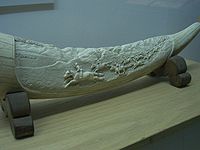
The museum also contains a number of intricate Mongol bone carving
s depicting historical events.
Régional
Régional Compagnie Aérienne Européenne, or Régional for short, is a subsidiary airline wholly owned by Air France which connects hubs at Paris, Lyon, Clermont-Ferrand, and Bordeaux to 49 airports in Europe. The airline operates in Air France livery, retaining its name in small titles and logo on...
museum
Museum
A museum is an institution that cares for a collection of artifacts and other objects of scientific, artistic, cultural, or historical importance and makes them available for public viewing through exhibits that may be permanent or temporary. Most large museums are located in major cities...
in the city of Hohhot
Hohhot
Hohhot , is a city in north-central China and the capital of the Inner Mongolian Autonomous Region, serving as the region's administrative, economic, and cultural centre....
in Inner Mongolia
Inner Mongolia
Inner Mongolia is an autonomous region of the People's Republic of China, located in the northern region of the country. Inner Mongolia shares an international border with the countries of Mongolia and the Russian Federation...
, in north China
North China
thumb|250px|Northern [[People's Republic of China]] region.Northern China or North China is a geographical region of China. The heartland of North China is the North China Plain....
.
This museum was founded on the occasion of the tenth anniversary of the establishment of the Inner Mongolia Autonomous Region, in 1957. The building, expressive of local minority characteristics, is located at the intersection of Xinhua Dajie and Zhongshan Lu in the heart of Hohhot City, the capital of the autonomous region.
The Museum has over 44,000 objects relating to ethnic history in its collections. Among these quite a few are rare treasures seldom seen in China, especially the artifacts relating to the northern tribes called Xiongnu
Xiongnu
The Xiongnu were ancient nomadic-based people that formed a state or confederation north of the agriculture-based empire of the Han Dynasty. Most of the information on the Xiongnu comes from Chinese sources...
, Xianbei
Xianbei
The Xianbei were a significant Mongolic nomadic people residing in Manchuria, Inner Mongolia and eastern Mongolia. The title “Khan” was first used among the Xianbei.-Origins:...
, Qidan
Khitan people
thumb|250px|Khitans [[Eagle hunting|using eagles to hunt]], painted during the Chinese [[Song Dynasty]].The Khitan people , or Khitai, Kitan, or Kidan, were a nomadic Mongolic people, originally located at Mongolia and Manchuria from the 4th century...
, Mongolians and others.
History
History is the discovery, collection, organization, and presentation of information about past events. History can also mean the period of time after writing was invented. Scholars who write about history are called historians...
and traditions of the Mongolian
Mongols
Mongols ) are a Central-East Asian ethnic group that lives mainly in the countries of Mongolia, China, and Russia. In China, ethnic Mongols can be found mainly in the central north region of China such as Inner Mongolia...
people exhibiting paraphernalia used by nomadic Mongols
Mongols
Mongols ) are a Central-East Asian ethnic group that lives mainly in the countries of Mongolia, China, and Russia. In China, ethnic Mongols can be found mainly in the central north region of China such as Inner Mongolia...
, including saddles, costumes, archery
Archery
Archery is the art, practice, or skill of propelling arrows with the use of a bow, from Latin arcus. Archery has historically been used for hunting and combat; in modern times, however, its main use is that of a recreational activity...
and polo
Polo
Polo is a team sport played on horseback in which the objective is to score goals against an opposing team. Sometimes called, "The Sport of Kings", it was highly popularized by the British. Players score by driving a small white plastic or wooden ball into the opposing team's goal using a...
equipment and a ger
Yurt
A yurt is a portable, bent wood-framed dwelling structure traditionally used by Turkic nomads in the steppes of Central Asia. The structure comprises a crown or compression wheel usually steam bent, supported by roof ribs which are bent down at the end where they meet the lattice wall...
(a portable tent used by Central Asian nomads).
One of the important sources of its collections are precious materials excavated from the earth as a result of archaeological research. These materials are of great speciality to the museum. The Inner Mongolia Museum is renowned for its extensive collection of fossils and dinosaur
Dinosaur
Dinosaurs are a diverse group of animals of the clade and superorder Dinosauria. They were the dominant terrestrial vertebrates for over 160 million years, from the late Triassic period until the end of the Cretaceous , when the Cretaceous–Paleogene extinction event led to the extinction of...
remains found in both Inner Mongolia
Inner Mongolia
Inner Mongolia is an autonomous region of the People's Republic of China, located in the northern region of the country. Inner Mongolia shares an international border with the countries of Mongolia and the Russian Federation...
and Outer Mongolia
Outer Mongolia
Outer Mongolia was a territory of the Qing Dynasty = the Manchu Empire. Its area was roughly equivalent to that of the modern state of Mongolia, which is sometimes informally called "Outer Mongolia" today...
including a complete skeleton
Skeleton
The skeleton is the body part that forms the supporting structure of an organism. There are two different skeletal types: the exoskeleton, which is the stable outer shell of an organism, and the endoskeleton, which forms the support structure inside the body.In a figurative sense, skeleton can...
of a wooly rhinoceros unearthed from a coal mine in Manzhouli
Manzhouli
- Administration :Manzhouli is divided into ten subdistricts and one town. Six of the subdistricts of Manzhouli are grouped into a district. Technically however, only a prefecture-level city can have districts, so Manzhouli's lone district is not officially listed.- History :In ancient times the...
.
The upper floor of the museum is dedicated to the life of Genghis Khan
Genghis Khan
Genghis Khan , born Temujin and occasionally known by his temple name Taizu , was the founder and Great Khan of the Mongol Empire, which became the largest contiguous empire in history after his death....
who in the 13th century united the disparate Mongol tribes and established one of the largest land empires in human history. Many of the maps
MAPS
Maps is the plural of map, a visual representation of an area.As an acronym, MAPS may refer to:* Mail Abuse Prevention System, an organisation that provides anti-spam support...
and objects on display have English
English language
English is a West Germanic language that arose in the Anglo-Saxon kingdoms of England and spread into what was to become south-east Scotland under the influence of the Anglian medieval kingdom of Northumbria...
captions.
The museum also contains a number of intricate Mongol bone carving
Bone carving
Bone carving is the act of creating art forms by carving into animal bones and often includes the carving of antlers and horns. It can result in the ornamentation of a bone, or the creation of a figure. It has been practiced by a variety of world cultures, sometimes as a cheaper substitute for...
s depicting historical events.