

Indian summer

Encyclopedia
Autumn
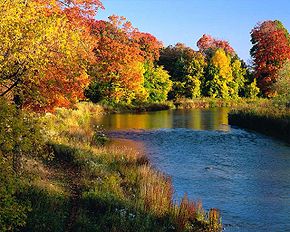
Autumn is one of the four temperate seasons. Autumn marks the transition from summer into winter usually in September or March when the arrival of night becomes noticeably earlier....
. It refers to a period of considerably above normal temperatures, accompanied by dry and hazy conditions, usually after there has been a killing frost. Depending on latitude and elevation, the phenomenon can occur in the Northern Hemisphere
Northern Hemisphere
The Northern Hemisphere is the half of a planet that is north of its equator—the word hemisphere literally means “half sphere”. It is also that half of the celestial sphere north of the celestial equator...
between late September and mid November.
Usage
The modern use of the term is when the weather is sunny and clear, and above 21 °C (70 °F), after there has been a sharp frost; a period normally associated with late-October to mid-November.In some regions of the southwestern United States, 'Indian summer' is colloquially used to describe the hottest times of the year, typically in late July or August. But in the South, as elsewhere in the US, this period is more commonly known as the dog days
Dog Days
"Dog Days" are the hottest, most sultry days of summer. In the Northern Hemisphere, the dog days of summer are most commonly experienced in the months of July and August, which typically observe the warmest summer temperatures. In the Southern Hemisphere, they typically occur in January and...
, in reference to the position of Sirius
Sirius
Sirius is the brightest star in the night sky. With a visual apparent magnitude of −1.46, it is almost twice as bright as Canopus, the next brightest star. The name "Sirius" is derived from the Ancient Greek: Seirios . The star has the Bayer designation Alpha Canis Majoris...
, the 'Dog Star' and brightest star in the sky other than the sun. In the desert southwestern United States, where frost is rare, the term is sometimes used to refer to a brief period of hot dry weather which occurs after the hottest months and before the onset of winter rains, typically in October or November. It may also be used to refer to any unseasonably warm weather during the first few weeks of the rainy season, before the approach of spring.
The term 'Indian summer' is also used metaphorically to refer to a late blooming of something, often unexpectedly, or after it has lost relevance. This is comparable to the use of the term renaissance
Renaissance
The Renaissance was a cultural movement that spanned roughly the 14th to the 17th century, beginning in Italy in the Late Middle Ages and later spreading to the rest of Europe. The term is also used more loosely to refer to the historical era, but since the changes of the Renaissance were not...
in the sense of 'revival', but it carries the added connotation that the revival is temporary. A famous use of the phrase in American literature is Van Wyck Brooks
Van Wyck Brooks
Van Wyck Brooks was an American literary critic, biographer, and historian.- Biography :Brooks was educated at Harvard University and graduated in 1908...
' New England: Indian Summer, a sequel to his Pulitzer Prize
Pulitzer Prize
The Pulitzer Prize is a U.S. award for achievements in newspaper and online journalism, literature and musical composition. It was established by American publisher Joseph Pulitzer and is administered by Columbia University in New York City...
-winning The Flowering of New England.
The etymology of 'Indian summer'
The expression 'Indian summer' has been used for more than two centuries. The earliest known use was by French-American writer John Hector St. John de Crevecoeur in rural New YorkNew York
New York is a state in the Northeastern region of the United States. It is the nation's third most populous state. New York is bordered by New Jersey and Pennsylvania to the south, and by Connecticut, Massachusetts and Vermont to the east...
in 1778: "Then a severe frost succeeds which prepares it to receive the voluminous coat of snow which is soon to follow; though it is often preceded by a short interval of smoke and mildness, called the Indian Summer." There are several theories as to its etymology
Etymology
Etymology is the study of the history of words, their origins, and how their form and meaning have changed over time.For languages with a long written history, etymologists make use of texts in these languages and texts about the languages to gather knowledge about how words were used during...
:
- In Colonial New England and New York, Indian Summer referred only to a January thaw, when American IndianIndigenous peoples of the AmericasThe indigenous peoples of the Americas are the pre-Columbian inhabitants of North and South America, their descendants and other ethnic groups who are identified with those peoples. Indigenous peoples are known in Canada as Aboriginal peoples, and in the United States as Native Americans...
raiding parties could be expected in the western and northern areas: the ground had briefly lost its snow cover so tracking the Native American raiders back to their winter camps was much more difficult for the Colonials. - In The Americans: The Colonial Experience, Daniel J. BoorstinDaniel J. BoorstinDaniel Joseph Boorstin was an American historian, professor, attorney, and writer. He was appointed twelfth Librarian of the United States Congress from 1975 until 1987.- Biography:...
speculates that the term originated from raids on European colonies by American IndianIndigenous peoples of the AmericasThe indigenous peoples of the Americas are the pre-Columbian inhabitants of North and South America, their descendants and other ethnic groups who are identified with those peoples. Indigenous peoples are known in Canada as Aboriginal peoples, and in the United States as Native Americans...
war parties; these raids usually ended in late autumn (due to snow covered ground), hence summer-like weather in the late fall and mid winter was an Indian Summer, a time raiding parties could be expected. - Two other known uses of the term in the 18th century are from accounts kept by two army officers leading retaliation expeditions against Indians for winter raiding parties on settlers in OhioOhioOhio is a Midwestern state in the United States. The 34th largest state by area in the U.S.,it is the 7th‑most populous with over 11.5 million residents, containing several major American cities and seven metropolitan areas with populations of 500,000 or more.The state's capital is Columbus...
and IndianaIndianaIndiana is a US state, admitted to the United States as the 19th on December 11, 1816. It is located in the Midwestern United States and Great Lakes Region. With 6,483,802 residents, the state is ranked 15th in population and 16th in population density. Indiana is ranked 38th in land area and is...
in 1790, and PennsylvaniaPennsylvaniaThe Commonwealth of Pennsylvania is a U.S. state that is located in the Northeastern and Mid-Atlantic regions of the United States. The state borders Delaware and Maryland to the south, West Virginia to the southwest, Ohio to the west, New York and Ontario, Canada, to the north, and New Jersey to...
in 1794. - It may be so named because this was the traditional period during which early American IndiansIndigenous peoples of the AmericasThe indigenous peoples of the Americas are the pre-Columbian inhabitants of North and South America, their descendants and other ethnic groups who are identified with those peoples. Indigenous peoples are known in Canada as Aboriginal peoples, and in the United States as Native Americans...
harvested their crops of squash and cornMaizeMaize known in many English-speaking countries as corn or mielie/mealie, is a grain domesticated by indigenous peoples in Mesoamerica in prehistoric times. The leafy stalk produces ears which contain seeds called kernels. Though technically a grain, maize kernels are used in cooking as a vegetable...
. - In the same way that the expression 'Indian giverIndian giverIndian giver is an expression used mostly by European Americans to describe a person who gives a gift and later wants it back, or something equivalent in return...
' was coined for people who take back presents they have bestowed, the phrase Indian summer may simply have been a way of saying "false summer". (However, some traditions maintain that "Indian giver" refers to the practice of giving gifts at the end of pow-wowPow-wowA pow-wow is a gathering of North America's Native people. The word derives from the Narragansett word powwaw, meaning "spiritual leader". A modern pow-wow is a specific type of event where both Native American and non-Native American people meet to dance, sing, socialize, and honor American...
to honor and support the receiver in living a good life. If the recipient fails to do so, the giver may take back the gift.)
Similar usages in Europe
St. Martin's Day
St. Martin's Day, also known as the Feast of St. Martin, Martinstag or Martinmas, the Feast of St Martin of Tours or Martin le Miséricordieux, is a time for feasting celebrations. This is the time when autumn wheat seeding is completed. Historically, hiring fairs were held where farm laborers...
, November 11, when it was supposed to end.
The phrase 'Saint Martin's Summer' is still widely used in France
France
The French Republic , The French Republic , The French Republic , (commonly known as France , is a unitary semi-presidential republic in Western Europe with several overseas territories and islands located on other continents and in the Indian, Pacific, and Atlantic oceans. Metropolitan France...
, where Saint Martin of Tours died in Candes sur Loire
Loire Valley
The Loire Valley , spanning , is located in the middle stretch of the Loire River in central France. Its area comprises approximately . It is referred to as the Cradle of the French Language, and the Garden of France due to the abundance of vineyards, fruit orchards, and artichoke, asparagus, and...
, now Candes-Saint-Martin
Candes-Saint-Martin
Candes-Saint-Martin is a commune in the Indre-et-Loire department in central France. It overlooks the confluence of the Vienne and Loire rivers from a steep hill on the left bank of the Loire, and marks the boundary between the modern departments of Indre-et-Loire to the east, and Maine-et-Loire...
, on November 8, 397 AD. His corpse was claimed by people of both Poitou
Poitou
Poitou was a province of west-central France whose capital city was Poitiers.The region of Poitou was called Thifalia in the sixth century....
and Touraine
Touraine
The Touraine is one of the traditional provinces of France. Its capital was Tours. During the political reorganization of French territory in 1790, the Touraine was divided between the departments of Indre-et-Loire, :Loir-et-Cher and Indre.-Geography:...
provinces. The latter pilfered him and brought him on a boat by the river Loire
Loire
Loire is an administrative department in the east-central part of France occupying the River Loire's upper reaches.-History:Loire was created in 1793 when after just 3½ years the young Rhône-et-Loire department was split into two. This was a response to counter-Revolutionary activities in Lyon...
to Tours
Tours
Tours is a city in central France, the capital of the Indre-et-Loire department.It is located on the lower reaches of the river Loire, between Orléans and the Atlantic coast. Touraine, the region around Tours, is known for its wines, the alleged perfection of its local spoken French, and for the...
where he was and still is buried. Legend has it that the river banks flowered as his corpse went by from Candes to Tours.
In Italy
Italy
Italy , officially the Italian Republic languages]] under the European Charter for Regional or Minority Languages. In each of these, Italy's official name is as follows:;;;;;;;;), is a unitary parliamentary republic in South-Central Europe. To the north it borders France, Switzerland, Austria and...
, St Martin's summer (Estate di San Martino) was expected and celebrated as a rural tradition with ancient origins, and is marked by a festival throughout the peninsula on November 11. By the ancient agriculture systems of rural tenancy
Rural tenancy
Rural tenancy refers to a type of share-cropping or tenancy arrangement that a landowner can use to make full use of property he may not otherwise be able to develop properly. A "tenant" or non-landowner will take residency on the property of the landowner and work the land in exchange for giving...
and sharecropping
Sharecropping
Sharecropping is a system of agriculture in which a landowner allows a tenant to use the land in return for a share of the crop produced on the land . This should not be confused with a crop fixed rent contract, in which a landowner allows a tenant to use the land in return for a fixed amount of...
the yearly rental of the lands traditionally ended just on November 11, right at the end of the harvesting season, but still before winter. So November 11 is still considered a "moving day" because on that day farmers used to move from land to land. In Spain
Spain
Spain , officially the Kingdom of Spain languages]] under the European Charter for Regional or Minority Languages. In each of these, Spain's official name is as follows:;;;;;;), is a country and member state of the European Union located in southwestern Europe on the Iberian Peninsula...
, an Indian summer is called Veranillo de San Miguel or Veranillo de San Martín, depending when it occurs, St Michael's day (September 29) or St Martin's (November 11). It can also be called Veranillo del Membrillo (little summer of the quince
Quince
The quince , or Cydonia oblonga, is the sole member of the genus Cydonia and native to warm-temperate southwest Asia in the Caucasus region...
). In Galicia (northern Spain
Spain
Spain , officially the Kingdom of Spain languages]] under the European Charter for Regional or Minority Languages. In each of these, Spain's official name is as follows:;;;;;;), is a country and member state of the European Union located in southwestern Europe on the Iberian Peninsula...
), it is called Veraninho de San Martinho, and in Portugal
Portugal
Portugal , officially the Portuguese Republic is a country situated in southwestern Europe on the Iberian Peninsula. Portugal is the westernmost country of Europe, and is bordered by the Atlantic Ocean to the West and South and by Spain to the North and East. The Atlantic archipelagos of the...
"Verão de São Martinho," both of which mean St. Martin's summer. In both, it is celebrated in rural areas with Magostos (Magusto in Portuguese, from Magnus Ustus, Big Fire), a celebration in which bonfires, roasted chestnuts and wine have an important role. Also in the eastern part of Spain
Spain
Spain , officially the Kingdom of Spain languages]] under the European Charter for Regional or Minority Languages. In each of these, Spain's official name is as follows:;;;;;;), is a country and member state of the European Union located in southwestern Europe on the Iberian Peninsula...
, the Catalans have their 'Estiuet de Sant Martí', a celebration of Celtic origins. In British English
British English
British English, or English , is the broad term used to distinguish the forms of the English language used in the United Kingdom from forms used elsewhere...
"St. Martin's Summer" was the most widely used term until the American phrase became better known in the 20th century. In the United Kingdom, the term 'Indian summer' is used loosely for a period of unseasonable warmth and sunshine in late September, October or November. Indian summers in Britain occurred in 1985 and 2011.
In many [Slavic languages|Slavic]]-speaking countries, it is called Old Ladies' Summer: in Russia
Russia
Russia or , officially known as both Russia and the Russian Federation , is a country in northern Eurasia. It is a federal semi-presidential republic, comprising 83 federal subjects...
Babye Leto (Бабье лето), in Poland
Poland
Poland , officially the Republic of Poland , is a country in Central Europe bordered by Germany to the west; the Czech Republic and Slovakia to the south; Ukraine, Belarus and Lithuania to the east; and the Baltic Sea and Kaliningrad Oblast, a Russian exclave, to the north...
Babie Lato, in Ukraine
Ukraine
Ukraine is a country in Eastern Europe. It has an area of 603,628 km², making it the second largest contiguous country on the European continent, after Russia...
Babyne Lito (Бабине літо), in Czech Republic
Czech Republic
The Czech Republic is a landlocked country in Central Europe. The country is bordered by Poland to the northeast, Slovakia to the east, Austria to the south, and Germany to the west and northwest....
Babí léto, in Slovakia
Slovakia
The Slovak Republic is a landlocked state in Central Europe. It has a population of over five million and an area of about . Slovakia is bordered by the Czech Republic and Austria to the west, Poland to the north, Ukraine to the east and Hungary to the south...
Babie leto, in Croatia
Croatia
Croatia , officially the Republic of Croatia , is a unitary democratic parliamentary republic in Europe at the crossroads of the Mitteleuropa, the Balkans, and the Mediterranean. Its capital and largest city is Zagreb. The country is divided into 20 counties and the city of Zagreb. Croatia covers ...
Bablje ljeto and in Slovenia
Slovenia
Slovenia , officially the Republic of Slovenia , is a country in Central and Southeastern Europe touching the Alps and bordering the Mediterranean. Slovenia borders Italy to the west, Croatia to the south and east, Hungary to the northeast, and Austria to the north, and also has a small portion of...
Babje leto.
In Bulgaria
Bulgaria
Bulgaria , officially the Republic of Bulgaria , is a parliamentary democracy within a unitary constitutional republic in Southeast Europe. The country borders Romania to the north, Serbia and Macedonia to the west, Greece and Turkey to the south, as well as the Black Sea to the east...
, the phenomenon is sometimes called "Gypsy Summer" and in some places "Gypsy Christmas" and refers to unseasonably warm weather in late fall, or a warm spell in between cold periods.
In Serbia
Serbia
Serbia , officially the Republic of Serbia , is a landlocked country located at the crossroads of Central and Southeast Europe, covering the southern part of the Carpathian basin and the central part of the Balkans...
it is called Miholjsko leto by the name of the orthodox saint from the 6th century Kiriak Otshelnik known as well as Saint Miholj who is celebrated each year on the same day named by him as Miholjdan – the 12th October. The warm period usually surrounds this date.
In Sweden
Sweden
Sweden , officially the Kingdom of Sweden , is a Nordic country on the Scandinavian Peninsula in Northern Europe. Sweden borders with Norway and Finland and is connected to Denmark by a bridge-tunnel across the Öresund....
it is called "brittsommar", which is derived from Birgitta
Birgitta
Birgitta is the Swedish form of the Irish Gaelic female name Brighid. Brighid was the name of an ancient Celtic goddess, and its English form is Bridget. Birgitta and its alternate form Birgit became common names in Scandinavia because of St. Bridget of Sweden....
and Britta, who have their name day in the Swedish calendar on October 7, when Britt Mass, an official fall open-air market, was held.
In Germany
Germany
Germany , officially the Federal Republic of Germany , is a federal parliamentary republic in Europe. The country consists of 16 states while the capital and largest city is Berlin. Germany covers an area of 357,021 km2 and has a largely temperate seasonal climate...
and Austria
Austria
Austria , officially the Republic of Austria , is a landlocked country of roughly 8.4 million people in Central Europe. It is bordered by the Czech Republic and Germany to the north, Slovakia and Hungary to the east, Slovenia and Italy to the south, and Switzerland and Liechtenstein to the...
, it is called "Altweibersommer", or if referring to mild sunny weather during October in particular, simply "Goldener Oktober" ("Golden October").
In Hungary
Hungary
Hungary , officially the Republic of Hungary , is a landlocked country in Central Europe. It is situated in the Carpathian Basin and is bordered by Slovakia to the north, Ukraine and Romania to the east, Serbia and Croatia to the south, Slovenia to the southwest and Austria to the west. The...
, it's "vénasszonyok nyara" (Old Ladies' Summer or Crone's Summer) because the many white spiders seen at this time of the year have been associated with the norns
Norns
The Norns in Norse mythology are female beings who rule the destiny of gods and men, a kind of dísir comparable to the Fates in classical mythology....
of Norse folklore or medieval witches.
In Flanders
Flanders
Flanders is the community of the Flemings but also one of the institutions in Belgium, and a geographical region located in parts of present-day Belgium, France and the Netherlands. "Flanders" can also refer to the northern part of Belgium that contains Brussels, Bruges, Ghent and Antwerp...
(Belgium
Belgium
Belgium , officially the Kingdom of Belgium, is a federal state in Western Europe. It is a founding member of the European Union and hosts the EU's headquarters, and those of several other major international organisations such as NATO.Belgium is also a member of, or affiliated to, many...
) it is also called "Oudewijvenzomer" (Old Ladies' Summer) or "Trezekeszomer" ("St-Theresa's Summer – St-Theresa's Day being on 15 October).
In the Netherlands
Netherlands
The Netherlands is a constituent country of the Kingdom of the Netherlands, located mainly in North-West Europe and with several islands in the Caribbean. Mainland Netherlands borders the North Sea to the north and west, Belgium to the south, and Germany to the east, and shares maritime borders...
it is sometimes called "oudewijvenzomer" or "sint-michielszomer" ("St. Michael's Summer"), although the term "nazomer" ("late summer") is used more.
In Welsh
Welsh language
Welsh is a member of the Brythonic branch of the Celtic languages spoken natively in Wales, by some along the Welsh border in England, and in Y Wladfa...
, it is known as "Haf Bach Mihangel" or (St.) Michael's Little Summer – St. Michael's Day being on 29 September.
An alternative to St Martin's summer was "Saint Luke's summer", as the saint's feast day is October 18. Another alternative was "All-hallown summer", as All Hallows' (= All Saints') Day is November 1, hence Halloween
Halloween
Hallowe'en , also known as Halloween or All Hallows' Eve, is a yearly holiday observed around the world on October 31, the night before All Saints' Day...
is October 31; the expression is used in Shakespeare's King Henry IV, Part 1
Henry IV, Part 1
Henry IV, Part 1 is a history play by William Shakespeare, believed to have been written no later than 1597. It is the second play in Shakespeare's tetralogy dealing with the successive reigns of Richard II, Henry IV , and Henry V...
, Act 1 Scene 2.
In Lithuania
Lithuania
Lithuania , officially the Republic of Lithuania is a country in Northern Europe, the biggest of the three Baltic states. It is situated along the southeastern shore of the Baltic Sea, whereby to the west lie Sweden and Denmark...
this time is called "Bobų vasara", which translates to "summer of old ladies".
In Latvia
Latvia
Latvia , officially the Republic of Latvia , is a country in the Baltic region of Northern Europe. It is bordered to the north by Estonia , to the south by Lithuania , to the east by the Russian Federation , to the southeast by Belarus and shares maritime borders to the west with Sweden...
this period is called "Atvasara", which translates to "re-summer" or "return/repeat/flashback of summer".
In Turkey
Turkey
Turkey , known officially as the Republic of Turkey , is a Eurasian country located in Western Asia and in East Thrace in Southeastern Europe...
the term "pastırma yazı", meaning Pastırma
Pastirma
Pastirma or bastirma is a highly seasoned, air-dried cured beef in the cuisines of the former Ottoman countries.-Etymology:The name bastirma is from . bastırma is the gerund of the verb bastırmak , which means "to depress, restrain"...
summer is used.
Similar usages in other countries
In ChinaChina
Chinese civilization may refer to:* China for more general discussion of the country.* Chinese culture* Greater China, the transnational community of ethnic Chinese.* History of China* Sinosphere, the area historically affected by Chinese culture...
, this period is called "qiū lǎohǔ" (秋老虎), which literally means 'a tiger in autumn'. In Chinese, it signifies the revival of often fierce, summer-like heat that persists well past the Beginning of Autumn
Liqiu
The traditional East Asian calendars divide a year into 24 solar terms . Lìqiū or Risshū is the 13th solar term. It begins when the Sun reaches the celestial longitude of 135° and ends when it reaches the longitude of 150°. It more often refers in particular to the day when the Sun is exactly at...
(the 13th seasonal division point according to the Chinese calendar, usually falling on the 7th or the 8th of August). This hot weather may persist until well into October or November in the southern regions.
In the south of Brazil
Brazil
Brazil , officially the Federative Republic of Brazil , is the largest country in South America. It is the world's fifth largest country, both by geographical area and by population with over 192 million people...
, a similar phenomenon is called "veranico de maio", a regional term roughly meaning "little summer of May", representing a short span of hot weather that occurs mid-autumn.
Indian Summer can occur in Australia during the months of April and May, where in Sydney weeklong stretches of above average, warm temperatures can occur.
External links
- BBC Website : Indian Summer - Exactly What Is It?
- Indian Summer Article – National Weather Service
- A close look at Indian summer, USA TodayUSA TodayUSA Today is a national American daily newspaper published by the Gannett Company. It was founded by Al Neuharth. The newspaper vies with The Wall Street Journal for the position of having the widest circulation of any newspaper in the United States, something it previously held since 2003...
- Babye Leto – what does it mean?