
See Also

Inclusion-exclusion principle

In combinatorial mathematics Mathematics

Mathematics is the discipline that deals with concepts such as quantity [i], structure [i], space [i] a ... 

, the inclusion-exclusion principle states that if A1, ..., A'n are finite sets, then where |A| denotes the cardinality of the set A. For example, taking n = 2, we get a special case of double counting: in words, we can count the size of the union of sets A and B by adding |A| and |B| and then subtracting the size of their intersection. The name comes from the idea that the principle is based on over-generous inclusion, followed by compensating exclusion.

Discussions

  Discussion Features

   Ask a question about 'Inclusion-exclusion principle'

   Start a new discussion about 'Inclusion-exclusion principle'

   Answer questions about 'Inclusion-exclusion principle'

   'Inclusion-exclusion principle' discussion forum


Encyclopedia

In combinatorial mathematics Mathematics

Mathematics is the discipline that deals with concepts such as quantity [i], structure [i], space [i] a ... 

, the inclusion-exclusion principle states that if A1, ..., An are finite sets, then

where |A| denotes the cardinality of the set A. For example, taking n = 2, we get a special case of double counting: in words, we can count the size of the union of sets A and B by adding |A| and |B| and then subtracting the size of their intersection. The name comes from the idea that the principle is based on over-generous inclusion, followed by compensating exclusion. When n > 2 the exclusion of the pairwise intersections is too severe, and the correct formula is as shown with alternating signs.

This formula is attributed to Abraham de Moivre Abraham de Moivre

Abraham de Moivre was a French [i] mathematician [i] famous for de Moivre's formula [i], whi ... 

; it is sometimes also named for Joseph Sylvester James Joseph Sylvester

James Joseph Sylvester was an English [i] mathematician [i].
... 

 or Henri Poincaré Henri Poincaré

Jules Henri Poincar , generally known as Henri Poincar, was one of France [i]'s greatest mathematician [i]... 

.

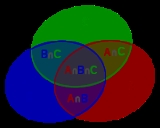
For the case of three sets A, B, C the inclusion-exclusion principle is illustrated in the graphic on the right.

Proof


To prove the inclusion-exclusion principle in general, let X be a superset of all A1, ..., An. The formula follows by first proving the identity

which is shown by manipulating indicator functions, and then summing over all x ? X.

Other forms


The principle is sometimes stated in the form that says that if

then

In that form it is seen to be the Möbius inversion formula for the incidence algebra of the partially ordered set Partially ordered set

In mathematics [i], especially order theory [i], a partially ordered set is a set [i] equipped with a p ... 

 of all subsets of A.

The inclusion-exclusion principle can also be used in probability where it becomes:

According to the Bonferroni inequalities, the sum of the first k terms in the formula is alternately an upper bound and a lower bound for the LHS. This can be used in cases where the full formula is too cumbersome.

Applications


Perhaps the most well-known application of the inclusion-exclusion principle is to the combinatorial problem of counting all derangements of a finite set. A derangement of a set A is a bijection Bijection

In mathematics [i], a function [i] f from a set [i] X to a set Y is said to be b ... 

 from A into itself that has no fixed points. Via the inclusion-exclusion principle one can show that if the cardinality of A is n, then the number of derangements is

where [x] denotes the nearest integer function.

This is also known as the subfactorial of n, written .
It follows that if all bijections are assigned the same probability then the probability that a random bijection is a derangement quickly approaches 1/e as n grows.

In many cases where the principle could give an exact formula , the formula arising doesn't offer useful content because the number of terms in it is excessive. If each term individually can be estimated accurately, the accumulation of errors may imply that the inclusion-exclusion formula isn't directly applicable. In number theory, this difficulty was addressed by Viggo Brun. After a slow start, his ideas were taken up by others, and a large variety of sieve methods developed. These for example may try to find upper bounds for the "sieved" sets, rather than an exact formula.

Counting intersections

The principle of inclusion-exclusion, combined with de Morgan's theorem, can be used to count the intersection of sets as well. Let be some universal set such that for each , and let represent the complement of with respect to . Then we have

thereby turning the problem of finding an intersection into the problem of finding a union.

See also

  • Combinatorial principles
  • Boole's inequality
  • Double counting
  • Necklace problem


Categories:
