


Imperial guardian lions

Encyclopedia
Chinese guardian lions, known as Shishi lions or Imperial guardian lion, and often incorrectly called "Foo Dogs" in the West, are a common representation of the lion
in pre-modern China. They have traditionally stood in front of Chinese
Imperial palaces, Imperial tombs, government offices, temples, and the homes of government officials and the wealthy, from the Han Dynasty
(206 BC
-AD 220
), and were believed to have powerful mythic
protective benefits. Pairs of guardian lions are still common decorative and symbolic elements at the entrances to restaurants, hotels, supermarkets and other structures, with one sitting on each side of the entrance, in China and in other places around the world where the Chinese people have immigrated and settled, especially in local Chinatown
s.
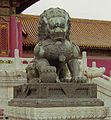
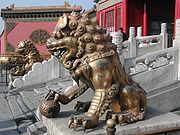 The lions are always created in pairs, with the male resting his paw upon the world and the female restraining a playful cub that is on its back. They occur in many types of Chinese pottery and in Western imitations.
In Asian cultures:
s to the words 佛 (pinyin: fó) or 福 (pinyin: fú), which means "buddha" or "prosperity" in Chinese, respectively. However, Chinese reference to the guardians lion are seldom prefixed with 佛 or 福, and more importantly never referred to as "dogs".
Reference to guardian lions as dogs in Western cultures may be due to the Japanese reference to them as "Korean dogs" (狛犬・高麗犬) due to their transmission from China through Korea into Japan. It may also be due to the misidentification of the guardian lion figures as representing certain Chinese dog breeds such as the Chow Chow
(鬆獅犬, Pinyin: sōngshī quǎn, lit. "puffy-lion dog") or Shih Tzu
(獅子狗; Pinyin: Shīzi Gǒu, lit. "lion dog").
The lions are always presented in pairs, a manifestation of yin and yang
, the female representing yin and the male yang. The male lion has its right front paw on an embroidered ball called a "xiù qiú
" (绣球), which is sometimes carved with a geometric pattern known in the West as the "Flower of life
" The female is essentially identical, but has a cub under the closer (left) paw to the male, representing the cycle of life. Symbolically, the female fu lion protects those dwelling inside, while the male guards the structure. Sometimes the female has her mouth closed, and the male open. This symbolizes the enunciation of the sacred word "om". However, Japanese adaptions state that the male is inhaling, representing life, while the female exhales, representing death. Other styles have both lions with a single large pearl
in each of their partially opened mouths. The pearl is carved so that it can roll about in the lion's mouth but sized just large enough so that it can never be removed.
According to feng shui
, correct placement of the lions is important to ensure their beneficial effect. When looking out of a building through the entrance to be guarded, looking in the same direction as the lions, the male is placed on the left and the female on the right. So when looking at the entrance from outside the building, facing the lions, the male lion with the ball is on the right, and the female with the cub is on the left.
s were once quite common throughout its historic range in Southwest and Central Asia
and are believed to be the ones depicted by the guardian lions in Chinese culture. With increased trade during the Han dynasty
and cultural exchanges through the Silk road
, lions were introduced into China from the ancient states of Central Asia by peoples of Sogdiana
, Samarkand
, and the Yuezhi
(月氏) in the form of pelts and live tribute, along with stories about them from Buddhist priests and travelers of the time. This exchange can be seen in that the Chinese word for lion is "Shi" (師, later 獅/狮), which shares the same etymological roots as "Shiar" (شیر), the Persian language
name for the animal.
Several instances of lions as imperial tributes from Central Asia was recorded in the document Book of the Later Han (後漢書) written from 25-220CE. On one particular event, on the eleventh lunar month of 87 CE, "... an envoy from Parthia
offered as tribute a lion and an ostrich" to the Han court. Indeed the lion was associated by the Han Chinese to earlier venerated creatures of the ancient Chinese, most notably by the monk Huilin (琳说) who stated that "the mythic suanni (狻猊) is actually the lion, coming from the Western Regions
" (狻猊即狮子也,出西域).
The Buddhist version of the Lion was originally introduced to Han China as the protector of dharma
and these lions have been found in religious art as early as 208 BC. Gradually they were incorporated as guardians of the Chinese Imperial dharm. Lions seemed appropriately regal beasts to guard the emperor's gates and have been used as such since. There are various styles of guardian lions reflecting influences from different time periods, imperial dynasties, and regions of China. These styles vary in their artistic detail and adornment as well as in the depiction of the lions from fierce to serene.
Although the form of the Chinese guardian lion was quite varied during its early history in China, the appearance, pose, and accessories of the lions eventually became standardized and formalized during the Ming and Qing dynasties into more or less its present form.
Asiatic Lion
The Asiatic lion also known as the Indian lion, Persian lion and Eurasian Lion is a subspecies of lion. The only place in the wild where the lion is found is in the Gir Forest of Gujarat, India...
in pre-modern China. They have traditionally stood in front of Chinese
China
Chinese civilization may refer to:* China for more general discussion of the country.* Chinese culture* Greater China, the transnational community of ethnic Chinese.* History of China* Sinosphere, the area historically affected by Chinese culture...
Imperial palaces, Imperial tombs, government offices, temples, and the homes of government officials and the wealthy, from the Han Dynasty
Han Dynasty
The Han Dynasty was the second imperial dynasty of China, preceded by the Qin Dynasty and succeeded by the Three Kingdoms . It was founded by the rebel leader Liu Bang, known posthumously as Emperor Gaozu of Han. It was briefly interrupted by the Xin Dynasty of the former regent Wang Mang...
(206 BC
206 BC
Year 206 BC was a year of the pre-Julian Roman calendar. At the time it was known as the Year of the Consulship of Philo and Metellus...
-AD 220
220
Year 220 was a leap year starting on Saturday of the Julian calendar. At the time, it was known as the Year of the Consulship of Antonius and Eutychianus...
), and were believed to have powerful mythic
Chinese mythology
Chinese mythology is a collection of cultural history, folktales, and religions that have been passed down in oral or written tradition. These include creation myths and legends and myths concerning the founding of Chinese culture and the Chinese state...
protective benefits. Pairs of guardian lions are still common decorative and symbolic elements at the entrances to restaurants, hotels, supermarkets and other structures, with one sitting on each side of the entrance, in China and in other places around the world where the Chinese people have immigrated and settled, especially in local Chinatown
Chinatown
A Chinatown is an ethnic enclave of overseas Chinese people, although it is often generalized to include various Southeast Asian people. Chinatowns exist throughout the world, including East Asia, Southeast Asia, the Americas, Australasia, and Europe. Binondo's Chinatown located in Manila,...
s.
Etymology
and less commonly:- Auspicious lion (瑞獅, PinyinPinyinPinyin is the official system to transcribe Chinese characters into the Roman alphabet in China, Malaysia, Singapore and Taiwan. It is also often used to teach Mandarin Chinese and spell Chinese names in foreign publications and used as an input method to enter Chinese characters into...
: Ruìshī): respecting reference to the Tibetan Snow Lion or with context to good fortune - Fortuitous lion (福獅, PinyinPinyinPinyin is the official system to transcribe Chinese characters into the Roman alphabet in China, Malaysia, Singapore and Taiwan. It is also often used to teach Mandarin Chinese and spell Chinese names in foreign publications and used as an input method to enter Chinese characters into...
: fúshī): reference in context to good fortune - Buddha's or Buddhist lion (佛獅, PinyinPinyinPinyin is the official system to transcribe Chinese characters into the Roman alphabet in China, Malaysia, Singapore and Taiwan. It is also often used to teach Mandarin Chinese and spell Chinese names in foreign publications and used as an input method to enter Chinese characters into...
: fóshī): reference in a religious context to the lion as protector of BuddhaBuddhaIn Buddhism, buddhahood is the state of perfect enlightenment attained by a buddha .In Buddhism, the term buddha usually refers to one who has become enlightened...
In Asian cultures:
- In JapanJapanJapan is an island nation in East Asia. Located in the Pacific Ocean, it lies to the east of the Sea of Japan, China, North Korea, South Korea and Russia, stretching from the Sea of Okhotsk in the north to the East China Sea and Taiwan in the south...
: the lion figures are known as KomainuKomainu, often called lion-dogs in English, are statue pairs of lion-like creatures either guarding the entrance or the inner shrine of many Japanese Shinto shrines or kept inside the inner shrine itself, where they are not visible to the public. The first type, born during the Edo period, is called , the...
(狛犬・高麗犬, lit Korea dogs) possibly due to their introduction to Japan through KoreaKoreaKorea ) is an East Asian geographic region that is currently divided into two separate sovereign states — North Korea and South Korea. Located on the Korean Peninsula, Korea is bordered by the People's Republic of China to the northwest, Russia to the northeast, and is separated from Japan to the...
. - In MyanmarMyanmarBurma , officially the Republic of the Union of Myanmar , is a country in Southeast Asia. Burma is bordered by China on the northeast, Laos on the east, Thailand on the southeast, Bangladesh on the west, India on the northwest, the Bay of Bengal to the southwest, and the Andaman Sea on the south....
: called ChintheChintheThe Chinthe is a leogryph that is often seen at the entrances of pagodas and temples in Burma and other Southeast Asian countries. The chinthe is featured prominently on the kyat, the currency of Burma. The chinthe is almost always depicted in pairs, and serve to protect the pagoda...
and gave their name to the World War IIWorld War IIWorld War II, or the Second World War , was a global conflict lasting from 1939 to 1945, involving most of the world's nations—including all of the great powers—eventually forming two opposing military alliances: the Allies and the Axis...
Chindit soldiers. - In Okinawa: similar lion formed statuettes are known as ShisaShisaShisa is a traditional Ryukyuan decoration, often in pairs, resembling a cross between a lion and a dog, from Okinawan mythology. People place pairs of shisa on their rooftops or flanking the gates to their houses. Shisa are wards, believed to protect from some evils...
. - In TibetTibetTibet is a plateau region in Asia, north-east of the Himalayas. It is the traditional homeland of the Tibetan people as well as some other ethnic groups such as Monpas, Qiang, and Lhobas, and is now also inhabited by considerable numbers of Han and Hui people...
: known as a Snow Lion
Western names
In English and several Western languages, the guardian lions are often referred in a multitude of name such as: "Fu Dogs", "Foo Dogs", "Fu Lions", "Fo Lions", and "Lion Dogs". The term "Fo" or "Fu" may be transliterationTransliteration
Transliteration is a subset of the science of hermeneutics. It is a form of translation, and is the practice of converting a text from one script into another...
s to the words 佛 (pinyin: fó) or 福 (pinyin: fú), which means "buddha" or "prosperity" in Chinese, respectively. However, Chinese reference to the guardians lion are seldom prefixed with 佛 or 福, and more importantly never referred to as "dogs".
Reference to guardian lions as dogs in Western cultures may be due to the Japanese reference to them as "Korean dogs" (狛犬・高麗犬) due to their transmission from China through Korea into Japan. It may also be due to the misidentification of the guardian lion figures as representing certain Chinese dog breeds such as the Chow Chow
Chow Chow
Chow chow is a breed of dog that was developed in China, where it is referred to as Songshi Quan , which literally means "puffy-lion dog".- Appearance :...
(鬆獅犬, Pinyin: sōngshī quǎn, lit. "puffy-lion dog") or Shih Tzu
Shih Tzu
The Shih Tzu is a breed of dog weighing with long silky hair. The breed originated in China and is among the earliest breeds. Shih Tzu were officially recognized by the American Kennel Club in 1969...
(獅子狗; Pinyin: Shīzi Gǒu, lit. "lion dog").
Appearance
The lions are traditionally carved from decorative stone, such as marble and granite or cast in bronze or iron. Because of the high cost of these materials and the labor required to produce them, private use of guardian lions was traditionally reserved for wealthy or elite families. Indeed, a traditional symbol of a family's wealth or social status was the placement of guardian lions in front of the family home. However, in modern times less expensive lions, mass produced in concrete and resin, have become available and their use is therefore no longer restricted to the elite.The lions are always presented in pairs, a manifestation of yin and yang
Yin and yang
In Asian philosophy, the concept of yin yang , which is often referred to in the West as "yin and yang", is used to describe how polar opposites or seemingly contrary forces are interconnected and interdependent in the natural world, and how they give rise to each other in turn. Opposites thus only...
, the female representing yin and the male yang. The male lion has its right front paw on an embroidered ball called a "xiù qiú
Temari (toy)
Temari balls are a folk art form that originated in China and was introduced to Japan five or six hundred years ago. "Temari" means "hand ball" in Japanese. Embroidered balls may be used in hand ball games.-History:...
" (绣球), which is sometimes carved with a geometric pattern known in the West as the "Flower of life
Flower of Life
The Flower of Life is the modern name given to a geometrical figure composed of multiple evenly-spaced, overlapping circles. They are arranged to form a flower-like pattern with a sixfold symmetry, similar to a hexagon...
" The female is essentially identical, but has a cub under the closer (left) paw to the male, representing the cycle of life. Symbolically, the female fu lion protects those dwelling inside, while the male guards the structure. Sometimes the female has her mouth closed, and the male open. This symbolizes the enunciation of the sacred word "om". However, Japanese adaptions state that the male is inhaling, representing life, while the female exhales, representing death. Other styles have both lions with a single large pearl
Pearl
A pearl is a hard object produced within the soft tissue of a living shelled mollusk. Just like the shell of a mollusk, a pearl is made up of calcium carbonate in minute crystalline form, which has been deposited in concentric layers. The ideal pearl is perfectly round and smooth, but many other...
in each of their partially opened mouths. The pearl is carved so that it can roll about in the lion's mouth but sized just large enough so that it can never be removed.
According to feng shui
Feng shui
Feng shui ' is a Chinese system of geomancy believed to use the laws of both Heaven and Earth to help one improve life by receiving positive qi. The original designation for the discipline is Kan Yu ....
, correct placement of the lions is important to ensure their beneficial effect. When looking out of a building through the entrance to be guarded, looking in the same direction as the lions, the male is placed on the left and the female on the right. So when looking at the entrance from outside the building, facing the lions, the male lion with the ball is on the right, and the female with the cub is on the left.
History
The Asiatic lionAsiatic Lion
The Asiatic lion also known as the Indian lion, Persian lion and Eurasian Lion is a subspecies of lion. The only place in the wild where the lion is found is in the Gir Forest of Gujarat, India...
s were once quite common throughout its historic range in Southwest and Central Asia
Central Asia
Central Asia is a core region of the Asian continent from the Caspian Sea in the west, China in the east, Afghanistan in the south, and Russia in the north...
and are believed to be the ones depicted by the guardian lions in Chinese culture. With increased trade during the Han dynasty
Han Dynasty
The Han Dynasty was the second imperial dynasty of China, preceded by the Qin Dynasty and succeeded by the Three Kingdoms . It was founded by the rebel leader Liu Bang, known posthumously as Emperor Gaozu of Han. It was briefly interrupted by the Xin Dynasty of the former regent Wang Mang...
and cultural exchanges through the Silk road
Silk Road
The Silk Road or Silk Route refers to a historical network of interlinking trade routes across the Afro-Eurasian landmass that connected East, South, and Western Asia with the Mediterranean and European world, as well as parts of North and East Africa...
, lions were introduced into China from the ancient states of Central Asia by peoples of Sogdiana
Sogdiana
Sogdiana or Sogdia was the ancient civilization of an Iranian people and a province of the Achaemenid Empire, eighteenth in the list on the Behistun Inscription of Darius the Great . Sogdiana is "listed" as the second of the "good lands and countries" that Ahura Mazda created...
, Samarkand
Samarkand
Although a Persian-speaking region, it was not united politically with Iran most of the times between the disintegration of the Seleucid Empire and the Arab conquest . In the 6th century it was within the domain of the Turkic kingdom of the Göktürks.At the start of the 8th century Samarkand came...
, and the Yuezhi
Yuezhi
The Yuezhi, or Rouzhi , also known as the Da Yuezhi or Da Rouzhi , were an ancient Central Asian people....
(月氏) in the form of pelts and live tribute, along with stories about them from Buddhist priests and travelers of the time. This exchange can be seen in that the Chinese word for lion is "Shi" (師, later 獅/狮), which shares the same etymological roots as "Shiar" (شیر), the Persian language
Persian language
Persian is an Iranian language within the Indo-Iranian branch of the Indo-European languages. It is primarily spoken in Iran, Afghanistan, Tajikistan and countries which historically came under Persian influence...
name for the animal.
Several instances of lions as imperial tributes from Central Asia was recorded in the document Book of the Later Han (後漢書) written from 25-220CE. On one particular event, on the eleventh lunar month of 87 CE, "... an envoy from Parthia
Parthia
Parthia is a region of north-eastern Iran, best known for having been the political and cultural base of the Arsacid dynasty, rulers of the Parthian Empire....
offered as tribute a lion and an ostrich" to the Han court. Indeed the lion was associated by the Han Chinese to earlier venerated creatures of the ancient Chinese, most notably by the monk Huilin (琳说) who stated that "the mythic suanni (狻猊) is actually the lion, coming from the Western Regions
Western Regions
The Western Regions or Xiyu was a historical name specified in the Chinese chronicles between the 3rd century BC to 8th century AD that referred to the regions west of Jade Gate, most often Central Asia or sometimes more specifically the easternmost portion of it The Western Regions or Xiyu was a...
" (狻猊即狮子也,出西域).
The Buddhist version of the Lion was originally introduced to Han China as the protector of dharma
Dharma
Dharma means Law or Natural Law and is a concept of central importance in Indian philosophy and religion. In the context of Hinduism, it refers to one's personal obligations, calling and duties, and a Hindu's dharma is affected by the person's age, caste, class, occupation, and gender...
and these lions have been found in religious art as early as 208 BC. Gradually they were incorporated as guardians of the Chinese Imperial dharm. Lions seemed appropriately regal beasts to guard the emperor's gates and have been used as such since. There are various styles of guardian lions reflecting influences from different time periods, imperial dynasties, and regions of China. These styles vary in their artistic detail and adornment as well as in the depiction of the lions from fierce to serene.
Although the form of the Chinese guardian lion was quite varied during its early history in China, the appearance, pose, and accessories of the lions eventually became standardized and formalized during the Ming and Qing dynasties into more or less its present form.
Literary References
- In the novelet "White Magic" by Albert E. Cowdrey (Magazine of Fantasy & Science Fiction, March 1998), the protaganist has a "foo" lion/dog that serves as his "familiar" and comes alive, when necessary, to protect him and his neighbors.
- Within the planned spinoffs of the comics based on the GargoylesGargoyles (TV series)Gargoyles is an American animated series created by Greg Weisman. It was produced by Greg Weisman and Frank Paur and aired from October 24, 1994 to February 15, 1997. Gargoyles is known for its dark tone, complex story arcs and melodrama...
Disney TV animated series, the "timedancing"Time travelTime travel is the concept of moving between different points in time in a manner analogous to moving between different points in space. Time travel could hypothetically involve moving backward in time to a moment earlier than the starting point, or forward to the future of that point without the...
gargoyle Brooklyn receives a green-skinned, leonine gargoyle beast that is named "fu-dog" from the Western name of the guardian lion statuary. - Stone lions feature in a well-known Chinese tongue-twister: sì shì sì, shí shì shí, shí sì shì shí sì, sì shí shì sì shí, sì shí sì zhī shí shī zǐ shì sǐ de. (4 is 4, 10 is 10, 14 is 14, 40 is 40, 44 stone lions are dead.)
See also
- Lion dog, dog breeds originating in China that resemble "Chinese guardian lions" and hence are also called Foo or Fu Dogs or Lion Dogs.
- Culture of ChinaCulture of ChinaChinese culture is one of the world's oldest and most complex. The area in which the culture is dominant covers a large geographical region in eastern Asia with customs and traditions varying greatly between towns, cities and provinces...
- Chinese dragonChinese dragonChinese dragons are legendary creatures in Chinese mythology and folklore, with mythic counterparts among Japanese, Korean, Vietnamese, Bhutanese, Western and Turkic dragons. In Chinese art, dragons are typically portrayed as long, scaled, serpentine creatures with four legs...
- Door godDoor godA door god is a Chinese decoration placed on each side of an entry to a temple, home, business, etc., which is believed to keep evil spirits from entering....
- Lion danceLion danceLion dance is a form of traditional dance in Chinese culture, in which performers mimic a lion's movements in a lion costume. The lion dance is often mistakenly referred to as dragon dance. An easy way to tell the difference is that a lion is operated by two people, while a dragon needs many people...
, another use of lion imagery in costume and motion. - ShisaShisaShisa is a traditional Ryukyuan decoration, often in pairs, resembling a cross between a lion and a dog, from Okinawan mythology. People place pairs of shisa on their rooftops or flanking the gates to their houses. Shisa are wards, believed to protect from some evils...
similar lion statues on the islands of Okinawa, Japan - NianNianAccording to Chinese mythology, a Nian is a beast that lives under the sea or in the mountains. Once each spring, on or around Chinese New Year, it comes out of hiding to attack people, and prefers children. Weaknesses of the Nian are purported to be a sensitivity to loud noises, and a fear of the...
to compare with a similar but horned (unicorn) mythical beast - PixiuPixiuPixiu or Pi Yao originally known as Pi Xie is a Chinese mythical hybrid creature considered to be a very powerful protector to practitioners of Feng Shui. It resembles a winged lion. Pixiu is an earth and sea variation, particularly an influential and auspicious creature for wealth...
to compare with a similar but winged mythical beast - HaetaeHaetaeXiezhi or Haetae is a legendary creature in both Korean and Chinese myths. According to Korean and Chinese records, an animal with a horn in the center of its head lived in the frontier areas of Manchuria....
to compare with similar lion-like statues in Korea - KomainuKomainu, often called lion-dogs in English, are statue pairs of lion-like creatures either guarding the entrance or the inner shrine of many Japanese Shinto shrines or kept inside the inner shrine itself, where they are not visible to the public. The first type, born during the Edo period, is called , the...
to compare its use in Japanese culture - Chinese mythologyChinese mythologyChinese mythology is a collection of cultural history, folktales, and religions that have been passed down in oral or written tradition. These include creation myths and legends and myths concerning the founding of Chinese culture and the Chinese state...
- Asiatic lionAsiatic LionThe Asiatic lion also known as the Indian lion, Persian lion and Eurasian Lion is a subspecies of lion. The only place in the wild where the lion is found is in the Gir Forest of Gujarat, India...
s found in nearby IndiaIndiaIndia , officially the Republic of India , is a country in South Asia. It is the seventh-largest country by geographical area, the second-most populous country with over 1.2 billion people, and the most populous democracy in the world...
are the ones depicted in the Chinese culture. - Tibetan Snow Lion
- Traditional Chinese Lions (Indianapolis Zoo)Traditional Chinese Lions (Indianapolis Zoo)Traditional Chinese Lions, is a public artwork located at the entrance to the Indianapolis Zoo, which is near downtown Indianapolis, Indiana, United States. The sculpture is made up of two traditional Chinese lions made of white marble situated on white marble bases. Each lion is approximately...
- Medici lionsMedici lionsThe Medici lions are two lion sculptures placed around 1600 at the Villa Medici, Rome, Italy, and since 1789 displayed at the Loggia dei Lanzi, Florence. The sculptures depict standing male lions with a sphere under one claw, looking to the side...
External links
- World heritage immersive panorama In this immersive panorama from the Imperial Palace Museum, Beijing, your viewpoint will be near a large bronze lion, the female whose male counterpart's image is in the gallery above, at the Gate of Supreme HarmonyGate of Supreme HarmonyThe Gate of Supreme Harmony , is the second major gate at the southern side of the Forbidden City.The gate was originally built during the Ming Dynasty, when it was called Fengtianmen . Following the Qing conquest of China, the gate was given its present Chinese and Manchu name.It is flanked by two...
. - A webpage with pictures of a variety of Chinese stone lions.