

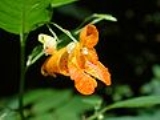
Impatiens capensis

Encyclopedia
Impatiens capensis, the Orange Jewelweed, Common Jewelweed, Spotted Jewelweed, Spotted Touch-me-not, or Orange Balsam, is an annual plant
native to North America
. It is common in bottomland soils, ditches, and along creeks, often growing side-by-side with its less common relative, Yellow Jewelweed (I. pallida).
The flowers are orange with a three-lobed corolla; one of the calyx lobes is colored similarly to the corolla and forms a hooked conical spur at the back of the flower. Plants may also produce non-showy cleistogamous flowers, which do not require cross-pollination. The stems are somewhat translucent, succulent, and have swollen or darkened nodes. The seed pods are pendant and have projectile
seeds that explode out of the pods when they are lightly touched, if ripe, which is where the name 'touch-me-not' comes from. The leaves appear to be silver or 'jeweled' when held underwater, which is possibly where the jewelweed name comes from. Along with other species of jewelweed it is a traditional remedy for skin rashes, although controlled studies have not shown efficacy for this purpose.
The species name "capensis", meaning "of the cape", is actually a misnomer, as Nicolaas Meerburgh was under the mistaken impression that it was native to the Cape of Good Hope
, in southern Africa
.
Impatiens capensis was transported in the 19th and 20th centuries to England, France, the Netherlands, Poland, Sweden, Finland, and potentially other areas of northern and central Europe. These naturalized populations persist in the absence of any common cultivation by people. This jewelweed species is quite similar to Impatiens noli-tangere, an Impatiens species native to Europe and Asia, as well as the other North American Impatiens. No evidence exists of natural hybrids, although the habitats occupied by the two species are very similar.
Plant
Plants are living organisms belonging to the kingdom Plantae. Precise definitions of the kingdom vary, but as the term is used here, plants include familiar organisms such as trees, flowers, herbs, bushes, grasses, vines, ferns, mosses, and green algae. The group is also called green plants or...
native to North America
North America
North America is a continent wholly within the Northern Hemisphere and almost wholly within the Western Hemisphere. It is also considered a northern subcontinent of the Americas...
. It is common in bottomland soils, ditches, and along creeks, often growing side-by-side with its less common relative, Yellow Jewelweed (I. pallida).
The flowers are orange with a three-lobed corolla; one of the calyx lobes is colored similarly to the corolla and forms a hooked conical spur at the back of the flower. Plants may also produce non-showy cleistogamous flowers, which do not require cross-pollination. The stems are somewhat translucent, succulent, and have swollen or darkened nodes. The seed pods are pendant and have projectile
Projectile use by living systems
Although projectiles are commonly used in human conflict, projectile use by living systems other than humans is relatively rare.-Liquid projectiles:...
seeds that explode out of the pods when they are lightly touched, if ripe, which is where the name 'touch-me-not' comes from. The leaves appear to be silver or 'jeweled' when held underwater, which is possibly where the jewelweed name comes from. Along with other species of jewelweed it is a traditional remedy for skin rashes, although controlled studies have not shown efficacy for this purpose.
The species name "capensis", meaning "of the cape", is actually a misnomer, as Nicolaas Meerburgh was under the mistaken impression that it was native to the Cape of Good Hope
Cape of Good Hope
The Cape of Good Hope is a rocky headland on the Atlantic coast of the Cape Peninsula, South Africa.There is a misconception that the Cape of Good Hope is the southern tip of Africa, because it was once believed to be the dividing point between the Atlantic and Indian Oceans. In fact, the...
, in southern Africa
Africa
Africa is the world's second largest and second most populous continent, after Asia. At about 30.2 million km² including adjacent islands, it covers 6% of the Earth's total surface area and 20.4% of the total land area...
.
Impatiens capensis was transported in the 19th and 20th centuries to England, France, the Netherlands, Poland, Sweden, Finland, and potentially other areas of northern and central Europe. These naturalized populations persist in the absence of any common cultivation by people. This jewelweed species is quite similar to Impatiens noli-tangere, an Impatiens species native to Europe and Asia, as well as the other North American Impatiens. No evidence exists of natural hybrids, although the habitats occupied by the two species are very similar.