


Ilya Yefimovich Repin

Encyclopedia
Ilya Yefimovich Repin is a unitary parliamentary republic in South-Central Europe. To the north it borders France, Switzerland, Austria and...
and lived in Paris
Paris
Paris is the capital and largest city in France, situated on the river Seine, in northern France, at the heart of the Île-de-France region...
, where he was exposed to French Impressionist painting, which had a lasting effect upon his use of light and colour. His style was to remain closer to that of the old European masters, especially Rembrandt, and he never embraced Impressionism.
Throughout his career, Repin was drawn to the common people from whom he traced his origins. He frequently painted country folk, both Ukrainian and Russian, though in later years he also painted members of the Imperial Russian elite, the intelligentsia
Intelligentsia
The intelligentsia is a social class of people engaged in complex, mental and creative labor directed to the development and dissemination of culture, encompassing intellectuals and social groups close to them...
, and the aristocracy, including Tsar Nicholas II.
The Itinerants
In 1878, Repin joined the free-thinking "Association of Peredvizhniki Artists", generally called "the Wanderers" or "The Itinerants" in English. About the time of his arrival in the capital, a core group of students rebelled against the academic formalism of the Imperial Academy. Repin's fame was established by his painting of the Barge Haulers on the VolgaBarge Haulers on the Volga
Barge Haulers on the Volga or Burlaki is a 1870–1873 oil-on-canvas painting by the Russian realist painter and sculptor Ilya Repin. The work depicts 11 labouring men dragging a barge on the Volga River...
, a work which portrayed the hard lot of the poor folk. From 1882 he lived in Saint Petersburg but visited his Ukrainian homeland and on occasion made tours abroad.

Historical and contemporary subjects
Beginning shortly before the assassination of Tsar Alexander II in 1881, Repin painted a series of pictures dealing with the theme of the Russian revolutionary movement: Refusal to Confess, Arrest of a Propagandist, The Meeting, and They Did Not Expect Him. The last is considered his masterpiece on the subject, mixing contrasting psychological moods and Russian and Ukrainian national motifs. His large-scale Religious Procession in the Province of KurskKursk
Kursk is a city and the administrative center of Kursk Oblast, Russia, located at the confluence of the Kur, Tuskar, and Seym Rivers. The area around Kursk was site of a turning point in the Russian-German struggle during World War II and the site of the largest tank battle in history...
is sometimes considered an archetype of the "Russian national style," as it displays various social classes and the tensions among them, set within the context of a traditional religious practice and united by a slow but relentless forward movement.
In 1885, Repin completed one of his most psychologically intense paintings, Ivan the Terrible and his Son. This canvas displayed a horrified Ivan embracing his dying son, whom he had just struck and mortally wounded in an uncontrolled fit of rage. The terrified face of Ivan is in marked contrast with that of his calm, almost Christlike son.
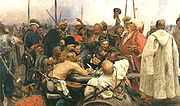
Reply of the Zaporozhian Cossacks
Reply of the Zaporozhian Cossacks to Sultan Mehmed IV of the Ottoman Empire, also known as Cossacks of Saporog Are Drafting a Manifesto , is a painting by Russian artist Ilya Repin. The 2.03 m by 3.58 m canvas was started in 1880 and finished in 1891. Repin recorded the years of work along the...
occupied him for more than a decade. He conceived this painting as a study in laughter, but also believed that it involved the ideals of liberty, equality, and fraternity. He wanted to portray Cossack
Cossack
Cossacks are a group of predominantly East Slavic people who originally were members of democratic, semi-military communities in what is today Ukraine and Southern Russia inhabiting sparsely populated areas and islands in the lower Dnieper and Don basins and who played an important role in the...
republicanism, in this particular case, Ukrainian Cossack
Cossack
Cossacks are a group of predominantly East Slavic people who originally were members of democratic, semi-military communities in what is today Ukraine and Southern Russia inhabiting sparsely populated areas and islands in the lower Dnieper and Don basins and who played an important role in the...
republicanism. Begun in the late 1870s, he completed it in 1891, when it was immediately purchased by the Tsar for 35,000 roubles
Russian ruble
The ruble or rouble is the currency of the Russian Federation and the two partially recognized republics of Abkhazia and South Ossetia. Formerly, the ruble was also the currency of the Russian Empire and the Soviet Union prior to their breakups. Belarus and Transnistria also use currencies with...
, an enormous amount at the time.
During his maturity, Repin painted many of his most celebrated compatriots, including the novelist Leo Tolstoy
Leo Tolstoy
Lev Nikolayevich Tolstoy was a Russian writer who primarily wrote novels and short stories. Later in life, he also wrote plays and essays. His two most famous works, the novels War and Peace and Anna Karenina, are acknowledged as two of the greatest novels of all time and a pinnacle of realist...
, the court photographer Rafail Levitsky
Rafail Levitsky
Rafail Sergeevich Levitsky was a Russian genre, romantic, and impressionist artist who was an active participant in the Peredvizhniki Movement....
, the scientist Dmitri Mendeleev
Dmitri Mendeleev
Dmitri Ivanovich Mendeleev , was a Russian chemist and inventor. He is credited as being the creator of the first version of the periodic table of elements...
, the imperial official Konstantin Pobedonostsev
Konstantin Pobedonostsev
Konstantin Petrovich Pobyedonostsyev was a Russian jurist, statesman, and adviser to three Tsars...
, the composer Modest Mussorgsky
Modest Mussorgsky
Modest Petrovich Mussorgsky was a Russian composer, one of the group known as 'The Five'. He was an innovator of Russian music in the romantic period...
, the cellist Aleksandr Verzhbilovich
Aleksandr Verzhbilovich
Aleksandr Valerianovich Verzhbilovich was a Russian classical cellist of Polish descent.His name also appears as Verzhbilovic, Verzhibilovic, Vierzbilovich, Wierzbillowicz, Wierzbiłłowicz, Wierzbilovich, Wierzbilovicz, and Wierzbilowicz...
, the philanthropist Pavel Tretyakov
Pavel Tretyakov
Pavel Mikhaylovich Tretyakov was a Russian businessman, patron of art, collector, and philanthropist who gave his name to the Tretyakov Gallery and Tretyakov Drive in Moscow. His brother S.M. Tretyakov was also a famous patron of art and a philanthropist....
, and the Ukrainian
Ukrainians
Ukrainians are an East Slavic ethnic group native to Ukraine, which is the sixth-largest nation in Europe. The Constitution of Ukraine applies the term 'Ukrainians' to all its citizens...
poet and painter, Taras Shevchenko
Taras Shevchenko
Taras Hryhorovych Shevchenko -Life:Born into a serf family of Hryhoriy Ivanovych Shevchenko and Kateryna Yakymivna Shevchenko in the village of Moryntsi, of Kiev Governorate of the Russian Empire Shevchenko was orphaned at the age of eleven...
.
In 1903, he was commissioned by the Russian government to paint a 400x877 cm canvas, representing a ceremonial session of the State Council of Imperial Russia
State Council of Imperial Russia
The State Council was the supreme state advisory body to the Tsar in Imperial Russia.-18th century:Early Tsars' Councils were small and dealt primarily with the external politics....
.
Later life

Grand Duchy of Finland
The Grand Duchy of Finland was the predecessor state of modern Finland. It existed 1809–1917 as part of the Russian Empire and was ruled by the Russian czar as Grand Prince.- History :...
. After the 1917 October Revolution
October Revolution
The October Revolution , also known as the Great October Socialist Revolution , Red October, the October Uprising or the Bolshevik Revolution, was a political revolution and a part of the Russian Revolution of 1917...
, Finland
Finland
Finland , officially the Republic of Finland, is a Nordic country situated in the Fennoscandian region of Northern Europe. It is bordered by Sweden in the west, Norway in the north and Russia in the east, while Estonia lies to its south across the Gulf of Finland.Around 5.4 million people reside...
declared independence. He was invited by various Soviet institutions to return to Russia but refused, saying that he was too old to make the journey. During this period, Repin devoted much time to painting religious subjects, though his treatment of these was usually innovative and not traditional. With the exception of a portrait of Provisional Government head, Alexander Kerensky
Alexander Kerensky
Alexander Fyodorovich Kerensky was a major political leader before and during the Russian Revolutions of 1917.Kerensky served as the second Prime Minister of the Russian Provisional Government until Vladimir Lenin was elected by the All-Russian Congress of Soviets following the October Revolution...
, he never painted anything substantial on the subject of the 1917 revolutions or the Soviet experiment that followed. His last painting, a joyous and exuberant canvas called The Hopak, was on a Ukrainian Cossack theme.
In 1930, he died in Kuokkala, Finland
Finland
Finland , officially the Republic of Finland, is a Nordic country situated in the Fennoscandian region of Northern Europe. It is bordered by Sweden in the west, Norway in the north and Russia in the east, while Estonia lies to its south across the Gulf of Finland.Around 5.4 million people reside...
. After the Continuation War
Continuation War
The Continuation War was the second of two wars fought between Finland and the Soviet Union during World War II.At the time of the war, the Finnish side used the name to make clear its perceived relationship to the preceding Winter War...
, Finland ceded Kuokkala to the Soviet Union, which renamed it Repino (Leningrad Oblast
Leningrad Oblast
Leningrad Oblast is a federal subject of Russia . It was established on August 1, 1927, although it was not until 1946 that the oblast's borders had been mostly settled in their present position...
). Penaty is part of the World Heritage Site
World Heritage Site
A UNESCO World Heritage Site is a place that is listed by the UNESCO as of special cultural or physical significance...
Saint Petersburg and Related Groups of Monuments. In 1940, Penaty was opened for the public as a house museum.
Legacy
Alexander GlazunovAlexander Glazunov
Alexander Konstantinovich Glazunov was a Russian composer of the late Russian Romantic period, music teacher and conductor...
's Oriental Rhapsody, Op. 29 (1889) is dedicated to Ilya Repin.
The world record price for a painting by Repin is £4.5 million ($7.2 million) at Christie’s for A Parisian Cafe .
He is in the highest category "1 - an artist of the world fame, tested with time (for no less than a century)" in "United Artists Rating
United Artists Rating
“United Art Rating” — rating, published since 1999 by Artists Trade Union of Russia; one of instruments of art market regulations.- About :“United Art Rating” is published as a periodical reference book, registered as mass media.XVII edition of the reference book includes the names, dates of life...
".
External links
- IlyaRepin.org 102 works by Ilya Repin
- Ilya Repin at Olga's Gallery
- Repin's paintings at The Russian Art Gallery
- Repin "Zdrawneva" Manor House-Museum in Ruba, Bielarus.
- Repin "Penaty" Estate in Repino/Kuokkala, Russia, currently a museum
- Repin House and Memorial Museum in Chuhuyiv, Ukraine.
- Ilya Yefimovich Repin on postage stamps