
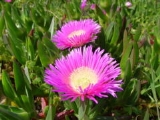
Carpobrotus edulis is a creeping, mat-forming succulent species and member of the Stone Plant family
AizoaceaeThe Family Aizoaceae or Ficoidaceae is a taxon of dicotyledonous flowering plants containing 135 genera and about 1900 species. They are commonly known as stone plants or carpet weeds. Species that resemble stones or pebbles are sometimes called mesems...
, one of about 30 species in the genus
CarpobrotusCarpobrotus is a genus of ground-creeping plants, with succulent leaves and large daisy-like flowers. The name refers to the edible fruits. It comes from the Greek "karpos" and "brota" ....
. It is also known as
Ice PlantCarpobrotus edulis is a creeping, mat-forming succulent species and member of the Stone Plant family Aizoaceae, one of about 30 species in the genus Carpobrotus. It is also known as Ice Plant, Highway Ice Plant, Pigface or Hottentot Fig and in South Africa as the Sour Fig, on account of its edible...
,
Highway Ice Plant,
Pigface or
Hottentot Fig and in
South AfricaThe Republic of South Africa is a country located at the southern tip of Africa, with a coastline on the Atlantic and Indian Oceans. To the north lie Namibia, Botswana and Zimbabwe, to the east are Mozambique and Swaziland, while Lesotho is an independent country surrounded by South Africa.Modern...
as the
Sour Fig, on account of its edible fruit. It was previously classified in
genusIn biology, a genus is a taxonomic unit used in the classification of living and fossil organisms. The term comes from Latin genus "descent, family, type, gender" , cognate with – genos, "race, stock, kin" ..In addition, genus is a taxonomic rank in the hierarchy In biology, a genus (plural:...
MesembryanthemumMesembryanthemum is a genus of plants native to southern Africa. Many species which were formerly placed herein have since been moved into other genera such as Carpobrotus Sceletium is sometimes included here....
and is sometimes referred to by this name.
Carpobrotus edulis is a creeping, mat-forming succulent species and member of the Stone Plant family
AizoaceaeThe Family Aizoaceae or Ficoidaceae is a taxon of dicotyledonous flowering plants containing 135 genera and about 1900 species. They are commonly known as stone plants or carpet weeds. Species that resemble stones or pebbles are sometimes called mesems...
, one of about 30 species in the genus
CarpobrotusCarpobrotus is a genus of ground-creeping plants, with succulent leaves and large daisy-like flowers. The name refers to the edible fruits. It comes from the Greek "karpos" and "brota" ....
. It is also known as
Ice PlantCarpobrotus edulis is a creeping, mat-forming succulent species and member of the Stone Plant family Aizoaceae, one of about 30 species in the genus Carpobrotus. It is also known as Ice Plant, Highway Ice Plant, Pigface or Hottentot Fig and in South Africa as the Sour Fig, on account of its edible...
,
Highway Ice Plant,
Pigface or
Hottentot Fig and in
South AfricaThe Republic of South Africa is a country located at the southern tip of Africa, with a coastline on the Atlantic and Indian Oceans. To the north lie Namibia, Botswana and Zimbabwe, to the east are Mozambique and Swaziland, while Lesotho is an independent country surrounded by South Africa.Modern...
as the
Sour Fig, on account of its edible fruit. It was previously classified in
genusIn biology, a genus is a taxonomic unit used in the classification of living and fossil organisms. The term comes from Latin genus "descent, family, type, gender" , cognate with – genos, "race, stock, kin" ..In addition, genus is a taxonomic rank in the hierarchy In biology, a genus (plural:...
MesembryanthemumMesembryanthemum is a genus of plants native to southern Africa. Many species which were formerly placed herein have since been moved into other genera such as Carpobrotus Sceletium is sometimes included here....
and is sometimes referred to by this name. The species is native to South Africa but is naturalised in many other regions throughout the world.
Carpobrotus edulis is easily confused with its close relative, the more diminutive and less aggressive
Carpobrotus chilensisCarpobrotus chilensis is a species of succulent plant known by the common name sea fig. It is probably native to southern Africa but is familiar elsewhere, particularly the coastline of western North America, where it is an invasive introduced species that has taken hold and become commonplace. It...
(sea fig), and the two species hybridize readily throughout their ranges in California. The large 2.5 to 6 inch diameter flowers of
C. edulis are yellow or light pink, whereas the smaller, 1.5 to 2.5 inch diameter
C. chilensis flowers are deep magenta.
Invasiveness
In several parts of the world, notably
AustraliaAustralia , officially the Commonwealth of Australia, is a country in the Southern Hemisphere comprising the continental mainland , the island of Tasmania, and numerous smaller islands in the Indian and Pacific Oceans...
,
CaliforniaCalifornia is the most populous state in the United States, and the third largest by area. California is the second most populous sub-national entity in the Americas, behind only São Paulo, Brazil...
and the Mediterranean, all of which share a similar climate, the Ice Plant has escaped from cultivation and has become an
invasive species'Invasive species' is a phrase with several definitions. The first definition expresses the phrase in terms of non-indigenous species that adversely affect the habitats they invade economically, environmentally or ecologically...
. The Ice Plant poses a serious ecological problem, forming vast monospecific zones, lowering
biodiversityBiodiversity is the variation of life forms within a given ecosystem, biome, or for the entire Earth. Biodiversity is often used as a measure of the health of biological systems...
, and competing directly with several threatened or endangered plant species for nutrients, water, light, and space (State Resources Agency 1990).
United States
In the early 1900s
C. edulis was brought to California from South Africa to stabilize soil along railroad tracks and was later put to use by Caltrans for similar purposes. Thousands of acres were planted in California until the 1970s. It easily spreads by seed (hundreds per
fruitThe term fruit has different meanings dependent on context, and the term is not synonymous in food preparation and biology. Fruits are the means by which flowering plants disseminate seeds, and the presence of seeds indicates that a structure is most likely a fruit, though not all seeds come from...
) and from segmentation (any shoot segment can produce roots). Its succulent foliage, bright magenta or yellow
flowerA flower, sometimes known as a bloom or blossom, is the reproductive structure found in flowering plants . The biological function of a flower is to mediate the union of male sperm with female ovum in order to produce seeds...
s, and resistance to some harsh coastal climatic conditions (salt) have also made it a favoured
gardenA garden is a planned space, usually outdoors, set aside for the display, cultivation, and enjoyment of plants and other forms of nature. The garden can incorporate both natural and man-made materials. The most common form is known as a residential garden. Western gardens are almost universally...
plant. The Ice Plant was for several decades widely promoted as an ornamental plant, and it is still available at some nurseries. Ice Plant foliage can turn a vibrant red to yellow in color.
The Ice Plant is still abundant along highways, beaches, on military bases, and in other public and private landscapes. It spreads beyond landscape plantings and has invaded foredune, dune scrub, coastal bluff scrub, coastal prairie, and most recently maritime
chaparralChaparral is a shrubland or heathland plant community found primarily in the U.S. state of California and in the northern portion of the Baja California peninsula, Mexico. It is shaped by a Mediterranean climate and wildfire...
communities. In California, the Ice Plant is found in coastal habitats from north of Eureka, California, south at least as far as Rosarito in
Baja CaliforniaBaja California is both the northernmost and westernmost state of Mexico. Before becoming a state in 1953, the area was known as the North Territory of Baja California. It has an area of , or 3.57% of the land mass of Mexico and comprises the northern half of the Baja California peninsula, north...
. It is intolerant of frost, and is not found far inland or at elevations greater than approximately 500 feet (150 m).
Mediterranean
On the Mediterranean coast,
Carpobrotus has spread out rapidly and now parts of the coastline are completely covered by this invasive species. Moreover, it has been shown that another invasive species, the
black ratThe Black Rat is a common long-tailed rodent of the genus Rattus in the subfamily Murinae...
, enhances the spreading of the ice plant through its feces. As the ice plant represents a food resource for the rat, the invasive species benefit from each other (invasive
mutualismMutualism is a biological interaction between two organisms, where each individual derives a fitness benefit . Similar interactions within a species are known as co-operation...
).
Removal of Plant
Control of Ice Plants can be attempted by pulling out individual plants by hand, or with the use of earth-moving machinery such as a skid-steer or tractor, though it is necessary to remove buried stems, and mulch the
soilSoil is a natural body consisting of layers of mineral constituents of variable thicknesses, which differ from the parent materials in their morphological, physical, chemical, and mineralogical characteristics. It is composed of particles of broken rock that have been altered by chemical and...
to prevent re-establishment. For chemical control,
glyphosateGlyphosate is a broad-spectrum systemic herbicide used to kill weeds, especially perennials. It is typically sprayed and absorbed through the leaves, injected into the trunk, or applied to the stump of a tree, or broadcast or used in the cut-stump treatment as a forestry herbicide...
herbicideA herbicide is a substance used to kill unwanted plants. Selective herbicides kill specific targets while leaving the desired crop relatively unharmed. Some of these act by interfering with the growth of the weed and are often synthetic "imitations" of plant hormones...
s are used. Because of the high water content of shoot tissues, burning of live or dead plants is not a useful method of control or disposal.
Growth
Ice Plants grow year round, with individual shoot segments growing more than three feet (1 m) per year (D’Antonio 1990b). Ice Plants can grow to at least 165 feet (50 m) in diameter. Flowering occurs almost year round, beginning in February in southern California and continuing through fall in northern California, with flowers present for at least a few months in any given population. Seed production is high, with hundreds of seeds produced in each fruit. The fruit is edible. In South Africa the Sour Fig's ripe fruit are gathered and either eaten fresh or made into a very tart jam.
Range
The Sour Fig grows on coastal and inland slopes from Namaqualand in the Northern Cape through the Western Cape to the Eastern Cape. It is often seen as a pioneer in disturbed sites.
Ecology
Leaves are eaten by tortoises. Puff-adders and other snakes such as the Cape Cobra are often found in Carpobrotus clumps where they ambush the small rodents that are attracted by the fruits. Flowers are pollinated by solitary bees, honey bees,
carpenter beeCarpenter bees are large, hairy bees distributed worldwide. There are some 500 species of carpenter bee in 31 subgenera...
s and many beetle species. Flowers are eaten by antelopes and baboons. The clumps provide shelter for
snailThe word snail is a common name for almost all members of the molluscan class Gastropoda that have coiled shells in the adult stage. When the word snail is used in a general sense, it includes sea snails, land snails and freshwater snails. Snails lacking a shell or having only a very small one are...
s,
lizardLizards are a very large and widespread group of squamate reptiles, with nearly 5,000 species, ranging across all continents except Antarctica as well as most oceanic island chains...
s and
skinkSkinks are the most diverse group of lizards. They make up the family Scincidae which shares the superfamily or infraorder Scincomorpha with several other lizard families, including Lacertidae...
s. Fruits are eaten by baboons, rodents, porcupines, antelopes and people, who also disperse the seeds.
Cultivation
It needs well-drained soil, a sunny position and room to spread. It is an excellent evergreen drought-, and wind-resistant groundcover that can be planted on flat, sandy ground, on loose sand dunes, gravelly gardens, lime-rich and brackish soils as well as in containers, rockeries, embankments and will cascade over terrace walls.
Uses
Its
leaves are edible, as are its fruit, as with other some members of the
AizoaceaeThe Family Aizoaceae or Ficoidaceae is a taxon of dicotyledonous flowering plants containing 135 genera and about 1900 species. They are commonly known as stone plants or carpet weeds. Species that resemble stones or pebbles are sometimes called mesems...
family.
It was used in California to stabilize soil around railroad tracks, as discussed above.
External links
- http://ucce.ucdavis.edu/datastore/detailreport.cfm?usernumber=25&surveynumber=182
- Carpobrotus edulis at PlantFiles
- http://www.hear.org/pier/species/carpobrotus_edulis.htm