

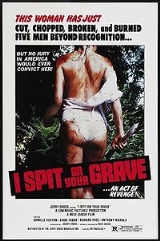
I Spit On Your Grave

Encyclopedia
Day of the Woman is a 1978 controversial rape revenge film
. The film received a limited release, with a wider release in 1980. Prominent film critics condemned the film for its graphic violence and lengthy depictions of gang rape, and the motion picture remains controversial to this day. The film was named in 2010 one of TIME
's Top 10 Ridiculously Violent Movies.
A remake was released in 2010.
short story writer Jennifer Hills (Camille Keaton
) rents an isolated cottage by a lake in the countryside to write her first novel. The arrival in town of the attractive and independent young woman attracts the attention of Johnny (Eron Tabor), the gas station manager, and Stanley (Anthony Nichols) and Andy (Gunter Kleemann), two unemployed youths who hang around the gas station. Jennifer receives a grocery delivery from Matthew (Richard Pace), who is apparently mildly mentally challenged, and befriends him. Matthew is friends with the other three men and reports back to them about the beautiful woman he met, claiming he saw her breasts.
Stanley and Andy start cruising by the cottage in their speedboat and apparently prowl around the house at night. One day, while Jennifer is relaxing in her canoe, they surprise her in their speedboat and tow her to shore. As she tries to escape, she is met by Johnny, while Matthew hides in bushes nearby. She realizes they planned her abduction so Matthew can lose his virginity
. Jennifer fights but is chased by the men through the forest. Matthew refuses to have sex with her, so Johnny rapes her. They allow her to escape but track her down shortly afterward. Andy brutally rapes her anally
, and after she crawls back to her house, they attack her again. Matthew finally rapes her after drinking alcohol, but he says that he can not reach orgasm
with the other men watching. The other men ridicule her book and rip up the manuscript, and Stanley sexually assaults her. She passes out, but after the men leave, Johnny realizes she is a witness to their crimes and orders Matthew to stab her to death. Matthew cannot bring himself to do this, so dabs the knife in her blood and returns to the other men claiming he has killed her.
In the following days, a traumatized
Jennifer pieces both herself and her manuscript back together. She goes to church and asks for forgiveness for what she plans to do. The men learn Jennifer has survived and beat Matthew up for deceiving them. Jennifer calls in a grocery order, knowing Matthew will deliver it. He takes the groceries, and a knife. At the cabin Jennifer entices him to have sex with her under a tree. As he becomes oblivious to his surroundings, she strings a noose around his neck and hangs
him, then cuts the rope and drops the body in the river.
Jennifer seductively collects Johnny from the gas station in her car. She stops halfway to her house and turns a gun on him and orders him to remove all his clothing. Johnny insists the rapes were her fault because she enticed the men by parading around in revealing clothing. She apparently believes this, lowers her gun, and invites him back to her cottage for a hot bath, where she manually stimulates him. When Johnny says that Matthew has been reported missing, Jennifer says she killed Matthew, and as he nears orgasm, Jennifer takes the knife Matthew brought with him from its hiding place under the bathmat and severs Johnny's genitals, letting him bleed to death. She later dumps the body in the basement and burns his clothes in the fireplace.
Stanley and Andy learn that Johnny is missing and take their boat to Jennifer's cabin. Andy goes ashore with an axe. Jennifer swims out to the boat and climbs aboard before Stanley realizes what she is doing and pushes him overboard. Andy tries to attack her when she speeds past him in the boat, but she escapes with the axe. Andy swims out to rescue Stanley, but Jennifer plunges the axe into Andy's back and backs the boat up to Stanley, who grabs hold of the motor to climb aboard, begging Jennifer not to kill him. She repeates his own words he used against Jennifer while assaulting her: "Suck it, bitch!", starts the engine, disemboweling him, and speeds away in the boat.
. The waterway is a section of the Housatonic River
. The house in real life was owned by Zarchi's friend Nouri Haviv, who photographed this film. Most of the house interior scenes were also shot inside this house.
Zarchi first visited the house while developing the script and its ambience and location influenced the development of the story.
(the grand-niece of Buster Keaton
) won a Best Actress award for her role in this film at the 1978 Catalonian International Film Festival in Spain.
Zarchi submitted the film to the Motion Picture Association of America
several times before they passed it. They rejected the film due to its violence, suggesting the violence should be toned down but refusing to specify which footage should be removed. Zarchi re-edited the film and submitted it a second time and it was again rejected. The MPAA finally passed the film after all footage depicting the anal rape was removed.
Zarchi was unable to find a distributor so distributed the film himself. It played a number of engagements in rural drive-in theater
s, but only for brief runs each time, and Zarchi barely made back what he spent in advertising. In 1980 it was picked up for distribution by the Jerry Gross Organization. A condition of this re-release was that they could change the title to anything they wished. It was at this time the film was retitled I Spit on Your Grave.
gave the film no stars, referring to it as "a vile bag of garbage...without a shred of artistic distinction," adding that "Attending it was one of the most depressing experiences of my life." In his review, Roger Ebert mentioned a female member of the audience (one of many people who randomly talked aloud) who had "feminist solidarity for the movie's heroine", and did not share her feelings. He wrote "I wanted to ask if she'd been appalled by the movie's hour of rape scenes". Ebert was also one of many to cite the movie's poor production quality as a weakness in addition to the scenes he found offensive, stating "The story of 'I Spit on Your Grave' is told with moronic simplicity. These horrible events are shown with an absolute minimum of dialogue, which is so poorly recorded that it often cannot be heard. There is no attempt to develop the personalities of the characters - they are, simply, a girl and four men, one of them mentally retarded. The movie is nothing more or less than a series of attacks on the girl and then her attacks on the men, interrupted only by an unbelievably grotesque and inappropriate scene in which she enters a church and asks forgiveness for the murders she plans to commit".
Encyclopedia of Horror notes that the film attracted much debate for and against, frequently involving people who clearly had not actually seen the film. "The men are so grossly unattractive and the rapes so harrowing, long-drawn-out and starkly presented it is hard to imagine most male spectators identifying with the perpretrators, especially as the film's narrative structure and mise-en-scene force the spectator to view the action from Keaton's point of view. Further, there is no suggestion that she 'asked for it' or enjoyed it, except, of course, in the rapists' own perceptions, from which the film is careful to distance itself." The book continues that the scenes of revenge were "grotesquely misread by some critics" as Jennifer only "pretends to have enjoyed the rape so as to lure the men to their destruction", and that in these scenes the film is critiquing "familiar male arguments about women 'bringing it on themselves'" as "simply sexist, self-excusing rhetoric and are quite clearly presented as such".
The initial criticism was followed by reappraisals of the film. Michael Kaminski's 2007 article for the website "Obsessed with Film", titled "Is 'I Spit on Your Grave' Really a Misunderstood Feminist Film?" argues that, when understood within the context in which director Zarchi was inspired to make it, the movie may be equally appropriate to analyze as "feminist wish-fulfillment" and a vehicle of personal expression reacting to violence against women.
A reappraisal was made by Carol J. Clover
in the third chapter of her 1992 book Men, Women, and Chainsaws
. Clover notes that she and others like her "appreciate, however grudgingly, the way in which [the movie's] brutal simplicity exposes a mainspring of popular culture." Clover further argues that the film's sympathies are entirely with Jennifer, that the male audience is meant to identify with her, and not with the attackers, and that the point of the film is a masochistic identification with pain used to justify the bloody catharsis
of revenge. Clover wrote that in her opinion the film owes a debt to Deliverance
. The British feminist Julie Bindel
, who was involved in pickets outside cinemas in Leeds when the film was released, has said that she was wrong about the film and that it is a feminist film.
Critic Luke Y. Thompson of the New Times stated that "defenders of the film have argued that it's actually pro-woman, due to the fact that the female lead wins in the end, which is sort of like saying that cockfights are pro-rooster because there's always one left standing".
, Norway
, Iceland
, and West Germany
, banned the film altogether, claiming that it "glorified violence against women". Canada
initially banned the film, but in the 1990s decided to allow its individual provinces to decide whether to permit its release. Since 1998, some provinces (such as Manitoba
, Nova Scotia
, and Quebec
) have released the film, with a rating that reflects its content.
The censored American version of the film was released in Australia
in 1982 with an R 18+ rating. In 1987 the film survived an appeal to ban it. It continued to be sold until 1997, when another reclassification caused its ban in Australia. In 2004 the full uncut version was awarded an R 18+, lifting the seven-year ban. The Office of Film and Literature Classification justified this decision by reasoning that castration
is not sexual violence (Australian censorship law forbids the release of films that depict scenes of sexual violence as acceptable or justified).
In the United Kingdom
, the film was branded a "video nasty
". It appeared on the Director of Public Prosecutions
's list of prosecutable films until 2001, when a heavily-cut version of was released with an 18 certificate
.
In New Zealand, the uncut version of the film (101 minutes) was classified in 1984 as R20 with the descriptive note 'Contains graphic violence, content may disturb'. Other versions with shorter running times (96 minutes) were also classified in 1984 and 1985, and received the same classification.
They quickly decided that they made the wrong decision — the officer, whom Zarchi described as "not fit to wear the uniform", delayed taking her to the hospital and instead insisted that she follow formalities such as giving her full name (and the spelling), even though her jaw had been broken and she could hardly speak. Zarchi insisted the officer take her to the hospital and he eventually complied. Soon afterwards the woman's father wrote both Zarchi and his friend a letter of thanks for helping his daughter. The father offered a reward, which Zarchi refused.
In the same commentary, Zarchi denied that the film was exploitative, and that the violent nature of the film was necessary to tell the story. He described actress Camille Keaton as "brave" for taking on the role.
(1993) in which Camille Keaton reprises the role of Jennifer.
The film was unofficially remade in 1985 as Naked Vengeance. CineTel Films acquired rights to remake I Spit on Your Grave 2010
, which had a Halloween 2010 worldwide theatrical release. The remake was produced by CineTel president and CEO Paul Hertzberg and Lisa Hansen, with Jeff Klein, Alan Ostroff, Gary Needle and Zarchi as executive producers. Steven R. Monroe directed, with newcomer Sarah Butler starring.
in a 'Limited Collector's Edition' on 7 February, 2011 in the UK. It was released on 8 February, 2011 in the United States from Starz/Anchor Bay Entertainment
. In Australia, the film was released on 16 March, 2011 as a 'Director's Cut' edition.
Rape and revenge films
Rape and revenge films are a subgenre of exploitation film that was particularly popular in the 1970s. Rape/revenge movies generally follow the same three act structure:...
. The film received a limited release, with a wider release in 1980. Prominent film critics condemned the film for its graphic violence and lengthy depictions of gang rape, and the motion picture remains controversial to this day. The film was named in 2010 one of TIME
Time
Time is a part of the measuring system used to sequence events, to compare the durations of events and the intervals between them, and to quantify rates of change such as the motions of objects....
's Top 10 Ridiculously Violent Movies.
A remake was released in 2010.
Plot
New YorkNew York
New York is a state in the Northeastern region of the United States. It is the nation's third most populous state. New York is bordered by New Jersey and Pennsylvania to the south, and by Connecticut, Massachusetts and Vermont to the east...
short story writer Jennifer Hills (Camille Keaton
Camille Keaton
Camille Keaton is an American actress, perhaps best known for her role in the 1978 film I Spit on Your Grave.-Early years:Keaton was born in Pine Bluff, Arkansas and is a grand-niece of Buster Keaton...
) rents an isolated cottage by a lake in the countryside to write her first novel. The arrival in town of the attractive and independent young woman attracts the attention of Johnny (Eron Tabor), the gas station manager, and Stanley (Anthony Nichols) and Andy (Gunter Kleemann), two unemployed youths who hang around the gas station. Jennifer receives a grocery delivery from Matthew (Richard Pace), who is apparently mildly mentally challenged, and befriends him. Matthew is friends with the other three men and reports back to them about the beautiful woman he met, claiming he saw her breasts.
Stanley and Andy start cruising by the cottage in their speedboat and apparently prowl around the house at night. One day, while Jennifer is relaxing in her canoe, they surprise her in their speedboat and tow her to shore. As she tries to escape, she is met by Johnny, while Matthew hides in bushes nearby. She realizes they planned her abduction so Matthew can lose his virginity
Virginity
Virginity refers to the state of a person who has never engaged in sexual intercourse. There are cultural and religious traditions which place special value and significance on this state, especially in the case of unmarried females, associated with notions of personal purity, honor and worth...
. Jennifer fights but is chased by the men through the forest. Matthew refuses to have sex with her, so Johnny rapes her. They allow her to escape but track her down shortly afterward. Andy brutally rapes her anally
Anal sex
Anal sex is the sex act in which the penis is inserted into the anus of a sexual partner. The term can also include other sexual acts involving the anus, including pegging, anilingus , fingering, and object insertion.Common misconception describes anal sex as practiced almost exclusively by gay men...
, and after she crawls back to her house, they attack her again. Matthew finally rapes her after drinking alcohol, but he says that he can not reach orgasm
Orgasm
Orgasm is the peak of the plateau phase of the sexual response cycle, characterized by an intense sensation of pleasure...
with the other men watching. The other men ridicule her book and rip up the manuscript, and Stanley sexually assaults her. She passes out, but after the men leave, Johnny realizes she is a witness to their crimes and orders Matthew to stab her to death. Matthew cannot bring himself to do this, so dabs the knife in her blood and returns to the other men claiming he has killed her.
In the following days, a traumatized
Psychological trauma
Psychological trauma is a type of damage to the psyche that occurs as a result of a traumatic event...
Jennifer pieces both herself and her manuscript back together. She goes to church and asks for forgiveness for what she plans to do. The men learn Jennifer has survived and beat Matthew up for deceiving them. Jennifer calls in a grocery order, knowing Matthew will deliver it. He takes the groceries, and a knife. At the cabin Jennifer entices him to have sex with her under a tree. As he becomes oblivious to his surroundings, she strings a noose around his neck and hangs
Hanging
Hanging is the lethal suspension of a person by a ligature. The Oxford English Dictionary states that hanging in this sense is "specifically to put to death by suspension by the neck", though it formerly also referred to crucifixion and death by impalement in which the body would remain...
him, then cuts the rope and drops the body in the river.
Jennifer seductively collects Johnny from the gas station in her car. She stops halfway to her house and turns a gun on him and orders him to remove all his clothing. Johnny insists the rapes were her fault because she enticed the men by parading around in revealing clothing. She apparently believes this, lowers her gun, and invites him back to her cottage for a hot bath, where she manually stimulates him. When Johnny says that Matthew has been reported missing, Jennifer says she killed Matthew, and as he nears orgasm, Jennifer takes the knife Matthew brought with him from its hiding place under the bathmat and severs Johnny's genitals, letting him bleed to death. She later dumps the body in the basement and burns his clothes in the fireplace.
Stanley and Andy learn that Johnny is missing and take their boat to Jennifer's cabin. Andy goes ashore with an axe. Jennifer swims out to the boat and climbs aboard before Stanley realizes what she is doing and pushes him overboard. Andy tries to attack her when she speeds past him in the boat, but she escapes with the axe. Andy swims out to rescue Stanley, but Jennifer plunges the axe into Andy's back and backs the boat up to Stanley, who grabs hold of the motor to climb aboard, begging Jennifer not to kill him. She repeates his own words he used against Jennifer while assaulting her: "Suck it, bitch!", starts the engine, disemboweling him, and speeds away in the boat.
Cast
- Camille KeatonCamille KeatonCamille Keaton is an American actress, perhaps best known for her role in the 1978 film I Spit on Your Grave.-Early years:Keaton was born in Pine Bluff, Arkansas and is a grand-niece of Buster Keaton...
as Jennifer Hills - Eron Tabor - Johnny
- Richard Pace - Matthew Lucas
- Anthony Nichols - Stanley
- Gunter Kleemanns - Andy
- Alexis Magnotti - Attendant's Wife
- Tammy Zarchi - The Children
- Terry Zarchi - The Children
- Traci Ferrante - Waitress
- William Tasgal - Porter
- Isaac Agami - Butcher
- Ronit Haviv - Supermarket Girl
Production
The house that Jennifer rents and its grounds, the river and the gas station, were all located in Kent, ConnecticutKent, Connecticut
Kent is a town in Litchfield County, Connecticut, alongside the border with New York. The population was 2,858 at the 2000 census. The town is home to three New England boarding schools: South Kent School, Kent School and The Marvelwood School. The Schaghticoke Indian Reservation is also located...
. The waterway is a section of the Housatonic River
Housatonic River
The Housatonic River is a river, approximately long, in western Massachusetts and western Connecticut in the United States. It flows south to southeast, and drains about of southwestern New England into Long Island Sound...
. The house in real life was owned by Zarchi's friend Nouri Haviv, who photographed this film. Most of the house interior scenes were also shot inside this house.
Zarchi first visited the house while developing the script and its ambience and location influenced the development of the story.
Title
The film's original title was Day of the Woman. It was also shown under the title I Hate Your Guts and The Rape and Revenge of Jennifer Hill. The title was changed to I Spit on Your Grave for the 1980 re-release.Release
Camille KeatonCamille Keaton
Camille Keaton is an American actress, perhaps best known for her role in the 1978 film I Spit on Your Grave.-Early years:Keaton was born in Pine Bluff, Arkansas and is a grand-niece of Buster Keaton...
(the grand-niece of Buster Keaton
Buster Keaton
Joseph Frank "Buster" Keaton was an American comic actor, filmmaker, producer and writer. He was best known for his silent films, in which his trademark was physical comedy with a consistently stoic, deadpan expression, earning him the nickname "The Great Stone Face".Keaton was recognized as the...
) won a Best Actress award for her role in this film at the 1978 Catalonian International Film Festival in Spain.
Zarchi submitted the film to the Motion Picture Association of America
Motion Picture Association of America
The Motion Picture Association of America, Inc. , originally the Motion Picture Producers and Distributors of America , was founded in 1922 and is designed to advance the business interests of its members...
several times before they passed it. They rejected the film due to its violence, suggesting the violence should be toned down but refusing to specify which footage should be removed. Zarchi re-edited the film and submitted it a second time and it was again rejected. The MPAA finally passed the film after all footage depicting the anal rape was removed.
Zarchi was unable to find a distributor so distributed the film himself. It played a number of engagements in rural drive-in theater
Drive-in theater
A drive-in theater is a form of cinema structure consisting of a large outdoor screen, a projection booth, a concession stand and a large parking area for automobiles. Within this enclosed area, customers can view movies from the privacy and comfort of their cars.The screen can be as simple as a...
s, but only for brief runs each time, and Zarchi barely made back what he spent in advertising. In 1980 it was picked up for distribution by the Jerry Gross Organization. A condition of this re-release was that they could change the title to anything they wished. It was at this time the film was retitled I Spit on Your Grave.
Critical reception
Movie critic Roger EbertRoger Ebert
Roger Joseph Ebert is an American film critic and screenwriter. He is the first film critic to win a Pulitzer Prize for Criticism.Ebert is known for his film review column and for the television programs Sneak Previews, At the Movies with Gene Siskel and Roger Ebert, and Siskel and Ebert and The...
gave the film no stars, referring to it as "a vile bag of garbage...without a shred of artistic distinction," adding that "Attending it was one of the most depressing experiences of my life." In his review, Roger Ebert mentioned a female member of the audience (one of many people who randomly talked aloud) who had "feminist solidarity for the movie's heroine", and did not share her feelings. He wrote "I wanted to ask if she'd been appalled by the movie's hour of rape scenes". Ebert was also one of many to cite the movie's poor production quality as a weakness in addition to the scenes he found offensive, stating "The story of 'I Spit on Your Grave' is told with moronic simplicity. These horrible events are shown with an absolute minimum of dialogue, which is so poorly recorded that it often cannot be heard. There is no attempt to develop the personalities of the characters - they are, simply, a girl and four men, one of them mentally retarded. The movie is nothing more or less than a series of attacks on the girl and then her attacks on the men, interrupted only by an unbelievably grotesque and inappropriate scene in which she enters a church and asks forgiveness for the murders she plans to commit".
Encyclopedia of Horror notes that the film attracted much debate for and against, frequently involving people who clearly had not actually seen the film. "The men are so grossly unattractive and the rapes so harrowing, long-drawn-out and starkly presented it is hard to imagine most male spectators identifying with the perpretrators, especially as the film's narrative structure and mise-en-scene force the spectator to view the action from Keaton's point of view. Further, there is no suggestion that she 'asked for it' or enjoyed it, except, of course, in the rapists' own perceptions, from which the film is careful to distance itself." The book continues that the scenes of revenge were "grotesquely misread by some critics" as Jennifer only "pretends to have enjoyed the rape so as to lure the men to their destruction", and that in these scenes the film is critiquing "familiar male arguments about women 'bringing it on themselves'" as "simply sexist, self-excusing rhetoric and are quite clearly presented as such".
The initial criticism was followed by reappraisals of the film. Michael Kaminski's 2007 article for the website "Obsessed with Film", titled "Is 'I Spit on Your Grave' Really a Misunderstood Feminist Film?" argues that, when understood within the context in which director Zarchi was inspired to make it, the movie may be equally appropriate to analyze as "feminist wish-fulfillment" and a vehicle of personal expression reacting to violence against women.
A reappraisal was made by Carol J. Clover
Carol J. Clover
Carol J. Clover is an American professor of film studies, rhetoric language and Scandinavian mythology. She has been widely published in her areas of expertise...
in the third chapter of her 1992 book Men, Women, and Chainsaws
Men, Women, and Chainsaws
Men, Women, and Chain Saws: Gender in the Modern Horror Film is a 1992 book by American academic Carol J. Clover. In it she investigates the appeal of horror cinema, in particular the slasher, occult, and rape-revenge genres, from a feminist perspective...
. Clover notes that she and others like her "appreciate, however grudgingly, the way in which [the movie's] brutal simplicity exposes a mainspring of popular culture." Clover further argues that the film's sympathies are entirely with Jennifer, that the male audience is meant to identify with her, and not with the attackers, and that the point of the film is a masochistic identification with pain used to justify the bloody catharsis
Catharsis
Catharsis or katharsis is a Greek word meaning "cleansing" or "purging". It is derived from the verb καθαίρειν, kathairein, "to purify, purge," and it is related to the adjective καθαρός, katharos, "pure or clean."-Dramatic uses:...
of revenge. Clover wrote that in her opinion the film owes a debt to Deliverance
Deliverance
Deliverance is a 1972 American thriller film produced and directed by John Boorman. Principal cast members include Jon Voight, Burt Reynolds, Ronny Cox and Ned Beatty in his film debut. The film is based on a 1970 novel of the same name by American author James Dickey, who has a small role in the...
. The British feminist Julie Bindel
Julie Bindel
Julie Bindel is an English writer, feminist and co-founder of the group Justice For Women, which opposes violence against women from a feminist viewpoint....
, who was involved in pickets outside cinemas in Leeds when the film was released, has said that she was wrong about the film and that it is a feminist film.
Critic Luke Y. Thompson of the New Times stated that "defenders of the film have argued that it's actually pro-woman, due to the fact that the female lead wins in the end, which is sort of like saying that cockfights are pro-rooster because there's always one left standing".
Censorship and film bans
Many nations, such as IrelandRepublic of Ireland
Ireland , described as the Republic of Ireland , is a sovereign state in Europe occupying approximately five-sixths of the island of the same name. Its capital is Dublin. Ireland, which had a population of 4.58 million in 2011, is a constitutional republic governed as a parliamentary democracy,...
, Norway
Norway
Norway , officially the Kingdom of Norway, is a Nordic unitary constitutional monarchy whose territory comprises the western portion of the Scandinavian Peninsula, Jan Mayen, and the Arctic archipelago of Svalbard and Bouvet Island. Norway has a total area of and a population of about 4.9 million...
, Iceland
Iceland
Iceland , described as the Republic of Iceland, is a Nordic and European island country in the North Atlantic Ocean, on the Mid-Atlantic Ridge. Iceland also refers to the main island of the country, which contains almost all the population and almost all the land area. The country has a population...
, and West Germany
West Germany
West Germany is the common English, but not official, name for the Federal Republic of Germany or FRG in the period between its creation in May 1949 to German reunification on 3 October 1990....
, banned the film altogether, claiming that it "glorified violence against women". Canada
Canada
Canada is a North American country consisting of ten provinces and three territories. Located in the northern part of the continent, it extends from the Atlantic Ocean in the east to the Pacific Ocean in the west, and northward into the Arctic Ocean...
initially banned the film, but in the 1990s decided to allow its individual provinces to decide whether to permit its release. Since 1998, some provinces (such as Manitoba
Manitoba
Manitoba is a Canadian prairie province with an area of . The province has over 110,000 lakes and has a largely continental climate because of its flat topography. Agriculture, mostly concentrated in the fertile southern and western parts of the province, is vital to the province's economy; other...
, Nova Scotia
Nova Scotia
Nova Scotia is one of Canada's three Maritime provinces and is the most populous province in Atlantic Canada. The name of the province is Latin for "New Scotland," but "Nova Scotia" is the recognized, English-language name of the province. The provincial capital is Halifax. Nova Scotia is the...
, and Quebec
Quebec
Quebec or is a province in east-central Canada. It is the only Canadian province with a predominantly French-speaking population and the only one whose sole official language is French at the provincial level....
) have released the film, with a rating that reflects its content.
The censored American version of the film was released in Australia
Australia
Australia , officially the Commonwealth of Australia, is a country in the Southern Hemisphere comprising the mainland of the Australian continent, the island of Tasmania, and numerous smaller islands in the Indian and Pacific Oceans. It is the world's sixth-largest country by total area...
in 1982 with an R 18+ rating. In 1987 the film survived an appeal to ban it. It continued to be sold until 1997, when another reclassification caused its ban in Australia. In 2004 the full uncut version was awarded an R 18+, lifting the seven-year ban. The Office of Film and Literature Classification justified this decision by reasoning that castration
Castration
Castration is any action, surgical, chemical, or otherwise, by which a male loses the functions of the testicles or a female loses the functions of the ovaries.-Humans:...
is not sexual violence (Australian censorship law forbids the release of films that depict scenes of sexual violence as acceptable or justified).
In the United Kingdom
United Kingdom
The United Kingdom of Great Britain and Northern IrelandIn the United Kingdom and Dependencies, other languages have been officially recognised as legitimate autochthonous languages under the European Charter for Regional or Minority Languages...
, the film was branded a "video nasty
Video nasty
"Video nasty" was a colloquial term coined in the United Kingdom by 1982 which originally applied to a number of films distributed on video cassette that were criticized for their violent content by the press, commentators such as Mary Whitehouse and various religious organizations.While violence...
". It appeared on the Director of Public Prosecutions
Director of Public Prosecutions
The Director of Public Prosecutions is the officer charged with the prosecution of criminal offences in several criminal jurisdictions around the world...
's list of prosecutable films until 2001, when a heavily-cut version of was released with an 18 certificate
18 certificate
The 18 certificate is issued by the British Board of Film Classification to state that, in its opinion, a film, video recording, or game should not be seen or purchased by a person under 18 years old....
.
In New Zealand, the uncut version of the film (101 minutes) was classified in 1984 as R20 with the descriptive note 'Contains graphic violence, content may disturb'. Other versions with shorter running times (96 minutes) were also classified in 1984 and 1985, and received the same classification.
Zarchi's inspiration and responses to criticism
In the commentary for the Millennium Edition, Zarchi said he was inspired to produce the film after helping a young woman who had been raped in New York. He tells of how a friend of his and his daughter were driving by a park when they witnessed a young woman crawling out of the bushes bloodied and naked (he later learned the young woman was taking a common shortcut to her boyfriend's house when she was attacked). They collected the traumatized girl, returned the daughter home, and quickly decided it was best to take the girl to the police rather than a hospital, lest the attackers escape and find further victims.They quickly decided that they made the wrong decision — the officer, whom Zarchi described as "not fit to wear the uniform", delayed taking her to the hospital and instead insisted that she follow formalities such as giving her full name (and the spelling), even though her jaw had been broken and she could hardly speak. Zarchi insisted the officer take her to the hospital and he eventually complied. Soon afterwards the woman's father wrote both Zarchi and his friend a letter of thanks for helping his daughter. The father offered a reward, which Zarchi refused.
In the same commentary, Zarchi denied that the film was exploitative, and that the violent nature of the film was necessary to tell the story. He described actress Camille Keaton as "brave" for taking on the role.
Sequel and remakes
The film was followed by unofficial sequel Savage VengeanceSavage Vengeance
Savage Vengeance is a 1993 slasher film, that served as an "unofficial" sequel to the controversial 1978 movie, I Spit on Your Grave, with Camille Keaton under the alias "Vickie Lahl" reprising her role as vengeful rape victim, Jennifer Hills. No scenes from the first movie were used...
(1993) in which Camille Keaton reprises the role of Jennifer.
The film was unofficially remade in 1985 as Naked Vengeance. CineTel Films acquired rights to remake I Spit on Your Grave 2010
I Spit on Your Grave (2010 film)
I Spit on Your Grave is a 2010 American rape and revenge horror film, and a remake of the controversial 1978 cult film of the same name. It was directed by Steven R...
, which had a Halloween 2010 worldwide theatrical release. The remake was produced by CineTel president and CEO Paul Hertzberg and Lisa Hansen, with Jeff Klein, Alan Ostroff, Gary Needle and Zarchi as executive producers. Steven R. Monroe directed, with newcomer Sarah Butler starring.
Cultural references
- In the horror film ScreamScreamScream may refer to:*Vociferation, a loud vocalization*The Scream, a famous painting by Edvard Munch-Amusement rides:* Scream! , a roller coaster at Six Flags Magic Mountain...
, just before Rose McGowan's character is killed, she jokingly asks the killer if he is making a movie called "I Spit On Your Garage", obviously referencing, 'I Spit On Your Grave'.
- SupernaturalSupernatural (TV series)Supernatural is an American supernatural and horror television series created by Eric Kripke, which debuted on September 13, 2005 on The WB, and is now part of The CW's lineup. Starring Jared Padalecki as Sam Winchester and Jensen Ackles as Dean Winchester, the series follows the brothers as they...
episode 4.13 "After School Special" a young Dean WinchesterDean WinchesterDean Winchester is a fictional character from The CW Television Network's Supernatural, portrayed by Jensen Ackles. He hunts demons, spirits and other supernatural creatures with his younger brother Sam.-Background:...
mentions a midnight showing of "I Spit on Your Grave" while making out with Amanda Heckerling in the Janitor's closet.
- The film was referenced in the name of 1980s AustraliaAustraliaAustralia , officially the Commonwealth of Australia, is a country in the Southern Hemisphere comprising the mainland of the Australian continent, the island of Tasmania, and numerous smaller islands in the Indian and Pacific Oceans. It is the world's sixth-largest country by total area...
n band I Spit on Your GravyFred NegroFred Negro is an Australian satirist, musician, songwriter, and cartoonist born in Richmond, a suburb of Melbourne, Victoria, in 1959...
.
- "I Spit On Your Grave" is the name of a track from Finnish Power Metal band SinergySinergySinergy was a Finnish power metal band started in 1998 by American musician, Kimberly Goss. Aside from Sinergy, the most notable bands Goss has been involved with are Dimmu Borgir; as keyboardist, and Children of Bodom; where she filled in live for Janne Wirman and also contributed lyrics...
's 2002 album, Suicide By My SideSuicide by My SideSuicide By My Side is the third album by the power metal band Sinergy, released in 2002. It shows a substantial progress in their musical style; singer Kimberly Goss performs in a sharper, more aggressive vocal style, and guitarists Alexi Laiho and Roope Latvala perform more technical solos...
.
- in The SimpsonsThe SimpsonsThe Simpsons is an American animated sitcom created by Matt Groening for the Fox Broadcasting Company. The series is a satirical parody of a middle class American lifestyle epitomized by its family of the same name, which consists of Homer, Marge, Bart, Lisa and Maggie...
the Drive-In theatre visible from Apu's rooftop garden is playing "I Spit On Your Grave", as well as "I Thumb Through Your Magazines"
Home media
The film received it's first Blu-ray release on 20 September, 2010 in the United Kingdom from 101 Films. It was released in an 'Ultimate Collector's Edition', containing both Blu-ray and DVD, a collector's booklet and poster. It is the first time the film has been released uncut in the UK. It was also released alongside the remakeI Spit on Your Grave (2010 film)
I Spit on Your Grave is a 2010 American rape and revenge horror film, and a remake of the controversial 1978 cult film of the same name. It was directed by Steven R...
in a 'Limited Collector's Edition' on 7 February, 2011 in the UK. It was released on 8 February, 2011 in the United States from Starz/Anchor Bay Entertainment
Anchor Bay Entertainment
Anchor Bay Entertainment is a U.S. based home entertainment and production company and is a division of Starz Media, which is a unit of Starz, LLC. It was previously owned by IDT Entertainment until 2006 when IDT was purchased by Starz Media. Anchor Bay markets and sells feature films, series,...
. In Australia, the film was released on 16 March, 2011 as a 'Director's Cut' edition.
Re-release ban in Ireland
The Irish Film Board has again banned the film from sale. Having been banned for many years in the country, the new Blu-ray and DVD uncensored edition has been prohibited from purchase by retailers due to the nature of the film.External links
- Official Website for the New Film The Official Website for the New Film