
Home      Discussion      Topics      Dictionary      Almanac
Signup       Login
IMac G4

IMac G4

Overview
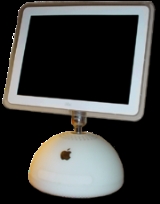
The iMac G4 was a computer
Computer
A computer is a programmable machine designed to sequentially and automatically carry out a sequence of arithmetic or logical operations. The particular sequence of operations can be changed readily, allowing the computer to solve more than one kind of problem...

 that was produced by Apple from the beginning of 2002 to mid 2004. It replaced the aging iMac G3
IMac G3
The iMac G3 was the first model of the iMac line of personal computers made by Apple Inc. , and the originator of the Legacy-free PC market category. Like the first Macs, the iMac G3 is an all-in-one personal computer, encompassing both the monitor and the system unit in a single enclosure...

. The computer had a new design compared to older Macs. It had a 15-inch LCD
Liquid crystal display
A liquid crystal display is a flat panel display, electronic visual display, or video display that uses the light modulating properties of liquid crystals . LCs do not emit light directly....

 which was mounted on an adjustable arm above a hemisphere containing a full-size, tray-loading optical drive and a sixteenth-generation CPU (the PPC 74xx-series
PowerPC G4
PowerPC G4 is a designation used by Apple Computer to describe a fourth generation of 32-bit PowerPC microprocessors. Apple has applied this name to various processor models from Freescale, a former part of Motorola....

). This LCD computer was known and sold as The New iMac, while existing egg-shaped iMac was renamed the "iMac G3" and continued to be sold for a few months. After the iMac G3 was discontinued, it was retroactively
Retronym
A retronym is a type of neologism that provides a new name for an object or concept to differentiate the original form or version of it from a more recent form or version. The original name is most often augmented with an adjective to account for later developments of the object or concept itself...

 labeled iMac G4 to distinguish itself from the succeeding iMac G5
IMac G5
The iMac G5 was a series of desktop Macintosh computers designed and built by Apple Inc. using the PowerPC chip architecture. It was the last line of iMac computers that used a PowerPC chip, making it the last of the iMacs that could run Mac OS 9 applications. In August 2004, the iMac design was...

.
Discussion
Ask a question about 'IMac G4'
Start a new discussion about 'IMac G4'
Answer questions from other users
Full Discussion Forum
 
Unanswered Questions
Encyclopedia
The iMac G4 was a computer
Computer
A computer is a programmable machine designed to sequentially and automatically carry out a sequence of arithmetic or logical operations. The particular sequence of operations can be changed readily, allowing the computer to solve more than one kind of problem...

 that was produced by Apple from the beginning of 2002 to mid 2004. It replaced the aging iMac G3
IMac G3
The iMac G3 was the first model of the iMac line of personal computers made by Apple Inc. , and the originator of the Legacy-free PC market category. Like the first Macs, the iMac G3 is an all-in-one personal computer, encompassing both the monitor and the system unit in a single enclosure...

. The computer had a new design compared to older Macs. It had a 15-inch LCD
Liquid crystal display
A liquid crystal display is a flat panel display, electronic visual display, or video display that uses the light modulating properties of liquid crystals . LCs do not emit light directly....

 which was mounted on an adjustable arm above a hemisphere containing a full-size, tray-loading optical drive and a sixteenth-generation CPU (the PPC 74xx-series
PowerPC G4
PowerPC G4 is a designation used by Apple Computer to describe a fourth generation of 32-bit PowerPC microprocessors. Apple has applied this name to various processor models from Freescale, a former part of Motorola....

). This LCD computer was known and sold as The New iMac, while existing egg-shaped iMac was renamed the "iMac G3" and continued to be sold for a few months. After the iMac G3 was discontinued, it was retroactively
Retronym
A retronym is a type of neologism that provides a new name for an object or concept to differentiate the original form or version of it from a more recent form or version. The original name is most often augmented with an adjective to account for later developments of the object or concept itself...

 labeled iMac G4 to distinguish itself from the succeeding iMac G5
IMac G5
The iMac G5 was a series of desktop Macintosh computers designed and built by Apple Inc. using the PowerPC chip architecture. It was the last line of iMac computers that used a PowerPC chip, making it the last of the iMacs that could run Mac OS 9 applications. In August 2004, the iMac design was...

.

The iMac G4 was sold with the "Apple Pro Keyboard" which would be later renamed the Apple Keyboard
Apple keyboard
The Apple Keyboard is a keyboard designed by Apple first for the Apple line, then the Macintosh line of computers. It is available in both wired and Bluetooth models.- Layout :...

 and an Apple Pro Mouse
Apple Pro Mouse
The Apple Mouse was originally introduced at the July 2000 Macworld Conference & Expo in New York City. Apple Computer was one of the first companies to ship an optical mouse as the standard input device...

 which would be later redesigned and named the Apple Mouse
Apple Mouse
The Apple Mouse began as one of the first commercial mice available to consumers. Over the years Apple has maintained a distinct form and function with its mice that reflects its design philosophies.-Features:...

. Also, there was an option to buy the "Apple Pro Speakers", which were better quality than the internal speakers, which were low quality due to their size. Apple Pro Speakers had a unique, small adaptor and only worked on a select few macs (such as this one).

Apple advertised it as having the flexibility of a desk lamp and it was nicknamed the "iLamp", similar to "Luxo Jr.
Luxo Jr.
Luxo Jr. is the first film produced in 1986 by Pixar Animation Studios, following its establishment as an independent film studio. It is a computer-animated short film , demonstrating the kind of things the newly-established company was capable of producing...

", who was featured in a short film produced by Pixar
Pixar
Pixar Animation Studios, pronounced , is an American computer animation film studio based in Emeryville, California. The studio has earned 26 Academy Awards, seven Golden Globes, and three Grammy Awards, among many other awards and acknowledgments. Its films have made over $6.3 billion worldwide...

, another venture of Apple co-founder Steve Jobs
Steve Jobs
Steven Paul Jobs was an American businessman and inventor widely recognized as a charismatic pioneer of the personal computer revolution. He was co-founder, chairman, and chief executive officer of Apple Inc...

. It was featured in an ad, sitting in a store window and "reacting" to every move made by a passer-by on the street. At the end, when the man sticks out his tongue, the iMac responds by opening its optical drive.

The iMac G4 was incrementally upgraded. They were made available with 17-inch (43 cm) and then 20-inch (51 cm) widescreen LCDs over the following two years. By then, Apple had all but eliminated the CRT machines from its product line. However, the LCD iMacs were unable to match the low price point of the previous iMac G3s, largely because of the higher cost of the LCD technology at the time.

The iMac G3 was obsolete by this point, but low-cost machines were particularly important for the education market. It was still being sold for a while after the iMac G4 debuted, until the G3 found a permanent replacement in April 2002 with the eMac
EMac
The eMac, short for education Mac, was a Macintosh desktop computer made by Apple Inc. It was originally aimed at the education market, but was later made available as a cheaper mass market alternative to Apple's second-generation LCD display iMac....

.

The iMac G4 was replaced by the iMac G5
IMac G5
The iMac G5 was a series of desktop Macintosh computers designed and built by Apple Inc. using the PowerPC chip architecture. It was the last line of iMac computers that used a PowerPC chip, making it the last of the iMacs that could run Mac OS 9 applications. In August 2004, the iMac design was...

 on August 31, 2004. Reaction to the iMac G5 was mixed: though it was a more powerful computer, reviewers commented that it was less aesthetic since it did not retain the flexible adjustable arm.

Technical specifications


The iMac G4 was one of the biggest improvements and advancements in Apple Inc's growing empire of Mac desktops. It included Mac OS 9 and Mac OS X due to it being relieved the year Mac OS 9 "died". .The computer was considered completely separate from the previous, half egg shaped G3 models. Some new features included a flat-panel LCD screen, with diagonal measurements up to 20 inches; tray loading DVD+CD drive; and many more features. Critics and consumers took to the new Mac style nicely, but many missed the slot loading drives that were available in earlier models. The floating monitor was easily adjustable, and stood at any angle around the dome-shaped bottom. Unlike previous iMac models, the iMac G4 came only in white, and was not translucent like the iMac G3s.

The Gateway
Gateway, Inc.
Gateway Computer Corporation, is a computer hardware company headquartered in Irvine, California, USA which develops, manufactures, supports, and markets a wide range of personal computers, computer monitors, servers, and computer accessories...

 Profile attempted to compete with the iMac G4 in the all-in-one LCD computer market. A reviewer noted that the Profile had better processing power, due to its Intel Pentium 4
Pentium 4
Pentium 4 was a line of single-core desktop and laptop central processing units , introduced by Intel on November 20, 2000 and shipped through August 8, 2008. They had a 7th-generation x86 microarchitecture, called NetBurst, which was the company's first all-new design since the introduction of the...

, whereas the iMac was hampered because its G4 chip lacked the 1MB L2 cache that the Intel chips had. The iMac had clear advantages in LCD screen quality (it uses a digital LCD as opposed to an analog LCD), aesthetics
Aesthetics
Aesthetics is a branch of philosophy dealing with the nature of beauty, art, and taste, and with the creation and appreciation of beauty. It is more scientifically defined as the study of sensory or sensori-emotional values, sometimes called judgments of sentiment and taste...

 (particularly the flexible monitor arm), and multimedia. Ending up, the reviewer concluded that the iMac was good for introducing users to a Macintosh, but he noted that their (relatively) high prices were approaching that of laptops, which are actually portable and have higher resolution LCD screens. The Profile would also be undercut by numerous OEM offerings (including one from Gateway) that bundled an LCD screen with the box containing a Pentium 4.
  • January 7, 2002 — Apple introduces a new iMac line with three models. It has a new futuristic form factor and contains a 700 or an 800 MHz G4 processor, and is only available in white. The display is now a 15-inch LCD, easily positioned by the "swing arm" attaching it to the base. (15-inch, 800 MHz model is M8535LL/A)
  • July 17, 2002 — A new 800 MHz model with a 17-inch screen and an updated GPU
    Graphics processing unit
    A graphics processing unit or GPU is a specialized circuit designed to rapidly manipulate and alter memory in such a way so as to accelerate the building of images in a frame buffer intended for output to a display...

     is added to the line. (M8812LL/A)
  • February 4, 2003 — The line is slimmed down to two models, one with a 15-inch LCD and a new 1.0 GHz model with a 17-inch LCD (M8935LL/A). AirPort Extreme
    AirPort
    AirPort and AirPort Extreme are local area wireless networking products from Apple Inc. based on the IEEE 802.11 standard ....

     as well as Bluetooth
    Bluetooth
    Bluetooth is a proprietary open wireless technology standard for exchanging data over short distances from fixed and mobile devices, creating personal area networks with high levels of security...

     are available on the 17-inch model. The 15-inch model is largely identical to the January 2002 models.
  • September 8, 2003 — The iMac 15-inch and 17-inch models are upgraded to a 1.0 GHz and 1.25 GHz G4 processors, respectively (M9285LL/A, M9168LL/A). New features are USB 2.0 and DDR memory, and they both now support AirPort Extreme and Bluetooth
    Bluetooth
    Bluetooth is a proprietary open wireless technology standard for exchanging data over short distances from fixed and mobile devices, creating personal area networks with high levels of security...

    .
  • November 18, 2003 — 20-inch screen model (M9290LL/A) is added that is capable of a 1680 x 1050 pixel screen resolution, and features a 1.25 GHz G4 processor.

Component iMac G4 iMac G4 (Mac OS X Only) iMac G4 (1Ghz, DDR) iMac G4 (USB 2.0)
Display
Display device
A display device is an output device for presentation of information in visual or tactile form...

15" TFT LCD, 1024 × 768
N/A
15" TFT LCD, 1024 × 768
17" TFT Widescreen LCD, 1440 × 900
N/A
17" TFT Widescreen LCD, 1440 × 900

N/A
20" TFT Widescreen LCD, 1680 x 1050
Graphics
Computer graphics
Computer graphics are graphics created using computers and, more generally, the representation and manipulation of image data by a computer with help from specialized software and hardware....

nVidia GeForce 2 MX with 32MB of DDR SDRAM (15"). nVidia GeForce 4 MX with 32MB of DDR SDRAM (17") nVidia GeForce 2 MX with 32MB of DDR SDRAM nVidia GeForce 4 MX with 64MB of DDR SDRAM nVidia GeForce 4 MX with 32MB of DDR SDRAM (15"). nVidia GeForce FX 5200 Ultra with 64MB of DDR SDRAM (17 & 20")
Hard drive 40GB, 60GB, 80GB 60GB 80GB
Supports Hard Drives larger than 128 GB
80GB
Supports Hard Drives larger than 128 GB
Processor
Central processing unit
The central processing unit is the portion of a computer system that carries out the instructions of a computer program, to perform the basic arithmetical, logical, and input/output operations of the system. The CPU plays a role somewhat analogous to the brain in the computer. The term has been in...

700 MHz or 800 MHz PowerPC G4 (7450) 800 MHz PowerPC G4 (7450) 1.0 GHz PowerPC G4 (7445) 1.0 GHz (15"), 1.25 GHz (17 & 20") PowerPC G4 (7445)
Cache
Cache
In computer engineering, a cache is a component that transparently stores data so that future requests for that data can be served faster. The data that is stored within a cache might be values that have been computed earlier or duplicates of original values that are stored elsewhere...

64 KB L1, 256 KB L2 (1:1)
Front Side Bus
Front side bus
A front-side bus is a computer communication interface often used in computers during the 1990s and 2000s.It typically carries data between the central processing unit and a memory controller hub, known as the northbridge....

100 MHz 133 MHz 167 MHz
Memory 128MB, 256MB of PC133 SDRAM
Expandable up to 1GB via one factory installed memory module in a 168-pin DIMM slot and one 144-pin user-accessible SO-DIMM slot.
256MB of PC133 SDRAM
Expandable up to 1GB via one factory installed memory module in a 168-pin DIMM slot and one 144-pin user-accessible SO-DIMM slot.
256MB of PC2100 (266 MHz) DDR SDRAM
Expandable up to 2GB via one factory installed memory module in a 184-pin DIMM slot and one 200-pin user-accessible SO-DIMM slot (officially only 1GB is supported)
256MB of PC2700 (333 MHz) DDR SDRAM
Expandable up to 2GB via one factory installed memory module in a 184-pin DIMM slot and one 200-pin user-accessible SO-DIMM slot. (officially only 1 GB is supported)
AirPort
AirPort
AirPort and AirPort Extreme are local area wireless networking products from Apple Inc. based on the IEEE 802.11 standard ....

Built-in antennas and card slot for optional 11 Mbit/s AirPort Card; IEEE 802.11b compliant Built-in antennas and expansion slot for optional 54 Mbit/s AirPort Extreme Card
Internal Combo drive
Combo Drive
A Combo drive is a type of optical drive that combines CD-R/CD-RW recording capability with the ability to read DVD media. The term is used almost exclusively by Apple Inc. as a name for the low-end substitute for their high-end SuperDrive, which was designed to both read and write DVD and DVD...

8x DVD and 32x CD read; 32x CD-R and 10x CD-RW write
N/A
12x DVD and 32x CD read; 32x CD-R and 24x CD-RW write
1Ghz only
Internal SuperDrive
SuperDrive
SuperDrive is a trademark used by Apple Inc. for two different storage drives: from 1988–99 to refer to a high-density floppy disk drive capable of reading all major 3.5" disk formats; and from 2001 onwards to refer to a combined CD/DVD reader/writer....

6x DVD and 24x CD read; 2x DVD-R, 8x CD-R, and 4x CD-RW write
N/A
10x DVD and 32x CD read; 8x DVD-R, 24x CD-R, and 10x CD-RW write 12x DVD and 32x CD read; 8x DVD+/-R, 4x DVD+/-RW, 2.4x DVD+R DL, 24x CD-R, 8x CD-RW write
Standard Features 3 Built-in USB 1.1 and 2 Firewire 400 ports, Built-in microphone, headphone/audio out, mini-jack for external Harmon Kardon speakers, Built-in modem, 10/100Base-T Ethernet, Mini-VGA Port 3 Built-in USB 2.0 and 2 Firewire 400 ports, Built-in microphone, audio in, headphone/audio out, mini-jack for external Harmon Kardon speakers, Built-in modem, 10/100Base-T Ethernet, Mini-VGA port
Maximum Operating System Mac OS X 10.4 “Tiger” and Mac OS 9.2.2
Unofficially, can run Mac OS X 10.5 “Leopard”
Mac OS X 10.4 “Tiger”.
Unofficially, can run Mac OS X 10.5 “Leopard”
Mac OS X 10.5 “Leopard”
Weight 15"-21.3 lbs. (9.7 kg), 17"-22.8 lbs. (10.4 kg) 21.3 lbs. (9.7 kg) 22.8 lbs. (10.4 kg) 15"-21.3 lbs. (9.7 kg), 17"-22.8 lbs. (10.4 kg), 20"-40.1 lbs. (18.2 kg)
Introduced 7 January 2002 (15"),17 July 2002 (17") 4 February 2003 4 February 2003 8 September 2003 (15 & 17"), 18 November 2003 (20")


External links