

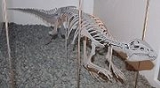
Hypsilophodont

Encyclopedia
Hypsilophodonts were small ornithopod
dinosaur
s, regarded as fast, herbivorous biped
s on the order of 1–2 meters long (3.3-6.6 feet). They are known from Asia
, Australia
, Europe
, New Zealand
, North America
, and South America
, from rocks
of Middle Jurassic
to late Cretaceous
age. The group traditionally has included almost all bipedal bird-hipped dinosaurs
other than iguanodont
s, and some early phylogenetic analyses
found it to be a natural group, but recent studies have found that the group is mostly paraphyletic and the taxa within represent a series leading up to Iguanodontia. Some of these studies have moved some traditional hypsilophodonts out of the Ornithopoda. Thus, the only certain member at this time is Hypsilophodon
. This area of the dinosaur family tree is complicated by a lack of research.
of hypsilophodont relationships depicts the paraphyletic
hypotheses; the "natural Hypsilophodontidae" hypothesis has been falling out of favor since the mid-late 1990s. It is after Boyd et al. (2009), the most recent analysis of hypsilophodonts. Ornithischia, Ornithopoda, and Iguanodontia were not designated in their result, and so are left out here. Additional ornithopods beyond Tenontosaurus are omitted. Dinosaurs traditionally described as hypsilophodonts are found from Agilisaurus or Hexinlusaurus to Hypsilophodon or Gasparinisaura.
In the most recent review of hypsilophodonts, by Norman et al. (2004), the following genera were known well enough to include in a phylogenetic analysis
:
The following genera were regarded as valid, but weren't classified:
Several other genera belong here somewhere, but are very poorly known or outright dubious:
The only new hypsilophodont genera named since this publication are Changchunsaurus
and Oryctodromeus
and Othnielosaurus
(=Othnielia
).
Varricchio et al. (2007) found that their new genus, Oryctodromeus
, forms a clade
with two other genera from Montana, Orodromeus and Zephyrosaurus. This relationship was also found by Boyd et al. (2009), who also recovered a Parksosaurus–Thescelosaurus clade more closely related to it than to other ornithopods, which would unite all North American Cretaceous hypsilophodonts in one clade.
al, cursorial
herbivores. The typical informal comparison has been to gazelle
s. However, there is evidence that at least some of them made burrow
s as places to rear their young. While so far only known for Oryctodromeus
, additional possible hypsilophodont burrows have been found in slightly older rocks in Victoria
, Australia
.
Ornithopod
Ornithopods or members of the clade Ornithopoda are a group of ornithischian dinosaurs that started out as small, bipedal running grazers, and grew in size and numbers until they became one of the most successful groups of herbivores in the Cretaceous world, and dominated the North American...
dinosaur
Dinosaur
Dinosaurs are a diverse group of animals of the clade and superorder Dinosauria. They were the dominant terrestrial vertebrates for over 160 million years, from the late Triassic period until the end of the Cretaceous , when the Cretaceous–Paleogene extinction event led to the extinction of...
s, regarded as fast, herbivorous biped
Biped
Bipedalism is a form of terrestrial locomotion where an organism moves by means of its two rear limbs, or legs. An animal or machine that usually moves in a bipedal manner is known as a biped , meaning "two feet"...
s on the order of 1–2 meters long (3.3-6.6 feet). They are known from Asia
Asia
Asia is the world's largest and most populous continent, located primarily in the eastern and northern hemispheres. It covers 8.7% of the Earth's total surface area and with approximately 3.879 billion people, it hosts 60% of the world's current human population...
, Australia
Australia
Australia , officially the Commonwealth of Australia, is a country in the Southern Hemisphere comprising the mainland of the Australian continent, the island of Tasmania, and numerous smaller islands in the Indian and Pacific Oceans. It is the world's sixth-largest country by total area...
, Europe
Europe
Europe is, by convention, one of the world's seven continents. Comprising the westernmost peninsula of Eurasia, Europe is generally 'divided' from Asia to its east by the watershed divides of the Ural and Caucasus Mountains, the Ural River, the Caspian and Black Seas, and the waterways connecting...
, New Zealand
New Zealand
New Zealand is an island country in the south-western Pacific Ocean comprising two main landmasses and numerous smaller islands. The country is situated some east of Australia across the Tasman Sea, and roughly south of the Pacific island nations of New Caledonia, Fiji, and Tonga...
, North America
North America
North America is a continent wholly within the Northern Hemisphere and almost wholly within the Western Hemisphere. It is also considered a northern subcontinent of the Americas...
, and South America
South America
South America is a continent situated in the Western Hemisphere, mostly in the Southern Hemisphere, with a relatively small portion in the Northern Hemisphere. The continent is also considered a subcontinent of the Americas. It is bordered on the west by the Pacific Ocean and on the north and east...
, from rocks
Rock formation
This is a list of rock formations that include isolated, scenic, or spectacular surface rock outcrops. These formations are usually the result of weathering and erosion sculpting the existing rock...
of Middle Jurassic
Middle Jurassic
The Middle Jurassic is the second epoch of the Jurassic Period. It lasted from 176-161 million years ago. In European lithostratigraphy, rocks of this Middle Jurassic age are called the Dogger....
to late Cretaceous
Late Cretaceous
The Late Cretaceous is the younger of two epochs into which the Cretaceous period is divided in the geologic timescale. Rock strata from this epoch form the Upper Cretaceous series...
age. The group traditionally has included almost all bipedal bird-hipped dinosaurs
Ornithischia
Ornithischia or Predentata is an extinct order of beaked, herbivorous dinosaurs. The name ornithischia is derived from the Greek ornitheos meaning 'of a bird' and ischion meaning 'hip joint'...
other than iguanodont
Iguanodont
Iguanodonts were herbivorous dinosaurs that lived from the mid-Jurassic to Late Cretaceous. Some members include Camptosaurus, Callovosaurus, Iguanodon, Ouranosaurus, and the hadrosaurids or "duck-billed dinosaurs". Iguanodonts were one of the first groups of dinosaurs to be found...
s, and some early phylogenetic analyses
Cladistics
Cladistics is a method of classifying species of organisms into groups called clades, which consist of an ancestor organism and all its descendants . For example, birds, dinosaurs, crocodiles, and all descendants of their most recent common ancestor form a clade...
found it to be a natural group, but recent studies have found that the group is mostly paraphyletic and the taxa within represent a series leading up to Iguanodontia. Some of these studies have moved some traditional hypsilophodonts out of the Ornithopoda. Thus, the only certain member at this time is Hypsilophodon
Hypsilophodon
Hypsilophodon is an ornithopod dinosaur genus from the Early Cretaceous period of Europe. It was a small bipedal animal with an herbivorous or possibly omnivorous diet...
. This area of the dinosaur family tree is complicated by a lack of research.
Relationships
The following cladogramCladistics
Cladistics is a method of classifying species of organisms into groups called clades, which consist of an ancestor organism and all its descendants . For example, birds, dinosaurs, crocodiles, and all descendants of their most recent common ancestor form a clade...
of hypsilophodont relationships depicts the paraphyletic
Paraphyly
A group of taxa is said to be paraphyletic if the group consists of all the descendants of a hypothetical closest common ancestor minus one or more monophyletic groups of descendants...
hypotheses; the "natural Hypsilophodontidae" hypothesis has been falling out of favor since the mid-late 1990s. It is after Boyd et al. (2009), the most recent analysis of hypsilophodonts. Ornithischia, Ornithopoda, and Iguanodontia were not designated in their result, and so are left out here. Additional ornithopods beyond Tenontosaurus are omitted. Dinosaurs traditionally described as hypsilophodonts are found from Agilisaurus or Hexinlusaurus to Hypsilophodon or Gasparinisaura.
In the most recent review of hypsilophodonts, by Norman et al. (2004), the following genera were known well enough to include in a phylogenetic analysis
Cladistics
Cladistics is a method of classifying species of organisms into groups called clades, which consist of an ancestor organism and all its descendants . For example, birds, dinosaurs, crocodiles, and all descendants of their most recent common ancestor form a clade...
:
- AgilisaurusAgilisaurusAgilisaurus is a genus of ornithischian dinosaur from the Middle Jurassic Period of what is now eastern Asia. The name is derived from the Latin agilis meaning 'agile' and the Greek sauros meaning 'lizard', and refers to the agility suggested by its lightweight skeleton and long legs...
- A. multidens (now HexinlusaurusHexinlusaurusHexinlusaurus is a genus of basal ornithischian dinosaur from the Middle Jurassic of China. The holotype , consists of an almost complete, articulated skull and some postcranial material, collected from a terrestrial sandstone within the Lower Shaximiao Formation at the famous dinosaur-bearing...
) - Bugenasaura (now regarded as a junior synonym of Thescelosaurus)
- GasparinisauraGasparinisauraGasparinisaura is a genus of ornithopod dinosaur from the Late Cretaceous. Its fossils were found in Argentina. The type species, Gasparinisaura cincosaltensis, was described in 1996 by Coria and Salgado. Originally classified as an iguanodont, recent research indicates it is more basal...
- HypsilophodonHypsilophodonHypsilophodon is an ornithopod dinosaur genus from the Early Cretaceous period of Europe. It was a small bipedal animal with an herbivorous or possibly omnivorous diet...
- OrodromeusOrodromeusOrodromeus is a genus of herbivorous ornithopod dinosaur from the Late Cretaceous of North America.-Discovery and naming:...
- OthnieliaOthnieliaOthnielia is a genus of ornithischian dinosaur, named after its original describer, Professor Othniel Charles Marsh, an American paleontologist of the 19th century...
(now OthnielosaurusOthnielosaurusOthnielosaurus is a genus of ornithischian dinosaur that lived about 155 to 148 million years ago, during the Late Jurassic-age Morrison Formation of the western United States. It is named in honor of famed paleontologist Othniel Charles Marsh, and was formerly assigned to the genus...
) - KoreanosaurusKoreanosaurus (ornithopod)Koreanosaurus is a genus of ornithopod dinosaur. In May 2003 three fossils of Koreanosaurus were found in the Late Cretaceous-age Seonso Conglomerate from the southern coast of the Bi-bong Dinosaur Fossil Findspot, Boseong, Korean Peninsula: the holotype KDRC-BB2, a partial skeleton lacking the...
- ParksosaurusParksosaurusParksosaurus was a genus of hypsilophodont ornithopod dinosaur from the early Maastrichtian-age Upper Cretaceous Horseshoe Canyon Formation of Alberta, Canada. It is based on most of a partially articulated skeleton and partial skull, showing it to have been a small, bipedal, herbivorous dinosaur...
- ThescelosaurusThescelosaurusThescelosaurus was a genus of small ornithopod dinosaur that appeared at the very end of the Late Cretaceous period in North America. It was a member of the last dinosaurian fauna before the Cretaceous-Tertiary extinction event around 65.5 million years ago...
- ZephyrosaurusZephyrosaurusZephyrosaurus is a genus of hypsilophodont ornithopod dinosaur. It is based on a partial skull and postcranial fragments discovered in the Aptian-Albian-age Lower Cretaceous Cloverly Formation of Carbon County, Montana...
The following genera were regarded as valid, but weren't classified:
- AnabisetiaAnabisetiaAnabisetia is a genus of ornithopod dinosaur from the Late Cretaceous Period of Patagonia, South America. It was a small bipedal herbivore, almost seven feet long....
- AtlascopcosaurusAtlascopcosaurusAtlascopcosaurus is a genus of herbivorous basal euornithopod dinosaur from the Early Cretaceous of the present Australia....
- DrinkerDrinkerDrinker was a genus of hypsilophodont dinosaur from the late Jurassic period of North America. Although based on good remains, it remains obscure due to a lack of post-naming publications.-Description:...
- "GongbusaurusGongbusaurusGongbusaurus is a genus of ornithischian, perhaps ornithopod, dinosaur that lived between about 160 and 155 million years ago, in the Late Jurassic period. A small herbivore, it is very poorly known. Two species have been assigned to it, but as the original name is based on teeth, there is no...
" wucaiwanensis (= "EugongbusaurusEugongbusaurus"Eugongbusaurus" is the informal name given to a genus of dinosaur that lived about 160 to 155 million years ago, in the Late Jurassic. It was either a hypsilophodont, or a less-derived ornithischian...
") - FulgurotheriumFulgurotheriumFulgurotherium is the name given to a genus of dinosaur from the Early Cretaceous . It lived in what is now Australia.The type species, Fulgurotherium australe, was named by Friedrich von Huene in 1932...
- JeholosaurusJeholosaurusJeholosaurus is a genus of ornithischian dinosaur from the Early Cretaceous Period. It is thought to have been a small ornithopod presumably related to the hypsilophodonts, and an herbivore. Although the back teeth are like those of a plant eater, the front premaxillary teeth are sharp and pointed...
- LeaellynasauraLeaellynasauraLeaellynasaura is a genus of small herbivorous ornithischian dinosaur from the Albian stage of the Early Cretaceous, first discovered in Dinosaur Cove, Australia. The type species is Leaellynasaura amicagraphica...
- NotohypsilophodonNotohypsilophodonNotohypsilophodon was a genus of hypsilophodont ornithopod dinosaur. It was described as the only hypsilophodont known from South America, although this assessment is not universally supported, and Gasparinisaura is now believed to have been a hypsilophodont as well...
- QantassaurusQantassaurusQantassaurus is a genus of two-legged, plant-eating ornithischian dinosaur that lived in Australia about 115 million years ago, when the continent was still partly south of the Antarctic Circle...
- YandusaurusYandusaurusYandusaurus is a genus of herbivorous basal euornithopod dinosaur from the Bathonian age of China.-Discovery and naming:...
- "Proctor Lake hypsilophodont"
Several other genera belong here somewhere, but are very poorly known or outright dubious:
- LaosaurusLaosaurusLaosaurus is a genus of hypsilophodont dinosaur. The type species is Laosaurus celer, first described by O.C. Marsh in 1878 from remains from the Oxfordian-Tithonian-age Upper Jurassic Morrison Formation of Wyoming. The validity of this genus is doubtful because it is based on fragmentary fossils...
- NanosaurusNanosaurusNanosaurus is the name given to a genus of dinosaur from the Late Jurassic. Described by Othniel Charles Marsh in 1877, it is a poorly-known ornithischian of uncertain affinities. Its fossils are known from the Morrison Formation of Colorado and possibly Wyoming...
- PhyllodonPhyllodonPhyllodon was a genus of small ornithopod dinosaur from the Kimmeridgian-age Upper Jurassic Guimarota Formation of Leiria, Portugal. It may have been closely related to contemporaneous dinosaurs in North America....
- SiluosaurusSiluosaurusSiluosaurus is a genus of ornithopod dinosaur from the Barremian-Albian-age Lower Cretaceous Xinminbao Group of Gansu, China. It is based on IVPP V.11117 , two teeth...
The only new hypsilophodont genera named since this publication are Changchunsaurus
Changchunsaurus
Changchunsaurus is an extinct genus of small herbivorous ornithopod dinosaur from Early Cretaceous deposits of Gongzhuling, Jilin, China. It is the first named dinosaur genus from Jilin.-Description:...
and Oryctodromeus
Oryctodromeus
Oryctodromeus was a genus of small ornithopod dinosaur. Fossils are known from the middle Cretaceous Blackleaf Formation of southwestern Montana and the Wayan Formation of southeastern Idaho, both of the Cenomanian stage, roughly 95 million years ago...
Alternate versions and new data
Several recent studies on the base of Ornithischia, such as Butler (2005), Barrett et al. (2005), Xu et al. (2006), and Butler et al. (2007) have found different arrangements of basal Ornithischia and basal ornithopods that have some bearing on the tree, but each has found different relationships. Given the lack of work on this area since the 1980s, this is not unexpected. One aspect is the reclassification of several genera outside of Ornithopoda, such as AgilisaurusAgilisaurus
Agilisaurus is a genus of ornithischian dinosaur from the Middle Jurassic Period of what is now eastern Asia. The name is derived from the Latin agilis meaning 'agile' and the Greek sauros meaning 'lizard', and refers to the agility suggested by its lightweight skeleton and long legs...
and Othnielosaurus
Othnielosaurus
Othnielosaurus is a genus of ornithischian dinosaur that lived about 155 to 148 million years ago, during the Late Jurassic-age Morrison Formation of the western United States. It is named in honor of famed paleontologist Othniel Charles Marsh, and was formerly assigned to the genus...
(=Othnielia
Othnielia
Othnielia is a genus of ornithischian dinosaur, named after its original describer, Professor Othniel Charles Marsh, an American paleontologist of the 19th century...
).
Varricchio et al. (2007) found that their new genus, Oryctodromeus
Oryctodromeus
Oryctodromeus was a genus of small ornithopod dinosaur. Fossils are known from the middle Cretaceous Blackleaf Formation of southwestern Montana and the Wayan Formation of southeastern Idaho, both of the Cenomanian stage, roughly 95 million years ago...
, forms a clade
Clade
A clade is a group consisting of a species and all its descendants. In the terms of biological systematics, a clade is a single "branch" on the "tree of life". The idea that such a "natural group" of organisms should be grouped together and given a taxonomic name is central to biological...
with two other genera from Montana, Orodromeus and Zephyrosaurus. This relationship was also found by Boyd et al. (2009), who also recovered a Parksosaurus–Thescelosaurus clade more closely related to it than to other ornithopods, which would unite all North American Cretaceous hypsilophodonts in one clade.
Paleobiology
Hypsilophodonts were small (often 1–2 m [3.28 to 6.56 ft (2 m)] long), bipedBiped
Bipedalism is a form of terrestrial locomotion where an organism moves by means of its two rear limbs, or legs. An animal or machine that usually moves in a bipedal manner is known as a biped , meaning "two feet"...
al, cursorial
Cursorial
Cursorial is a biological term that describes an organism as being adapted specifically to run. It is typically used in conjunction with an animal's feeding habits or another important adaptation. For example, a horse can be considered a "cursorial grazer", while a wolf may be considered a...
herbivores. The typical informal comparison has been to gazelle
Gazelle
A gazelle is any of many antelope species in the genus Gazella, or formerly considered to belong to it. Six species are included in two genera, Eudorcas and Nanger, which were formerly considered subgenera...
s. However, there is evidence that at least some of them made burrow
Burrow
A burrow is a hole or tunnel dug into the ground by an animal to create a space suitable for habitation, temporary refuge, or as a byproduct of locomotion. Burrows provide a form of shelter against predation and exposure to the elements, so the burrowing way of life is quite popular among the...
s as places to rear their young. While so far only known for Oryctodromeus
Oryctodromeus
Oryctodromeus was a genus of small ornithopod dinosaur. Fossils are known from the middle Cretaceous Blackleaf Formation of southwestern Montana and the Wayan Formation of southeastern Idaho, both of the Cenomanian stage, roughly 95 million years ago...
, additional possible hypsilophodont burrows have been found in slightly older rocks in Victoria
Victoria (Australia)
Victoria is the second most populous state in Australia. Geographically the smallest mainland state, Victoria is bordered by New South Wales, South Australia, and Tasmania on Boundary Islet to the north, west and south respectively....
, Australia
Australia
Australia , officially the Commonwealth of Australia, is a country in the Southern Hemisphere comprising the mainland of the Australian continent, the island of Tasmania, and numerous smaller islands in the Indian and Pacific Oceans. It is the world's sixth-largest country by total area...
.