

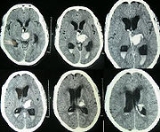
Hydrocephalus

Encyclopedia
Hydrocephalus also known as "water in the brain," is a medical condition in which there is an abnormal accumulation of cerebrospinal fluid
Cerebrospinal fluid
Cerebrospinal fluid , Liquor cerebrospinalis, is a clear, colorless, bodily fluid, that occupies the subarachnoid space and the ventricular system around and inside the brain and spinal cord...
(CSF) in the ventricles
Ventricular system
The ventricular system is a set of structures containing cerebrospinal fluid in the brain. It is continuous with the central canal of the spinal cord.-Components:The system comprises four ventricles:* right and left lateral ventricles* third ventricle...
, or cavities, of the brain
Brain
The brain is the center of the nervous system in all vertebrate and most invertebrate animals—only a few primitive invertebrates such as sponges, jellyfish, sea squirts and starfishes do not have one. It is located in the head, usually close to primary sensory apparatus such as vision, hearing,...
. This may cause increased intracranial pressure
Intracranial pressure
Intracranial pressure is the pressure inside the skull and thus in the brain tissue and cerebrospinal fluid . The body has various mechanisms by which it keeps the ICP stable, with CSF pressures varying by about 1 mmHg in normal adults through shifts in production and absorption of CSF...
inside the skull
Human skull
The human skull is a bony structure, skeleton, that is in the human head and which supports the structures of the face and forms a cavity for the brain.In humans, the adult skull is normally made up of 22 bones...
and progressive enlargement of the head, convulsion, tunnel vision
Tunnel vision
Tunnel vision is the loss of peripheral vision with retention of central vision, resulting in a constricted circular tunnel-like field of vision.- Medical / biological causes :Tunnel vision can be caused by:...
, and mental disability. Hydrocephalus can also cause death. The name derives from the Greek words ὑδρο- (hudro-) "water", and κέφαλος (kephalos) "head".
Signs and symptoms
The clinical presentation of hydrocephalus varies with chronicity. Acute dilatation of the ventricular system is more likely to manifest with the nonspecific signs and symptoms of increased intracranial pressure. By contrast chronic dilatation (especially in the elderly population) may have a more insidious onset presenting, for instance, with Hakim's triad (Adams triad).Symptoms of increased intracranial pressure may include headache
Headache
A headache or cephalalgia is pain anywhere in the region of the head or neck. It can be a symptom of a number of different conditions of the head and neck. The brain tissue itself is not sensitive to pain because it lacks pain receptors. Rather, the pain is caused by disturbance of the...
s, vomiting
Vomiting
Vomiting is the forceful expulsion of the contents of one's stomach through the mouth and sometimes the nose...
, nausea
Nausea
Nausea , is a sensation of unease and discomfort in the upper stomach with an involuntary urge to vomit. It often, but not always, precedes vomiting...
, papilledema
Papilledema
Papilledema is optic disc swelling that is caused by increased intracranial pressure. The swelling is usually bilateral and can occur over a period of hours to weeks. Unilateral presentation is extremely rare....
, sleepiness
Somnolence
Somnolence is a state of near-sleep, a strong desire for sleep, or sleeping for unusually long periods . It has two distinct meanings, referring both to the usual state preceding falling asleep, and the chronic condition referring to being in that state independent of a circadian rhythm...
or coma
Coma
In medicine, a coma is a state of unconsciousness, lasting more than 6 hours in which a person cannot be awakened, fails to respond normally to painful stimuli, light or sound, lacks a normal sleep-wake cycle and does not initiate voluntary actions. A person in a state of coma is described as...
. Elevated intracranial pressure
Intracranial pressure
Intracranial pressure is the pressure inside the skull and thus in the brain tissue and cerebrospinal fluid . The body has various mechanisms by which it keeps the ICP stable, with CSF pressures varying by about 1 mmHg in normal adults through shifts in production and absorption of CSF...
may result in uncal
Temporal lobe
The temporal lobe is a region of the cerebral cortex that is located beneath the Sylvian fissure on both cerebral hemispheres of the mammalian brain....
and/or cerebellar tonsill
Cerebellum
The cerebellum is a region of the brain that plays an important role in motor control. It may also be involved in some cognitive functions such as attention and language, and in regulating fear and pleasure responses, but its movement-related functions are the most solidly established...
herniation, with resulting life threatening brain stem
Brain stem
In vertebrate anatomy the brainstem is the posterior part of the brain, adjoining and structurally continuous with the spinal cord. The brain stem provides the main motor and sensory innervation to the face and neck via the cranial nerves...
compression.
Hakim's triad of gait instability, urinary incontinence
Urinary incontinence
Urinary incontinence is any involuntary leakage of urine. It is a common and distressing problem, which may have a profound impact on quality of life. Urinary incontinence almost always results from an underlying treatable medical condition but is under-reported to medical practitioners...
and dementia
Dementia
Dementia is a serious loss of cognitive ability in a previously unimpaired person, beyond what might be expected from normal aging...
is a relatively typical manifestation of the distinct entity normal pressure hydrocephalus
Normal pressure hydrocephalus
Normal pressure hydrocephalus , also termed symptomatic hydrocephalus, occurs when there is an increase in intracranial pressure due to an abnormal accumulation of cerebrospinal fluid in the ventricles of the brain, which can cause ventriculomegaly...
(NPH). Focal neurological deficits may also occur, such as abducens nerve palsy and vertical gaze palsy (Parinaud syndrome due to compression of the quadrigeminal plate, where the neural centers coordinating the conjugated vertical eye movement are located). The symptoms depend on the cause of the blockage, the person's age, and how much brain tissue has been damaged by the swelling.
In infants with hydrocephalus, CSF builds up in the central nervous system, causing the fontanelle (soft spot) to bulge and the head to be larger than expected. Early symptoms may also include:
- Eyes that appear to gaze downward
- Irritability
- Seizures
- Separated sutures
- Sleepiness
- Vomiting
Symptoms that may occur in older children can include:
- Brief, shrill, high-pitched cry
- Changes in personality, memory, or the ability to reason or think
- Changes in facial appearance and eye spacing
- Crossed eyes or uncontrolled eye movements
- Difficulty feeding
- Excessive sleepiness
- Headache
- Irritability, poor temper control
- Loss of bladder control (urinary incontinence)
- Loss of coordination and trouble walking
- Muscle spasticity (spasm)
- Slow growth (child 0–5 years)
- Slow or restricted movement
- Vomiting http://www.nlm.nih.gov/medlineplus/ency/article/001571.htm Accessed 19 June 2010
History
References to hydrocephalic skulls can be found in ancient Egyptian medicalAncient Egyptian medicine
The medicine of the ancient Egyptians is some of the oldest documented. From the beginnings of the civilization in the until the Persian invasion of 525 BC, Egyptian medical practice went largely unchanged and was highly advanced for its time, including simple non-invasive surgery, setting of...
literature from 2500 BC to 500 AD. Hydrocephalus was described more clearly by the ancient Greek physician Hippocrates
Hippocrates
Hippocrates of Cos or Hippokrates of Kos was an ancient Greek physician of the Age of Pericles , and is considered one of the most outstanding figures in the history of medicine...
in the 4th century BC, while a more accurate description was later given by the Roman
Medicine in ancient Rome
Medicine in ancient Rome combined various techniques using different tools and rituals. Ancient Roman medicine included a number of specializations such as internal medicine, ophthalmology and urology...
physician Galen
Galen
Aelius Galenus or Claudius Galenus , better known as Galen of Pergamon , was a prominent Roman physician, surgeon and philosopher...
in the 2nd century AD. The first clinical description of and operative procedure for hydrocephalus appears in the Al-Tasrif
Al-Tasrif
The Kitab al-Tasrif was an Arabic encyclopedia on medicine and surgery, written near the year 1000 by Abu al-Qasim al-Zahrawi...
(1000 AD) by the Arab surgeon, Abu al-Qasim al-Zahrawi, who clearly described the evacuation of superficial intracranial fluid in hydrocephalic children. He described it in his chapter on neurosurgical disease, describing infantile hydrocephalus as being caused by mechanical compression. He states:
It remained an intractable condition until the 20th century, when shunts
Shunt (medical)
In medicine, a shunt is a hole or a small passage which moves, or allows movement of fluid from one part of the body to another. The term may describe either congenital or acquired shunts; and acquired shunts may be either biological or mechanical.* Cardiac shunts may be described as...
and other neurosurgical treatment modalities were developed. It is a lesser-known medical condition; relatively small amounts of research are conducted to improve treatments for hydrocephalus, and to this day there remains no cure for the condition.
Pathology
Hydrocephalus is usually due to blockage of cerebrospinal fluidCerebrospinal fluid
Cerebrospinal fluid , Liquor cerebrospinalis, is a clear, colorless, bodily fluid, that occupies the subarachnoid space and the ventricular system around and inside the brain and spinal cord...
(CSF) outflow in the ventricles
Ventricular system
The ventricular system is a set of structures containing cerebrospinal fluid in the brain. It is continuous with the central canal of the spinal cord.-Components:The system comprises four ventricles:* right and left lateral ventricles* third ventricle...
or in the subarachnoid space
Subarachnoid space
In the central nervous system, the subarachnoid cavity is the interval between the arachnoid membrane and pia mater....
over the brain. In a person without hydrocephalus, CSF continuously circulates through the brain, its ventricles and the spinal cord
Spinal cord
The spinal cord is a long, thin, tubular bundle of nervous tissue and support cells that extends from the brain . The brain and spinal cord together make up the central nervous system...
and is continuously drained away into the circulatory system. Alternatively, the condition may result from an overproduction of the CSF fluid, from a congenital malformation blocking normal drainage of the fluid, or from complications of head injuries
Head Injuries
Head Injuries is an album by Midnight Oil that was released in 1979 under the Columbia Records label. It was the last Midnight Oil album to feature Andrew James on bass who quit the band due to illness....
or infections.
Compression of the brain by the accumulating fluid eventually may cause convulsions and mental retardation
Mental retardation
Mental retardation is a generalized disorder appearing before adulthood, characterized by significantly impaired cognitive functioning and deficits in two or more adaptive behaviors...
. These signs occur sooner in adults, whose skulls no longer are able to expand to accommodate the increasing fluid volume within. Fetuses, infants, and young children with hydrocephalus typically have an abnormally large head, excluding the face, because the pressure of the fluid causes the individual skull bones — which have yet to fuse — to bulge outward at their juncture points. Another medical sign
Medical sign
A medical sign is an objective indication of some medical fact or characteristic that may be detected by a physician during a physical examination of a patient....
, in infants, is a characteristic fixed downward gaze with whites of the eyes showing above the iris, as though the infant were trying to examine its own lower eyelids.
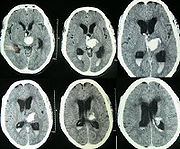
If the foramina (pl.) of the fourth ventricle
Fourth ventricle
The fourth ventricle is one of the four connected fluid-filled cavities within the human brain. These cavities, known collectively as the ventricular system, consist of the left and right lateral ventricles, the third ventricle, and the fourth ventricle...
or the cerebral aqueduct
Cerebral aqueduct
The mesencephalic duct, also known as the aqueductus mesencephali, aqueduct of Sylvius or the cerebral aqueduct, contains cerebrospinal fluid , is within the mesencephalon and connects the third ventricle in the diencephalon to the fourth ventricle in the mesencephalon, which is between the pons...
are blocked, cereobrospinal fluid (CSF) can accumulate within the ventricles. This condition is called internal hydrocephalus and it results in increased CSF pressure. The production of CSF continues, even when the passages that normally allow it to exit the brain are blocked. Consequently, fluid builds inside the brain causing pressure that compresses the nervous tissue
Nervous tissue
Nervous tissue is one of four major classes of vertebrate tissue.Nervous tissue is the main component of the nervous system - the brain, spinal cord, and nerves-which regulates and controls body functions...
and dilates the ventricles. Compression of the nervous tissue usually results in irreversible brain damage. If the skull
Human skull
The human skull is a bony structure, skeleton, that is in the human head and which supports the structures of the face and forms a cavity for the brain.In humans, the adult skull is normally made up of 22 bones...
bones are not completely ossified when the hydrocephalus occurs, the pressure may also severely enlarge the head. The cerebral aqueduct may be blocked at the time of birth
Birth
Birth is the act or process of bearing or bringing forth offspring. The offspring is brought forth from the mother. The time of human birth is defined as the time at which the fetus comes out of the mother's womb into the world...
or may become blocked later in life because of a tumor
Tumor
A tumor or tumour is commonly used as a synonym for a neoplasm that appears enlarged in size. Tumor is not synonymous with cancer...
growing in the brainstem.
Internal hydrocephalus can be successfully treated by placing a drainage tube (shunt) between the brain ventricles and abdominal cavity to eliminate the high internal pressures. There is some risk of infection
Infection
An infection is the colonization of a host organism by parasite species. Infecting parasites seek to use the host's resources to reproduce, often resulting in disease...
being introduced into the brain through these shunts, however, and the shunts must be replaced as the person grows. A subarachnoid hemorrhage may block the return of CSF to the circulation. If CSF accumulates in the subarachnoid space
Subarachnoid space
In the central nervous system, the subarachnoid cavity is the interval between the arachnoid membrane and pia mater....
, the condition is called external hydrocephalus. In this condition, pressure is applied to the brain externally, compressing neural tissues and causing brain damage. Thus resulting in further damage of the brain tissue and leading to necrotization.
Classification
Hydrocephalus can be caused by impaired cerebrospinal fluidCerebrospinal fluid
Cerebrospinal fluid , Liquor cerebrospinalis, is a clear, colorless, bodily fluid, that occupies the subarachnoid space and the ventricular system around and inside the brain and spinal cord...
(CSF) flow, reabsorption, or excessive CSF production.
- The most common cause of hydrocephalus is CSF flow obstructionObstructionObstruction may refer to:* Obstruction theory, in mathematics* Obstruction of justice, the crime of interfering with law enforcement* Obstructing government administration* Propagation path obstruction** Single Vegetative Obstruction Model-Medical:...
, hindering the free passage of cerebrospinal fluid through the ventricular system and subarachnoid spaceSubarachnoid spaceIn the central nervous system, the subarachnoid cavity is the interval between the arachnoid membrane and pia mater....
(e.g., stenosisStenosisA stenosis is an abnormal narrowing in a blood vessel or other tubular organ or structure.It is also sometimes called a stricture ....
of the cerebral aqueductCerebral aqueductThe mesencephalic duct, also known as the aqueductus mesencephali, aqueduct of Sylvius or the cerebral aqueduct, contains cerebrospinal fluid , is within the mesencephalon and connects the third ventricle in the diencephalon to the fourth ventricle in the mesencephalon, which is between the pons...
or obstruction of the interventricular foraminaInterventricular foraminaIn the brain, the interventricular foramina are channels that connect the paired lateral ventricles with the third ventricle at the midline of the brain. As channels, they allow cerebrospinal fluid produced in the lateral ventricles to reach the third ventricle and then the rest of the brain's...
- foramina of Monro secondary to tumorTumorA tumor or tumour is commonly used as a synonym for a neoplasm that appears enlarged in size. Tumor is not synonymous with cancer...
s, hemorrhages, infectionInfectionAn infection is the colonization of a host organism by parasite species. Infecting parasites seek to use the host's resources to reproduce, often resulting in disease...
s or congenital malformations). - Hydrocephalus can also be caused by overproduction of cerebrospinal fluid (relative obstruction) (e.g., papilloma of choroid plexus).
Based on its underlying mechanisms, hydrocephalus can be classified into communicating and non-communicating (obstructive). Both forms can be either congenital or acquired.
Communicating
Communicating hydrocephalus, also known as non-obstructive hydrocephalus, is caused by impaired cerebrospinal fluid resorption in the absence of any CSF-flow obstruction between the ventricles and subarachnoid space. It has been theorized that this is due to functional impairment of the arachnoidal granulations (also called arachnoid granulations or Pacchioni's granulations), which are located along the superior sagittal sinusSuperior sagittal sinus
The superior sagittal sinus , within the human head, is an unpaired area along the attached margin of falx cerebri. It allows blood to drain from the lateral aspects of anterior cerebral hemispheres to the confluence of sinuses...
and is the site of cerebrospinal fluid resorption back into the venous system. Various neurologic conditions may result in communicating hydrocephalus, including subarachnoid/intraventricular hemorrhage, meningitis
Meningitis
Meningitis is inflammation of the protective membranes covering the brain and spinal cord, known collectively as the meninges. The inflammation may be caused by infection with viruses, bacteria, or other microorganisms, and less commonly by certain drugs...
and congenital absence of arachnoid villi. Scarring and fibrosis of the subarachnoid space
Subarachnoid space
In the central nervous system, the subarachnoid cavity is the interval between the arachnoid membrane and pia mater....
following infectious, inflammatory, or hemorrhagic events can also prevent resorption of CSF, causing diffuse ventricular dilatation.
- Normal pressure hydrocephalusNormal pressure hydrocephalusNormal pressure hydrocephalus , also termed symptomatic hydrocephalus, occurs when there is an increase in intracranial pressure due to an abnormal accumulation of cerebrospinal fluid in the ventricles of the brain, which can cause ventriculomegaly...
(NPH) is a particular form of communicating hydrocephalus, characterized by enlarged cerebral ventricles, with only intermittently elevated cerebrospinal fluid pressure. The diagnosis of NPH can be established only with the help of continuous intraventricular pressure recordings (over 24 hours or even longer), since more often than not instant measurements yield normal pressure values. Dynamic compliance studies may be also helpful. Altered compliance (elasticity) of the ventricular walls, as well as increased viscosityViscosityViscosity is a measure of the resistance of a fluid which is being deformed by either shear or tensile stress. In everyday terms , viscosity is "thickness" or "internal friction". Thus, water is "thin", having a lower viscosity, while honey is "thick", having a higher viscosity...
of the cerebrospinal fluid, may play a role in the pathogenesis of normal pressure hydrocephalusNormal pressure hydrocephalusNormal pressure hydrocephalus , also termed symptomatic hydrocephalus, occurs when there is an increase in intracranial pressure due to an abnormal accumulation of cerebrospinal fluid in the ventricles of the brain, which can cause ventriculomegaly...
.
- Hydrocephalus ex vacuo also refers to an enlargement of cerebral ventricles and subarachnoid spaces, and is usually due to brain atrophyAtrophyAtrophy is the partial or complete wasting away of a part of the body. Causes of atrophy include mutations , poor nourishment, poor circulation, loss of hormonal support, loss of nerve supply to the target organ, disuse or lack of exercise or disease intrinsic to the tissue itself...
(as it occurs in dementiaDementiaDementia is a serious loss of cognitive ability in a previously unimpaired person, beyond what might be expected from normal aging...
s), post-traumatic brain injuriesTraumatic brain injuryTraumatic brain injury , also known as intracranial injury, occurs when an external force traumatically injures the brain. TBI can be classified based on severity, mechanism , or other features...
and even in some psychiatric disorders, such as schizophreniaSchizophreniaSchizophrenia is a mental disorder characterized by a disintegration of thought processes and of emotional responsiveness. It most commonly manifests itself as auditory hallucinations, paranoid or bizarre delusions, or disorganized speech and thinking, and it is accompanied by significant social...
. As opposed to hydrocephalus, this is a compensatory enlargement of the CSF-spaces in response to brain parenchymaParenchymaParenchyma is a term used to describe a bulk of a substance. It is used in different ways in animals and in plants.The term is New Latin, f. Greek παρέγχυμα - parenkhuma, "visceral flesh", f. παρεγχεῖν - parenkhein, "to pour in" f. para-, "beside" + en-, "in" + khein, "to pour"...
loss - it is not the result of increased CSF pressure.
Non-communicating
Non-communicating hydrocephalus, or obstructive hydrocephalus, is caused by a CSF-flow obstruction ultimately preventing CSF from flowing into the subarachnoid space (either due to external compression or intraventricular mass lesions).- Foramen of MonroInterventricular foraminaIn the brain, the interventricular foramina are channels that connect the paired lateral ventricles with the third ventricle at the midline of the brain. As channels, they allow cerebrospinal fluid produced in the lateral ventricles to reach the third ventricle and then the rest of the brain's...
obstruction may lead to dilation of one or, if large enough (e.g., in Colloid cystColloid cystA colloid cyst is a cyst containing gelatinous material in the brain. It is almost always found just posterior to the foramen of Monro in the anterior aspect of the third ventricle, originating from the roof of the ventricle. Because of its location, it can cause obstructive hydrocephalus and...
), both lateral ventricles. - The aqueduct of SylviusCerebral aqueductThe mesencephalic duct, also known as the aqueductus mesencephali, aqueduct of Sylvius or the cerebral aqueduct, contains cerebrospinal fluid , is within the mesencephalon and connects the third ventricle in the diencephalon to the fourth ventricle in the mesencephalon, which is between the pons...
, normally narrow to begin with, may be obstructed by a number of genetically or acquired lesions (e.g., atresia, ependymitis, hemorrhage, tumor) and lead to dilation of both lateral ventricles as well as the third ventricle. - Fourth ventricleFourth ventricleThe fourth ventricle is one of the four connected fluid-filled cavities within the human brain. These cavities, known collectively as the ventricular system, consist of the left and right lateral ventricles, the third ventricle, and the fourth ventricle...
obstruction will lead to dilatation of the aqueduct as well as the lateral and third ventricles (e.g., Chiari malformation). - The foramina of Luschka and foramen of MagendieMedian apertureThe median aperture drains CSF from the fourth ventricle into the cisterna magna. The two lateral apertures , one on the left and one on the right, are the primary routes for drainage of cerebrospinal fluid from the fourth ventricle into the cerebellopontine angle cistern...
may be obstructed due to congenital failure of opening (e.g., Dandy-Walker malformation).
Congenital
The cranial bones fuse by the end of the third year of life. For head enlargement to occur, hydrocephalus must occur before then. The causes are usually genetic but can also be acquired and usually occur within the first few months of life, which include 1) intraventricular matrix hemorrhages in premature infants, 2) infections, 3) type II Arnold-Chiari malformationArnold-Chiari malformation
Arnold–Chiari malformation, or often simply Chiari malformation, is a malformation of the brain. It consists of a downward displacement of the cerebellar tonsils through the foramen magnum , sometimes causing non-communicating hydrocephalus as a result of obstruction of cerebrospinal fluid outflow...
, 4) aqueduct atresia and stenosis, and 5) Dandy-Walker malformation.
In newborns and toddlers with hydrocephalus, the head circumference is enlarged rapidly and soon surpasses the 97th percentile. Since the skull bones have not yet firmly joined together, bulging, firm anterior and posterior fontanelles may be present even when the patient is in an upright position.
The infant exhibits fretfulness, poor feeding, and frequent vomiting. As the hydrocephalus progresses, torpor sets in, and the infant shows lack of interest in his surroundings. Later on, the upper eyelids become retracted and the eyes are turned downwards (due to hydrocephalic pressure on the mesencephalic tegmentum and paralysis of upward gaze). Movements become weak and the arms may become tremulous. Papilledema is absent but there may be reduction of vision. The head becomes so enlarged that the child may eventually be bedridden.
About 80-90% of fetuses or newborn infants with spina bifida
Spina bifida
Spina bifida is a developmental congenital disorder caused by the incomplete closing of the embryonic neural tube. Some vertebrae overlying the spinal cord are not fully formed and remain unfused and open. If the opening is large enough, this allows a portion of the spinal cord to protrude through...
—often associated with meningocele or myelomeningocele—develop hydrocephalus.
Acquired
This condition is acquired as a consequence of CNS infections, meningitisMeningitis
Meningitis is inflammation of the protective membranes covering the brain and spinal cord, known collectively as the meninges. The inflammation may be caused by infection with viruses, bacteria, or other microorganisms, and less commonly by certain drugs...
, brain tumors, head trauma
Traumatic brain injury
Traumatic brain injury , also known as intracranial injury, occurs when an external force traumatically injures the brain. TBI can be classified based on severity, mechanism , or other features...
, intracranial hemorrhage
Stroke
A stroke, previously known medically as a cerebrovascular accident , is the rapidly developing loss of brain function due to disturbance in the blood supply to the brain. This can be due to ischemia caused by blockage , or a hemorrhage...
(subarachnoid or intraparenchymal) and is usually extremely painful.
Effects
Because hydrocephalus can injure the brain, thought and behavior may be adversely affected. Learning disabilitiesLearning disability
Learning disability is a classification including several disorders in which a person has difficulty learning in a typical manner, usually caused by an unknown factor or factors...
including short-term memory loss are common among those with hydrocephalus, who tend to score better on verbal IQ than on performance IQ, which is thought to reflect the distribution of nerve damage to the brain. However the severity of hydrocephalus can differ considerably between individuals and some are of average or above-average intelligence. Someone with hydrocephalus may have motion and visual problems, problems with coordination, or may be clumsy. They may reach puberty earlier than the average child (see precocious puberty
Precocious puberty
As a medical term, precocious puberty describes puberty occurring at an unusually early age. In most of these children, the process is normal in every respect except the unusually early age, and simply represents a variation of normal development. In a minority of children, the early development is...
). About one in four develops epilepsy
Epilepsy
Epilepsy is a common chronic neurological disorder characterized by seizures. These seizures are transient signs and/or symptoms of abnormal, excessive or hypersynchronous neuronal activity in the brain.About 50 million people worldwide have epilepsy, and nearly two out of every three new cases...
.
Treatment
Hydrocephalus treatmentTreatment
Treatment may refer to:* Treatment, therapy used to remedy a health problem* Treatment, a process or intervention in the design of experiments* Treatment group, a collection of items or individuals given the same treatment in an experiment* Water treatment...
is surgical, generally creating various types of cerebral shunt
Cerebral shunt
Cerebral shunts are commonly used to treat hydrocephalus, the swelling of the brain due to excess buildup of cerebrospinal fluid . If left unchecked, the cerebral spinal fluid can build up leading to an increase in intracranial pressure which can lead to intracranial hematoma, cerebral edema,...
s. It involves the placement of a ventricular catheter
Catheter
In medicine, a catheter is a tube that can be inserted into a body cavity, duct, or vessel. Catheters thereby allow drainage, administration of fluids or gases, or access by surgical instruments. The process of inserting a catheter is catheterization...
(a tube made of silastic
Silastic
Silastic is a trademark registered in 1948 by Dow Corning Corporation for flexible, inert silicone elastomer...
), into the cerebral ventricles to bypass the flow obstruction/malfunctioning arachnoidal granulations and drain the excess fluid into other body cavities, from where it can be resorbed. Most shunts drain the fluid into the peritoneal cavity
Peritoneum
The peritoneum is the serous membrane that forms the lining of the abdominal cavity or the coelom — it covers most of the intra-abdominal organs — in amniotes and some invertebrates...
(ventriculo-peritoneal shunt
Cerebral shunt
Cerebral shunts are commonly used to treat hydrocephalus, the swelling of the brain due to excess buildup of cerebrospinal fluid . If left unchecked, the cerebral spinal fluid can build up leading to an increase in intracranial pressure which can lead to intracranial hematoma, cerebral edema,...
), but alternative sites include the right atrium
Right atrium
The right atrium is one of four chambers in the hearts of mammals and archosaurs...
(ventriculo-atrial shunt
Cerebral shunt
Cerebral shunts are commonly used to treat hydrocephalus, the swelling of the brain due to excess buildup of cerebrospinal fluid . If left unchecked, the cerebral spinal fluid can build up leading to an increase in intracranial pressure which can lead to intracranial hematoma, cerebral edema,...
), pleural cavity (ventriculo-pleural shunt
Cerebral shunt
Cerebral shunts are commonly used to treat hydrocephalus, the swelling of the brain due to excess buildup of cerebrospinal fluid . If left unchecked, the cerebral spinal fluid can build up leading to an increase in intracranial pressure which can lead to intracranial hematoma, cerebral edema,...
), and gallbladder
Gallbladder
In vertebrates the gallbladder is a small organ that aids mainly in fat digestion and concentrates bile produced by the liver. In humans the loss of the gallbladder is usually easily tolerated....
. A shunt system can also be placed in the lumbar space of the spine and have the CSF redirected to the peritoneal cavity
Peritoneal cavity
The peritoneal cavity is a potential space between the parietal peritoneum and visceral peritoneum, that is, the two membranes that separate the organs in the abdominal cavity from the abdominal wall...
(Lumbar-peritoneal shunt
Lumbar-peritoneal shunt
A lumbar-peritoneal shunt is a type of cerebral shunt.-Lumbar-peritoneal shunt:A shunt is described as a tube, catheter or "surgically created anastomosis" and is designed to bypass or redirect bodily fluids from one point in the body to another....
). An alternative treatment for obstructive hydrocephalus in selected patients is the endoscopic third ventriculostomy
Endoscopic third ventriculostomy
Endoscopic third ventriculostomy is a surgical procedure in which an opening is created in the floor of the third ventricle using an endoscope placed within the ventricular system through a burr hole. This allows the cerebrospinal fluid to flow directly to the basal cisterns, thereby shortcutting...
(ETV), whereby a surgically created opening in the floor of the third ventricle allows the CSF to flow directly to the basal cisterns, thereby shortcutting any obstruction, as in aqueductal stenosis. This may or may not be appropriate based on individual anatomy.
Shunt complications
Examples of possible complications include shunt malfunction, shunt failure, and shunt infection, along with infection of the shunt tract following surgery (the most common reason for shunt failure is infection of the shunt tract). Although a shunt generally works well, it may stop working if it disconnects, becomes blocked (clogged), infected, or it is outgrown. If this happens the cerebrospinal fluid will begin to accumulate again and a number of physical symptoms will develop (headaches, nausea, vomiting, photophobia/light sensitivity), some extremely serious, like seizureSeizure
An epileptic seizure, occasionally referred to as a fit, is defined as a transient symptom of "abnormal excessive or synchronous neuronal activity in the brain". The outward effect can be as dramatic as a wild thrashing movement or as mild as a brief loss of awareness...
s. The shunt failure rate is also relatively high (of the 40,000 surgeries performed annually to treat hydrocephalus, only 30% are a patient's first surgery) and it is not uncommon for patients to have multiple shunt revisions within their lifetime.
The diagnosis of cerebrospinal fluid buildup is complex and requires specialist expertise.
Another complication can occur when CSF drains more rapidly than it is produced by the choroid plexus
Choroid plexus
The choroid plexus is a structure in the ventricles of the brain where cerebrospinal fluid is produced...
, causing symptoms -listlessness, severe headaches, irritability
Irritability
Irritability is an excessive response to stimuli. The term is used for both the physiological reaction to stimuli and for the pathological, abnormal or excessive sensitivity to stimuli; It is usually used to refer to anger or frustration....
, light sensitivity
Light sensitivity
Light sensitivity or photosensitivity is an increase in the reactivity of the skin to sunlight. Apart from vision, human beings have many physiological and psychological responses to light. In rare individuals an atypical response may result in serious discomfort, disease, or injury. Some drugs...
, auditory hyperesthesia
Hyperesthesia
Hyperesthesia is a condition that involves an abnormal increase in sensitivity to stimuli of the sense. "When a non-noxious stimulus causes the sensation of pain the area will be termed hyperaesthetic". Stimuli of the senses can include sound that one hears, foods that one tastes, textures that...
(sound sensitivity), nausea
Nausea
Nausea , is a sensation of unease and discomfort in the upper stomach with an involuntary urge to vomit. It often, but not always, precedes vomiting...
, vomiting
Vomiting
Vomiting is the forceful expulsion of the contents of one's stomach through the mouth and sometimes the nose...
, dizziness
Dizziness
Dizziness refers to an impairment in spatial perception and stability. The term is somewhat imprecise. It can be used to mean vertigo, presyncope, disequilibrium, or a non-specific feeling such as giddiness or foolishness....
, vertigo
Vertigo (medical)
Vertigo is a type of dizziness, where there is a feeling of motion when one is stationary. The symptoms are due to a dysfunction of the vestibular system in the inner ear...
, migraines, seizures, a change in personality, weakness
Weakness
Weakness is a symptom represented, medically, by a number of different conditions, including: lack of muscle strength, malaise, dizziness, or fatigue. The causes are many and can be divided into conditions that have true or perceived muscle weakness. True muscle weakness is a primary symptom of a...
in the arms or legs, strabismus
Strabismus
Strabismus is a condition in which the eyes are not properly aligned with each other. It typically involves a lack of coordination between the extraocular muscles, which prevents bringing the gaze of each eye to the same point in space and preventing proper binocular vision, which may adversely...
, and double vision
Diplopia
Diplopia, commonly known as double vision, is the simultaneous perception of two images of a single object that may be displaced horizontally, vertically, or diagonally in relation to each other...
- to appear when the patient is vertical. If the patient lies down, the symptoms usually vanish in a short amount of time. A CT scan may or may not show any change in ventricle size, particularly if the patient has a history of slit-like ventricles. Difficulty in diagnosing overdrainage can make treatment of this complication particularly frustrating for patients and their families.
Resistance to traditional analgesic
Analgesic
An analgesic is any member of the group of drugs used to relieve pain . The word analgesic derives from Greek an- and algos ....
pharmacological therapy may also be a sign of shunt overdrainage or failure. Diagnosis of the particular complication usually depends on when the symptoms appear - that is, whether symptoms occur when the patient is upright or in a prone position, with the head at roughly the same level as the feet.
Shunts in developing countries
Since the cost of shunt systems is beyond the reach of common people in developing countries, most people with hydrocephalus die without even getting a shunt. Worse is the rate of revision in shunt systems that adds to the cost of shunting many times. Looking at this point, a study done by Dr. Benjamin C. Warf compares different shunt systems and highlighting the role of low cost shunt systems in most of the developing countries. This study has been published in Journal of NeurosurgeryNeurosurgery
Neurosurgery is the medical specialty concerned with the prevention, diagnosis, treatment, and rehabilitation of disorders which affect any portion of the nervous system including the brain, spine, spinal cord, peripheral nerves, and extra-cranial cerebrovascular system.-In the United States:In...
: Pediatrics May 2005 issue. It is about comparing Chhabra shunt system to those of the shunt systems from developed countries. The study was done in Uganda
Uganda
Uganda , officially the Republic of Uganda, is a landlocked country in East Africa. Uganda is also known as the "Pearl of Africa". It is bordered on the east by Kenya, on the north by South Sudan, on the west by the Democratic Republic of the Congo, on the southwest by Rwanda, and on the south by...
and the shunts were donated by the International Federation for Spina Bifida and Hydrocephalus.
Exceptional case
One interesting case involving a person with past hydrocephalus was a 44-year old FrenchFrance
The French Republic , The French Republic , The French Republic , (commonly known as France , is a unitary semi-presidential republic in Western Europe with several overseas territories and islands located on other continents and in the Indian, Pacific, and Atlantic oceans. Metropolitan France...
man, whose brain had been reduced to little more than a thin sheet of actual brain tissue, due to the buildup of cerebrospinal fluid in his head. The man, who had had a shunt inserted into his head to drain away fluid (which was removed when he was 14), went to a hospital after he had been experiencing mild weakness in his left leg.
In July 2007, Fox News quoted Dr. Lionel Feuillet of Hôpital de la Timone in Marseille
Marseille
Marseille , known in antiquity as Massalia , is the second largest city in France, after Paris, with a population of 852,395 within its administrative limits on a land area of . The urban area of Marseille extends beyond the city limits with a population of over 1,420,000 on an area of...
as saying: "The images were most unusual... the brain was virtually absent." When doctors learned of the man's medical history, they performed a computed tomography
Computed tomography
X-ray computed tomography or Computer tomography , is a medical imaging method employing tomography created by computer processing...
(CT) scan and magnetic resonance imaging
Magnetic resonance imaging
Magnetic resonance imaging , nuclear magnetic resonance imaging , or magnetic resonance tomography is a medical imaging technique used in radiology to visualize detailed internal structures...
(MRI) scan, and were astonished to see "massive enlargement" of the lateral ventricles
Lateral ventricles
The lateral ventricles are part of the ventricular system of the brain. Classified as part of the telencephalon, they are the largest of the ventricles....
in the skull. Intelligence tests showed the man had an IQ of 75, below the average score of 100. This would be considered "borderline intellectual functioning"- which is just next to the level of being officially considered mentally challenged.
Remarkably, the man was a married father of two children, and worked as a civil servant, leading an at least superficially normal life, despite having enlarged ventricles with a decreased volume of brain tissue. "What I find amazing to this day is how the brain can deal with something which you think should not be compatible with life," commented Dr. Max Muenke, a pediatric brain defect specialist at the National Human Genome Research Institute. "If something happens very slowly over quite some time, maybe over decades, the different parts of the brain take up functions that would normally be done by the part that is pushed to the side."
Famous people with hydrocephalus
According to Maureen Waller, author of Ungrateful Daughters (2002), the son of Queen Anne of Britain, Prince William, Duke of Gloucester (1689-1700) is believed to have had hydrocephalus, both due to the size of his head and to autopsy reports following his death at age 11 from a fever. He was believed by his contemporaries to have above average intelligence; however, he did not speak properly until the age of three and had difficulty balancing and climbing stairs throughout his short life.Author Sherman Alexie
Sherman Alexie
Sherman Joseph Alexie, Jr. is a writer, poet, filmmaker, and occasional comedian. Much of his writing draws on his experiences as a Native American. Two of Alexie's best known works are The Lone Ranger and Tonto Fistfight in Heaven , a book of short stories and Smoke Signals, a film...
was born with Hydrocephalus, which he wrote about in his autobiographical junior fiction novel The Absolutely True Diary of a Part-Time Indian
The Absolutely True Diary of a Part-Time Indian
The Absolutely True Diary of a Part Time Indian is a novel for young adults written by Sherman Alexie. It is told in the first-person, from the viewpoint of Native American teenager and budding cartoonist Arnold Spirit, Jr....
.
Fictional serial killer Jason Voorhees
Jason Voorhees
Jason Voorhees is a fictional character from the Friday the 13th series of slasher films. He first appeared in Friday the 13th , as the son of camp cook-turned-murderer, Mrs. Voorhees, in which he was portrayed by Ari Lehman. Created by Victor Miller, with contributions by Ron Kurz, Sean S...
is afflicted with this condition, and is ridiculed by the campers of Crystal Lake because of this.
Emperor Ferdinand I of Austria
Ferdinand I of Austria
Ferdinand I was Emperor of Austria, President of the German Confederation, King of Hungary and Bohemia , as well as associated dominions from the death of his father, Francis II, Holy Roman Emperor, until his abdication after the Revolutions of 1848.He married Maria Anna of Savoy, the sixth child...
is suspected to have had hydrocephalus, on account of the shape of his head and apparent mild mental handicap.
Also 4-year-old Filippo de' Medici
Filippo de' Medici
Filippo de' Medici was the youngest child of Francesco I de' Medici and Johanna of Austria. He was the heir to the Tuscan throne.-Life:Filippo received his name in honour of the King Philip II of Spain...
died of hydrocephalus.
Son of the ex-Yugoslav footballer and Real Madrid sports director Predrag Mijatović
Predrag Mijatovic
Predrag "Peđa" Mijatović is a Montenegrin football player and former sports director of Real Madrid. He is considered one of Yugoslavia's best players of the 1990s. He was acclaimed as the best athlete of Yugoslavia in 1997...
, Andreja died at the age of 14 after a long battle with
Hydrocephalus.
Awareness Ribbon
Hydrocephalus is represented by a two tone blue ribbon, often used with a crystal water droplet to represent CSF (cerebralspinal fluid)See also
- Spina bifidaSpina bifidaSpina bifida is a developmental congenital disorder caused by the incomplete closing of the embryonic neural tube. Some vertebrae overlying the spinal cord are not fully formed and remain unfused and open. If the opening is large enough, this allows a portion of the spinal cord to protrude through...
- Acquired hydrocephalus (causes of it)
- CNSCentral nervous systemThe central nervous system is the part of the nervous system that integrates the information that it receives from, and coordinates the activity of, all parts of the bodies of bilaterian animals—that is, all multicellular animals except sponges and radially symmetric animals such as jellyfish...
-infections - Brain tumors
- Head traumaTraumatic brain injuryTraumatic brain injury , also known as intracranial injury, occurs when an external force traumatically injures the brain. TBI can be classified based on severity, mechanism , or other features...
- Intracranial hemorrhageStrokeA stroke, previously known medically as a cerebrovascular accident , is the rapidly developing loss of brain function due to disturbance in the blood supply to the brain. This can be due to ischemia caused by blockage , or a hemorrhage...
- CNS
- Arachnoid granulationArachnoid granulationArachnoid granulations are small protrusions of the arachnoid through the dura mater...
- BrainBrainThe brain is the center of the nervous system in all vertebrate and most invertebrate animals—only a few primitive invertebrates such as sponges, jellyfish, sea squirts and starfishes do not have one. It is located in the head, usually close to primary sensory apparatus such as vision, hearing,...
- Cerebrospinal fluidCerebrospinal fluidCerebrospinal fluid , Liquor cerebrospinalis, is a clear, colorless, bodily fluid, that occupies the subarachnoid space and the ventricular system around and inside the brain and spinal cord...
- Intracranial pressureIntracranial pressureIntracranial pressure is the pressure inside the skull and thus in the brain tissue and cerebrospinal fluid . The body has various mechanisms by which it keeps the ICP stable, with CSF pressures varying by about 1 mmHg in normal adults through shifts in production and absorption of CSF...
- Normal pressure hydrocephalusNormal pressure hydrocephalusNormal pressure hydrocephalus , also termed symptomatic hydrocephalus, occurs when there is an increase in intracranial pressure due to an abnormal accumulation of cerebrospinal fluid in the ventricles of the brain, which can cause ventriculomegaly...
- Cerebral shuntCerebral shuntCerebral shunts are commonly used to treat hydrocephalus, the swelling of the brain due to excess buildup of cerebrospinal fluid . If left unchecked, the cerebral spinal fluid can build up leading to an increase in intracranial pressure which can lead to intracranial hematoma, cerebral edema,...
- Subarachnoid spaceSubarachnoid spaceIn the central nervous system, the subarachnoid cavity is the interval between the arachnoid membrane and pia mater....
- Ventricular systemVentricular systemThe ventricular system is a set of structures containing cerebrospinal fluid in the brain. It is continuous with the central canal of the spinal cord.-Components:The system comprises four ventricles:* right and left lateral ventricles* third ventricle...
- VentriculomegalyVentriculomegalyVentriculomegaly is a brain condition that occurs when the lateral ventricles become dilated. The most common definition uses a width of the atrium of the lateral ventricle of greater than 10 mm. This occurs in around 1% of pregnancies. When this measurement is between 10 and 15 mm, the...
- HEC syndromeHEC syndromeHEC syndrome is a syndrome characterized by hydrocephalus, endocardial fibroelastosis and cataracts....
External links
- http://www.fetalhydrocephalus.com/hydro/default.aspx A site dedicated to helping parents and families of children with congenital hydrocephalus. In addition to the usual medical definitions of what hydrocephalus is, it focuses on how to take care of these children at home. It provides information on many aspects of hydrocephalus, including personal stories.
- International Federation for Spina Bifida and Hydrocephalus (IF), the umbrella organisation for national spina bifida and hydrocephalus organisations
- Hydrocephalus Association at hydroassoc.org, US
- Hydrocephalus Clinical Research Network (HCRN) a multi-center clinical research network collaboration of several leading pediatric neurosurgeons in North America.
- Team Hydro a group affiliated with the Hydrocephalus Association in US, swims from Alcatraz to San Francisco every year to raise awareness and fund research for a cure
- Fetal Hydrocephalus Information about diagnosis and treatment for fetal hydrocephalus from the Center for Fetal Diagnosis and Treatment at The Children's Hospital of Philadelphia
- Hydrocephalus Support Association Australian Support Group.