

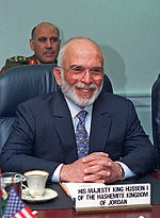
Hussein of Jordan

Encyclopedia
Hussein bin Talal was the third King of Jordan
from the abdication of his father, King Talal
, in 1952, until his death. Hussein's rule extended through the Cold War
and four decades of Arab-Israeli conflict. He recognized Israel in 1994, becoming the second Arab head of state to do so.
Hussein's family claims to descent from the Islamic prophet Muhammad
and his clan
.
on 14 November 1935 to Talal bin Abdullah
and Princess Zein al-Sharaf bint Jamil. After completing his elementary education in Amman, he was educated at Victoria College
in Alexandria
. He proceeded to Harrow School
in England
, where he befriended his cousin Faisal II of Iraq
. He pursued further study at the Royal Military Academy Sandhurst
.
On 20 July 1951, Prince Hussein traveled to Jerusalem to perform Friday prayers at the Al-Aqsa Mosque
with his grandfather, King Abdullah I
, where an assassin opened fire on Abdullah and his grandson. Abdullah was killed, but the 15-year-old Hussein survived the assassination attempt, and according to the Jordanian government, pursued the gunman. The Jordanian government claims that the gunman turned his weapon on the young prince, who was saved when the bullet was deflected by a medal on his uniform which had been given to him by his grandfather.
Hussein was appointed Crown Prince of Jordan on 9 September 1951. Abdullah's eldest son, King Talal
, became King of Jordan, but within a year was forced to abdicate owing to his mental state (European and Arab doctors diagnosed schizophrenia). King Talal's son, Crown Prince Hussein, was proclaimed King of the Hashemite Kingdom of Jordan on 11 August 1952, succeeding at the age of 16; because this was under the legal age, he was enthroned a year later, on 2 May 1953.
Hussein was an avid amateur radio
operator and an Honorary Member of the Radio Society of Harrow (callsign JY1). A trained aircraft pilot, he was also known for flying airplanes (propeller and jet), as well as helicopter
s as a hobby.
King Hussein was succeeded as king by his eldest son Abdullah II of Jordan
.
as the commander of the Jordanian Army, and replacing all the British officers with Jordanians. This now mainly Bedouin
army was fiercely loyal to him, due to tribal connections.
Hussein's rule was marred with secret collaboration with Israel and the United States, which often adversely affected the surrounding Arab States and peoples, including the Palestinians. Secret meetings between King Hussein and Israeli foreign ministers Abba Eban
and Golda Meir
began on or before 1963. At first the meetings took place in London at the home of Dr. Emanuel Herbert, King Hussein's physician. Dr. Herbert, a Jew who desired to help Hussein and the Israeli government became the confidential go-between for contact between Israel and Jordan. Jordan, sharing the longest contiguous border with Israel was very interested in maintaining a peaceful posture towards Israel. As Avi Shlaim
states Hussein's "...purpose throughout the 1960s was to see if there was any way to resolve the dispute with Israel peacefully."
King Hussein sought to understand Israel's position and preferred dialogue to the futility of war with its many dangers. Much of this desire grows out of the threat from other Arab states, specifically the Ba'athist regimes in Iraq and Syria and Nasser's ideology of Arab nationalism which had heavily influenced the Army. The first secret meeting took place on September 24, 1963 between King Hussein and Yaacov Herzog, a diplomat with wide experience and special emissary of prime minister Levi Eshkol
. Among other things such as discussions regarding water rights, the purpose of the meetings were to plan and support Israeli and Jordanian initiatives in combating Fatah
guerrillas. Hussein accepted minor raids into Jordanian territory by the Israeli Defence Forces. He would later state "I told them I could not absorb a serious retaliatory raid, and they accepted the logic of this and promised there would never be one".
On Nov 13, 1966, Israeli military conducted a major incursion into Jordanian territory, violating their secret agreement with King Hussein, in what became known as the Samu Incident
. Two days later, in response to the incident, in a memo to U.S. President
Lyndon B. Johnson
, his Special Assistant Walt Rostow
wrote: "retaliation is not the point in this case. This 3000-man raid with tanks and planes was out of all proportion to the provocation and was aimed at the wrong target," and went on to describe the damage done to US and Israeli interests:
Perception of King Hussein's secret collaboration with Israel led to great dissatisfaction of his rule both at home and throughout the Arab World. President Gamal Abdul Nasser of Egypt
often referred to Hussein as "an "imperialist lackey". Army Commander-in-Chief General Sharif Zaid Ben Shaker warned in a press conference that "If Jordan does not join the war a civil war will erupt in Jordan". In order to maintain credibility in the Arab world and maintain stability at home, on May 30, 1967, King Hussein signed a mutual defense treaty with Egypt, and handed over command of the Jordanian military to Egyptian generals.
Jordan lost control of the West Bank
and east Jerusalem
and saw its military shattered. In addition the country was, for a second time, over-run with many Palestinian refugees, fleeing the Israeli assault. Much like after the 1948 war, Israel did not allow the fleeing refugees to return to the territories it had captured during the war. As a result, Palestinian refugees who fled the 1948 and 1967 wars, outnumbered Jordan's natural citizens. Most refugees were provided citizenship by the Hussein regime. Due to their sheer numbers, Palestinian factions in Jordan were able to exercise considerable authority essentially governing some areas of Jordan, leading to many considering them a state within a state, eroding Hussein's central authority.
by the Jordanian military. The attacks on Palestinian fighters and civilians further deteriorated King Hussein's image in the Arab and Muslim world.
's stalemate policy. . Sadat warned that Egypt would attempt to recapture the territories through war, but the Israeli government, perhaps due to the perception of the Israeli military invincibility after the six day war, dismissed Sadat's threat as empty posturing.
Egyptian president Anwar Sadat
and Syrian president Hafez al-Assad
met King Hussein in 1973 to discuss the possibility of war. Hussein, fearing another loss of territory to Israel, declined. Furthermore, Hussein was suspicious of Sadat's promise to PLO Chairman Yasser Arafat
to hand over the West Bank to the Palestinians in the event of a victory, as he considered the West Bank
to be Jordanian territory. On the night of September 25, Hussein secretly flew to Tel Aviv
to warn Israeli Prime Minister Golda Meir of an impending Syrian attack. "Are (the Syrians) going to war without the Egyptians, asked Mrs. Meir. The king said he didn't think so. 'I think they [Egypt] would cooperate'".
On Oct 6, 1973, Syria and Egypt attacked Israel without the aid of Jordan. The war led to Israel taking Sadat seriously and engaging in negotiations which resulted in the return of captured Egyptian territories and the recognition of Israel by Egypt.
primarily due to the country's severe economic reliance of Iraqi oil.
resulting in the Israel–Jordan Treaty of Peace which he had begun negotiating in secret with the Israelis in the 1960s. Between 1963—1994 he had held at least 55 secret meetings with leading Israelis including at least seven prime and foreign ministers.
Due to the close relationship forged with Israeli Prime Minister Yitzhak Rabin
during the negotiations of the treaty, Hussein was invited to give a speech during Rabin's funeral.
, Egypt
hosted by Egyptian President Hosni Mubarak
. In addition to King Hussein, Turkish President Suleiman Demirel, Israeli Prime Minister Shimon Peres
, US President Bill Clinton
, and Russian President Boris Yeltsin
were present at the summit. The summit was convened with the expressed aim of putting the Israeli-Palestinian peace process back on track after a period of increased tension and hostility.
and Israeli Prime Minister Benjamin Netanyahu
to an agreement on the long-awaited withdrawal of Israeli troops from most of the West Bank
town of Hebron
.
invited Hussein, who was in the US undergoing chemotherapy treatment for cancer, to attend the Wye Plantation talks
. Hussein received a standing ovation at the ceremony and praise from Clinton
. Hussein's lymphoma
was of a type that responded to chemotherapy
, which the King had already begun and his physicians were optimistic he could be cured. Speaking on Jordanian television via satellite
, Hussein reassured the Jordanian people that the cancer was curable. Nevertheless, he looked fragile and pale. It was the 62-year-old monarch's second bout with cancer; he lost a kidney to the disease in 1992.
On his way back to Jordan in January 1999, Hussein stopped in London
. Doctors advised him to rest and stay in England for a few weeks, as he was still too fragile to travel. According to Jordanian government sources, Hussein stated that:
Upon returning to Jordan Hussein was greeted by family members, ministers, parliament members, foreign dignitaries and a crowd of Jordanian citizens, estimated by Jordanian government officials of 2 million.
. He abruptly returned to the U.S. clinic on 25 January 1999 for further treatment undergoing a failed bone marrow transplant
after which he returned to Jordan.
On 7 February 1999 King Hussein died of complications related to non-Hodgkin's lymphoma. He was, at the time of his death, one of the longest-serving leaders in international politics. He had been the King of Jordan for over 46 years and during which he was an important actor in various Middle East conflicts. Just prior to his death, during an interview with CNN
's Christiane Amanpour
Hussein expressed his opinion that a peaceful resolution would eventually be reached in the Arab-Israeli conflict.
King Hussein's funeral was held on February 8, 1999 in the presence of all five of his sons, foreign dignitaries and statesmen, and an estimated 800,000 Jordanians. The UN General Assembly held an Emergency Special Session in "Tribute to the Memory of His Majesty the King of Jordan" on the same day.
Jordan
Jordan , officially the Hashemite Kingdom of Jordan , Al-Mamlaka al-Urduniyya al-Hashemiyya) is a kingdom on the East Bank of the River Jordan. The country borders Saudi Arabia to the east and south-east, Iraq to the north-east, Syria to the north and the West Bank and Israel to the west, sharing...
from the abdication of his father, King Talal
Talal of Jordan
Talal I bin Abdullah 26 February 1909 – 7 July 1972) was the second King of Jordan from 20 July 1951 until forced to abdicate in favour of his son Hussein due to health reasons on 11 August 1952....
, in 1952, until his death. Hussein's rule extended through the Cold War
Cold War
The Cold War was the continuing state from roughly 1946 to 1991 of political conflict, military tension, proxy wars, and economic competition between the Communist World—primarily the Soviet Union and its satellite states and allies—and the powers of the Western world, primarily the United States...
and four decades of Arab-Israeli conflict. He recognized Israel in 1994, becoming the second Arab head of state to do so.
Hussein's family claims to descent from the Islamic prophet Muhammad
Muhammad
Muhammad |ligature]] at U+FDF4 ;Arabic pronunciation varies regionally; the first vowel ranges from ~~; the second and the last vowel: ~~~. There are dialects which have no stress. In Egypt, it is pronounced not in religious contexts...
and his clan
Hashemite
Hashemite is the Latinate version of the , transliteration: Hāšimī, and traditionally refers to those belonging to the Banu Hashim, or "clan of Hashim", a clan within the larger Quraish tribe...
.
Early life and accession
Hussein was born in AmmanAmman
Amman is the capital of Jordan. It is the country's political, cultural and commercial centre and one of the oldest continuously inhabited cities in the world. The Greater Amman area has a population of 2,842,629 as of 2010. The population of Amman is expected to jump from 2.8 million to almost...
on 14 November 1935 to Talal bin Abdullah
Talal of Jordan
Talal I bin Abdullah 26 February 1909 – 7 July 1972) was the second King of Jordan from 20 July 1951 until forced to abdicate in favour of his son Hussein due to health reasons on 11 August 1952....
and Princess Zein al-Sharaf bint Jamil. After completing his elementary education in Amman, he was educated at Victoria College
Victoria College, Alexandria
Victoria College, Alexandria, was founded in 1902 under the impetus of the recently ennobled Evelyn Baring, 1st Earl of Cromer of the Barings Bank, that was heavily invested in Egyptian stability. For years the British Consul-General was ex officio on the board of Victoria College...
in Alexandria
Alexandria
Alexandria is the second-largest city of Egypt, with a population of 4.1 million, extending about along the coast of the Mediterranean Sea in the north central part of the country; it is also the largest city lying directly on the Mediterranean coast. It is Egypt's largest seaport, serving...
. He proceeded to Harrow School
Harrow School
Harrow School, commonly known simply as "Harrow", is an English independent school for boys situated in the town of Harrow, in north-west London.. The school is of worldwide renown. There is some evidence that there has been a school on the site since 1243 but the Harrow School we know today was...
in England
England
England is a country that is part of the United Kingdom. It shares land borders with Scotland to the north and Wales to the west; the Irish Sea is to the north west, the Celtic Sea to the south west, with the North Sea to the east and the English Channel to the south separating it from continental...
, where he befriended his cousin Faisal II of Iraq
Faisal II of Iraq
Faisal II was the last King of Iraq. He reigned from 4 April 1939 until July 1958, when he was killed during the "14 July Revolution" together with several members of his family...
. He pursued further study at the Royal Military Academy Sandhurst
Royal Military Academy Sandhurst
The Royal Military Academy Sandhurst , commonly known simply as Sandhurst, is a British Army officer initial training centre located in Sandhurst, Berkshire, England...
.
On 20 July 1951, Prince Hussein traveled to Jerusalem to perform Friday prayers at the Al-Aqsa Mosque
Al-Aqsa Mosque
Al-Aqsa Mosque also known as al-Aqsa, is the third holiest site in Sunni Islam and is located in the Old City of Jerusalem...
with his grandfather, King Abdullah I
Abdullah I of Jordan
Abdullah I bin al-Hussein, King of Jordan [‘Abd Allāh ibn al-Husayn] عبد الله الأول بن الحسين born in Mecca, Second Saudi State, was the second of three sons of Sherif Hussein bin Ali, Sharif and Emir of Mecca and his first wife Abdiyya bint Abdullah...
, where an assassin opened fire on Abdullah and his grandson. Abdullah was killed, but the 15-year-old Hussein survived the assassination attempt, and according to the Jordanian government, pursued the gunman. The Jordanian government claims that the gunman turned his weapon on the young prince, who was saved when the bullet was deflected by a medal on his uniform which had been given to him by his grandfather.
Hussein was appointed Crown Prince of Jordan on 9 September 1951. Abdullah's eldest son, King Talal
Talal of Jordan
Talal I bin Abdullah 26 February 1909 – 7 July 1972) was the second King of Jordan from 20 July 1951 until forced to abdicate in favour of his son Hussein due to health reasons on 11 August 1952....
, became King of Jordan, but within a year was forced to abdicate owing to his mental state (European and Arab doctors diagnosed schizophrenia). King Talal's son, Crown Prince Hussein, was proclaimed King of the Hashemite Kingdom of Jordan on 11 August 1952, succeeding at the age of 16; because this was under the legal age, he was enthroned a year later, on 2 May 1953.
Personal life
King Hussein was married four times (never simultaneously):- Sharifa Dina bint 'Abdu'l-Hamid (born 1929), on 18 April 1955. She was an EgyptEgyptEgypt , officially the Arab Republic of Egypt, Arabic: , is a country mainly in North Africa, with the Sinai Peninsula forming a land bridge in Southwest Asia. Egypt is thus a transcontinental country, and a major power in Africa, the Mediterranean Basin, the Middle East and the Muslim world...
ian-born third cousin of King Hussein's father, King Talal. A graduate of Cambridge UniversityUniversity of CambridgeThe University of Cambridge is a public research university located in Cambridge, United Kingdom. It is the second-oldest university in both the United Kingdom and the English-speaking world , and the seventh-oldest globally...
and a former lecturer in English literatureEnglish literatureEnglish literature is the literature written in the English language, including literature composed in English by writers not necessarily from England; for example, Robert Burns was Scottish, James Joyce was Irish, Joseph Conrad was Polish, Dylan Thomas was Welsh, Edgar Allan Poe was American, J....
at Cairo UniversityCairo UniversityCairo University is a public university located in Giza, Egypt.The university was founded on December 21, 1908, as the result of an effort to establish a national center for educational thought...
. They separated in 1956 and were divorced in 1957, at which time Queen Dina became known as Her Royal Highness Princess Dina Abdul-Hamid of Jordan. She became an Egyptian citizen in 1963, and in October 1970, Princess Dina of JordanJordanJordan , officially the Hashemite Kingdom of Jordan , Al-Mamlaka al-Urduniyya al-Hashemiyya) is a kingdom on the East Bank of the River Jordan. The country borders Saudi Arabia to the east and south-east, Iraq to the north-east, Syria to the north and the West Bank and Israel to the west, sharing...
married Lieut-ColonelLieutenant colonelLieutenant colonel is a rank of commissioned officer in the armies and most marine forces and some air forces of the world, typically ranking above a major and below a colonel. The rank of lieutenant colonel is often shortened to simply "colonel" in conversation and in unofficial correspondence...
Asad Sulayman Abd al-Qadir, alias Salah Taamari, a Palestinian guerrillaGuerrilla warfareGuerrilla warfare is a form of irregular warfare and refers to conflicts in which a small group of combatants including, but not limited to, armed civilians use military tactics, such as ambushes, sabotage, raids, the element of surprise, and extraordinary mobility to harass a larger and...
commando who became a high-ranking official in the Palestine Liberation OrganizationPalestine Liberation OrganizationThe Palestine Liberation Organization is a political and paramilitary organization which was created in 1964. It is recognized as the "sole legitimate representative of the Palestinian people" by the United Nations and over 100 states with which it holds diplomatic relations, and has enjoyed...
.- Daughter: H.R.H.Princess Alia bint Al HusseinPrincess Alia bint Al HusseinPrincess Alia bint Al Hussein of Jordan was born on 13 February 1956 to King Hussein of Jordan and his first wife, Sharifa Dina bint 'Abdu'l-Hamid.-Education:...
(born 1956). Married first to Sayyid Nasser Mirza, they have one child together, a son Hussein. They divorced in 1987. She remarried in 1988 to Sayyid Mohammed Al-Saleh; they have two sons, Talal and Abdulhamid.
- Daughter: H.R.H.Princess Alia bint Al Hussein
- Antoinette Avril Gardiner ('Toni Gardiner'), (born 1941), on 25 May 1961, styled HRH Princess Muna al-Hussein from marriage. An award-winning field hockey player, former typist, and daughter of a British army officer turned innkeeper, Lieutenant-Colonel Walter Percy Gardiner, she was given the title Her Royal Highness Princess Muna al-Hussein and retained this title after they divorced on 21 December 1971.
- Children:
- His Majesty Abdullah II, King of The Hashemite Kingdom of JordanAbdullah II of JordanAbdullah II ibn al-Hussein is the reigning King of the Hashemite Kingdom of Jordan. He ascended the throne on 7 February 1999 after the death of his father King Hussein. King Abdullah, whose mother is Princess Muna al-Hussein, is a member of the Hashemite family...
(born 1962). The current KingMonarchA monarch is the person who heads a monarchy. This is a form of government in which a state or polity is ruled or controlled by an individual who typically inherits the throne by birth and occasionally rules for life or until abdication...
of the HashemiteHashemiteHashemite is the Latinate version of the , transliteration: Hāšimī, and traditionally refers to those belonging to the Banu Hashim, or "clan of Hashim", a clan within the larger Quraish tribe...
Kingdom of JordanJordanJordan , officially the Hashemite Kingdom of Jordan , Al-Mamlaka al-Urduniyya al-Hashemiyya) is a kingdom on the East Bank of the River Jordan. The country borders Saudi Arabia to the east and south-east, Iraq to the north-east, Syria to the north and the West Bank and Israel to the west, sharing...
. Married to Rania Al-Yassin. They have four children: Prince Hussein, Princess Iman, Princess Salma and Prince Hashem. - His Royal Highness Prince Faisal bin Al Hussein of JordanPrince Faisal bin Al HusseinPrince Faisal of Jordan is the son of King Hussein and Princess Muna Al Hussein, and the younger brother of King Abdullah II.-Education:...
(born 1963). Lieutenant-General, former CommanderCommanderCommander is a naval rank which is also sometimes used as a military title depending on the individual customs of a given military service. Commander is also used as a rank or title in some organizations outside of the armed forces, particularly in police and law enforcement.-Commander as a naval...
of Royal Jordanian Air ForceRoyal Jordanian Air ForceThe Royal Jordanian Air Force is the air force branch of the Jordanian Armed Forces.-Early days:...
. Married to Alia Tabbaa (now known as Her Royal Highness Princess Alia Tabbaa). They have four children: Princess Ayah, Prince Omar, and twins Princess Sara and Princess Aisha. - Her Royal Highness Princess Aisha bint HusseinPrincess Aisha bint Al HusseinHRH Princess Aisha bint Al Hussein is the sister of King Abdullah II of Jordan and is the twin sister of Princess Zein. Her parents are Princess Muna al-Hussein and King Hussein.-Education:...
(born 1968). Brigadier-General of JordanJordanJordan , officially the Hashemite Kingdom of Jordan , Al-Mamlaka al-Urduniyya al-Hashemiyya) is a kingdom on the East Bank of the River Jordan. The country borders Saudi Arabia to the east and south-east, Iraq to the north-east, Syria to the north and the West Bank and Israel to the west, sharing...
's Royal Jordanian Land ForceRoyal Jordanian Land ForceThe Royal Jordanian Land Force is part of the Jordanian Armed Forces . It draws its origins from units first formed in the British Mandate of Transjordan in the 1920s. It has seen combat against Israel in 1948, 1956, 1967, and 1973...
. Married to Sayyid Zeid Juma, they have two children, a son Aoun and a daughter Muna. - Her Royal Highness Princess Zein bint HusseinPrincess Zein bint Al HusseinPrincess Zein bint Al Hussein is the sister of King Abdullah II of Jordan and is the twin sister of Princess Aisha bint Al Hussein. She attended Westover School and graduated in 1986.-Ancestry:-External links:*...
(born 1968, AishaAishaAisha bint Abu Bakr also transcribed as was Muhammad's favorite wife...
's twin). Married to Sayyid Majdi Al-Saleh, they have two children: a son Jaafar and a daughter Jumana, and an adopted daughter called Tahani Al Shawan.
- His Majesty Abdullah II, King of The Hashemite Kingdom of Jordan
- Children:
- Alia Baha el-Din Toukan H.M. Queen Alia al-Hussein (1948–1977), on 24 December 1972, after whom Jordan's international airport (Queen Alia International AirportQueen Alia International AirportQueen Alia International Airport is Jordan's largest airport that is situated in Zizya area, 20 miles south of Amman. The airport has three terminals: two passenger terminals and one cargo terminal. It is the home hub of Royal Jordanian Airlines, the national flag carrier, as well as being a...
) is named. She died in a helicopter crash in Amman, Jordan in 1977.- Children:
- Her Royal Highness Princess Haya bint HusseinHaya bint HusseinHaya bint Al Hussein, is one of King Hussein I of Jordan's daughters and a wife of Sheikh Mohammed bin Rashid Al Maktoum. She is known as Her Royal Highness Princess Haya of Jordan , a title derived from her father.-Education:...
(born 1974). Married to Sheikh Mohammed bin Rashid Al MaktoumMohammed bin Rashid Al MaktoumMohammed bin Rashid Al Maktoum , also Sheikh Mohammed, , is the Prime Minister and Vice President of the United Arab Emirates , and absolute monarch of Dubai.-Personal life and education:...
, Ruler of DubaiDubaiDubai is a city and emirate in the United Arab Emirates . The emirate is located south of the Persian Gulf on the Arabian Peninsula and has the largest population with the second-largest land territory by area of all the emirates, after Abu Dhabi...
and has a daughter HH Sheikha Al Jalila. - His Royal Highness Prince Ali bin Al Hussein of JordanAli bin Al HusseinPrince Ali Bin al Hussein of Jordan is the fourth son of the late King Hussein of Jordan, and the second child of the king with his third wife, Queen Alia. Prince Ali is the 43rd generation direct descendant of the Islamic prophet Muhammad...
(born 1975). Married to Rym Brahimi now known as Her Royal Highness Princess Rym al-Ali. They have two children, Princess Jalilah and Prince Abdullah. - Adopted daughter: Abir MuhaisenAbir MuhaisenAbir Muhaisen was adopted by King Hussein of Jordan and his third wife, Queen Alia, after her mother was killed by a plane crash at their Palestinian refugee camp in Amman, Jordan in 1976. She attended Oldfields School in Glencoe, Maryland and graduated in 1992...
, (born 1972, adopted 1976). She attended Oldfields Prep School in GlencoeGlencoe, MarylandGlencoe is an unincorporated community in Baltimore County, Maryland, United States. Glencoe was listed on the National Register of Historic Places in 1983....
, MarylandMarylandMaryland is a U.S. state located in the Mid Atlantic region of the United States, bordering Virginia, West Virginia, and the District of Columbia to its south and west; Pennsylvania to its north; and Delaware to its east...
, U.S.United StatesThe United States of America is a federal constitutional republic comprising fifty states and a federal district...
(boarding school).
- Her Royal Highness Princess Haya bint Hussein
- Children:
- Elizabeth Najeeb Halaby (born 1951), (renamed Queen Noor al Hussein on her conversion to Islam), married in AmmanAmmanAmman is the capital of Jordan. It is the country's political, cultural and commercial centre and one of the oldest continuously inhabited cities in the world. The Greater Amman area has a population of 2,842,629 as of 2010. The population of Amman is expected to jump from 2.8 million to almost...
on 15 June 1978- Children:
- His Royal Highness Prince Hamzah bin al Hussein of JordanPrince Hamzah bin Al HusseinPrince Hamzah bin Al Hussein of Jordan is the son of the late King Hussein of Jordan from his American-born fourth wife, Queen Noor al-Hussein. He was named Crown Prince of Jordan in 1999, a position he held until it was rescinded in 2004 by his half-brother, King Abdullah II of Jordan...
(born 1980). Married to Her Royal Highness Princess Noor bint Asem of JordanNoor bint Asem bin NayefPrincess Noor bint Asem of Jordan, born on 6 October 1982 as Noor bint Asem , is a member of the Jordanian Royal Family.-Family:Her father is Prince Asem bin Al Nayef, a grandson of King Abdullah I of Jordan and her mother is Firouzeh Vokhshouri...
, third daughter of His Royal Highness Prince Asem Abu Bakar of JordanPrince Asem bin Al NayefPrince Asem "Abu Bakr" bin Al Nayef was born in Alexandria, Egypt on 27 April 1948. He is the son of Prince Nayef bin Abdullah I and Princess Mihrimah Sultan Osmanoğlu...
, by his first wife, Princess Firouzeh Vokhshouri. Princess Noor became Her Royal Highness Princess Noor Hamzah of JordanNoor bint Asem bin NayefPrincess Noor bint Asem of Jordan, born on 6 October 1982 as Noor bint Asem , is a member of the Jordanian Royal Family.-Family:Her father is Prince Asem bin Al Nayef, a grandson of King Abdullah I of Jordan and her mother is Firouzeh Vokhshouri...
upon her marriage. They have a daughter, Princess Hayah - His Royal Highness Prince Hashim bin Al Hussein of JordanPrince Hashim bin Al HusseinPrince Hashim bin Al Hussein was born on 10 June 1981. He is the younger of the two sons of King Hussein and Queen Noor. In her autobiography, Queen Noor states that Hashim was named after the clan of Hashim, a tribe to which the Prophet Muhammad and King Hussein belong...
(born 1981). Married to Her Royal Highness Princess Fahdah. They have two daughters: Princess Halaah and Princess Rayet Al Noor. - Her Royal Highness Princess Iman bint HusseinPrincess Iman bint Al HusseinPrincess Iman is the daughter of King Hussein and Queen Noor. She has two brothers Hamzah and Hashim and a younger sister, Princess Raiyah...
(born 1983). - Her Royal Highness Princess Raiyah bint HusseinPrincess Raiyah bint Al HusseinPrincess Raiyah Bint Al-Hussein is the youngest daughter of the late King Hussein of Jordan and Queen Noor. She has two brothers Hamzah and Hashem and an elder sister Princess Iman....
(born 1986).
- His Royal Highness Prince Hamzah bin al Hussein of Jordan
- Children:
Hussein was an avid amateur radio
Amateur radio
Amateur radio is the use of designated radio frequency spectrum for purposes of private recreation, non-commercial exchange of messages, wireless experimentation, self-training, and emergency communication...
operator and an Honorary Member of the Radio Society of Harrow (callsign JY1). A trained aircraft pilot, he was also known for flying airplanes (propeller and jet), as well as helicopter
Helicopter
A helicopter is a type of rotorcraft in which lift and thrust are supplied by one or more engine-driven rotors. This allows the helicopter to take off and land vertically, to hover, and to fly forwards, backwards, and laterally...
s as a hobby.
King Hussein was succeeded as king by his eldest son Abdullah II of Jordan
Abdullah II of Jordan
Abdullah II ibn al-Hussein is the reigning King of the Hashemite Kingdom of Jordan. He ascended the throne on 7 February 1999 after the death of his father King Hussein. King Abdullah, whose mother is Princess Muna al-Hussein, is a member of the Hashemite family...
.
Reign
In March 1956 Hussein was appointed the King of Jordan, and burnished his own nationalist credentials by dismissing Glubb “Pasha”John Bagot Glubb
Lieutenant-General Sir John Bagot Glubb KCB, CMG, DSO, OBE, MC better known as Glubb Pasha , was a British soldier, scholar and author, best known for leading and training Transjordan's Arab Legion 1939-1956 as its commanding general...
as the commander of the Jordanian Army, and replacing all the British officers with Jordanians. This now mainly Bedouin
Bedouin
The Bedouin are a part of a predominantly desert-dwelling Arab ethnic group traditionally divided into tribes or clans, known in Arabic as ..-Etymology:...
army was fiercely loyal to him, due to tribal connections.
Hussein's rule was marred with secret collaboration with Israel and the United States, which often adversely affected the surrounding Arab States and peoples, including the Palestinians. Secret meetings between King Hussein and Israeli foreign ministers Abba Eban
Abba Eban
Abba Eban was an Israeli diplomat and politician.In his career he was Israeli Foreign Affairs Minister, Education Minister, Deputy Prime Minister, and ambassador to the United States and to the United Nations...
and Golda Meir
Golda Meir
Golda Meir ; May 3, 1898 – December 8, 1978) was a teacher, kibbutznik and politician who became the fourth Prime Minister of the State of Israel....
began on or before 1963. At first the meetings took place in London at the home of Dr. Emanuel Herbert, King Hussein's physician. Dr. Herbert, a Jew who desired to help Hussein and the Israeli government became the confidential go-between for contact between Israel and Jordan. Jordan, sharing the longest contiguous border with Israel was very interested in maintaining a peaceful posture towards Israel. As Avi Shlaim
Avi Shlaim
Avi Shlaim FBA is a British/Israeli historian. He is a professor of International Relations at the University of Oxford and a fellow of the British Academy.Shlaim is especially well known as a historian of the Arab-Israeli conflict...
states Hussein's "...purpose throughout the 1960s was to see if there was any way to resolve the dispute with Israel peacefully."
King Hussein sought to understand Israel's position and preferred dialogue to the futility of war with its many dangers. Much of this desire grows out of the threat from other Arab states, specifically the Ba'athist regimes in Iraq and Syria and Nasser's ideology of Arab nationalism which had heavily influenced the Army. The first secret meeting took place on September 24, 1963 between King Hussein and Yaacov Herzog, a diplomat with wide experience and special emissary of prime minister Levi Eshkol
Levi Eshkol
' served as the third Prime Minister of Israel from 1963 until his death from a heart attack in 1969. He was the first Israeli Prime Minister to die in office.-Biography:...
. Among other things such as discussions regarding water rights, the purpose of the meetings were to plan and support Israeli and Jordanian initiatives in combating Fatah
Fatah
Fataḥ is a major Palestinian political party and the largest faction of the Palestine Liberation Organization , a multi-party confederation. In Palestinian politics it is on the left-wing of the spectrum; it is mainly nationalist, although not predominantly socialist. Its official goals are found...
guerrillas. Hussein accepted minor raids into Jordanian territory by the Israeli Defence Forces. He would later state "I told them I could not absorb a serious retaliatory raid, and they accepted the logic of this and promised there would never be one".
On Nov 13, 1966, Israeli military conducted a major incursion into Jordanian territory, violating their secret agreement with King Hussein, in what became known as the Samu Incident
Samu Incident
The Samu incident refers to events on November 13, 1966 involving an Israeli military attack on the Jordanian-controlled West Bank village of Samu in response to Fatah raids against Israelis near the West Bank border...
. Two days later, in response to the incident, in a memo to U.S. President
President of the United States
The President of the United States of America is the head of state and head of government of the United States. The president leads the executive branch of the federal government and is the commander-in-chief of the United States Armed Forces....
Lyndon B. Johnson
Lyndon B. Johnson
Lyndon Baines Johnson , often referred to as LBJ, was the 36th President of the United States after his service as the 37th Vice President of the United States...
, his Special Assistant Walt Rostow
Walt Whitman Rostow
Walt Whitman Rostow was a United States economist and political theorist who served as Special Assistant for National Security Affairs to U.S. President Lyndon B...
wrote: "retaliation is not the point in this case. This 3000-man raid with tanks and planes was out of all proportion to the provocation and was aimed at the wrong target," and went on to describe the damage done to US and Israeli interests:
They've wrecked a good system of tacit cooperation between Hussein and the Israelis... They've undercut Hussein. We've spent $500 million to shore him up as a stabilizing factor on Israel's longest border and vis-à-vis Syria and Iraq. Israel's attack increases the pressure on him to counterattack not only from the more radical Arab governments and from the Palestinians in Jordan but also from the Army, which is his main source of support and may now press for a chance to recoup its Sunday losses... They've set back progress toward a long term accommodation with the Arabs... They may have persuaded the Syrians that Israel didn't dare attack Soviet-protected Syria but could attack US-backed Jordan with impunity.
Perception of King Hussein's secret collaboration with Israel led to great dissatisfaction of his rule both at home and throughout the Arab World. President Gamal Abdul Nasser of Egypt
Egypt
Egypt , officially the Arab Republic of Egypt, Arabic: , is a country mainly in North Africa, with the Sinai Peninsula forming a land bridge in Southwest Asia. Egypt is thus a transcontinental country, and a major power in Africa, the Mediterranean Basin, the Middle East and the Muslim world...
often referred to Hussein as "an "imperialist lackey". Army Commander-in-Chief General Sharif Zaid Ben Shaker warned in a press conference that "If Jordan does not join the war a civil war will erupt in Jordan". In order to maintain credibility in the Arab world and maintain stability at home, on May 30, 1967, King Hussein signed a mutual defense treaty with Egypt, and handed over command of the Jordanian military to Egyptian generals.
Six-Day War
In June 1967, as a result of what later became known as the Six-Day WarSix-Day War
The Six-Day War , also known as the June War, 1967 Arab-Israeli War, or Third Arab-Israeli War, was fought between June 5 and 10, 1967, by Israel and the neighboring states of Egypt , Jordan, and Syria...
Jordan lost control of the West Bank
West Bank
The West Bank ) of the Jordan River is the landlocked geographical eastern part of the Palestinian territories located in Western Asia. To the west, north, and south, the West Bank shares borders with the state of Israel. To the east, across the Jordan River, lies the Hashemite Kingdom of Jordan...
and east Jerusalem
East Jerusalem
East Jerusalem or Eastern Jerusalem refer to the parts of Jerusalem captured and annexed by Jordan in the 1948 Arab-Israeli War and then captured and annexed by Israel in the 1967 Six-Day War...
and saw its military shattered. In addition the country was, for a second time, over-run with many Palestinian refugees, fleeing the Israeli assault. Much like after the 1948 war, Israel did not allow the fleeing refugees to return to the territories it had captured during the war. As a result, Palestinian refugees who fled the 1948 and 1967 wars, outnumbered Jordan's natural citizens. Most refugees were provided citizenship by the Hussein regime. Due to their sheer numbers, Palestinian factions in Jordan were able to exercise considerable authority essentially governing some areas of Jordan, leading to many considering them a state within a state, eroding Hussein's central authority.
Black September
In September, 1970, in accordance with secret agreements with Israel and the US, Hussein ordered the forcible expulsion of the Palestine Liberation OrganizationPalestine Liberation Organization
The Palestine Liberation Organization is a political and paramilitary organization which was created in 1964. It is recognized as the "sole legitimate representative of the Palestinian people" by the United Nations and over 100 states with which it holds diplomatic relations, and has enjoyed...
by the Jordanian military. The attacks on Palestinian fighters and civilians further deteriorated King Hussein's image in the Arab and Muslim world.
1973 Arab-Israeli War
After the death of Egyptian president Gamal Abdul Nasser, his successor, Anwar Sadat, made several offers of peace and recognition, in return for the Egyptian lands captured by Israel during the six day war. The Israeli government rejected all offers, in line with US secretary of state Henry KissingerHenry Kissinger
Heinz Alfred "Henry" Kissinger is a German-born American academic, political scientist, diplomat, and businessman. He is a recipient of the Nobel Peace Prize. He served as National Security Advisor and later concurrently as Secretary of State in the administrations of Presidents Richard Nixon and...
's stalemate policy. . Sadat warned that Egypt would attempt to recapture the territories through war, but the Israeli government, perhaps due to the perception of the Israeli military invincibility after the six day war, dismissed Sadat's threat as empty posturing.
Egyptian president Anwar Sadat
Anwar Sadat
Muhammad Anwar al-Sadat was the third President of Egypt, serving from 15 October 1970 until his assassination by fundamentalist army officers on 6 October 1981...
and Syrian president Hafez al-Assad
Hafez al-Assad
Hafez ibn 'Ali ibn Sulayman al-Assad or more commonly Hafez al-Assad was the President of Syria for three decades. Assad's rule consolidated the power of the central government after decades of coups and counter-coups, such as Operation Wappen in 1957 conducted by the Eisenhower administration and...
met King Hussein in 1973 to discuss the possibility of war. Hussein, fearing another loss of territory to Israel, declined. Furthermore, Hussein was suspicious of Sadat's promise to PLO Chairman Yasser Arafat
Yasser Arafat
Mohammed Yasser Abdel Rahman Abdel Raouf Arafat al-Qudwa al-Husseini , popularly known as Yasser Arafat or by his kunya Abu Ammar , was a Palestinian leader and a Laureate of the Nobel Prize. He was Chairman of the Palestine Liberation Organization , President of the Palestinian National Authority...
to hand over the West Bank to the Palestinians in the event of a victory, as he considered the West Bank
West Bank
The West Bank ) of the Jordan River is the landlocked geographical eastern part of the Palestinian territories located in Western Asia. To the west, north, and south, the West Bank shares borders with the state of Israel. To the east, across the Jordan River, lies the Hashemite Kingdom of Jordan...
to be Jordanian territory. On the night of September 25, Hussein secretly flew to Tel Aviv
Tel Aviv
Tel Aviv , officially Tel Aviv-Yafo , is the second most populous city in Israel, with a population of 404,400 on a land area of . The city is located on the Israeli Mediterranean coastline in west-central Israel. It is the largest and most populous city in the metropolitan area of Gush Dan, with...
to warn Israeli Prime Minister Golda Meir of an impending Syrian attack. "Are (the Syrians) going to war without the Egyptians, asked Mrs. Meir. The king said he didn't think so. 'I think they [Egypt] would cooperate'".
On Oct 6, 1973, Syria and Egypt attacked Israel without the aid of Jordan. The war led to Israel taking Sadat seriously and engaging in negotiations which resulted in the return of captured Egyptian territories and the recognition of Israel by Egypt.
The Gulf War
Jordan remained neutral during the Gulf WarGulf War
The Persian Gulf War , commonly referred to as simply the Gulf War, was a war waged by a U.N.-authorized coalition force from 34 nations led by the United States, against Iraq in response to Iraq's invasion and annexation of Kuwait.The war is also known under other names, such as the First Gulf...
primarily due to the country's severe economic reliance of Iraqi oil.
Peace with Israel
In 1994, Hussein concluded negotiations to end the official state of war with IsraelIsrael
The State of Israel is a parliamentary republic located in the Middle East, along the eastern shore of the Mediterranean Sea...
resulting in the Israel–Jordan Treaty of Peace which he had begun negotiating in secret with the Israelis in the 1960s. Between 1963—1994 he had held at least 55 secret meetings with leading Israelis including at least seven prime and foreign ministers.
Due to the close relationship forged with Israeli Prime Minister Yitzhak Rabin
Yitzhak Rabin
' was an Israeli politician, statesman and general. He was the fifth Prime Minister of Israel, serving two terms in office, 1974–77 and 1992 until his assassination in 1995....
during the negotiations of the treaty, Hussein was invited to give a speech during Rabin's funeral.
- Full text: wikisource:Hussein of Jordan's Speech at Rabin's Funeral
Summit of the Peacemakers
On 13 March 1996 the “Summit of the Peacemakers” was held at Sharm el-SheikhSharm el-Sheikh
Sharm el-Sheikh is a city situated on the southern tip of the Sinai Peninsula, in South Sinai Governorate, Egypt, on the coastal strip along the Red Sea. Its population is approximately 35,000...
, Egypt
Egypt
Egypt , officially the Arab Republic of Egypt, Arabic: , is a country mainly in North Africa, with the Sinai Peninsula forming a land bridge in Southwest Asia. Egypt is thus a transcontinental country, and a major power in Africa, the Mediterranean Basin, the Middle East and the Muslim world...
hosted by Egyptian President Hosni Mubarak
Hosni Mubarak
Muhammad Hosni Sayyid Mubarak is a former Egyptian politician and military commander. He served as the fourth President of Egypt from 1981 to 2011....
. In addition to King Hussein, Turkish President Suleiman Demirel, Israeli Prime Minister Shimon Peres
Shimon Peres
GCMG is the ninth President of the State of Israel. Peres served twice as the eighth Prime Minister of Israel and once as Interim Prime Minister, and has been a member of 12 cabinets in a political career spanning over 66 years...
, US President Bill Clinton
Bill Clinton
William Jefferson "Bill" Clinton is an American politician who served as the 42nd President of the United States from 1993 to 2001. Inaugurated at age 46, he was the third-youngest president. He took office at the end of the Cold War, and was the first president of the baby boomer generation...
, and Russian President Boris Yeltsin
Boris Yeltsin
Boris Nikolayevich Yeltsin was the first President of the Russian Federation, serving from 1991 to 1999.Originally a supporter of Mikhail Gorbachev, Yeltsin emerged under the perestroika reforms as one of Gorbachev's most powerful political opponents. On 29 May 1990 he was elected the chairman of...
were present at the summit. The summit was convened with the expressed aim of putting the Israeli-Palestinian peace process back on track after a period of increased tension and hostility.
Hebron Agreement
Hussein was often involved in negotiations between the Israelis and Palestinians. His 11th-hour intervention in January 1997 is said to have brought Palestinian Chairman Yasser ArafatYasser Arafat
Mohammed Yasser Abdel Rahman Abdel Raouf Arafat al-Qudwa al-Husseini , popularly known as Yasser Arafat or by his kunya Abu Ammar , was a Palestinian leader and a Laureate of the Nobel Prize. He was Chairman of the Palestine Liberation Organization , President of the Palestinian National Authority...
and Israeli Prime Minister Benjamin Netanyahu
Benjamin Netanyahu
Benjamin "Bibi" Netanyahu is the current Prime Minister of Israel. He serves also as the Chairman of the Likud Party, as a Knesset member, as the Health Minister of Israel, as the Pensioner Affairs Minister of Israel and as the Economic Strategy Minister of Israel.Netanyahu is the first and, to...
to an agreement on the long-awaited withdrawal of Israeli troops from most of the West Bank
West Bank
The West Bank ) of the Jordan River is the landlocked geographical eastern part of the Palestinian territories located in Western Asia. To the west, north, and south, the West Bank shares borders with the state of Israel. To the east, across the Jordan River, lies the Hashemite Kingdom of Jordan...
town of Hebron
Hebron
Hebron , is located in the southern West Bank, south of Jerusalem. Nestled in the Judean Mountains, it lies 930 meters above sea level. It is the largest city in the West Bank and home to around 165,000 Palestinians, and over 500 Jewish settlers concentrated in and around the old quarter...
.
The Wye accords
In 1997 U.S. President Bill ClintonBill Clinton
William Jefferson "Bill" Clinton is an American politician who served as the 42nd President of the United States from 1993 to 2001. Inaugurated at age 46, he was the third-youngest president. He took office at the end of the Cold War, and was the first president of the baby boomer generation...
invited Hussein, who was in the US undergoing chemotherapy treatment for cancer, to attend the Wye Plantation talks
Wye River Memorandum
The Wye River Memorandum was an agreement negotiated between Israel and the Palestine Authority to implement the earlier Interim Agreement of 28 September, 1995...
. Hussein received a standing ovation at the ceremony and praise from Clinton
Illness
At the end of July 1998 it was made public that Hussein was diagnosed lymphatic cancer by doctors at the Mayo ClinicMayo Clinic
Mayo Clinic is a not-for-profit medical practice and medical research group specializing in treating difficult patients . Patients are referred to Mayo Clinic from across the U.S. and the world, and it is known for innovative and effective treatments. Mayo Clinic is known for being at the top of...
. Hussein's lymphoma
Lymphoma
Lymphoma is a cancer in the lymphatic cells of the immune system. Typically, lymphomas present as a solid tumor of lymphoid cells. Treatment might involve chemotherapy and in some cases radiotherapy and/or bone marrow transplantation, and can be curable depending on the histology, type, and stage...
was of a type that responded to chemotherapy
Chemotherapy
Chemotherapy is the treatment of cancer with an antineoplastic drug or with a combination of such drugs into a standardized treatment regimen....
, which the King had already begun and his physicians were optimistic he could be cured. Speaking on Jordanian television via satellite
Satellite
In the context of spaceflight, a satellite is an object which has been placed into orbit by human endeavour. Such objects are sometimes called artificial satellites to distinguish them from natural satellites such as the Moon....
, Hussein reassured the Jordanian people that the cancer was curable. Nevertheless, he looked fragile and pale. It was the 62-year-old monarch's second bout with cancer; he lost a kidney to the disease in 1992.
On his way back to Jordan in January 1999, Hussein stopped in London
London
London is the capital city of :England and the :United Kingdom, the largest metropolitan area in the United Kingdom, and the largest urban zone in the European Union by most measures. Located on the River Thames, London has been a major settlement for two millennia, its history going back to its...
. Doctors advised him to rest and stay in England for a few weeks, as he was still too fragile to travel. According to Jordanian government sources, Hussein stated that:
-
- “I need very much to feel the warmth of my people around me, there is work to be done and I will get the strength from my people to finish the business.“
Upon returning to Jordan Hussein was greeted by family members, ministers, parliament members, foreign dignitaries and a crowd of Jordanian citizens, estimated by Jordanian government officials of 2 million.
Death
Just before his death, Hussein made a change to his will, disinheriting the heir-apparent of several decades, his brother Hassan, in favor of his eldest son AbdullahAbdullah II of Jordan
Abdullah II ibn al-Hussein is the reigning King of the Hashemite Kingdom of Jordan. He ascended the throne on 7 February 1999 after the death of his father King Hussein. King Abdullah, whose mother is Princess Muna al-Hussein, is a member of the Hashemite family...
. He abruptly returned to the U.S. clinic on 25 January 1999 for further treatment undergoing a failed bone marrow transplant
Bone marrow transplant
Hematopoietic stem cell transplantation is the transplantation of multipotent hematopoietic stem cell or blood, usually derived from bone marrow, peripheral blood stem cells, or umbilical cord blood...
after which he returned to Jordan.
On 7 February 1999 King Hussein died of complications related to non-Hodgkin's lymphoma. He was, at the time of his death, one of the longest-serving leaders in international politics. He had been the King of Jordan for over 46 years and during which he was an important actor in various Middle East conflicts. Just prior to his death, during an interview with CNN
CNN
Cable News Network is a U.S. cable news channel founded in 1980 by Ted Turner. Upon its launch, CNN was the first channel to provide 24-hour television news coverage, and the first all-news television channel in the United States...
's Christiane Amanpour
Christiane Amanpour
Christiane Amanpour, CBE is anchor of ABC News's This Week and formerly chief international correspondent at CNN, where she worked for 27 years. She is a Board Member at the IWMF .-Early years:...
Hussein expressed his opinion that a peaceful resolution would eventually be reached in the Arab-Israeli conflict.
King Hussein's funeral was held on February 8, 1999 in the presence of all five of his sons, foreign dignitaries and statesmen, and an estimated 800,000 Jordanians. The UN General Assembly held an Emergency Special Session in "Tribute to the Memory of His Majesty the King of Jordan" on the same day.
Honours
King Faisal II Coronation Medal – 1953 Collar of the Grand Order of the Hashemites – 1953 Grand Cordon of the Order of the Two Rivers – 1953 Knight Grand Cross of the Royal Victorian Order (GCVO) – 1953- Bailiff Grand Cross of the Venerable Order of Saint JohnVenerable Order of Saint JohnThe Most Venerable Order of the Hospital of Saint John of Jerusalem , is a royal order of chivalry established in 1831 and found today throughout the Commonwealth of Nations, Hong Kong, Ireland and the United States of America, with the world-wide mission "to prevent and relieve sickness and...
of Jerusalem (GCStJ) – 1955 Grand Collar of the Order of the NileOrder of the NileThe Order of the Nile is Egypt's highest state honor. The award was instituted in 1915 by Sultan Hussein Kamel to be awarded by Egypt for exceptional services to the nation...
– 1955 Collar of the Order of Military Merit – 1955 Grand Cordon of the Order of Omayyad of SyriaSyriaSyria , officially the Syrian Arab Republic , is a country in Western Asia, bordering Lebanon and the Mediterranean Sea to the West, Turkey to the north, Iraq to the east, Jordan to the south, and Israel to the southwest....
– 1955 Grand Cordon of the Order of Independence of TunisiaTunisiaTunisia , officially the Tunisian RepublicThe long name of Tunisia in other languages used in the country is: , is the northernmost country in Africa. It is a Maghreb country and is bordered by Algeria to the west, Libya to the southeast, and the Mediterranean Sea to the north and east. Its area...
– 1956 Collar special class of the Order of the Propitious Clouds – 1959 Collar of the Order of Pahlavi – 1959Collar of the Order of Muhammadiya of MoroccoMoroccoMorocco , officially the Kingdom of Morocco , is a country located in North Africa. It has a population of more than 32 million and an area of 710,850 km², and also primarily administers the disputed region of the Western Sahara...
– 1960 Collar of the Order of Solomon of the Ethiopian EmpireEthiopian EmpireThe Ethiopian Empire also known as Abyssinia, covered a geographical area that the present-day northern half of Ethiopia and Eritrea covers, and included in its peripheries Zeila, Djibouti, Yemen and Western Saudi Arabia...
– 1960 Collar of the Order of Idris I – 1960 Collar special class of the Order of Merit – 1960 Grand Collar of the King Abdul Aziz Decoration of – 1960 Collar of the Order of the Badr Chain – 1960 Collar of the Order of National Merit of GuineaGuineaGuinea , officially the Republic of Guinea , is a country in West Africa. Formerly known as French Guinea , it is today sometimes called Guinea-Conakry to distinguish it from its neighbour Guinea-Bissau. Guinea is divided into eight administrative regions and subdivided into thirty-three prefectures...
– 1960 Collar of the Order of the RedeemerOrder of the RedeemerThe Order of the Redeemer , also known as the Order of the Savior, is an order of Greece. The Order of the Redeemer is the oldest and highest decoration awarded by the modern Greek state.- History :...
– 1960 Collar of the Order of Leopold – 1964 Grand Cross of the Order of the Netherlands Lion – 1964 Collar of the Order of St Olav – 1964 Collar of the Order of the Tower and SwordOrder of the Tower and SwordThe Military Order of the Tower and of the Sword, of Valour, Loyalty and Merit is a Portuguese order of knighthood and the pinnacle of the Portuguese honours system. It was created by King Afonso V in 1459....
(GCollTE) – 1964 Knight of the Order of the Golden Spur of the VaticanHoly SeeThe Holy See is the episcopal jurisdiction of the Catholic Church in Rome, in which its Bishop is commonly known as the Pope. It is the preeminent episcopal see of the Catholic Church, forming the central government of the Church. As such, diplomatically, and in other spheres the Holy See acts and...
– 1964 Grand Cordon of the Order of the State Crown of Malaysia (DMN) – 1965 Royal Victorian ChainRoyal Victorian ChainThe Royal Victorian Chain is an award, instituted in 1902 by King Edward VII as a personal award of the Monarch...
– 1966 Grand Cross of the Legion of Honour – 1967 Grand Cross special class of the BundesverdienstkreuzBundesverdienstkreuzThe Order of Merit of the Federal Republic of Germany is the only general state decoration of the Federal Republic of Germany. It has existed since 7 September 1951, and between 3,000 and 5,200 awards are given every year across all classes...
of West Germany – 1967 Collar of the Order of Mubarak the Great – 1974 Collar of the Order of the ChrysanthemumOrder of the Chrysanthemumis Japan's highest order. The Grand Cordon of the Order was established in 1876 by Emperor Meiji of Japan; the collar of the Order was added on January 4, 1888. Although technically the order has only one class, it can either be awarded with collar , or with grand cordon...
– 1976 Collar of the Order of al-Khalifa of – 1976 Collar of the Order of Independence of QatarQatarQatar , also known as the State of Qatar or locally Dawlat Qaṭar, is a sovereign Arab state, located in the Middle East, occupying the small Qatar Peninsula on the northeasterly coast of the much larger Arabian Peninsula. Its sole land border is with Saudi Arabia to the south, with the rest of its...
– 1978 Grand Cordon of the Yugoslavian Grand Star – 1979 Collar of the Order of Merit of the Republic – 1983 Knight Grand Cross of the Order of the Bath (GCB) – 1984
External links
- King Hussein Bin Talal of Jordan \ A Photo Tribute.
- Ancestry of Antoinette Avril Gardiner (b. 1941)
- Obituary, NY Times, February 8, 1999 Death of a King; Cautious King Took Risks In Straddling Two Worlds
- A Living Tribute to the Legacy of King Hussein I – official Royal Jordanian memorial website
- Slide Show – Personal Tribute Page
- King Hussein Bin Talal coins 1955–1977
- King Hussein Bin Talal coins 1978–1999
- King Hussein interviewed by Peter Krogh On American Interests, 1985