

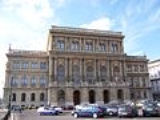
Hungarian Academy of Sciences

Encyclopedia
The Hungarian Academy of Sciences (in short: HAS; , MTA) is the most important and prestigious learned society
of Hungary
. Its seat is at the bank of the Danube
in Budapest
.
offered one year's income of his estate for the purposes of a Learned Society at a district session of the Diet
in Pressburg
(Pozsony, present Bratislava, seat of the Hungarian Parliament at the time), and his example was followed by other delegates. Its task was specified as the development of the Hungarian language
and the study and propagation of the sciences and the arts in Hungarian. It received its current name in 1845. Its central building was inaugurated in 1865, in neo-Renaissance
style.
, Magda Szabó
, Péter Nádas
writers, Zoltán Kocsis
pianist, Miklós Jancsó
, István Szabó
film directors.The president is László Dobszay musical historian.
Learned society
A learned society is an organization that exists to promote an academic discipline/profession, as well a group of disciplines. Membership may be open to all, may require possession of some qualification, or may be an honor conferred by election, as is the case with the oldest learned societies,...
of Hungary
Hungary
Hungary , officially the Republic of Hungary , is a landlocked country in Central Europe. It is situated in the Carpathian Basin and is bordered by Slovakia to the north, Ukraine and Romania to the east, Serbia and Croatia to the south, Slovenia to the southwest and Austria to the west. The...
. Its seat is at the bank of the Danube
Danube
The Danube is a river in the Central Europe and the Europe's second longest river after the Volga. It is classified as an international waterway....
in Budapest
Budapest
Budapest is the capital of Hungary. As the largest city of Hungary, it is the country's principal political, cultural, commercial, industrial, and transportation centre. In 2011, Budapest had 1,733,685 inhabitants, down from its 1989 peak of 2,113,645 due to suburbanization. The Budapest Commuter...
.
History
The history of the academy began in 1825, when Count István SzéchenyiIstván Széchenyi
Széchenyi committed suicide by a shot to his head on April 8, 1860. All Hungary mourned his death. The Academy was in official mourning, along with the most prominent persons of the leading political and cultural associations...
offered one year's income of his estate for the purposes of a Learned Society at a district session of the Diet
Diet (assembly)
In politics, a diet is a formal deliberative assembly. The term is mainly used historically for the Imperial Diet, the general assembly of the Imperial Estates of the Holy Roman Empire, and for the legislative bodies of certain countries.-Etymology:...
in Pressburg
Bratislava
Bratislava is the capital of Slovakia and, with a population of about 431,000, also the country's largest city. Bratislava is in southwestern Slovakia on both banks of the Danube River. Bordering Austria and Hungary, it is the only national capital that borders two independent countries.Bratislava...
(Pozsony, present Bratislava, seat of the Hungarian Parliament at the time), and his example was followed by other delegates. Its task was specified as the development of the Hungarian language
Hungarian language
Hungarian is a Uralic language, part of the Ugric group. With some 14 million speakers, it is one of the most widely spoken non-Indo-European languages in Europe....
and the study and propagation of the sciences and the arts in Hungarian. It received its current name in 1845. Its central building was inaugurated in 1865, in neo-Renaissance
Neo-Renaissance
Renaissance Revival is an all-encompassing designation that covers many 19th century architectural revival styles which were neither Grecian nor Gothic but which instead drew inspiration from a wide range of classicizing Italian modes...
style.
Sections of the Hungarian Academy of Sciences
Today it has eleven main sections:- I. Linguistics and Literary Studies Section
- II. Philosophy and Historical Studies Section,
- III. Mathematical Sciences Section,
- IV. Agricultural Sciences Section,
- V. Medical Sciences Section,
- VI. Technical Sciences Section,
- VII. Chemical Sciences Section,
- VIII. Biological Sciences Section,
- IX. Economics and Law Section,
- X. Earth Sciences Section,
- XI. Physical Sciences Section.
Presidents of the Hungarian Academy of Sciences
| József Teleki | November 17, 1830 - February 15, 1855 |
| Emil Dessewffy Emil Dessewffy Count Emil Dessewffy de Csernek et Tarkeő was a Hungarian conservative politician who served as President of the Hungarian Academy of Sciences from 1855 until his death.- References :... |
1855. April 17, 1855 – January 10, 1866 |
| József Eötvös József Eötvös József baron Eötvös de Vásárosnamény was a Hungarian writer and statesman, the son of Ignacz baron Eötvös de Vásárosnamény and Anna von Lilien, who stemmed from an Erbsälzer family of Werl in Germany.... |
March 18, 1866 – February 2, 1871 |
| Menyhért Lónyay | May 17, 1871 – November 3, 1884 |
| Ágoston Trefort Ágoston Trefort Dr. Ágoston Trefort was a Hungarian politician, who served as Minister of Religion and Education from 1872 until his death. He was the President of the Hungarian Academy of Sciences from 1885.-Family:... |
May 28, 1885 – August 22, 1888 |
| Loránd Eötvös Loránd Eötvös Baron Loránd Eötvös de Vásárosnamény , more commonly called Baron Roland von Eötvös in English literature, was a Hungarian physicist. He is remembered today largely for his work on gravitation and surface tension.-Life:... |
May 3, 1889 – October 5, 1905 |
| Albert Berzeviczy Albert Berzeviczy Albert Berzeviczy de Berzevicze et Kakaslomnic was a Hungarian politician, who served as Minister of Religion and Education between 1903 and 1905.-Career:... |
November 27, 1905 – March 22, 1936 |
| Joseph Habsburg Archduke Joseph August of Austria Archduke Joseph August Viktor Klemens Maria of Austria, Prince of Hungary and Bohemia was for a short period head of state of Hungary, a member of the House of Habsburg-Lorraine and the eldest son of Archduke Joseph Karl of Austria and his wife Princess Clotilde of Saxe-Coburg-Gotha... |
March 22, 1936 – October 1944 |
| Gyula Kornis | March 7, 1945 – October 29, 1945 |
| Gyula Moór | October 29, 1945 – July 24, 1946 |
| Zoltán Kodály Zoltán Kodály Zoltán Kodály was a Hungarian composer, ethnomusicologist, pedagogue, linguist, and philosopher. He is best known internationally as the creator of the Kodály Method.-Life:Born in Kecskemét, Kodály learned to play the violin as a child.... |
July 24, 1946 – November 29, 1949 |
| István Rusznyák | November 29, 1949 – February 5, 1970 |
| Tibor Erdey-Grúz Tibor Erdey-Grúz Tibor Erdey-Grúz was a Hungarian chemist and politician, who served as Minister of Higher Education between 1952 and 1953 and after that as Minister of Education from 1953 to 1956.-References:*... |
February 5, 1970 – August 16, 1976 |
| János Szentágothai | October 26, 1976 – May 6, 1977 |
| János Szentágothai | May 6, 1977 – May 10, 1985 |
| Iván Berend Iván Berend Iván Tibor Berend is a Hungarian historian and teacher who served as President of the Hungarian Academy of Sciences from 1985 until 1990. He was a member of Hungarian Socialist Workers' Party's Central Committee between 1988 and 1989... |
May 10, 1985 – May 24, 1990 |
| Domokos Kosáry Domokos Kosáry Domokos Kosáry was a Hungarian historian and writer who served as president of the Hungarian Academy of Sciences from 1990 until 1996.... |
May 24, 1990 – May 9, 1996 |
| Ferenc Glatz Ferenc Glatz Ferenc Glatz is a Hungarian historian and academic. He has served three terms as the president of the Hungarian Academy of Sciences.-Biography:Ferenc Glatz was born in Csepel on 2 April 1941... |
May 9, 1996 – May 4, 2002 |
| Szilveszter Vizi | May 5, 2002 – May 6, 2008 |
| József Pálinkás József Pálinkás József Pálinkás is a Hungarian atomic physicist and politician, who served as Minister of Education between 2001 and 2002... |
May 6, 2008 |
Research institutes
- ATOMKIATOMKIATOMKI is the Institute of Nuclear Research of the Hungarian Academy of Sciences. The institute was established in 1954 by Sándor Szalay the founder director....
, Institute of Nuclear Research - Research Institute for LinguisticsResearch Institute for Linguistics of the Hungarian Academy of SciencesThe Research Institute for Linguistics of the Hungarian Academy of Sciences was created in 1949, is under supervision of the Hungarian Academy of Sciences since 1951...
- Computer and Automation Research Institute (SZTAKI)
- Alfréd Rényi Institute of MathematicsAlfréd Rényi Institute of MathematicsThe Alfréd Rényi Institute of Mathematics is the research institute in mathematics of the Hungarian Academy of Sciences. It was created in 1950 by Alfréd Rényi, who directed it until his death. Since its creation, the institute has been the center of mathematical research in Hungary. It received...
- KFKI Research Institutes
- Biological Research CentreBiological Research CentreThe Biological Research Centre of the Hungarian Academy of Sciences is located in Szeged, Hungary. The research center was founded in 1971, created by Brunó F. Straub, who was director until 1977. As of 2011, the director is Dénes Dudits and the deputy director is Ormos Pál...
, Szeged - Chemical Research Center of the HAS
- HAS Research Institute of Philosophy
- HAS Institute for Psychology
Széchenyi Academy of Literature and Arts
The Széchenyi Academy of Literature and Arts was created in 1992 as an academy associated yet independent from the HAS. Some of the known members are György KonrádGyörgy Konrád
György Konrád is a Hungarian novelist and essayist, known as an advocate of individual freedom. He was a dissident under the communist regime.- Life :...
, Magda Szabó
Magda Szabó
Magda Szabó was a Hungarian writer, arguably Hungary's foremost woman novelist. She also wrote dramas, essays, studies, memories and poetry....
, Péter Nádas
Péter Nádas
Péter Nádas is a Hungarian writer, playwright, and essayist.- Biography :He was born in Budapest as the son of László Nádas and Klára Tauber. After the takeover of the Hungarian Nazis, the Arrow Cross Party on 15 October 1944, Klára Tauber escaped with her son to Bačka and Novi Sad, but returned...
writers, Zoltán Kocsis
Zoltán Kocsis
Zoltán Kocsis is a Hungarian pianist, conductor, and composer.Born in Budapest, he started his musical studies at the age of five and continued them at the Béla Bartók Conservatory in 1963, studying piano and composition...
pianist, Miklós Jancsó
Miklós Jancsó
Miklós Jancsó is a Hungarian film director and screenwriter.Jancsó achieved international prominence from the mid-1960s onwards, with works including The Round Up , The Red and the White and Red Psalm .Jancsó's films are characterized by visual stylization,...
, István Szabó
István Szabó
István Szabó is a Hungarian film director, screenwriter, and opera director.Szabó is the most internationally famous Hungarian filmmaker since the late 1960s. Working in the tradition of European, auteurist art cinema, he has made films that represent many of the psychological and political...
film directors.The president is László Dobszay musical historian.
External links
- Brief history of the Hungarian Academy of Sciences (in English)
- Hungarian Academy of Sciences (in English) -- also available in Hungarian
- Picture of its central building -- additional picture
- homepage of the Széchenyi Academy

