
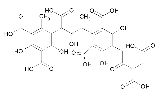
Humic acid is one of the major components of humic substances which are dark brown and major constituents of soil organic matter
humusHumus is degraded organic material in soil, which causes some soil layers to be dark brown or black....
that contributes to
soilSoil is a natural body consisting of layers of mineral constituents of variable thicknesses, which differ from the parent materials in their morphological, physical, chemical, and mineralogical characteristics. It is composed of particles of broken rock that have been altered by chemical and...
chemical and physical quality and are also precursors of some
fossil fuelFossil fuels or mineral fuels are fuels formed by natural resources such as anaerobic decomposition of buried dead organisms. The age of the organisms and their resulting fossil fuels is typically millions of years, and sometimes exceeds 650 million years...
s. They can also be found in
peatPeat is an accumulation of partially decayed vegetation matter. Peat forms in wetlandbogs, moors, muskegs, pocosins, mires, and peat swamp forests...
,
coalCoal is a readily combustible black or brownish-black sedimentary rock normally occurring in rock strata in layers or veins called coal beds. The harder forms, such as anthracite coal, can be regarded as metamorphic rock because of later exposure to elevated temperature and pressure...
, many upland
streamsA river is a natural watercourse, usually freshwater, flowing toward an ocean, a lake, a sea or another river. In a few cases, a river simply flows into the ground or dries up completely before reaching another body of water...
,
dystrophic lakeDystrophic lake refers to lakes with brown- or tea-coloured waters, the colour being the result of high concentrations of humic substances and organic acids suspended in the water. Because the term has long been misused in the literature, these lakes are better referred to as humic lakes...
s and
oceanAn ocean is a large body of saline water, and a principal component of the hydrosphere. Approximately 75% of the Earth's surface is covered by ocean, a continuous body of water that is customarily divided into several principal oceans and smaller seas.More than half of this area is over 3,000...
waterWater is an ubiquitous chemical substance that is composed of hydrogen and oxygen and is essential for all known forms of life.In typical usage, water refers only to its liquid form or state, but the substance also has a solid state, ice, and a gaseous state, water vapor or steam. Water covers 71%...
.
Humic substances make up a large portion of the dark matter in humus and consist of heterogeneous mixtures of small-size molecules which arise from the biological transformation of dead cells and mutually associate in a supramolecular structure , that can be separated in their small molecular components by chemical fractionation .
Humic acid is one of the major components of humic substances which are dark brown and major constituents of soil organic matter
humusHumus is degraded organic material in soil, which causes some soil layers to be dark brown or black....
that contributes to
soilSoil is a natural body consisting of layers of mineral constituents of variable thicknesses, which differ from the parent materials in their morphological, physical, chemical, and mineralogical characteristics. It is composed of particles of broken rock that have been altered by chemical and...
chemical and physical quality and are also precursors of some
fossil fuelFossil fuels or mineral fuels are fuels formed by natural resources such as anaerobic decomposition of buried dead organisms. The age of the organisms and their resulting fossil fuels is typically millions of years, and sometimes exceeds 650 million years...
s. They can also be found in
peatPeat is an accumulation of partially decayed vegetation matter. Peat forms in wetlandbogs, moors, muskegs, pocosins, mires, and peat swamp forests...
,
coalCoal is a readily combustible black or brownish-black sedimentary rock normally occurring in rock strata in layers or veins called coal beds. The harder forms, such as anthracite coal, can be regarded as metamorphic rock because of later exposure to elevated temperature and pressure...
, many upland
streamsA river is a natural watercourse, usually freshwater, flowing toward an ocean, a lake, a sea or another river. In a few cases, a river simply flows into the ground or dries up completely before reaching another body of water...
,
dystrophic lakeDystrophic lake refers to lakes with brown- or tea-coloured waters, the colour being the result of high concentrations of humic substances and organic acids suspended in the water. Because the term has long been misused in the literature, these lakes are better referred to as humic lakes...
s and
oceanAn ocean is a large body of saline water, and a principal component of the hydrosphere. Approximately 75% of the Earth's surface is covered by ocean, a continuous body of water that is customarily divided into several principal oceans and smaller seas.More than half of this area is over 3,000...
waterWater is an ubiquitous chemical substance that is composed of hydrogen and oxygen and is essential for all known forms of life.In typical usage, water refers only to its liquid form or state, but the substance also has a solid state, ice, and a gaseous state, water vapor or steam. Water covers 71%...
.
Definition
Humic substances make up a large portion of the dark matter in humus and consist of heterogeneous mixtures of small-size molecules which arise from the biological transformation of dead cells and mutually associate in a supramolecular structure , that can be separated in their small molecular components by chemical fractionation . Humic molecules are held together in supramolecular conformations by weak hydrophobic bonds at neutral and alkaline pH and also by Hydrogen-bonds at low pH.
Since the end of the 18th century, humic substances have been designated as humic acid, fulvic acid or
huminPart of the organic soil compounds that don't dissolve when treated with diluted alkali solutions....
. These fractions are defined strictly on their solubility in either acid or alkali, describing the materials by operation only, thus imparting little chemical information about the extracted materials. The term ‘humic substances’ is used in a generic sense to distinguish the naturally occurring material from the chemical extractions named humic acid and fulvic acid, which are defined “operationally” by their solubility in alkali or acid solutions. It is important to note, however, that no sharp divisions exist between humic acids, fulvic acids and humins. They are all part of an extremely heterogeneous supramolecular system and the differences between the subdivisions are due to variations in acidity, degree of hydrophobicity (content of aromatic and long-chain alkyl molecules) and entropy-driven self-associations of molecules. When humic substances are characterized for their molecular structure, a chromatographic and/or chemical separation of their large number of different bioorganic molecules is required .
Some of the earliest work by
Carl SprengelKarl or Carl Philipp Sprengel was a German botanist from Schillerslage .Sprengel worked under Albrecht Thaer in Celle...
on the fractionation of organic matter still forms the basis of methods currently in use. These methods utilize dilute sodium hydroxide (2 percent) to separate humus as a colloidal sol from alkali-insoluble plant residues. From this humus sol, the humic fraction is precipitated by acid which leaves a straw-yellow supernatant, the fulvic fraction. The alcohol soluble portion of the humic fraction is generally named
ulmic acid. Gray humic acids (GHA) are soluble in low ionic strength alkaline media, brown humic acids (BHA) are soluble in alkaline conditions independent of ionic strength, and fulvic acids (FA) are soluble independent of pH and I.
Formation of humic substances in the environment
Humic substances are the most stable fraction of organic matter in soils and can persist for up to thousands of years . They arise by the microbial degradation of plant (and possibly animal) biomolecules (for example aromatic
ligninLignin or lignen is a complex chemical compound most commonly derived from wood, and an integral part of the secondary cell walls of plants and some algae. The term was introduced in 1819 by de Candolle and is derived from the Latin word lignum, meaning wood...
polymers) dispersed in the environment after the death of living cells. Humic material is a supramolecular structure of relatively small bio-organic molecules (having molecular mass <1000
DaThe unified atomic mass unit or atomic mass unit , or dalton or, sometimes, universal mass unit , is a unit of mass used to express atomic and molecular masses...
) self-assembled mainly by weak dispersive forces such as
Van der Waals forceIn physical chemistry, the van der Waals force , named after Dutch scientist Johannes Diderik van der Waals, is the attractive or repulsive force between molecules other than those due to covalent bonds or to the electrostatic interaction of ions with one another or with neutral molecules...
, π-π, and CH-π bonds into only apparently large molecular sizes (Piccolo, 2002). Their dark color is due partially to
quinoneQuinones are "compounds having a fully conjugated cyclic dione structure, such as that of benzoquinones, derived from aromatic compounds by conversion of an even number of –CH= groups into –C– groups with any necessary rearrangement of double bonds ."Benzoquinone, sometimes referred to simply as...
structures formed at the environmental
redoxRedox describes all chemical reactions in which atoms have their oxidation number changed....
conditions and partially to enhanced light absorption by the strictly associated
chromophoreA chromophore is part of a molecule responsible for its color.When a molecule absorbs certain wavelengths of visible light and transmits or reflects others, the molecule has a color. A chromophore is a region in a molecule where the energy difference between two different molecular orbitals falls...
s (Piccolo, 2002).
Chemical characteristics of humic substances
Recent studies using pyrolysis-FIMS and -GC/MS, multidimensional NMR and
synchrotronA synchrotron is a particular type of cyclic particle accelerator in which the magnetic field and the electric field are carefully synchronized with the travelling particle beam. The proton synchrotron was originally conceived by Sir Marcus Oliphant...
-based spectroscopy have shown that humic substances possess both aromatic and aliphatic characteristics. The dominant functional groups which contribute to surface charge and reactivity of humic substances are
phenolPhenol, also known as carbolic acid, is a toxic, white crystalline solid. Its chemical formula is C6H5OH and its structure is that of a hydroxyl group bonded to a phenyl ring, making it an aromatic compound.-Phenols:...
ic and carboxylic groups .
Humic substances may
chelateChelation is the formation or presence of two or more separate bindings between apolydentate ligand and a single central atom.Usually these ligands are organic compounds, and are called chelants, chelators, chelating agents, or sequestering agents....
multivalent cations such as
2+,
2+, and
2+. By chelating the ions, they increase the availability of these cations to organisms, including
plantPlants are living organisms belonging to the kingdom Plantae. They include familiar organisms such as trees, herbs, bushes, grasses, vines, ferns, mosses, and green algae. The scientific study of plants, known as botany, has identified about 350,000 extant species of plants, defined as seed plants,...
s.
Determination of humic acids in water samples
The presence of humic acid in water intended for potable or industrial use can have a significant impact on the
treatabilityWater purification is the process of removing undesirable chemicals, materials, and biological contaminants from raw water. The goal is to produce water fit for a specific purpose...
of that water and the success of chemical
disinfectionDisinfectants are antimicrobial agents that are applied to non-living objects to destroy microorganisms, the process of which is known as disinfection....
processes. Accurate methods of establishing humic acid concentrations are therefore essential in maintaining water supplies, especially from upland
peatPeat is an accumulation of partially decayed vegetation matter. Peat forms in wetlandbogs, moors, muskegs, pocosins, mires, and peat swamp forests...
y catchments in temperate climates.
As a lot of different bio-organic molecules in very diverse physical associations are mixed together in natural environments, it is cumbersome to measure their exact concentrations in the humic superstructure. For this reason, concentrations of humic acid are traditionally estimated out of concentrations of organic matter (typically from concentrations of
total organic carbonTotal organic carbon is the amount of carbon bound in an organic compound and is often used as a non-specific indicator of water quality or cleanliness of pharmaceutical manufacturing equipment....
(TOC) or dissolved organic carbon DOC).
Extraction procedures are bound to alter some of the chemical linkages present in the soil humic substances (mainly ester bonds in biopolyesters such as cutins and suberins). The humic extracts are composed by large numbers of different bio-organic molecules which have not yet totally separated and identified. However, single classes of residual biomolecules have been identified by selective extractions and chemical fractionation and are represented by alkanoic and hydroxy alkanoic acids, resins, waxes, lignin residues,sugars, and peptides.
Ecological effects
The value of regular additions of organic matter to the soil has been recognized by growers since prehistoric times. However, the chemistry and function of the organic matter have been a subject of controversy since men began their postulating about it in the 18th century. Until the time of Liebig, it was supposed that humus was used directly by plants, but, after Liebig had shown that plant growth depended upon inorganic compounds, many soil scientists held the view that organic matter was useful for fertility only as it was broken down with the release of its constituent
nutrientA nutrient is a chemical that an organism needs to live and grow or a substance used in an organism's metabolism which must be taken in from its environment. Nutrients are the substances that enrich the body. They build and repair tissues, give heat and energy, and regulate body processes...
elements into inorganic forms.
At the present time soil scientists hold a more holistic view and at least recognize that humus influences soil fertility through its effect on the water-holding capacity of the soil. Also, since plants have been shown to absorb and translocate the complex organic molecules of systemic insecticides, they can no longer discredit the idea that plants may be able to absorb the soluble forms of humus; this may in fact be an essential process for the uptake of otherwise insoluble iron oxides.
Humic acid as a chelator
A substantial fraction of the mass of the humic acids is in
carboxylic acidCarboxylic acids are organic acids characterized by the presence of a carboxyl group, which has the formula -COH, usually written -COOH or -CO2H. Carboxylic acids are Brønsted-Lowry acids — they are proton donors. Salts and anions of carboxylic acids are called...
functional groups, which endow these molecules with the ability to chelate (bind) (precipitate in some media, make solution in other media) positively charged multivalent ions (Mg
2+, Ca
2+, Fe
2+, Fe
3+, most other "trace elements" of value to plants, as well as other ions that have no positive biological role, such as Cd
2+ and Pb
2+.) This chelation of ions is probably the most important role of humic acids with respect to living systems. By chelating the ions, they facilitate the uptake of these ions by several mechanisms, one of which is preventing their precipitation, another seems to be a direct and positive influence on their
bioavailabilityIn pharmacology, bioavailability is used to describe the fraction of an administered dose of unchanged drug that reaches the systemic circulation, one of the principal pharmacokinetic properties of drugs. By definition, when a medication is administered intravenously, its bioavailability is 100%...
.
Ancient Masonry
In Ancient Egypt, according to archaeology as well as the account provided in the book of Exodus chapter 5, straw was mixed with mud in order to produce building bricks. Modern investigations have found that the humic acid is released from straw when the straw is mixed with mud and that this strengthens the material, which produces stronger bricks that are less likely to break or lose their shape.
External links