
In Depth
See Also

Human feces

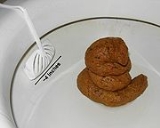
Human feces, also known as fesces, vary significantly in appearance, depending on the state of the whole digestive system Gastrointestinal tract

The gastrointestinal tract or digestive tract, also referred to as the GI tract or the al... 

, influenced by diet and health Health

Health is the functional and/or metabolic efficiency of an organism, at any moment in time, at both the ... 

. Normally they are semisolid, with mucus coating. Small pieces of harder, less moist feces can sometimes be seen impacted on the distal Anatomical terms of location

In human and zoological anatomy [i], several terms are used to describe the location of organ [i]s and o ... 

 end . Meconium Meconium

Meconium is the first stool [i] of an infant [i], composed of materials ingested during the time t ... 

  is a newborn baby Infant

Infant is a formal term for the word baby, the youngest category of a child [i]. ... 

's first feces. Due to its taboo, feces is a subject of toilet humor. A diet high in cellulose Cellulose

Cellulose n is a long-chain polymer [i]ic polysaccharide [i] carbohydrate [i], of beta-glucose [i] ... 

 results in bulky stools.

Discussions

  Discussion Features

   Ask a question about 'Human feces'

   Start a new discussion about 'Human feces'

   Answer questions about 'Human feces'

   'Human feces' discussion forum


Encyclopedia

Human feces, also known as fesces, vary significantly in appearance, depending on the state of the whole digestive system Gastrointestinal tract

The gastrointestinal tract or digestive tract, also referred to as the GI tract or the al... 

, influenced by diet and health Health

Health is the functional and/or metabolic efficiency of an organism, at any moment in time, at both the ... 

. Normally they are semisolid, with mucus coating. Small pieces of harder, less moist feces can sometimes be seen impacted on the distal Anatomical terms of location

In human and zoological anatomy [i], several terms are used to describe the location of organ [i]s and o ... 

 end .

Meconium Meconium

Meconium is the first stool [i] of an infant [i], composed of materials ingested during the time t ... 

  is a newborn baby Infant

Infant is a formal term for the word baby, the youngest category of a child [i]. ... 

's first feces.

Due to its taboo, feces is a subject of toilet humor.

A diet high in cellulose Cellulose

Cellulose
n
is a long-chain polymer [i]ic polysaccharide [i] carbohydrate [i], of beta-glucose [i] ... 

 results in bulky stools.

Composition

Approximately 75% of an ordinary sample of human feces is water. This percentage changes; diarrhea has more water than average and the longer the piece is in the bowels, the more water is taken out. Of the remaining 25%, 1/3 is dead bacteria. Another 1/3 of the remaining quarter is indigestible food, such as cellulose Cellulose

Cellulose
n
is a long-chain polymer [i]ic polysaccharide [i] carbohydrate [i], of beta-glucose [i] ... 

.

Feces disposal


Main articles: Toilet Toilet

A toilet is a plumbing fixture [i] and a disposal system [i] primarily intended for the ... 

, Latrine, Sewage.


The problem of efficient feces disposal existed since the times when people started to live in permanent settlements, primarily for the reasons of cleanliness and odor. Toilets were known in ancient India India

India , officially the Republic of India, is a country in South Asia [i]. ... 

 , in Ancient Rome Ancient Rome

Ancient Rome was a civilization [i] that grew out of the city-state [i] of Rome [i], founded in the Italian Peninsula [i] ... 

, Egypt Egypt

[i] country in [[North Africa]... 

 and China China

China is a cultural region [i] and ancient civilization [i] in East Asia [i]. ... 

.

Over time it has become clear that the disposal of feces is an issue of hygiene, since feces contribute to spreading of diseases and intestinal parasites. It is a matter of attention and education in developing countries Developing country

A developing country is a country [i] with a relatively low standard of living [i], undeveloped industrial base [i] ... 

.

Until about the end of the 19th century, the primary concern of sewage collection and disposal was to remove waste away from inhabited places, and it was common to use waterflows and larger bodies of water as a destination of sewage, where waste could be naturally dissipated and neutralized. With the increased population density this is no longer a viable solution, and special processing of sewage is required. The lack of the latter is a grave sanitary and public health problem in developing countries.

Tourism


Nature reserve Nature reserve

*Biosphere Reserve [i]
  • Conservation designation [i]

... 

 organizations, parks, and tourist Tourism

Tourism is the act of travel [i] for predominantly recreation [i]al or leisure [i] purposes, and also re ... 

 agencies often issue regulations for tourists aimed at the prevention of the pollution of the nature. In particular, catholes , i.e., pits for feces, must be located at a reasonable distance from water sources , to avoid possible bacterial contamination of water via precipitation, as well as away from trails. For faster feces decomposition, organic soil is preferred over sandy mineral soil. It is also recommended to avoid concentration of catholes around campsites. Filled catholes must be covered with a reasonably thick layer of soil, to prevent access by animals, some of which are coprophagous Coprophagia

Coprophagia is the consumption of feces [i], from the Greek copros and phagein . ... 

.

Some areas require special instructions on human waste disposal. In rocky places, with the absence of soil, it is advised to spread feces thinly by smearing over rocks with good sun access for faster sterilization by UV Ultraviolet

Ultraviolet light is electromagnetic radiation [i] with a wavelength [i] shorter than that of visible l ... 

 radiation and drying. In larger snow fields, a larger distance from trails and campsites may be mandated, if the waste is being disposed under snow.

Laboratory testing of feces


In the medical profession, feces are referred to as stools. This comes from the Anglo-Saxon Old English language

Old English is an early form of the English language [i] that was spoken in parts of what is now England [i] ... 

 word stol, which means "seat". The word stool was originally used to describe the seat one sat on to defecate. So, a euphemism was that they were "going to stool". By the end of the 16th century 16th century

As a means of recording the passage of time [i], the 16th century was that century [i] which lasted from ... 

, the word stool was used to mean the same thing as feces.

Feces will usually be required for microbiological Microbiology

Microbiology is the study of microorganisms [i], which are unicellular [i] or cell-cluster microscopic [i] ... 

 testing, looking for an intestinal Intestine

In anatomy [i], the intestine is the portion of the alimentary canal [i] extendin ... 

 pathogen.

Biochemical tests done on feces include fecal elastase and fecal fat measurements, as well as tests for fecal occult blood.

It is recommended that the clinician correlate the symptoms and submit specimens according to laboratory guidelines to obtain results that are clinically significant. Formed stools often do not give satisfactory results and suggest little of actual pathologic conditions.

Three main types of microbiological tests are commonly done on feces:
  • Antibody-antigen type tests, that look for a specific virus .
  • Microscopic examination for intestinal parasites and their ova .
  • Routine culture.


Routine culture involves streaking the sample onto agar plate Agar plate

An agar plate is a sterile Petri dish [i] that contains agar [i] plus nutrients, used to culture [i] ... 

s containing special additives, such as MacConkey agar MacConkey agar

MacConkey agar is a culture medium [i] designed to grow Gram-negative [i] bacteria and ... 

, that will inhibit the growth of Gram-positive Gram-positive

Gram-positive bacteria [i] are classified as bacteria that retain a crystal violet dye during the Gram stain [i] ... 

 organisms and will selectively allow enteric pathogens to grow, and incubating them for a period, and observing the bacterial colonies that have grown.

Yellowing of feces can be caused by an infection known as Giardiasis, which derives its name from Giardia Giardia lamblia

Giardia lamblia is a flagellate [i]d protozoa [i]n parasite [i] that infects the gastrointestinal tr... 

, a tiny parasitic organism. If Giardia infects the intestines it can cause severe yellow diarrhea. This is a dangerous communicable infection and must be reported.

Another cause of yellowing is a condition known as Gilbert's Syndrome. This condition is characterized by jaundice and hyperbilirubinemia. Hyperbilirubinemia occurs when too much bilirubin Bilirubin

Bilirubin is a yellow breakdown [i] product of normal heme [i] catabolism [i]. ... 

 is present in the circulating blood.

Feces can be black if dried blood is present in them from a bleed. More active bleeding can lead feces to be red in color, signaling a need for medical attention.

In children with certain illnesses, feces can be blue or green. Eating green or leafy food can turn feces green. Babies when digesting solid food for the first time also produce feces which tends to be green and of unusual consistency because of the presence of cells discarded during development of the digestive tract.

Food with large amounts of food color Food coloring

A food coloring is any substance that is added to food [i] to change its color [i]. ... 

 can cause feces to be colored.

The main pathogens that are commonly looked for in feces include:
  • Salmonella Salmonella

    Salmonella is a genus [i] of rod-shaped Gram-negative [i] enterobacteria [i] that ... 

     and Shigella Shigella

    Shigella are Gram-negative [i], non-motile [i], non-spore forming [i] rod-shaped ... 

  • Yersinia
  • Campylobacter Campylobacter

    Campylobacter is a genus [i] of Gram-negative [i] bacteria [i]. ... 

  • Aeromonas
  • Candida
  • E. coli O157
  • Cryptosporidium Cryptosporidium

    Cryptosporidium is a protozoan pathogen of the Phylum Apicomplexa [i] and causes a diarrhea [i]l illness ... 


See also

  • Bristol Stool Chart Bristol Stool Scale

    The Bristol Stool Scale or Bristol Stool Chart is a medical [i] aid designed to classify the feces [i] ... 

  • Constipation
  • Defecation Defecation

    Defecation or feceation is the act or process by which organisms eliminate solid or semisolid waste [i] ... 

  • Diarrhea
  • Meconium Meconium

    Meconium is the first stool [i] of an infant [i], composed of materials ingested during the time t ... 

  • Scatology
  • Ecological sanitation

External links

  • Instructions from Olympic National Park Olympic National Park

    Olympic National Park is located in the U.S. state [i] of Washington [i], in the far northwestern part o ... 

    .
  • - Bristol stool form chart


Categories: