
|
|
|
|
Hull House
|
| |
|
| |
Hull House was co-founded in 1889, in Chicago, Illinois, by Jane Addams and Ellen Gates Starr and is located in the Near West Side community area of Chicago in Cook County, Illinois. It was one of the first settlement houses in the U.S. and eventually grew into one of the largest, with facilities in 13 buildings. Because of the Hull House’s social, educational, and artistic programs, it earned a reputation as the best-known settlement house in the U.S. and became the standard bearer for the movement that included almost 500 settlements nationally by 1920.
The original building and several subsequent acquisitions were continuously renovated to accommodate the changing demands of the association.

Discussion
Ask a question about 'Hull House'
Start a new discussion about 'Hull House'
Answer questions from other users
|
Encyclopedia
Hull House was co-founded in 1889, in Chicago, Illinois, by Jane Addams and Ellen Gates Starr and is located in the Near West Side community area of Chicago in Cook County, Illinois. It was one of the first settlement houses in the U.S. and eventually grew into one of the largest, with facilities in 13 buildings. Because of the Hull House’s social, educational, and artistic programs, it earned a reputation as the best-known settlement house in the U.S. and became the standard bearer for the movement that included almost 500 settlements nationally by 1920.
The original building and several subsequent acquisitions were continuously renovated to accommodate the changing demands of the association. The original building and one additional building (which has been moved ) survive today. The original building was designated a Chicago Landmark on June 12, 1974. It was designated as a U.S. National Historic Landmark on June 23, 1965. It was listed on the National Register of Historic Places on October 15, 1966, which is the day that the National Historic Preservation Act of 1966 was enacted creating the register. It is one of the four Chicago Registered Historic Places from the original October 15, 1966 National Register of Historic Places list (along with Chicago Pile-1, Robie House & Lorado Taft Midway Studios).
Mission
Following the example of the original settlement house, Toynbee Hall (founded in 1885 in the East End of London as center for social reform), Hull House had, at its inception five years later, the main purpose of providing social and educational opportunities for working class people (many of them recent immigrants) in the surrounding neighborhood. The Hull House conducted careful studies of the Near West Side, Chicago community area, which housed many of Chicago's most recent European immigrants. The "residents" (volunteers at Hull were given this title) held classes in literature, history, art, domestic activities (such as sewing), and many other subjects. Hull House also held concerts that were free to everyone, offered free lectures on current issues, and operated clubs for both children and adults.
The Hull House Neighborhood
One of the first newspaper articles ever written about Hull House acknowledges the following invitation sent to the residents of the Hull House neighborhood. It begins with: "Mio Carissimo Amico"…and is signed, Le Signorine, Jane Addams and Ellen Starr. That invitation to the community, written during the first year of Hull House's existence, suggests that the inner core of what Jane Addams labeled "The Hull House Neighborhood," was overwhelmingly Italian American, as far back as the beginnings of the Jane Addams and Ellen Starr social experiment...as far back as the final decades of the 19th century.
The Bethlehem-Howard Neighborhood Center Records further substantiate that, as early as the 1890s, the inner core of the Hull House Neighborhood was predominantly of Italian origin. "Germans and Jews resided south of that inner core (south of twelfth street)…The Greek delta formed by Harrison, Halsted and Blue Island Streets served as a buffer to the Irish residing to the north and the Canadian–French to the northwest." From the river on the east end, on out to the western ends of what came to be know as "Little Italy"—(from Roosevelt Road on the south to the Harrison Street delta on the north)—became the port-of-call for Italians who had emigrated from the shores of southern Italy.
By all accounts, the greater Hull House Neighborhood was a mix of various ethnic groups who had emigrated to Chicago. The Greek Town residents, along with the Maxwell Street residents, disappeared long before the physical demise of Hull House by the UIC in 1963. The exodus of the non-Italians began shortly after the turn-of-the century. Their businesses, however, remained. Italian Americans were the only immigant group that endured as a community. That community came to be known as "Little Italy." Taylor Street's Little Italy, the inner core of Jane Addams' "Hull House Neighborhood," remained as the laboratory upon which the social and philanthropic groups of Hull House elitists had tested their theories and formulated their challenges to the establishment.
Jane Addams's personal observations further reinforce the dominance of the Italian American influence by suggesting that the 1895 federal census maps, currently housed at the UIC's Hull House Museum, misrepresent the number of Italian-Americans residing in the inner core of the Hull House Neighborhood. "10,000 Italians lived between the river and Halsted Street." There are many reasons why Italian immigrants would mislead a stranger knocking on their door to inquire about the number of residents who resided in their home.
The synergy between Taylor Street’s Little Italy and the Hull House complex; i.e., the settlement house and its summer camp (the Bowen Country Club), is well documented. Alice Hamilton, medical professional and early member of that elite Hull House hierarchy, was quoted as saying, "Those Italian women knew what a baby needed more than my Ann Harbor professors did." The ancillary literature between, among and about members of Hull House's inner sanctum of sociologists and philanthropists is littered with such comments, reinforcing the relationship that existed between Taylor Street's Little Italy and Hull House. A review of the ethnic composition of those who registered for and attended the services provided by the Hull House complex, during its 74 years as a tenant of the near-west side, suggests an ethnic bias. Of the 264 known WWII veterans who were alumni of the Bowen Country Club (the Hull House summer camp), "virtually all had a vowel at the end of their name...denoting their Italian heritage."
A historic picture, "Meet the Hull House Kids," was taken on a summer day in 1924 by Wallace K. Kirkland Sr., Hull House Director. He later became a top photographer with Life. The twenty Hull House Kids were erroneously described as young boys, of Irish ancestry, posing in the Dante school yard on Forquer Street (now Arthington Street). It circulated the world as a "poster child" of sorts for the Jane Addams's Hull House social experiment. On April 5, 1987, over a half century later, the Chicago Sun-Times refuted the contention that the Hull House Boys were of Irish ancestry. In doing so, the Sun-Times article listed the names of each of the young boys. All twenty boys were first generation Italian Americans…all with vowels at the end of their names. "They grew up to be lawyers and mechanics, sewer workers and dump truck drivers, a candy shop owner, a boxer and a mob boss."
Accomplishments
During the first two decades of operation, Hull House attracted many female residents who later became prominent and influential reformers at various levels. The settlement was also gradually drawn into advocating for legislative reforms at the municipal, state and federal levels, addressing issues such as child labor, women's suffrage, healthcare reform, and immigration policy. Some claim that the work of the Hull House marked the beginning of what we know today as "Social Welfare". At the neighborhood level, Hull House established the city’s first public playground and bathhouse, pursued educational and political reform, and investigated housing, working, and sanitation issues. At the municipal level, their pursuit of legal reforms led to the first juvenile court in the United States, and their work influenced urban planning and the transition to a branch library system. At the state level Hull House influenced legislation on child labor laws, occupational safety and health provisions, compulsory education, immigrant rights, and pension laws. These experiences translated to success at the federal level, working with the settlement house network to champion national child labor laws, women’s suffrage, a Children’s Bureau, unemployment compensation, workers' compensation, and other elements of the Progressive agenda during the first two decades of the 20th century.
Teachings Later, the settlement branched out and offered services to ameliorate some of the effects of poverty. A public dispensary provided nutritious food for the sick as well as a daycare center and public baths. Among the courses Hull House offered was a bookbinding course, which was timely given the employment opportunities in the growing printing trade. Hull House was well-known for its success in aiding American assimilation, especially with immigrant youth. Hull House became the center of the movement to promote hand workmanship as a moral regenerative force. Under the direction of Laura Dainty Pelham their theater group performed the Chicago premiers of several plays by Galsworthy, Ibsen, and George Bernard Shaw and was given credit for founding the American Little Theatre Movement. The success of Hull House led Paul Kellogg to refer to the group as the "Great Ladies of Halsted Street.
The objective of Hull House, as stated in its charter, was: "To provide a center for a higher civic and social life; to institute and maintain educational and philanthropic enterprises, and to investigate and improve the conditions in the industrial districts of Chicago."
The Building Hull House was located in, and took its name from, the Italianate mansion built by real estate magnate Charles J. Hull at 800 South Halsted Street in 1856. The building was located in what had once been a fashionable part of town, but by 1889, when Addams was searching for a location for her experiment, it had descended into squalor. This was partly due to the rapid and overwhelming influx of immigrants into the Near West Side neighborhood. Charles Hull granted his former home to his niece Helen Culver, who in turn granted it to Addams on a 25-year rent-free lease. By 1907, Addams had acquired 13 buildings surrounding Hull's mansion. Between 1889 and 1935, Addams and Ellen Gates Starr continuously redeveloped the building. The facility remained at the original location until it was purchased in 1963 by what was then called the University of Illinois-Circle Campus. The development of University of Illinois-Circle Campus required the demolition of many surrounding Hull House buildings and the 1967 restoration to the original building by Frazier, Raftery, Orr and Fairbank removed Addams's third floor addition. Of the dozen additional buildings only the craftsman style dining hall (built in 1905 and designed by Pond & Pond) survives and it was moved from its original site.
The Haunting of Hull House
Over the years, numerous stories of ghosts and hauntings have surrounded Hull House, making it a stop on many of the "ghosts in Chicago" tours. Charles Hull's wife had died in her bedroom, which was later used by Addams after the establishment of Hull House. Addams did not believe in ghosts, but noted that many believed that building to be haunted in her book Twenty Years at Hull House.
In 1913, another Hull House ghost story began circulating. According to this legend, after a man claimed that he would rather have the Devil in his house than a picture of The Virgin Mary, his child was born with pointed ears, horns, scale-covered skin and a tail. The mother was said to have taken the baby to Hull House, where Addams was said to have attempted to have it baptized and wound up locking it in the attic. While initially annoyed about the story, which had no basis in fact, Addams used the episode as a basis for her book, The Long Road of Woman's Memory.. Many erroneous stories have circulated about the house, including stories that it was built on grounds cursed by Native Americans and that the devil baby was buried in the garden adjacent to the house (in reality, there was a building on the spot where the garden now stands at the time of the Devil Baby story).
Theater
Addams felt that the community benefits from theater plays and thus established an amateur theater in the Hull House in 1899. In 1963, when road tours of Broadway productions became common, the Hull House Theater in the Jane Addams Center at 3212 North Broadway fostered the development of Chicago Theater companies for the rest of the century. Founder Bob Sickinger created an environment to nourish young talent with professionalism.
Today
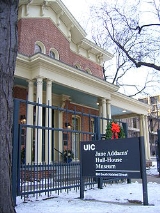
Addams ran Hull House as head resident until her death in 1935. Hull House continued to serve the community surrounding the Halsted location until it was displaced by the urban campus of the University of Illinois. Today, the social service center role is performed throughout the city at various locations under the Jane Addams Hull House Association umbrella organization. The association has, since 1962, perpetuated the name and many of the aspirations of the original institution. The original Hull House building itself is a museum, part of the College of Architecture and the Arts at the University of Illinois at Chicago, and is open to the public.
Also, Jane Addams Hull House Association is one of Chicago’s largest not-for-profit social welfare organizations. Its mission is to improve social conditions for underserved people and communities by providing creative, innovative programs and by advocating for related public policy reforms. The Association has more than 50 programs at over 40 sites throughout Chicago and serves approximately 60,000 individuals, families, and community members every year.
The Jane Addams Hull-House Museum is part of the College of Architecture and the Arts at the University of Illinois at Chicago and serves as a memorial to social reformer and Nobel Peace Prize recipient Jane Addams and other resident social reformers, whose work influenced the lives of their immigrant neighbors as well as national and international public policy. The museum and its programs connect the work of Hull-House residents to important contemporary social issues. The Museum's collection includes over 1,100 artifacts related to Hull-House history and over 100 oral interviews conducted with people who have shared their stories about Hull-House and the surrounding neighborhood.
Selected notable residents
See also
External links
- , by Jane Addams, MacMillan & Co, 1910, at Project Gutenberg
-
|
| |
|
|