
In
Aztec mythologyThe aztec civilization recognized a polytheistic mythology, which contained the many deities and supernatural creatures from their religious beliefs. "orlando"- History :...
,
Huitzilopochtli, also spelled
Uitzilopochtli ( "Hummingbird on the Left", or "Left-Handed Hummingbird",
huitzilin being
NahuatlNahuatl is thought to mean "a good, clear sound" This language name has several spellings, among them náhuatl , Naoatl, Nauatl, Nahuatl, Nawatl. In a back formation from the name of the language, the ethnic group of Nahuatl speakers are called Nahua...
for
hummingbirdHummingbirds are birds that comprise the family Trochilidae. They are among the smallest of birds, most species measuring in the 7.5–13 cm range. Indeed, the smallest extant bird species is a hummingbird, the 5-cm Bee Hummingbird. They can hover in mid-air by rapidly flapping their wings...
), was a god of war, a sun god, and the patron of the city of
Tenochtitlan. He was also the national god of the
MexicaThe Mexica were a pre-Columbian people of central Mexico.Mexica may also refer to:*Mexica , a board game designed by Wolfgang Kramer and Michael Kiesling*Mexica , a 2005 novel by Norman Spinrad...
s of
Tenochtitlan.
Genealogy
Huitzilopochtli's mother was
CoatlicueCoatlicue, also known as Teteoinan , "The Mother of Gods" , is the Aztec goddess who gave birth to the moon, stars, and Huitzilopochtli, the god of the sun and war...
, and his father was a ball of feathers (or, alternatively,
MixcoatlMixcoatl , or Camaxtli, was the god of the hunt and identified with the Milky Way, the stars, and the heavens in several Mesoamerican cultures. He was the patron deity of the Otomi, the Chichimecs, and several groups that claimed descent from the Chichimecs...
). His sister was Malinalxochitl, a beautiful sorceress, who was also his rival. His messenger or impersonator was
PaynalIn Aztec religion, Painal was a god who served as a representative of Huitzilopochtli....
.
In one of the recorded creation myths, Huitzilopochtli is one of the four sons of
OmeteotlOmeteotl is a name sometimes used about the pair of god Ometecuhtli/Omecihuatl in Aztec mythology...
, and he made the first fire from which a half sun was created by Quetzalcoatl.
The legend of Huitzilopochtli is recorded in the
Mexicayotl ChronicleThe Crónica Mexicayotl is a chronicle of the Aztec empire that was written in the Nahuatl language by Fernando Alvarado Tezozómoc around 1598. Given that its author belonged to the Aztec royal lineage, the manuscript documents the Aztec version of the history of central Mexico. It was written in...
. His sister,
CoyolxauhquiIn Aztec mythology, Coyolxauhqui was a daughter of Coatlicue and Mixcoatl and is the leader of the Centzon Huitznahuas, the star gods. Coyolxauhqui was a powerful magician and led her siblings in an attack on their mother, Coatlicue, because Coatlicue had become pregnant.- Attack on Coatlicue :The...
, tried to kill their mother because she became pregnant in a shameful way (by a ball of
featherFeathers are one of the epidermal growths that form the distinctive outer covering, or plumage, on birds and some non-avian theropod dinosaurs. They are considered the most complex integumentary structures found in vertebrates, and indeed a premier example of a complex evolutionary novelty. They...
s). Her offspring, Huitzilopochtli, learned of this plan while still in the womb, and before it was put into action, sprang from his mother's womb fully grown and fully armed. He then killed his sister Coyolxauhqui and many of his 400 brothers. He tossed his sister's head into the sky, where it became the moon, so that his mother would be comforted in seeing her daughter in the sky every night. He threw his other brothers and sisters into the sky, where they became the stars.
History and myth
Huitzilopochtli was a tribal god and a legendary wizard of the Aztecs. Originally he was of little importance to the Nahuas, but after the rise of the Aztecs,
TlacaelelTlacaelel I was the principal architect of the Aztec Triple Alliance and hence the Mexica empire. He was the son of Emperor Huitzilihuitl and Queen Cacamacihuatl, nephew of Emperor Itzcoatl, and brother of Emperors Chimalpopoca and Moctezuma I.During the reign of his uncle Itzcoatl, Tlacaelel was...
reformed their religion and put Huitzilopochtli at the same level as
QuetzalcoatlQuetzalcoatl is a Mesoamerican deity whose name comes from the Nahuatl language and has the meaning of "feathered serpent". The worship of a feathered serpent deity is first documented in Teotihuacan in the first century BCE or first century CE...
,
TlalocTlaloc was an important deity in Aztec religion, a god of rain, fertility, and water. He was a beneficent god who gave life and sustenance, but he was also feared for his ability to send hail, thunder and lightning, and for being the lord of the powerful element of water. In Aztec iconography he...
, and
TezcatlipocaTezcatlipoca was a central deity in Aztec religion. One of the four sons of Ometeotl, he is associated with a wide range of concepts, including the night sky, the night winds, hurricanes, the north, the earth, obsidian, enmity, discord, rulership, divination, temptation, jaguars, sorcery, beauty,...
, making him a solar god. Through this, Huitzilopochtli replaced Nanahuatzin, the solar god from the Nahua legend.
Huitzilopochtli was said to be in a constant struggle with the darkness and required nourishment in the form of sacrifices to ensure the sun would survive the cycle of 52 years, which was the basis of many Mesoamerican myths. While popular accounts claim it was necessary to have a daily sacrifice, sacrifices were only done on festive days. There were 18 especially holy festive days, and only one of them was dedicated to Huitzilopochtli.
Every 52 years, the Nahuas feared the world would end as the other four creations of their legends had. Under
TlacaelelTlacaelel I was the principal architect of the Aztec Triple Alliance and hence the Mexica empire. He was the son of Emperor Huitzilihuitl and Queen Cacamacihuatl, nephew of Emperor Itzcoatl, and brother of Emperors Chimalpopoca and Moctezuma I.During the reign of his uncle Itzcoatl, Tlacaelel was...
, Aztecs believed that they could give strength to Huitzilopochtli with human blood and thereby postpone the end of the world, at least for another 52 years.
The Great Temple of Tenochtitlan was dedicated to Huitzilopochtli and
TlalocTlaloc was an important deity in Aztec religion, a god of rain, fertility, and water. He was a beneficent god who gave life and sustenance, but he was also feared for his ability to send hail, thunder and lightning, and for being the lord of the powerful element of water. In Aztec iconography he...
because they were considered equals in power. Sixteenth century
DominicanThe Order of Preachers , after the 15th century more commonly known as the Dominican Order or Dominicans, is a Catholic religious order founded by Saint Dominic and approved by Pope Honorius III on 22 December 1216 in France...
FriarA friar is a member of one of the mendicant orders.-Friars and monks:...
Diego DuránDiego Durán was a Dominican friar best known for his authorship of one of the earliest Western books on the history and culture of the Aztecs, The History of the Indies of New Spain, a book that was much criticized in his lifetime for helping the "heathen" maintain their culture.Also known as the...
wrote, "These two gods were always meant to be together, since they were considered companions of equal power." The Templo Mayor actually consisted of a pyramidal platform, on top of which were twin temples. The left one was Huitzilopochtli's, and the right one was
TlalocTlaloc was an important deity in Aztec religion, a god of rain, fertility, and water. He was a beneficent god who gave life and sustenance, but he was also feared for his ability to send hail, thunder and lightning, and for being the lord of the powerful element of water. In Aztec iconography he...
's.
According to
Miguel León-PortillaMiguel León-Portilla is a Mexican anthropologist and historian, and a prime authority on Nahuatl thought and literature.He wrote a doctoral thesis on Nahua philosophy under the tutelage of Fr...
, in this new vision from Tlacaelel, the warriors that died in battle and women who died in childbirth would go to serve Huitzilopochtli in his palace (in the south, or left). From a description in the
Florentine CodexThe Florentine Codex is the common name given to a 16th century ethnographic research project in Mesoamerica by Franciscan friar Bernardino de Sahagún. Bernardino originally titled it: La Historia General de las Cosas de Nueva Espana...
, Huitzilopochtli was so bright that the warrior souls had to use their shields to protect their eyes. They could only see the god through the arrow holes in their shields, so it was the bravest warrior who could see him best. From time to time, those warriors could return to earth as butterflies or hummingbirds.
Tenochtitlan mythic origins
There are several legends and myths of Huitzilopochtli. According the
Aubin CodexThe Aubin Codex is a textual and pictorial history of the Aztecs from their departure from Aztlán through the Spanish conquest to the early Spanish colonial period, ending in 1607...
, the Aztecs originally came from a place called
AztlanAztlán is the mythical ancestral home of the Nahua peoples, one of the main cultural groups in Mesoamerica. And, by extension, is the mythical homeland of the Uto-Aztecan peoples. Aztec is the Nahuatl word for "people from Aztlan".-Legend:...
. They lived under the ruling of a powerful elite called the "Azteca Chicomoztoca". Huitzilopochtli ordered them to abandon Aztlan to find a new home. He also ordered them never to call themselves Aztec; instead they should be called "Mexica." Huitzilopochtli guided them through a long journey. For a time, Huitzilopochtli left them in the charge of his sister Malinalxochitl, who, according to legend, founded
MalinalcoMalinalco is a town and municipality located 65 kilometers south of the city of Toluca in the south of the western portion of the Mexico State. Malinalco is 115 km southwest Mexico City....
, but the Aztecs resented her ruling and called back Huitzilopochtli. He put his sister to sleep and ordered the Aztecs to leave the place. When she woke up and realized she was alone, she became angry and desired revenge. She gave birth to a son called Copil. When he grew up, he confronted Huitzilpochtli, who had to kill him. Huitzilopochtli then took his heart and threw it in the middle of
Lake TexcocoLake Texcoco was a natural lake formation within the Valley of Mexico. The Aztecs built the city of Tenochtitlan on an island in the lake. The Spaniards built Mexico City over Tenochtitlan...
. Many years later, Huitzilopochtli ordered the Aztecs to search for Copil's heart and build their city over it. The sign would be an eagle perched on a cactus, eating a precious serpent. The Aztecs finally found the eagle, who bowed to them, and they built a temple in the place, which became
Tenochtitlan.
There are different versions of this encounter, but generally the eagle is told to have been eating a snake. This image is seen on the
flag of MexicoThe flag of Mexico is a vertical tricolor of green, white, and red with the national coat of arms charged in the center of the white stripe. While the meaning of the colors has changed over time, these three colors were adopted by Mexico following independence from Spain during the country's War...
.
Iconography
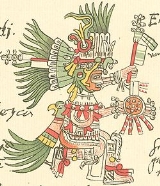
In art and
iconographyIconography is the branch of art history which studies the identification, description, and the interpretation of the content of images. The word iconography literally means "image writing", and comes from the Greek "image" and "to write". A secondary meaning is the painting of icons in the...
, Huitzilopochtli was represented as a
hummingbirdHummingbirds are birds that comprise the family Trochilidae. They are among the smallest of birds, most species measuring in the 7.5–13 cm range. Indeed, the smallest extant bird species is a hummingbird, the 5-cm Bee Hummingbird. They can hover in mid-air by rapidly flapping their wings...
(or with just the feathers of such on his head and left leg), a black face, and holding a scepter shaped like a
snakeSnakes are elongate, legless, carnivorous reptiles of the suborder Serpentes that can be distinguished from legless lizards by their lack of eyelids and external ears. Like all squamates, snakes are ectothermic, amniote vertebrates covered in overlapping scales...
and a
mirrorA mirror is an object that reflects light or sound in a way that preserves much of its original quality prior to its contact with the mirror. Some mirrors also filter out some wavelengths, while preserving other wavelengths in the reflection...
. In the great temple his statue was decorated with cloth, feathers, gold, and jewels, and was hidden behind a curtain to give it more reverence and veneration. Another variation lists him having a face that was marked with yellow and blue stripes and he carries around the fire serpent Xiuhcoatl with him.
http://atheism.about.com/od/aztecgodsgoddesses/p/Huitzilopochtli.htm
According to legend, the statue was supposed to be destroyed by the soldier Gil González de Benavides, but it was rescued by a man called Tlatolatl. The statue appeared some years later during an investigation by
Bishop ZummáragaJuan de Zumárraga was a Spanish Basque Franciscan prelate and first bishop of Mexico.-Origins and arrival in New Spain:...
in the 1530s, only to be lost again. There is speculation that the statue still exists in a cave somewhere in the Anahuac Valley.
Calendar
Diego DuranDiego Durán was a Dominican friar best known for his authorship of one of the earliest Western books on the history and culture of the Aztecs, The History of the Indies of New Spain, a book that was much criticized in his lifetime for helping the "heathen" maintain their culture.Also known as the...
described the festivities for Huitzilopochtli.
PanquetzaliztliThe Aztec calendar is the calendar system that was used by the Aztecs as well as other Pre-Columbian peoples of central Mexico. It is one of the Mesoamerican calendars, sharing the basic structure of calendars from throughout ancient Mesoamerica....
(7 December to 26 December) was the Aztec month dedicated to Huitzilopochtli. People decorated their homes and trees with paper flags; there were ritual races, processions, dances, songs, prayers, and finally human sacrifices. This was one of the more important Aztec festivals, and the people prepared for the whole month. They fasted or ate very little; a statue of the god was made with
amaranthAmaranthus, collectively known as amaranth, is a cosmopolitan genus of herbs. Approximately 60 species are recognized, with inflorescences and foliage ranging from purple and red to gold...
(huautli) seeds and honey, and at the end of the month, it was cut into small pieces so everybody could eat a little piece of the god. After the Spanish conquest, cultivation of amaranth was outlawed, while some of the festivities were subsumed into the
ChristmasChristmas or Christmas Day is an annual holiday generally celebrated on December 25 by billions of people around the world. It is a Christian feast that commemorates the birth of Jesus Christ, liturgically closing the Advent season and initiating the season of Christmastide, which lasts twelve days...
celebration.
According to the
Ramirez CodexThe Ramírez Codex is a post-conquest codex from the late 16th century entitled Relación del origen de los indios que hábitan esta Nueva España según sus Historias .Ascribed to Juan de Tovar, most scholars believe that he based this work on an...
, in Tenochtitlan
circaCirca , usually abbreviated c. or ca. , means "approximately" in the English language, usually referring to a date...
sixty prisoners were sacrificed at the festivities. Sacrifices were reported to be made in other Aztec cities, including
TlatelolcoTlatelolco was a pre-Columbian Nahua altepetl in the Valley of Mexico. Its inhabitants were known as Tlatelolca. The Tlatelolca were a part of the Mexica ethnic group, a Nahuatl speaking people who arrived in what is now central Mexico in the 13th century...
,
XochimilcoXochimilco is one of the sixteen delegaciones or boroughs within Mexican Federal District. The borough is centered on the formerly independent city of Xochimilco, which was established on what was the southern shore of Lake Xochimilco in the pre-Hispanic period...
, and Texcoco, but the number is unknown, and no currently available archeological findings confirm this.
For the reconsecration of Great Pyramid of Tenochtitlan in 1487, dedicated to Tlaloc and Huitzilopochtli, the Aztecs reported that they sacrificed about 20,400 prisoners over the course of four days. While accepted by some scholars, this claim also has been considered Aztec propaganda. There were 19 altars in the city of Tenochtitlan.
External links