


Hughie Jennings

Encyclopedia
Hugh Ambrose Jennings was a Major League Baseball
player and manager
from 1891 to 1925. Jennings was a leader, both as a batter and as a shortstop, with the Baltimore Orioles teams that won National League championships in 1894, 1895, and 1896. During the three championship seasons, Jennings had 355 RBIs and hit .335, .386, and .401. Jennings was a fiery, hard-nosed player who was not afraid to be hit by a pitch to get on base. Also in 1896, he was hit by a pitch
51 times – a major league record that has never been broken. Jennings also holds the career record for being hit by a pitch
with 287, with Craig Biggio
(who retired in 2007) holding the modern day career record of 285. Jennings also played on the Brooklyn Superbas teams that won National League pennants in 1899 and 1900. From 1907-1920, Jennings was the manager of the Detroit Tigers
, where he was known for his colorful antics, hoots, whistles, and his famous shouts of “Ee-Yah” from the third base coaching box. Jennings suffered a nervous breakdown in 1925 that forced him to leave Major League Baseball. He died in 1928 and was posthumously inducted into the Baseball Hall of Fame in 1945.
, Jennings was the son of a Scottish mother and James Jennings, a native of County Galway
.
Jennings worked as a breaker boy
(young boys who separated the coal from the slate) in the local anthracite coal mines. He drew attention playing shortstop
for a semi-professional baseball team in Lehighton, Pennsylvania
in 1890. He was signed by the Louisville Colonels
of the American Association
in . He stayed with the Colonels when they joined the National League
in and was traded on June 7, to the Baltimore Orioles.
, second baseman John McGraw, shortstop Jennings, catcher Wilbert Robinson
, right fielder ”Wee Willie” Keeler
, and left fielder Joe Kelley
.
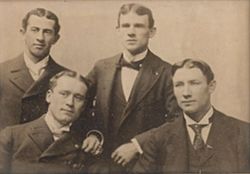 During the Orioles’ championship years, Jennings had some of the best seasons ever by a major league shortstop. In , he hit .386, scored 159 runs, collected 204 hits, knocked in 125 runs, and stole 53 bases. In , his performance was even better, as he hit .401 (2nd best in the National League) with 209 hits, 121 RBIs, and 70 stolen bases.
The fiery Jennings was also known as one of the most fearless players of his time, allowing himself to be hit by a pitch
more than any other player. In one game, he was hit by a pitch three times. In 1896, he was hit by a pitch 51 times—a Major League record that still stands. In just five seasons with the Orioles from 1894–1898, Jennings was hit by a pitch an unprecedented 202 times. During one game, Jennings was hit in the head by a pitch from Amos Rusie
the 3rd inning, but managed to finish the game. As soon as the game ended, Jennings collapsed and was unconscious for three days.
Jennings was also one of the best fielding shortstops of the era. He led the National League in fielding percentage
and putouts three times each. He had as many as 537 assists and 425 putouts in single seasons during his prime. His 425 putouts ties him with Donie Bush
for the single season record for a shortstop. In 1895, he had a career-high range factor
of 6.73—1.19 points higher than the league average (5.54) for shortstops that year. He once handled 20 chances in a game, and on another occasion had 10 assists in a game. In 1898, he threw his arm out, and his career as a shortstop came to an end. After that, Jennings was forced to move to first base.
, and Willie Keeler
followed. While Jennings was never the same after the injury to his arm in 1898, he contributed to Brooklyn’s National League pennants in and .
In 1901, Jennings was traded to the Philadelphia Phillies
. However, his failing arm cut his career short, as he never played in more than 82 games or hit above .272 in two seasons with the Phillies. Jennings played 6 games for the Superbas in 1903, effectively ending his playing career, with the exception of 9 at bats during his tenure as the manager of the Detroit Tigers
.
. After the 1899 season, Jennings was accepted to Cornell Law School
. He managed the Cornell baseball team while studying law and concluded that he was well-suited to being a manager. Jennings continued as a scholar-athlete until the spring of 1904, when he left campus early to manage the Orioles. Though he never finished his law degree at Cornell, Jennings passed the Maryland bar exam in 1905 and started a law practice. He continued to work at his law practice during the off-season through the remainder of his baseball career.
team that included future Hall of Famers Ty Cobb
and Sam Crawford
. Jennings led the Tigers to three consecutive American League
pennants, in -08-09. However, Jennings' teams lost the 1907, 1908, and 1909 World Series to the "Tinker to Evers to Chance" Chicago Cubs
and Honus Wagner's Pittsburgh Pirates
. Jennings continued to manage the Tigers through the 1920 season, though his team never won another pennant.
 During his years as Detroit’s manager, Jennings became famous for his antics, mostly in the third base coaching box, which variously included shouts of “Ee-Yah,” and other whoops, whistles, horns, gyrations, jigs, and grass-plucking. The "Ee-Yah" whoop became his trademark and was accompanied with waves of both arms over his head and a sharp raising of his right knee. In 1907, he was suspended for taunting opponents with a tin whistle. The "Ee-Yah" shouts continued and became such a trademark that Jennings became known as Hughie "Ee-Yah" Jennings, and Detroit fans would shout "Ee-Yah" when Jennings would appear on the field. (See also Jack Smile, Ee-yah: The Life And Times Of Hughie Jennings, Baseball Hall Of Famer)
Behind the antics was a great coaching mind. Connie Mack
called Jennings one of the three greatest managers in history, along with John McGraw
and Joe McCarthy. One of his greatest challenges, and accomplishments, during his years in Detroit was to manage the unmanageable -- Ty Cobb
. Jennings recognized Cobb’s talent and his complicated psychological makeup and concluded the best strategy would be to let Cobb be Cobb. Jennings reportedly called Cobb aside one day and said: “There isn’t anything about baseball I can teach you. Anything I might say to you would merely hinder you in your development. The only thing for you to do is go ahead and do as you please. Use your own judgment.. . . . . Do what you think is best and I’ll back you up.”
In , during a game in which "pick-ups" played for the Tigers when the regular team went on strike to protest the suspension of Cobb after an incident involving a fan in the stands whom Cobb assaulted, Jennings, who also sent his coaches
in as substitute players, came to bat himself once as a pinch hitter
. According to one source, when the umpire
asked him for whom he was batting, Jennings answered, "None of your business." The umpire noted on his lineup sheet, "Jennings--batted for exercise."
While Jennings was fiery, hard-nosed, colorful, and even eccentric, he insisted he had always played the game honestly. When a scandal arose in 1926 concerning whether Ty Cobb
and Tris Speaker
had fixed a 1919 game between Detroit and Cleveland while Jennings was the manager, Jennings initially spoke of how easy it would be to fix a game and issued a "no comment" on the specific game. After his "no comment" drew negative publicity, Jennings issued a statement to the press in December 1926 denying knowledge of the matter and adding: "My slate has been clean base ball for 35 years... Whatever I have done in base ball has been of such a nature that I would be ready any time to go before anyone and place my case before them." After the 1920 season, Jennings stepped down as the Tigers’ manager. His 1,131 wins remained the most in Tigers history until Sparky Anderson
passed him.
. Jennings and McGraw, who met as teammates on the Orioles, became close friends. Jennings was the best man at McGraw's wedding and a pallbearer following the death of McGraw's 23-year-old wife in 1899. McGraw and Jennings staged a reunion year after year on their birthdays. When McGraw became ill, Jennings filled in as the Giants' manager for parts of 1924 and 1925. His overall managing record was 1184-995.
near Goldsborough, 23 miles southeast of Scranton. In the crash, Jennings again fractured his skull, suffered a concussion of the brain, and broke both legs and his left arm. For several days after the accident, doctors were unsure if Jennings would survive.
The physical abuse and blows to the head undoubtedly took their toll. During the 1925 season, McGraw was ill, and Jennings was put in full charge of the Giants. The team finished in second place and the strain caught up with Jennings, who suffered a nervous breakdown
when the season ended. According to his obituary, Jennings “was unable to report” to spring training in 1926 due to his condition. Jennings retired to the Winyah Sanatorium in Asheville, North Carolina
. He did return home to Scranton, Pennsylvania
, spending much of his time recuperating in the Pocono Mountains. In early 1928, Jennings died from meningitis
in Scranton, Pennsylvania
at age 58.
Jennings was elected to the Baseball Hall of Fame in 1945
as a player.
Major League Baseball
Major League Baseball is the highest level of professional baseball in the United States and Canada, consisting of teams that play in the National League and the American League...
player and manager
Manager (baseball)
In baseball, the field manager is an individual who is responsible for matters of team strategy on the field and team leadership. Managers are typically assisted by between one and six assistant coaches, whose responsibilities are specialized...
from 1891 to 1925. Jennings was a leader, both as a batter and as a shortstop, with the Baltimore Orioles teams that won National League championships in 1894, 1895, and 1896. During the three championship seasons, Jennings had 355 RBIs and hit .335, .386, and .401. Jennings was a fiery, hard-nosed player who was not afraid to be hit by a pitch to get on base. Also in 1896, he was hit by a pitch
Hit by pitch
In baseball, hit by pitch , or hit batsman , is a batter or his equipment being hit in some part of his body by a pitch from the pitcher.-Official rule:...
51 times – a major league record that has never been broken. Jennings also holds the career record for being hit by a pitch
Hit by pitch
In baseball, hit by pitch , or hit batsman , is a batter or his equipment being hit in some part of his body by a pitch from the pitcher.-Official rule:...
with 287, with Craig Biggio
Craig Biggio
Craig Alan Biggio is a former Major League Baseball second baseman, catcher, and outfielder. He played his entire 20-year baseball career with the Houston Astros . He ranks 21st all-time with 3,060 career hits, and is the ninth player in the 3000 hit club to get all his hits with the same team. He...
(who retired in 2007) holding the modern day career record of 285. Jennings also played on the Brooklyn Superbas teams that won National League pennants in 1899 and 1900. From 1907-1920, Jennings was the manager of the Detroit Tigers
Detroit Tigers
The Detroit Tigers are a Major League Baseball team located in Detroit, Michigan. One of the American League's eight charter franchises, the club was founded in Detroit in as part of the Western League. The Tigers have won four World Series championships and have won the American League pennant...
, where he was known for his colorful antics, hoots, whistles, and his famous shouts of “Ee-Yah” from the third base coaching box. Jennings suffered a nervous breakdown in 1925 that forced him to leave Major League Baseball. He died in 1928 and was posthumously inducted into the Baseball Hall of Fame in 1945.
Early years
Born in Pittston, PennsylvaniaPittston, Pennsylvania
Pittston is a city in Luzerne County, Pennsylvania, United States, between Scranton and Wilkes-Barre. It gained prominence in the late 19th and early 20th centuries as an active anthracite coal mining city, drawing a large portion of its labor force from European immigrants. The population was...
, Jennings was the son of a Scottish mother and James Jennings, a native of County Galway
County Galway
County Galway is a county in Ireland. It is located in the West Region and is also part of the province of Connacht. It is named after the city of Galway. Galway County Council is the local authority for the county. There are several strongly Irish-speaking areas in the west of the county...
.
Jennings worked as a breaker boy
Breaker boy
A breaker boy was a coal-mining worker in the United States and United Kingdom whose job was to separate impurities from coal by hand in a coal breaker. Although breaker boys were primarily children, elderly coal miners who could no longer work in the mines because of age, disease, or accident were...
(young boys who separated the coal from the slate) in the local anthracite coal mines. He drew attention playing shortstop
Shortstop
Shortstop, abbreviated SS, is the baseball fielding position between second and third base. Shortstop is often regarded as the most dynamic defensive position in baseball, because there are more right-handed hitters in baseball than left-handed hitters, and most hitters have a tendency to pull the...
for a semi-professional baseball team in Lehighton, Pennsylvania
Lehighton, Pennsylvania
Lehighton is a borough in Carbon County, Pennsylvania, north by west of Philadelphia. In the past, it developed early industries because of water power from the Lehigh River. With the location of a repair facility here and its regional operations, the Lehigh Valley Railroad became for years a...
in 1890. He was signed by the Louisville Colonels
Louisville Colonels
The Louisville Colonels were a Major League Baseball team that played in the American Association throughout that league's ten-year existence from 1882 until 1891, first as the Louisville Eclipse and later as the Louisville Colonels , the latter name derived from the historic Kentucky colonels...
of the American Association
American Association (19th century)
The American Association was a Major League Baseball league that existed for 10 seasons from to . During that time, it challenged the National League for dominance of professional baseball...
in . He stayed with the Colonels when they joined the National League
National League
The National League of Professional Baseball Clubs, known simply as the National League , is the older of two leagues constituting Major League Baseball, and the world's oldest extant professional team sports league. Founded on February 2, 1876, to replace the National Association of Professional...
in and was traded on June 7, to the Baltimore Orioles.
Baltimore Orioles: 1893-1899
Jennings played with the Orioles for parts of seven seasons and became a star during his years in Baltimore. The Baltimore Orioles teams of , , and are regarded as one of the greatest teams of all time. The teams featured Hall of Fame manager Ned Hanlon and a lineup with six future Hall of Famers: first baseman Dan BrouthersDan Brouthers
Dennis Joseph "Dan" Brouthers was an American first baseman in Major League Baseball whose career spanned the period from to , with a brief return in...
, second baseman John McGraw, shortstop Jennings, catcher Wilbert Robinson
Wilbert Robinson
Wilbert Robinson , nicknamed "Uncle Robbie", was an American catcher, coach and manager in Major League Baseball...
, right fielder ”Wee Willie” Keeler
Willie Keeler
William Henry Keeler in Brooklyn, New York, nicknamed "Wee Willie", was a right fielder in professional baseball who played from 1892 to 1910, primarily for the Baltimore Orioles and Brooklyn Superbas in the National League, and the New York Highlanders in the American League.- Biography :Keeler's...
, and left fielder Joe Kelley
Joe Kelley
Joseph James Kelley was an American left fielder in Major League Baseball who starred in the outfield of the powerful Baltimore Oriole teams of the 1890s.-Career:...
.
The fiery Jennings was also known as one of the most fearless players of his time, allowing himself to be hit by a pitch
Hit by pitch
In baseball, hit by pitch , or hit batsman , is a batter or his equipment being hit in some part of his body by a pitch from the pitcher.-Official rule:...
more than any other player. In one game, he was hit by a pitch three times. In 1896, he was hit by a pitch 51 times—a Major League record that still stands. In just five seasons with the Orioles from 1894–1898, Jennings was hit by a pitch an unprecedented 202 times. During one game, Jennings was hit in the head by a pitch from Amos Rusie
Amos Rusie
Amos Wilson Rusie , nicknamed "The Hoosier Thunderbolt", was an American right-handed pitcher in Major League Baseball during the late 19th century...
the 3rd inning, but managed to finish the game. As soon as the game ended, Jennings collapsed and was unconscious for three days.
Jennings was also one of the best fielding shortstops of the era. He led the National League in fielding percentage
Fielding percentage
In baseball statistics, fielding percentage, also known as fielding average, is a measure that reflects the percentage of times a defensive player properly handles a batted or thrown ball...
and putouts three times each. He had as many as 537 assists and 425 putouts in single seasons during his prime. His 425 putouts ties him with Donie Bush
Donie Bush
Owen Joseph "Donie" Bush , was a Major League Baseball shortstop in the American League for the Detroit Tigers and the Washington Senators...
for the single season record for a shortstop. In 1895, he had a career-high range factor
Range Factor
Range Factor is a baseball statistic developed by Bill James. It is calculated by dividing putouts and assists by number of innings or games played at a given defense position...
of 6.73—1.19 points higher than the league average (5.54) for shortstops that year. He once handled 20 chances in a game, and on another occasion had 10 assists in a game. In 1898, he threw his arm out, and his career as a shortstop came to an end. After that, Jennings was forced to move to first base.
Brooklyn Superbas and Philadelphia Phillies: 1899-1903
In 1899, when manager Ned Hanlon moved to the Brooklyn Superbas, several of his star players, including Jennings, Joe KelleyJoe Kelley
Joseph James Kelley was an American left fielder in Major League Baseball who starred in the outfield of the powerful Baltimore Oriole teams of the 1890s.-Career:...
, and Willie Keeler
Willie Keeler
William Henry Keeler in Brooklyn, New York, nicknamed "Wee Willie", was a right fielder in professional baseball who played from 1892 to 1910, primarily for the Baltimore Orioles and Brooklyn Superbas in the National League, and the New York Highlanders in the American League.- Biography :Keeler's...
followed. While Jennings was never the same after the injury to his arm in 1898, he contributed to Brooklyn’s National League pennants in and .
In 1901, Jennings was traded to the Philadelphia Phillies
Philadelphia Phillies
The Philadelphia Phillies are a Major League Baseball team. They are the oldest continuous, one-name, one-city franchise in all of professional American sports, dating to 1883. The Phillies are a member of the Eastern Division of Major League Baseball's National League...
. However, his failing arm cut his career short, as he never played in more than 82 games or hit above .272 in two seasons with the Phillies. Jennings played 6 games for the Superbas in 1903, effectively ending his playing career, with the exception of 9 at bats during his tenure as the manager of the Detroit Tigers
Detroit Tigers
The Detroit Tigers are a Major League Baseball team located in Detroit, Michigan. One of the American League's eight charter franchises, the club was founded in Detroit in as part of the Western League. The Tigers have won four World Series championships and have won the American League pennant...
.
Cornell Law School and an off-season law practice
While playing for the Orioles in the 1890s, Jennings and John McGraw both attended classes at St. Bonaventure UniversitySt. Bonaventure University
St. Bonaventure University is a private, Franciscan Catholic university, located in Allegany, Cattaraugus County, New York, United States. It has roughly 2,400 undergraduate and graduate students....
. After the 1899 season, Jennings was accepted to Cornell Law School
Cornell Law School
Cornell Law School, located in Ithaca, New York, is a graduate school of Cornell University and one of the five Ivy League law schools. The school confers three law degrees...
. He managed the Cornell baseball team while studying law and concluded that he was well-suited to being a manager. Jennings continued as a scholar-athlete until the spring of 1904, when he left campus early to manage the Orioles. Though he never finished his law degree at Cornell, Jennings passed the Maryland bar exam in 1905 and started a law practice. He continued to work at his law practice during the off-season through the remainder of his baseball career.
The "Ee-Yah" years: 1907-1920
In , Jennings was hired as manager of a talented Detroit TigersDetroit Tigers
The Detroit Tigers are a Major League Baseball team located in Detroit, Michigan. One of the American League's eight charter franchises, the club was founded in Detroit in as part of the Western League. The Tigers have won four World Series championships and have won the American League pennant...
team that included future Hall of Famers Ty Cobb
Ty Cobb
Tyrus Raymond "Ty" Cobb , nicknamed "The Georgia Peach," was an American Major League Baseball outfielder. He was born in Narrows, Georgia...
and Sam Crawford
Sam Crawford
Samuel Earl Crawford , nicknamed "Wahoo Sam", was a Major League Baseball player who played outfield for the Cincinnati Reds and Detroit Tigers. He was elected to the Baseball Hall of Fame in 1957....
. Jennings led the Tigers to three consecutive American League
American League
The American League of Professional Baseball Clubs, or simply the American League , is one of two leagues that make up Major League Baseball in the United States and Canada. It developed from the Western League, a minor league based in the Great Lakes states, which eventually aspired to major...
pennants, in -08-09. However, Jennings' teams lost the 1907, 1908, and 1909 World Series to the "Tinker to Evers to Chance" Chicago Cubs
Chicago Cubs
The Chicago Cubs are a professional baseball team located in Chicago, Illinois. They are members of the Central Division of Major League Baseball's National League. They are one of two Major League clubs based in Chicago . The Cubs are also one of the two remaining charter members of the National...
and Honus Wagner's Pittsburgh Pirates
Pittsburgh Pirates
The Pittsburgh Pirates are a Major League Baseball club based in Pittsburgh, Pennsylvania. They play in the Central Division of the National League, and are five-time World Series Champions...
. Jennings continued to manage the Tigers through the 1920 season, though his team never won another pennant.
Behind the antics was a great coaching mind. Connie Mack
Connie Mack (baseball)
Cornelius McGillicuddy, Sr. , better known as Connie Mack, was an American professional baseball player, manager, and team owner. The longest-serving manager in Major League Baseball history, he holds records for wins , losses , and games managed , with his victory total being almost 1,000 more...
called Jennings one of the three greatest managers in history, along with John McGraw
John McGraw
John McGraw may refer to:* John McGraw , , New York lumber tycoon, and one of the founding trustees of Cornell University* John McGraw , , Governor of Washington state from 1893–1897...
and Joe McCarthy. One of his greatest challenges, and accomplishments, during his years in Detroit was to manage the unmanageable -- Ty Cobb
Ty Cobb
Tyrus Raymond "Ty" Cobb , nicknamed "The Georgia Peach," was an American Major League Baseball outfielder. He was born in Narrows, Georgia...
. Jennings recognized Cobb’s talent and his complicated psychological makeup and concluded the best strategy would be to let Cobb be Cobb. Jennings reportedly called Cobb aside one day and said: “There isn’t anything about baseball I can teach you. Anything I might say to you would merely hinder you in your development. The only thing for you to do is go ahead and do as you please. Use your own judgment.. . . . . Do what you think is best and I’ll back you up.”
In , during a game in which "pick-ups" played for the Tigers when the regular team went on strike to protest the suspension of Cobb after an incident involving a fan in the stands whom Cobb assaulted, Jennings, who also sent his coaches
Coach (baseball)
In baseball, a number of coaches assist in the smooth functioning of a team. They are assistants to the manager, or head coach, who determines the lineup and decides how to substitute players during the game...
in as substitute players, came to bat himself once as a pinch hitter
Pinch hitter
In baseball, a pinch hitter is a substitute batter. Batters can be substituted at any time while the ball is dead ; the manager may use any player that has not yet entered the game as a substitute...
. According to one source, when the umpire
Umpire (baseball)
In baseball, the umpire is the person charged with officiating the game, including beginning and ending the game, enforcing the rules of the game and the grounds, making judgment calls on plays, and handling the disciplinary actions. The term is often shortened to the colloquial form ump...
asked him for whom he was batting, Jennings answered, "None of your business." The umpire noted on his lineup sheet, "Jennings--batted for exercise."
While Jennings was fiery, hard-nosed, colorful, and even eccentric, he insisted he had always played the game honestly. When a scandal arose in 1926 concerning whether Ty Cobb
Ty Cobb
Tyrus Raymond "Ty" Cobb , nicknamed "The Georgia Peach," was an American Major League Baseball outfielder. He was born in Narrows, Georgia...
and Tris Speaker
Tris Speaker
Tristram E. Speaker , nicknamed "Spoke" and "The Grey Eagle", was an American baseball player. Considered one of the best offensive and defensive center fielders in the history of Major League Baseball, he compiled a career batting average of .345 , and still holds the record of 792 career doubles...
had fixed a 1919 game between Detroit and Cleveland while Jennings was the manager, Jennings initially spoke of how easy it would be to fix a game and issued a "no comment" on the specific game. After his "no comment" drew negative publicity, Jennings issued a statement to the press in December 1926 denying knowledge of the matter and adding: "My slate has been clean base ball for 35 years... Whatever I have done in base ball has been of such a nature that I would be ready any time to go before anyone and place my case before them." After the 1920 season, Jennings stepped down as the Tigers’ manager. His 1,131 wins remained the most in Tigers history until Sparky Anderson
Sparky Anderson
George Lee "Sparky" Anderson was an American Major League Baseball manager. He managed the National League's Cincinnati Reds to the 1975 and 1976 championships, then added a third title in 1984 with the Detroit Tigers of the American League. He was the first manager to win the World Series in both...
passed him.
New York Giants: 1921-1925
Jennings signed on as a coach with his old friend, John McGraw, who was managing the New York GiantsSan Francisco Giants
The San Francisco Giants are a Major League Baseball team based in San Francisco, California, playing in the National League West Division....
. Jennings and McGraw, who met as teammates on the Orioles, became close friends. Jennings was the best man at McGraw's wedding and a pallbearer following the death of McGraw's 23-year-old wife in 1899. McGraw and Jennings staged a reunion year after year on their birthdays. When McGraw became ill, Jennings filled in as the Giants' manager for parts of 1924 and 1925. His overall managing record was 1184-995.
A lifetime of tragic accidents
Jennings’ life was filled with several tragic accidents. There was the beaning incident in Philadelphia that left him unconscious for three days. While attending Cornell, he fractured his skull diving head-first into a swimming pool at night, only to find the pool had been emptied. In December 1911, Jennings came close to death after an off-season automobile accident. While driving a car given to him by admirers, Jennings’ car overturned while crossing a bridge over the Lehigh RiverLehigh River
The Lehigh River, a tributary of the Delaware River, is a river located in eastern Pennsylvania, in the United States. Part of the Lehigh, along with a number of its tributaries, is designated a Pennsylvania Scenic River by the state's Department of Conservation and Natural Resources...
near Goldsborough, 23 miles southeast of Scranton. In the crash, Jennings again fractured his skull, suffered a concussion of the brain, and broke both legs and his left arm. For several days after the accident, doctors were unsure if Jennings would survive.
The physical abuse and blows to the head undoubtedly took their toll. During the 1925 season, McGraw was ill, and Jennings was put in full charge of the Giants. The team finished in second place and the strain caught up with Jennings, who suffered a nervous breakdown
Nervous breakdown
Mental breakdown is a non-medical term used to describe an acute, time-limited phase of a specific disorder that presents primarily with features of depression or anxiety.-Definition:...
when the season ended. According to his obituary, Jennings “was unable to report” to spring training in 1926 due to his condition. Jennings retired to the Winyah Sanatorium in Asheville, North Carolina
Asheville, North Carolina
Asheville is a city in and the county seat of Buncombe County, North Carolina, United States. It is the largest city in Western North Carolina, and the 11th largest city in North Carolina. The City is home to the United States National Climatic Data Center , which is the world's largest active...
. He did return home to Scranton, Pennsylvania
Scranton, Pennsylvania
Scranton is a city in the northeastern part of Pennsylvania, United States. It is the county seat of Lackawanna County and the largest principal city in the Scranton/Wilkes-Barre metropolitan area. Scranton had a population of 76,089 in 2010, according to the U.S...
, spending much of his time recuperating in the Pocono Mountains. In early 1928, Jennings died from meningitis
Meningitis
Meningitis is inflammation of the protective membranes covering the brain and spinal cord, known collectively as the meninges. The inflammation may be caused by infection with viruses, bacteria, or other microorganisms, and less commonly by certain drugs...
in Scranton, Pennsylvania
Scranton, Pennsylvania
Scranton is a city in the northeastern part of Pennsylvania, United States. It is the county seat of Lackawanna County and the largest principal city in the Scranton/Wilkes-Barre metropolitan area. Scranton had a population of 76,089 in 2010, according to the U.S...
at age 58.
Jennings was elected to the Baseball Hall of Fame in 1945
Baseball Hall of Fame balloting, 1945
Elections to the Baseball Hall of Fame for 1945 included the first regular election conducted in three years and a strong response to criticism of the slow pace of honors....
as a player.
Career statistics
| G Games played Games played is a statistic used in team sports to indicate the total number of games in which a player has participated ; the statistic is generally applied irrespective of whatever portion of the game is contested.-Baseball:In baseball, the statistic applies also to players who, prior to a game,... |
AB At bat In baseball, an at bat or time at bat is used to calculate certain statistics, including batting average, on base percentage, and slugging percentage. It is a more restricted definition of a plate appearance... |
R | H | 2B Double (baseball) In baseball, a double is the act of a batter striking the pitched ball and safely reaching second base without being called out by the umpire, without the benefit of a fielder's misplay or another runner being put out on a fielder's choice.... |
3B Triple (baseball) In baseball, a triple is the act of a batter safely reaching third base after hitting the ball, with neither the benefit of a fielder's misplay nor another runner being put out on a fielder's choice.... |
HR Home run In baseball, a home run is scored when the ball is hit in such a way that the batter is able to reach home safely in one play without any errors being committed by the defensive team in the process... |
RBI | BB Base on balls A base on balls is credited to a batter and against a pitcher in baseball statistics when a batter receives four pitches that the umpire calls balls. It is better known as a walk. The base on balls is defined in Section 2.00 of baseball's Official Rules, and further detail is given in 6.08... |
SO Strikeout In baseball or softball, a strikeout or strike-out occurs when a batter receives three strikes during his time at bat. A strikeout is a statistic recorded for both pitchers and batters.... |
SB Stolen base In baseball, a stolen base occurs when a baserunner successfully advances to the next base while the pitcher is delivering the ball to home plate... |
AVG Batting average Batting average is a statistic in both cricket and baseball that measures the performance of cricket batsmen and baseball hitters. The two statistics are related in that baseball averages are directly descended from the concept of cricket averages.- Cricket :... |
OBP On base percentage In baseball statistics, on-base percentage is a measure of how often a batter reaches base for any reason other than a fielding error, fielder's choice, dropped/uncaught third strike, fielder's obstruction, or catcher's interference In baseball statistics, on-base percentage (OBP) (sometimes... |
SLG | HBP Hit by pitch In baseball, hit by pitch , or hit batsman , is a batter or his equipment being hit in some part of his body by a pitch from the pitcher.-Official rule:... |
|---|---|---|---|---|---|---|---|---|---|---|---|---|---|---|
| 1285 | 4904 | 994 | 1527 | 232 | 88 | 18 | 840 | 347 | 117 | 359 | .311 | .390 | .406 | 287 |
See also
- List of Major League Baseball leaders in career stolen bases
- 1909 Detroit Tigers season1909 Detroit Tigers seasonThe 1909 Detroit Tigers won the American League pennant with a record of 96-56, but lost to the Pittsburgh Pirates in the 1909 World Series, 4 games to 3. The season was their 9th since they were charter members of the American League in 1901. It was the third consecutive season in which they won...