

Hubert Gough

Encyclopedia
General
Sir Hubert de la Poer Gough GCB
, GCMG
, KCVO
(12 August 1870 – 18 March 1963) was a senior officer in the British Army
, who commanded the British Fifth Army
from 1916 to 1918 during the First World War.
, the eldest son of Sir Charles John Stanley Gough
VC, GCB, nephew of General Sir Hugh Henry Gough
VC and brother of Brigadier-General John Edmund Gough VC (the only family to ever win the Victoria Cross
, the highest award for bravery, three times). He married Harriette Anastasia de la Poer, daughter of John William Poer, styled 17th Baron de la Poer, of Gurteen, County Waterford
, formerly MP for County Waterford. Their daughter Myrtle Eleanore Gough married Major Eric Adlhelm Torlogh Dutton, CMG, CBE, in 1936.
, and according to his autobiography "Soldiering On" he was terrible at Latin. But he was good at sports such as football and rugby.
After leaving Eton, Gough gained entrance to the Royal Military Academy, Sandhurst in 1888. He joined the 16th Lancers in 1889 and served in the Tirah campaign
. Gough first became widely known for his command of a relief column during the siege of Ladysmith
in the Second Boer War
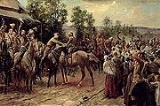
. His meeting with George Stuart White was widely portrayed.
From 1904 to 1906 he was an instructor at the Staff College and from December 1906 he commanded the 16th lancers. In 1911 he returned to Ireland as a brigadier-general commanding 3rd cavalry brigade, which included the 16th lancers, at the Curragh.
In March 1914 Gough was a leader in the Curragh Incident
, in which a number of British Army officers said that they would rather resign rather than enforce the Government's plans to realise Irish home rule.
and later commanded the 7th Division, known as "Gough's Mobile Army". A favourite of the British Commander-in-Chief, General Sir Douglas Haig
, he experienced a meteoric rise through the ranks during the war. By the time of the Battle of Loos
in September 1915, he was commanding I Corps and, at the start of the Battle of the Somme
in July 1916, Gough was in charge of the Reserve Army
, despite only being a lieutenant general
.
At the end of October 1916, Gough's Reserve Army was renamed the Fifth Army. The 16th (Irish) Division and the 36th (Ulster) Division moved under his command. In July 1917 during the Third Battle of Ypres although both divisions were exhausted after 13 days of moving heavy equipment under heavy shelling he ordered their battalions to advance to the east of Ypres through deep mud towards well fortified German positions left untouched by inadequate artillery preparation. By mid August, the 16th (Irish) had suffered over 4,200 casualties and the 36th (Ulster) had suffered almost 3,600 casualties, or more than 50% of their numbers. General Haig was critical of him for "playing the Irish card".
offensive on 21 March 1918 and the assumed failure of his army to hold the line and stem the German advance led to his dismissal. Andrew Roberts
offers a more favourable assessment of Gough's contribution:
Other historians such as Les Carlyon
concur in holding the opinion that Gough was unfairly dealt with following the Michael Offensive, but also regard Gough's performance during the Great War in generally unflattering terms, citing documented and repeated failings in planning, preparation, comprehension of the battle space, and a lack of empathy with the common soldier.
). He retired as a general
in 1922.
From 1936 until 1943, he was honorary colonel of the 16th/5th The Queen's Royal Lancers
, and President of the Irish Servicemen's Shamrock Club in Park Lane, London W.1.
His book The Fifth Army defended his record as commander in 1918.
Gough died in London on 18 March 1963, aged 92. He suffered from bronchial pneumonia for a month before he died, but it is unclear whether this was the official cause of death.
|-
|-
General
A general officer is an officer of high military rank, usually in the army, and in some nations, the air force. The term is widely used by many nations of the world, and when a country uses a different term, there is an equivalent title given....
Sir Hubert de la Poer Gough GCB
Order of the Bath
The Most Honourable Order of the Bath is a British order of chivalry founded by George I on 18 May 1725. The name derives from the elaborate mediæval ceremony for creating a knight, which involved bathing as one of its elements. The knights so created were known as Knights of the Bath...
, GCMG
Order of St Michael and St George
The Most Distinguished Order of Saint Michael and Saint George is an order of chivalry founded on 28 April 1818 by George, Prince Regent, later George IV of the United Kingdom, while he was acting as Prince Regent for his father, George III....
, KCVO
Royal Victorian Order
The Royal Victorian Order is a dynastic order of knighthood and a house order of chivalry recognising distinguished personal service to the order's Sovereign, the reigning monarch of the Commonwealth realms, any members of her family, or any of her viceroys...
(12 August 1870 – 18 March 1963) was a senior officer in the British Army
British Army
The British Army is the land warfare branch of Her Majesty's Armed Forces in the United Kingdom. It came into being with the unification of the Kingdom of England and Scotland into the Kingdom of Great Britain in 1707. The new British Army incorporated Regiments that had already existed in England...
, who commanded the British Fifth Army
British Fifth Army
The Fifth Army was a field army of the British Army during World War I and part of the British Expeditionary Force during the First World War.-History:...
from 1916 to 1918 during the First World War.
Family background
He was born in LondonLondon
London is the capital city of :England and the :United Kingdom, the largest metropolitan area in the United Kingdom, and the largest urban zone in the European Union by most measures. Located on the River Thames, London has been a major settlement for two millennia, its history going back to its...
, the eldest son of Sir Charles John Stanley Gough
Charles John Stanley Gough
General Sir Charles John Stanley Gough VC, GCB was born in Chittagong, India was a recipient of the Victoria Cross, the highest and most prestigious award for gallantry in the face of the enemy that can be awarded to British and Commonwealth forces.-Details:At age 16, Gough moved to India,...
VC, GCB, nephew of General Sir Hugh Henry Gough
Hugh Henry Gough
General Sir Hugh Henry Gough VC, GCB was born in Calcutta, India and was a recipient of the Victoria Cross, the highest and most prestigious award for gallantry in the face of the enemy that can be awarded to British and Commonwealth forces.-Details:He was 23 years old, and a lieutenant in the...
VC and brother of Brigadier-General John Edmund Gough VC (the only family to ever win the Victoria Cross
Victoria Cross
The Victoria Cross is the highest military decoration awarded for valour "in the face of the enemy" to members of the armed forces of various Commonwealth countries, and previous British Empire territories....
, the highest award for bravery, three times). He married Harriette Anastasia de la Poer, daughter of John William Poer, styled 17th Baron de la Poer, of Gurteen, County Waterford
County Waterford
*Abbeyside, Affane, Aglish, Annestown, An Rinn, Ardmore*Ballinacourty, Ballinameela, Ballinamult, Ballinroad, Ballybeg, Ballybricken, Ballyduff Lower, Ballyduff Upper, Ballydurn, Ballygunner, Ballylaneen, Ballymacarbry, Ballymacart, Ballynaneashagh, Ballysaggart, Ballytruckle, Bilberry, Bunmahon,...
, formerly MP for County Waterford. Their daughter Myrtle Eleanore Gough married Major Eric Adlhelm Torlogh Dutton, CMG, CBE, in 1936.
Early career
Gough attended Eton CollegeEton College
Eton College, often referred to simply as Eton, is a British independent school for boys aged 13 to 18. It was founded in 1440 by King Henry VI as "The King's College of Our Lady of Eton besides Wyndsor"....
, and according to his autobiography "Soldiering On" he was terrible at Latin. But he was good at sports such as football and rugby.
After leaving Eton, Gough gained entrance to the Royal Military Academy, Sandhurst in 1888. He joined the 16th Lancers in 1889 and served in the Tirah campaign
Tirah Campaign
The Tirah Campaign, often referred to in contemporary British accounts as the Tirah Expedition, was an Indian frontier war in 1897–98. Tirah is a mountainous tract of country.-Rebellion:...
. Gough first became widely known for his command of a relief column during the siege of Ladysmith
Siege of Ladysmith
The Siege of Ladysmith was a protracted engagement in the Second Boer War, taking place between 30 October 1899 and 28 February 1900 at Ladysmith, Natal.-Background:...
in the Second Boer War
Second Boer War
The Second Boer War was fought from 11 October 1899 until 31 May 1902 between the British Empire and the Afrikaans-speaking Dutch settlers of two independent Boer republics, the South African Republic and the Orange Free State...
. His meeting with George Stuart White was widely portrayed.
From 1904 to 1906 he was an instructor at the Staff College and from December 1906 he commanded the 16th lancers. In 1911 he returned to Ireland as a brigadier-general commanding 3rd cavalry brigade, which included the 16th lancers, at the Curragh.
In March 1914 Gough was a leader in the Curragh Incident
Curragh Incident
The Curragh Incident of 20 March 1914, also known as the Curragh Mutiny, occurred in the Curragh, County Kildare, Ireland. The Curragh Camp was then the main base for the British Army in Ireland, which at the time formed part of the United Kingdom....
, in which a number of British Army officers said that they would rather resign rather than enforce the Government's plans to realise Irish home rule.
First World War
At the outbreak of war in August 1914, Gough was commanding a brigadeBrigade
A brigade is a major tactical military formation that is typically composed of two to five battalions, plus supporting elements depending on the era and nationality of a given army and could be perceived as an enlarged/reinforced regiment...
and later commanded the 7th Division, known as "Gough's Mobile Army". A favourite of the British Commander-in-Chief, General Sir Douglas Haig
Douglas Haig, 1st Earl Haig
Field Marshal Douglas Haig, 1st Earl Haig, KT, GCB, OM, GCVO, KCIE, ADC, was a British senior officer during World War I. He commanded the British Expeditionary Force from 1915 to the end of the War...
, he experienced a meteoric rise through the ranks during the war. By the time of the Battle of Loos
Battle of Loos
The Battle of Loos was one of the major British offensives mounted on the Western Front in 1915 during World War I. It marked the first time the British used poison gas during the war, and is also famous for the fact that it witnessed the first large-scale use of 'new' or Kitchener's Army...
in September 1915, he was commanding I Corps and, at the start of the Battle of the Somme
Battle of the Somme (1916)
The Battle of the Somme , also known as the Somme Offensive, took place during the First World War between 1 July and 14 November 1916 in the Somme department of France, on both banks of the river of the same name...
in July 1916, Gough was in charge of the Reserve Army
British Reserve Army
The Reserve Army was a field army of the British Army during World War I and part of the British Expeditionary Force during the First World War...
, despite only being a lieutenant general
Lieutenant General
Lieutenant General is a military rank used in many countries. The rank traces its origins to the Middle Ages where the title of Lieutenant General was held by the second in command on the battlefield, who was normally subordinate to a Captain General....
.
At the end of October 1916, Gough's Reserve Army was renamed the Fifth Army. The 16th (Irish) Division and the 36th (Ulster) Division moved under his command. In July 1917 during the Third Battle of Ypres although both divisions were exhausted after 13 days of moving heavy equipment under heavy shelling he ordered their battalions to advance to the east of Ypres through deep mud towards well fortified German positions left untouched by inadequate artillery preparation. By mid August, the 16th (Irish) had suffered over 4,200 casualties and the 36th (Ulster) had suffered almost 3,600 casualties, or more than 50% of their numbers. General Haig was critical of him for "playing the Irish card".
Spring offensive
It was Gough's Fifth Army that bore the brunt of the German Operation MichaelOperation Michael
Operation Michael was a First World War German military operation that began the Spring Offensive on 21 March 1918. It was launched from the Hindenburg Line, in the vicinity of Saint-Quentin, France...
offensive on 21 March 1918 and the assumed failure of his army to hold the line and stem the German advance led to his dismissal. Andrew Roberts
Andrew Roberts
Andrew Roberts is an English historian and journalist.-Background:Roberts was born in London, England, the son of Simon from Cobham, Surrey, and Katie Roberts...
offers a more favourable assessment of Gough's contribution:
. . . the offensive saw a great wrong perpetrated on a distinguished British commander that was not righted for many years. Gough's Fifth Army had been spread thin on a forty-two-mile front lately taken over from the exhausted and demoralised French. The reason why the Germans did not break through to Paris, as by all the laws of strategy they ought to have done, was the heroism of the Fifth Army and its utter refusal to break. They fought a thirty-eight-mile rearguard action, contesting every village, field and, on occasion, yard . . . With no reserves and no strongly defended line to its rear, and with eighty German divisions against fifteen British, the Fifth Army fought the Somme offensive to a standstill on the Ancre, not retreating beyond Villers-Bretonneux . . .
Other historians such as Les Carlyon
Les Carlyon
Les Carlyon is an Australian writer, who was born in northern Victoria in 1942. He has been editor of Melbourne's journal of record, The Age, as well as editor-in-chief of The Herald and Weekly Times Ltd, and has twice won the Walkley Award for journalism...
concur in holding the opinion that Gough was unfairly dealt with following the Michael Offensive, but also regard Gough's performance during the Great War in generally unflattering terms, citing documented and repeated failings in planning, preparation, comprehension of the battle space, and a lack of empathy with the common soldier.
Later life
In 1919 he was the head of the Allied Military Mission to the Baltic States (see United Baltic DuchyUnited Baltic Duchy
The proposed United Baltic Duchy also known as the Grand Duchy of Livonia was a state proposed by the Baltic German nobility and exiled Russian nobility after the Russian revolution and German occupation of the Courland, Livonian and Estonian governorates of the Russian Empire.The idea comprised...
). He retired as a general
General
A general officer is an officer of high military rank, usually in the army, and in some nations, the air force. The term is widely used by many nations of the world, and when a country uses a different term, there is an equivalent title given....
in 1922.
From 1936 until 1943, he was honorary colonel of the 16th/5th The Queen's Royal Lancers
16th/5th The Queen's Royal Lancers
The 16th/5th The Queen's Royal Lancers was a cavalry regiment of the British Army from 1922 to 1993.It was formed at Lucknow in India as 16th/5th Lancers by the amalgamation of two regiments, 16th The Queen's Lancers and 5th Royal Irish Lancers....
, and President of the Irish Servicemen's Shamrock Club in Park Lane, London W.1.
His book The Fifth Army defended his record as commander in 1918.
Gough died in London on 18 March 1963, aged 92. He suffered from bronchial pneumonia for a month before he died, but it is unclear whether this was the official cause of death.
Further reading
- Walker, Jonathan The Blood Tub - General Gough and the Battle of Bullecourt 1917 Spellmount, 2000
External links
|-
|-