


Hoysala architecture

Encyclopedia
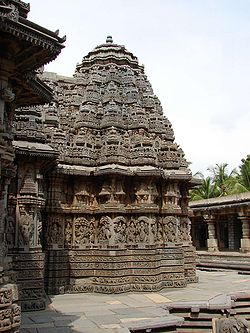
Hoysala Empire
The Hoysala Empire was a prominent South Indian Kannadiga empire that ruled most of the modern day state of Karnataka between the 10th and the 14th centuries. The capital of the Hoysalas was initially located at Belur but was later moved to Halebidu....
between the 11th and 14th centuries, in the region known today as Karnataka
Karnataka
Karnataka , the land of the Kannadigas, is a state in South West India. It was created on 1 November 1956, with the passing of the States Reorganisation Act and this day is annually celebrated as Karnataka Rajyotsava...
, a state of India
States and territories of India
India is a federal union of states comprising twenty-eight states and seven union territories. The states and territories are further subdivided into districts and so on.-List of states and territories:...
. Hoysala influence was at its peak in the 13th century, when it dominated the Southern Deccan
Deccan Plateau
The Deccan Plateau is a large plateau in India, making up the majority of the southern part of the country. It rises a hundred meters high in the north, rising further to more than a kilometers high in the south, forming a raised triangle nested within the familiar downward-pointing triangle of...
Plateau region. Large and small temples built during this era remain as examples of the Hoysala architectural style, including the Chennakesava Temple
Chennakesava Temple
The Chennakesava Temple originally called Vijayanarayana Temple was built on the banks of the Yagachi River in Belur, an early capital of the Hoysala Empire. Belur is 40 km from Hassan city and 220 km from Bangalore, in Hassan district of Karnataka state, India. Chennakesava literally...
at Belur
Belur
Belur may refer to any of the following:* Belur, Karnataka, town in Karnataka, India* Belur, West Bengal, India, a locality on the west bank of the Hooghly River* Belur Math, the religious abbey located in Belur, West Bengal, India...
, the Hoysaleswara Temple
Hoysaleswara temple
Hoysaleswara temple is a temple dedicated to Hindu God Shiva. It was built in Halebidu during the Hoysala Empire rule in the 12th century by King Vishnuvardhana. The construction was completed in 1121 CE. During the early 14th century, Halebidu was sacked and looted by Muslim invaders from...
at Halebidu
Halebidu
Halebidu is located in Hassan District, Karnataka, India. Halebidu was the regal capital of the Hoysala Empire in the 12th century. It is home to one of the best examples of Hoysala architecture in the ornate Hoysaleswara and Kedareswara temples. Halebidu literally means ruined city...
, and the Kesava Temple at Somanathapura
Somanathapura
The Chennakesava Temple located at Somanathapura is one of the finest examples of Hoysala architecture. This temple was built by Soma, a Dandanayaka in 1268 under Hoysala king Narasimha III, when the Hoysala Empire was the major power in South India.-Deity and sculptures:The ceiling of the hall...
. Other examples of fine Hoysala craftsmanship are the temples at Belavadi
Belavadi
The Veera Narayana temple is located in Belavadi , a village in Chikmagalur district of Karnataka state, India. The temple was built by the Hoysala Empire.This village was also known as Ekachakranagara, a place mentioned in Mahabharatha where Bheemasena killed the demon Bakasura and protected the...
, Amruthapura, Hosaholalu, Arasikere
Ishvara Temple (Arasikere)
The Ishvara Temple in Arasikere, Hassan district of Karnataka state, India, dates to c. 1220 CE rule of Hoysala Empire. Arasikere is located 60 km north the historic city of Mysore and 41 km north of Hassan city...
and Nuggehalli
Nuggehalli
Nuggehalli , is a town in Hassan district of Karnataka, India. Nuggehalli is located on the Tiptur-Channarayanapatna state highway. It is about 50 km from Hassan city. It is connected by road with Bangalore, the state capital...
. Study of the Hoysala architectural style has revealed a negligible Indo-Aryan
Indo-Aryans
Indo-Aryan is an ethno-linguistic term referring to the wide collection of peoples united as native speakers of the Indo-Aryan branch of the Indo-Iranian family of Indo-European languages...
influence while the impact of Southern Indian style is more distinct.
The vigorous temple building activity of the Hoysala Empire was due to the social, cultural and political events of the period. The stylistic transformation of the Karnata temple building tradition reflected religious trends popularized by the Vaishnava and Virashaiva philosophers as well as the growing military prowess of the Hoysala kings who desired to surpass their Western Chalukya overlords in artistic achievement. Temples built prior to Hoysala independence in the mid-12th century reflect significant Western Chalukya influences, while later temples retain some features salient to Chalukyan art but have additional inventive decoration and ornamentation, features unique to Hoysala artisans. About one hundred temples have survived in present-day Karnataka state, mostly in the Malnad
Malnad
Malenadu is a region of Karnataka state in South India. Malenadu covers the western and eastern slopes of the Western Ghats, roughly 100 kilometers in width. Malenadu covers portions of the Shimoga, Chikmagalur, Uttara Kannada, Kodagu and Hassan districts....
(hill) districts, the native home of the Hoysala kings.
As popular tourist destinations in Karnataka, Hoysala temples offer an opportunity for pilgrims and students of architecture to examine medieval Hindu architecture in the Karnata Dravida tradition. This tradition began in the 7th century under the patronage of the Chalukya dynasty
Chalukya dynasty
The Chalukya dynasty was an Indian royal dynasty that ruled large parts of southern and central India between the 6th and the 12th centuries. During this period, they ruled as three related yet individual dynasties. The earliest dynasty, known as the "Badami Chalukyas", ruled from Vatapi from the...
of Badami
Badami
Badami , formerly known as Vatapi, is a town and headquarters of a taluk by the same name, in the Bagalkot district of Karnataka, India. It was the regal capital of the Badami Chalukyas from 540 to 757 AD. It is famous for rock cut and other structural temples...
, developed further under the Western Chalukyas of Basavakalyan
Basavakalyan
Basavakalyan is a town in Bidar District of the state of Karnataka, India, and was historically known as Kalyan.-History:Basavakalyan's history dates back to 3000 years with its name being mentioned in Guru Charitra....
in the 11th century and finally transformed into an independent style by the 12th century during the reign of the Hoysalas. Medieval Kannada language
Kannada language
Kannada or , is a language spoken in India predominantly in the state of Karnataka. Kannada, whose native speakers are called Kannadigas and number roughly 50 million, is one of the 30 most spoken languages in the world...
inscriptions displayed prominently at temple locations give details of the temples and offer information about the history of the Hoysala dynasty.
Temple deities


Hindu temples began as simple shrines housing a deity and by the time of the Hoysalas had evolved into well articulated edifices in which worshippers sought transcendence of the daily world. Hoysala temples were not limited to any specific organised tradition of Hinduism and encouraged pilgrims of different Hindu devotional movements. The Hoysalas usually dedicated their temples to Lord Shiva
Shiva
Shiva is a major Hindu deity, and is the destroyer god or transformer among the Trimurti, the Hindu Trinity of the primary aspects of the divine. God Shiva is a yogi who has notice of everything that happens in the world and is the main aspect of life. Yet one with great power lives a life of a...
or to Lord Vishnu
Vishnu
Vishnu is the Supreme god in the Vaishnavite tradition of Hinduism. Smarta followers of Adi Shankara, among others, venerate Vishnu as one of the five primary forms of God....
(two of the major Hindu gods), but they occasionally chose a different deity. Worshippers of Shiva are called Shaivas or Lingayats and worshippers of Vishnu are called Vaishnavas. While King Vishnuvardhana
Vishnuvardhana
Vishnuvardhana was an emperor of the Hoysala Empire in present day Indian state of Karnataka. Vishnuvardhana took the first step in consolidating the Hoysala Empire in South India through a series of battles against his overlords, the Western Chalukya empire...
and his descendants were Vaishnava by faith, records show that the Hoysalas maintained religious harmony by building as many temples dedicated to Shiva as they did to Vishnu. Most of these temples have secular features with broad themes depicted in their sculptures. This can be seen in the famous Chennakesava Temple
Chennakesava Temple
The Chennakesava Temple originally called Vijayanarayana Temple was built on the banks of the Yagachi River in Belur, an early capital of the Hoysala Empire. Belur is 40 km from Hassan city and 220 km from Bangalore, in Hassan district of Karnataka state, India. Chennakesava literally...
at Belur
Belur
Belur may refer to any of the following:* Belur, Karnataka, town in Karnataka, India* Belur, West Bengal, India, a locality on the west bank of the Hooghly River* Belur Math, the religious abbey located in Belur, West Bengal, India...
dedicated to Vishnu and in the Hoysaleswara temple
Hoysaleswara temple
Hoysaleswara temple is a temple dedicated to Hindu God Shiva. It was built in Halebidu during the Hoysala Empire rule in the 12th century by King Vishnuvardhana. The construction was completed in 1121 CE. During the early 14th century, Halebidu was sacked and looted by Muslim invaders from...
at Halebidu
Halebidu
Halebidu is located in Hassan District, Karnataka, India. Halebidu was the regal capital of the Hoysala Empire in the 12th century. It is home to one of the best examples of Hoysala architecture in the ornate Hoysaleswara and Kedareswara temples. Halebidu literally means ruined city...
dedicated to Shiva
Shiva
Shiva is a major Hindu deity, and is the destroyer god or transformer among the Trimurti, the Hindu Trinity of the primary aspects of the divine. God Shiva is a yogi who has notice of everything that happens in the world and is the main aspect of life. Yet one with great power lives a life of a...
. The Kesava temple at Somanathapura
Somanathapura
The Chennakesava Temple located at Somanathapura is one of the finest examples of Hoysala architecture. This temple was built by Soma, a Dandanayaka in 1268 under Hoysala king Narasimha III, when the Hoysala Empire was the major power in South India.-Deity and sculptures:The ceiling of the hall...
is different in that its ornamentation is strictly Vaishnavan. Generally Vaishnava temples are dedicated to Keshava
Keshava
Keshava is a name of Krishna from within Hindu tradition.The name appears as the 23rd and 648th names in the Vishnu sahasranama.Lord Keshava is venerated by those persons wanting to avert bad luck, or ill omens...
(or to Chennakeshava, meaning "Beautiful Vishnu") while a small number are dedicated to Lakshminarayana and Lakshminarasimha (Narayana and Narasimha both being Avatar
Avatar
In Hinduism, an avatar is a deliberate descent of a deity to earth, or a descent of the Supreme Being and is mostly translated into English as "incarnation," but more accurately as "appearance" or "manifestation"....
s, or physical manifestations, of Vishnu) with Lakshmi
Lakshmi
Lakshmi or Lakumi is the Hindu goddess of wealth, prosperity , light, wisdom, fortune, fertility, generosity and courage; and the embodiment of beauty, grace and charm. Representations of Lakshmi are also found in Jain monuments...
, consort of Vishnu, seated at his feet. Temples dedicated to Vishnu are always named after the deity.
The Shaiva
Shaivism
Shaivism is one of the four major sects of Hinduism, the others being Vaishnavism, Shaktism and Smartism. Followers of Shaivism, called "Shaivas," and also "Saivas" or "Saivites," revere Shiva as the Supreme Being. Shaivas believe that Shiva is All and in all, the creator, preserver, destroyer,...
temples have a Shiva linga
Lingam
The Lingam is a representation of the Hindu deity Shiva used for worship in temples....
, symbol of fertility and the universal symbol of Shiva, in the shrine
Shrine
A shrine is a holy or sacred place, which is dedicated to a specific deity, ancestor, hero, martyr, saint, daemon or similar figure of awe and respect, at which they are venerated or worshipped. Shrines often contain idols, relics, or other such objects associated with the figure being venerated....
. The names of Shiva temples can end with the suffix eshwara meaning "Lord of". The name "Hoysaleswara", for instance, means "Lord of Hoysala". The temple can also be named after the devotee who commissioned the construction of the temple, an example being the Bucesvara temple at Koravangala, named after the devotee Buci. The most striking sculptural decorations are the horizontal rows of exquisitely detailed, intricately carved images of gods, goddesses and their attendants on the outer temple wall panels.
The Doddagaddavalli
Doddagaddavalli
The Lakshimi Devi temple is located in Doddagaddavalli, a village in Hassan District of Karnataka state, India. It is located 16 km from Hassan and lies on the route to the famous temple town, Belur. The town's main attraction, the Lakshmi Devi temple, was built by the Hoysalas in the year...
Lakshmi Devi ("Goddess of Wealth") Temple is an exception as it is dedicated to neither Vishnu nor Shiva. The defeat of the Jain Western Ganga Dynasty (of present-day south Karnataka) by the Cholas in the early 11th century and the rising numbers of followers of Vaishnava Hinduism and Virashaivism in the 12th century was mirrored by a decreased interest in Jainism
Jainism
Jainism is an Indian religion that prescribes a path of non-violence towards all living beings. Its philosophy and practice emphasize the necessity of self-effort to move the soul towards divine consciousness and liberation. Any soul that has conquered its own inner enemies and achieved the state...
. However, two notable locations of Jain worship in the Hoysala territory were Shravanabelagola
Shravanabelagola
Shravana Belgola is a city located in the Hassan district in the Indian state of Karnataka and is 158 km from Bangalore. The statue of Gommateshvara Bahubali at Śravaṇa Beḷgoḷa is one of the most important pilgrimage destinations in Jainism, one that reached a peak in architectural and sculptural...
and Kambadahalli
Kambadahalli
Kambadahalli is a village in Mandya district of Karnataka state, in southwestern India. Previously known as Kambapuri, it is one of the oldest and most important Jain religious centers in Karnataka. The monuments here were built by the Western Ganga Dynasty in the 9th - 10th century...
. The Hoysalas built Jain temples to satisfy the needs of its Jain population, a few of which have survived in Halebidu
Halebidu
Halebidu is located in Hassan District, Karnataka, India. Halebidu was the regal capital of the Hoysala Empire in the 12th century. It is home to one of the best examples of Hoysala architecture in the ornate Hoysaleswara and Kedareswara temples. Halebidu literally means ruined city...
containing icons of Jain tirthankaras. They constructed stepped wells called Pushkarni or Kalyani, the ornate tank
Temple tank
Temple tanks are wells or reservoirs built as part of the temple complex in Indian temples. Bathing in the sacred waters of these tanks is thought to cure disease and maladies...
at Hulikere being an example. The tank has twelve minor shrines containing Hindu deities.
The two main deities found in Hoysala temple sculpture are Lord Shiva
Shiva
Shiva is a major Hindu deity, and is the destroyer god or transformer among the Trimurti, the Hindu Trinity of the primary aspects of the divine. God Shiva is a yogi who has notice of everything that happens in the world and is the main aspect of life. Yet one with great power lives a life of a...
and Lord Vishnu in their various forms and avatars (incarnations). Shiva is usually shown with four arms holding a trident
Trident
A trident , also called a trishul or leister or gig, is a three-pronged spear. It is used for spear fishing and was also a military weapon. Tridents are featured widely in mythical, historical and modern culture. The major Hindu god, Shiva the Destroyer and the sea god Poseidon or Neptune are...
and a small drum among other emblems that symbolise objects worshiped independently of the divine image with which they are associated. Any male icon portrayed in this way is Shiva although a female icon may sometimes be portrayed with these attributes as Shiva's consort, Parvati
Parvati
Parvati is a Hindu goddess. Parvati is Shakti, the wife of Shiva and the gentle aspect of Mahadevi, the Great Goddess...
. Various depictions of Lord Shiva
Shiva
Shiva is a major Hindu deity, and is the destroyer god or transformer among the Trimurti, the Hindu Trinity of the primary aspects of the divine. God Shiva is a yogi who has notice of everything that happens in the world and is the main aspect of life. Yet one with great power lives a life of a...
show him in action, such as slaying a demon or dancing on the head of an elephant. He is often accompanied by his consort Parvati or shown with Nandi the bull. He may be represented as Bhairava
Bhairava
Bhairava , sometimes known as Bhairo or Bhairon or Bhairadya or Bheruji , Kaala Bhairavar or Vairavar , is the fierce manifestation of Lord Shiva associated with annihilation...
, another of Shiva
Shiva
Shiva is a major Hindu deity, and is the destroyer god or transformer among the Trimurti, the Hindu Trinity of the primary aspects of the divine. God Shiva is a yogi who has notice of everything that happens in the world and is the main aspect of life. Yet one with great power lives a life of a...
's many manifestations.
A male figure depicted holding certain objects such as a conch
Conch
A conch is a common name which is applied to a number of different species of medium-sized to large sea snails or their shells, generally those which are large and have a high spire and a siphonal canal....
(symbol of eternal, heavenly space) and a wheel (eternal time and destructive power) is Vishnu. If a female figure is depicted holding these objects, she is seen as his consort, Lakshmi
Lakshmi
Lakshmi or Lakumi is the Hindu goddess of wealth, prosperity , light, wisdom, fortune, fertility, generosity and courage; and the embodiment of beauty, grace and charm. Representations of Lakshmi are also found in Jain monuments...
. In all the depictions Vishnu is holding four objects: a conch, a wheel, a lotus
Nelumbo nucifera
Nelumbo nucifera, known by a number of names including Indian Lotus, Sacred Lotus, Bean of India, or simply Lotus, is a plant in the monogeneric family Nelumbonaceae...
and a mace. These can be held in any of the icon's hands, making possible twenty-four different forms of Vishnu, each with a unique name. Apart from these, Vishnu is depicted in any of his ten avataras, which include Vishnu sitting on Anantha (the celestial snake and keeper of life energy), Vishnu with Lakshmi seated on his lap (Lakshminarayana), with the head of a lion disemboweling a demon on his lap (Lakshminarasimha
Narasimha
Narasimha or Nrusimha , also spelt as Narasingh and Narasingha, whose name literally translates from Sanskrit as "Man-lion", is an avatar of Vishnu described in the Puranas, Upanishads and other ancient religious texts of Hinduism...
), with head of a boar walking over a demon (Varaha
Varaha
Varaha is the third Avatar of the Hindu Godhead Vishnu, in the form of a Boar. He appeared in order to defeat Hiranyaksha, a demon who had taken the Earth and carried it to the bottom of what is described as the cosmic ocean in the story. The battle between Varaha and Hiranyaksha is believed to...
), in the Krishna
Krishna
Krishna is a central figure of Hinduism and is traditionally attributed the authorship of the Bhagavad Gita. He is the supreme Being and considered in some monotheistic traditions as an Avatar of Vishnu...
avatar (as Venugopala
Sree Venugopala
Sree Venugopla Krishna Swami Dewastan is a Hindu temple located in Chendamangalam, Kerala, India.Sree Venugopala Krishna Swami Dewasthan was established in 1900 at Chennamangalam , 42 km from Ernakulam, 22 km from Alwaye and 5 km from North Parur.Its main deity is Venugopalakrishna...
or the cow herder playing the Venu
Venu
The venu is a bamboo transverse flute used in the Carnatic music of South India. Although it is often called Carnatic flute or simply flute in English, venu is the instrument's ancient Sanskrit name...
(flute), dancing on the head of the snake Kaliya
Kaliya
Kaliya , in Hindu mythology, was the name of a poisonous Naga living in the Yamuna River, in Vrindavan. The water of the Yamuna for four leagues all around him boiled and bubbled with poison...
, lifting a hill such as Govardhana), with his feet over head of a small figure (Vamana
Vamana
Vamana is described in the Puranic texts of Hinduism as the Fifth Avatar of Vishnu, and the first incarnation of the Second Age, or the Treta yuga. Also he is the first Avatar of Vishnu which appears with a completely human form, though it was that of a dwarf brahmin. He is also sometimes known as...
), with Lakshmi
Lakshmi
Lakshmi or Lakumi is the Hindu goddess of wealth, prosperity , light, wisdom, fortune, fertility, generosity and courage; and the embodiment of beauty, grace and charm. Representations of Lakshmi are also found in Jain monuments...
seated on Garuda
Garuda
The Garuda is a large mythical bird or bird-like creature that appears in both Hindu and Buddhist mythology.From an Indian perspective, Garuda is the Hindu name for the constellation Aquila and...
, and the eagle (stealing the parijata tree
Pandanus fascicularis
Screw Pine is a species of Pandanus native to southern Asia, from southern India east to Taiwan and the Ryukyu Islands south of Japan, and south to Indonesia.-Uses:...
).
Temple complex
_altered.jpg)
Sanctum sanctorum
The Latin phrase sanctum sanctorum is a Latin translation of the biblical term: "Holy of Holies" which generally refers in Latin texts to the Holiest place of the Tabernacle of Ancient Israel and later the Temples in Jerusalem, but also has some derivative use in application to imitations of the...
(garbhagriha
Garbhagriha
Garbhagriha or Garbha griha is the small unlit shrine of a Hindu temple.Garbhagriha or ' is a Sanskrit word meaning the interior of the sanctum sanctorum, the innermost sanctum of a Hindu temple where resides the murti of the primary deity of the temple...
) where the image of the deity resides, so temple architecture is designed to move the devotee from outside to the garbhagriha through ambulatory passageways for circumambulation
Circumambulation
Circumambulation is the act of moving around a sacred object.Circumambulation of temples or deity images is an integral part of Hindu ritual. It is also practised in Buddhism. In Islam, circumambulation is performed around the Kaaba in Mecca, in a counter-clockwise direction...
and halls or chambers (mantapas) that become increasingly sacred as the deity is approached.
Hoysala temples have distinct parts that are merged to form a unified organic whole, in contrast to the temples of Tamil country
Tamil Nadu
Tamil Nadu is one of the 28 states of India. Its capital and largest city is Chennai. Tamil Nadu lies in the southernmost part of the Indian Peninsula and is bordered by the union territory of Pondicherry, and the states of Kerala, Karnataka, and Andhra Pradesh...
where different parts of a temple stand independently. Although superficially unique, Hoysala temples resemble each other structurally. They are characterised by a complex profusion of sculpture decorating all the temple parts chiseled of soft soapstone
Soapstone
Soapstone is a metamorphic rock, a talc-schist. It is largely composed of the mineral talc and is thus rich in magnesium. It is produced by dynamothermal metamorphism and metasomatism, which occurs in the areas where tectonic plates are subducted, changing rocks by heat and pressure, with influx...
(chloritic schist), a good material for intricate carving
Stone carving
Stone carving is an ancient activity where pieces of rough natural stone are shaped by the controlled removal of stone. Owing to the permanence of the material, evidence can be found that even the earliest societies indulged in some form of stone work....
, executed mostly by local craftsmen, and exhibit architectural features that distinguish them from other temple architectures of South India.
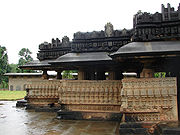
Most Hoysala temples have a plain covered entrance porch
Porch
A porch is external to the walls of the main building proper, but may be enclosed by screen, latticework, broad windows, or other light frame walls extending from the main structure.There are various styles of porches, all of which depend on the architectural tradition of its location...
supported by lathe
Lathe
A lathe is a machine tool which rotates the workpiece on its axis to perform various operations such as cutting, sanding, knurling, drilling, or deformation with tools that are applied to the workpiece to create an object which has symmetry about an axis of rotation.Lathes are used in woodturning,...
turned (circular or bell-shaped) pillars which were sometimes further carved with deep fluting and moulded with decorative motifs. The temples may be built upon a platform raised by about a metre called a "jagati
Jagati (temple)
Jagati is a term used in Indian temple architecture. A Jagati is a raised surface, platform or terrace upon which the temple is placed....
". The jagati, apart from giving a raised look to the temple, serves as a pradakshina
Pradakshina
Pradakshina or Pradakshinam , meaning circumambulation, consists of walking around in a 'circle' as a form of worship in Hindu ceremonies in India. The devotees walk around the sanctum sanctorum, the innermost chamber of the shrine housing the temple deity. It is done around sacred fire , trees and...
patha or "circumambulation
Circumambulation
Circumambulation is the act of moving around a sacred object.Circumambulation of temples or deity images is an integral part of Hindu ritual. It is also practised in Buddhism. In Islam, circumambulation is performed around the Kaaba in Mecca, in a counter-clockwise direction...
path" for circumambulation around the temple, as the garbagriha
Garbhagriha
Garbhagriha or Garbha griha is the small unlit shrine of a Hindu temple.Garbhagriha or ' is a Sanskrit word meaning the interior of the sanctum sanctorum, the innermost sanctum of a Hindu temple where resides the murti of the primary deity of the temple...
(inner sanctum
Sanctum sanctorum
The Latin phrase sanctum sanctorum is a Latin translation of the biblical term: "Holy of Holies" which generally refers in Latin texts to the Holiest place of the Tabernacle of Ancient Israel and later the Temples in Jerusalem, but also has some derivative use in application to imitations of the...
) provides no such feature. Such temples will have an additional set of steps leading to an open mantapa (open hall) with parapet
Parapet
A parapet is a wall-like barrier at the edge of a roof, terrace, balcony or other structure. Where extending above a roof, it may simply be the portion of an exterior wall that continues above the line of the roof surface, or may be a continuation of a vertical feature beneath the roof such as a...
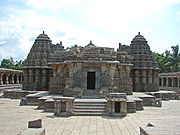
walls. A good example of this style is the Kesava Temple at Somanathapura
Somanathapura
The Chennakesava Temple located at Somanathapura is one of the finest examples of Hoysala architecture. This temple was built by Soma, a Dandanayaka in 1268 under Hoysala king Narasimha III, when the Hoysala Empire was the major power in South India.-Deity and sculptures:The ceiling of the hall...
. The jagati which is in unity with the rest of the temple follows a star-shaped design and the walls of the temple follow a zig-zag pattern, a Hoysala innovation. A pair of small shrines, each with a deity and a miniature tower directly facing the entrance, could adorn either side of steps of the jagati. This would be repeated for all entrances leading to the jagati.
Devotees can first complete a ritual circumambulation on the jagati starting from the main entrance by walking in a clockwise direction (towards the left) before entering the mantapa, following the sculptural clockwise-sequenced reliefs on the outer temple walls depicting a sequence of epic scenes from the Hindu epics. Temples that are not built on a jagati can have steps flanked by elephant balustrades (parapet
Parapet
A parapet is a wall-like barrier at the edge of a roof, terrace, balcony or other structure. Where extending above a roof, it may simply be the portion of an exterior wall that continues above the line of the roof surface, or may be a continuation of a vertical feature beneath the roof such as a...
s) that lead to the mantapa from ground level. An example of a temple that does not exhibit the raised platform is the Bucesvara temple in Korvangla, Hassan District
Hassan district
Hassan is a district in Karnataka state, India. The district headquarters are Hassan.Hassan district was the seat of the Hoysala Empire which at its peak ruled large parts of south India from Belur as its early capital and Halebidu as its later capital during the period 1000 - 1334 CE...
. In temples with two shrines (dvikuta), the vimanas
Vimana (shrine)
Vimana is a term for the tower above the Garbhagriha or Sanctum sanctorum in a Hindu temple.-Architecture:A typical Hindu temple in Dravidian style may have multiple gopurams, typically constructed into multiple walls in tiers around the main shrine...
(the shrines or cella
Cella
A cella or naos , is the inner chamber of a temple in classical architecture, or a shop facing the street in domestic Roman architecture...
e) may be placed either next to each other or on opposite sides. The Lakshmidevi temple at Doddagaddavalli
Doddagaddavalli
The Lakshimi Devi temple is located in Doddagaddavalli, a village in Hassan District of Karnataka state, India. It is located 16 km from Hassan and lies on the route to the famous temple town, Belur. The town's main attraction, the Lakshmi Devi temple, was built by the Hoysalas in the year...
has a minor shrine at each of the four corners of the walled temple complex in addition to five major shrines.
Mantapa
Chikmagalur District
Chikkamagaluru is a district in the Indian state of Karnataka. Chikkamagaluru is where coffee was first cultivated in India. The mountains here which are a part of the Western Ghats are the source of rivers like Tunga and Bhadra. Chikkamagaluru district also contains Mullayanagiri; which is the...
has forty-eight domes in the mahamantapa ("great open hall").
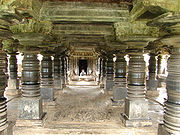
Latticework
Latticework is a framework consisting of a criss-crossed pattern of strips of building material, typically wood or metal. The design is created by crossing the strips to form a network...
screens placed between pillars to filter the light is a characteristic Hoysala stylistic element.
A porch adorns the entrance to a closed mantapa, consisting of an awning supported by two half-pillars (engaged column
Engaged column
In architecture, an engaged column is a column embedded in a wall and partly projecting from the surface of the wall, sometimes defined as semi or three-quarter detached...
s) and two parapets, all richly decorated. The closed mantapa is connected to the shrine(s) by a vestibule, a square area that also connects the shrines. Its outer walls are finely decorated, but as the size the vestibule is not large, this may not be a conspicuous part of the temple. The vestibule also has a short tower called the sukanasi or "nose" upon which is mounted the Hoysala emblem. In Belur
Belur
Belur may refer to any of the following:* Belur, Karnataka, town in Karnataka, India* Belur, West Bengal, India, a locality on the west bank of the Hooghly River* Belur Math, the religious abbey located in Belur, West Bengal, India...
and Halebidu
Halebidu
Halebidu is located in Hassan District, Karnataka, India. Halebidu was the regal capital of the Hoysala Empire in the 12th century. It is home to one of the best examples of Hoysala architecture in the ornate Hoysaleswara and Kedareswara temples. Halebidu literally means ruined city...
, these sculptures are quite large and are placed at all doorways.
The outer and inner mantapa (open and closed) have circular lathe-turned pillars having four brackets at the top. Over each bracket stands sculptured figure(s) called salabhanjika
Salabhanjika
Salabhanjika refers to the sculpture of a woman, displaying stylized feminine features, standing near a tree and grasping a branch. The name of these figures comes from the Sanskrit śālabañjika meaning 'breaking a branch of a sala tree'...
or madanika. The pillars may also exhibit fine ornamental carvings on the surface and no two pillars are alike. This is how Hoysala art differs from the work of their early overlords, the Western Chalukyas
Western Chalukyas
The Western Chalukya Empire ruled most of the western Deccan, South India, between the 10th and 12th centuries. This dynasty is sometimes called the Kalyani Chalukya after its regal capital at Kalyani, today's Basavakalyan in Karnataka and alternatively the Later Chalukya from its theoretical...
, who added sculptural details to the circular pillar base and left the top plain. The lathe-turned pillars are 16, 32, or 64-pointed; some are bell-shaped and have properties that reflect light. The Parsvanatha Basadi at Halebidu is a good example. The shaft of the pillar is a monolith
Monolith
A monolith is a geological feature such as a mountain, consisting of a single massive stone or rock, or a single piece of rock placed as, or within, a monument...
with the base left as a square and with well-sculpted figures adorning the top.
Vimana
Vimana (shrine)
Vimana is a term for the tower above the Garbhagriha or Sanctum sanctorum in a Hindu temple.-Architecture:A typical Hindu temple in Dravidian style may have multiple gopurams, typically constructed into multiple walls in tiers around the main shrine...
, also called the cella
Cella
A cella or naos , is the inner chamber of a temple in classical architecture, or a shop facing the street in domestic Roman architecture...
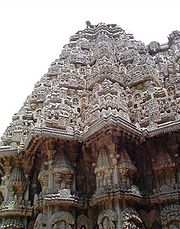
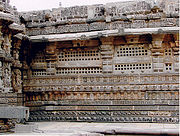
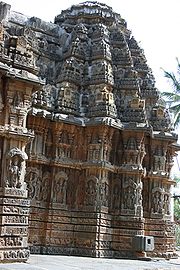
, contains the most sacred shrine wherein resides the image of the presiding deity. The vimana is often topped by a tower which is quite different on the outside than on the inside. Inside, the vimana is plain and square, whereas outside it is profusely decorated and can be either stellate ("star-shaped") or shaped as a staggered square, or feature a combination of these designs, giving it many projections and recesses that seem to multiply as the light falls on it. Each projection and recess has a complete decorative articulation that is rhythmic and repetitive and composed of blocks and mouldings
Molding (decorative)
Molding or moulding is a strip of material with various profiles used to cover transitions between surfaces or for decoration. It is traditionally made from solid milled wood or plaster but may be made from plastic or reformed wood...
, obscuring the tower profile. Depending on the number of shrines (and hence on the number of towers), the temples are classified as ekakuta (one), dvikuta (two), trikuta (three), chatushkuta (four) and panchakuta (five). Most Hoysala temples are ekakuta, dvikuta or trikuta. In temples with multiple shrines, all essential parts are duplicated for symmetry and balance. A temple's minor shrine usually has its own tower. There are cases where a temple is trikuta but has only one tower over the main shrine (in the middle). So the terminology trikuta may not be literally accurate. Smaller shrines attached to the outer walls and facing outward from a larger vimana are a common feature.
The highest point of the temple (kalasa) has the shape of a beautiful water pot and stands on top of the tower. This portion of the vimana is often lost due to age and has been replaced with a metallic pinnacle. Below the kalasa is a large, highly- sculptured structure resembling a dome which is made from large stones and looks like a helmet. It may be 2 m by 2 m in size and follows the shape of the shrine. Below this structure are domed roofs in a square plan, all of them much smaller and crowned with small kalasas. They are mixed with other small roofs of different shapes and are ornately decorated. The tower of the shrine usually has three or four tiers of rows of decorative roofs while the tower on top of the sukanasi has one less tier, making the tower look like an extension of the main tower (the "nose"). One decorated roof tier runs on top of the wall of a closed mantapa above the heavy eaves of an open mantapa and above the porches.
Puranas
The Puranas are a genre of important Hindu, Jain and Buddhist religious texts, notably consisting of narratives of the history of the universe from creation to destruction, genealogies of kings, heroes, sages, and demigods, and descriptions of Hindu cosmology, philosophy, and geography.Puranas...
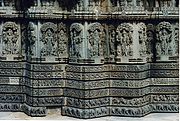
scenes executed with detail. Above this are two friezes of yallis or makaras (imaginary beasts) and hamsas (swans). The vimana (tower) is divided into three horizontal sections and is even more ornate than the walls.
Sculpture
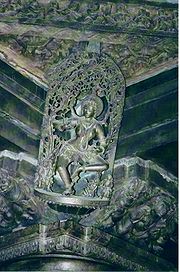
Hindu
Hindu refers to an identity associated with the philosophical, religious and cultural systems that are indigenous to the Indian subcontinent. As used in the Constitution of India, the word "Hindu" is also attributed to all persons professing any Indian religion...
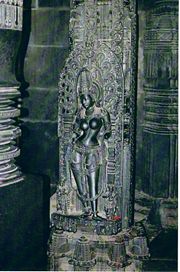
epics, yallis, deities, kirthimukha
Kirthimukha
Kirtimukha is the name of a swallowing fierce monster face with huge fangs, and gaping mouth, quite common in the iconography of Indian and Southeast Asian temple architecture...
(gargoyles), eroticism or aspects of daily life. Their medium, the soft chlorite schist, enabled a virtuoso carving style. Their workmanship shows an attention paid to precise detail. Every aspect down to a fingernail or toenail is perfected.
Salabhanjika
Salabhanjika
Salabhanjika refers to the sculpture of a woman, displaying stylized feminine features, standing near a tree and grasping a branch. The name of these figures comes from the Sanskrit śālabañjika meaning 'breaking a branch of a sala tree'...
, a common form of Hoysala sculpture, is an old Indian tradition going back to Buddhist sculpture. Sala is the sala tree and bhanjika is the chaste maiden. In the Hoysala idiom, madanika figures are decorative objects put at an angle on the outer walls of the temple near the roof so that worshipers circumambulating the temple can view them. They served the function of bracket figures to pillars inside the mantapa. These madanika were sculpted as seemingly engaged in artistic activities such as music (holding musical instruments) and dance. Kirthimukhas (demon faces) adorn the towers of vimanas in some temples. Sometimes the artists left behind their signatures on the sculptures they created.
The sthamba buttalikas are pillar images that show traces of Chola art in the Chalukyan touches. Some of the artists working for the Hoysalas may have been from Chola country, a result of the expansion of the empire into Tamil-speaking regions of Southern India. The image of mohini on one of the pillars in the mantapa
Mandapa
A mandapa in Indian architecture is a pillared outdoor hall or pavilion for public rituals.-Temple architecture:...
(closed hall) of the Chennakeshava temple is a fine example of Chola art.
General life themes are portrayed on wall panels such as the way horses were reined, the type of stirrup used, the depiction of dancers, musicians, instrumentalists, and rows of animals such as lions and elephants (where no two animals are identical). Perhaps no other temple in the country depicts the Ramayana
Ramayana
The Ramayana is an ancient Sanskrit epic. It is ascribed to the Hindu sage Valmiki and forms an important part of the Hindu canon , considered to be itihāsa. The Ramayana is one of the two great epics of India and Nepal, the other being the Mahabharata...
and Mahabharata
Mahabharata
The Mahabharata is one of the two major Sanskrit epics of ancient India and Nepal, the other being the Ramayana. The epic is part of itihasa....
epics more effectively than the Hoysaleshwara temple at Halebidu.
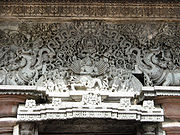
Erotica was a subject the Hoysala artist handled with discretion. There is no exhibitionism in this, and erotic themes were carved into recesses and niches, generally miniature in form, making them inconspicuous. These erotic representations are associated with the Shakta practice. The temple doorway is heavily engraved with ornamentation called Makaratorana (makara being an imaginary beast) and each side of the doorway exhibits sculptured Salabhanjika (maidens).
Apart from these sculptures, entire sequences from the Hindu
Hindu
Hindu refers to an identity associated with the philosophical, religious and cultural systems that are indigenous to the Indian subcontinent. As used in the Constitution of India, the word "Hindu" is also attributed to all persons professing any Indian religion...
epics (commonly the Ramayana
Ramayana
The Ramayana is an ancient Sanskrit epic. It is ascribed to the Hindu sage Valmiki and forms an important part of the Hindu canon , considered to be itihāsa. The Ramayana is one of the two great epics of India and Nepal, the other being the Mahabharata...
and the Mahabharata
Mahabharata
The Mahabharata is one of the two major Sanskrit epics of ancient India and Nepal, the other being the Ramayana. The epic is part of itihasa....
) have been sculpted in a clockwise direction starting at the main entrance. The right to left sequence is the same direction taken by the devotees in their ritual circumambulation as they wind inward toward the inner sanctum. Depictions from mythology such as the epic hero Arjuna
Arjuna
Arjuna in Indian mythology is the greatest warrior on earth and is one of the Pandavas, the heroes of the Hindu epic Mahābhārata. Arjuna, whose name means 'bright', 'shining', 'white' or 'silver' Arjuna (Devanagari: अर्जुन, Thai: อรชุน, Orachun, Tamil: Arjunan, Indonesian and Javanese: Harjuna,...
shooting fish, the elephant-headed god Ganesha
Ganesha
Ganesha , also spelled Ganesa or Ganesh, also known as Ganapati , Vinayaka , and Pillaiyar , is one of the deities best-known and most widely worshipped in the Hindu pantheon. His image is found throughout India and Nepal. Hindu sects worship him regardless of affiliations...
, the Sun god Surya
Surya
Surya Suraya or Phra Athit is the chief solar deity in Hinduism, one of the Adityas, son of Kasyapa and one of his wives, Aditi; of Indra; or of Dyaus Pitar . The term Surya also refers to the Sun, in general. Surya has hair and arms of gold...
, the weather and war god Indra
Indra
' or is the King of the demi-gods or Devas and Lord of Heaven or Svargaloka in Hindu mythology. He is also the God of War, Storms, and Rainfall.Indra is one of the chief deities in the Rigveda...
, and Brahma
Brahma
Brahma is the Hindu god of creation and one of the Trimurti, the others being Vishnu and Shiva. According to the Brahma Purana, he is the father of Mānu, and from Mānu all human beings are descended. In the Ramayana and the...
with Sarasvati are common. Also frequently seen in these temples is Durga
Durga
For the 1985 Hindi Film of Rajesh Khanna see DurgaaIn Hinduism, Durga ; ; meaning "the inaccessible" or "the invincible"; , durga) or Maa Durga "one who can redeem in situations of utmost distress" is a form of Devi, the supremely radiant goddess, depicted as having eighteen arms, riding a lion...
, with several arms holding weapons given to her by other gods, in the act of killing a buffalo (a demon in a buffalo's form) and Harihara
Harihara
Harihara is the name of a combined deity form of both Vishnu and Shiva from the Hindu tradition. Also known as Shankaranarayana , Harihara is thus worshipped by both Vaishnavites and Shaivities as a form of the Supreme God, as well as being a figure of worship for other Hindu traditions in general...
(a fusion of Shiva and Vishnu) holding a conch, wheel and trident. Many of these friezes were signed by the artisans, the first known instance of signed artwork in India.
Research
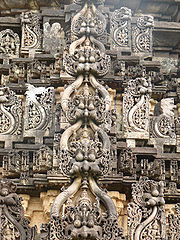
Dravidian architecture
Dravidian architecture was a style of architecture that emerged thousands of years ago in Southern part of the Indian subcontinent or South India. They consist primarily of pyramid shaped temples called Koils which are dependent on intricate carved stone in order to create a step design consisting...
, and owing to its unique features, Hoysala architecture qualifies as an independent style. While the Hoysalas introduced innovative features into their architecture, they also borrowed features from the earlier great builders of Karnata like the Kadambas, Western Chalukyas
Western Chalukyas
The Western Chalukya Empire ruled most of the western Deccan, South India, between the 10th and 12th centuries. This dynasty is sometimes called the Kalyani Chalukya after its regal capital at Kalyani, today's Basavakalyan in Karnataka and alternatively the Later Chalukya from its theoretical...
. These features were the use of chloritic schist or soapstone
Soapstone
Soapstone is a metamorphic rock, a talc-schist. It is largely composed of the mineral talc and is thus rich in magnesium. It is produced by dynamothermal metamorphism and metasomatism, which occurs in the areas where tectonic plates are subducted, changing rocks by heat and pressure, with influx...
as a basic building material, pierced stone window screens which were very popular in Hoysala temples, and the vimana
Vimanam
The word Vimanam can refer to any of the following:#Sikhara — the rising roof of a Hindu temple in North India.#vimanam is the tower that crowns the innermost sanctum of a South Indian temple ....
which follows a stellate pattern. All these features were popular with their early overlords, the Western Chalukyas
Western Chalukyas
The Western Chalukya Empire ruled most of the western Deccan, South India, between the 10th and 12th centuries. This dynasty is sometimes called the Kalyani Chalukya after its regal capital at Kalyani, today's Basavakalyan in Karnataka and alternatively the Later Chalukya from its theoretical...
. Other features were the stepped style of vimana
Vimanam
The word Vimanam can refer to any of the following:#Sikhara — the rising roof of a Hindu temple in North India.#vimanam is the tower that crowns the innermost sanctum of a South Indian temple ....
tower called the Kadamba shikhara, which was inherited from the Kadambas. Engrained in the craftsmanship of Hoysala sculptors was their knowledge of the effect of light and shade on carved walls, which they used to maximum effect in their sculptures in the numerous projections and recesses. The Hoysala sculpture in all its richness is said to be a challenge to photography. The artistry of the Hoysalas in stone has been compared to the finesse of an ivory worker or a goldsmith. The abundance of jewelry worn by the sculpted figures and the variety of hairstyles and headdresses depicted give a fair idea of the lifestyles of the Hoysala times.
Notable craftsmen
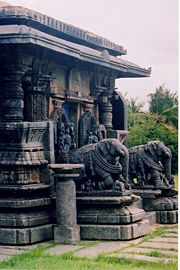
Amarashilpi Jakanachari
Amarashilpi Jakanacharya was a legendary sculptor credited with building many fine temples forthe Kalyani Chalukyas and Hoysalas, including the famous sculptures at Belur andHalebidu.- His life :...
, a native of Kaidala in Tumkur district
Tumkur district
Tumkur district is an administrative district in the state of Karnataka in India. The district headquarters are located at Tumkur. The district occupies an area of 10,598 km² and had a population of 2,584,711, of which 19.62% were urban as of 2001...
, who also built temples for the Western Chalukyas
Western Chalukyas
The Western Chalukya Empire ruled most of the western Deccan, South India, between the 10th and 12th centuries. This dynasty is sometimes called the Kalyani Chalukya after its regal capital at Kalyani, today's Basavakalyan in Karnataka and alternatively the Later Chalukya from its theoretical...
. Ruvari Malithamma
Ruvari Malithamma
Ruvari Malithamma was a famous architect and sculptor in the 12th century who made many important contributions to temples built by the Hoysala Empire in Karnataka state, India. His contributions greatly enriched the idiom called Hoysala architecture...
built the Kesava Temple at Somanathapura
Somanathapura
The Chennakesava Temple located at Somanathapura is one of the finest examples of Hoysala architecture. This temple was built by Soma, a Dandanayaka in 1268 under Hoysala king Narasimha III, when the Hoysala Empire was the major power in South India.-Deity and sculptures:The ceiling of the hall...
and worked on forty other monuments, including the Amruteshwara temple at Amruthapura. Malithamma specialised in ornamentation, and his works span six decades. His sculptures were typically signed in shorthand as Malli or simply Ma. Dasoja and his son Chavana from Balligavi
Balligavi
Balligavi a town in Shikaripura taluk Shimoga district of Karnataka state, India, is today known as Belagami or Balagame. Its ancient names are Dakshina Kedara,Valliggame and Valligrame. Dakshina Kedara means Kedarnath of the South. A place of antiquity, it is known for its ancient monuments...
were the architects of Chennakesava Temple at Belur; Kedaroja was the chief architect of the Hoysaleswara Temple
Hoysaleswara temple
Hoysaleswara temple is a temple dedicated to Hindu God Shiva. It was built in Halebidu during the Hoysala Empire rule in the 12th century by King Vishnuvardhana. The construction was completed in 1121 CE. During the early 14th century, Halebidu was sacked and looted by Muslim invaders from...
at Halebidu
Halebidu
Halebidu is located in Hassan District, Karnataka, India. Halebidu was the regal capital of the Hoysala Empire in the 12th century. It is home to one of the best examples of Hoysala architecture in the ornate Hoysaleswara and Kedareswara temples. Halebidu literally means ruined city...
. Their influence is seen in other temples built by the Hoysalas as well. Names of other locals found in inscriptions are Maridamma, Baicoja, Caudaya, Nanjaya and Bama, Malloja, Nadoja, Siddoja, Masanithamma, Chameya and Rameya. Artists from Tamil country included Pallavachari and Cholavachari.
Notable temples
Selected famous temples built by the Hoysalas are shown in the table.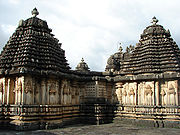
See also
- Indian ArchitectureIndian architectureThe architecture of India is rooted in its history, culture and religion. Indian architecture progressed with time and assimilated the many influences that came as a result of India's global discourse with other regions of the world throughout its millennia-old past...
- Vijayanagara architecture
- Badami Chalukya ArchitectureBadami Chalukya ArchitectureThe Badami Chalukya architecture was a temple building idiom that evolved in the time period of 5th – 8th centuries AD. in the area of Malaprabha basin, in present day Bagalkot district of Karnataka state. This style is sometimes called the Vesara style and Chalukya style...