
The
House of Representatives of the Philippines (
FilipinoThis move has drawn much criticism from other regional groups.In 1987, a new constitution introduced many provisions for the language.Article XIV, Section 6, omits any mention of Tagalog as the basis for Filipino, and states that:...
:
Kapulungan ng mga Kinatawan ng Pilipinas; also known in its
SpanishSpanish , also known as Castilian , is a Romance language in the Ibero-Romance group that evolved from several languages and dialects in central-northern Iberia around the 9th century and gradually spread with the expansion of the Kingdom of Castile into central and southern Iberia during the...
name
Camara de Representantes de Filipinas) is the lower chamber of the
CongressThe Congress of the Philippines is the national legislature of the Republic of the Philippines. It is a bicameral body consisting of the Senate , and the House of Representatives although commonly in the Philippines the term congress refers to the latter.The Senate is composed of 24 senators half...
of the
PhilippinesThe Philippines , officially known as the Republic of the Philippines , is a country in Southeast Asia in the western Pacific Ocean. To its north across the Luzon Strait lies Taiwan. West across the South China Sea sits Vietnam...
. The
SenateThe Senate of the Philippines is the upper chamber of the bicameral legislature of the Philippines, the Congress of the Philippines...
is the upper chamber. The House is often informally called the
Congress. Members of the house are called
Congressmen (
mga kinatawan or
mga konggresista) and their title is
Representative. Congressmen are elected to a three-year term and can be reelected, but cannot serve more than three consecutive terms. Around eighty percent of congressmen are district representatives, representing a particular geographical area. There are 229
legislative districtsThe Legislative districts of the Philippines are the division are the representations of the Philippines' provinces and cities in the House of Representatives. The first composition of legislative districts were enshrined in the Ordinance appended to the Constitution...
in the country, each composed of about 250,000 people. There are also
sectoral representativesThe sectoral representation in the House of Representatives of the Philippines is achieved via the party-list system of representation. Under-represented sectoral groups such as labor, peasant, urban poor, indigenous cultural communities, women, youth, and such other sectors as may be provided by...
elected through the party-list system who constitute not more than twenty percent of the total number of Representatives.
The official headquarters of the House of Representatives is at the
Batasang PambansaThe Batasang Pambansa Complex is the headquarters of the House of Representatives of the Philippines. It is located at Batasan Road, Batasan Hills, Quezon City....
(literally,
national legislature) located at the
Batasan HillsBatasan Hills is a barangay located in the 2nd District of Quezon City, Philippines. It borders the barangays of Commonwealth and Bagong Silangan to the north, Barangay Holy Spirit to the west, Barangay Matandang Balara to the south, and the town of San Mateo, Rizal to the east...
in
Quezon CityQuezon City is the former capital and the most populous city in the Philippines. Located on the island of Luzon, Quezon City is one of the cities and municipalities that make up Metro Manila, the National Capital Region. The city was named after Manuel L...
in
Metro ManilaMetropolitan Manila , the National Capital Region , or simply Metro Manila, is the metropolitan region encompassing the City of Manila and its surrounding areas in the Philippines...
. The building is often simply called
Batasan; the word has also became a metonym to refer to the House of Representatives.
History
When the Philippines was under
AmericanThe United States of America is a federal constitutional republic comprising fifty states and a federal district...
colonial rule, the legislative body was the Philippine Commission which existed from September 1900 to October 1907. The
President of the United StatesThe President of the United States of America is the head of state and head of government of the United States. The president leads the executive branch of the federal government and is the commander-in-chief of the United States Armed Forces....
appointed the members of the Philippine Commission.
The Philippine Bill of 1902 mandated the creation of a bicameral or a two-chamber
Philippine LegislatureThe Philippine Legislature was the legislative body of the Philippines during the earlier part U.S. colonial administration. It was a bicameral legislature, with the Philippine Commission, headed by the U.S. Governor General serving as the upper house, and the Philippine Assembly serving as the...
with the Philippine Commission as the Upper House and the Philippine Assembly as the Lower House. This bicameral legislature was inaugurated in October 1907. Through the leadership of Speaker
Sergio OsmeñaSergio Osmeña y Suico was a Filipino politician who served as the 4th President of the Philippines from 1944 to 1946. He was Vice President under Manuel L. Quezon, and rose to the presidency upon Quezon's death in 1944, being the oldest Philippine president to hold office at age 65...
and Floor Leader
Manuel L. QuezonManuel Luis Quezón y Molina served as president of the Commonwealth of the Philippines from 1935 to 1944. He was the first Filipino to head a government of the Philippines...
, the Rules of the
59th United States CongressThe Fifty-ninth United States Congress was a meeting of the legislative branch of the United States federal government, composed of the United States Senate and the United States House of Representatives. It met in Washington, DC from March 4, 1905 to March 4, 1907, during the fifth and sixth...
was substantially adopted as the Rules of the Philippine Legislature. Osmeña and Quezon led the
Nacionalista PartyThe Nacionalista Party is the oldest political party in the Philippines today and was responsible for leading the country throughout the majority of the 20th century since its founding in 1907...
, with a platform of independence from the United States, into successive electoral victories against the
Progresista PartyThe Progresista Party was a conservative political party in the Philippines during the early 20th century. Formed in 1900 as the Federal Party , the party originally had the Philippines becoming a U.S...
and later the Democrata Party, which first advocated United States statehood, then opposed immediate independence.
In 1916, the
Jones ActThe term Jones Act may refer to one of several federal laws in the United States:*The Jones Act was a 1916 statute sponsored by Representative William Atkinson Jones that provided the Philippine Islands a "more autonomous government" to prepare the territory for independence.*The Jones-Shafroth...
or the Philippine Autonomy Act changed the legislative system. The Philippine Commission was abolished and a new bicameral Philippine Legislature consisting of a House of Representatives and a
SenateThe Senate of the Philippines is the upper chamber of the bicameral legislature of the Philippines, the Congress of the Philippines...
was established. The Nacionalistas continued their electoral dominance at this point, although they were split into two factions led by Osmeña and Quezon; the two reconciled in 1924, and controlled the Assembly via a virtual
dominant-party systemA dominant-party system, or one-party dominant system, is a system where there is "a category of parties/political organizations that have successively won election victories and whose future defeat cannot be envisaged or is unlikely for the foreseeable future." A wide range of parties have been...
.
The legislative system was changed again in 1935. The 1935
ConstitutionThe Constitution of the Philippines is the supreme law of the Philippines.The Constitution currently in effect was enacted in 1987, during the administration of President Corazon Aquino, and is popularly known as the "1987 Constitution"...
established a unicameral
National AssemblyThe National Assembly of the Philippines refers to the legislature of the Philippine Commonwealth from 1935 to 1941, and the Second Philippine Republic. The National Assembly of the Commonwealth of the Philippines was created under the 1935 Constitution, which served as the Philippines' fundamental...
. But in 1940, through an amendment to the 1935 Constitution, a bicameral Congress of the Philippines consisting of a House of Representatives and a Senate was adopted.
Upon the inauguration of the Republic of the Philippines in 1946, Republic Act No. 6 was enacted providing that on the date of the proclamation of the Republic of the Philippines, the existing Congress would be known as the First Congress of the Republic. The "Liberal bloc" of the Nacionalistas permanently split from their ranks, creating the
Liberal PartyThe Liberal Party of the Philippines is a liberal party in the Philippines, founded by then senators Senate President Manuel Roxas, Senate President Pro-Tempore Elpidio Quirino, and former 9th Senatorial District Senator Jose Avelino, on November 24, 1945 by a breakaway Liberal group from the...
. These two will contest all of the elections in what appeared to be a
two-party systemA two-party system is a system where two major political parties dominate voting in nearly all elections at every level of government and, as a result, all or nearly all elected offices are members of one of the two major parties...
. The party of the ruling president wins the elections in the House of Representatives; in cases where the party of the president and the majority of the members of the House of Representatives are different, a sufficient enough number will break away and join the party of the president, thereby ensuring that the president will have control of the House of Representatives.
This set up continued until President
Ferdinand MarcosFerdinand Emmanuel Edralin Marcos, Sr. was a Filipino leader and an authoritarian President of the Philippines from 1965 to 1986. He was a lawyer, member of the Philippine House of Representatives and a member of the Philippine Senate...
declared martial law and abolished Congress. He would rule by decree even after the 1973 Constitution abolished the bicameral Congress and created a unicameral
Batasang Pambansa parliamentary system of government, as parliamentary election would not occur in
1978A general election was held in the Philippines on April 7, 1978 for the election of the 166 regional representatives to the Interim Batasang Pambansa...
. Marcos'
Kilusang Bagong LipunanThe Kilusang Bagong Lipunan , formerly the Kilusang Bagong Lipunan ng Nagkakaisang Nacionalista, Liberal, at iba pa, , is a political party in the Philippines...
(KBL; New Society Movement) won all of the seats except those from the
Central VisayasCentral Visayas, designated as Region VII, is a region of the Philippines located in the central part of the Visayas island group. It consists of four provinces—Bohol, Cebu, Negros Oriental, and Siquijor— and the highly urbanized cities of Cebu City, Lapu-Lapu City, and Mandaue City....
ushering in an era of KBL dominance, which will continue until the People Power Revolution overthrew Marcos in 1986.
The 1987 Constitution restored the presidential system of government together with a bicameral Congress of the Philippines. One deviation from the previous setup was the introduction of the mid-term election; however, the dynamics of the House of Representatives resumed its pre-1972 state, with the party of the president controlling the chamber, although political pluralism ensued that prevented the restoration of the old Nacionalista-Liberal two-party system. Instead, a
multi-party systemA multi-party system is a system in which multiple political parties have the capacity to gain control of government separately or in coalition, e.g.The Conservative-Liberal Democrat coalition in the United Kingdom formed in 2010. The effective number of parties in a multi-party system is normally...
evolved.
Corazon AquinoMaria Corazon Sumulong Cojuangco-Aquino was the 11th President of the Philippines and the first woman to hold that office in Philippine history. She is best remembered for leading the 1986 People Power Revolution, which toppled Ferdinand Marcos and restored democracy in the Philippines...
who nominally had no party, supported the
Laban ng Demokratikong PilipinoThe Laban ng Demokratikong Pilipino is a political party in the Philippines founded in 1988.There are no results available of the last elections for the House of Representatives, but according to the website of the House, the party holds 7 out of 235 seats . The party is divided into two factions...
(LDP; Struggle of the Democratic Filipinos). With the victory of
Fidel V. RamosFidel "Eddie" Valdez Ramos , popularly known as FVR, was the 12th President of the Philippines from 1992 to 1998. During his six years in office, Ramos was widely credited and admired by many for revitalizing and renewing international confidence in the Philippine economy.Prior to his election as...
in the
1992 presidential electionPresidential elections, legislative elections and local elections were held in the Philippines on May 11, 1992. This was the first general elections under the 1987 Philippine Constitution. An estimated 80,000 candidates ran for 17,000 posts from the presidency down to municipal councilors...
, many representatives defected to his Lakas-NUCD party; the same would happen with
Joseph EstradaJoseph "Erap" Ejercito Estrada was the 13th President of the Philippines, serving from 1998 until 2001. Estrada was the first person in the Post-EDSA era to be elected both to the presidency and vice-presidency.Estrada gained popularity as a film actor, playing the lead role in over 100 films in...
's victory in
1998Presidential elections, legislative elections and local elections were held in the Philippines on May 11, 1998. In the presidential election, Vice President Joseph Estrada won a six-year term as President by a landslide victory. In the vice-presidential race, Senator Gloria Macapagal-Arroyo won a...
, but he lost support when he was ousted after the
2001 EDSA RevolutionThe EDSA Revolution of 2001, also called by the local media as EDSA II or the Second People Power Revolution, is the common name of the four-day revolution that peacefully overthrew Philippine President Joseph Estrada from January 17–20, 2001...
that brought his vice president
Gloria Macapagal-ArroyoGloria Macapagal-Arroyo is a Filipino politician who served as the 14th President of the Philippines from 2001 to 2010, as the 12th Vice President of the Philippines from 1998 to 2001, and is currently a member of the House of Representatives representing the 2nd District of Pampanga...
to power. This also meant the restoration of Lakas-NUCD as the top party in the chamber. The same would happen when
Benigno AquinoBenigno Aquino may refer to:*Benigno Aquino, Sr. , cabinet member, senator, and Speaker of the National Assembly of the Philippines*Benigno Aquino, Jr...
won in 2010-Timeline:The COMELEC-mandated election period for this election was from January 10 to June 9, 2010.-2008:*August 26 - Then Metro Manila Development Authority Chairman Bayani Fernando announces bid for presidency....
, which returned the Liberals into power.
The presiding officer is the
SpeakerThe Speaker of the House of Representatives of the Philippines is the presiding officer of the lower house of Congress, the House of Representatives....
. Unlike the
Senate PresidentThe President of the Senate of the Philippines, or more popularly known as the Senate President, is the presiding officer and the highest ranking-official of the Senate of the Philippines. He/she is elected by the entire body to be their leader...
, the Speaker usually serves the entire term of Congress, although there had been instances when the Speaker left office due to conflict with the president: examples include
Jose de Venecia, Jr.Jose Claveria de Venecia, Jr. also known as JDV or Joe De V is a former Speaker of the House of Representatives of the Philippines, serving from 1992 to 1998 and from 2001 to 2008. As Speaker, he was the fourth highest ranking official of the Philippines. He was the former president of the...
's resignation as speaker in 2008 when his son
Joey de VeneciaJose "Joey" P. de Venecia III is the eldest son of Jose de Venecia, Jr., the Philippines' former five-term Speaker of Congress. He received much attention in the Philippines as a whistleblower related to the corruption scandal surrounding the ZTE broadband project.-Early life:He was born in 1963...
exposed alleged corrupt practices by First Gentleman Mike Arroyo, and
Manny VillarManuel "Manny" Bamba Villar, Jr. is a Filipino businessman and politician. He is currently a Philippine Senator, president of the Nacionalista Party...
's ouster occurred after he allowed the impeachment of President Estrada in 2000.
Speaker
The Speaker is the head of the House of Representatives. He presides over the session; decides on all questions of order, subject to appeal by any member; signs all acts, resolutions, memorials, writs, warrants and subpoenas issued by or upon order of the House; appoints, suspends, dismisses or disciplines House personnel; and exercise administrative functions.
The speaker is elected by majority of all the members of the house, including vacant seats. The speaker is traditionally elected at the convening of each Congress. Before a speaker is elected, the House's sergeant-at-arms sits as the "Presiding Officer" until a speaker is elected. Compared to the
Senate PresidentThe President of the Senate of the Philippines, or more popularly known as the Senate President, is the presiding officer and the highest ranking-official of the Senate of the Philippines. He/she is elected by the entire body to be their leader...
, the unseating of an incumbent speaker is rarer.
The incumbent speaker is
Feliciano Belmonte, Jr.Feliciano "Sonny" Racimo Belmonte, Jr. is a member of the Philippine House of Representatives representing the Fourth District of Quezon City. He is also the house speaker of the Congress from 2010 to present. He was the mayor of Quezon City from 2001-2010.-Early Life and Career:Belmonte was born...
of
Quezon CityQuezon City is the former capital and the most populous city in the Philippines. Located on the island of Luzon, Quezon City is one of the cities and municipalities that make up Metro Manila, the National Capital Region. The city was named after Manuel L...
's 4th congressional district.
Deputy Speakers
There are a constant number of deputy speakers. The deputy speakers perform the speaker's role when the speaker is absent. In the 14th Congress, there were deputy speakers for
LuzonLuzon is the largest island in the Philippines. It is located in the northernmost region of the archipelago, and is also the name for one of the three primary island groups in the country centered on the Island of Luzon...
,
VisayasThe Visayas or Visayan Islands and locally known as Kabisay-an gid, is one of the three principal geographical divisions of the Philippines, along with Mindanao and Luzon. It consists of several islands, primarily surrounding the Visayan Sea, although the Visayas are considered the northeast...
,
MindanaoMindanao is the second largest and easternmost island in the Philippines. It is also the name of one of the three island groups in the country, which consists of the island of Mindanao and smaller surrounding islands. The other two are Luzon and the Visayas. The island of Mindanao is called The...
and women. In the 15th Congress, the deputy speakers represent the chamber at-large.
Lorenzo Tañada IIILorenzo "Erin" Reyes Tañada III is a Filipino politician. A member of the Liberal Party, he was elected as a Member of the House of Representatives of the Philippines representing the 4th District of Quezon beginning in 2004...
of Quezon's
4th districtThe Legislative Districts of Quezon, namely the first, second, third and fourth districts, are the current representations of the Province of Quezon and the independent city of Lucena in the Philippine House of Representatives....
,
Pablo GarciaPablo García may refer to:* Pablo Gabriel García , Uruguayan footballer* Pablo García , Spanish guitarist and member of the band WarCry* Pablo P...
of
CebuCebu is a province in the Philippines, consisting of Cebu Island and 167 surrounding islands. It is located to the east of Negros, to the west of Leyte and Bohol islands...
's 2nd district,
Arnulfo FuentebellaArnulfo P. Fuentabella was the Speaker of the Philippine House of Representatives from 2000 to 2001. He is now a representative of Camarines Sur.-Speakership:...
of
Camarines SurCamarines Sur is a province of the Philippines located in the Bicol Region in Luzon. Its capital is Pili and the province borders Camarines Norte and Quezon to the north, and Albay to the south...
's
4th districtThe Legislative Districts of Camarines Sur, namely the first, second, third and fourth districts are the representations of the Province of Camarines Sur and the independent city of Naga in the Philippine House of Representatives. Camarines Sur was represented as part of Ambos Camarines until it...
, Crispin Remulla of
CaviteCavite is a province of the Philippines located on the southern shores of Manila Bay in the CALABARZON region in Luzon, just 30 kilometers south of Manila. Cavite is surrounded by Laguna to the east, Metro Manila to the northeast, and Batangas to the south...
's 7th district,
Maria Isabelle Climaco SalazarMaria Isabelle Climaco Salazar , also known as Beng Climaco is a Filipino politician.Having been elected as a topnotch Councilor of the Zamboanga City for two terms, her performance was undeniably outstanding...
of
Zamboanga CityThe City of Zamboanga : is a highly urbanized, independent and a chartered city located in Mindanao, Philippines....
's 1st district and Raul Daza of
Northern SamarNorthern Samar is a province of the Philippines located in the Eastern Visayas region. Its capital is Catarman and is located at the northern portion of the island of Samar. Bordering the province to the south are the provinces of Samar and Eastern Samar...
's 1st district are the deputy speakers.
Majority Floor Leader
The majority leader, aside from being the spokesman of the majority party, is to direct the deliberations on the floor. The Majority Leader is also concurrently the Chairman of the Committee on Rules. The majority leader is elected in a party caucus of the ruling majority party.
The incumbent majority floor leader is
Neptali M. Gonzales, Jr.Neptali "Boyet" Medina Gonzales, Jr. is a Filipino lawmaker. He is a current house member, representing the Lone District of Mandaluyong City in the Filipino House of Representatives. He has been a house member during the 10th, 11th, 12th and 14th Congress, respectively...
of Mandaluyong's congressional district.
Minority Floor Leader
The minority leader is the spokesman of the minority party in the House and is an
ex-officio member of all standing Committees. The minority leader is elected in party caucus of all Members of the House in the minority party, although by tradition, the losing candidate for speaker is named the minority leader.
The incumbent minority floor leader is
Edcel LagmanEdcel Lagman is a Filipino politician from the province of Albay and a prominent supporter of the Reproductive Health Bill .-Political life:...
of
AlbayAlbay is a province of the Philippines located in the Bicol Region in Luzon. Its capital is Legazpi City and the province borders Camarines Sur to the north and Sorsogon to the south. Also to the northeast is Lagonoy Gulf....
's 1st congressional district.
Speaker pro tempore
There was a position of speaker
pro tempore for congresses prior the declaration of
martial lawThis article covers the history of the Philippines during the presidency of Ferdinand Marcos. The Marcos era includes the final years of the Third Republic and the entirety of the Fourth Republic .-Marcos Administration :...
. The speaker pro tempore was the next highest position in the House after the speaker. The position was replaced by the deputy speakers.
Secretary General
The secretary general enforces orders and decisions of the House; keeps the Journal of each session; notes all questions of order, among other things. The secretary general presides over the chamber at the first legislative session after an election, and is elected by a majority of the members.
Marilyn Barua-Yap is the Secretary General of the House of Representatives.
Sergeant-at-Arms
The Sergeant-at-Arms is responsible for the maintenance of order in the House of Representatives, among other things. Like the secretary general, the sergeant-at-arms is elected by a majority of the members.
Retired Brigadier General Nicasio J. Radovan, Jr. is the Sergeant-at-Arms of the House of Representatives.
District representation
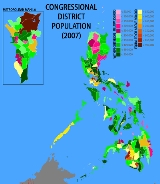
There are two types of representatives in the chamber: representatives from congressional districts and sectoral representatives. Eighty percent of representatives shall come from congressional districts, with each district returning one representative. Although each district should have a population of at least 250,000 people, all
provincesThe Provinces of the Philippines are the primary political and administrative divisions of the Philippines. There are 80 provinces at present, further subdivided into component cities and municipalities. The National Capital Region, as well as independent cities, are autonomous from any provincial...
have at least one legislative district, regardless of population, whose residents vote for their own congressman; several
citiesA city is a tier of local government in the Philippines. All Philippine cities are chartered cities, whose existence as corporate and administrative entities is governed by their own specific charters in addition to the Local Government Code of 1991, which specifies the administrative structure...
have representation on their own independent of provinces, although they should have at least a population of 250,000. For provinces that have more than one legislative district, the provincial districts are identical to the corresponding legislative district, with the exclusion of cities that do not vote for provincial officials.
The representatives from the districts comprise at most 80% of the members of the House; therefore, for a party to have a majority of seats in the House, the party needs to win at least 60% of the district seats. No party since the approval of the 1987 constitution has been able to win a majority of seats, hence coalitions are not uncommon.
Legislative districts in provinces
Note: Some independent cities are grouped with provinces for purposes of representation to the House of Representatives.
- Abra (1)
- Agusan del Norte (2)
- Agusan del Sur (2)
- Aklan (1)
- Albay (3)
- Antique (1)
- Apayao (1)
- Aurora (1)
- Basilan (1)
- Bataan (2)
- Batanes (1)
- Batangas (4)
- Benguet (1)
- Biliran
The lone Congressional District of Biliran is the representation of the Province of Biliran in the Philippine House of Representatives. It was part of the representation of the Leyte until 1995.-Lone District:*Population : 150,031-References:...
(1)
- Bohol (3)
- Bukidnon (3)
- Bulacan
The Legislative Districts of Bulacan, namely the first, second, third and fourth districts, are the current representations of the province of Bulacan in the Philippine House of Representatives....
(4)
- Cagayan
The Legislative Districts of Cagayan, namely the first, second and third districts, are the current representations of the province of Cagayan in the Philippine House of Representatives....
(3)
- Camarines Norte
The lone Legislative District of Camarines Norte is the representation of the Province of Camarines Norte in the Philippine House of Representatives. Camarines Norte was represented as part of the first and second districts of Ambos Camarines prior to being granted its own representation, after the...
(2)
- Camarines Sur
The Legislative Districts of Camarines Sur, namely the first, second, third and fourth districts are the representations of the Province of Camarines Sur and the independent city of Naga in the Philippine House of Representatives. Camarines Sur was represented as part of Ambos Camarines until it...
(5)
- Camiguin (1)
- Capiz
The Legislative Districts of Capiz, namely the first and second districts, are the representations of the Province of Capiz in the Philippine House of Representatives. Capiz was divided into three legislative districts until 1957, when Aklan was granted its own representative, reducing it to two...
(2)
- Catanduanes
The lone Legislative District of Catanduanes is the representation of the Province of Catanduanes in the Philippine House of Representatives. Catanduanes was represented as part of Albay's second district from 1907 to 1931, and fully comprised that province's fourth district from 1931 to 1946...
(1)
- Cavite (6, excluding Dasmariñas City
The Legislative District of Dasmariñas City is the representation of the city of Dasmariñas, Cavite in the House of Representatives of the Philippines. The district corresponds to the 4th Legislative District of Cavite, which was created on October 22, 2009 just right before the ratification of the...
)
- Cebu (6)
- Compostela Valley
The Legislative districts of Compostela Valley, namely the first and second districts are the representations of the Province of Compostela Valley in the Philippine House of Representatives...
(2)
- Cotabato
The Legislative Districts of Cotabato, namely the first and second districts are the representations of the Province of Cotabato in the Philippine House of Representatives...
(2)
- Davao del Norte
The Legislative districts of Davao del Norte, namely the first and second districts are the representations of the Province of Davao del Norte in the Philippine House of Representatives. Davao del Norte was part of the representation of Davao Province until 1965, when it was created and granted its...
(2)
- Davao del Sur
The Legislative districts of Davao del Sur, namely the first and second districts are the representations of the Province of Davao del Sur in the Philippine House of Representatives. Davao del Sur was part of the representation of Davao Province until 1965, when it was created and granted its own...
(2)
- Davao Oriental
The Legislative districts of Davao Oriental, namely the first and second districts are the representations of the Province of Davao Oriental in the Philippine House of Representatives. Davao Oriental was part of the representation of Davao Province until 1965, when it was created and granted its...
(2)
- Dinagat Islands
The lone Congressional District of Dinagat Islands is the representation of Dinagat Islands in the Philippine House of Representatives. It was established in 2007, after Dinagat Islands was established as a province on December 2, 2007. From 1907 until its reestablishment in 2007, it was part of...
(1)
- Eastern Samar (1)
- Guimaras
The Legislative District of Guimaras is the representation of the Province of Guimaras in the Philippine House of Representatives. It represented as part of the second district of Iloilo until 1995.-Lone District:*Population : 151,238...
(1)
- Ifugao (1)
- Ilocos Norte (2)
- Ilocos Sur (2)
- Iloilo
The Legislative Districts of Iloilo, namely the first, second, third, fourth and fifth districts, are the representations of the Province of Iloilo in the Philippine House of Representatives. The province has been divided into five congressional districts since 1907. Minor adjustments were made to...
(5)
- Isabela
The Legislative Districts of Isabela, namely the first, second, third, fourth districts, are the representations of the Province of Isabela and the independent city of Santiago in the Philippine House of Representatives. The province was represented as a lone legislative district until 1972...
(4)
- Kalinga (1)
- La Union (2)
- Laguna
The Legislative Districts of Laguna, namely the first, second, third and fourth districts, are the representations of the Province of Laguna in the Philippine House of Representatives. The province was divided into two legislative districts from 1907 to 1972...
(4)
- Lanao del Norte
The Legislative Districts of Lanao del Norte, namely the first and second districts are the representations of the Province of Lanao del Norte in the Philippine House of Representatives. Lanao del Norte was part of the representation of Lanao until 1961, when it was granted its own representation....
(2)
- Lanao del Sur
The Legislative Districts of Lanao del Sur, namely the first and second districts are the representations of the Province of Lanao del Sur in the Philippine House of Representatives. Lanao del Sur was part of the representation of Lanao until 1961, when...
(2)
- Leyte
The Legislative districts of Leyte, namely the first, second, third, fourth and fifth districts, are the representations of the Province of Leyte in the Philippine House of Representatives....
(5)
- Maguindanao (1)
- Marinduque
The Legislative District of Marinduque is the current representation of the Province of Marinduque in the Philippine House of Representatives....
(1)
- Masbate
The Legislative Districts of Masbate, namely the first, second and third districts, are the representations of the Province of Masbate in the Philippine House of Representatives. Masbate was represented as part of the second district of Sorsogon until it was granted its own representation in 1922...
(3)
- Misamis Occidental
The Legislative Districts of Misamis Occidental, namely the first and second districts are the representations of the Province of Misamis Oriental in the Philippine House of Representatives. Misamis Oriental was a part of Misamis Province, until it was granted it own representation in 1931. It was...
(2)
- Misamis Oriental
The Legislative Districts of Misamis Oriental, namely the first and second districts are the representations of the Province of Misamis Oriental in the Philippine House of Representatives. Misamis Oriental was a part of Misamis Province, until it was granted it own representation in 1931. It was...
(2)
- Mountain Province (1)
- Negros Occidental (6)
- Negros Oriental (3)
- Northern Samar (2)
- Nueva Ecija
The Legislative Districts of Nueva Ecija, namely the first, second, third and fourth districts are the representations of the Province of Nueva Ecija in the Philippine House of Representatives. Nueva Ecija was a lone legislative district from 1907 until 1928. Act No. 3336 enacted in 1927 divided...
(4)
- Nueva Vizcaya
The lone Legislative District of Nueva Vizcaya is the representation of the Province of Nueva Vizcaya in the Philippine House of Representatives. Nueva Vizcaya was first represented in the Philippine Assembly in 1916, which included the present-day Quirino Province in 1972...
(1)
- Occidental Mindoro
The Legislative District of Occidental Mindoro is the representation of the Province of Occidental Mindoro in the Philippine House of Representatives. Occidental Mindoro was represented as part of Mindoro Province prior to being granted its own representation in 1951...
(1)
- Oriental Mindoro
The Legislative Districts of Oriental Mindoro, namely the first and second districts, are the representations of the Province of Oriental Mindoro in the Philippine House of Representatives. Oriental Mindoro was represented as part of Mindoro Province until 1951, when the latter was divided and its...
(2)
- Palawan
The Legislative Districts of Palawan, namely the first and second districts, are the representations of the Province of Palawan and the independent city of Puerto Princesa in the Philippine House of Representatives. The province was a lone legislative district until 1972. It was part of the...
(2)
- Pampanga
The Legislative Districts of Pampanga, namely the first, second, third and fourth districts, are the current representations of the Province of Pampanga and the independent city of Angeles in the Philippine House of Representatives....
(4)
- Pangasinan (6)
- Quezon
The Legislative Districts of Quezon, namely the first, second, third and fourth districts, are the current representations of the Province of Quezon and the independent city of Lucena in the Philippine House of Representatives....
(4)
- Quirino
The lone Legislative District of Quirino is the representation of the Province of Quirino in the Philippine House of Representatives. The province was part of Nueva Vizcaya until 1973, and was last represented in Congress as part of it in 1972...
(1)
- Rizal (2)
- Romblon
The Legislative District of Romblon is the representation of the Province of Romblon in the Philippine House of Representatives. From 1907 to 1919 Romblon was represented as part of the third district of Capiz...
(1)
- Samar (2)
- Sarangani
The lone Legislative District of Sarangani is the representation of the Province of Sarangani in the Philippine House of Representatives. Sarangani was part of the representation of the South Cotabato until 1995, when it was first granted its own representation.-Lone District:*Population :...
(1)
- Siquijor
The Legislative District of Siquijor is the current representation of the province of Siquijor in the Philippine House of Representatives.From 1907 the sub-province Siquijor was represented as part of the second district of Negros Oriental...
(1)
- Shariff Kabunsuan (1)
- Sorsogon
The Legislative Districts of Sorsogon, namely the first and second are the representations of the Province of Sorsogon in the Philippine House of Representatives. Sorsogon had been divided into two congressional districts since 1907, which included Masbate until 1922...
(2)
- South Cotabato
The Legislative Districts of South Cotabato, namely the first and second districts are the representations of the Province of South Cotabato and the independent city of General Santos in the Philippine House of Representatives. South Cotabato was part of the representation of the Cotabato until...
(2)
- Southern Leyte
The Legislative District of Southern Leyte is the representation of the Province of Southern Leyte in the Philippine House of Representatives. Prior to the election of Southern Leyte's own representative as an independent province, areas currently under the jurisdiction of the province were...
(1)
- Sultan Kudarat (2)
- Sulu (2)
- Surigao del Norte
The Legislative Districts of Surigao del Norte, namely the first and second districts are the representations of the Province of Surigao del Norte in the Philippine House of Representatives. Misamis Oriental was a part of Surigao Province, until it was granted it own representation in 1961. It was...
(2)
- Surigao del Sur
The Legislative Districts of Surigao del Sur are the representations of the Province of Surigao del Sur in the Philippine House of Representatives. Surigao del Sur was a part of Surigao Province until it was granted it own representation in 1961. It was part of the representation of Region XI from...
(2)
- Tarlac
The Legislative Districts of Tarlac, namely the first, second and third districts, are the representations of the Province of Tarlac in the Philippine House of Representatives. The province was divided into two legislative districts until 1972. It was part of the representation of Region III from...
(3)
- Tawi-Tawi (1)
- Zambales
The Legislative Districts of Zambales, namely the first and second districts, are the current representations of the province of Zambales and the independent city of Olongapo in the Philippine House of Representatives....
(2)
- Zamboanga del Norte (3)
- Zamboanga del Sur (2)
- Zamboanga Sibugay (2)
Legislative districts in cities
- Antipolo (2)
- Bacolod (1)
- Baguio (1)
- Cagayan de Oro
Congressional Districts of Cagayan de Oro City is the representation of the City of Cagayan de Oro in the Philippine House of Representatives. Prior to being granted its first representation in 1984, the city was part of the representation of Misamis Oriental until 1972 and Region X from 1978 to...
(2)
- Caloocan (2)
- Cebu City (2)
- Dasmariñas
The Legislative District of Dasmariñas City is the representation of the city of Dasmariñas, Cavite in the House of Representatives of the Philippines. The district corresponds to the 4th Legislative District of Cavite, which was created on October 22, 2009 just right before the ratification of the...
(1)
- Davao City (3)
- Iligan (1)
- Iloilo City
The Legislative District of Iloilo City is the representation of the City of Iloilo in the Philippine House of Representatives. It was represented as part of Iloilo Province until 1987, when it was granted its own representation.-Lone District:...
(1)
- Lapu-Lapu City
The City of Lapu-Lapu is a first class highly urbanized city in the province of Cebu in the Philippines. The city occupies most of Mactan Island, a few kilometer off the main island of Cebu and also covers the Olango Island Group further to the southeast, plus a few other islets. It is part of the...
(1)
- Las Piñas (1)
- Makati (2)
- Malabon
The Legislative District of Malabon City is the representation of Malabon City in the Philippine House of Representatives. Malabon was represented as part of the first district of Rizal from 1907 to 1972, and of Region IV from 1978 to 1984...
(1)
- Mandaluyong (1)
- Manila (6)
- Marikina (2)
- Muntinlupa (1)
- Navotas
The Legislative District of Navotas City is the representation of Navotas City in the Philippine House of Representatives. Navotas was represented as part of the first district of Rizal from 1907 to 1972, and of Region IV from 1978 to 1984...
(1)
- Parañaque (2)
- Pasay (1)
- Pasig (1)
- Pateros and Taguig (1)
- Quezon City (4)
- San Jose del Monte (1)
- San Juan (1)
- Taguig
The Legislative district of Taguig City is the representation of the Second Councilor District of the City of Taguig in the Philippine House of Representatives. It was established under on February 11, 1998, which converted Taguig into a highly-urbanized city, but it did not take effect until...
(1)
- Valenzuela (2)
- Zamboanga City (2)
Sectoral representation
The party-list system is the name designated for sectoral representation. Under the
1987 ConstitutionThe Constitution of the Philippines is the supreme law of the Philippines.The Constitution currently in effect was enacted in 1987, during the administration of President Corazon Aquino, and is popularly known as the "1987 Constitution"...
, the electorate can vote for certain party-list organizations in order to give voice to significant minorities of society that would otherwise not be adequately represented through geographical district. From 1987-1998, sectoral representatives were appointed by the President.
Since 1998, each voter votes for a single party-list organization. Organizations that garner at least 2% of the total number of votes are awarded one representative for every 2% up to a maximum of three representatives. Thus, there can be at most 50 sectoral representatives in Congress, though usually no more than 20 are elected because many organizations do not reach the required 2% minimum number of votes.
After the
2007 electionThe 2007 Philippine House of Representatives elections were held on May 14, 2007, to elect members to the House of Representatives of the Philippines to serve in the 14th Congress of the Philippines from June 30, 2007, until June 30, 2010...
, in a controversial decision, the Supreme Court ordered the COMELEC to change how it allocates the party-list seats. Under the new formula only one party will have the maximum 3 seats. It based its decision on a formula contained in the
VFP vs. COMELEC decision. In 2009, in the
BANAT vs. COMELEC decision, it was changed anew in which parties with less than 2% of the vote were given seats to fulfill the 20% quota as set forth in the constitution.
Aside from determining which party won and allocating the number of seats won per party, another point of contention was whether the nominees should be a member of the marginalized group they are supposed to represent; in the
Ang Bagong Bayani vs. COMELEC decision, the Supreme Court not only ruled that the nominees should be a member of the marginalized sector, but it also disallowed major political parties from participating in the party-list election. However, on the
BANAT decision, the court ruled hat since the law didn't specify who belongs to a marginalized sector, the court allowed anyone to be a nominee as long as the nominee as a member of the
party (not necessarily the marginalized group the party is supposed to represent).
Redistricting
Congress is mandated to reapportion the legislative districts within three years following the return of every census. Since its restoration in 1987, no general apportionment law has been passed, despite the publication of four censuses in 1990, 1995, 2000 and 2007. The increase in the number of representative districts since 1987 were mostly due to the creation of new provinces, cities, and piecemeal redistricting of certain provinces and cities.
Most populous legislative districts
| Rank |
|
|
| 1 |
2nd District of Quezon City |
1,559,641 |
| 2 |
1st District of Caloocan City |
984,530 |
| 3 |
1st District of Rizal |
899,538 |
| 4 |
1st District of Maguindanao |
822,039 |
| 5 |
1st District of Laguna |
811,486 |
| 6 |
2nd District of Rizal |
761,617 |
| 7 |
1st District of South Cotabato |
753,002 |
| 8 |
2nd District of Laguna |
715,044 |
| 9 |
2nd District of Maguindanao |
710,829 |
| 10 |
1st District of Bulacan |
658,222 |
- Based on the Ordinance appended to the 1987 Constitution apportioning the seats of the House of Representatives.
- Based on the 2007 Census figures.
- Population figure for the first district of Rizal excludes the 24,789 persons residing in areas disputed by the city of Pasig and the municipality of Cainta, Rizal
The Municipality of Cainta is a first-class urban municipality in the province of Rizal, Philippines. It is one of the oldest , and is the town with the second smallest land area of 26.81 km² next to Angono with 26.22 km².Cainta serves as the secondary gateway to the rest of Rizal...
.
- Known as the Lone District of Shariff Kabunsuan until July 16, 2008.
Underrepresentation
Because of not having nationwide reapportioning every after the census since the Constitution was made, many populous provinces and cities are underrepresented. Each legislative district is supposed to have a population of 250,000.
| Province/City | |Population (2007 census) | |Number of legislative districts |
| Currently | Proposed |
| Cavite |
2,856,765 |
7 |
11 |
| Bulacan |
2,826,926 |
4 |
11 |
| Quezon City |
2,679,450 |
4 |
10 |
| Pangasinan |
2,645,395 |
6 |
10 |
| Laguna |
2,473,530 |
4 |
9 |
| Cebu |
2,439,005 |
6 |
9 |
| Negros Occidental |
2,370,269 |
6 |
9 |
| Batangas |
2,245,869 |
4 |
8 |
| Pampanga |
2,226,444 |
4 |
8 |
| Quezon |
1,882,900 |
4 |
7 |
| Nueva Ecija |
1,853,853 |
4 |
7 |
| Caloocan |
1,381,610 |
2 |
5 |
| Davao City |
1,366,153 |
3 |
5 |
| Philippines | 88,574,614 | 229 | 354 |
Source: Excerpts from
Most populous provinces and their legislative districts researched by:
Jesus F. Llanto of
Newsbreak
With 354 representatives elected from congressional districts, there should be 88 sectoral representatives, or a total of 442.
Seat
The
Batasang Pambansa ComplexThe Batasang Pambansa Complex is the headquarters of the House of Representatives of the Philippines. It is located at Batasan Road, Batasan Hills, Quezon City....
(National Legislature) at
Quezon CityQuezon City is the former capital and the most populous city in the Philippines. Located on the island of Luzon, Quezon City is one of the cities and municipalities that make up Metro Manila, the National Capital Region. The city was named after Manuel L...
is the seat of the House of Representatives since its restoration in 1987; it took its name from the
Batasang PambansaThe Batasang Pambansa , also known by its nickname, the Batasan, was the former parliament of the Philippines, established as an interim assembly in 1978 and finally as an official body in 1984. Under the 1973 constitution, it replaced the former Congress established under the 1935 Commonwealth...
, the national parliament which convened there from 1978 to 1986.
The
Philippine LegislatureThe Philippine Legislature was the legislative body of the Philippines during the earlier part U.S. colonial administration. It was a bicameral legislature, with the Philippine Commission, headed by the U.S. Governor General serving as the upper house, and the Philippine Assembly serving as the...
was inaugurated at the
Manila Grand Opera HouseThe Manila Grand Opera House was a theater and opera house located in the Santa Cruz district of Manila on the intersection of Rizal Avenue and Doroteo Jose Street. Built in the mid-19th century as the H.T...
at 1907, then it conducted business at the Ayuntamiento in
IntramurosIntramuros is the oldest district in the present day city of Manila, the capital of the Republic of the Philippines. Nicknamed the "Walled City", Intramuros is the historic fortified city of Manila, the seat ot the government during the Spanish Colonial Period. Its name in Latin, intramuros,...
,
ManilaManila is the capital of the Philippines. It is one of the sixteen cities forming Metro Manila.Manila is located on the eastern shores of Manila Bay and is bordered by Navotas and Caloocan to the north, Quezon City to the northeast, San Juan and Mandaluyong to the east, Makati on the southeast,...
, across the
University of Santo TomasThe Pontifical and Royal University of Santo Tomas, The Catholic University of the Philippines , is a private Roman Catholic university run by the Order of Preachers in Manila. Founded on April 28, 1611 by archbishop of Manila Miguel de Benavides, it has the oldest extant university charter in the...
. Governor-General
Leonard WoodLeonard Wood was a physician who served as the Chief of Staff of the United States Army, Military Governor of Cuba and Governor General of the Philippines. Early in his military career, he received the Medal of Honor. Wood also holds officer service #2 in the Regular Army...
summoned the
2nd Philippine LegislatureThe Second Philippine Legislature was the meeting of the legislature of the Philippines under the sovereign control of the United States from March 28, 1910 to February 6, 1912.-Sessions:**First Special Session: March 28 – April 19, 1910...
at Baguio and convened at the The Mansion in Baguio for three weeks. The legislature returned to the Ayutamiento, as the
Manila Legislative BuildingThe Old Congress Building is a building located on Padre Burgos Avenue, Ermita, Manila, Philippines. It is currently home of the National Art Gallery of the National Museum of the Philippines...
was being constructed; it first convened there on July 26, 1926. The House of Representatives continued to occupy the second floor until 1945 when the area was shelled during the Battle of Manila. The building was damaged beyond repair and Congress convened at the Old Japanese Schoolhouse at Manila until the Legislative Building can be occupied again in 1949. Congress stayed at the Legislative Building, by now called the Congress Building, until President Marcos shut Congress and ruled by decree starting in 1972.
Marcos then oversaw the construction of the new home of parliament at
Quezon CityQuezon City is the former capital and the most populous city in the Philippines. Located on the island of Luzon, Quezon City is one of the cities and municipalities that make up Metro Manila, the National Capital Region. The city was named after Manuel L...
, which convened in 1978. The parliament, called the
Batasang PambansaThe Batasang Pambansa , also known by its nickname, the Batasan, was the former parliament of the Philippines, established as an interim assembly in 1978 and finally as an official body in 1984. Under the 1973 constitution, it replaced the former Congress established under the 1935 Commonwealth...
continued to sit there until the approval of the 1986 constitution. The House of Representatives inherited the Batasang Pambansa Complex in 1987.
Batasang Pambansa Complex
The Batasang Pambansa Complex, now officially called the House of Representatives Building Complex, is at the National Government Center, Constitution Hills, Quezon City. Accessible via
Commonwealth AvenueCommonwealth Avenue is an avenue which may refer to:in Australia*Commonwealth Avenue, Canberrain the Philippines*Commonwealth Avenue, Quezon Cityin Singapore*Commonwealth Avenue, Singaporein the United States...
, the complex consists of four buildings. The Main Building hosts the session hall; the North and South wings, inaugurated on December 1977, are attached to it. The newest building, the Ramon Mitra, Jr. Building, was completed in 2001. It houses the Legislative Library, the Committee offices, the Reference and Research Bureau, and the Conference Rooms.
Current composition
The members of the House of Representatives, aside from being grouped into political parties, are also grouped into the "majority bloc," "minority bloc" and "independents" (different from the independent in the sense that they are not affiliated into a political party). Originally, those who voted for the winning Speaker belongs to the majority and those who voted for the opponent is the minority; each bloc is to elect amongst themselves a floor leader. While members are allowed to switch blocs, they must do so in writing to the bloc they are transferring to, with consent from the bloc, also expressed in writing. When the bloc the member ought to transfer to refuses to accept the transferring member, or a member does not want to be a member of either bloc, that member becomes an independent member. A member that transfers to a new bloc forfeits one's committee chairmanships and memberships, until the bloc the member transfers to elects the member to committees.
The membership in each committee should be in proportion to the size of each bloc, with each bloc deciding who amongst them who will go to each committee, upon a motion by the floor leader concerned to the House of Representatives in plenary. The Speaker, Deputy Speakers, floor leaders, deputy floor leaders and the chairperson of the Committee on Accounts can vote in committees; the committee chairperson can only vote to break a tie.
To ensure that the representatives each get their pork barrel, most of them will join the majority bloc, or even to the president's party, as basis of patronage politics (known as the
Padrino SystemPadrino System, or patronage in the Filipino culture and politics is the value system where one gains favor, promotion, or political appointment through family affiliation or friendship , as opposed to one's merit...
locally); thus, the House of Representatives always aligns itself with the party of the sitting president.
The majority bloc sits to the right side of the speaker, facing the House of Representatives.
| | Party | Majority Bloc | Minority Bloc | Total | % |
>
1 |
0 |
1 |
0.35% |
>
1 |
0 |
1 |
0.35% |
>
1 |
0 |
1 |
0.35% |
>
36 |
26 |
62 |
21.75% |
>
72 |
0 |
72 |
25.26% |
>
20 |
2 |
22 |
7.72% |
>
30 |
0 |
30 |
10.53% |
>
30 |
0 |
30 |
10.53% |
>
2 |
0 |
2 |
0.70% |
>
5 |
0 |
5 |
1.75% |
s >
1 |
1 |
2 |
0.70% |
| |
Sectoral The sectoral representation in the House of Representatives of the Philippines is achieved via the party-list system of representation. Under-represented sectoral groups such as labor, peasant, urban poor, indigenous cultural communities, women, youth, and such other sectors as may be provided by... |
51 |
5 |
56 |
19.65% |
| Totals | 250 | 34 | 284 | 100.00%* |
*for purposes of quorum and voting, the one unfilled sectoral seat is not included.
Latest election
- For the party-list result, see Philippine House of Representatives party-list election, 2010
The 2010 House of Representatives of the Philippines party-list election was on May 10, 2010. The whole country was one at-large district, where parties nominate three persons to be their candidates, ranked in order of which they'll be seated if elected...
.
See also
- List of Philippine House committees
- 2007 Batasang Pambansa bombing
- Politics of the Philippines
The Politics of the Philippines takes place in an organized framework of a presidential, representative, and democratic republic whereby the president is both the head of state and the head of government within a pluriform multi-party system...
- President of the Philippines
The President of the Philippines is the head of state and head of government of the Philippines. The president leads the executive branch of the Philippine government and is the commander-in-chief of the Armed Forces of the Philippines...
- Executive Departments of the Philippines
The Executive departments of the Philippines is the largest component of the national executive branch of the government of the Philippines. There are a total of nineteen executive departments. The departments comprise the largest part of the country's bureaucracy...
- Congress of the Philippines
The Congress of the Philippines is the national legislature of the Republic of the Philippines. It is a bicameral body consisting of the Senate , and the House of Representatives although commonly in the Philippines the term congress refers to the latter.The Senate is composed of 24 senators half...
- Senate of the Philippines
The Senate of the Philippines is the upper chamber of the bicameral legislature of the Philippines, the Congress of the Philippines...
- Ombudsman of the Philippines
- Supreme Court of the Philippines
The Supreme Court of the Philippines is the Philippines' highest judicial court, as well as the court of last resort. The court consists of 14 Associate Justices and 1 Chief Justice...
- Republic Acts of the Philippines
This article contains a partial list of Philippine laws. Philippine laws have had various nomenclature designations at different periods in the history of the Philippines, as shown in the following table:...
- Batasang Pambansa
The Batasang Pambansa , also known by its nickname, the Batasan, was the former parliament of the Philippines, established as an interim assembly in 1978 and finally as an official body in 1984. Under the 1973 constitution, it replaced the former Congress established under the 1935 Commonwealth...
External links