


Hortus Botanicus Leiden

Encyclopedia
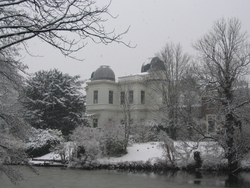
The Hortus botanicus of Leiden is the oldest botanical garden
of the Netherlands
, and one of the oldest in the world. It is located in the southwestern part of the historical centre of the city, between the Academy building and the Leiden Observatory
.
 In 1587 the young University of Leiden requested the burgomasters of Leiden permission to establish a hortus academicus behind the Academy building, for the benefit of the medicine students. Permission was granted in 1590, and as prefect
was appointed the famous botanist Carolus Clusius (1526–1609), who arrived in Leiden in 1593. Clusius' knowledge, reputation and international contacts allowed him to set up a very extensive plant
collection
. Clusius also urged the Dutch East India Company
(VOC) to collect plants and (dried) plant specimens. The original garden set up by Clusius was small (about 35 by 40 meters), but contained more than 1000 different plants.
The collecting of tropical (from the Indies
) and sub-tropical (from the Cape Colony
) plants was continued under Clusius' successors. Especially Herman Boerhaave
(1668–1738, prefect from 1709–1730), contributed greatly to the fame of the Hortus with his efforts to collect new plants and specimens, and with his publications, such as a catalog of the plants then to be found in the Hortus.
Another major contribution to the collections was made by Philipp Franz von Siebold
, a German physician who was employed on Deshima (Japan
) by the VOC from 1823 until his expulsion by Japan in 1829. During that period he collected many dried and living plants from all over Japan (as well as animals, ethnographical
objects, maps, etc.), and sent them to Leiden.
The first greenhouse
s appeared in the Hortus in the second half of the 17th century, the monumental Orangery
was built between 1740 and 1744. From its original plan the Hortus was expanded in 1736 by Adriaan van Royen
and Carl Linnaeus, and in 1817 by Theodor Friedrich Ludwig Nees von Esenbeck
and Sebald Justinus Brugmans
. In 1857, a part was used for building the new Leiden Observatory.
(Laburnum anagyroides), planted in 1601, the Tuliptree (Liriodendron tulipifera) from 1682 and the Ginkgo (Ginkgo biloba) from 1785 are worth mentioning.
The greenhouses with Victoria amazonica
and other tropical plants, and the large collection of sub-tropical plants in the recently renovated Orangery and the new Winter Garden draw many visitors. The park itself is an oasis inside the old city, with many more interesting plants and trees.
A Japanese garden
in honour of Von Siebold
opened in 1990.
A reconstruction of Clusius' original garden, based on a plant list dating from the end of the 16th century, was opened in 2009.
From a scientific point of view, the Leiden Hortus is known for its collections of Asian Araceae
(among which the Amorphophallus titanum), Hoya
, Dischidia
, Nepenthes
, Fern
s and one of the biggest collections of Asian Orchids in the world.
Botanical garden
A botanical garden The terms botanic and botanical, and garden or gardens are used more-or-less interchangeably, although the word botanic is generally reserved for the earlier, more traditional gardens. is a well-tended area displaying a wide range of plants labelled with their botanical names...
of the Netherlands
Netherlands
The Netherlands is a constituent country of the Kingdom of the Netherlands, located mainly in North-West Europe and with several islands in the Caribbean. Mainland Netherlands borders the North Sea to the north and west, Belgium to the south, and Germany to the east, and shares maritime borders...
, and one of the oldest in the world. It is located in the southwestern part of the historical centre of the city, between the Academy building and the Leiden Observatory
Leiden Observatory
Leiden Observatory is an astronomical observatory in the city of Leiden, Netherlands. It was established by Leiden University in 1633, to house the quadrant of Snellius, and is the oldest operating University observatory in the world Leiden Observatory (Sterrewacht Leiden in Dutch) is an...
.
History
Prefect
Prefect is a magisterial title of varying definition....
was appointed the famous botanist Carolus Clusius (1526–1609), who arrived in Leiden in 1593. Clusius' knowledge, reputation and international contacts allowed him to set up a very extensive plant
Plant
Plants are living organisms belonging to the kingdom Plantae. Precise definitions of the kingdom vary, but as the term is used here, plants include familiar organisms such as trees, flowers, herbs, bushes, grasses, vines, ferns, mosses, and green algae. The group is also called green plants or...
collection
Collection (museum)
A museum is distinguished by a collection of often unique objects that forms the core of its activities for exhibitions, education, research, etc. This differentiates it from an archive or library, where the contents may be more paper-based, replaceable and less exhibition oriented...
. Clusius also urged the Dutch East India Company
Dutch East India Company
The Dutch East India Company was a chartered company established in 1602, when the States-General of the Netherlands granted it a 21-year monopoly to carry out colonial activities in Asia...
(VOC) to collect plants and (dried) plant specimens. The original garden set up by Clusius was small (about 35 by 40 meters), but contained more than 1000 different plants.
The collecting of tropical (from the Indies
Indies
The Indies is a term that has been used to describe the lands of South and Southeast Asia, occupying all of the present India, Pakistan, Bangladesh, Myanmar, Nepal, Sri Lanka, the Maldives, and also Thailand, Cambodia, Laos, Vietnam, Brunei, Singapore, the Philippines, East Timor, Malaysia and...
) and sub-tropical (from the Cape Colony
Cape Colony
The Cape Colony, part of modern South Africa, was established by the Dutch East India Company in 1652, with the founding of Cape Town. It was subsequently occupied by the British in 1795 when the Netherlands were occupied by revolutionary France, so that the French revolutionaries could not take...
) plants was continued under Clusius' successors. Especially Herman Boerhaave
Herman Boerhaave
Herman Boerhaave was a Dutch botanist, humanist and physician of European fame. He is regarded as the founder of clinical teaching and of the modern academic hospital. His main achievement was to demonstrate the relation of symptoms to lesions...
(1668–1738, prefect from 1709–1730), contributed greatly to the fame of the Hortus with his efforts to collect new plants and specimens, and with his publications, such as a catalog of the plants then to be found in the Hortus.
Another major contribution to the collections was made by Philipp Franz von Siebold
Philipp Franz von Siebold
Philipp Franz Balthasar von Siebold was a German physician and traveller. He was the first European to teach Western medicine in Japan...
, a German physician who was employed on Deshima (Japan
Japan
Japan is an island nation in East Asia. Located in the Pacific Ocean, it lies to the east of the Sea of Japan, China, North Korea, South Korea and Russia, stretching from the Sea of Okhotsk in the north to the East China Sea and Taiwan in the south...
) by the VOC from 1823 until his expulsion by Japan in 1829. During that period he collected many dried and living plants from all over Japan (as well as animals, ethnographical
Ethnography
Ethnography is a qualitative method aimed to learn and understand cultural phenomena which reflect the knowledge and system of meanings guiding the life of a cultural group...
objects, maps, etc.), and sent them to Leiden.
The first greenhouse
Greenhouse
A greenhouse is a building in which plants are grown. These structures range in size from small sheds to very large buildings...
s appeared in the Hortus in the second half of the 17th century, the monumental Orangery
Orangery
An orangery was a building in the grounds of fashionable residences from the 17th to the 19th centuries and given a classicising architectural form. The orangery was similar to a greenhouse or conservatory...
was built between 1740 and 1744. From its original plan the Hortus was expanded in 1736 by Adriaan van Royen
Adriaan van Royen
Adriaan van Royen was a Dutch botanist. He was a professor at Leiden University and is associated with Carl Linnaeus....
and Carl Linnaeus, and in 1817 by Theodor Friedrich Ludwig Nees von Esenbeck
Theodor Friedrich Ludwig Nees von Esenbeck
Theodor Friedrich Ludwig Nees von Esenbeck was a German botanist and pharmacologist who was a native of Schloss Reichenberg in Reichelsheim...
and Sebald Justinus Brugmans
Sebald Justinus Brugmans
Sebald Justinus Brugmans was a Dutch botanist, physician and professor of natural sciences.Brugmans studied at the University of Groningen, where he earned doctorates in medicine and philosophy, and also a masters degree in liberal arts...
. In 1857, a part was used for building the new Leiden Observatory.
Collection
From a historical perspective, the old Golden ChainLaburnum
Laburnum is a genus of two species of small trees in the subfamily Faboideae of the pea family Fabaceae, Laburnum anagyroides and L. alpinum . They are native to the mountains of southern Europe from France to the Balkan Peninsula...
(Laburnum anagyroides), planted in 1601, the Tuliptree (Liriodendron tulipifera) from 1682 and the Ginkgo (Ginkgo biloba) from 1785 are worth mentioning.
The greenhouses with Victoria amazonica
Victoria amazonica
Victoria amazonica is a species of flowering plant, the largest of the Nymphaeaceae family of water lilies.-Description:The species has very large leaves, up to 3 m in diameter, that float on the water's surface on a submerged stalk, 7–8 m in length. The species was once called Victoria...
and other tropical plants, and the large collection of sub-tropical plants in the recently renovated Orangery and the new Winter Garden draw many visitors. The park itself is an oasis inside the old city, with many more interesting plants and trees.
A Japanese garden
Japanese garden
, that is, gardens in traditional Japanese style, can be found at private homes, in neighborhood or city parks, and at historical landmarks such as Buddhist temples, Shinto shrines and old castles....
in honour of Von Siebold
Philipp Franz von Siebold
Philipp Franz Balthasar von Siebold was a German physician and traveller. He was the first European to teach Western medicine in Japan...
opened in 1990.
A reconstruction of Clusius' original garden, based on a plant list dating from the end of the 16th century, was opened in 2009.
From a scientific point of view, the Leiden Hortus is known for its collections of Asian Araceae
Araceae
Araceae are a family of monocotyledonous flowering plants in which flowers are borne on a type of inflorescence called a spadix. The spadix is usually accompanied by, and sometimes partially enclosed in, a spathe or leaf-like bract. Also known as the Arum family, members are often colloquially...
(among which the Amorphophallus titanum), Hoya
Hoya
Hoya is a genus of 200-300 species of tropical plants in the family Apocynaceae , fomerly considered to be in the Asclepiadaceae...
, Dischidia
Dischidia
Dischidia is a genus of plants in the Milkweed family, Asclepiadaceae. It comprises about 80 known species which all grow as epiphytes and are native to tropical areas of China, India and most areas of Indo-China. Dischidia are closely aligned with the sister genus Hoya...
, Nepenthes
Nepenthes
The Nepenthes , popularly known as tropical pitcher plants or monkey cups, are a genus of carnivorous plants in the monotypic family Nepenthaceae. The genus comprises roughly 130 species, numerous natural and many cultivated hybrids...
, Fern
Fern
A fern is any one of a group of about 12,000 species of plants belonging to the botanical group known as Pteridophyta. Unlike mosses, they have xylem and phloem . They have stems, leaves, and roots like other vascular plants...
s and one of the biggest collections of Asian Orchids in the world.