


Hormel

Encyclopedia
Hormel Foods Corporation
is a food company based in southeastern Minnesota
(Mower County
), perhaps best known as the producer of Spam
luncheon meat. The company was founded as George A. Hormel & Company in Austin, Minnesota
, U.S.
, by George A. Hormel
in 1891. The company changed its name to Hormel Foods Corporation 102 years later in 1993. Hormel sells food under many brands, including the Chi-Chi's
, Dinty Moore, Farmer John, Herdez, Jennie-O
, Lloyd's, Spam
and Stagg brands, as well as under its own name. The company is listed on the Fortune 500
.
 George A. Hormel
(born 1860 in Buffalo, New York
) worked in a Chicago
slaughterhouse
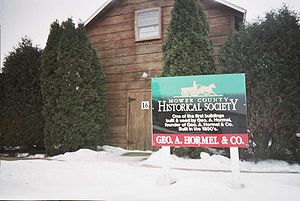
before becoming a traveling wool and hide buyer. His travels took him to Austin and he decided to settle there, borrow $500, and open a meat business. Hormel handled the production side of the business and his partner, Albert Friedrich, handled the retail side. The two dissolved their partnership in 1891 so that Hormel could start a complete meat packing
operation on his own. He opened George A. Hormel & Co. in the northeast part of Austin in an old creamery
building on the Cedar River. To make ends meet in those early days, Hormel continued to trade in hides, eggs, wool, and poultry. Joining George in November 1891 was his youngest brother, Benjamin, age 14. By the end of 1891 Hormel employed six men and had slaughtered and sold 610 head of livestock. By 1893, the increased use of refrigerator car
s had allowed many large meat packers to force smaller business under. Two additional Hormel brothers, Herman and John, joined the business that same year and together they processed 1,532 hogs
, enough to stay in business. The remaining members of the Hormel family moved to Austin in 1895 and joined the growing business. George turned to full-time management in 1899 and turned his focus on increasing production.
. The first directors were A.L. Eberhart and the four Hormel brothers: George, Herman, John and Ben. In 1903 George decided to add a three-story hog-kill, a two-story beef-kill, an annex, an engine room, a machine shop
and a casing
production department. The name Dairy Brand was registered with the U.S. Patent Office in 1903. In the first decade of the 20th century distribution centers were opened in St. Paul, Minneapolis
, Duluth
, San Antonio
, Dallas
, Chicago, Atlanta
, and Birmingham
. George Hormel visited England in 1905 and started exporting products soon after.
its waste water by daily evaporating
up to 9,000 gallons of water, leaving a syrupy liquid which was dried to produce a commercial fertilizer
. In 1915 Hormel began selling dry sausages under the names of Cedar Cervelat, Holsteiner and Noxall Salami. That same year Hormel bought Alderson's Mill and began selling Hormel Peerless Minnesota flour nationwide. Hormel joined the World War I
effort, George's son Jay C. went into military service and by the end of the war, exports accounted for 33% of the company's yearly volume.
, he uncovered that assistant controller Cy Thomson
had embezzled $1,187,000 from the company over the previous ten years. The embezzlement
scandal provided George Hormel with additional incentive to fortify his company. He did so by arranging for more reliable capital management, by dismissing unproductive employees, and by continuing to develop new products. In 1926, the company introduced Hormel Flavor-Sealed Ham, America's first canned
ham
and it added chicken
to its line in 1928. Jay C. Hormel became company president in 1929 and that same year the plant was expanded again to include eight new structures and the main office was tripled in size. In the late 1920s and early 1930s sales branches opened up in Houston
, Beaumont
, Chattanooga
, New Orleans
, Baton Rouge
, Newark
, Los Angeles
, Vicksburg
, and Nuevo Laredo
(Mexico
).
, profit sharing
and pension plan
s to the company. Later that year a slaughtering plant was constructed in Mitchell, South Dakota
, and in 1933, a cattle slaughtering plant was finished in Austin. John G. Hormel, brother of George A., retired in 1933 following 40 years of service. Dinty Moore beef stew was introduced in 1935 first created by Ryen "Gunns" Gunning and Hormel Chili
and Spam
soon followed in 1936 and 1937 respectively. In 1938, Jay C. Hormel introduced the "Joint Savings Plan" which allowed employees to share in the proceeds of the company. By the late-1930s, full-page, four color
ads were routinely appearing in the Saturday Evening Post, Ladies Home Journal and Woman's Home Companion
. Hormel ads also were featured on the radio program The George Burns and Gracie Allen Show
.
The 1930s also saw the establishment of the Hormel & Co. refrigerator car line, with an initial roster of 125 units.
 After reaching sales of $75 million in 1941, George and Jay established The Hormel Foundation to provide perpetual independence of the company, act as trustee
s of the family trusts and to start and fund The Hormel Institute, a research unit at the University of Minnesota
. Benjamin F. Hormel, brother of George A., retired in 1941 after completing 50 years of service. Hormel's production increased to aid in World War II
and 65% of its products were purchased by the U.S. government by 1945. Founder George A. Hormel
died in 1946 in California
where he had lived in retirement. He is buried in Austin's Oakwood Cemetery. Jay C. then became chairman of the board
, H.H. Corey became president, and R.F. Gray became vice-president. Hormel acquired the Fremont
Packing Company in 1947.
. Also in 1953, distribution centers were opened in San Francisco
, Seattle
and Beaumont and the company's first non-continental plant opened in Honolulu
. Jay C. Hormel died on August 30, 1954, and Corey was named chairman of the board and R.F. Gray was elected president the following year. During Gray's tenure as president, the company greatly expanded its international business through arrangements with companies in Ireland
, England, Canada
and Venezuela
. In 1959, Hormel was the first meatpacker to receive the Seal of Approval of the American Humane Society
for its practice of anesthetizing
animals before slaughter.
, and the Ottawa Meat Packing Company plant in Miami, Oklahoma
. New plants were also constructed in Chattanooga and Los Angeles
and the plants in Charlotte
, Winston-Salem
, Fresno
and Houston
were remodeled or expanded. In 1964, the Hormel Corporate Offices were opened just to the north of Interstate 90
in Austin. Gray replaced Corey as chairman of the board upon the latter's retirement
in 1965, and M.B. Thompson became president. During Thompson's tenure (1965–1969) a dry sausage plant was built in Algona
and distribution centers were built in San Antonio
, New Orleans
and Atlanta. In 1967, the Hormel Foundation, in cooperation with the National Merit Scholarship Program
, started a college scholarship program for the children of Hormel employees. Partial scholarships were awarded through this program on the basis of the student's test scores, academic records, financial need, and school and community involvement. A separate building to house the growing research and development
department was built northwest of the corporate office in Austin in 1968. In 1969, Gray resigned from the company and Thompson replaced him as chairman (by this time the chairman was called the CEO) and I.J. Holton was named president.
, and a dry sausage plant was built in Algona. In 1971, meat processing facilities and distribution centers were opened in both Dallas and Seattle
. That same year the company introduced its Matching Gifts program in which it offered to match the donation (up to $2,000) made by any employee to any accredited college or university. In 1972, Holton became CEO and distribution centers were opened in Orlando
and Shreveport
and a food service facility was built in Oklahoma City
. A grocery products plant was opened in Beloit
in 1973. On this site the city now boasts the world's largest can of chili. Also in 1973, Hormel Foods became the first company in the meatpacking industry to introduce nutritional and ingredient labeling on meat products. A frozen food
s plant was opened in Fort Worth
in 1974. A distribution plant was opened in Houston
in 1975. In 1976, a slaughtering and processing plant was opened in Ottumwa
, a dry sausage plant was opened in Knoxville, Iowa
, and a grocery products canning
facility was acquired in Stockton
. A distribution plant was built in Fresno
in 1978. A gelatin
plant was opened in Davenport
and groundbreaking for a new, one-story Austin plant in 1979. That same year Richard Knowlton was elected as president, the first Austinian to hold that post since Jay Catherwood Hormel
.
brand products. The following year, Hormel Foods introduced the Top Shelf line of microwavable non-frozen products. The company added to their poultry offerings by purchasing Chicken by George, created by former Miss America
Phyllis George
, in 1988. That same year, Hormel Foods also introduced microwave bacon
.
in Austin, Minnesota
. In the early 1980s, recession impacted several meatpacking companies, increasing competition which led smaller and less-efficient companies to go out of business. In an effort to keep plants from closing, many instituted wage cuts. Wilson Food Company declared bankruptcy in 1983, allowing them to cut wages from $10.69 to $6.50 and significantly reduce benefits. Hormel Foods had avoided such drastic action, but by 1985, pressure to stay competitive remained. Workers had already labored under a wage freeze and dangerous working conditions, leading to many cases of repetitive strain injury
. When management demanded a 23% wage cut from the workers they decided to begin the strike. It became one of the longest strikes of the 1980s. The strike began with the sanction of the Local of the United Food and Commercial Workers International Union, P-9. The local chapter of the United Food and Commercial Workers Union P-9 led the strike, but was not supported by their parent union. The strike gained national attention and led to a widely publicized boycott
of Hormel products.
After six months, a significant number of strikebreakers crossed the picket line, provoking riots in Austin. On January 21, 1986, the Governor of Minnesota
, Rudy Perpich
, called in the National Guard
to protect the strikebreakers. This brought protests against the governor, and the National Guard withdrew from Austin. The action had a greater effect on the UFCW international, which ousted the local P-9.
The strike ended in June 1986, after lasting 10 months. Over 700 of the workers did not return to their jobs, refusing to cross the picket line. In solidarity with those workers, the boycott of Hormel products continued for some time. Ultimately, however, the company did succeed in hiring new workers at significantly lower wages.
The strike was chronicled in the film American Dream
, which won the Academy Award
for best documentary
in 1990
. A song about the strike, entitled "P-9" (link to music video of song), was written by Dave Pirner
of the Minneapolis band, Soul Asylum
. The song can be found on their 1989 album, Clam Dip & Other Delights
.
The strike has also had a Harvard Business School Case written based on it (with assumed names), called "Adam Baxter Co./Local 190" which features multiple rounds of negotiations between unions and management.
Recent acquisitions by Hormel Foods include: Century Foods International (2003) Clougherty Packing (Farmer John) (2004), Lloyd’s Barbeque (2005), Mark-Lynn Foods (2005), Arriba Foods (2005), Provena Foods (2006) and Burke Foods
(2007).
Under Ettinger, Hormel Foods issued the Billion Dollar Challenge with a goal to generate $1 billion in sales of products introduced to the market since 2000. The target date for this achievement was 2009. In 2007, Ettinger announced that the goal had been exceeded a full two years early. At the same time, a new challenge was issued: $2 billion in new product sales by 2012.
In 2008, animal rights organization PETA
sent members to work undercover at a pig factory farm in Iowa to investigate allegations of animal rights abuses, then released a video record showing workers treating the pigs cruelly and without regard for animal rights. The factory farm was owned by Natural Pork Production II LLP of Iowa until August 18th, 2008, at which point ownership had transferred to MowMar LLP. Prior to this the farm was not a supplier to Hormel Foods. Hormel spokeswoman Julie Henderson Craven, who responded to the PETA video, called the videotaped abuses "completely unacceptable." In their 2007 Corporate Responsibility Report, Hormel Foods stated that all suppliers are expected to comply with several welfare programs to ensure that the hogs purchased are treated humanely. Because of the investigation, several employees of the farm were fired and six individuals faced charges due to the abuse.
In November 2008, an article in the New York Times, "Spam Turns Serious and Hormel Turns Out More," detailed an overwhelming spike in the demand for SPAM, perhaps due to the flagging economy. In November 2009, Hormel Foods plans to open a new production facility in Dubuque, IA. The plant will produce microwave meals and is being constructed with the intention to meet the U.S. Green Building Council's Leadership in Energy and Environmental Design
recognition.
and Mayo Clinic
.
is a food company based in southeastern Minnesota
Minnesota
Minnesota is a U.S. state located in the Midwestern United States. The twelfth largest state of the U.S., it is the twenty-first most populous, with 5.3 million residents. Minnesota was carved out of the eastern half of the Minnesota Territory and admitted to the Union as the thirty-second state...
(Mower County
Mower County, Minnesota
As of the census of 2000, there were 38,603 people, 15,582 households, and 10,315 families residing in the county. The population density was 54 people per square mile . There were 16,251 housing units at an average density of 23 per square mile...
), perhaps best known as the producer of Spam
Spam (food)
Spam is a canned precooked meat product made by the Hormel Foods Corporation, first introduced in 1937. The labeled ingredients in the classic variety of Spam are chopped pork shoulder meat, with ham meat added, salt, water, modified potato starch as a binder, and sodium nitrite as a preservative...
luncheon meat. The company was founded as George A. Hormel & Company in Austin, Minnesota
Austin, Minnesota
As of the census of 2000, there were 23,314 people, 9,897 households, and 6,076 families residing in the city. The population density was 2,168.2 people per square mile . There were 10,261 housing units at an average density of 954.3 per square mile...
, U.S.
United States
The United States of America is a federal constitutional republic comprising fifty states and a federal district...
, by George A. Hormel
George A. Hormel
George A. Hormel was the founder of Hormel in 1891.Hormel was born in Buffalo, New York, USA, in 1860 and later settled in Austin, Minnesota. He established his meat packing company in 1891 and established a food company that continues to thrive today.He remained head of the company until 1929...
in 1891. The company changed its name to Hormel Foods Corporation 102 years later in 1993. Hormel sells food under many brands, including the Chi-Chi's
Chi-Chi's
Chi-Chi's was a popular Mexican restaurant chain from 1975 to 2004. It ceased to exist within the United States following a 2003 Hepatitis A outbreak that began at one of its locations in suburban Pittsburgh, Pennsylvania. Chi-Chi's is still in operation in Belgium, Luxembourg, United Arab...
, Dinty Moore, Farmer John, Herdez, Jennie-O
Jennie-O
Jennie-O is a brand name of turkey products. It is now a subsidiary of the Hormel Foods Corporation in Willmar, Minnesota.The company was founded by Earl B. Olson in 1940, when he began raising turkeys. In 1949, he bought the former Farmers Produce Company of Willmar and its turkey processing...
, Lloyd's, Spam
Spam (food)
Spam is a canned precooked meat product made by the Hormel Foods Corporation, first introduced in 1937. The labeled ingredients in the classic variety of Spam are chopped pork shoulder meat, with ham meat added, salt, water, modified potato starch as a binder, and sodium nitrite as a preservative...
and Stagg brands, as well as under its own name. The company is listed on the Fortune 500
Fortune 500
The Fortune 500 is an annual list compiled and published by Fortune magazine that ranks the top 500 U.S. closely held and public corporations as ranked by their gross revenue after adjustments made by Fortune to exclude the impact of excise taxes companies collect. The list includes publicly and...
.
19th century
George A. Hormel
George A. Hormel was the founder of Hormel in 1891.Hormel was born in Buffalo, New York, USA, in 1860 and later settled in Austin, Minnesota. He established his meat packing company in 1891 and established a food company that continues to thrive today.He remained head of the company until 1929...
(born 1860 in Buffalo, New York
Buffalo, New York
Buffalo is the second most populous city in the state of New York, after New York City. Located in Western New York on the eastern shores of Lake Erie and at the head of the Niagara River across from Fort Erie, Ontario, Buffalo is the seat of Erie County and the principal city of the...
) worked in a Chicago
Chicago
Chicago is the largest city in the US state of Illinois. With nearly 2.7 million residents, it is the most populous city in the Midwestern United States and the third most populous in the US, after New York City and Los Angeles...
slaughterhouse
Slaughterhouse
A slaughterhouse or abattoir is a facility where animals are killed for consumption as food products.Approximately 45-50% of the animal can be turned into edible products...
before becoming a traveling wool and hide buyer. His travels took him to Austin and he decided to settle there, borrow $500, and open a meat business. Hormel handled the production side of the business and his partner, Albert Friedrich, handled the retail side. The two dissolved their partnership in 1891 so that Hormel could start a complete meat packing
Meat packing industry
The meat packing industry handles the slaughtering, processing, packaging, and distribution of animals such as cattle, pigs, sheep and other livestock...
operation on his own. He opened George A. Hormel & Co. in the northeast part of Austin in an old creamery
Creamery
In a dairy, the creamery is the location of cream processing. Cream is separated from whole milk; pasteurization is done to the skimmed milk and cream separately. Whole milk for sale has had some cream returned to the skimmed milk....
building on the Cedar River. To make ends meet in those early days, Hormel continued to trade in hides, eggs, wool, and poultry. Joining George in November 1891 was his youngest brother, Benjamin, age 14. By the end of 1891 Hormel employed six men and had slaughtered and sold 610 head of livestock. By 1893, the increased use of refrigerator car
Refrigerator car
A refrigerator car is a refrigerated boxcar , a piece of railroad rolling stock designed to carry perishable freight at specific temperatures. Refrigerator cars differ from simple insulated boxcars and ventilated boxcars , neither of which are fitted with cooling apparatus...
s had allowed many large meat packers to force smaller business under. Two additional Hormel brothers, Herman and John, joined the business that same year and together they processed 1,532 hogs
Pig
A pig is any of the animals in the genus Sus, within the Suidae family of even-toed ungulates. Pigs include the domestic pig, its ancestor the wild boar, and several other wild relatives...
, enough to stay in business. The remaining members of the Hormel family moved to Austin in 1895 and joined the growing business. George turned to full-time management in 1899 and turned his focus on increasing production.
1900s
In 1901, the plant was expanded and the business was incorporatedIncorporation (business)
Incorporation is the forming of a new corporation . The corporation may be a business, a non-profit organisation, sports club, or a government of a new city or town...
. The first directors were A.L. Eberhart and the four Hormel brothers: George, Herman, John and Ben. In 1903 George decided to add a three-story hog-kill, a two-story beef-kill, an annex, an engine room, a machine shop
Machining
Conventional machining is a form of subtractive manufacturing, in which a collection of material-working processes utilizing power-driven machine tools, such as saws, lathes, milling machines, and drill presses, are used with a sharp cutting tool to physical remove material to achieve a desired...
and a casing
Casing (sausage)
Casing, sausage casing, or sausage skin is the material that encloses the filling of a sausage. Casings are divided into two categories, natural and artificial...
production department. The name Dairy Brand was registered with the U.S. Patent Office in 1903. In the first decade of the 20th century distribution centers were opened in St. Paul, Minneapolis
Minneapolis, Minnesota
Minneapolis , nicknamed "City of Lakes" and the "Mill City," is the county seat of Hennepin County, the largest city in the U.S. state of Minnesota, and the 48th largest in the United States...
, Duluth
Duluth, Minnesota
Duluth is a port city in the U.S. state of Minnesota and is the county seat of Saint Louis County. The fourth largest city in Minnesota, Duluth had a total population of 86,265 in the 2010 census. Duluth is also the second largest city that is located on Lake Superior after Thunder Bay, Ontario,...
, San Antonio
San Antonio, Texas
San Antonio is the seventh-largest city in the United States of America and the second-largest city within the state of Texas, with a population of 1.33 million. Located in the American Southwest and the south–central part of Texas, the city serves as the seat of Bexar County. In 2011,...
, Dallas
Dallas, Texas
Dallas is the third-largest city in Texas and the ninth-largest in the United States. The Dallas-Fort Worth Metroplex is the largest metropolitan area in the South and fourth-largest metropolitan area in the United States...
, Chicago, Atlanta
Atlanta, Georgia
Atlanta is the capital and most populous city in the U.S. state of Georgia. According to the 2010 census, Atlanta's population is 420,003. Atlanta is the cultural and economic center of the Atlanta metropolitan area, which is home to 5,268,860 people and is the ninth largest metropolitan area in...
, and Birmingham
Birmingham, Alabama
Birmingham is the largest city in Alabama. The city is the county seat of Jefferson County. According to the 2010 United States Census, Birmingham had a population of 212,237. The Birmingham-Hoover Metropolitan Area, in estimate by the U.S...
. George Hormel visited England in 1905 and started exporting products soon after.
1910s
By 1910, Hormel products were routinely appearing in national magazines. That same year the company developed a procedure to recycleRecycling
Recycling is processing used materials into new products to prevent waste of potentially useful materials, reduce the consumption of fresh raw materials, reduce energy usage, reduce air pollution and water pollution by reducing the need for "conventional" waste disposal, and lower greenhouse...
its waste water by daily evaporating
Evaporation
Evaporation is a type of vaporization of a liquid that occurs only on the surface of a liquid. The other type of vaporization is boiling, which, instead, occurs on the entire mass of the liquid....
up to 9,000 gallons of water, leaving a syrupy liquid which was dried to produce a commercial fertilizer
Fertilizer
Fertilizer is any organic or inorganic material of natural or synthetic origin that is added to a soil to supply one or more plant nutrients essential to the growth of plants. A recent assessment found that about 40 to 60% of crop yields are attributable to commercial fertilizer use...
. In 1915 Hormel began selling dry sausages under the names of Cedar Cervelat, Holsteiner and Noxall Salami. That same year Hormel bought Alderson's Mill and began selling Hormel Peerless Minnesota flour nationwide. Hormel joined the World War I
World War I
World War I , which was predominantly called the World War or the Great War from its occurrence until 1939, and the First World War or World War I thereafter, was a major war centred in Europe that began on 28 July 1914 and lasted until 11 November 1918...
effort, George's son Jay C. went into military service and by the end of the war, exports accounted for 33% of the company's yearly volume.
1920s
In 1921, when Jay Hormel returned from service in WWIWorld War I
World War I , which was predominantly called the World War or the Great War from its occurrence until 1939, and the First World War or World War I thereafter, was a major war centred in Europe that began on 28 July 1914 and lasted until 11 November 1918...
, he uncovered that assistant controller Cy Thomson
Cy Thomson
Ransom J. "Cy" Thomson is best known as the man who, between the years of 1911 and 1921, embezzled over $1,000,000 from Hormel Foods in Austin, Minnesota....
had embezzled $1,187,000 from the company over the previous ten years. The embezzlement
Embezzlement
Embezzlement is the act of dishonestly appropriating or secreting assets by one or more individuals to whom such assets have been entrusted....
scandal provided George Hormel with additional incentive to fortify his company. He did so by arranging for more reliable capital management, by dismissing unproductive employees, and by continuing to develop new products. In 1926, the company introduced Hormel Flavor-Sealed Ham, America's first canned
Canning
Canning is a method of preserving food in which the food contents are processed and sealed in an airtight container. Canning provides a typical shelf life ranging from one to five years, although under specific circumstances a freeze-dried canned product, such as canned, dried lentils, can last as...
ham
Ham
Ham is a cut of meat from the thigh of the hind leg of certain animals, especiallypigs. Nearly all hams sold today are fully cooked or cured.-Etymology:...
and it added chicken
Chicken
The chicken is a domesticated fowl, a subspecies of the Red Junglefowl. As one of the most common and widespread domestic animals, and with a population of more than 24 billion in 2003, there are more chickens in the world than any other species of bird...
to its line in 1928. Jay C. Hormel became company president in 1929 and that same year the plant was expanded again to include eight new structures and the main office was tripled in size. In the late 1920s and early 1930s sales branches opened up in Houston
Houston, Texas
Houston is the fourth-largest city in the United States, and the largest city in the state of Texas. According to the 2010 U.S. Census, the city had a population of 2.1 million people within an area of . Houston is the seat of Harris County and the economic center of , which is the ...
, Beaumont
Beaumont, Texas
Beaumont is a city in and county seat of Jefferson County, Texas, United States, within the Beaumont–Port Arthur Metropolitan Statistical Area. The city's population was 118,296 at the 2010 census. With Port Arthur and Orange, it forms the Golden Triangle, a major industrial area on the...
, Chattanooga
Chattanooga, Tennessee
Chattanooga is the fourth-largest city in the US state of Tennessee , with a population of 169,887. It is the seat of Hamilton County...
, New Orleans
New Orleans, Louisiana
New Orleans is a major United States port and the largest city and metropolitan area in the state of Louisiana. The New Orleans metropolitan area has a population of 1,235,650 as of 2009, the 46th largest in the USA. The New Orleans – Metairie – Bogalusa combined statistical area has a population...
, Baton Rouge
Baton Rouge, Louisiana
Baton Rouge is the capital of the U.S. state of Louisiana. It is located in East Baton Rouge Parish and is the second-largest city in the state.Baton Rouge is a major industrial, petrochemical, medical, and research center of the American South...
, Newark
Newark, New Jersey
Newark is the largest city in the American state of New Jersey, and the seat of Essex County. As of the 2010 United States Census, Newark had a population of 277,140, maintaining its status as the largest municipality in New Jersey. It is the 68th largest city in the U.S...
, Los Angeles
Los Angeles, California
Los Angeles , with a population at the 2010 United States Census of 3,792,621, is the most populous city in California, USA and the second most populous in the United States, after New York City. It has an area of , and is located in Southern California...
, Vicksburg
Vicksburg, Mississippi
Vicksburg is a city in Warren County, Mississippi, United States. It is the only city in Warren County. It is located northwest of New Orleans on the Mississippi and Yazoo rivers, and due west of Jackson, the state capital. In 1900, 14,834 people lived in Vicksburg; in 1910, 20,814; in 1920,...
, and Nuevo Laredo
Nuevo Laredo
Nuevo Laredo is a city located in the Municipality of Nuevo Laredo in the Mexican state of Tamaulipas. The city lies on the banks of the Río Grande, across from the United States city of Laredo, Texas. The 2010 census population of the city was 373,725. Nuevo Laredo is part of the Laredo-Nuevo...
(Mexico
Mexico
The United Mexican States , commonly known as Mexico , is a federal constitutional republic in North America. It is bordered on the north by the United States; on the south and west by the Pacific Ocean; on the southeast by Guatemala, Belize, and the Caribbean Sea; and on the east by the Gulf of...
).
1930s
In 1931, Jay C. instituted the Annual Wage Plan: under this plan, employees were paid weekly and they were guaranteed 52 weeks' notice before termination of employment. He also introduced incentive payIncentive
In economics and sociology, an incentive is any factor that enables or motivates a particular course of action, or counts as a reason for preferring one choice to the alternatives. It is an expectation that encourages people to behave in a certain way...
, profit sharing
Profit sharing
Profit sharing, when used as a special term, refers to various incentive plans introduced by businesses that provide direct or indirect payments to employees that depend on company's profitability in addition to employees' regular salary and bonuses...
and pension plan
Pension
In general, a pension is an arrangement to provide people with an income when they are no longer earning a regular income from employment. Pensions should not be confused with severance pay; the former is paid in regular installments, while the latter is paid in one lump sum.The terms retirement...
s to the company. Later that year a slaughtering plant was constructed in Mitchell, South Dakota
Mitchell, South Dakota
-Demographics:As of the census of 2000, there were 14,558 people, 6,121 households, and 3,599 families residing in the city. The population density was 1,475.7 people per square mile . There were 6,555 housing units at an average density of 664.4 per square mile...
, and in 1933, a cattle slaughtering plant was finished in Austin. John G. Hormel, brother of George A., retired in 1933 following 40 years of service. Dinty Moore beef stew was introduced in 1935 first created by Ryen "Gunns" Gunning and Hormel Chili
Chili con carne
Chili con carne is a spicy stew. The name of the dish derives from the Spanish chile con carne, "chili pepper with meat". Traditional versions are made, minimally, from chili peppers, garlic, onions, and cumin, along with chopped or ground beef. Beans and tomatoes are frequently included...
and Spam
Spam (food)
Spam is a canned precooked meat product made by the Hormel Foods Corporation, first introduced in 1937. The labeled ingredients in the classic variety of Spam are chopped pork shoulder meat, with ham meat added, salt, water, modified potato starch as a binder, and sodium nitrite as a preservative...
soon followed in 1936 and 1937 respectively. In 1938, Jay C. Hormel introduced the "Joint Savings Plan" which allowed employees to share in the proceeds of the company. By the late-1930s, full-page, four color
Color printing
Color printing or Colour printing is the reproduction of an image or text in color...
ads were routinely appearing in the Saturday Evening Post, Ladies Home Journal and Woman's Home Companion
Woman's Home Companion
Woman's Home Companion was an American monthly publication, published from 1873 to 1957. It was highly successful, climbing to a circulation peak of more than four million during the 1930s and 1940s....
. Hormel ads also were featured on the radio program The George Burns and Gracie Allen Show
Burns and Allen
Burns and Allen, an American comedy duo consisting of George Burns and his wife, Gracie Allen, worked together as a comedy team in vaudeville, films, radio and television and achieved great success over four decades.-Vaudeville:...
.
The 1930s also saw the establishment of the Hormel & Co. refrigerator car line, with an initial roster of 125 units.
1940s
Trustee
Trustee is a legal term which, in its broadest sense, can refer to any person who holds property, authority, or a position of trust or responsibility for the benefit of another...
s of the family trusts and to start and fund The Hormel Institute, a research unit at the University of Minnesota
University of Minnesota
The University of Minnesota, Twin Cities is a public research university located in Minneapolis and St. Paul, Minnesota, United States. It is the oldest and largest part of the University of Minnesota system and has the fourth-largest main campus student body in the United States, with 52,557...
. Benjamin F. Hormel, brother of George A., retired in 1941 after completing 50 years of service. Hormel's production increased to aid in World War II
World War II
World War II, or the Second World War , was a global conflict lasting from 1939 to 1945, involving most of the world's nations—including all of the great powers—eventually forming two opposing military alliances: the Allies and the Axis...
and 65% of its products were purchased by the U.S. government by 1945. Founder George A. Hormel
George A. Hormel
George A. Hormel was the founder of Hormel in 1891.Hormel was born in Buffalo, New York, USA, in 1860 and later settled in Austin, Minnesota. He established his meat packing company in 1891 and established a food company that continues to thrive today.He remained head of the company until 1929...
died in 1946 in California
California
California is a state located on the West Coast of the United States. It is by far the most populous U.S. state, and the third-largest by land area...
where he had lived in retirement. He is buried in Austin's Oakwood Cemetery. Jay C. then became chairman of the board
Board of directors
A board of directors is a body of elected or appointed members who jointly oversee the activities of a company or organization. Other names include board of governors, board of managers, board of regents, board of trustees, and board of visitors...
, H.H. Corey became president, and R.F. Gray became vice-president. Hormel acquired the Fremont
Fremont, Nebraska
Fremont is a city in and the county seat of Dodge County, Nebraska, United States, near Omaha in the eastern part of the state. The population was 26,397 at the 2010 census....
Packing Company in 1947.
1950s
In 1953, it acquired the Tobin Packing Company of Fort DodgeFort Dodge, Iowa
Fort Dodge is a city and county seat of Webster County, Iowa, United States, along the Des Moines River. The population was 25,206 in the 2010 census, an increase from 25,136 in the 2000 census. Fort Dodge is a major commercial center for North Central and Northwest Iowa. It is located on U.S...
. Also in 1953, distribution centers were opened in San Francisco
San Francisco, California
San Francisco , officially the City and County of San Francisco, is the financial, cultural, and transportation center of the San Francisco Bay Area, a region of 7.15 million people which includes San Jose and Oakland...
, Seattle
Seattle, Washington
Seattle is the county seat of King County, Washington. With 608,660 residents as of the 2010 Census, Seattle is the largest city in the Northwestern United States. The Seattle metropolitan area of about 3.4 million inhabitants is the 15th largest metropolitan area in the country...
and Beaumont and the company's first non-continental plant opened in Honolulu
Honolulu, Hawaii
Honolulu is the capital and the most populous city of the U.S. state of Hawaii. Honolulu is the southernmost major U.S. city. Although the name "Honolulu" refers to the urban area on the southeastern shore of the island of Oahu, the city and county government are consolidated as the City and...
. Jay C. Hormel died on August 30, 1954, and Corey was named chairman of the board and R.F. Gray was elected president the following year. During Gray's tenure as president, the company greatly expanded its international business through arrangements with companies in Ireland
Ireland
Ireland is an island to the northwest of continental Europe. It is the third-largest island in Europe and the twentieth-largest island on Earth...
, England, Canada
Canada
Canada is a North American country consisting of ten provinces and three territories. Located in the northern part of the continent, it extends from the Atlantic Ocean in the east to the Pacific Ocean in the west, and northward into the Arctic Ocean...
and Venezuela
Venezuela
Venezuela , officially called the Bolivarian Republic of Venezuela , is a tropical country on the northern coast of South America. It borders Colombia to the west, Guyana to the east, and Brazil to the south...
. In 1959, Hormel was the first meatpacker to receive the Seal of Approval of the American Humane Society
Humane Society
A humane society may be a group that aims to stop human or animal suffering due to cruelty or other reasons, although in many countries, it is now used mostly for societies for the prevention of cruelty to animals...
for its practice of anesthetizing
Anesthesia
Anesthesia, or anaesthesia , traditionally meant the condition of having sensation blocked or temporarily taken away...
animals before slaughter.
1960s
Little Sizzlers sausages were introduced in 1961 and Cure 81 hams were introduced in 1963. In 1962, Hormel constructed a 75000 square feet (6,967.7 m²) sausage manufacturing building in Austin and discontinued the slaughter of calves and lambs. Also in 1963, Hormel acquired the Queen City Packing Company plant in Springfield, MissouriSpringfield, Missouri
Springfield is the third largest city in the U.S. state of Missouri and the county seat of Greene County. According to the 2010 census data, the population was 159,498, an increase of 5.2% since the 2000 census. The Springfield Metropolitan Area, population 436,712, includes the counties of...
, and the Ottawa Meat Packing Company plant in Miami, Oklahoma
Miami, Oklahoma
Miami is a city in Ottawa County, Oklahoma, United States. As of 2009, the population estimate was 12,910. It is the county seat of Ottawa County. The city is named after the Miami tribe...
. New plants were also constructed in Chattanooga and Los Angeles
Los Angeles, California
Los Angeles , with a population at the 2010 United States Census of 3,792,621, is the most populous city in California, USA and the second most populous in the United States, after New York City. It has an area of , and is located in Southern California...
and the plants in Charlotte
Charlotte, North Carolina
Charlotte is the largest city in the U.S. state of North Carolina and the seat of Mecklenburg County. In 2010, Charlotte's population according to the US Census Bureau was 731,424, making it the 17th largest city in the United States based on population. The Charlotte metropolitan area had a 2009...
, Winston-Salem
Winston-Salem, North Carolina
Winston-Salem is a city in the U.S. state of North Carolina, with a 2010 population of 229,617. Winston-Salem is the county seat and largest city of Forsyth County and the fourth-largest city in the state. Winston-Salem is the second largest municipality in the Piedmont Triad region and is home to...
, Fresno
Fresno, California
Fresno is a city in central California, United States, the county seat of Fresno County. As of the 2010 census, the city's population was 510,365, making it the fifth largest city in California, the largest inland city in California, and the 34th largest in the nation...
and Houston
Houston, Texas
Houston is the fourth-largest city in the United States, and the largest city in the state of Texas. According to the 2010 U.S. Census, the city had a population of 2.1 million people within an area of . Houston is the seat of Harris County and the economic center of , which is the ...
were remodeled or expanded. In 1964, the Hormel Corporate Offices were opened just to the north of Interstate 90
Interstate 90
Interstate 90 is the longest Interstate Highway in the United States at . It is the northernmost coast-to-coast interstate, and parallels US 20 for the most part. Its western terminus is in Seattle, at Edgar Martinez Drive S. near Safeco Field and CenturyLink Field, and its eastern terminus is in...
in Austin. Gray replaced Corey as chairman of the board upon the latter's retirement
Retirement
Retirement is the point where a person stops employment completely. A person may also semi-retire by reducing work hours.Many people choose to retire when they are eligible for private or public pension benefits, although some are forced to retire when physical conditions don't allow the person to...
in 1965, and M.B. Thompson became president. During Thompson's tenure (1965–1969) a dry sausage plant was built in Algona
Algona, Iowa
Algona is a city in and the county seat of Kossuth County, Iowa, United States. The population was 5,741 at the 2000 census. Ambrose A. Call State Park is located two miles southwest of the city.-History:...
and distribution centers were built in San Antonio
San Antonio, Texas
San Antonio is the seventh-largest city in the United States of America and the second-largest city within the state of Texas, with a population of 1.33 million. Located in the American Southwest and the south–central part of Texas, the city serves as the seat of Bexar County. In 2011,...
, New Orleans
New Orleans, Louisiana
New Orleans is a major United States port and the largest city and metropolitan area in the state of Louisiana. The New Orleans metropolitan area has a population of 1,235,650 as of 2009, the 46th largest in the USA. The New Orleans – Metairie – Bogalusa combined statistical area has a population...
and Atlanta. In 1967, the Hormel Foundation, in cooperation with the National Merit Scholarship Program
National Merit Scholarship Program
The National Merit Scholarship Program is a United States academic scholarship competition for recognition and college scholarships administered by National Merit Scholarship Corporation , a privately funded, not-for-profit organization. The program began in 1955...
, started a college scholarship program for the children of Hormel employees. Partial scholarships were awarded through this program on the basis of the student's test scores, academic records, financial need, and school and community involvement. A separate building to house the growing research and development
Research and development
The phrase research and development , according to the Organization for Economic Co-operation and Development, refers to "creative work undertaken on a systematic basis in order to increase the stock of knowledge, including knowledge of man, culture and society, and the use of this stock of...
department was built northwest of the corporate office in Austin in 1968. In 1969, Gray resigned from the company and Thompson replaced him as chairman (by this time the chairman was called the CEO) and I.J. Holton was named president.
1970s
In 1970, a distribution plant was built in Albany, GeorgiaAlbany, Georgia
Albany is a city in and the county seat of Dougherty County, Georgia, United States, in the southwestern part of the state. It is the principal city of the Albany, Georgia metropolitan area and the southwest part of the state. The population was 77,434 at the 2010 U.S. Census, making it the...
, and a dry sausage plant was built in Algona. In 1971, meat processing facilities and distribution centers were opened in both Dallas and Seattle
Seattle, Washington
Seattle is the county seat of King County, Washington. With 608,660 residents as of the 2010 Census, Seattle is the largest city in the Northwestern United States. The Seattle metropolitan area of about 3.4 million inhabitants is the 15th largest metropolitan area in the country...
. That same year the company introduced its Matching Gifts program in which it offered to match the donation (up to $2,000) made by any employee to any accredited college or university. In 1972, Holton became CEO and distribution centers were opened in Orlando
Orlando, Florida
Orlando is a city in the central region of the U.S. state of Florida. It is the county seat of Orange County, and the center of the Greater Orlando metropolitan area. According to the 2010 US Census, the city had a population of 238,300, making Orlando the 79th largest city in the United States...
and Shreveport
Shreveport, Louisiana
Shreveport is the third largest city in Louisiana. It is the principal city of the fourth largest metropolitan area in the state of Louisiana and is the 109th-largest city in the United States....
and a food service facility was built in Oklahoma City
Oklahoma City, Oklahoma
Oklahoma City is the capital and the largest city in the state of Oklahoma. The county seat of Oklahoma County, the city ranks 31st among United States cities in population. The city's population, from the 2010 census, was 579,999, with a metro-area population of 1,252,987 . In 2010, the Oklahoma...
. A grocery products plant was opened in Beloit
Beloit, Wisconsin
Beloit is a city in Rock County, Wisconsin, United States. As of the 2010 census, Beloit had a population of 36,966. The greater Beloit area is home to more than 91,000 residents.-Claim to fame:...
in 1973. On this site the city now boasts the world's largest can of chili. Also in 1973, Hormel Foods became the first company in the meatpacking industry to introduce nutritional and ingredient labeling on meat products. A frozen food
Frozen food
Freezing food preserves it from the time it is prepared to the time it is eaten. Since early times, farmers, fishermen, and trappers have preserved their game and produce in unheated buildings during the winter season. Freezing food slows down decomposition by turning water to ice, making it...
s plant was opened in Fort Worth
Fort Worth, Texas
Fort Worth is the 16th-largest city in the United States of America and the fifth-largest city in the state of Texas. Located in North Central Texas, just southeast of the Texas Panhandle, the city is a cultural gateway into the American West and covers nearly in Tarrant, Parker, Denton, and...
in 1974. A distribution plant was opened in Houston
Houston, Texas
Houston is the fourth-largest city in the United States, and the largest city in the state of Texas. According to the 2010 U.S. Census, the city had a population of 2.1 million people within an area of . Houston is the seat of Harris County and the economic center of , which is the ...
in 1975. In 1976, a slaughtering and processing plant was opened in Ottumwa
Ottumwa, Iowa
Ottumwa is a city in and the county seat of Wapello County, Iowa, United States. The population was 24,998 at the 2000 census. It is located in the southeastern part of Iowa, and the city is split into northern and southern halves by the Des Moines River....
, a dry sausage plant was opened in Knoxville, Iowa
Knoxville, Iowa
Knoxville is a city in Marion County, Iowa, United States. The population was 7,731 at the 2000 census. It is the county seat of Marion County. Knoxville is home of the National Sprint Car Hall of Fame & Museum located next to the famous dirt track known as Knoxville Raceway.-History:The site for...
, and a grocery products canning
Canning
Canning is a method of preserving food in which the food contents are processed and sealed in an airtight container. Canning provides a typical shelf life ranging from one to five years, although under specific circumstances a freeze-dried canned product, such as canned, dried lentils, can last as...
facility was acquired in Stockton
Stockton, California
Stockton, California, the seat of San Joaquin County, is the fourth-largest city in the Central Valley of the U.S. state of California. With a population of 291,707 at the 2010 census, Stockton ranks as this state's 13th largest city...
. A distribution plant was built in Fresno
Fresno, California
Fresno is a city in central California, United States, the county seat of Fresno County. As of the 2010 census, the city's population was 510,365, making it the fifth largest city in California, the largest inland city in California, and the 34th largest in the nation...
in 1978. A gelatin
Gelatin
Gelatin is a translucent, colorless, brittle , flavorless solid substance, derived from the collagen inside animals' skin and bones. It is commonly used as a gelling agent in food, pharmaceuticals, photography, and cosmetic manufacturing. Substances containing gelatin or functioning in a similar...
plant was opened in Davenport
Davenport, Iowa
Davenport is a city located along the Mississippi River in Scott County, Iowa, United States. Davenport is the county seat of and largest city in Scott County. Davenport was founded on May 14, 1836 by Antoine LeClaire and was named for his friend, George Davenport, a colonel during the Black Hawk...
and groundbreaking for a new, one-story Austin plant in 1979. That same year Richard Knowlton was elected as president, the first Austinian to hold that post since Jay Catherwood Hormel
Jay Catherwood Hormel
Jay Catherwood Hormel was the son of George A. Hormel, founder of Hormel Foods, and was head of the company from 1929 to 1954.Hormel was born in Austin, Minnesota, in 1892....
.
1980s
Holton continued as CEO until 1981 and then this duty was also passed to Knowlton. The construction of the current Austin plant began in 1980, and the Knoxville and Ottumwa plants were expanded. The plants in Beloit, Los Angeles and Ottumwa were renovated and expanded. The new Austin plant, a 1300000 square feet (120,774 m²) facility, began production on May 24, 1982, and was dedicated on Sept. 12, 1982. Knowlton also became chairman of the board in 1984, while continuing to hold the titles of president and CEO. Not-So-Sloppy-Joe Sloppy Joe sauce made its debut in 1985. In 1986, Hormel Foods acquired Jennie-O Foods and also began an exclusive licensing arrangement to produce Chi-Chi'sChi-Chi's
Chi-Chi's was a popular Mexican restaurant chain from 1975 to 2004. It ceased to exist within the United States following a 2003 Hepatitis A outbreak that began at one of its locations in suburban Pittsburgh, Pennsylvania. Chi-Chi's is still in operation in Belgium, Luxembourg, United Arab...
brand products. The following year, Hormel Foods introduced the Top Shelf line of microwavable non-frozen products. The company added to their poultry offerings by purchasing Chicken by George, created by former Miss America
Miss America
The Miss America pageant is a long-standing competition which awards scholarships to young women from the 50 states plus the District of Columbia, Puerto Rico and the US Virgin Islands...
Phyllis George
Phyllis George
Phyllis Ann George Brown is an American businesswoman, actress and a former sportscaster. She is a former Miss Texas and Miss America of 1971.- Early life :...
, in 1988. That same year, Hormel Foods also introduced microwave bacon
Bacon
Bacon is a cured meat prepared from a pig. It is first cured using large quantities of salt, either in a brine or in a dry packing; the result is fresh bacon . Fresh bacon may then be further dried for weeks or months in cold air, boiled, or smoked. Fresh and dried bacon must be cooked before eating...
.
1985 strike
In August 1985, Hormel workers went on strike at the Hormel headquartersHeadquarters
Headquarters denotes the location where most, if not all, of the important functions of an organization are coordinated. In the United States, the corporate headquarters represents the entity at the center or the top of a corporation taking full responsibility managing all business activities...
in Austin, Minnesota
Austin, Minnesota
As of the census of 2000, there were 23,314 people, 9,897 households, and 6,076 families residing in the city. The population density was 2,168.2 people per square mile . There were 10,261 housing units at an average density of 954.3 per square mile...
. In the early 1980s, recession impacted several meatpacking companies, increasing competition which led smaller and less-efficient companies to go out of business. In an effort to keep plants from closing, many instituted wage cuts. Wilson Food Company declared bankruptcy in 1983, allowing them to cut wages from $10.69 to $6.50 and significantly reduce benefits. Hormel Foods had avoided such drastic action, but by 1985, pressure to stay competitive remained. Workers had already labored under a wage freeze and dangerous working conditions, leading to many cases of repetitive strain injury
Repetitive strain injury
Repetitive strain injury is an injury of the musculoskeletal and nervous systems that may be caused by...
. When management demanded a 23% wage cut from the workers they decided to begin the strike. It became one of the longest strikes of the 1980s. The strike began with the sanction of the Local of the United Food and Commercial Workers International Union, P-9. The local chapter of the United Food and Commercial Workers Union P-9 led the strike, but was not supported by their parent union. The strike gained national attention and led to a widely publicized boycott
Boycott
A boycott is an act of voluntarily abstaining from using, buying, or dealing with a person, organization, or country as an expression of protest, usually for political reasons...
of Hormel products.
After six months, a significant number of strikebreakers crossed the picket line, provoking riots in Austin. On January 21, 1986, the Governor of Minnesota
Governor of Minnesota
The Governor of Minnesota is the chief executive of the U.S. state of Minnesota, leading the state's executive branch. Forty different people have been governors of the state, though historically there were also three governors of Minnesota Territory. Alexander Ramsey, the first territorial...
, Rudy Perpich
Rudy Perpich
Rudolph George "Rudy" Perpich, Sr. was an American politician and the longest-serving governor of Minnesota. A member of the Democratic-Farmer-Labor Party, he served as the 34th and 36th Governor of Minnesota from December 29, 1976 to January 4, 1979, and from January 3, 1983, to January 7, 1991...
, called in the National Guard
United States National Guard
The National Guard of the United States is a reserve military force composed of state National Guard militia members or units under federally recognized active or inactive armed force service for the United States. Militia members are citizen soldiers, meaning they work part time for the National...
to protect the strikebreakers. This brought protests against the governor, and the National Guard withdrew from Austin. The action had a greater effect on the UFCW international, which ousted the local P-9.
The strike ended in June 1986, after lasting 10 months. Over 700 of the workers did not return to their jobs, refusing to cross the picket line. In solidarity with those workers, the boycott of Hormel products continued for some time. Ultimately, however, the company did succeed in hiring new workers at significantly lower wages.
The strike was chronicled in the film American Dream
American Dream (film)
American Dream is a cinéma vérité documentary film directed by Barbara Kopple and co-directed by Cathy Caplan, Thomas Haneke, and Lawrence Silk....
, which won the Academy Award
Academy Awards
An Academy Award, also known as an Oscar, is an accolade bestowed by the American Academy of Motion Picture Arts and Sciences to recognize excellence of professionals in the film industry, including directors, actors, and writers...
for best documentary
Documentary film
Documentary films constitute a broad category of nonfictional motion pictures intended to document some aspect of reality, primarily for the purposes of instruction or maintaining a historical record...
in 1990
63rd Academy Awards
The 63rd Academy Awards were presented March 25, 1991 at the Shrine Auditorium, Los Angeles. The show was hosted by Billy Crystal.The prominent winner was Dances with Wolves which earned seven Oscars, including Best Picture. Joe Pesci winning Best Supporting Actor...
. A song about the strike, entitled "P-9" (link to music video of song), was written by Dave Pirner
Dave Pirner
David Anthony "Dave" Pirner is an American songwriter, singer, and producer best known for being the lead vocalist and frontman for the alternative rock/grunge band, Soul Asylum.-Biography:...
of the Minneapolis band, Soul Asylum
Soul Asylum
Soul Asylum is an American alternative rock band that formed in Minneapolis, Minnesota in 1983.The band originally formed in 1981 under the name Loud Fast Rules, with the original line-up consisting of Dan Murphy, Dave Pirner, Karl Mueller and Pat Morley. The latter was replaced by Grant Young in...
. The song can be found on their 1989 album, Clam Dip & Other Delights
Clam Dip & Other Delights
Clam Dip & Other Delights is the 1989 grab-bag EP from Minneapolis rockers Soul Asylum. The title and cover art are both parodies of Herb Alpert and the Tijuana Brass's album Whipped Cream and Other Delights. It was a humorous nod to their new record label, A&M . Bassist Karl Mueller sat in for the...
.
The strike has also had a Harvard Business School Case written based on it (with assumed names), called "Adam Baxter Co./Local 190" which features multiple rounds of negotiations between unions and management.
1990s
Hormel Foods celebrated 100 years of operation in 1991. In 1993, the name of the company was officially changed from Geo. A. Hormel & Company to Hormel Foods Corporation. That same year Knowlton retired and Joel W. Johnson became president and CEO. Production facilities were opened in Osceola, Iowa in 1996.2000s
The SPAM Museum in Austin, Minnesota, was opened in 2001. In 2004, Jennie-O Turkey Store launched its Jennie-O Turkey Store Oven Ready turkey. In 2005, Jeffrey M. Ettinger was named President and, in 2006, Johnson retired and Ettinger became President and CEO of Hormel Foods. In 2007, Ettinger was named Chairman of the Board. The same year Hormel Foods introduced the first nationally distributed all-natural line of meat products with Hormel Natural Choice deli meats, which utilizes high pressure processing technology.Recent acquisitions by Hormel Foods include: Century Foods International (2003) Clougherty Packing (Farmer John) (2004), Lloyd’s Barbeque (2005), Mark-Lynn Foods (2005), Arriba Foods (2005), Provena Foods (2006) and Burke Foods
Burke Corporation
Burke Corporation is a manufacturer of pizza toppings and other fully cooked meat products for use in the restaurant, foodservice and prepared foods industries. Burke is headquartered in Nevada, Iowa, with a second production facility in Ames, Iowa...
(2007).
Under Ettinger, Hormel Foods issued the Billion Dollar Challenge with a goal to generate $1 billion in sales of products introduced to the market since 2000. The target date for this achievement was 2009. In 2007, Ettinger announced that the goal had been exceeded a full two years early. At the same time, a new challenge was issued: $2 billion in new product sales by 2012.
In 2008, animal rights organization PETA
Peta
Peta can refer to:* peta-, an SI prefix denoting a factor of 1015* Peta, Greece, a town in Greece* Peta, the Pāli word for a Preta, or hungry ghost in Buddhism* Peta Wilson, an Australian actress and model* Peta Todd, English glamour model...
sent members to work undercover at a pig factory farm in Iowa to investigate allegations of animal rights abuses, then released a video record showing workers treating the pigs cruelly and without regard for animal rights. The factory farm was owned by Natural Pork Production II LLP of Iowa until August 18th, 2008, at which point ownership had transferred to MowMar LLP. Prior to this the farm was not a supplier to Hormel Foods. Hormel spokeswoman Julie Henderson Craven, who responded to the PETA video, called the videotaped abuses "completely unacceptable." In their 2007 Corporate Responsibility Report, Hormel Foods stated that all suppliers are expected to comply with several welfare programs to ensure that the hogs purchased are treated humanely. Because of the investigation, several employees of the farm were fired and six individuals faced charges due to the abuse.
In November 2008, an article in the New York Times, "Spam Turns Serious and Hormel Turns Out More," detailed an overwhelming spike in the demand for SPAM, perhaps due to the flagging economy. In November 2009, Hormel Foods plans to open a new production facility in Dubuque, IA. The plant will produce microwave meals and is being constructed with the intention to meet the U.S. Green Building Council's Leadership in Energy and Environmental Design
Leadership in Energy and Environmental Design
Leadership in Energy and Environmental Design consists of a suite of rating systems for the design, construction and operation of high performance green buildings, homes and neighborhoods....
recognition.
Corporate Social Responsibility
Hormel Foods was listed on the Corporate Responsibility Officer Magazine's 2010 list of the 100 Best Corporate Citizens. In 2008, Hormel Foods donated funds to The Hormel Institute, which dedicated an expansion to their cancer research facility. The project renovated a building adding research facilities, including space to house the Blue Gene/L supercomputer. The Institute, located in Austin, MN, was the result of a partnership in 1942 between the Hormel Foundation, the University of MinnesotaUniversity of Minnesota system
The University of Minnesota is a large university with several campuses spread throughout the U.S. state of Minnesota. There are five primary campuses in the Twin Cities, Duluth, Crookston, Morris, and Rochester. A campus was open in Waseca for a time. The university also operates several...
and Mayo Clinic
Mayo Clinic
Mayo Clinic is a not-for-profit medical practice and medical research group specializing in treating difficult patients . Patients are referred to Mayo Clinic from across the U.S. and the world, and it is known for innovative and effective treatments. Mayo Clinic is known for being at the top of...
.
External links
- Hormel Foods Corporation official website
- Hormel Foods 2009 Corporate Responsibility Report website
- Hormel Foods Recipes website
- Hormel brand website
- Hormel Natural Choice website
- SPAM brand website
- Minnesota Public Radio 2003 interview with two former Hormel strikers.
- Hormel Historic Home Home of George A. and Lillian Hormel in Austin, Minnesota
- Slaughterhouse Fight: A Look at the Hormel Strike