
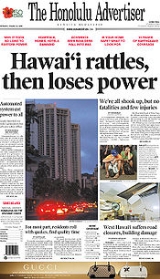
The Honolulu Advertiser was a daily
newspaperA newspaper is a scheduled publication containing news of current events, informative articles, diverse features and advertising. It usually is printed on relatively inexpensive, low-grade paper such as newsprint. By 2007, there were 6580 daily newspapers in the world selling 395 million copies a...
published in
Honolulu, HawaiiHonolulu is the capital and the most populous city of the U.S. state of Hawaii. Honolulu is the southernmost major U.S. city. Although the name "Honolulu" refers to the urban area on the southeastern shore of the island of Oahu, the city and county government are consolidated as the City and...
. At the time publication ceased on June 6, 2010, it was the largest daily
newspaperA newspaper is a scheduled publication containing news of current events, informative articles, diverse features and advertising. It usually is printed on relatively inexpensive, low-grade paper such as newsprint. By 2007, there were 6580 daily newspapers in the world selling 395 million copies a...
in the
American stateA U.S. state is any one of the 50 federated states of the United States of America that share sovereignty with the federal government. Because of this shared sovereignty, an American is a citizen both of the federal entity and of his or her state of domicile. Four states use the official title of...
of
HawaiiHawaii is the newest of the 50 U.S. states , and is the only U.S. state made up entirely of islands. It is the northernmost island group in Polynesia, occupying most of an archipelago in the central Pacific Ocean, southwest of the continental United States, southeast of Japan, and northeast of...
. It published daily with special Sunday and
InternetThe Internet is a global system of interconnected computer networks that use the standard Internet protocol suite to serve billions of users worldwide...
editions. The Honolulu Advertiser is the parent publisher of Island Weekly, Navy News, Army Weekly, Ka Nupepa People, West Oahu People, Leeward People, East Oahu People, Windward People, Metro Honolulu People, and Honolulu People small, community-based newspapers for the public.
The Honolulu Advertiser has had a succession of owners since it began publishing in 1856. On February 25, 2010, Black Press, which owned the
Honolulu Star-BulletinThe Honolulu Star-Bulletin was a daily newspaper based in Honolulu, Hawaii, United States. At the time publication ceased on June 6, 2010, it was the second largest daily newspaper in the state of Hawaii...
, purchased The Honolulu Advertiser from Gannett Pacific Corporation, which acquired the Advertiser in 1992 after it had sold the Star-Bulletin to another publisher that later sold it to Black Press in 2000. On May 3, 2010, a new company set up by Black Press, HA Management, took over operations of Advertiser and merged it with the Star-Bulletin on June 7, 2010, to form the
Honolulu Star-AdvertiserThe Honolulu Star-Advertiser, based in Honolulu, Hawaii, United States, is the largest daily newspaper in the state of Hawaii. Formed from the merger of The Honolulu Advertiser and the Honolulu Star-Bulletin following the acquisition of the former by Black Press, owner of the latter, the newspaper...
.
Henry M. Whitney
Businessman and son of
CongregationalCongregational churches are Protestant Christian churches practicing Congregationalist church governance, in which each congregation independently and autonomously runs its own affairs....
missionariesA missionary is a member of a religious group sent into an area to do evangelism or ministries of service, such as education, literacy, social justice, health care and economic development. The word "mission" originates from 1598 when the Jesuits sent members abroad, derived from the Latin...
, Henry M. Whitney founded the Pacific Commercial Advertiser in 1856, a weekly newspaper that was circulated primarily in the
whalingWhaling is the hunting of whales mainly for meat and oil. Its earliest forms date to at least 3000 BC. Various coastal communities have long histories of sustenance whaling and harvesting beached whales...
port of
HonoluluHonolulu is the capital and the most populous city of the U.S. state of Hawaii. Honolulu is the southernmost major U.S. city. Although the name "Honolulu" refers to the urban area on the southeastern shore of the island of Oahu, the city and county government are consolidated as the City and...
. The inaugural edition was published on July 2 of that year with this statement from Whitney:
Thank Heaven, the day at length has dawned when the Hawaiian nation can boast a free press, untrammeled by government patronage or party pledges, unbiased by ministerial frowns or favors.
The biggest story in the first edition was a report on the wedding of
Kamehameha IVKamehameha IV, born Alexander Iolani Liholiho Keawenui , reigned as the fourth king of the Kingdom of Hawaii from January 11, 1855 to November 30, 1863.-Early life:...
and
Queen EmmaQueen Consort Emma Kalanikaumakaamano Kaleleonālani Naea Rooke of Hawaii was queen consort of King Kamehameha IV from 1856 to his death in 1863. She ran for ruling monarch against King David Kalākaua but was defeated....
. However, the front page was devoted almost exclusively to advertisements. Throughout the paper, Whitney posted fifty-two advertisements for sailing ships in port at Honolulu Harbor with three hundred vessel timetables. In 1870, Whitney went broke and was forced to sell the Commercial Advertiser to James Black and William Auld, local printers. Whitney stayed on as the newspaper's editor.
Claus Spreckles
In 1880, Black and Auld sold the Pacific Commercial Advertiser to cabinet minister
Walter M. GibsonWalter Murray Gibson was an American adventurer and a government minister in the Kingdom of Hawaii prior to the kingdom's 1887 constitution.-Life:...
, who was generally under financial control of Claus Spreckles.
John Edward BushJohn Edward Bush was a politician and newspaper publisher in the Kingdom of Hawaii.-Early life:John Edward Bush was born in Honolulu on February 15, 1842 ....
, who was minister of the interior at the time, arranged for a government loan, and a guarantee of all government printing contracts.
Vehemently opposed to Spreckles' conservative and pro-monarchy political stance, Whitney, as a devout annexationist, resigned as editor. In his place,
Wallace Rider Farrington, future
GovernorThe Governor of Hawaii is the chief executive of the state of Hawaii and its various agencies and departments, as provided in the Hawaii State Constitution Article V, Sections 1 through 6. It is a directly elected position, votes being cast by popular suffrage of residents of the state...
of the
Territory of HawaiiThe Territory of Hawaii or Hawaii Territory was an organized incorporated territory of the United States that existed from July 7, 1898, until August 21, 1959, when its territory, with the exception of Johnston Atoll, was admitted to the Union as the fiftieth U.S. state, the State of Hawaii.The U.S...
, arrived from
MaineMaine is a state in the New England region of the northeastern United States, bordered by the Atlantic Ocean to the east and south, New Hampshire to the west, and the Canadian provinces of Quebec to the northwest and New Brunswick to the northeast. Maine is both the northernmost and easternmost...
to become the new editor. Spreckles' royalist slant in his editorial articles were deplored by many of the American businessmen residing in Hawaii at the time. Revenue suffered as a result, forcing Spreckles to eventually sell the Pacific Commercial Advertiser.
Lorrin A. Thurston and Son
In 1888, Spreckles sold his newspaper to the Hawaiian Gazette Company. It in turn sold the newspaper in 1898 to
Lorrin A. ThurstonLorrin Andrews Thurston was a lawyer, politician, and businessman born and raised in the Kingdom of Hawaii. The grandson of two of the first Christian missionaries to Hawaii, Thurston played a prominent role in the overthrow of the Hawaiian Kingdom that replaced Queen Liliuokalani with the...
. Thurston was organizer of the Hawaiian League, which had forced
King KalākauaKalākaua, born David Laamea Kamanakapuu Mahinulani Nalaiaehuokalani Lumialani Kalākaua and sometimes called The Merrie Monarch , was the last reigning king of the Kingdom of Hawaii...
to agree to the "Bayonet Constitution" of 1887 backed by the
Honolulu RiflesThe Honolulu Rifle Company was a paramilitary force loyal to the Missionary Party and the later Reform Party. It was created in 1854 as a militia to deal with internal conflict, 24 Rifles were deployed during the [[ʻIolani Barracks#1873 Barracks Revolt|1873 Barracks Revolt]]...
armed
militiaThe term militia is commonly used today to refer to a military force composed of ordinary citizens to provide defense, emergency law enforcement, or paramilitary service, in times of emergency without being paid a regular salary or committed to a fixed term of service. It is a polyseme with...
, and make Thurston a cabinet minister. The 1887 constitution stripped the monarchy of most authority, took away many rights of
native HawaiiansNative Hawaiians refers to the indigenous Polynesian people of the Hawaiian Islands or their descendants. Native Hawaiians trace their ancestry back to the original Polynesian settlers of Hawaii.According to the U.S...
to vote in elections, and granted voting rights to American residents, even those who did not have citizenship in the kingdom. Thurston had been instrumental to the overthrow of the monarchy and the end of the existence of the
Kingdom of HawaiiThe Kingdom of Hawaii was established during the years 1795 to 1810 with the subjugation of the smaller independent chiefdoms of Oahu, Maui, Molokai, Lānai, Kauai and Niihau by the chiefdom of Hawaii into one unified government...
.
In 1921, Thurston changed the name of the Pacific Commercial Advertiser to The Honolulu Advertiser. The following year, Thurston hired Raymond S. Coll to be the newspaper editor. Coll served in that capacity until his retirement in 1959.
In 1931, Lorrin P. Thurston took over his father's position as editor and president of The Honolulu Advertiser. He would later become chairman of the Hawaii Statehood Commission. Upon Raymond Coll's retirement, Thurston hired George Chaplin, former editor of the military newspaper
Pacific Stars and StripesStars and Stripes is a news source that operates from inside the United States Department of Defense but is editorially separate from it. The First Amendment protection which Stars and Stripes enjoys is safeguarded by Congress to whom an independent ombudsman, who serves the readers' interests,...
, as the editor of The Honolulu Advertiser. He would serve in this capacity for 28 years.
Thurston Twigg-Smith and George Chaplin
In 1961,
Thurston Twigg-Smith-Biography:Twigg-Smith is a fifth generation Hawaii resident. He was born in 1921 in Honolulu, Hawaii. He is the son of William and Margaret Thurston Twigg-Smith , making him the great-great grandson of Asa and Lucy Goodale Thurston as well as Lorrin Andrews — who were pioneer missionaries to the...
continued family ownership as he inherited The Honolulu Advertiser from his uncle. He remained publisher and president until 1986. With the coupling of Chaplin and Twigg-Smith, The Honolulu Advertiser shifted its political slant from a staunchly conservative pro-
Big FiveThe Big Five was the name given to a group of what started as sugarcane processing corporations that wielded considerable political power in the Territory of Hawaii during the early 20th century and leaned heavily towards the Hawaii Republican Party. The Big Five were Castle & Cooke, Alexander &...
newspaper to become a more moderate, racially progressive newspaper. Both were enormously influenced by the rising local
Chinese AmericanChinese Americans represent Americans of Chinese descent. Chinese Americans constitute one group of overseas Chinese and also a subgroup of East Asian Americans, which is further a subgroup of Asian Americans...
,
Filipino AmericanFilipino Americans are Americans of Filipino ancestry. Filipino Americans, often shortened to "Fil-Ams", or "Pinoy",Filipinos in what is now the United States were first documented in the 16th century, with small settlements beginning in the 18th century...
and
Japanese Americanare American people of Japanese heritage. Japanese Americans have historically been among the three largest Asian American communities, but in recent decades have become the sixth largest group at roughly 1,204,205, including those of mixed-race or mixed-ethnicity...
readership and worked to cater to these communities' news interests. In 1967, Twigg-Smith formed the Persis Corporation (known as Asa Hawaii Corporation until 1978) as the Advertisers parent company.
Gannett Pacific Corporation
In 1992, The Honolulu Advertiser was purchased by the Gannett Pacific Corporation, a subsidiary of Gannett Company Incorporated. It became the first morning edition publication in Ganett's corporate history. The company had already owned Honolulu's other major newspaper, the
Honolulu Star-BulletinThe Honolulu Star-Bulletin was a daily newspaper based in Honolulu, Hawaii, United States. At the time publication ceased on June 6, 2010, it was the second largest daily newspaper in the state of Hawaii...
, since 1973. From 1962 to 2001, both dueling newspapers were administered under a joint operating agreement under which they shared printing and advertising operations but kept separate editorial staff and printing functions. The agreement ended when the Honolulu Star-Bulletin was sold to a separate company.
Acquisition by Black Press and merger
On February 25, 2010, Black Press, which owned the
Honolulu Star-BulletinThe Honolulu Star-Bulletin was a daily newspaper based in Honolulu, Hawaii, United States. At the time publication ceased on June 6, 2010, it was the second largest daily newspaper in the state of Hawaii...
, purchased The Honolulu Advertiser. As part of the deal to acquire the Advertiser, Black Press agreed to place the Star-Bulletin on the selling block. If no buyer came forward by March 29, 2010, Black Press started making preparations to operate both papers through a transitional management team and then combine the two dailies into one.
On March 30, 2010, three parties came forward with offers to buy the Star-Bulletin, but a month later on April 27, 2010, the bids were rejected because their bids for the Star-Bulletin was below the minimum liquidation price. Black Press canceled the sale as a result and proceeded with transition plans, which came on the same day that they were approved to take over the Advertiser by the Department of Justice.
On May 3, 2010, a new company set up by Black Press, HA Management, took over the operations of the paper while Black Press continued overseeing the Star-Bulletin during a 30–60-day transition period, in which both papers merged into one daily, The Honolulu Star-Advertiser. The Advertiser published its final edition at 12:01 AM on June 6, 2010, and Black Press officially launched the Honolulu Star-Advertiser as a broadsheet morning daily on June 7, 2010.
The newspaper will be based out of the former Star-Bulletin offices at Restaurant Row and published at the former Advertiser printing facilities in Kapolei. A total of 474 staffers are employed at the daily, 265 from the Advertiser and 209 from Star-Bulletin. The fonts still use the "Star-Bulletin" masthead but with "Advertiser" replacing the "Bulletin" name.
Advertiser Building
The Honolulu Advertiser staff occupied the Advertiser Building on 605 Kapiolani Boulevard in
downtown HonoluluDowntown Honolulu is the current historic, economic, governmental, and central part of Honolulu—bounded by Nuuanu Stream to the west, Ward Avenue to the east, Vineyard Boulevard to the north, and Honolulu Harbor to the south—situated within the larger Honolulu District...
up until its last day of business on June 4, 2010 and its final pressing of its June 6, 2010 issue. Built in 1929 by the architectural firm Emory & Webb in the
beaux arts style. From the 1930s through the 1950s the building's roof sported two radio towers with the transmitting antenna of
AM radioAM broadcasting is the process of radio broadcasting using amplitude modulation. AM was the first method of impressing sound on a radio signal and is still widely used today. Commercial and public AM broadcasting is carried out in the medium wave band world wide, and on long wave and short wave...
station KGU strung between them.
Although Gannett sold the Advertiser in May 2010, the building that housed the paper will not be for sale, as it is expected to be sold to a different party down the road. The employees and staff have since moved over to the "Star-Advertiser" offices at Restaurant Row and to the Kapolei facility, leaving the building vacant except for a small crew that will remove most of the equipment and items in preparation for its sale.
The Advertiser Building is also used as a soundstage and houses small studios for Hawaii Five-0.
External links