
The
Hong Kong Identity Card (abbreviation:
HKID,
ID card) is an official
identity documentAn identity document is any document which may be used to verify aspects of a person's personal identity. If issued in the form of a small, mostly standard-sized card, it is usually called an identity card...
issued by the
Immigration DepartmentThe Immigration Department of the Government of Hong Kong is responsible for immigration control of Hong Kong. After the People's Republic of China assumed sovereignty of the territory in July 1997, Hong Kong's immigration system remained largely unchanged from its British predecessor model...
of
Hong KongHong Kong is one of two Special Administrative Regions of the People's Republic of China , the other being Macau. A city-state situated on China's south coast and enclosed by the Pearl River Delta and South China Sea, it is renowned for its expansive skyline and deep natural harbour...
. The
Hong Kong Permanent Identity Card is a class of HKID issued to
Hong Kong residentsHong Kong residents , also called Residents of the Hong Kong Special Administrative Region. According to Hong Kong Basic Law, Residents of the Hong Kong Special Administrative Region include permanent residents and non-permanent residents...
who have the
right of abodeThe right of abode in Hong Kong is the right to legally reside in Hong Kong and was governed by rules both under British and Chinese administration. As the People's Republic of China stood to resume sovereignty over Hong Kong in 1997, the nationality of Hong Kongers as well as their right of abode...
(ROA) in Hong Kong SAR. According to the Registration of Persons Ordinance (Cap. 177), all residents of age 11 or above who are living in Hong Kong for longer than 180 days must, within 30 days of either reaching the age of 11 or arriving in Hong Kong, register for an HKID. HKIDs contain amongst others the name of the bearer in
EnglishEnglish is a West Germanic language that arose in the Anglo-Saxon kingdoms of England and spread into what was to become south-east Scotland under the influence of the Anglian medieval kingdom of Northumbria...
, and if applicable in Chinese. It does not expire as long as you are resident in Hong Kong.
History
The use of identity documents has a long history in Hong Kong, starting with manually-filled paper documents, to the smart card introduced on 23 June 2003.
Before 1949, people could move freely into and out of Hong Kong (then a British colony), and China (then
Republic of ChinaThe Republic of China , commonly known as Taiwan , is a unitary sovereign state located in East Asia. Originally based in mainland China, the Republic of China currently governs the island of Taiwan , which forms over 99% of its current territory, as well as Penghu, Kinmen, Matsu and other minor...
). Hong Kong residents who held
Republic of China citizenshipThe Nationality Law of the Republic of China defines and regulates nationality of the Republic of China . It was first promulgated by the Nationalist Government on February 5, 1929 and revised by the Taipei-based Legislative Yuan in 2000, 2001, and 2006.The Act, like the Constitution of the...
were not registered. In 1949, when the
Government of the Republic of ChinaThe Republic of China was formally established by Dr. Sun Yat-sen in 1912 in Nanjing under the Provisional Constitution of the Republic of China but this government was moved to Beijing in the same year and continued as the internationally recognized government of China until 1928. In the history...
retreated to
TaiwanTaiwan , also known, especially in the past, as Formosa , is the largest island of the same-named island group of East Asia in the western Pacific Ocean and located off the southeastern coast of mainland China. The island forms over 99% of the current territory of the Republic of China following...
and the
People's Republic of ChinaChina , officially the People's Republic of China , is the most populous country in the world, with over 1.3 billion citizens. Located in East Asia, the country covers approximately 9.6 million square kilometres...
was established on the mainland, the Hong Kong Government began to register Hong Kong residents in order to issue compulsory identity documents. These measures were put into practice in order to halt the large influx of
refugeeA refugee is a person who outside her country of origin or habitual residence because she has suffered persecution on account of race, religion, nationality, political opinion, or because she is a member of a persecuted 'social group'. Such a person may be referred to as an 'asylum seeker' until...
s from Communist China and control the border with
mainland ChinaMainland China, the Chinese mainland or simply the mainland, is a geopolitical term that refers to the area under the jurisdiction of the People's Republic of China . According to the Taipei-based Mainland Affairs Council, the term excludes the PRC Special Administrative Regions of Hong Kong and...
. The registration was completed in 1951. Although registration was compulsory for all residents, people were not required to carry their documents with them at all times when going into public.
Beginning on 1 June 1960, the government introduced the second generation of ID cards. These bore the holder's fingerprint and photograph, and an official stamp. The information was typed, and the card was laminated. Males had a blue card and females had a red card. The format of card was replaced in November 1973 with a card without fingerprints. The colour of the stamp identified and differentiated permanent residents (black) from non-permanent ones (green). New immigrants subsequently became known colloquially as "green stamp tourists" (Chinese: 綠印客).
From 24 October 1980, carrying the identity card in public areas and showing it when requested by a police or immigration officer became compulsory. This law was passed in order to halt large numbers of illegal immigrants arriving in the city. The government adopted a policy of deporting illegal immigrants to China within three days if they could not produce a valid ID card.
From March 1983, digitally processed identity cards was introduced to reduce forgery. This also simplified border controls. On 1 June 1987, the Immigration Department produced cards without the coat of arms of British Hong Kong, which would last through the handover on 1 July 1997. In 2003, the government began replacing the cards with smart IDs in stages.
Classes of HKID
There are two classes of Hong Kong Identity Card:
- Hong Kong Permanent Identity Card — states that the holder has the right of abode
The right of abode in Hong Kong is the right to legally reside in Hong Kong and was governed by rules both under British and Chinese administration. As the People's Republic of China stood to resume sovereignty over Hong Kong in 1997, the nationality of Hong Kongers as well as their right of abode...
in the Hong Kong Special Administrative Region
- Hong Kong Identity Card — which does not state that right.
The card types can be further divided into cards bearing the term "child" (below age 11 and not compulsory. The card can be requested to obtain later a passport with a Hong Kong permanent resident number), "youth" (from age 11 up until 18), and "adult" (issued from age 18 onwards).
Permanent HKID and right of abode
Permanent HKID holders have the
Right of AbodeThe right of abode in Hong Kong is the right to legally reside in Hong Kong and was governed by rules both under British and Chinese administration. As the People's Republic of China stood to resume sovereignty over Hong Kong in 1997, the nationality of Hong Kongers as well as their right of abode...
(Chinese: 居留權) in Hong Kong. Under the Basic Law of Hong Kong, a person who belongs to one of the following categories is a permanent resident of the HKSAR with right of abode privileges:
- (a) Chinese citizen born in Hong Kong before or after the establishment of the HKSAR
- (b) Chinese citizen who has ordinarily resided in Hong Kong for a continuous period of not less than seven years before or after the establishment of the HKSAR.
- (c) Person of Chinese nationality born outside Hong Kong before or after the establishment of the Hong Kong Special Administrative Region to a parent who, at the time of birth of that person, was a Chinese citizen falling within category (a) or (b).
- (d) Person not of Chinese nationality who has entered Hong Kong with a valid travel document, has ordinarily resided in Hong Kong for a continuous period of not less than seven years and has taken Hong Kong as his place of permanent residence before or after the establishment of the HKSAR.
- (e) Person under 21 years of age born in Hong Kong to a parent who is a permanent resident of the HKSAR in category (d) before or after the establishment of the HKSAR if at the time of his birth or at any later time before he attains 21 years of age, one of his parents has the ROA in Hong Kong.
- (f) Person other than those residents in categories (a) to (e), who, before the establishment of the HKSAR, had the ROA in Hong Kong only.
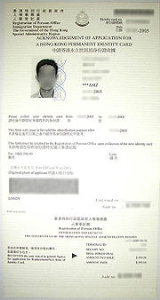
Paper versions of the Hong Kong Identity card (such as the one on the right) are issued by the Registration of Persons Office for temporary use until a smart card can be manufactured. This process requires two weeks, and the smart card must be collected within six weeks.
Hong Kong Identity Card
The following conditions are required to receive a non-permanent Hong Kong Identity Card:
(to be expanded)
- Right to Land — free from any condition of stay (including a limit of stay) or removal from HKSAR (and does not possess the right of abode)
- Anyone 11 years of age or above who enters and is permitted to stay in Hong Kong for more than 180 days
Eligibility
Residents of Hong Kong are required to obtain an HKID card at the age of 11. Hong Kong residents age 18 or over are required to carry legal identification with them at all times (that is, the HKID card). Bearers of a "youth" HKID card must switch to an "adult" HKID within 30 days after their 18th birthday. The "youth" card will be invalid as re-entry travel document 30 days after the 18th birthday.
Photographs are not required on HKID for children under the age of 11and cannot be used as a travel document. A
Hong Kong Re-entry PermitHong Kong Re-entry Permit are issued to Hong Kong residents by the Hong Kong Special Administrative Region for travel to the mainland China and Macau Special Administrative Region.-Eligibility:...
is issued in its place.
HKID number
HKID cards contain the bearer's HKID number, of which the standard format is X123456(A). X represents any one or two letters of the alphabet. The letter
U followed by any letter of the alphabet (
UH and
UY are common but others exist. These are usually given to mothers who have just given birth, but may or may not have right of abode in Hong Kong, and are therefore temporary until a proper number can be established, and used most commonly in hospitals. Also, the babies cannot hold HKIDs but hospital filing systems are based on ID number, hence the need to assign temporary ones). The numerals may represent any Arabic number. A is the
check digitA check digit is a form of redundancy check used for error detection, the decimal equivalent of a binary checksum. It consists of a single digit computed from the other digits in the message....
which has 11 possible values from 0 to 9 and A. There are 26 million possible card numbers using only the one-letter prefix, and 676 million using a two-letter prefix. The numbers of dead people are not recycled.
Information on first and second-generation computerised Hong Kong identity cards
- Name in Chinese (if any)
- Name in English
- Name in Chinese Commercial Code
The Chinese Telegraph Code, Chinese Telegraphic Code, or Chinese Commercial Code is a four-digit decimal code for electrically telegraphing messages written with Chinese characters.- Encoding and decoding :...
(if any)
- Sex
- Date of birth
- Symbols
- Holder's digital image
- Month and year of first registration
- Date of registration
- Date of expiry (first-generation computerised Hong Kong ID card only)
- Identity card number (Note)
| Symbol |
Description |
| *** |
the holder is of the age of 18 or over and is eligible for a Hong Kong (S. A. R.) Re-entry Permit. |
| * |
the holder is between the age of 11 and 17 and is eligible for a Hong Kong (S. A. R.) Re-entry Permit. |
| A |
the holder has the right of abode in (the) Hong Kong (S. A. R.). |
| B |
the holder's place of birth, date of birth or gender has been changed since his/ her first registration. |
| C |
the holder's stay in (the) Hong Kong (S. A. R.) is limited by the Director of Immigration at the time of his registration of the card. |
| F |
the holder is a female. |
| H1 |
code of ID card issuing office |
| K2 |
code of ID card issuing office |
| L |
the holder has lost his/ her ID card once or more since his/ her first registration; 'L1' means he/ she has lost his/ her ID card once, 'L2' means twice, and so on.. |
| M |
the holder is a male. |
| R |
the holder has a right to land in (the) Hong Kong (S. A. R.). |
| S1 |
code of ID card issuing office |
| U |
the holder's stay in (the) Hong Kong (S. A. R.) is not limited by the Director of Immigration at the time of his registration of the card. |
| Y |
the Immigration Department has verified the holder's reported date of birth by his/ her birth certificate or passport. |
| Z |
the holder's place of birth reported is Hong Kong. |
| X |
the holder's place of birth reported is the Mainland (mainland China). |
| W |
the holder's place of birth reported is the region of Macau. |
| O |
the holder's place of birth reported is in other countries. |
| N |
the holder's place of birth, date of birth or gender has not been changed since his/ her first registration. |
| Note: |
The check digit in brackets is not part of the identity card number, such as for legal purposes. It is only to facilitate computer data processing. |
Information on the face of a smart identity card
- Name in Chinese (if any)
- Name in English
- Name in Chinese Commercial Code
The Chinese Telegraph Code, Chinese Telegraphic Code, or Chinese Commercial Code is a four-digit decimal code for electrically telegraphing messages written with Chinese characters.- Encoding and decoding :...
(if any)
- Sex
- Date of birth
- Symbols
- Holder's digital image
- Month and year of first registration
- Date of registration
- Identity card number (Note)
Only the codes *, ***, A, C, R, U, Z, X, W, O, B, N can be shown on the card.
| Note: |
The check digit in brackets is not part of the identity card number, but appended solely to facilitate computer data processing. |
Hong Kong Smart Identity Cards
From 23 June 2003, only Smart ID cards were issued .Between August 2003 to 2007, all Hong Kong ID cards were replaced.
On 23 June 2003, the
Immigration Department of Hong KongThe Immigration Department of the Government of Hong Kong is responsible for immigration control of Hong Kong. After the People's Republic of China assumed sovereignty of the territory in July 1997, Hong Kong's immigration system remained largely unchanged from its British predecessor model...
began issuing a new revised Smart Identity card. The new cards contain an
embedded microchipAn integrated circuit or monolithic integrated circuit is an electronic circuit manufactured by the patterned diffusion of trace elements into the surface of a thin substrate of semiconductor material...
, which stores the bearer's information electronically. Previous HKIDs remained valid until the
Executive CouncilThe Executive Council of Hong Kong is a core policy-making organ in the executive branch of the government of Hong Kong.. The Chief Executive of Hong Kong serves as its President.The Executive Council normally meets once a week...
, through the
Secretary for SecurityThe Secretary for Security is the member of the Hong Kong Government in charge of the Security Bureau, which is responsible for public safety, security, and immigration matters....
, declared them invalid. In addition, existing holders of HKID documents were called to apply to have their old-style HKID documents replaced by the new cards. This eligibility was offered to existing HKID holders based their date of birth on a rolling basis in order to prevent the volume of applications exceeding the pace at which the government could issue these revised documents. The
Government of Hong KongThe Government of the Hong Kong Special Administrative Region of the People's Republic of China, commonly the Hong Kong Government, is led by the Chief Executive as Head of the Government, who is also the head of the Hong Kong SAR...
has been gradually moving the window of applicants eligible for replacement. Persons born in 1993 to 1996 or 1986 to 1989 should have applied/apply for smart identity cards at the Registration of Persons Offices when they attain the age of 11 or 18.
The introduction of Smart Identity Cards was, motivated partially by the influx of counterfeit HKID documents being produced in China, and partially in order to speed up processing at Hong Kong's Immigration checkpoints, especially into
ShenzhenShenzhen is a major city in the south of Southern China's Guangdong Province, situated immediately north of Hong Kong. The area became China's first—and one of the most successful—Special Economic Zones...
, China. In the latter checkpoint, an estimated 7,200 Hong Kong residents commuted daily to Shenzhen for work and 2,200 students from Shenzhen commuted to school in Hong Kong in 2002.
Names in Chinese and Roman script
It is common for ethnic Chinese Hongkongers to adopt western-style English names (such as John, Mary, etc.), in addition to their phonetic English names, after being registered on the birth register. Some of them may wish to include their western-style English name as part of their official English name (this is known as 'adding an English name' locally). They can apply to the Immigration Department for including such name as part of their official English name (example: someone named 'Tai Ming CHAN' may have adopted a Western-style English name Peter and wish to have this name shown as 'Peter Tai Ming CHAN' ('Peter' as a first name) or 'Tai Ming Peter CHAN' ('Peter' as a middle name) on his HKID card and the government's records.). This is not considered by the Immigration Department as a name change. The Immigration Department considers that his or her original name (in the format of 'Tai Man CHAN') is an alias, and that the newly lodged name (usually in the format of 'Peter Tai Man CHAN' or 'Tai Man Peter CHAN') is the proper name of the applicant (in the sense that such name is the 'proper name' of the applicant).
Normally, when non-ethnic Chinese register for their first HKID card, the space reserved for a Chinese name is automatically left blank by the Immigration Department. It is possible, however, to add the person's name in Chinese characters if desired at any time by making an application to the Immigration Department. This may be important for some who wish their children born in Hong Kong to also have a name in Chinese characters, as it is possible to register a Chinese surname on the birth certificate only if the father's HKID bears his Chinese name in Chinese characters.
Use as a travel document
The Hong Kong identity card by itself can be used to travel to
MacauMacau , also spelled Macao , is, along with Hong Kong, one of the two special administrative regions of the People's Republic of China...
, as long as the holder has the right of abode in Hong Kong (the holder is able to stay for up to one year in Macau visa-free).
Some foreign territories require Hong Kong Special Administrative Region passport holders to present their HKID as well in order to benefit from a visa exemption scheme: these territories include
GuamGuam is an organized, unincorporated territory of the United States located in the western Pacific Ocean. It is one of five U.S. territories with an established civilian government. Guam is listed as one of 16 Non-Self-Governing Territories by the Special Committee on Decolonization of the United...
, the
Northern Mariana IslandsThe Northern Mariana Islands, officially the Commonwealth of the Northern Mariana Islands , is a commonwealth in political union with the United States, occupying a strategic region of the western Pacific Ocean. It consists of 15 islands about three-quarters of the way from Hawaii to the Philippines...
and
TaiwanTaiwan , also known, especially in the past, as Formosa , is the largest island of the same-named island group of East Asia in the western Pacific Ocean and located off the southeastern coast of mainland China. The island forms over 99% of the current territory of the Republic of China following...
.
See also
- Identity document
An identity document is any document which may be used to verify aspects of a person's personal identity. If issued in the form of a small, mostly standard-sized card, it is usually called an identity card...
- History of Hong Kong
Hong Kong began as a coastal island geographically located off the southern coast of China. While pockets of settlements had taken place in the region with archaeological findings dating back thousands of years, regular written records were not made...
- National identification number
A national identification number, national identity number, or national insurance number is used by the governments of many countries as a means of tracking their citizens, permanent residents, and temporary residents for the purposes of work, taxation, government benefits, health care, and other...
- Resident Identity Card
The Resident Identity Card is the official form of personal identification in the People's Republic of China.-History:Prior to 1984, citizens within the People's Republic of China were not required to obtain or carry identification in public...
used in the People's Republic of ChinaChina , officially the People's Republic of China , is the most populous country in the world, with over 1.3 billion citizens. Located in East Asia, the country covers approximately 9.6 million square kilometres...
- National Identification Card (Republic of China) used in the Republic of China
The Republic of China , commonly known as Taiwan , is a unitary sovereign state located in East Asia. Originally based in mainland China, the Republic of China currently governs the island of Taiwan , which forms over 99% of its current territory, as well as Penghu, Kinmen, Matsu and other minor...
- Right of abode issue, Hong Kong
The right of abode in Hong Kong is the right to legally reside in Hong Kong and was governed by rules both under British and Chinese administration. As the People's Republic of China stood to resume sovereignty over Hong Kong in 1997, the nationality of Hong Kongers as well as their right of abode...
- Hongkonger
External links